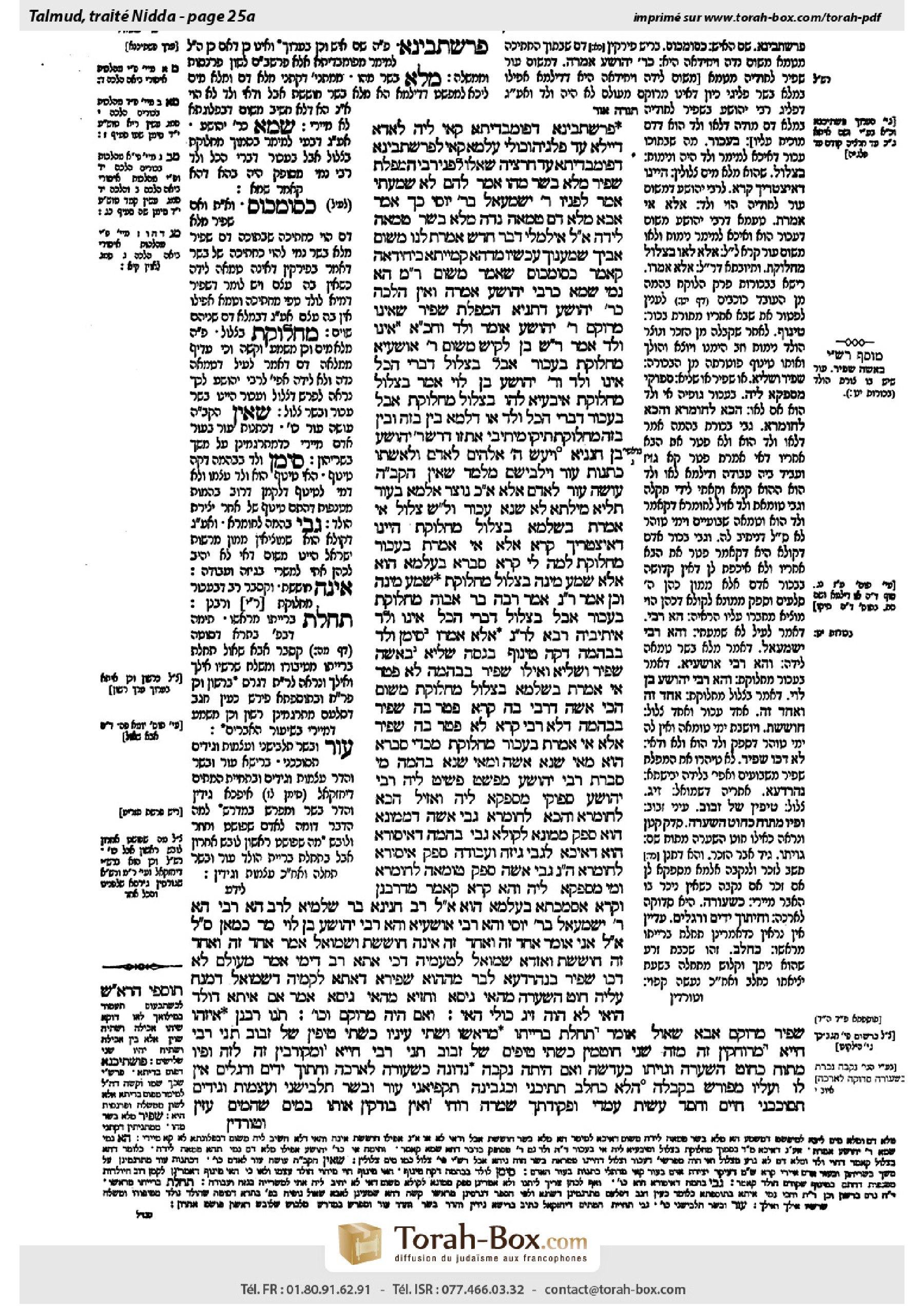
Niddah 25a: Talmud study for Daf Yomi
Daf Yomi is the daily study of one Talmud folio. Explore 37 tractates with scans, Hebrew text, Sefaria English and AI-generated French translations where annotated.
Passage selection and English or AI-generated French translation are available where the scan has annotations. Daf Study is independent of Torah-Box and Sefaria.
Browse Niddah · נידה · All tractatesNiddah 25a text and translations
This page of Niddah includes the Aramaic text, an English translation and an AI-generated French translation, alongside the scan above.
נידה כ״ה א · Aramaic and Hebrew text
פְּרַשְׁתְּבִינָא דְּפוּמְבְּדִיתָא קָאֵי לֵיהּ לְאַדָּא דַּיָּילָא עַד פַּלְגֵיהּ, וְכוּלֵּי עָלְמָא קָאֵי לִפְרַשְׁתְּבִינָא דְּפוּמְבְּדִיתָא עַד חַרְצֵיהּ.
שָׁאֲלוּ לִפְנֵי רַבִּי: הַמַּפֶּלֶת שָׁפִיר מָלֵא בָּשָׂר מַהוּ? אָמַר לָהֶם: לֹא שָׁמַעְתִּי.
אָמַר לְפָנָיו רַבִּי יִשְׁמָעֵאל בְּרַבִּי יוֹסֵי: כָּךְ אָמַר אַבָּא — מָלֵא דָּם טְמֵאָה נִדָּה, מָלֵא בָּשָׂר טְמֵאָה לֵידָה.
אָמַר לֹיה: אִילְמָלֵי דְּבַר חָדָשׁ אָמַרְתָּ לָנוּ מִשּׁוּם אָבִיךָ — שְׁמַעְנוּךָ. עַכְשָׁיו,
מִדְּהָא קַמַּיְיתָא כִּיחִידָאָה קָאָמַר — כְּסוֹמְכוֹס שֶׁאָמַר מִשּׁוּם רַבִּי מֵאִיר, הָא נָמֵי — שֶׁמָּא כְּרַבִּי יְהוֹשֻׁעַ אֲמָרָהּ, וְאֵין הֲלָכָה כְּרַבִּי יְהוֹשֻׁעַ.
דְּתַנְיָא: הַמַּפֶּלֶת שָׁפִיר שֶׁאֵינוֹ מְרוּקָּם, רַבִּי יְהוֹשֻׁעַ אוֹמֵר: וָלָד, וַחֲכָמִים אוֹמְרִים: אֵינוֹ וָלָד.
אָמַר רַבִּי שִׁמְעוֹן בֶּן לָקִישׁ מִשּׁוּם רַבִּי אוֹשַׁעְיָא: מַחְלוֹקֶת בְּעָכוּר, אֲבָל בְּצָלוּל דִּבְרֵי הַכֹּל אֵינוֹ וָלָד. וְרַבִּי יְהוֹשֻׁעַ בֶּן לֵוִי אָמַר: בְּצָלוּל מַחְלוֹקֶת.
אִיבַּעְיָא לְהוּ: בְּצָלוּל מַחְלוֹקֶת, אֲבָל בְּעָכוּר דִּבְרֵי הַכֹּל וָלָד, אוֹ דִּלְמָא בֵּין בָּזֶה וּבֵין בָּזֶה מַחְלוֹקֶת? תֵּיקוּ.
מֵיתִיבִי: אֶת זוֹ דָּרַשׁ רַבִּי יְהוֹשֻׁעַ בֶּן חֲנַנְיָא — ״וַיַּעַשׂ ה׳ אֱלֹהִים לְאָדָם וּלְאִשְׁתּוֹ כׇּתְנוֹת עוֹר וַיַּלְבִּישֵׁם״, מְלַמֵּד שֶׁאֵין הַקָּדוֹשׁ בָּרוּךְ הוּא עוֹשֶׂה עוֹר לָאָדָם אֶלָּא אִם כֵּן נוֹצַר.
אַלְמָא: בְּעוֹר תַּלְיָא מִילְּתָא, לָא שְׁנָא עָכוּר וְלָא שְׁנָא צָלוּל.
אִי אָמְרַתְּ בִּשְׁלָמָא בְּצָלוּל מַחְלוֹקֶת — הַיְינוּ דְּאִיצְטְרִיךְ קְרָא, אֶלָּא אִי אָמְרַתְּ בְּעָכוּר מַחְלוֹקֶת — לְמָה לִי קְרָא? סְבָרָא בְּעָלְמָא הוּא! אֶלָּא שְׁמַע מִינַּהּ: בְּצָלוּל מַחְלוֹקֶת, שְׁמַע מִינַּהּ.
וְכֵן אָמַר רַב נַחְמָן, אָמַר רַבָּה בַּר אֲבוּהּ: מַחְלוֹקֶת בְּעָכוּר, אֲבָל בְּצָלוּל — דִּבְרֵי הַכֹּל אֵינוֹ וָלָד.
אֵיתִיבֵיהּ רָבָא לְרַב נַחְמָן: אֶלָּא אָמְרוּ, סִימָן וָלָד בִּבְהֵמָה דַּקָּה — טִינּוּף, בְּגַסָּה — שִׁלְיָא, בְּאִשָּׁה — שָׁפִיר וְשִׁלְיָא.
וְאִילּוּ שָׁפִיר בִּבְהֵמָה לָא פָּטַר, אִי אָמְרַתְּ בִּשְׁלָמָא בְּצָלוּל מַחְלוֹקֶת — מִשּׁוּם הָכִי.
אִשָּׁה דְּרַבִּי בַּהּ קְרָא, פְּטַר בַּהּ שָׁפִיר; בִּבְהֵמָה דְּלָא רַבִּי קְרָא, לָא פְּטַר בַּהּ שָׁפִיר.
אֶלָּא אִי אָמְרַתְּ בְּעָכוּר מַחְלוֹקֶת, מִכְּדֵי סְבָרָא הוּא, מַאי שְׁנָא אִשָּׁה, וּמַאי שְׁנָא בְּהֵמָה?
מִי סָבְרַתְּ רַבִּי יְהוֹשֻׁעַ מִפְשָׁט פְּשִׁיט לֵיהּ? רַבִּי יְהוֹשֻׁעַ סַפּוֹקֵי מְסַפְּקָא לֵיהּ, וְאָזֵיל הָכָא לְחוּמְרָא וְהָכָא לְחוּמְרָא.
גַּבֵּי אִשָּׁה, דְּמָמוֹנָא הוּא — סְפֵק מָמוֹנָא לְקוּלָּא.
גַּבֵּי בְּהֵמָה, דְּאִיסּוּרָא הוּא דְּאִיכָּא לְגַבֵּי גִּיזָּה וַעֲבוֹדָה — סְפֵק אִיסּוּרָא לְחוּמְרָא; הָכִי נָמֵי גַּבֵּי אִשָּׁה — סְפֵק טוּמְאָה לְחוּמְרָא.
וּמִי מְסַפְּקָא לֵיהּ? וְהָא קְרָא קָאָמַר! מִדְּרַבָּנַן, וּקְרָא אַסְמַכְתָּא בְּעָלְמָא הוּא.
אֲמַר לֵיהּ רַב חֲנִינָא בַּר שֶׁלֶמְיָא לְרַב: הָא רַבִּי, הָא רַבִּי יִשְׁמָעֵאל בְּרַבִּי יוֹסֵי, וְהָא רַבִּי אוֹשַׁעְיָא, וְהָא רַבִּי יְהוֹשֻׁעַ בֶּן לֵוִי — מָר כְּמַאן סְבִירָא לֵיהּ?
אֲמַר לֵיהּ: אֲנִי אוֹמֵר אֶחָד זֶה וְאֶחָד זֶה, אֵינָהּ חוֹשֶׁשֶׁת.
וּשְׁמוּאֵל אָמַר: אֶחָד זֶה וְאֶחָד זֶה חוֹשֶׁשֶׁת. וְאַזְדָּא שְׁמוּאֵל לְטַעְמֵיהּ, דְּכִי אֲתָא רַב דִּימִי אֲמַר: מֵעוֹלָם לָא דָּכוּ שָׁפִיר בִּנְהַרְדְּעָא, לְבַר מֵהָהוּא שְׁפִירָא דַּאֲתָא לְקַמֵּיהּ דִּשְׁמוּאֵל, דְּמַנַּח עֲלֵיהּ חוּט הַשַּׂעֲרָה מֵהַאי גִּיסָא וְחַזְיֵהּ מֵהַאי גִּיסָא. אֲמַר: אִם אִיתָא דְּוָלָד הוּאי — לָא הֲוָה זִיג כּוּלֵּי הַאי.
וְאִם הָיָה מְרוּקָּם וְכוּ׳. תָּנוּ רַבָּנַן: אֵיזֶהוּ שָׁפִיר מְרוּקָּם? אַבָּא שָׁאוּל אוֹמֵר: תְּחִלַּת בְּרִיָּיתוֹ מֵרֹאשׁוֹ, וּשְׁתֵּי עֵינָיו כִּשְׁתֵּי טִיפִּין שֶׁל זְבוּב. תָּנֵי רַבִּי חִיָּיא: מְרוּחָקִין זֶה מִזֶּה. שְׁנֵי חֳוטָמִין כִּשְׁתֵּי טִיפִּים שֶׁל זְבוּב.
תָּנֵי רַבִּי חִיָּיא: וּמְקוֹרָבִין זֶה לָזֶה, וּפִיו מָתוּחַ כְּ״חוּט הַשַּׂעֲרָה״, וּגְוִיָּתוֹ כַּ״עֲדָשָׁה״, וְאִם הָיְתָה נְקֵבָה — נִדּוֹנָה כִּ״שְׂעוֹרָה״ לְאׇרְכָּהּ.
וְחִתּוּךְ יָדַיִם וְרַגְלַיִם אֵין לוֹ, וְעָלָיו מְפוֹרָשׁ בַּקַּבָּלָה: ״הֲלֹא כֶחָלָב תַּתִּיכֵנִי וְכַגְּבִינָּה תַּקְפִּיאֵנִי עוֹר וּבָשָׂר תַּלְבִּישֵׁנִי וַעֲצָמוֹת וְגִידִים תְּסוֹכְכֵנִי חַיִּים וָחֶסֶד עָשִׂיתָ עִמָּדִי וּפְקֻדָּתְךָ שָׁמְרָה רוּחִי״.
וְאֵין בּוֹדְקִין אוֹתוֹ בְּמַיִם — שֶׁהַמַּיִם עַזִּין
Niddah 25a · English translation
and when the governor [parashtevina] of Pumbedita would stand next to Adda the attendant, he would reach only half of his height. And when everyone else in the world would stand next to the governor of Pumbedita, they would reach only his loins [ḥartzeih].
§ The students asked Rabbi Yehuda HaNasi: In the case of a woman who discharges a gestational sac full of flesh, what is the halakha? Does she have the impurity of a woman after childbirth? Rabbi Yehuda HaNasi said to them: I have not heard from my teachers the halakha in this case.
Rabbi Yishmael, son of Rabbi Yosei, said to him: This is what my father, i.e., Rabbi Yosei ben Ḥalafta, one of Rabbi Yehuda HaNasi’s teachers, said: If a woman discharged a gestational sac full of blood, she is impure with the impurity of a menstruating woman. If it is full of flesh, she is impure with the impurity of a woman after childbirth.
Rabbi Yehuda HaNasi said to him: If you had told us an entirely new statement in the name of your father, no part of which was also stated by another Sage, we would have listened to you, i.e., we would have accepted the statement as halakha. But now that you stated two halakhot, one with regard to a woman who discharged a gestational sac full of blood, and the other with regard to a woman who discharged a gestational sac full of flesh, the entire statement cannot be accepted as halakha.
Rabbi Yehuda HaNasi explains: From the fact that Rabbi Yosei said this first clause of his statement, with regard to a gestational sac full of blood, in accordance with an individual opinion, i.e., in accordance with the opinion of Sumakhos, who said in the name of Rabbi Meir that the woman is impure, contrary to the opinion of the other Sages, it follows that with regard to this latter statement as well, with regard to a gestational sac full of flesh, one can say that perhaps Rabbi Yosei said it in accordance with the opinion of another individual Sage, Rabbi Yehoshua. And the halakha is not in accordance with the opinion of Rabbi Yehoshua.
As it is taught in a baraita: In the case of a woman who discharges a gestational sac in which tissue did not develop, Rabbi Yehoshua says: It has the status of an offspring, and the woman has the impurity of a woman after childbirth; and the Rabbis say: It is not an offspring, and the woman is pure. The opinion of Rabbi Yosei that a woman who discharged a gestational sac full of flesh is impure might be in accordance with the ruling of Rabbi Yehoshua, which is not accepted as halakha, since the majority of the other Sages disagree with him. Therefore, the halakha cannot be decided in accordance with either part of the statement of Rabbi Yosei.
Rabbi Shimon ben Lakish says in the name of Rabbi Oshaya: The dispute between Rabbi Yehoshua and the Rabbis applies in a case where the amniotic fluid is turbid, as Rabbi Yehoshua holds that the turbidity indicates that there was likely an embryo in the sac that liquefied. But in a case where the amniotic fluid is clear, everyone agrees that the discharged sac is not considered an offspring. And Rabbi Yehoshua ben Levi says: The dispute applies in a case where the amniotic fluid is clear.
A dilemma was raised before the Sages: What does Rabbi Yehoshua ben Levi mean? Does he mean that the dispute applies only in a case where the amniotic fluid is clear, but in a case where it is turbid, everyone agrees that it has the halakhic status of an offspring? Or perhaps Rabbi Yehoshua ben Levi means that the dispute applies in this case and in that case, i.e., the Rabbis hold that the sac does not have the status of an offspring even if the amniotic fluid is turbid. The Gemara concludes that the dilemma shall stand unresolved.
The Gemara raises an objection to the opinion that the dispute between Rabbi Yehoshua and the Rabbis applies only in a case where the amniotic fluid is turbid. It is taught in a baraita that Rabbi Yehoshua ben Ḥananya, who is the same Rabbi Yehoshua who disagrees with the Rabbis with regard to the case of a woman who discharges a gestational sac in which tissue did not develop, taught this following proof for his opinion that the woman is impure: It is stated: “And the Lord God made for Adam and for his wife garments of skins, and clothed them” (Genesis 3:21). This teaches that the Holy One, Blessed be He, does not make skin for a person unless he is already created, as God first created Adam and Eve, and then gave them skin. Consequently, the existence of a gestational sac proves that there is an offspring.
Evidently, according to Rabbi Yehoshua the matter of whether or not an embryo is considered offspring is dependent on whether or not there is skin, and there is no difference whether the amniotic fluid is turbid, and there is no difference whether it is clear.
Granted, if you say that the dispute applies in a case where it is clear, that is why it was necessary for Rabbi Yehoshua to derive from a verse that an embryo that has skin is considered an offspring. But if you say that the dispute applies in a case where the amniotic fluid is turbid, but Rabbi Yehoshua concedes that the woman is pure if it is clear, why do I need a verse to teach that if the amniotic fluid is turbid the woman is impure? It is logical that where the amniotic fluid is turbid there was probably an embryo that liquefied. Rather, conclude from it that the dispute applies in a case where the amniotic fluid is clear. The Gemara concludes: Conclude from it that this is correct.
And likewise, just as Rabbi Oshaya interprets the dispute between Rabbi Yehoshua and the Rabbis as referring to a case where the amniotic fluid is turbid, Rav Naḥman says that Rabba bar Avuh says: The dispute between Rabbi Yehoshua and the Rabbis applies in a case where the amniotic fluid is turbid; but in a case where the amniotic fluid is clear, everyone agrees that the discharged sac is not considered an offspring.
Rava raised an objection to the opinion of Rav Naḥman from a mishna that specifies the obligations that apply to firstborn animals (Bekhorot 19b):But the Sages said that not only does a viable offspring exempt any subsequent offspring from being counted a firstborn, but the same applies to an indication of the offspring that is discharged from the womb. The indication in a small animal is a murky discharge from the womb, in a large animal it is the emergence of an afterbirth, and in a woman the indication is a gestational sac or an afterbirth.
Rava infers: And yet the miscarriage of a gestational sac in the case of a large animal does not exempt the animal’s subsequent offspring from being counted a firstborn. Granted, if you say that the dispute between Rabbi Yehoshua and the Rabbis applies in a case where the amniotic fluid is clear, it is due to that reason that the mishna differentiates between a large animal and a woman with regard to a gestational sac.
Rava explains: With regard to a woman, as the aforementioned verse: “And the Lord God made for Adam and for his wife garments of skins,” includes in the definition of offspring a gestational sac, i.e., skin, one can say that such a gestational sac exempts subsequent births from the obligations of primogeniture. By contrast, in the case of an animal, as the verse does not include a gestational sac in the definition of offspring, discharging a gestational sac does not exempt the animal’s subsequent offspring from being considered a firstborn.
But if you say that the dispute applies in a case where the amniotic fluid is turbid, and Rabbi Yehoshua deems the woman impure due to the likelihood that there was an embryo that liquefied, since this halakha is based on logic, what is different in the case of a woman, and what is different in the case of an animal? Rabbi Yehoshua’s reasoning applies equally to both. Evidently, the dispute applies in a case where the amniotic fluid is clear.
The Gemara answers: Do you hold that it is obvious to Rabbi Yehoshua that a gestational sac in which the amniotic fluid is turbid has the halakhic status of an offspring? That is not so; rather, Rabbi Yehoshua is uncertain of its halakhic status, and therefore here, in this case, he rules stringently, and there he also rules stringently.
The Gemara elaborates: First of all, with regard to a situation where a woman discharged a gestational sac in which the amniotic fluid was turbid, in which case the obligation of primogeniture is a monetary matter, i.e., the obligation to redeem the newborn child by paying money to a priest, the subsequent births are exempt, in accordance with the principle that uncertainty with regard to monetary matters is treated leniently.
By contrast, with regard to an animal, in which case firstborn status is a ritual matter, as there are prohibitions involving, i.e., against, shearing the animal’s wool and using the animal for labor before it incurs a blemish, the discharged gestational sac is not considered an offspring and does not exempt subsequent births from the obligations of firstborn status, as uncertainty with regard to ritual matters is treated stringently. So too, with regard to the impurity of a woman who discharged a gestational sac, she is deemed impure, as uncertainty with regard to impurity is treated stringently, which means that for the purposes of this halakha a gestational sac is considered an offspring.
The Gemara asks: And is Rabbi Yehoshua uncertain about the halakha of a woman who discharges a gestational sac? But doesn’t he cite a verse as proof that the woman has the impurity of one who gave birth? The Gemara answers: Rabbi Yehoshua maintains that the woman is impure by rabbinic law, and the verse he cites is a mere support for this halakha; it is not the actual source.
Rav Ḥanina bar Shelamya said to Rav: This is the opinion of Rabbi Yehuda HaNasi, who told his students that he did not hear from his teachers the halakha in the case of a woman who discharged a gestational sac full of flesh; and this is the opinion of Rabbi Yishmael, son of Rabbi Yosei, who cited his father’s opinion that in such a case the woman is impure. And this is the opinion of Rabbi Oshaya, that the dispute between Rabbi Yehoshua and the Rabbis applies only in a case where the amniotic fluid is turbid; and finally this is the opinion of Rabbi Yehoshua ben Levi, who holds that the dispute applies if the amniotic fluid is clear. In accordance with whose opinion does the Master hold?
Rav said to Rav Ḥanina bar Shelamya: I say that both in this case, where the amniotic fluid is turbid, and in that case, where the fluid is clear, the woman does not need to be concerned that she has the status of a woman who gave birth to an offspring.
And Shmuel says: In both this case and that case, the woman must be concerned that the discharged gestational sac has the status of an offspring, and therefore she is considered impure like a woman who gave birth. And Shmuel follows his standard line of reasoning here, as when Rav Dimi came and transmitted many halakhic traditions, the latter said: In Neharde’a the Sages never deemed a woman who discharged a gestational sac pure, except for the case of a certain gestational sac that came before Shmuel, who placed a hair on this side of that sac, and it was visible from that side. Shmuel said, based on this test: If it were so, that there was an offspring in the sac, it would not have been so transparent. He therefore deemed the woman pure, but his ruling applied only in that extreme case.
§ The mishna teaches: But if the sac was one in which tissue developed, the halakhic status of the woman is that of a woman after childbirth. Since the sex of the embryo is unknown, she observes the strictures of a woman who gave birth both to a male and to a female; she is impure for fourteen days like a woman who gave birth to a female, but blood that she sees thereafter is pure only until forty days after birth, like a woman who gave birth to a male. The Sages taught in a baraita: What is the definition of a gestational sac in which tissue developed? Abba Shaul says: The beginning of the formation of the embryo is from its head, and its two eyes look like two drops, similar to the eyes of a fly. Rabbi Ḥiyya teaches: These eyes must be distant from each other. Furthermore, its two nostrils look like two drops, similar to the nostrils of a fly.
Rabbi Ḥiyya teaches: And these eyes must be close to each other. And its mouth stretches along the width of its face like a strand of hair. And its body is like the size of a lentil. And if it was female, its vagina can be discerned by the appearance of a line like a cracked grain of barley oriented along the length of its body.
And it does not have the shape of arms and legs at this stage. And it is said with regard to an embryo at this stage, in the texts of tradition, the Prophets: “Have You not poured me out as milk, and curdled me like cheese? You have clothed me with skin and flesh, and knit me together with bones and sinews. You have granted me life and favor, and Your providence has preserved my spirit” (Job 10:10–12).
And one does not examine it with water to discover its sex, as water is too strong,
Niddah 25a · Traduction française (IA)
Et lorsque le gouverneur [parashtevina] de Poumbedita se tenait à côté d’Adda le préposé, il ne lui arrivait qu’à la moitié de la taille. Et lorsque tous les autres hommes du monde se tenaient à côté du gouverneur de Poumbedita, ils ne lui arrivaient qu’aux reins [ḥartzeih].
§ Les élèves demandèrent à Rabbi Yehouda HaNassi : Dans le cas d’une femme qui expulse un sac gestationnel rempli de chair, quelle est la halakha ? Est-elle soumise à l’impureté d’une femme après l’accouchement ? Rabbi Yehouda HaNassi leur répondit : Je n’ai pas entendu de mes maîtres quelle est la halakha dans ce cas.
Rabbi Yishmaël, fils de Rabbi Yossei, lui dit : Voici ce qu’a dit mon père, c’est-à-dire Rabbi Yossei ben Ḥalafta, l’un des maîtres de Rabbi Yehouda HaNassi : Si une femme expulse un sac gestationnel rempli de sang, elle est impure de l’impureté menstruelle. S’il est rempli de chair, elle est impure de l’impureté d’une femme après l’accouchement.
Rabbi Yehouda HaNassi lui dit : Si tu nous avais rapporté au nom de ton père un enseignement entièrement nouveau, dont aucune partie n’avait été enseignée également par un autre Sage, nous t’aurions écouté, c’est-à-dire que nous aurions accepté cet enseignement comme halakha. Mais puisque tu as rapporté deux halakhot, l’une concernant une femme qui expulse un sac gestationnel rempli de sang, et l’autre concernant une femme qui expulse un sac gestationnel rempli de chair, l’ensemble de cet enseignement ne peut être accepté comme halakha.
Rabbi Yehouda HaNassi explique : Puisque Rabbi Yossei a énoncé cette première partie de son enseignement, concernant un sac gestationnel rempli de sang, conformément à une opinion individuelle, c’est-à-dire à celle de Soumakhos, qui a dit au nom de Rabbi Meïr que la femme est impure, contrairement à l’opinion des autres Sages, on peut en déduire que, pour cette dernière partie également, concernant un sac gestationnel rempli de chair, Rabbi Yossei a peut-être suivi l’opinion d’un autre Sage isolé, Rabbi Yehoshoua. Or la halakha ne suit pas l’opinion de Rabbi Yehoshoua.
En effet, il est enseigné dans une baraïta : Dans le cas d’une femme qui expulse un sac gestationnel dans lequel aucun tissu ne s’est développé, Rabbi Yehoshoua dit : Il a le statut d’un enfant, et la femme est soumise à l’impureté d’une femme après l’accouchement ; mais les Rabbins disent : Ce n’est pas un enfant, et la femme est pure. L’opinion de Rabbi Yossei, selon laquelle une femme qui expulse un sac gestationnel rempli de chair est impure, pourrait correspondre à la décision de Rabbi Yehoshoua, qui n’est pas retenue comme halakha, puisque la majorité des autres Sages s’y oppose. Par conséquent, la halakha ne peut être établie selon l’une ou l’autre partie de l’enseignement de Rabbi Yossei.
Rabbi Shimon ben Lakish dit au nom de Rabbi Oshaya : La controverse entre Rabbi Yehoshoua et les Rabbins porte sur le cas où le liquide amniotique est trouble, car Rabbi Yehoshoua estime que cette turbidité indique qu’il y avait probablement dans le sac un embryon qui s’est liquéfié. Mais lorsque le liquide amniotique est clair, tous s’accordent à dire que le sac expulsé n’est pas considéré comme un enfant. Et Rabbi Yehoshoua ben Levi dit : La controverse porte sur le cas où le liquide amniotique est clair.
Une question fut soulevée devant les Sages : Que veut dire Rabbi Yehoshoua ben Levi ? Veut-il dire que la controverse porte uniquement sur le cas où le liquide amniotique est clair, mais que, lorsqu’il est trouble, tous s’accordent à dire que le sac a le statut halakhique d’un enfant ? Ou bien Rabbi Yehoshoua ben Levi veut-il dire que la controverse porte sur les deux cas, c’est-à-dire que les Rabbins estiment que le sac n’a pas le statut d’un enfant, même si le liquide amniotique est trouble ? La Guemara conclut que la question reste sans réponse.
La Guemara soulève une objection contre l’opinion selon laquelle la controverse entre Rabbi Yehoshoua et les Rabbins porte uniquement sur le cas où le liquide amniotique est trouble. Il est enseigné dans une baraïta que Rabbi Yehoshoua ben Ḥananya, qui est le même Rabbi Yehoshoua que celui qui est en désaccord avec les Rabbins au sujet du cas d’une femme qui expulse un sac gestationnel dans lequel aucun tissu ne s’est développé, enseigna la preuve suivante à l’appui de son opinion selon laquelle la femme est impure : Il est écrit : « Et l’Éternel Dieu fit pour Adam et pour sa femme des vêtements de peau, et les en revêtit » (Genèse 3:21). Cela enseigne que le Saint, béni soit-Il, ne crée une peau pour une personne que lorsque celle-ci a déjà été créée, car Dieu créa d’abord Adam et Ève, puis leur donna une peau. Par conséquent, l’existence d’un sac gestationnel prouve qu’il y a un enfant.
Il ressort de là que, selon Rabbi Yehoshoua, la question de savoir si un embryon est considéré comme un enfant dépend de la présence ou de l’absence de peau, que le liquide amniotique soit trouble ou clair.
Certes, si tu dis que la controverse porte sur le cas où le liquide amniotique est clair, on comprend pourquoi Rabbi Yehoshoua devait déduire d’un verset qu’un embryon doté de peau est considéré comme un enfant. Mais si tu dis que la controverse porte sur le cas où le liquide amniotique est trouble, et que Rabbi Yehoshoua reconnaît que la femme est pure lorsqu’il est clair, pourquoi faut-il un verset pour enseigner que la femme est impure lorsque le liquide amniotique est trouble ? Il est logique que, lorsque le liquide amniotique est trouble, il y ait probablement eu un embryon qui s’est liquéfié. Déduis-en plutôt que la controverse porte sur le cas où le liquide amniotique est clair. La Guemara conclut : Déduis-en que c’est bien le cas.
De même, tout comme Rabbi Oshaya interprète la controverse entre Rabbi Yehoshoua et les Rabbins comme portant sur le cas où le liquide amniotique est trouble, Rav Naḥman dit au nom de Rabba bar Avuh : La controverse entre Rabbi Yehoshoua et les Rabbins porte sur le cas où le liquide amniotique est trouble ; mais lorsqu’il est clair, tous s’accordent à dire que le sac expulsé n’est pas considéré comme un enfant.
Rava soulève une objection à l’opinion de Rav Naḥman à partir d’une Michna qui précise les obligations relatives aux animaux premiers-nés (Bekhorot 19b) : « Mais les Sages ont dit que non seulement un petit viable exempte tout petit né ultérieurement du statut de premier-né, mais qu’il en va de même d’un signe du petit expulsé de l’utérus. Chez les petits animaux, ce signe est un écoulement trouble de l’utérus ; chez les grands animaux, c’est la sortie du placenta ; et chez une femme, ce signe est un sac gestationnel ou un placenta. »
Rava déduit : Et pourtant, l’expulsion d’un sac gestationnel par une femelle d’une grande espèce animale n’exempte pas ses petits ultérieurs du statut de premier-né. Certes, si tu dis que la controverse entre Rabbi Yehoshoua et les Rabbins porte sur le cas où le liquide amniotique est clair, on comprend pourquoi la Michna distingue, au sujet du sac gestationnel, les grands animaux et les femmes.
Rava explique : Pour une femme, puisque le verset susmentionné, « Et l’Éternel Dieu fit pour Adam et pour sa femme des vêtements de peau », inclut un sac gestationnel, c’est-à-dire de la peau, dans la définition d’un enfant, on peut dire qu’un tel sac gestationnel exempte les naissances ultérieures des obligations liées au statut de premier-né. En revanche, pour un animal, puisque le verset n’inclut pas le sac gestationnel dans la définition d’un enfant, l’expulsion d’un sac gestationnel n’exempte pas ses petits ultérieurs du statut de premier-né.
Mais si tu dis que la controverse porte sur le cas où le liquide amniotique est trouble, et que Rabbi Yehoshoua déclare la femme impure parce qu’il est probable qu’un embryon s’y soit liquéfié, puisque cette halakha repose sur la logique, quelle différence y a-t-il entre le cas d’une femme et celui d’un animal ? Le raisonnement de Rabbi Yehoshoua s’applique également aux deux. Il ressort de là que la controverse porte sur le cas où le liquide amniotique est clair.
La Guemara répond : Penses-tu qu’il est évident pour Rabbi Yehoshoua qu’un sac gestationnel dont le liquide amniotique est trouble a le statut halakhique d’un enfant ? Ce n’est pas le cas : Rabbi Yehoshoua est plutôt incertain quant à son statut halakhique. Par conséquent, ici, dans ce cas, il tranche avec rigueur, et là aussi, il tranche avec rigueur.
La Guemara développe : Tout d’abord, dans le cas où une femme a expulsé un sac gestationnel dont le liquide amniotique était trouble, les naissances ultérieures sont exemptées, car l’obligation liée au statut de premier-né est d’ordre financier, c’est-à-dire qu’il faut racheter le nouveau-né en versant de l’argent à un prêtre, conformément au principe selon lequel, en cas d’incertitude dans les questions financières, on tranche avec indulgence.
En revanche, pour un animal, le statut de premier-né relève d’une question rituelle : il est interdit de tondre sa laine ou de l’utiliser pour le travail avant qu’il ne présente un défaut. Le sac gestationnel expulsé n’est donc pas considéré comme un enfant et n’exempte pas les naissances ultérieures des obligations liées au statut de premier-né, car, en cas d’incertitude dans les questions rituelles, on tranche avec rigueur. De même, concernant l’impureté d’une femme qui a expulsé un sac gestationnel, elle est considérée comme impure, car, en cas d’incertitude concernant l’impureté, on tranche avec rigueur ; cela signifie que, pour cette halakha, un sac gestationnel est considéré comme un enfant.
La Guemara demande : Rabbi Yehoshoua est-il donc incertain au sujet de la halakha concernant une femme qui expulse un sac gestationnel ? Pourtant, ne cite-t-il pas un verset pour prouver que la femme est soumise à l’impureté de celle qui a accouché ? La Guemara répond : Rabbi Yehoshoua estime que la femme est impure en vertu d’une loi rabbinique, et le verset qu’il cite n’est qu’un appui à cette halakha ; il n’en est pas la source véritable.
Rav Ḥanina bar Shelamya dit à Rav : Telle est l’opinion de Rabbi Yehouda HaNassi, qui a dit à ses élèves qu’il n’avait pas entendu de ses maîtres quelle était la halakha concernant une femme qui expulse un sac gestationnel rempli de chair ; telle est l’opinion de Rabbi Yishmaël, fils de Rabbi Yossei, qui a cité l’opinion de son père selon laquelle, dans ce cas, la femme est impure ; telle est l’opinion de Rabbi Oshaya, selon qui la controverse entre Rabbi Yehoshoua et les Rabbins porte uniquement sur le cas où le liquide amniotique est trouble ; et enfin, telle est l’opinion de Rabbi Yehoshoua ben Levi, qui estime que la controverse porte sur le cas où le liquide amniotique est clair. Selon quelle opinion le Maître tranche-t-il ?
Rav dit à Rav Ḥanina bar Shelamya : Selon moi, dans les deux cas, celui où le liquide amniotique est trouble et celui où il est clair, la femme n’a pas à craindre d’être considérée comme une femme ayant donné naissance à un enfant.
Et Shmouel dit : Dans les deux cas, la femme doit craindre que le sac gestationnel expulsé ait le statut d’un enfant ; elle est donc considérée comme impure, à l’instar d’une femme qui a accouché. Shmouel suit ici son raisonnement habituel : lorsque Rav Dimi vint transmettre de nombreuses traditions halakhiques, il dit : « À Nehardea, les Sages n’ont jamais déclaré pure une femme qui avait expulsé un sac gestationnel, à l’exception du cas d’un certain sac gestationnel qui fut présenté à Shmouel. Celui-ci plaça un cheveu d’un côté du sac, et il était visible de l’autre côté. Shmouel dit, sur la base de ce test : “S’il y avait eu un enfant dans le sac, il n’aurait pas été aussi transparent.” » Il déclara donc la femme pure, mais sa décision ne s’appliquait qu’à ce cas extrême.
§ La Michna enseigne : Mais si le sac contenait du tissu qui s’était développé, la femme a le statut d’une femme après l’accouchement. Comme le sexe de l’embryon est inconnu, elle observe les rigueurs applicables à une femme ayant donné naissance aussi bien à un garçon qu’à une fille : elle est impure pendant quatorze jours, comme une femme ayant donné naissance à une fille, mais le sang qu’elle voit ensuite n’est considéré comme pur que jusqu’à quarante jours après l’accouchement, comme pour une femme ayant donné naissance à un garçon. Les Sages enseignèrent dans une baraïta : Quelle est la définition d’un sac gestationnel dans lequel du tissu s’est développé ? Abba Shaoul dit : La formation de l’embryon commence par sa tête, et ses deux yeux ressemblent à deux gouttes, comme les yeux d’une mouche. Rabbi Ḥiyya enseigne : Ces yeux doivent être éloignés l’un de l’autre. De plus, ses deux narines ressemblent à deux gouttes, comme les narines d’une mouche.
Rabbi Ḥiyya enseigne : Et ces yeux doivent être rapprochés l’un de l’autre. Sa bouche s’étend sur la largeur de son visage comme un fil. Son corps a la taille d’une lentille. Et s’il s’agit d’une femelle, son vagin est reconnaissable à une ligne semblable à un grain d’orge fendu, orientée dans le sens de la longueur de son corps.
À ce stade, il n’a pas la forme de bras ni de jambes. Et il est dit au sujet d’un embryon à ce stade, dans les textes traditionnels des Prophètes : « Ne m’as-tu pas versé comme du lait et fait cailler comme du fromage ? Tu m’as revêtu de peau et de chair, tu m’as tissé d’os et de nerfs. Tu m’as accordé la vie et la faveur, et ta providence a préservé mon esprit » (Job 10:10–12).
Et on ne l’examine pas dans l’eau pour découvrir son sexe, car l’eau est trop puissante,
Traduction française générée par IA à partir de l’édition anglaise de Sefaria. Vérifie toujours un passage avec le texte source.
Text from Sefaria: William Davidson Edition - Vocalized Aramaic (CC BY NC); William Davidson Edition - English (CC BY NC).