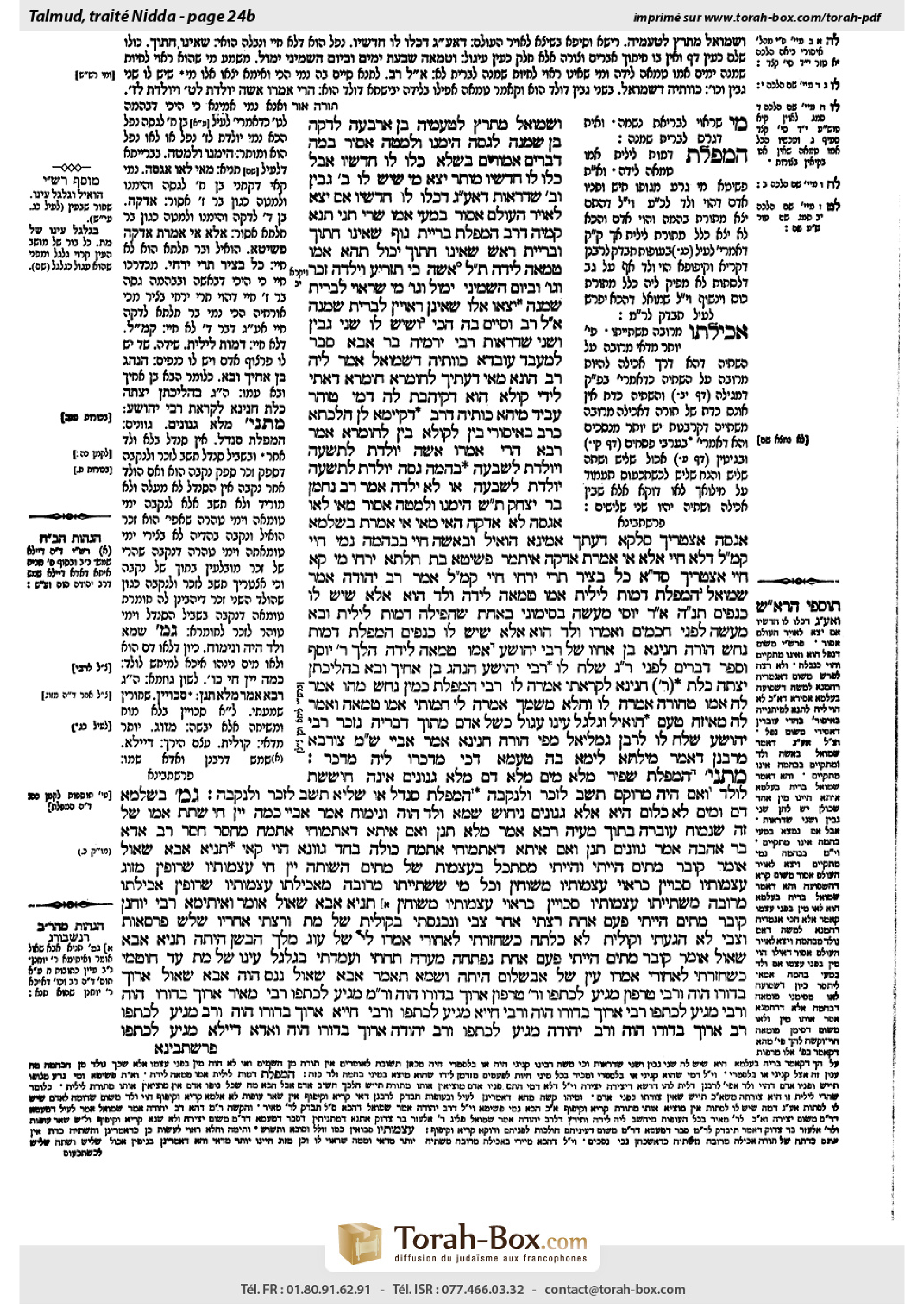
Niddah 24b: Talmud study for Daf Yomi
Daf Yomi is the daily study of one Talmud folio. Explore 37 tractates with scans, Hebrew text, Sefaria English and AI-generated French translations where annotated.
Passage selection and English or AI-generated French translation are available where the scan has annotations. Daf Study is independent of Torah-Box and Sefaria.
Browse Niddah · נידה · All tractatesNiddah 24b text and translations
This page of Niddah includes the Aramaic text, an English translation and an AI-generated French translation, alongside the scan above.
נידה כ״ד ב · Aramaic and Hebrew text
וּשְׁמוּאֵל מְתָרֵץ לְטַעְמֵיהּ: בֶּן אַרְבָּעָה לְדַקָּה, בֶּן שְׁמֹנֶה לְגַסָּה — הֵימֶנּוּ וּלְמַטָּה אָסוּר. בַּמֶּה דְבָרִים אֲמוּרִים? בְּשֶׁלֹּא כָּלוּ לוֹ חֳדָשָׁיו, אֲבָל כָּלוּ לוֹ חֳדָשָׁיו — מוּתָּר. יָצָא מִי שֶׁיֵּשׁ לוֹ שְׁנֵי גַּבִּין וּשְׁנֵי שִׁדְרָאוֹת, דְּאַף עַל גַּב דְּכָלוּ לוֹ חֳדָשָׁיו — אִם יָצָא לַאֲוִיר הָעוֹלָם אָסוּר, בִּמְעֵי אִמּוֹ שְׁרֵי.
תָּנֵי תַּנָּא קַמֵּיהּ דְּרַב: הַמַּפֶּלֶת בְּרִיַּית גּוּף שֶׁאֵינוֹ חָתוּךְ, וּבְרִיַּית רֹאשׁ שֶׁאֵינוֹ חָתוּךְ, יָכוֹל תְּהֵא אִמּוֹ טְמֵאָה לֵידָה? תַּלְמוּד לוֹמַר ״אִשָּׁה כִּי תַזְרִיעַ וְיָלְדָה זָכָר וְגוֹ׳ וּבַיּוֹם הַשְּׁמִינִי יִמּוֹל וְגוֹ׳״ —
מִי שֶׁרָאוּי לִבְרִית שְׁמֹנָה, יָצְאוּ אֵלּוּ שֶׁאֵינָן רְאוּיִין לִבְרִית שְׁמֹנָה. אֲמַר לֵיהּ רַב וְסַיֵּים בַּהּ הָכִי: וְשֶׁיֵּשׁ לוֹ שְׁנֵי גַּבִּין וּשְׁנֵי שִׁדְרָאוֹת.
רַבִּי יִרְמְיָה בַּר אַבָּא סָבַר לְמֶעְבַּד עוֹבָדָא כְּוָותֵיהּ דִּשְׁמוּאֵל, אֲמַר לֵיהּ רַב הוּנָא: מַאי דַּעְתָּיךְ לְחוּמְרָא? חוּמְרָא דְּאָתֵי לִידֵי קוּלָּא הוּא, דְּקָיָהֲבַתְּ לַהּ דְּמֵי טוֹהַר. עֲבֵיד מִיהָא כְּוָתֵיהּ דְּרַב, דְּקַיְימָא לַן הִלְכְתָא כְּרַב בְּאִיסּוּרֵי, בֵּין לְקוּלָּא בֵּין לְחוּמְרָא.
אָמַר רָבָא: הֲרֵי אָמְרוּ, אִשָּׁה יוֹלֶדֶת לְתִשְׁעָה וְיוֹלֶדֶת לְשִׁבְעָה, בְּהֵמָה גַּסָּה יוֹלֶדֶת לְתִשְׁעָה — יוֹלֶדֶת לְשִׁבְעָה אוֹ לֹא יָלְדָה?
אָמַר רַב נַחְמָן בַּר יִצְחָק: תָּא שְׁמַע, הֵימֶנּוּ וּלְמַטָּה אָסוּר. מַאי לָאו אַגַּסָּה? לָא, אַדַּקָּה.
הַאי מַאי? אִי אָמְרַתְּ בִּשְׁלָמָא אַגַּסָּה — אִצְטְרִיךְ, סָלְקָא דַעְתָּךְ אָמֵינָא: הוֹאִיל וּבְאִשָּׁה חָיֵי, בִּבְהֵמָה נָמֵי חָיֵי, קָא מַשְׁמַע לַן דְּלָא חָיֵי.
אֶלָּא אִי אָמְרַתְּ אַדַּקָּה אִיתְּמַר, פְּשִׁיטָא! בַּת תְּלָתָא יַרְחֵי מִי קָא חָיֵי?!
אִצְטְרִיךְ, סָלְקָא דַעְתָּךְ אֲמִינָא: כֹּל בְּצִיר תְּרֵי יַרְחֵי חָיֵי, קָא מַשְׁמַע לַן.
אָמַר רַב יְהוּדָה אָמַר שְׁמוּאֵל: הַמַּפֶּלֶת דְּמוּת לִילִית, אִמּוֹ טְמֵאָה לֵידָה, וָלָד הוּא אֶלָּא שֶׁיֵּשׁ לוֹ כְּנָפַיִם. תַּנְיָא נָמֵי הָכִי: אָמַר רַבִּי יוֹסֵי, מַעֲשֶׂה בְּסִימוֹנְיָא בְּאַחַת שֶׁהִפִּילָה דְּמוּת לִילִית, וּבָא מַעֲשֶׂה לִפְנֵי חֲכָמִים וְאָמְרוּ: וָלָד הוּא אֶלָּא שֶׁיֵּשׁ לוֹ כְּנָפַיִם.
הַמַּפֶּלֶת דְּמוּת נָחָשׁ, הוֹרָה חֲנִינָא בֶּן אָחִיו שֶׁל רַבִּי יְהוֹשֻׁעַ: אִמּוֹ טְמֵאָה לֵידָה. הָלַךְ רַבִּי יוֹסֵף וְסִפֵּר דְּבָרִים לִפְנֵי רַבָּן גַּמְלִיאֵל, שָׁלַח לוֹ רַבִּי יְהוֹשֻׁעַ: הַנְהֵג בֶּן אָחִיךָ וָבֹא.
בַּהֲלִיכָתָן, יָצְתָה כַּלַּת (רַבִּי) חֲנִינָא לִקְרָאתוֹ, אָמְרָה לוֹ: רַבִּי, הַמַּפֶּלֶת כְּמִין נָחָשׁ מַהוּ? אָמַר לָהּ: אִמּוֹ טְהוֹרָה. אָמְרָה לוֹ: וַהֲלֹא מִשִּׁמְךָ אָמְרָה לִי חֲמוֹתִי אִמּוֹ טְמֵאָה? וְאָמַר לָהּ: מֵאֵיזֶה טַעַם? הוֹאִיל וְגַלְגַּל עֵינוֹ עָגוֹל כְּשֶׁל אָדָם. מִתּוֹךְ דְּבָרֶיהָ נִזְכַּר רַבִּי יְהוֹשֻׁעַ, שָׁלַח לוֹ לְרַבָּן גַּמְלִיאֵל: מִפִּי הוֹרָה חֲנִינָא.
אָמַר אַבָּיֵי: שְׁמַע מִינַּהּ, צוּרְבָּא מֵרַבָּנַן דְּאָמַר מִילְּתָא — לֵימָא בַּהּ טַעְמָא, דְּכִי מַדְכְּרוּ לֵיהּ — מִדְּכַר.
מַתְנִי' הַמַּפֶּלֶת שָׁפִיר מָלֵא מַיִם, מָלֵא דָּם, מָלֵא גְּנִינִים — אֵינָהּ חוֹשֶׁשֶׁת לְוָלָד. וְאִם הָיָה מְרוּקָּם — תֵּשֵׁב לְזָכָר וְלִנְקֵבָה. הַמַּפֶּלֶת סַנְדָּל אוֹ שִׁלְיָא — תֵּשֵׁב לְזָכָר וְלִנְקֵבָה.
גְּמָ' בִּשְׁלָמָא דָּם וּמַיִם — לֹא כְּלוּם הִיא, אֶלָּא גְּנִינִים — נֵיחוּשׁ שֶׁמָּא וָלָד הֲוָה וְנִימּוֹחַ? אָמַר אַבָּיֵי: כַּמָּה יַיִן חַי שָׁתַת אִמּוֹ שֶׁל זֶה שֶׁנִּמּוֹחַ עוּבָּרָהּ בְּתוֹךְ מֵעֶיהָ?
רָבָא אָמַר: ״מָלֵא״ תְּנַן, וְאִם אִיתָא דְּאִתְּמוֹחֵי אִתְּמַח — מִחְסָר [הֲוָה] חָסַר. רַב אַדָּא בַּר אַהֲבָה אָמַר: ״גְּוָונִים״ תְּנַן, וְאִם אִיתָא דְּאִתְּמוֹחֵי אִתְּמַח — כּוּלֵּהּ בְּחַד גַּוְונָא הָוֵי קָאֵי.
תַּנְיָא, אַבָּא שָׁאוּל אוֹמֵר: קוֹבֵר מֵתִים הָיִיתִי, וְהָיִיתִי מִסְתַּכֵּל בַּעֲצָמוֹת שֶׁל מֵתִים. הַשּׁוֹתֶה יַיִן חַי — עַצְמוֹתָיו שְׂרוּפִין, מָזוּג — עַצְמוֹתָיו סְכוּיִין, כָּרָאוּי — עַצְמוֹתָיו מְשׁוּחִין. וְכׇל מִי שֶׁשְּׁתִיָּיתוֹ מְרוּבָּה מַאֲכִילָתוֹ — עַצְמוֹתָיו שְׂרוּפִין, אֲכִילָתוֹ מְרוּבָּה מִשְּׁתִיָּיתוֹ — עַצְמוֹתָיו סְכוּיִין, כָּרָאוּי — עַצְמוֹתָיו מְשׁוּחִין.
תַּנְיָא, אַבָּא שָׁאוּל אוֹמֵר, וְאִיתֵּימָא רַבִּי יוֹחָנָן: קוֹבֵר מֵתִים הָיִיתִי. פַּעַם אַחַת רַצְתִּי אַחַר צְבִי, וְנִכְנַסְתִּי בְּקוּלִית שֶׁל מֵת, וְרַצְתִּי אַחֲרָיו שָׁלֹשׁ פַּרְסָאוֹת, וּצְבִי לֹא הִגַּעְתִּי, וְקוּלִית לֹא כָּלְתָה. כְּשֶׁחָזַרְתִּי לַאֲחוֹרַי, אָמְרוּ לִי: שֶׁל עוֹג מֶלֶךְ הַבָּשָׁן הָיְתָה.
תַּנְיָא, אַבָּא שָׁאוּל אוֹמֵר: קוֹבֵר מֵתִים הָיִיתִי. פַּעַם אַחַת נִפְתְּחָה מְעָרָה תַּחְתַּי, וְעָמַדְתִּי בְּגַלְגַּל עֵינוֹ שֶׁל מֵת עַד חוֹטְמִי. כְּשֶׁחָזַרְתִּי לַאֲחוֹרַי, אָמְרוּ: עַיִן שֶׁל אַבְשָׁלוֹם הָיְתָה.
וְשֶׁמָּא תֹּאמַר: אַבָּא שָׁאוּל נַנָּס הֲוָה — אַבָּא שָׁאוּל אָרוֹךְ בְּדוֹרוֹ הֲוָה וְרַבִּי טַרְפוֹן מַגִּיעַ לִכְתֵפוֹ, וְרַבִּי טַרְפוֹן אָרוֹךְ בְּדוֹרוֹ הֲוָה וְרַבִּי מֵאִיר מַגִּיעַ לִכְתֵפוֹ, רַבִּי מֵאִיר אָרוֹךְ בְּדוֹרוֹ הֲוָה וְרַבִּי מַגִּיעַ לִכְתֵפוֹ, רַבִּי אָרוֹךְ בְּדוֹרוֹ הֲוָה
וְרַבִּי חִיָּיא מַגִּיעַ לִכְתֵפוֹ, וְרַבִּי חִיָּיא אָרוֹךְ בְּדוֹרוֹ הֲוָה וְרַב מַגִּיעַ לִכְתֵפוֹ, רַב אָרוֹךְ בְּדוֹרוֹ הֲוָה וְרַב יְהוּדָה מַגִּיעַ לִכְתֵפוֹ, וְרַב יְהוּדָה אָרוֹךְ בְּדוֹרוֹ הֲוָה וְאַדָּא דַּיָּילָא מַגִּיעַ לִכְתֵפוֹ,
Niddah 24b · English translation
And Shmuel explains the baraita according to his line of reasoning, in the following manner: If an animal fetus is born in the fourth month of pregnancy in the case of small domesticated animals, or it is born in the eighth month of pregnancy in the case of large livestock, or if it was born from this stage of the pregnancy and earlier, the animal is forbidden. In what case is this statement said? In a case when the fetus’s months of gestation were not completed; but in a case when its months of gestation were completed, it is permitted for consumption even outside the womb. This excludes a fetus that has two backs and two spines, as even in a case where its months of gestation were completed, if it emerged into the airspace of the world, it is forbidden, whereas if it is found in the womb of its mother, it is permitted.
A tanna taught a baraita before Rav: In the case of a woman who discharges an entity that has a shapeless body, i.e., it does not have the outline of limbs, or an entity that has a shapeless head, one might have thought that its mother should be impure with the impurity of a woman after childbirth. Therefore, the verse states: “If a woman bears seed and gives birth to a male, she shall be impure seven days; as in the days of the menstruation of her sickness she shall be impure. And on the eighth day the flesh of his foreskin shall be circumcised” (Leviticus 12:2–3).
Those verses teach that the impurity of a woman after childbirth applies only to one who gave birth to a child that is fit for circumcision on the eighth day, excluding these cases, where the child is not fit for circumcision on the eighth day, as it cannot survive that long. Consequently, this woman does not have the impurity of a woman after childbirth. Rav said to the tanna: And conclude the baraita like this: Excluding these cases, where the child is not fit for circumcision on the eighth day, and excluding the case of a woman who discharges a child that has two backs and two spines.
Rabbi Yirmeya bar Abba thought to perform an action, i.e., to issue a ruling, in accordance with the opinion of Shmuel, that a woman who gives birth to a child with two backs and two spines is impure. Rav Huna said to him: What is your thinking? That as this matter is subject to a dispute, one should rule stringently? Your ruling is a stringency that leads to a leniency, as you have given the woman a period of thirty-three days following her period of impurity when any blood that emerges is blood of purity. In any event, you should perform, i.e., issue your ruling, in accordance with the opinion of Rav, as we maintain that the halakha is in accordance with the opinion of Rav with regard to ritual matters, whether his opinion leads to a leniency or to a stringency.
§ Rava says: The Sages said that a woman can give birth to a viable offspring after nine months of pregnancy or after seven months of pregnancy; but if a woman gives birth after eight months of pregnancy, the child cannot survive and is stillborn. Similarly, a large domesticated animal gives birth to a viable offspring after nine months of pregnancy, and if it discharges a fetus after only eight months, the newborn animal cannot survive. With this in mind, Rava asked: Can a large domesticated animal give birth to a viable offspring after seven months of pregnancy, like a human, or can such an animal not give birth to a viable offspring after only seven months?
Rav Naḥman bar Yitzḥak said: Come and hear a resolution to this dilemma from the aforementioned baraita: If an animal discharges from this stage of the pregnancy and earlier, the fetus is forbidden in consumption as an unslaughtered animal carcass. What, is it not referring to large livestock, which indicates that large livestock do not give birth to a viable offspring after only seven months of pregnancy? The Gemara answers: No, the reference is specifically to small domesticated animals, which do not give birth to a viable offspring until after five months of pregnancy.
The Gemara raises a difficulty with regard to this answer: What is this? Granted, if you say that the reference is to large livestock, it is necessary for the baraita to state that an animal does not give birth to a viable offspring after less than a complete period of pregnancy, as otherwise it might enter your mind to say that since in the case of a woman who gives birth after seven months the baby survives, it is logical that in the case of a large domesticated animal that gives birth after seven months the newborn also survives, and it is therefore permitted for consumption. Consequently, the baraita teaches us that such an animal does not survive.
But if you say that the ruling in the baraita, that if an animal discharged a fetus before the period of gestation was completed then the fetus is prohibited, was stated with regard to small domesticated animals, isn’t it obvious that if a sheep or goat fetus was discharged at this stage it cannot survive? Can it survive after only three months of gestation?
The Gemara answers that in fact it is necessary for the baraita to state this halakha with regard to small domesticated animals, as otherwise it might enter your mind to say that any mammal that is born two months less than its complete gestation survives, just as a human born at seven months of gestation survives. Therefore, the baraita teaches us that a sheep or goat that is born at three months of gestation cannot survive and is forbidden for consumption.
§ Rav Yehuda says that Shmuel says: In the case of a woman who discharges a fetus that has the form of a lilith, a female demon with wings and a human face, its mother is impure with the impurity of a woman after childbirth, as it is a viable offspring, only it has wings. This is also taught in a baraita: Rabbi Yosei said: An incident occurred in Simoni involving a certain woman who discharged a fetus that had the form of a lilith, and the incident was brought before the Sages; and they said that it is a viable offspring, only it has wings.
There was a case of a woman who discharged an item that had the form of a snake. Ḥanina, the son of Rabbi Yehoshua’s brother, ruled that its mother is impure with the impurity of a woman after childbirth. Rabbi Yosef went and told this matter to Rabban Gamliel. Rabban Gamliel sent to Rabbi Yehoshua: Take hold of your nephew and come to me, so that I may admonish him for his ruling.
While they were going to Rabban Gamliel, Ḥanina’s daughter-in-law went out to greet Rabbi Yehoshua, and said to him: My teacher, what is the halakha with regard to a woman who discharges an item that looks like a snake? Rabbi Yehoshua said to her: Its mother is pure. She said to him: But my mother-in-law said to me in your name that its mother is impure in such a case, and that you said to her: For what reason is she impure? It is because the pupil of a snake is round like that of a human. Due to her statement, Rabbi Yehoshua remembered that he had issued such a ruling. He subsequently sent a message to Rabban Gamliel: Ḥanina issued the ruling based on my own statement.
Abaye said: Conclude from this incident that a Torah scholar [tzurva merabbanan] who says a halakhic matter should say the reason for his statement, so that when his colleagues remind him of his reasoning, he will remember that ruling, as happened to Rabbi Yehoshua.
MISHNA: A woman who discharges a gestational sac full of fluid, full of blood, or full of different colors need not be concerned that it was an offspring. But if the sac was one in which tissue developed, her halakhic status is that of a woman after childbirth. Since the sex of the embryo is unknown, the woman observes the strictures of a woman who gave birth both to a male and to a female; she is impure for fourteen days like a woman who gave birth to a female, but blood that she sees thereafter is pure only until forty days after birth, like a woman who gave birth to a male. A woman who discharges a sandal fetus, i.e., one that has the form of a sandal fish, and one who discharges an afterbirth observes the strictures of a woman who gave birth both to a male and to a female.
GEMARA: The Gemara raises a difficulty: Granted, one can understand why a woman who discharges a gestational sac full of blood or water is pure, as such an item is nothing, i.e., it is not an offspring. But if the gestational sac was full of different colors, let us be concerned that perhaps it was an offspring and it liquefied. Abaye says in response: How much undiluted wine, which can be harmful to an embryo, did the mother of this purported embryo drink, that her embryo was liquefied in her womb? In other words, there is no such concern.
Rava says that there is a different explanation: We learned in the mishna that the gestational sac was full of different colors, and if it is so, that there was an embryo in the sac that liquefied, the sac would have been lacking some of the mass of the liquified portion. Rav Adda bar Ahava says that there is yet another explanation: We learned in the mishna that the gestational sac is full of different colors, and if it is so, that there was an embryo there that liquefied, it would all be of one color.
With regard to the effect of drinking wine on a person’s body, it is taught in a baraita that Abba Shaul says: I used to be a gravedigger, and I would observe the bones of corpses. I discovered that the bones of one who drinks too much undiluted wine during his lifetime look burnt, the bones of one who drinks too much diluted wine are black, and the bones of one who drinks the appropriate amount of wine are fat, i.e., full of marrow. And furthermore, I discovered that the bones of anyone who drinks much more than he eats look burnt, the bones of one who eats much more than he drinks are black, and the bones of one who eats and drinks appropriate amounts are fat.
It is taught in a baraita that Abba Shaul says the following, and some say that Rabbi Yoḥanan said it: I used to be a gravedigger. Once I ran after a deer, and I entered the thighbone of a corpse; and it was so large that I ran after the deer for three parasangs inside the thighbone, and although I did not reach the deer, the thighbone did not end. When I came back and related this to the Sages, they said to me: It was evidently the thighbone of Og, king of Bashan, a known giant.
It is likewise taught in a baraita that Abba Shaul says: I used to be a gravedigger. Once a burial cave opened up underneath where I was standing, and I found myself standing in the eye socket of a corpse until my nose. When I came back and told this to the Sages, they said to me: It was evidently the eye of Absalom.
And lest you say that Abba Shaul was a midget, and therefore he was capable of standing in an eye socket until his nose, Abba Shaul was the tallest person in his generation. And Rabbi Tarfon reached only his shoulder, and Rabbi Tarfon was the tallest person in his generation. And Rabbi Meir reached only the shoulder of Rabbi Tarfon, and Rabbi Meir was the tallest person in his generation. And Rabbi Yehuda HaNasi reached only the shoulder of Rabbi Meir, and Rabbi Yehuda HaNasi was the tallest person in his generation.
The Gemara continues: And Rabbi Ḥiyya reached only the shoulder of Rabbi Yehuda HaNasi, and Rabbi Ḥiyya was the tallest person in his generation. And Rav reached only the shoulder of Rabbi Ḥiyya, and Rav was the tallest person in his generation. And Rav Yehuda reached only the shoulder of Rav, and Rav Yehuda was the tallest person in his generation. And Adda the attendant [dayyala] reached only the shoulder of Rav Yehuda,
Niddah 24b · Traduction française (IA)
Et Shmuel explique la baraïta conformément à son raisonnement, de la manière suivante : si le fœtus d’un animal naît au quatrième mois de gestation chez les petits animaux domestiques, ou au huitième mois chez les grands animaux d’élevage, ou s’il est expulsé à ce stade de la gestation ou avant, il est interdit à la consommation. Dans quel cas cette règle s’applique-t-elle ? Lorsque les mois de gestation du fœtus ne sont pas achevés ; mais lorsque sa gestation est arrivée à terme, il est permis à la consommation, même hors de la matrice. Cela exclut un fœtus qui a deux dos et deux colonnes vertébrales : même si sa gestation est arrivée à terme, s’il est sorti à l’air libre, il est interdit, tandis que s’il est trouvé dans la matrice de sa mère, il est permis.
Un tanna enseignait une baraïta devant Rav : dans le cas d’une femme qui expulse un être au corps informe, c’est-à-dire sans contours de membres, ou un être à la tête informe, on aurait pu penser que sa mère soit impure de l’impureté qui frappe une femme après l’accouchement. C’est pourquoi le verset dit : « Si une femme conçoit et donne naissance à un mâle, elle sera impure pendant sept jours ; elle sera impure comme aux jours de son indisposition menstruelle. Et le huitième jour, on circoncira la chair de son prépuce » (Lévitique 12, 2-3).
Ces versets enseignent que l’impureté d’une femme après l’accouchement ne s’applique qu’à celle qui a donné naissance à un enfant apte à être circoncis le huitième jour. Cela exclut ces cas, où l’enfant n’est pas apte à être circoncis le huitième jour, car il ne peut survivre jusque-là. Par conséquent, cette femme ne contracte pas l’impureté d’une femme après l’accouchement. Rav dit au tanna : Conclus la baraïta ainsi : « Cela exclut ces cas, où l’enfant n’est pas apte à être circoncis le huitième jour, ainsi que le cas d’une femme qui expulse un enfant ayant deux dos et deux colonnes vertébrales. »
Rabbi Yirmeya bar Abba envisagea de statuer conformément à l’opinion de Shmuel, selon laquelle une femme qui donne naissance à un enfant ayant deux dos et deux colonnes vertébrales est impure. Rav Huna lui dit : « À quoi penses-tu ? Puisque cette question fait l’objet d’un désaccord, tu crois qu’il faut statuer avec rigueur ? Ta décision est une rigueur qui entraîne une indulgence, car tu as accordé à la femme une période de trente-trois jours après sa période d’impureté, durant laquelle tout sang qui s’écoule est du sang de pureté. Quoi qu’il en soit, tu dois statuer conformément à l’opinion de Rav, car nous suivons l’opinion de Rav pour les questions rituelles, que son avis entraîne une indulgence ou une rigueur. »
§ Rava dit : Les Sages ont enseigné qu’une femme peut donner naissance à un enfant viable après neuf mois de grossesse ou après sept mois de grossesse ; mais si elle accouche après huit mois de grossesse, l’enfant ne peut survivre et est mort-né. De même, un grand animal domestique donne naissance à un petit viable après neuf mois de gestation, et s’il expulse un fœtus après seulement huit mois, le nouveau-né ne peut survivre. À ce propos, Rava demanda : Un grand animal domestique peut-il donner naissance à un petit viable après sept mois de gestation, comme un être humain, ou un tel animal ne peut-il pas donner naissance à un petit viable après seulement sept mois ?
Rav Naḥman bar Yitzḥak dit : Viens et entends une réponse à ce dilemme tirée de la baraïta déjà mentionnée : si un animal expulse un fœtus à ce stade de la gestation ou avant, le fœtus est interdit à la consommation comme une carcasse d’animal non abattu rituellement. N’est-ce pas une référence aux grands animaux d’élevage, ce qui indiquerait qu’ils ne donnent pas naissance à un petit viable après seulement sept mois de gestation ? La Guemara répond : Non, il s’agit précisément des petits animaux domestiques, qui ne donnent pas naissance à un petit viable avant cinq mois de gestation.
La Guemara soulève une difficulté à propos de cette réponse : Qu’en est-il ? Certes, si tu dis qu’il s’agit des grands animaux d’élevage, il est nécessaire que la baraïta précise qu’un animal ne donne pas naissance à un petit viable avant que la période complète de gestation soit achevée ; sinon, on pourrait penser que, puisque le bébé d’une femme qui accouche après sept mois survit, il est logique que le nouveau-né d’un grand animal domestique qui met bas après sept mois survive lui aussi et soit donc permis à la consommation. La baraïta nous enseigne par conséquent qu’un tel animal ne survit pas.
Mais si tu dis que la règle énoncée dans la baraïta, selon laquelle un fœtus expulsé avant l’achèvement de la période de gestation est interdit, concerne les petits animaux domestiques, n’est-il pas évident qu’un fœtus de mouton ou de chèvre expulsé à ce stade ne peut survivre ? Peut-il survivre après seulement trois mois de gestation ?
La Guemara répond qu’il est en réalité nécessaire que la baraïta énonce cette halakha à propos des petits animaux domestiques, car sinon on pourrait penser que tout mammifère né deux mois avant la fin de sa gestation survit, comme un être humain né après sept mois de gestation. La baraïta nous enseigne donc qu’un mouton ou une chèvre né après trois mois de gestation ne peut survivre et est interdit à la consommation.
§ Rav Yehuda dit au nom de Shmuel : dans le cas d’une femme qui expulse un fœtus ayant la forme d’une lilith, un démon femelle pourvu d’ailes et d’un visage humain, sa mère est impure de l’impureté qui frappe une femme après l’accouchement, car il s’agit d’un enfant viable, qui a seulement des ailes. Cela est également enseigné dans une baraïta : Rabbi Yosei dit : « Un incident eut lieu à Simoni, où une certaine femme expulsa un fœtus ayant la forme d’une lilith. L’affaire fut portée devant les Sages, qui déclarèrent qu’il s’agissait d’un enfant viable, qui avait seulement des ailes. »
Il arriva qu’une femme expulse un être ayant la forme d’un serpent. Ḥanina, le fils du frère de Rabbi Yehoshua, statua que sa mère était impure de l’impureté qui frappe une femme après l’accouchement. Rabbi Yosef alla rapporter cette affaire à Rabban Gamliel. Rabban Gamliel envoya dire à Rabbi Yehoshua : « Prends ton neveu et viens me voir, afin que je lui fasse des reproches au sujet de sa décision. »
Alors qu’ils se rendaient chez Rabban Gamliel, la belle-fille de Ḥanina sortit à la rencontre de Rabbi Yehoshua et lui dit : « Mon maître, quelle est la halakha concernant une femme qui expulse un être ressemblant à un serpent ? » Rabbi Yehoshua lui dit : « Sa mère est pure. » Elle lui dit : « Mais ma belle-mère m’a dit en votre nom que sa mère est impure dans un tel cas, et que vous lui avez dit : “Pourquoi est-elle impure ? Parce que la pupille d’un serpent est ronde comme celle d’un être humain.” » À ses paroles, Rabbi Yehoshua se souvint qu’il avait rendu une telle décision. Il envoya ensuite un message à Rabban Gamliel : « Ḥanina a statué en se fondant sur ma propre déclaration. »
Abaye dit : Déduis de cet incident qu’un érudit de la Torah [tzurva merabbanan] qui énonce une halakha doit en donner la raison, afin que, lorsque ses collègues la lui rappellent, il se souvienne de cette décision, comme ce fut le cas pour Rabbi Yehoshua.
MICHNA : Une femme qui expulse un sac gestationnel rempli de liquide, de sang ou de matières de couleurs différentes n’a pas à craindre qu’il s’agisse d’un fœtus. Mais si le sac contenait des tissus qui s’étaient développés, son statut halakhique est celui d’une femme après l’accouchement. Le sexe de l’embryon étant inconnu, la femme observe les règles de sévérité applicables à une femme ayant donné naissance à un garçon comme à une fille : elle est impure pendant quatorze jours, comme une femme ayant donné naissance à une fille, mais le sang qu’elle voit ensuite n’est pur que jusqu’au quarantième jour après la naissance, comme pour une femme ayant donné naissance à un garçon. Une femme qui expulse un fœtus en sandale, c’est-à-dire ayant la forme d’un poisson-sandale, ainsi qu’une femme qui expulse un placenta, observent les règles de sévérité applicables à une femme ayant donné naissance à un garçon comme à une fille.
GUEMARA : La Guemara soulève une difficulté : certes, on comprend pourquoi une femme qui expulse un sac gestationnel rempli de sang ou d’eau est pure, car une telle chose n’est rien, c’est-à-dire qu’il ne s’agit pas d’un fœtus. Mais si le sac gestationnel était rempli de matières de couleurs différentes, ne devrait-on pas craindre qu’il s’agisse d’un fœtus qui se serait liquéfié ? Abaye répond : « Quelle quantité de vin pur, qui peut nuire à un embryon, la mère de cet embryon supposé a-t-elle donc bue pour que son embryon se liquéfie dans sa matrice ? » Autrement dit, il n’y a pas lieu de craindre une telle éventualité.
Rava donne une autre explication : nous avons appris dans la Michna que le sac gestationnel était rempli de matières de couleurs différentes ; or, si un embryon s’y trouvait et s’est liquéfié, il manquerait au sac une partie de la masse correspondant à la portion liquéfiée. Rav Adda bar Ahava donne encore une autre explication : nous avons appris dans la Michna que le sac gestationnel était rempli de matières de couleurs différentes ; or, si un embryon s’y trouvait et s’est liquéfié, tout aurait été d’une seule couleur.
Concernant l’effet de la consommation de vin sur le corps humain, une baraïta enseigne qu’Abba Shaul dit : « J’étais fossoyeur et j’examinais les os des morts. J’ai découvert que les os de celui qui boit trop de vin pur de son vivant paraissent brûlés ; les os de celui qui boit trop de vin dilué sont noirs ; et les os de celui qui boit la quantité appropriée de vin sont gras, c’est-à-dire remplis de moelle. J’ai en outre découvert que les os de toute personne qui boit beaucoup plus qu’elle ne mange paraissent brûlés ; les os de celui qui mange beaucoup plus qu’il ne boit sont noirs ; et les os de celui qui mange et boit en quantités appropriées sont gras. »
Une baraïta enseigne qu’Abba Shaul dit ce qui suit, et certains disent que c’est Rabbi Yoḥanan qui l’a dit : « J’étais fossoyeur. Un jour, je poursuivais un cerf et je pénétrai dans le fémur d’un cadavre ; il était si grand que je poursuivis le cerf sur trois parasanges à l’intérieur de ce fémur. Bien que je n’aie pas rattrapé le cerf, le fémur ne prenait pas fin. Lorsque je revins et racontai cela aux Sages, ils me dirent : “Il s’agissait manifestement du fémur d’Og, roi de Bashan, un géant connu.” »
Une baraïta enseigne également qu’Abba Shaul dit : « J’étais fossoyeur. Un jour, une grotte funéraire s’ouvrit sous l’endroit où je me tenais, et je me retrouvai debout dans l’orbite d’un cadavre, jusqu’au nez. Lorsque je revins et racontai cela aux Sages, ils me dirent : “Il s’agissait manifestement de l’œil d’Absalom.” »
Et de peur que tu dises qu’Abba Shaul était un nain et qu’il pouvait donc se tenir dans une orbite jusqu’au nez, sache qu’Abba Shaul était la personne la plus grande de sa génération. Rabbi Tarfon ne lui arrivait qu’à l’épaule, et Rabbi Tarfon était la personne la plus grande de sa génération. Rabbi Meir n’arrivait qu’à l’épaule de Rabbi Tarfon, et Rabbi Meir était la personne la plus grande de sa génération. Rabbi Yehuda HaNasi n’arrivait qu’à l’épaule de Rabbi Meir, et Rabbi Yehuda HaNasi était la personne la plus grande de sa génération.
La Guemara poursuit : Rabbi Ḥiyya n’arrivait qu’à l’épaule de Rabbi Yehuda HaNasi, et Rabbi Ḥiyya était la personne la plus grande de sa génération. Rav n’arrivait qu’à l’épaule de Rabbi Ḥiyya, et Rav était la personne la plus grande de sa génération. Rav Yehuda n’arrivait qu’à l’épaule de Rav, et Rav Yehuda était la personne la plus grande de sa génération. Adda, l’intendant [dayyala], n’arrivait qu’à l’épaule de Rav Yehuda,
Traduction française générée par IA à partir de l’édition anglaise de Sefaria. Vérifie toujours un passage avec le texte source.
Text from Sefaria: William Davidson Edition - Vocalized Aramaic (CC BY NC); William Davidson Edition - English (CC BY NC).