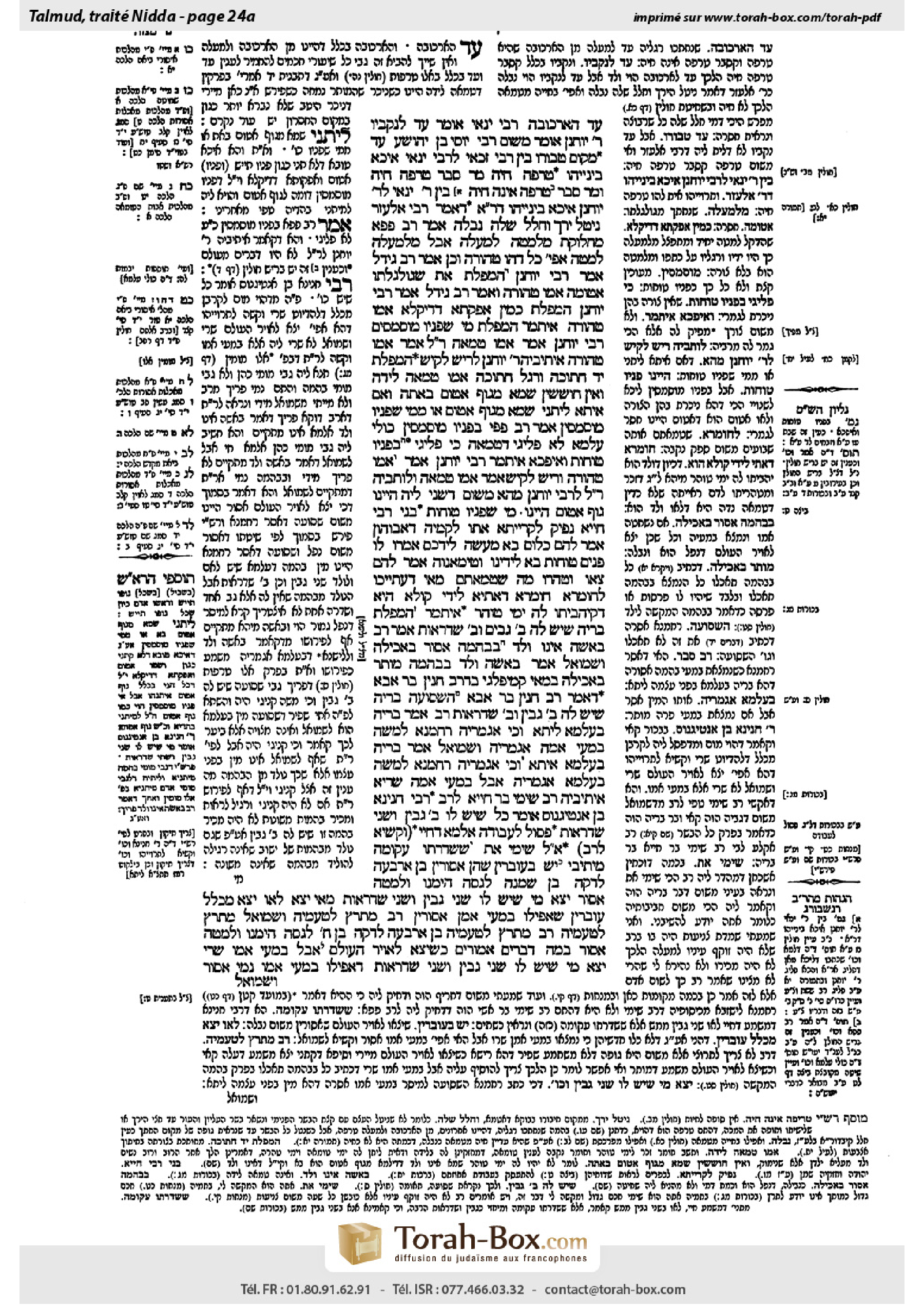
Niddah 24a: Talmud study for Daf Yomi
Daf Yomi is the daily study of one Talmud folio. Explore 37 tractates with scans, Hebrew text, Sefaria English and AI-generated French translations where annotated.
Passage selection and English or AI-generated French translation are available where the scan has annotations. Daf Study is independent of Torah-Box and Sefaria.
Browse Niddah · נידה · All tractatesNiddah 24a text and translations
This page of Niddah includes the Aramaic text, an English translation and an AI-generated French translation, alongside the scan above.
נידה כ״ד א · Aramaic and Hebrew text
עַד הָאַרְכּוּבָּה. רַבִּי יַנַּאי אוֹמֵר: עַד לִנְקָבָיו, רַבִּי יוֹחָנָן אוֹמֵר מִשּׁוּם רַבִּי יוֹסֵי בֶּן יְהוֹשֻׁעַ: עַד מְקוֹם טַבּוּרוֹ.
בֵּין רַבִּי זַכַּאי לְרַבִּי יַנַּאי אִיכָּא בֵינַיְיהוּ ״טְרֵפָה חַיָּה״, מָר סָבַר ״טְרֵפָה חַיָּה״, וּמָר סָבַר ״טְרֵפָה אֵינָהּ חַיָּה״.
בֵּין רַבִּי יַנַּאי לְרַבִּי יוֹחָנָן, אִיכָּא בֵינַיְיהוּ דְּרַבִּי אֶלְעָזָר, דְּאָמַר רַבִּי אֶלְעָזָר: (ניטל) [נִיטְּלָה] יָרֵךְ וְחָלָל שֶׁלָּהּ — נְבֵלָה.
אָמַר רַב פָּפָּא: מַחְלוֹקֶת מִלְּמַטָּה לְמַעְלָה, אֲבָל מִלְּמַעְלָה לְמַטָּה אֲפִילּוּ כֹּל דְּהוּ — טְהוֹרָה. וְכֵן אָמַר רַב גִּידֵּל אָמַר רַבִּי יוֹחָנָן: הַמַּפֶּלֶת אֶת שֶׁגּוּלְגׇּלְתּוֹ אֲטוּמָה — אִמּוֹ טְהוֹרָה.
וְאָמַר רַב גִּידֵּל, אָמַר רַבִּי יוֹחָנָן: הַמַּפֶּלֶת כְּמִין אַפָּקוּתָא דְּדִיקְלָא — אִמּוֹ טְהוֹרָה.
אִיתְּמַר: הַמַּפֶּלֶת מִי שֶׁפָּנָיו מוּסְמָסִים, רַבִּי יוֹחָנָן אָמַר: אִמּוֹ טְמֵאָה, רֵישׁ לָקִישׁ אָמַר: אִמּוֹ טְהוֹרָה.
אֵיתִיבֵיהּ רַבִּי יוֹחָנָן לְרֵישׁ לָקִישׁ: הַמַּפֶּלֶת יָד חֲתוּכָה וְרֶגֶל חֲתוּכָה — אִמּוֹ טְמֵאָה לֵידָה, וְאֵין חוֹשְׁשִׁין שֶׁמָּא מִגּוּף אָטוּם בָּאתָה. וְאִם אִיתָא, לִיתְנֵי: שֶׁמָּא מִגּוּף אָטוּם אוֹ מִמִּי שֶׁפָּנָיו מוּסְמָסִין!
אָמַר רַב פַּפֵּי: בְּפָנָיו מוּסְמָסִין — כּוּלֵּי עָלְמָא לָא פְּלִיגִי דִּטְמֵאָה, כִּי פְּלִיגִי — בְּפָנָיו טוּחוֹת, וְאִיפְּכָא אִיתְּמַר: רַבִּי יוֹחָנָן אָמַר אִמּוֹ טְהוֹרָה, וְרֵישׁ לָקִישׁ אָמַר אִמּוֹ טְמֵאָה.
וְלוֹתְבֵיהּ רֵישׁ לָקִישׁ לְרַבִּי יוֹחָנָן מֵהָא! מִשּׁוּם דְּשַׁנִּי לֵיהּ: הַיְינוּ גּוּף אָטוּם, הַיְינוּ מִי שֶׁפָּנָיו טוּחוֹת.
בְּנֵי רַבִּי חִיָּיא נְפוּק לְקִרְיָיתָא, אֲתוֹ לְקַמֵּיהּ דַּאֲבוּהוֹן, אָמַר לָהֶם: כְּלוּם בָּא מַעֲשֶׂה לְיֶדְכֶם? אָמְרוּ לוֹ: פָּנִים טוּחוֹת בָּא לְיָדֵינוּ, וְטִימֵּאנוּהָ.
אָמַר לָהֶם: צְאוּ וְטַהֲרוּ מָה שֶׁטִּמֵּאתֶם. מַאי דַּעְתַּיְיכוּ, לְחוּמְרָא? חוּמְרָא דְּאָתְיָא לִידֵי קוּלָּא הִיא, דְּקָיָהֲבִיתוּ לַהּ יְמֵי טוֹהַר.
אִיתְּמַר: הַמַּפֶּלֶת בְּרִיָּה שֶׁיֵּשׁ לָהּ שְׁנֵי גַּבִּים וּשְׁנֵי שִׁדְרָאוֹת, אָמַר רַב: בְּאִשָּׁה — אֵינוֹ וָלָד, בִּבְהֵמָה — אָסוּר בַּאֲכִילָה. וּשְׁמוּאֵל אָמַר: בְּאִשָּׁה — וָלָד, בִּבְהֵמָה — מוּתָּר בַּאֲכִילָה.
בְּמַאי קָמִיפַּלְגִי? בִּדְרַב חָנִין בַּר אַבָּא, דְּאָמַר רַב חָנִין בַּר אַבָּא: ״הַשְּׁסוּעָה״ — בְּרִיָּה שֶׁיֵּשׁ לָהּ שְׁנֵי גַּבִּין וּשְׁנֵי שִׁדְרָאוֹת.
רַב אָמַר: בְּרִיָּה בְּעָלְמָא לֵיתַהּ, וְכִי אַגְמְרֵיהּ רַחֲמָנָא לְמֹשֶׁה — בִּמְעֵי אִמָּהּ אַגְמְרֵיהּ. וּשְׁמוּאֵל אָמַר: בְּרֵיהּ בְּעָלְמָא אִיתַאּ, וְכִי אַגְמְרֵיהּ רַחֲמָנָא לְמֹשֶׁה — בְּעָלְמָא אַגְמְרֵיהּ, אֲבָל בִּמְעֵי אִמָּהּ — שָׁרְיָא.
אֵיתִיבֵיהּ רַב שִׁימִי בַּר חִיָּיא לְרַב: רַבִּי חֲנִינָא בֶּן אַנְטִיגְנוֹס אוֹמֵר, כֹּל שֶׁיֵּשׁ לוֹ שְׁנֵי גַּבִּין וּשְׁנֵי שִׁדְרָאוֹת פָּסוּל לַעֲבוֹדָה, אַלְמָא דְּחָיֵי, וְקַשְׁיָא לְרַב! אֲמַר לֵיהּ: שִׁימִי אַתְּ! שֶׁשִּׁדְרָתוֹ עֲקוּמָּה.
מֵיתִיבִי: יֵשׁ בְּעוּבָּרִין שֶׁהֵן אֲסוּרִין — בֶּן אַרְבָּעָה לְדַקָּה, בֶּן שְׁמֹנָה לְגַסָּה, הֵימֶנּוּ וּלְמַטָּה אָסוּר. יָצָא מִי שֶׁיֵּשׁ לוֹ שְׁנֵי גַּבִּין וּשְׁנֵי שִׁדְרָאוֹת.
מַאי ״יָצָא״? לָאו יָצָא מִכְּלַל עוּבָּרִין, שֶׁאֲפִילּוּ בִּמְעֵי אִמָּן אֲסוּרִין?
רַב מְתָרֵץ לְטַעְמֵיהּ, וּשְׁמוּאֵל מְתָרֵץ לְטַעְמֵיהּ. רַב מְתָרֵץ לְטַעְמֵיהּ: בֶּן אַרְבָּעָה לְדַקָּה, בֶּן שְׁמוֹנֶה לְגַסָּה, הֵימֶנּוּ וּלְמַטָּה — אָסוּר.
בַּמֶּה דְבָרִים אֲמוּרִים? כְּשֶׁיָּצָא לַאֲוִיר הָעוֹלָם, אֲבָל בִּמְעֵי אִמּוֹ — שְׁרֵי. יָצָא מִי שֶׁיֵּשׁ לוֹ שְׁנֵי גַּבִּין וּשְׁנֵי שִׁדְרָאוֹת, דַּאֲפִילּוּ בִּמְעֵי אִמּוֹ נָמֵי אָסוּר.
Niddah 24a · English translation
Until above the knee. Rabbi Yannai says: Until his orifices. Rabbi Yoḥanan says in the name of Rabbi Yosei ben Yehoshua: Until the location of his navel.
The Gemara explains the dispute between the amora’im: The difference between the opinion of Rabbi Zakkai and that of Rabbi Yannai is whether a tereifa can survive beyond twelve months. One Sage, Rabbi Yannai, holds that a tereifa can survive beyond twelve months. Therefore, although one whose legs were removed until above the knee has the status of a tereifa, if a woman discharges a fetus of this form she is impure. Only if the fetus lacks legs until his orifices is the woman pure, as such a person cannot survive. And one Sage, Rabbi Zakkai, holds that a tereifa cannot survive beyond twelve months. Therefore, even if the fetus lacks legs only from above the knee and not from his orifices, the woman is not impure.
The difference between the opinion of Rabbi Yannai and the opinion of Rabbi Yoḥanan, who both agree that a tereifa can survive, is with regard to a statement of Rabbi Elazar, as Rabbi Elazar said: If the thigh, i.e., the hind leg of the animal, and its recess were removed from an animal before slaughter, the animal is considered an unslaughtered carcass; consequently, it is forbidden in consumption and imparts ritual impurity even while still alive. Rabbi Yannai agrees with the statement of Rabbi Elazar, and accordingly holds that if the lower part of a person’s body until his orifices is missing or removed, the person immediately assumes the halakhic status of a corpse. Rabbi Yoḥanan disagrees with Rabbi Elazar and holds that one whose lower part of his body was missing or removed has the status of a corpse only if it is removed until his navel.
Rav Pappa says: The dispute between the amora’im is with regard to a fetus that is lacking part of its body from below to above, i.e., the lower part of his body; but if it is lacking part of its body from above to below, even any amount of its skull, the woman is pure. And likewise, Rav Giddel says that Rabbi Yoḥanan says: In the case of a woman who discharges a fetus whose skull is sealed, i.e., deficient, its mother is pure.
The Gemara cites another halakha: And Rav Giddel says that Rabbi Yoḥanan says: In the case of a woman who discharges a fetus that looks like the part of a palm tree that branches out, i.e., the lower part of its body is formless while the upper part has arms and legs coming out of its shoulders like branches, its mother is pure.
§ It was stated with regard to a woman who discharges a fetus whose face is mashed but not completely flattened, that Rabbi Yoḥanan says its mother is impure, and Reish Lakish says its mother is pure.
Rabbi Yoḥanan raised an objection to Reish Lakish from a baraita: In the case of a woman who discharges a shaped hand, i.e., a hand whose fingers are discernible, or a shaped foot, its mother is impure with the impurity of a woman after childbirth, as it certainly came from a full-fledged fetus, and we are not concerned that perhaps it came from a fetus with a sealed, i.e., deficient, body. And if it is so, that a fetus with a mashed face does not render its mother impure, let the baraita teach: We are not concerned that perhaps it came from a fetus with a sealed body or from one whose face is mashed.
Rav Pappi says: In a case where its face is mashed, everyone agrees that the woman is impure. When they disagree, it is in a case where its face is completely flat, i.e., none of its features are discernible; and the opposite was stated: Rabbi Yoḥanan says that its mother is pure, and Reish Lakish says that its mother is impure.
The Gemara raises a difficulty: But according to this version of the dispute, let Reish Lakish raise an objection to the opinion of Rabbi Yoḥanan from this baraita, from which Rabbi Yoḥanan raised an objection to the opinion of Reish Lakish according to the previous version of the dispute: If a woman who discharges a fetus whose face is flat is pure, the baraita should have stated that there is no concern that the hand or foot might have come from a fetus with a sealed body or one whose face is flat. The Gemara answers: Reish Lakish did not raise the objection, because Rabbi Yoḥanan would have responded to him that the status of a sealed body is the same as that of one whose face is flat. There is no reason to mention both types of deformities.
The Gemara relates: The sons of Rabbi Ḥiyya went out to the villages to inspect their father’s fields. When they came back to their father, he said to them: Wasn’t any incident brought to you for a halakhic ruling? They said to him: A case of a woman who discharged a fetus with a flat face was brought to us, and we deemed her impure with the impurity of a woman after childbirth.
Rabbi Ḥiyya said to them: Go out and deem pure that which you have deemed impure. What was your thinking when you ruled that she is impure? Did you reason that as the matter is subject to a dispute, one should rule stringently? But your ruling is a stringency that leads to a leniency, as you have given the woman thirty-three days of purity after the birth of a male, following her period of impurity, which are the minimum days of purity established in the Torah for a woman who gave birth.
§ It was stated: With regard to a woman or female animal who discharges an entity that has two backs and two spines, Rav says that in the case of the woman, her discharged fetus is not considered an offspring, as it cannot survive, and therefore the woman does not have the ritual impurity caused by childbirth, and in the case of the animal, its fetus is prohibited for consumption. And Shmuel says: In the case of a woman, the discharged fetus is considered an offspring, and the woman is impure, and in the case of an animal, the fetus is permitted for consumption.
The Gemara asks: With regard to what do Rav and Shmuel disagree? The Gemara answers: They disagree concerning the statement of Rav Ḥanin bar Abba, as Rav Ḥanin bar Abba said: The verse states: “Nevertheless these you shall not eat of them that only chew the cud, or of them that only have the hoof cloven [umimafrisei haparsa hashesua]: The camel, and the hare, and the rock badger” (Deuteronomy 14:7). The apparently superfluous term hashesua is not a redundant description of the cloven hoof; it is referring to a separate entity that has two backs and two spines and therefore looks like an entirely cloven animal.
It is with regard to this prohibition that Rav and Shmuel disagree. Rav says that there is no such living entity in the world, and when the Merciful One taught this prohibition to Moses, he taught it to him with regard to a fetus that has two backs and two spines that is found in the womb of its mother after slaughter. And Shmuel says that there is such an entity in the world, and when the Merciful One taught this prohibition to Moses, he taught it to him with regard to a living animal in the world, but a fetus that has two backs and two spines in the womb of its mother is permitted for consumption.
Rav Shimi bar Ḥiyya raised an objection to Rav from a baraita: Rabbi Ḥanina ben Antigonus says: Any priest who has two backs and two spines is disqualified from the Temple service, as he is blemished. Evidently, an entity that has two backs and two spines can survive, and this is difficult for the opinion of Rav. Rav said to him: You are clearly Shimi, i.e., you asked well. Yet the statement of Rabbi Ḥanina ben Antigonus is not referring to one who literally has two backs and two spines, but rather to one whose spine is crooked and therefore appears as though he has two spines. One who actually has two backs and two spines cannot survive.
The Gemara raises an objection from a baraita: Among discharged animal fetuses, there are those that are forbidden in consumption, as they have the halakhic status of carcasses of unslaughtered animals. Specifically, if an animal fetus is born in the fourth month of pregnancy in the case of small domesticated animals, where the pregnancy is normally five months long, or it is born in the eighth month of pregnancy in the case of large livestock, where the pregnancy is normally nine months long, or if the miscarriage occurred from this stage of the pregnancy and earlier, i.e., if the pregnancy ended before this stage, the animal is forbidden. This excludes one that has two backs and two spines.
The Gemara asks: What does the baraita mean when it states that an animal with two backs and two spines is excluded? Does it not mean that it is excluded from the category of those fetuses, which are permitted for consumption if found inside their mother’s womb, as such animals are forbidden even while they are in the wombs of their mothers? This contradicts the opinion of Shmuel, who holds that an animal fetus of that type is permitted for consumption.
The Gemara answers: Rav explains the baraita according to his line of reasoning, and Shmuel explains the baraita according to his line of reasoning. Rav explains the baraita according to his line of reasoning, as was assumed above: If an animal fetus is born in the fourth month of pregnancy in the case of small domesticated animals, or it is born in the eighth month of pregnancy in the case of large livestock, or if it was born from this stage of the pregnancy and earlier, the animal is forbidden.
In what case is this statement said? In a case where the animal emerged into the airspace of the world; but if it was found in its mother’s womb after its mother was slaughtered, it is permitted for consumption. This excludes the case of a fetus that has two backs and two spines, as even if it is found in the womb of its mother it is prohibited.
Niddah 24a · Traduction française (IA)
Jusqu’au-dessus du genou. Rabbi Yannai dit : jusqu’à ses orifices. Rabbi Yoḥanan dit au nom de Rabbi Yosei ben Yehoshua : jusqu’à l’emplacement de son nombril.
La Guemara explique le désaccord entre les amoraïm : la différence entre l’opinion de Rabbi Zakkai et celle de Rabbi Yannai porte sur la question de savoir si un tereifa peut survivre plus de douze mois. Rabbi Yannai estime qu’un tereifa peut survivre plus de douze mois. Par conséquent, bien qu’une personne dont les jambes ont été amputées au-dessus des genoux ait le statut de tereifa, si une femme expulse un fœtus de cette forme, elle est impure. La femme n’est pure que si le fœtus n’a pas de jambes jusqu’à ses orifices, car un être ainsi constitué ne peut pas survivre. Rabbi Zakkai estime, quant à lui, qu’un tereifa ne peut pas survivre plus de douze mois. Par conséquent, même si le fœtus n’a pas de jambes à partir du dessus des genoux, mais pas jusqu’à ses orifices, la femme n’est pas impure.
La différence entre l’opinion de Rabbi Yannai et celle de Rabbi Yoḥanan, qui conviennent tous deux qu’un tereifa peut survivre, concerne une déclaration de Rabbi Elazar. En effet, Rabbi Elazar a dit : si la cuisse, c’est-à-dire la patte arrière de l’animal, et son creux sont retirés avant l’abattage, l’animal est considéré comme une carcasse non abattue ; par conséquent, sa consommation est interdite et il transmet l’impureté rituelle même tant qu’il est vivant. Rabbi Yannai est d’accord avec Rabbi Elazar et estime donc que si la partie inférieure du corps d’une personne, jusqu’à ses orifices, est absente ou retirée, cette personne prend immédiatement le statut halakhique d’un cadavre. Rabbi Yoḥanan n’est pas d’accord avec Rabbi Elazar et estime que celui dont la partie inférieure du corps est absente ou retirée n’a le statut de cadavre que si elle est retirée jusqu’au nombril.
Rav Pappa dit : le désaccord entre les amoraïm concerne un fœtus auquel il manque une partie du corps depuis le bas vers le haut, c’est-à-dire dans la partie inférieure du corps ; mais s’il lui manque une partie du corps depuis le haut vers le bas, même une partie quelconque du crâne, la femme est pure. De même, Rav Giddel dit au nom de Rabbi Yoḥanan : dans le cas d’une femme qui expulse un fœtus au crâne fermé, c’est-à-dire incomplet, sa mère est pure.
La Guemara cite une autre halakha : Rav Giddel dit au nom de Rabbi Yoḥanan : dans le cas d’une femme qui expulse un fœtus ayant l’apparence de la partie d’un palmier d’où partent les ramifications, c’est-à-dire que la partie inférieure de son corps est informe, tandis que ses bras et ses jambes sortent de ses épaules comme des branches, sa mère est pure.
§ Il a été enseigné au sujet d’une femme qui expulse un fœtus dont le visage est écrasé, mais pas entièrement aplati : Rabbi Yoḥanan dit que sa mère est impure, tandis que Reish Lakish dit que sa mère est pure.
Rabbi Yoḥanan soulève une objection contre Reish Lakish à partir d’une baraïta : dans le cas d’une femme qui expulse une main bien formée, dont les doigts sont distincts, ou un pied bien formé, sa mère est impure de l’impureté d’une femme après l’accouchement, car ces membres proviennent certainement d’un fœtus pleinement constitué ; on ne craint pas qu’ils proviennent d’un fœtus au corps fermé, c’est-à-dire incomplet. Or, s’il en est ainsi, si un fœtus au visage écrasé ne rend pas sa mère impure, que la baraïta enseigne : « On ne craint pas qu’ils proviennent d’un fœtus au corps fermé ou d’un fœtus au visage écrasé. »
Rav Pappi dit : dans le cas où son visage est écrasé, tous conviennent que la femme est impure. Leur désaccord porte sur le cas où son visage est entièrement plat, c’est-à-dire qu’aucun de ses traits n’est discernable ; et la version inverse a été rapportée : Rabbi Yoḥanan dit que sa mère est pure, tandis que Reish Lakish dit que sa mère est impure.
La Guemara soulève une difficulté : mais selon cette version du désaccord, que Reish Lakish soulève une objection contre l’opinion de Rabbi Yoḥanan à partir de cette baraïta, celle-là même à partir de laquelle Rabbi Yoḥanan avait soulevé une objection contre l’opinion de Reish Lakish selon la version précédente du désaccord. Si une femme qui expulse un fœtus au visage plat est pure, la baraïta aurait dû préciser qu’il n’y a pas lieu de craindre que la main ou le pied provienne d’un fœtus au corps fermé ou au visage plat. La Guemara répond : Reish Lakish n’a pas soulevé cette objection, car Rabbi Yoḥanan lui aurait répondu que le statut d’un corps fermé est le même que celui d’un fœtus au visage plat. Il n’y a aucune raison de mentionner les deux types de malformations.
La Guemara rapporte : les fils de Rabbi Ḥiyya se rendirent dans les villages pour inspecter les champs de leur père. À leur retour auprès de lui, il leur dit : « Aucun cas ne vous a-t-il été soumis pour une décision halakhique ? » Ils lui répondirent : « On nous a soumis le cas d’une femme qui avait expulsé un fœtus au visage plat, et nous l’avons déclarée impure de l’impureté d’une femme après l’accouchement. »
Rabbi Ḥiyya leur dit : « Allez déclarer pure celle que vous avez déclarée impure. Qu’avez-vous pensé en statuant qu’elle était impure ? Avez-vous raisonné ainsi : puisque la question fait l’objet d’un désaccord, il faut statuer avec rigueur ? Mais votre décision constitue une rigueur qui entraîne une indulgence, car vous avez accordé à la femme trente-trois jours de pureté après la naissance d’un garçon, à la suite de sa période d’impureté ; c’est le nombre minimal de jours de pureté fixé par la Torah pour une femme qui a accouché. »
§ Il a été enseigné : au sujet d’une femme ou d’un animal femelle qui expulse un être ayant deux dos et deux colonnes vertébrales, Rav dit que, dans le cas de la femme, le fœtus expulsé n’est pas considéré comme une progéniture, car il ne peut pas survivre. La femme n’est donc pas soumise à l’impureté rituelle causée par l’accouchement. Dans le cas de l’animal, le fœtus est interdit à la consommation. Shmuel dit : dans le cas de la femme, le fœtus expulsé est considéré comme une progéniture, et la femme est impure ; dans le cas de l’animal, le fœtus est permis à la consommation.
La Guemara demande : sur quoi portent le désaccord entre Rav et Shmuel ? La Guemara répond : ils sont en désaccord au sujet de la déclaration de Rav Ḥanin bar Abba. En effet, Rav Ḥanin bar Abba a dit : le verset dit : « Toutefois, vous ne mangerez pas de ceux qui ruminent ou qui ont le sabot fendu [umimafrisei haparsa hashesua] : le chameau, le lièvre et le daman » (Deutéronome 14, 7). Le terme apparemment superflu hashesua ne constitue pas une description redondante du sabot fendu ; il désigne un être distinct qui a deux dos et deux colonnes vertébrales et qui ressemble donc à un animal dont le sabot est entièrement fendu.
Rav et Shmuel sont en désaccord au sujet de cette interdiction. Rav dit qu’un tel être vivant n’existe pas dans le monde et que, lorsque le Miséricordieux enseigna cette interdiction à Moïse, il la lui enseigna à propos d’un fœtus ayant deux dos et deux colonnes vertébrales, trouvé dans le ventre de sa mère après l’abattage de celle-ci. Shmuel dit qu’un tel être existe dans le monde et que, lorsque le Miséricordieux enseigna cette interdiction à Moïse, il la lui enseigna à propos d’un animal vivant ; mais un fœtus ayant deux dos et deux colonnes vertébrales dans le ventre de sa mère est permis à la consommation.
Rav Shimi bar Ḥiyya soulève une objection contre Rav à partir d’une baraïta : Rabbi Ḥanina ben Antigonus dit : tout prêtre qui a deux dos et deux colonnes vertébrales est disqualifié pour le service du Temple, car il présente un défaut physique. Il apparaît donc qu’un être ayant deux dos et deux colonnes vertébrales peut survivre, ce qui pose une difficulté à l’opinion de Rav. Rav lui dit : « Tu es bien Shimi, c’est-à-dire que ta question est pertinente. » Cependant, la déclaration de Rabbi Ḥanina ben Antigonus ne concerne pas quelqu’un qui aurait littéralement deux dos et deux colonnes vertébrales, mais plutôt quelqu’un dont la colonne vertébrale est courbée et donne ainsi l’impression qu’il en a deux. Celui qui a réellement deux dos et deux colonnes vertébrales ne peut pas survivre.
La Guemara soulève une objection à partir d’une baraïta : parmi les fœtus animaux expulsés, certains sont interdits à la consommation, car ils ont le statut halakhique de carcasses d’animaux non abattus. Plus précisément, un fœtus animal est interdit s’il naît au quatrième mois de gestation chez les petits animaux domestiques, dont la gestation dure normalement cinq mois, ou au huitième mois chez les grands animaux d’élevage, dont la gestation dure normalement neuf mois ; il est également interdit si la fausse couche se produit à partir de ce stade de la gestation et avant, c’est-à-dire si la gestation prend fin avant ce stade. Cette règle exclut le cas d’un fœtus qui a deux dos et deux colonnes vertébrales.
La Guemara demande : que veut dire la baraïta lorsqu’elle précise que le cas d’un animal ayant deux dos et deux colonnes vertébrales est exclu ? Cela signifie-t-il qu’il est exclu de la catégorie des fœtus permis à la consommation lorsqu’ils sont trouvés dans le ventre de leur mère, de sorte que ces animaux sont interdits même dans le ventre de leur mère ? Cela contredit l’opinion de Shmuel, selon laquelle un fœtus animal de ce type est permis à la consommation.
La Guemara répond : Rav explique la baraïta selon son raisonnement, et Shmuel l’explique selon le sien. Rav explique la baraïta selon son raisonnement, comme on l’a supposé plus haut : un fœtus animal est interdit s’il naît au quatrième mois de gestation chez les petits animaux domestiques, ou au huitième mois chez les grands animaux d’élevage, ou s’il naît à partir de ce stade de la gestation et avant.
Dans quel cas cette déclaration s’applique-t-elle ? Lorsque l’animal est sorti dans l’air du monde ; mais s’il a été trouvé dans le ventre de sa mère après l’abattage de celle-ci, il est permis à la consommation. Cette règle exclut le cas d’un fœtus ayant deux dos et deux colonnes vertébrales, car celui-ci est interdit même s’il est trouvé dans le ventre de sa mère.
Traduction française générée par IA à partir de l’édition anglaise de Sefaria. Vérifie toujours un passage avec le texte source.
Text from Sefaria: William Davidson Edition - Vocalized Aramaic (CC BY NC); William Davidson Edition - English (CC BY NC).