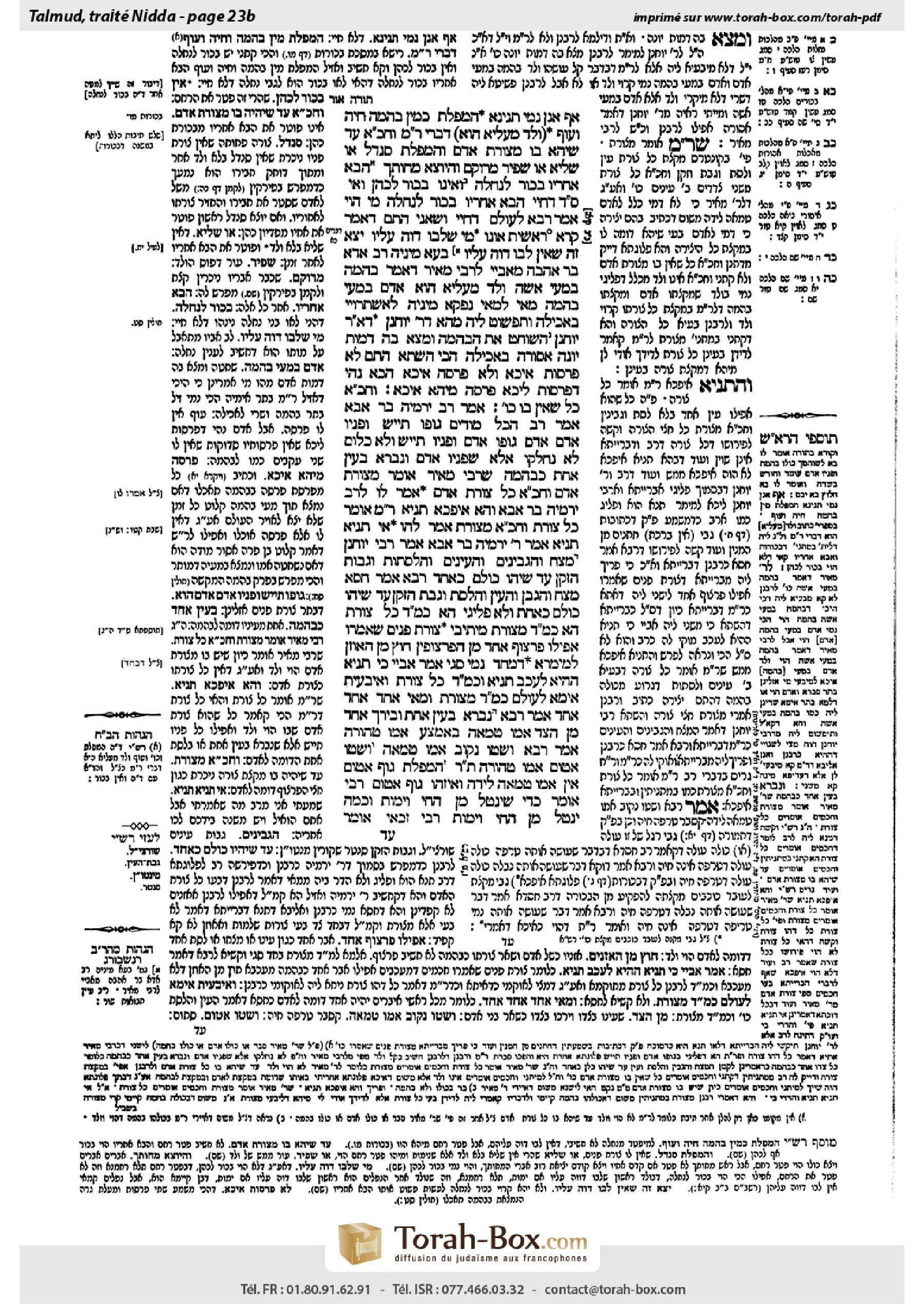
Niddah 23b: Talmud study for Daf Yomi
Daf Yomi is the daily study of one Talmud folio. Explore 37 tractates with scans, Hebrew text, Sefaria English and AI-generated French translations where annotated.
Passage selection and English or AI-generated French translation are available where the scan has annotations. Daf Study is independent of Torah-Box and Sefaria.
Browse Niddah · נידה · All tractatesNiddah 23b text and translations
This page of Niddah includes the Aramaic text, an English translation and an AI-generated French translation, alongside the scan above.
נידה כ״ג ב · Aramaic and Hebrew text
אַף אֲנַן נָמֵי תְּנֵינָא: הַמַּפֶּלֶת כְּמִין בְּהֵמָה חַיָּה וְעוֹף — וָלָד מְעַלְּיָא הוּא, דִּבְרֵי רַבִּי מֵאִיר. וַחֲכָמִים אוֹמְרִים: עַד שֶׁיְּהֵא בּוֹ מִצּוּרַת אָדָם.
וְהַמַּפֶּלֶת סַנְדָּל, אוֹ שִׁלְיָא, אוֹ שָׁפִיר מְרוּקָּם, וְהַיּוֹצֵא מְחוּתָּךְ — הַבָּא אַחֲרָיו בְּכוֹר לְנַחֲלָה, וְאֵינוֹ בְּכוֹר לְכֹהֵן. וְאִי סָלְקָא דַעְתָּךְ דְּחָיֵי, הַבָּא אַחֲרָיו בְּכוֹר לְנַחֲלָה מִי הָוֵי?
אָמַר רָבָא: לְעוֹלָם דְּחָיֵי, וְשָׁאנֵי הָתָם, דְּאָמַר קְרָא: ״רֵאשִׁית אוֹנוֹ״ — מִי שֶׁלִּבּוֹ דָּוֶה עָלָיו, יָצָא זֶה שֶׁאֵין לִבּוֹ דָּוֶה עָלָיו.
בְּעָא מִינֵּיהּ רַב אַדָּא בַּר אַהֲבָה מֵאַבָּיֵי: לְרַבִּי מֵאִיר, דְּאָמַר בְּהֵמָה בִּמְעֵי אִשָּׁה וָלָד מְעַלְּיָא הוּא — אָדָם בִּמְעֵי בְהֵמָה מַאי? לְמַאי נָפְקָא מִינֵּיהּ? לְאִשְׁתְּרוֹיֵי בַּאֲכִילָה.
וְתִפְשׁוֹט לֵיהּ מֵהָא דְּרַבִּי יוֹחָנָן, דְּאָמַר רַבִּי יוֹחָנָן: הַשּׁוֹחֵט אֶת הַבְּהֵמָה וּמָצָא בָּהּ דְּמוּת יוֹנָה — אֲסוּרָה בַּאֲכִילָה!
הָכִי הַשְׁתָּא? הָתָם — לָא פְּרָסוֹת אִיכָּא, וְלָא פַּרְסָה אִיכָּא; הָכָא — נְהִי דִּפְרָסוֹת לֵיכָּא, פַּרְסָה מִיהָא אִיכָּא.
וַחֲכָמִים אוֹמְרִים: כֹּל שֶׁאֵין בּוֹ כּוּ׳. אָמַר רַב יִרְמְיָה בַּר אַבָּא אָמַר רַב: הַכֹּל מוֹדִים: גּוּפוֹ תַּיִישׁ וּפָנָיו אָדָם — אָדָם, גּוּפוֹ אָדָם וּפָנָיו תַּיִישׁ — וְלֹא כְלוּם.
לֹא נֶחְלְקוּ אֶלָּא שֶׁפָּנָיו אָדָם, וְנִבְרָא בְּעַיִן אַחַת כִּבְהֵמָה. שֶׁרַבִּי מֵאִיר אוֹמֵר מִצּוּרַת אָדָם, וַחֲכָמִים אוֹמְרִים כֹּל צוּרַת אָדָם.
(אָמַר לוֹ) [אֲמַרוּ לֵיהּ רַבָּנַן] לְרַב יִרְמְיָה בַּר אַבָּא: וְהָא אִיפְּכָא תַּנְיָא, רַבִּי מֵאִיר אוֹמֵר: ״כֹּל צוּרַת״, וַחֲכָמִים אוֹמְרִים: ״מִצּוּרַת״! אֲמַר לְהוּ: אִי תַּנְיָא — תַּנְיָא.
אָמַר רַבִּי יִרְמְיָה בַּר אַבָּא, אָמַר רַבִּי יוֹחָנָן: מֵצַח, וְהַגְּבִינִים, וְהָעֵינַיִם, וְהַלְּסָתוֹת, וְגַבּוֹת הַזָּקָן — עַד שֶׁיְּהוּ כּוּלָּם כְּאֶחָת. רָבָא אָמַר חַסָּא: מֵצַח, וְהַגָּבִין, וְהָעַיִן, וְהַלֶּסֶת, וְגַבַּת הַזָּקָן — עַד שֶׁיְּהוּ כּוּלָּם כְּאֶחָת.
וְלָא פְלִיגִי: הָא כְּמַאן דְּאָמַר ״כֹּל צוּרַת״, הָא כְּמַאן דְּאָמַר ״מִצּוּרַת״.
מֵיתִיבִי: צוּרַת פָּנִים שֶׁאָמְרוּ — אֲפִילּוּ פַּרְצוּף אֶחָד מִן הַפַּרְצוּפִין, חוּץ מִן הָאוֹזֶן. לְמֵימְרָא דְּמֵחַד נָמֵי סַגִּי?
אֲמַר אַבָּיֵי: כִּי תַּנְיָא הַהִיא לְעַכֵּב תַּנְיָא, וּכְמַאן דְּאָמַר כֹּל צוּרַת, וְאִיבָּעֵית אֵימָא: לְעוֹלָם כְּמַאן דְּאָמַר מִצּוּרַת, וּמַאי ״אֶחָד״ — אֶחָד אֶחָד.
אָמַר רָבָא: נִבְרָא בְּעַיִן אַחַת וּבְיָרֵךְ אֶחָד — מִן הַצַּד, אִמּוֹ טְמֵאָה; בָּאֶמְצַע, אִמּוֹ טְהוֹרָה.
אָמַר רָבָא: וִשְׁטוֹ נָקוּב — אִמּוֹ טְמֵאָה, וִשְׁטוֹ אָטוּם — אִמּוֹ טְהוֹרָה.
תָּנוּ רַבָּנַן: הַמַּפֶּלֶת גּוּף אָטוּם — אֵין אִמּוֹ טְמֵאָה לֵידָה. וְאֵיזֶהוּ גּוּף אָטוּם? רַבִּי אוֹמֵר: כְּדֵי שֶׁיִּנָּטֵל מִן הַחַי וְיָמוּת.
וְכַמָּה יִנָּטֵל מִן הַחַי וְיָמוּת? רַבִּי זַכַּאי אוֹמֵר:
Niddah 23b · English translation
We, too, learn in a mishna (Bekhorot 46a) that the fetus of a woman that has the form of an animal cannot survive: In the case of a woman who had previously discharged a fetus with the appearance similar to that of a domesticated animal, an undomesticated animal, or bird before giving birth to any children, and subsequently she gives birth to a son, the son is considered a firstborn with regard to the halakhot of inheritance, but he does not require redemption, as the fetus is considered a full-fledged offspring in that regard. This is the statement of Rabbi Meir. And the Rabbis say: The son is not exempted from the requirement of redemption from a priest unless it follows the birth of a fetus that takes the form of a person; otherwise, it is not considered the offspring that “opens the womb” (Exodus 13:2), and the son requires redemption as a firstborn.
And in the case of a woman who discharges a fetus in the form of a sandal fish, or from whom an afterbirth or a gestational sac in which tissue developed emerged, or who delivered a fetus that emerged in pieces, the son that follows them is considered a firstborn with regard to inheritance but is not a firstborn with regard to redemption from a priest. The Gemara explains the proof: And if it enters your mind that a fetus that has the form of an animal can survive, is the son that follows it a firstborn with regard to inheritance?
Rava said, in rejection of this proof: Actually, it is possible that a fetus shaped like an animal can survive; but it is different there, with regard to inheritance. The son that follows such a fetus has the status of a firstborn, as the verse states with regard to the inheritance of a firstborn: “By giving him a double portion of all that he has; for he is the first fruits of his strength [ono]; the right of the firstborn is his” (Deuteronomy 21:17). It is derived from the verse that the status of a firstborn applies only to a son over whose death a father would mourn. The word ono is interpreted homiletically based on its similarity to the word onen, acute mourner. This offspring that has the form of an animal is therefore excluded, as its father would not mourn over its death.
§ Rav Adda bar Ahava asked Abaye: According to Rabbi Meir, who said that an item that is similar to an animal in the womb of a woman is considered a full-fledged offspring, what is the halakha with regard to a human fetus in the womb of an animal? The Gemara explains: What is the practical difference of this inquiry? The difference is with regard to permitting the fetus in consumption. A full-fledged fetus found inside its slaughtered mother is permitted to be eaten, despite the fact that it was not slaughtered itself.
The Gemara suggests: But one can resolve the dilemma from that statement of Rabbi Yoḥanan, as Rabbi Yoḥanan said: In the case of one who slaughters an animal and finds in it an item that has the form of a pigeon, the pigeon is prohibited for consumption. Evidently, the ritual slaughter of a pregnant animal renders its fetus permitted to be eaten only if the fetus is of the same species as the mother. Accordingly, if the fetus has the form of a human, it is prohibited for consumption.
The Gemara rejects this suggestion: How can these cases be compared? There, with regard to a pigeon fetus, there are no split hooves, and there is not even a hoof at all. Since a pigeon is completely different from the slaughtered animal, the fetus is forbidden. By contrast, here, in the case of a human fetus, although there are no split hooves, there is at least a hoof, i.e., solid feet. Therefore, it is possible that the human fetus is permitted for consumption, and the dilemma remains unresolved.
§ The mishna teaches: And the Rabbis say: Any discharged entity that is not of human form does not render the woman impure. Rav Yirmeya bar Abba says that Rav says: All concede that if a woman discharged an entity whose body is that of a goat and whose face is that of a human, it is considered a human offspring, i.e., even the Rabbis rule that the woman is impure in this case. Likewise, if its body is that of a human and its face is that of a goat, Rabbi Meir concedes that it is nothing, and the woman is pure.
They disagree only in a case where its face is that of a human, but it was created with one human eye and one eye like that of an animal. As Rabbi Meir says that if the offspring has part of the form of a human face, even if one eye is not like that of a human, it is considered a human offspring, and the woman is impure. And the Rabbis say that it must have the entire form of a human face to be considered a human offspring, and otherwise the woman is not impure.
One of the Sages said to Rav Yirmeya bar Abba: But isn’t the opposite taught in a baraita: Rabbi Meir says that a woman who discharged is impure if the fetus has any part of the form of a human face, and the Rabbis say that the woman is impure only if the fetus has a recognizable part of the form of a human face, e.g., half of a human face? According to this baraita, Rabbi Meir does not even require that a significant part of it must look human. In his opinion, even if it has only one human eye or one human cheek and the rest of the face is like that of an animal, the woman is impure. Rav Yirmeya bar Abba said to the Sages: If this baraita is taught, it is taught, and I cannot take issue with it. I have my tradition from Rav, and you should rule in accordance with the baraita that you received.
Rabbi Yirmeya bar Abba says that Rabbi Yoḥanan says: A woman who discharges an entity is impure only if the entire face of the fetus has a human form. This includes its forehead, and the eyebrows, and the eyes, and the cheeks, and its chin. The woman is not impure unless these facial features all as one have the human form. Rava says that Ḥasa says: It is sufficient for the fetus to have the appearance of a human on one side of its face; its forehead, and one eyebrow, and one eye, and one cheek, and its chin are enough. The woman is not impure unless these facial features all as one have the human form.
And Rabbi Yoḥanan and Ḥasa do not disagree about whether the halakha is in accordance with the opinion of Rabbi Meir or that of the Rabbis, as they both accept the opinion of the Rabbis. The difference between them is that this amora, Rabbi Yoḥanan, holds like the one who says that the Rabbis require the entire form of the face to be human, and that amora, Ḥasa, holds like the one who says that the Rabbis require only a recognizable part of the form of a human face.
Ḥasa evidently interprets the version of the Rabbis’ statement that only part of a human face is required as referring to half of a human face. The Gemara raises an objection to this interpretation from a baraita: The miscarriage of a fetus with the form of a human face, which the Rabbis said renders the woman impure, includes even one of the facial features, apart from the ear. Apparently, that is to say that even if the fetus has only one facial feature of a human, this is also sufficient to render the woman impure.
Abaye says: When that baraita is taught, it is taught with regard to the halakha of rendering all of the facial features indispensable for the fetus to be defined as human, except for the ear. And this ruling is in accordance with the one who says that the Rabbis require that the entire form of the face must be human. And if you wish, say that actually this ruling is in accordance with the one who says that the Rabbis require only a recognizable part of the form of a human face. And what is the meaning of the claim that it is sufficient for the fetus to have one facial feature of a human? It means one of each facial feature of which a human has two, i.e., one eye, one eyebrow, and so on.
Rava says: In a case where a fetus was created with one eye or with one thigh, if the eye is located to the side on the middle of the face, or the thigh is located at the side of the hip, where a human eye or thigh is normally located, the fetus is considered human, and its mother is impure. If it appears in the middle of the face or hip, the fetus is not considered human, and its mother is pure.
Rava says: If its esophagus is punctured, although the fetus is considered a tereifa, i.e., one that has a wound that will cause it to die within twelve months, its mother is impure. But if its esophagus is sealed, i.e., it is closed at one end, it does not have the status of a human fetus, and therefore its mother is pure.
§ The Sages taught in a baraita: In the case of a woman who discharges a fetus that has a sealed body, its mother is not impure with the impurity of a woman after childbirth. And what is a sealed body? Rabbi Yehuda HaNasi says: It is a body which is lacking a limb that when removed from a living person would cause him to die.
And how much of the lower part of a person’s body when removed from a living person would cause him to die, because one cannot survive such a wound? Rabbi Zakkai says:
Niddah 23b · Traduction française (IA)
Nous apprenons également dans une Michna (Bekhorot 46a) que le fœtus d’une femme qui a la forme d’un animal ne peut pas survivre : si une femme a auparavant expulsé un fœtus ayant l’apparence d’un animal domestique, d’un animal sauvage ou d’un oiseau, avant d’avoir mis au monde un enfant, puis donne naissance à un garçon, celui-ci est considéré comme premier-né en matière d’héritage, mais n’a pas besoin d’être racheté, car le fœtus est considéré à cet égard comme un enfant à part entière. Telle est la déclaration de Rabbi Meïr. Les Sages disent : le garçon n’est dispensé de l’obligation de rachat auprès d’un prêtre que si sa naissance est précédée de celle d’un fœtus ayant forme humaine ; dans le cas contraire, ce fœtus n’est pas considéré comme celui qui « ouvre la matrice » (Exode 13:2), et le garçon doit être racheté en tant que premier-né.
Et dans le cas d’une femme qui expulse un fœtus ayant la forme d’un poisson-sandale, ou dont sortent un placenta ou une poche gestationnelle dans laquelle des tissus se sont développés, ou qui met au monde un fœtus en morceaux, le garçon qui naît ensuite est considéré comme premier-né en matière d’héritage, mais pas en matière de rachat auprès d’un prêtre. La Guemara explique la preuve : si tu pensais qu’un fœtus ayant la forme d’un animal peut survivre, le garçon qui naît après lui serait-il considéré comme premier-né en matière d’héritage ?
Rava dit, pour réfuter cette preuve : en réalité, il est possible qu’un fœtus ayant la forme d’un animal puisse survivre ; mais, là-bas, le cas est différent en matière d’héritage. Le garçon qui naît après un tel fœtus a le statut de premier-né, comme le dit le verset au sujet de l’héritage du premier-né : « En lui donnant une double part de tout ce qu’il possède, car il est le premier fruit de sa vigueur [ono] ; le droit d’aînesse lui revient » (Deutéronome 21:17). Le verset enseigne que le statut de premier-né ne s’applique qu’à un fils dont le père serait en deuil s’il mourait. Le mot ono est interprété par homélie en raison de sa ressemblance avec le mot onen, qui désigne une personne en deuil immédiat. Ce fœtus ayant forme animale est donc exclu, car son père ne serait pas en deuil s’il mourait.
§ Rav Adda bar Ahava demanda à Abaye : selon Rabbi Meïr, qui dit qu’un être ressemblant à un animal dans le ventre d’une femme est considéré comme un enfant à part entière, quelle est la halakha concernant un fœtus humain dans le ventre d’un animal ? La Guemara explique : quelle est la conséquence pratique de cette question ? Elle concerne la permission de consommer le fœtus. Un fœtus à part entière trouvé dans sa mère abattue peut être consommé, bien qu’il n’ait pas été abattu lui-même.
La Guemara suggère : mais on peut résoudre le dilemme grâce à cette déclaration de Rabbi Yoḥanan, car Rabbi Yoḥanan a dit : dans le cas de celui qui abat un animal et y trouve un être ayant la forme d’un pigeon, celui-ci est interdit à la consommation. Il apparaît donc que l’abattage rituel d’un animal gestant ne rend son fœtus consommable que si celui-ci appartient à la même espèce que sa mère. Par conséquent, si le fœtus a forme humaine, il est interdit à la consommation.
La Guemara rejette cette suggestion : comment peut-on comparer ces cas ? Là-bas, pour un fœtus ayant la forme d’un pigeon, il n’y a pas de sabots fendus, ni même de sabot. Puisque le pigeon est entièrement différent de l’animal abattu, le fœtus est interdit. En revanche, ici, dans le cas d’un fœtus humain, même s’il n’a pas de sabots fendus, il a au moins un sabot, c’est-à-dire des pieds solides. Il est donc possible que le fœtus humain soit permis à la consommation, et le dilemme reste sans réponse.
§ La Michna enseigne : « Les Sages disent : tout être expulsé qui n’a pas forme humaine ne rend pas la femme impure. » Rav Yirmeya bar Abba dit au nom de Rav : tous reconnaissent que si une femme expulse un être dont le corps est celui d’une chèvre et le visage celui d’un humain, il est considéré comme un enfant humain ; autrement dit, même les Sages statuent que la femme est impure dans ce cas. De même, si son corps est celui d’un humain et son visage celui d’une chèvre, Rabbi Meïr reconnaît qu’il ne vaut rien et que la femme est pure.
Ils ne sont en désaccord que dans le cas où son visage est celui d’un humain, mais où il a été formé avec un œil humain et un œil semblable à celui d’un animal. Rabbi Meïr dit que si le fœtus présente une partie d’un visage humain, même si l’un de ses yeux n’a pas une forme humaine, il est considéré comme un enfant humain et la femme est impure. Les Sages disent qu’il doit avoir un visage entièrement humain pour être considéré comme un enfant humain ; sinon, la femme n’est pas impure.
Un des Sages dit à Rav Yirmeya bar Abba : mais n’enseigne-t-on pas le contraire dans une baraïta ? Rabbi Meïr dit qu’une femme qui a expulsé un fœtus est impure si celui-ci présente une partie quelconque d’un visage humain, tandis que les Sages disent que la femme n’est impure que si le fœtus présente une partie reconnaissable d’un visage humain, par exemple la moitié d’un visage humain. Selon cette baraïta, Rabbi Meïr n’exige même pas qu’une partie importante ait une apparence humaine. Selon lui, même si le fœtus n’a qu’un œil humain ou une joue humaine et que le reste du visage ressemble à celui d’un animal, la femme est impure. Rav Yirmeya bar Abba dit aux Sages : si cette baraïta est enseignée, elle est enseignée, et je ne peux pas la contester. Je tiens ma tradition de Rav, et vous devez statuer conformément à la baraïta que vous avez reçue.
Rabbi Yirmeya bar Abba dit au nom de Rabbi Yoḥanan : une femme qui expulse un être n’est impure que si tout le visage du fœtus a une forme humaine. Cela comprend le front, les sourcils, les yeux, les joues et le menton. La femme n’est impure que si tous ces traits du visage, pris ensemble, ont une forme humaine. Rava dit au nom de Ḥasa : il suffit que le fœtus ait une apparence humaine d’un côté du visage ; son front, un sourcil, un œil, une joue et son menton suffisent. La femme n’est impure que si tous ces traits du visage, pris ensemble, ont une forme humaine.
Rabbi Yoḥanan et Ḥasa ne sont pas en désaccord sur la question de savoir si la halakha suit l’opinion de Rabbi Meïr ou celle des Sages, car tous deux acceptent l’opinion des Sages. Leur désaccord tient au fait que Rabbi Yoḥanan suit celui qui dit que les Sages exigent que le visage ait une forme entièrement humaine, tandis que Ḥasa suit celui qui dit que les Sages n’exigent qu’une partie reconnaissable d’un visage humain.
Ḥasa interprète manifestement la version de la déclaration des Sages selon laquelle une partie seulement d’un visage humain est requise comme désignant la moitié d’un visage humain. La Guemara soulève une objection à cette interprétation à partir d’une baraïta : l’expulsion d’un fœtus ayant la forme d’un visage humain, qui, selon les Sages, rend la femme impure, est également le cas si le fœtus n’en présente qu’un seul des traits, à l’exception de l’oreille. Cela signifie apparemment que si le fœtus n’a qu’un seul trait humain, cela suffit également à rendre la femme impure.
Abaye dit : lorsque cette baraïta est enseignée, elle porte sur la règle selon laquelle tous les traits du visage sont indispensables pour définir le fœtus comme humain, à l’exception de l’oreille. Cette règle suit celui qui dit que les Sages exigent que le visage ait une forme entièrement humaine. Et si tu veux, dis plutôt qu’en réalité cette règle suit celui qui dit que les Sages n’exigent qu’une partie reconnaissable d’un visage humain. Que signifie alors l’affirmation selon laquelle un seul trait humain suffit ? Elle signifie qu’il suffit d’un élément de chacun des traits du visage dont un humain possède deux, c’est-à-dire un œil, un sourcil, et ainsi de suite.
Rava dit : dans le cas d’un fœtus formé avec un seul œil ou une seule cuisse, si l’œil est situé sur le côté du milieu du visage, ou si la cuisse est située sur le côté de la hanche, à l’endroit où se trouve normalement l’œil ou la cuisse d’un humain, le fœtus est considéré comme humain et sa mère est impure. Si l’œil ou la cuisse se trouve au milieu du visage ou de la hanche, le fœtus n’est pas considéré comme humain et sa mère est pure.
Rava dit : si son œsophage est perforé, bien que le fœtus soit considéré comme une tereifa, c’est-à-dire qu’il présente une blessure qui entraînera sa mort dans les douze mois, sa mère est impure. Mais si son œsophage est obstrué, c’est-à-dire fermé à une extrémité, il n’a pas le statut de fœtus humain et sa mère est donc pure.
§ Les Sages ont enseigné dans une baraïta : dans le cas d’une femme qui expulse un fœtus dont le corps est clos, sa mère n’est pas impure de l’impureté d’une femme après l’accouchement. Qu’est-ce qu’un corps clos ? Rabbi Yehouda HaNassi dit : c’est un corps auquel il manque un membre dont l’ablation chez une personne vivante entraînerait sa mort.
Et quelle partie du bas du corps d’une personne, si elle était retirée d’une personne vivante, entraînerait sa mort, car on ne peut survivre à une telle blessure ? Rabbi Zakkaï dit :
Traduction française générée par IA à partir de l’édition anglaise de Sefaria. Vérifie toujours un passage avec le texte source.
Text from Sefaria: William Davidson Edition - Vocalized Aramaic (CC BY NC); William Davidson Edition - English (CC BY NC).