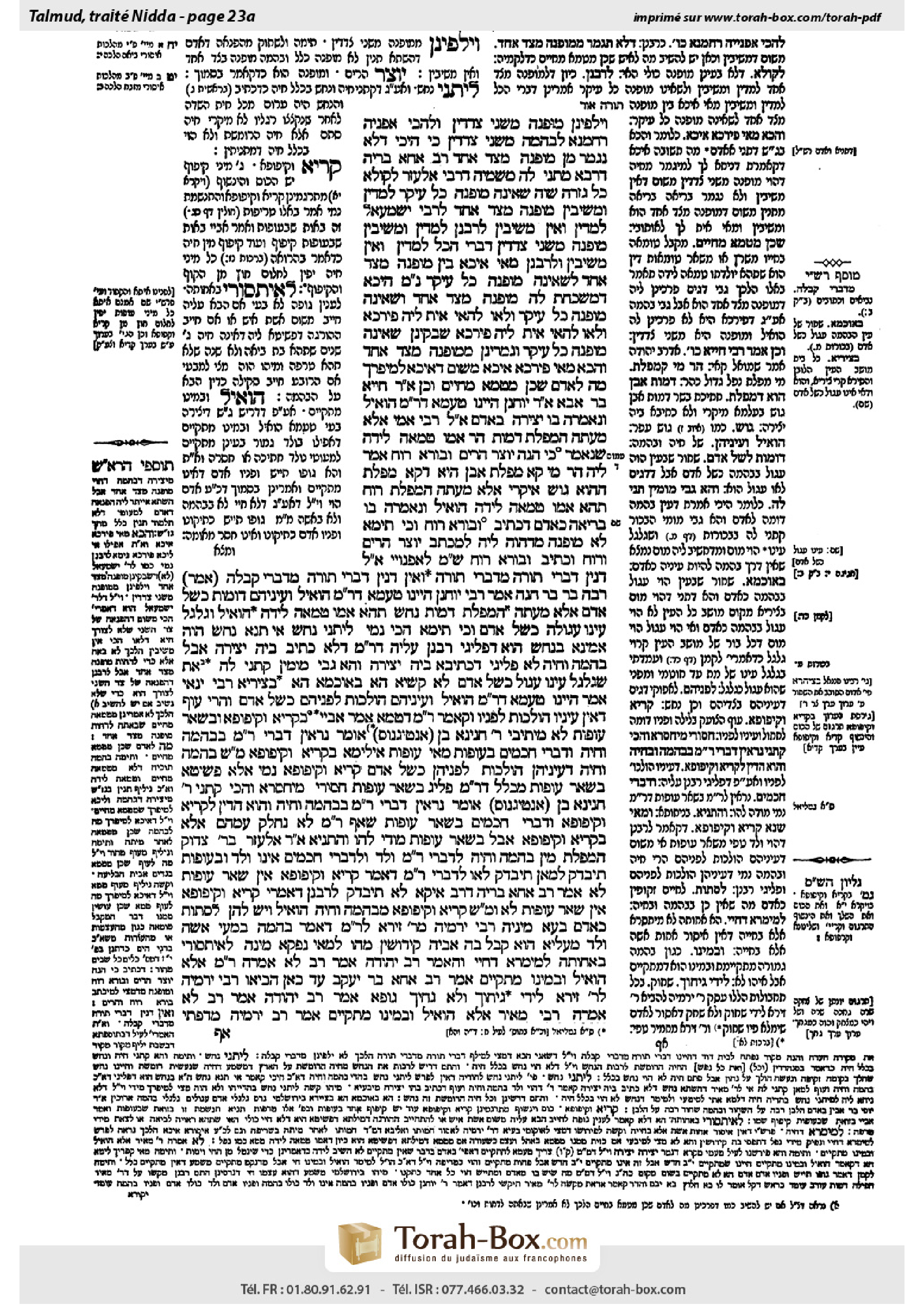
Niddah 23a: Talmud study for Daf Yomi
Daf Yomi is the daily study of one Talmud folio. Explore 37 tractates with scans, Hebrew text, Sefaria English and AI-generated French translations where annotated.
Passage selection and English or AI-generated French translation are available where the scan has annotations. Daf Study is independent of Torah-Box and Sefaria.
Browse Niddah · נידה · All tractatesNiddah 23a text and translations
This page of Niddah includes the Aramaic text, an English translation and an AI-generated French translation, alongside the scan above.
נידה כ״ג א · Aramaic and Hebrew text
וְיָלְפִינַן מוּפְנָה מִשְּׁנֵי צְדָדִין. וּלְהָכִי אַפְנְיֵהּ רַחֲמָנָא לִבְהֵמָה מִשְּׁנֵי צְדָדִין, כִּי הֵיכִי דְּלָא נִגְמַר מִן מוּפְנָה מִצַּד אֶחָד.
רַב אַחָא בְּרֵיהּ דְּרָבָא מַתְנֵי לַהּ מִשְּׁמֵיהּ דְּרַבִּי אֶלְעָזָר לְקוּלָּא: כׇּל גְּזֵרָה שָׁוָה שֶׁאֵינָהּ מוּפְנָה כׇּל עִיקָּר — לְמֵדִין וּמְשִׁיבִין, מוּפְנָה מִצַּד אֶחָד — לְרַבִּי יִשְׁמָעֵאל לְמֵדִין וְאֵין מְשִׁיבִין, לְרַבָּנַן לְמֵדִין וּמְשִׁיבִין, מוּפְנָה מִשְּׁנֵי צְדָדִין — דִּבְרֵי הַכֹּל לְמֵדִין וְאֵין מְשִׁיבִין.
וּלְרַבָּנַן, מַאי אִיכָּא בֵּין מוּפְנָה מִצַּד אֶחָד לְשֶׁאֵינָהּ מוּפְנָה כׇּל עִיקָּר?
נָפְקָא מִינַּהּ הֵיכָא דְּמַשְׁכַּחַתְּ לַהּ מוּפְנָה מִצַּד אֶחָד, וְשֶׁאֵינָהּ מוּפְנָה כׇּל עִיקָּר, וְלָאו לְהַאי אִית לֵיהּ פִּירְכָא, וְלָאו לְהַאי אִית לֵיהּ פִּירְכָא — שָׁבְקִינַן שֶׁאֵינָהּ מוּפְנָה כׇּל עִיקָּר, וְגָמְרִינַן מִמּוּפְנָה מִצַּד אֶחָד.
וְהָכָא, מַאי פִּירְכָא אִיכָּא? מִשּׁוּם דְּאִיכָּא לְמִיפְרַךְ: מָה לְאָדָם, שֶׁכֵּן מִטַּמֵּא מֵחַיִּים.
וְכֵן אָמַר רַבִּי חִיָּיא בַּר אַבָּא אָמַר רַבִּי יוֹחָנָן: הַיְינוּ טַעְמָא דְּרַבִּי מֵאִיר — הוֹאִיל וְנֶאֶמְרָה בּוֹ ״יְצִירָה״ כְּאָדָם.
אֲמַר לֵיהּ רַבִּי אַמֵּי: אֶלָּא מֵעַתָּה הַמַּפֶּלֶת דְּמוּת הַר — אִמּוֹ טְמֵאָה לֵידָה, שֶׁנֶּאֱמַר ״כִּי הִנֵּה יוֹצֵר הָרִים וּבוֹרֵא רוּחַ״? אֲמַר לֵיהּ: הַר מִי קָא מַפְּלָה? אֶבֶן הִיא דְּקָא מַפְּלָה, הָהוּא ״גּוּשׁ״ אִיקְּרִי.
אֶלָּא מֵעַתָּה הַמַּפֶּלֶת רוּחַ — תְּהֵא אִמּוֹ טְמֵאָה לֵידָה, הוֹאִיל וְנֶאֶמְרָה בּוֹ ״בְּרִיאָה״ כְּאָדָם, דִּכְתִיב ״וּבוֹרֵא רוּחַ״? וְכִי תֵימָא לֹא מוּפְנֶה, מִדַּהֲוָה לֵיהּ לְמִכְתַּב ״יוֹצֵר הָרִים וְרוּחַ״, וּכְתִיב ״וּבוֹרֵא רוּחַ״, שְׁמַע מִינַּהּ לְאַפְנוֹיֵי!
אֲמַר לֵיהּ: דָּנִין דִבְרֵי תוֹרָה מִדִּבְרֵי תוֹרָה, וְאֵין דָּנִין דִבְרֵי תוֹרָה מִדִּבְרֵי קַבָּלָה.
(אָמַר) רַבָּה בַּר בַּר חַנָּה, אָמַר רַבִּי יוֹחָנָן: הַיְינוּ טַעְמָא דְּרַבִּי מֵאִיר — הוֹאִיל וְעֵינֵיהֶם דּוֹמוֹת כְּשֶׁל אָדָם.
אֶלָּא מֵעַתָּה, הַמַּפֶּלֶת דְּמוּת נָחָשׁ תְּהֵא אִמּוֹ טְמֵאָה לֵידָה, הוֹאִיל וְגַלְגַּל עֵינוֹ עָגוֹלה כְּשֶׁל אָדָם! וְכִי תֵימָא הָכִי נָמֵי, לִיתְנֵי נָחָשׁ!
אִי תְּנָא נָחָשׁ, הֲוָה אָמֵינָא: בְּנָחָשׁ הוּא דִּפְלִיגִי רַבָּנַן עֲלֵיהּ דְּרַבִּי מֵאִיר, דְּלָא כְּתִיב בֵּיהּ ״יְצִירָה״, אֲבָל בְּהֵמָה וְחַיָּה — לָא פְּלִיגִי, דִּכְתִיבָא (ביה) [בְּיהוּ] ״יְצִירָה״.
וְהָא גַּבֵּי מוּמִין קָתָנֵי לַהּ: אֶת שֶׁגַּלְגַּל עֵינוֹ עָגוֹל כְּשֶׁל אָדָם! לָא קַשְׁיָא — הָא בְּאוּכָּמָא, הָא בְּצִירְיָא.
רַבִּי יַנַּאי אָמַר: הַיְינוּ טַעְמָא דְּרַבִּי מֵאִיר — הוֹאִיל וְעֵינֵיהֶם הוֹלְכוֹת לִפְנֵיהֶם כְּשֶׁל אָדָם. וַהֲרֵי עוֹף, דְּאֵין עֵינָיו הוֹלְכוֹת לְפָנָיו, וְקָאָמַר רַבִּי מֵאִיר דְּטָמֵא! אָמַר אַבָּיֵי: בְּקַרְיָא וְקִיפוֹפָא, וּבִשְׁאָר עוֹפוֹת — לָא.
מֵיתִיבִי: רַבִּי חֲנִינָא בֶּן אַנְטִיגְנוֹס אוֹמֵר: נִרְאִין דִּבְרֵי רַבִּי מֵאִיר בִּבְהֵמָה וְחַיָּה, וְדִבְרֵי חֲכָמִים בְּעוֹפוֹת.
מַאי עוֹפוֹת? אִילֵּימָא בְּקַרְיָא וְקִיפוֹפָא, מַאי שְׁנָא בְּהֵמָה וְחַיָּה דְּעֵינֵיהֶן הוֹלְכוֹת לִפְנֵיהֶן כְּשֶׁל אָדָם? קַרְיָא וְקִיפוֹפָא נָמֵי!
אֶלָּא פְּשִׁיטָא בִּשְׁאָר עוֹפוֹת. מִכְּלָל דְּרַבִּי מֵאִיר פְּלִיג בִּשְׁאָר עוֹפוֹת!
חַסּוֹרֵי מִיחַסְּרָא וְהָכִי קָתָנֵי: רַבִּי חֲנִינָא בֶּן אַנְטִיגְנוֹס אוֹמֵר — נִרְאִין דִּבְרֵי רַבִּי מֵאִיר בִּבְהֵמָה וְחַיָּה, וְהוּא הַדִּין לְקַרְיָא וְקִיפוֹפָא, וְדִבְרֵי חֲכָמִים בִּשְׁאָר עוֹפוֹת, שֶׁאַף רַבִּי מֵאִיר לֹא נֶחְלַק עִמָּהֶם אֶלָּא בְּקַרְיָא וְקִיפוֹפָא, אֲבָל בִּשְׁאָר עוֹפוֹת — מוֹדֵי לְהוּ.
וְהָתַנְיָא: אָמַר רַבִּי אֶלְעָזָר בְּרַבִּי צָדוֹק: הַמַּפֶּלֶת מִין בְּהֵמָה וְחַיָּה, לְדִבְרֵי רַבִּי מֵאִיר — וָלָד, וּלְדִבְרֵי חֲכָמִים — אֵינוֹ וָלָד. בְּעוֹפוֹת — תִּיבָּדֵק.
לְמַאן תִּיבָּדֵק? לָאו לְדִבְרֵי רַבִּי מֵאִיר, דְּאָמַר: קַרְיָא וְקִיפוֹפָא — אִין, שְׁאָר עוֹפוֹת — לָא?
אָמַר רַב אַחָא בְּרֵיהּ דְּרַב אִיקָא: לָא, תִּיבָּדֵק לְרַבָּנַן, דְּאָמְרִי: קַרְיָא וְקִיפוֹפָא — אִין, שְׁאָר עוֹפוֹת — לָא.
וּמַאי שְׁנָא קַרְיָא וְקִיפוֹפָא מִבְּהֵמָה וְחַיָּה? הוֹאִיל וְיֵשׁ לָהֶן לְסָתוֹת כְּאָדָם.
בְּעָא מִינֵּיהּ רַבִּי יִרְמְיָה מֵרַבִּי זֵירָא: לְרַבִּי מֵאִיר דְּאָמַר בְּהֵמָה בִּמְעֵי אִשָּׁה וָלָד מְעַלְּיָא הוּא, קִבֵּל בָּהּ אָבִיהָ קִידּוּשִׁין מַהוּ? לְמַאי נָפְקָא מִינַּהּ? לְאִיתְּסוֹרֵי בַּאֲחוֹתָהּ.
לְמֵימְרָא דְּחָיֵי? וְהָאָמַר רַב יְהוּדָה אָמַר רַב: לֹא אֲמָרָהּ רַבִּי מֵאִיר אֶלָּא הוֹאִיל וּבְמִינוֹ מִתְקַיֵּים! אָמַר רַב אַחָא בַּר יַעֲקֹב: עַד כָּאן הֱבִיאוֹ רַבִּי יִרְמְיָה לְרַבִּי זֵירָא לִידֵי גִּיחוּךְ, וְלֹא גִּחֵיךְ.
גּוּפָא, אָמַר רַב יְהוּדָה אָמַר רַב: לֹא אֲמָרָהּ רַבִּי מֵאִיר אֶלָּא הוֹאִיל וּבְמִינוֹ מִתְקַיֵּים. אָמַר רַב יִרְמְיָה מִדִּפְתִּי:
Niddah 23a · English translation
and derive the halakha from the analogy that is free on both sides. And it is for this reason that the Merciful One rendered the verbal analogy between animal and man free on both sides, so that one would not derive the halakha from the verbal analogy between sea monster and man, which is free on only one side.
Rav Aḥa, son of Rava, teaches in the name of Rabbi Elazar a more lenient version of the aforementioned principle of exegesis of verbal analogy: With regard to any verbal analogy that is not free at all, one can derive halakhot from it, but one can also refute it logically. If the verbal analogy is free on one side, according to Rabbi Yishmael one can derive halakhot from it, and one cannot refute it. According to the Rabbis, one can derive halakhot from it, but one can also refute it. If the verbal analogy is free on both sides, everyone agrees that one can derive halakhot from it and one cannot refute it.
The Gemara asks: But if so, according to the Rabbis, what difference is there between a verbal analogy that is free on one side and one that is not free at all? In both cases, the Rabbis hold that one can derive halakhot from such a verbal analogy but one can also refute it.
The Gemara answers: The difference is in a case where you find two mutually exclusive verbal analogies, one that is free on one side and one that is not free at all, and neither does this one have a logical refutation nor does that one have a logical refutation. In such a case, we disregard the analogy that is not free at all, and we derive the halakha from the one that is free on one side.
The Gemara asks: And here, with regard to the verbal analogy between man and sea monster, which was rejected because it is free on only one side, what logical refutation is there on account of which this verbal analogy is rejected? The Gemara answers: The verbal analogy between man and sea monster is rejected because it can be refuted as follows: What is unique about man? Man is unique in that a person can become impure while he is alive, unlike an animal, which can become impure only after it dies, or a sea monster, which cannot become impure at all.
And likewise, Rabbi Ḥiyya bar Abba said that Rabbi Yoḥanan said: This is the reason for the opinion of Rabbi Meir, that a woman who discharges an item similar to a domesticated animal, an undomesticated animal, or a bird is impure: It is because formation is stated with regard to the creation of these animals, just as it is stated with regard to the creation of man.
Rabbi Ami said to him: If that is so, then in the case of a woman who discharges an item that has the shape of a mountain, its mother should be impure with the impurity of a woman after childbirth, as it is stated with regard to the creation of mountains: “For He Who forms the mountains and creates the wind” (Amos 4:13). Rabbi Ḥiyya bar Abba said to him: Does she discharge a mountain? The discharged item cannot possibly be that large. It is an item with the form of a stone that she discharges, and that is called a clod, not a mountain.
Rabbi Ami further inquired: If that is so, in the case of a woman who discharges an item having an amorphous form [ruaḥ], its mother should be impure with the impurity of a woman after childbirth, since creation is stated with regard to it, just as it is stated with regard to man, as it is written: “And creates the wind [ruaḥ].” And if you would say that no verbal analogy can be drawn here, because the verse is not free, i.e., it is not superfluous, as it is necessary to recount the creation of the wind, that is not so. Rabbi Ami explains: From the fact that the verse could have written: Who forms the mountains and the wind, and instead it is written: “Who forms the mountains and creates the wind,” conclude from it that the superfluous word “creates” serves to render it free for drawing a verbal analogy between ruaḥ and man.
Rabbi Ḥiyya bar Abba said to Rabbi Ami: One derives matters that are stated in the Torah from matters that are stated in the Torah, i.e., from verses in the Torah, but one does not derive matters that are stated in the Torah from the words of the tradition, i.e., verses in the Prophets or the Writings, such as the verse in Amos.
§ Rabba bar bar Ḥana said that Rabbi Yoḥanan said: This is the reason for the opinion of Rabbi Meir: Since the eyes of these animals are similar to those of a human, a woman who discharges an item of that type is impure.
The Gemara objects: If that is so, then in the case of a woman who discharges an item that has the form of a snake, its mother should likewise be impure with the impurity of a woman after childbirth, since the pupil of a snake is round, like that of a human. And if you would say that indeed, this is the halakha, then let the mishna teach this case of a woman who discharges an item that has the form of a snake among the other cases where the woman discharges an item of an unusual form.
The Gemara explains: If the mishna had taught the case of a snake, I would say that it is only in the case of a woman who discharges an item having the form of a snake that the Rabbis disagree with Rabbi Meir and rule that the woman is not impure, as a term of formation is not written with regard to the creation of the snake. But with regard to a woman who discharges an item having the form of a domesticated animal or an undomesticated animal, they do not disagree with Rabbi Meir, as the concept of formation is written with regard to them.
The Gemara raises a difficulty: But with regard to the halakhot of blemishes that render the slaughter of a firstborn animal permitted, it is taught in a mishna (Bekhorot 40a) that an animal whose pupil is round like that of a human is considered blemished. Evidently, the eyes of animals are dissimilar to those of humans. The Gemara answers that it is not difficult; this statement, that the eyes of animals are similar to those of humans, is referring to the pupil, and that statement, that the eyes of animals are not similar to those of humans, is referring to the entire eyeball in the socket.
§ Rabbi Yannai said: This is the reason for the opinion of Rabbi Meir: It is because the eyes of these animals are fixed in the front of their heads like those of a human, unlike the eyes of birds and snakes, a woman who discharges an item of that kind is impure. The Gemara raises a difficulty: But there is the case of a woman who discharges an item similar to a bird, whose eyes are not fixed in the front of its head, and nevertheless Rabbi Meir says that the woman is impure. This apparently contradicts Rabbi Yannai’s explanation. Abaye said: Rabbi Meir is referring to the little owl [bekarya] and the great owl [vekifofa], whose eyes are fixed in the front of their heads, but in the case of a woman who discharges any of the other species of birds, Rabbi Meir does not deem her impure.
The Gemara raises an objection to this answer from a baraita: Rabbi Ḥanina ben Antigonus says: The statement of Rabbi Meir seems correct in the case of a woman who discharges the form of a domesticated animal or an undomesticated animal, and the statement of the Rabbis seems correct in the case of birds.
The Gemara asks: To what birds is Rabbi Ḥanina ben Antigonus referring? If we say he is referring to the little owl and the great owl, what is the difference between this case and the cases of a domesticated animal or an undomesticated animal, with regard to which Rabbi Ḥanina ben Antigonus accepts the opinion of Rabbi Meir? If the key factor is that their eyes are fixed in the front of their heads like those of a human, Rabbi Ḥanina ben Antigonus should accept the opinion of Rabbi Meir in the case of a little owl or a great owl as well, as their eyes are also fixed in the front of their heads.
Rather, it is obvious that when Rabbi Ḥanina ben Antigonus says that he does not accept the opinion of Rabbi Meir, he is referring to the other species of birds. From the fact that it is necessary for Rabbi Ḥanina ben Antigonus to reject Rabbi Meir’s opinion in those cases, it may be concluded that Rabbi Meir himself disagrees with the Rabbis with regard to the other species of birds as well, despite the fact that their eyes are not fixed in the front of their heads.
The Gemara explains that the baraita is incomplete, and this is what it is teaching: Rabbi Ḥanina ben Antigonus says: The statement of Rabbi Meir seems correct in the case of a domesticated animal or an undomesticated animal, and the same is true with regard to a little owl or a great owl. And the statement of the Rabbis appears correct even to Rabbi Meir with regard to the other species of birds. The reason is that even Rabbi Meir agrees that if a woman discharges an item that has the form of one of the other species of birds, she is not impure, i.e., he disagrees with them only with regard to a little owl or a great owl, but he concedes to their opinion with regard to the other species of birds.
The Gemara cites proof for Abaye’s claim that Rabbi Meir differentiates between an owl and other species of birds, as it is taught in a baraita that Rabbi Elazar, son of Rabbi Tzadok, says: In the case of a woman who discharges an item that has the form of a type of domesticated animal or undomesticated animal, according to the statement of Rabbi Meir it has the halakhic status of a full-fledged offspring, and according to the statement of the Rabbis, it does not have the status of a full-fledged offspring. In the case of a woman who discharges an item that has the form of birds, it must be examined.
The Gemara asks: According to whom must it be examined? Is this not referring to the statement of Rabbi Meir, who said that if a woman discharges an item that has the form of a little owl or a great owl, yes, she is impure, but if she discharges an item that has the form of other birds, she is not impure? Consequently, the item must be examined to determine what type of bird it resembles.
Rav Aḥa, son of Rav Ika, said: No, this baraita does not prove that Rabbi Meir differentiates between owls and other species of birds, as perhaps the statement that the discharged item must be examined applies according to the Rabbis, as they say that if a woman discharges an item that has the form of a little owl or a great owl, yes, she is impure, but if a woman discharges an item that has the form of other birds, she is not impure.
The Gemara asks: But if the Rabbis hold that a woman who discharges an item similar to a land animal is not impure, why would they hold that if she discharges an item that has the form of owls she is impure? What is the difference between a little owl and a great owl on the one hand, and a domesticated animal and an undomesticated animal on the other? The Gemara answers: Since owls have cheeks like those of a human, therefore a woman who discharges an item similar to an owl is impure, whereas if she discharges an item that has the form of a land animal she is pure, despite the fact that their eyes are fixed in the front of their heads.
§ Rabbi Yirmeya asked Rabbi Zeira: According to Rabbi Meir, who said that an animal in the womb of a woman is considered a full-fledged offspring, what is the halakha in a case where it is a female, and her father accepted betrothal for her, i.e., he married her off by accepting betrothal money from a man, or a document of betrothal? Is such a betrothal valid? Rabbi Yirmeya elaborated: What practical difference is there whether it is valid? The difference is with regard to whether it is prohibited for the man to marry her sister. If the betrothal is valid, it is prohibited for the husband to marry her sister, as one may not marry his wife’s sister.
The Gemara asks: Is this to say that such an offspring can live? This factor is important, as a man is prohibited from marrying his wife’s sister only during his wife’s lifetime. But doesn’t Rav Yehuda say that Rav says: Rabbi Meir said that a woman who discharges an item that has the form of an animal is impure only since there are other animals of its type that can live, i.e., there are animals similar to the discharged item that do survive, but not that creature itself. Rav Aḥa bar Ya’akov says: Rabbi Yirmeya tried this hard to cause Rabbi Zeira to laugh, but he did not laugh. In other words, Rabbi Yirmeya was not asking his question seriously.
The Gemara discusses the matter itself. Rav Yehuda says that Rav says: Rabbi Meir said that a woman who discharges an item that has the form of an animal is impure only since there are animals of its type that can live. Rav Yirmeya of Difti says:
Niddah 23a · Traduction française (IA)
et déduire la halakha de l’analogie verbale libre des deux côtés. C’est pour cette raison que le Miséricordieux a rendu libre des deux côtés l’analogie verbale entre l’animal et l’homme, afin que l’on ne déduise pas la halakha de l’analogie verbale entre le monstre marin et l’homme, qui n’est libre que d’un seul côté.
Rav Aḥa, fils de Rava, enseigne au nom de Rabbi Elazar une version plus souple du principe d’exégèse de l’analogie verbale mentionné précédemment : pour toute analogie verbale qui n’est libre d’aucun côté, on peut en déduire des halakhot, mais on peut aussi la réfuter par un raisonnement logique. Si l’analogie verbale est libre d’un côté, selon Rabbi Yishmael, on peut en déduire des halakhot et on ne peut pas la réfuter. Selon les Rabbins, on peut en déduire des halakhot, mais on peut aussi la réfuter. Si l’analogie verbale est libre des deux côtés, tous sont d’accord qu’on peut en déduire des halakhot et qu’on ne peut pas la réfuter.
La Guemara demande : Mais alors, selon les Rabbins, quelle différence y a-t-il entre une analogie verbale libre d’un côté et une analogie qui n’est libre d’aucun côté ? Dans les deux cas, les Rabbins estiment qu’on peut déduire des halakhot d’une telle analogie verbale, mais qu’on peut aussi la réfuter.
La Guemara répond : La différence apparaît dans le cas où l’on trouve deux analogies verbales mutuellement exclusives, l’une libre d’un côté et l’autre libre d’aucun côté, et où aucune des deux ne peut être réfutée par un raisonnement logique. Dans ce cas, on écarte l’analogie qui n’est libre d’aucun côté et on déduit la halakha de celle qui est libre d’un côté.
La Guemara demande : Et ici, au sujet de l’analogie verbale entre l’homme et le monstre marin, qui a été rejetée parce qu’elle n’est libre que d’un côté, quelle réfutation logique justifie son rejet ? La Guemara répond : L’analogie verbale entre l’homme et le monstre marin est rejetée parce qu’on peut la réfuter ainsi : Qu’est-ce qui distingue l’homme ? Il se distingue en ce qu’une personne peut devenir impure de son vivant, contrairement à un animal, qui ne peut devenir impur qu’après sa mort, ou à un monstre marin, qui ne peut jamais devenir impur.
De même, Rabbi Ḥiyya bar Abba a dit que Rabbi Yoḥanan a dit : Voici la raison de l’opinion de Rabbi Meir, selon laquelle une femme qui expulse un élément semblable à un animal domestique, à un animal sauvage ou à un oiseau est impure : la formation est mentionnée à propos de la création de ces animaux, tout comme elle l’est à propos de la création de l’homme.
Rabbi Ami lui dit : Si c’est ainsi, dans le cas d’une femme qui expulse un élément ayant la forme d’une montagne, sa mère devrait être impure de l’impureté d’une femme après l’accouchement, puisque la formation des montagnes est mentionnée : « Car Celui qui forme les montagnes et crée le vent » (Amos 4:13). Rabbi Ḥiyya bar Abba lui dit : Expulse-t-elle une montagne ? L’élément expulsé ne peut certainement pas être aussi grand. Elle expulse un élément ayant la forme d’une pierre, que l’on appelle une motte, et non une montagne.
Rabbi Ami demanda encore : Si c’est ainsi, dans le cas d’une femme qui expulse un élément de forme indéfinie [ruaḥ], sa mère devrait être impure de l’impureté d’une femme après l’accouchement, puisque la création est mentionnée à son propos, tout comme elle l’est à propos de l’homme, ainsi qu’il est écrit : « Et crée le vent [ruaḥ]. » Et si l’on disait qu’on ne peut pas établir ici d’analogie verbale, parce que le verset n’est pas libre, c’est-à-dire qu’il n’est pas superflu, puisqu’il est nécessaire de rapporter la création du vent, ce n’est pas le cas. Rabbi Ami explique : Puisque le verset aurait pu dire : « Celui qui forme les montagnes et le vent », mais qu’il dit au contraire : « Celui qui forme les montagnes et crée le vent », déduis-en que le mot superflu « crée » rend possible l’analogie verbale entre ruaḥ et l’homme.
Rabbi Ḥiyya bar Abba dit à Rabbi Ami : On déduit les éléments énoncés dans la Torah à partir d’autres éléments énoncés dans la Torah, c’est-à-dire de versets de la Torah, mais on ne déduit pas les éléments énoncés dans la Torah à partir des paroles de la tradition, c’est-à-dire de versets des Prophètes ou des Écrits, comme le verset d’Amos.
§ Rabba bar bar Ḥana a dit que Rabbi Yoḥanan a dit : Voici la raison de l’opinion de Rabbi Meir : les yeux de ces animaux ressemblent à ceux d’un être humain ; une femme qui expulse un élément de ce type est donc impure.
La Guemara objecte : Si c’est ainsi, dans le cas d’une femme qui expulse un élément ayant la forme d’un serpent, sa mère devrait également être impure de l’impureté d’une femme après l’accouchement, puisque la pupille du serpent est ronde, comme celle d’un être humain. Et si l’on disait que telle est effectivement la halakha, la Michna devrait alors enseigner le cas d’une femme qui expulse un élément ayant la forme d’un serpent parmi les autres cas où une femme expulse un élément de forme inhabituelle.
La Guemara explique : Si la Michna avait enseigné le cas du serpent, j’aurais dit que c’est uniquement dans le cas d’une femme qui expulse un élément ayant la forme d’un serpent que les Rabbins sont en désaccord avec Rabbi Meir et statuent que la femme n’est pas impure, puisqu’aucun terme relatif à la formation n’est employé à propos de la création du serpent. Mais ils ne sont pas en désaccord avec Rabbi Meir au sujet d’une femme qui expulse un élément ayant la forme d’un animal domestique ou d’un animal sauvage, car la notion de formation est mentionnée à leur propos.
La Guemara soulève une difficulté : Mais, au sujet des défauts qui rendent l’abattage d’un animal premier-né permis, une Michna (Bekhorot 40a) enseigne qu’un animal dont la pupille est ronde comme celle d’un être humain est considéré comme porteur d’un défaut. Il ressort donc que les yeux des animaux ne ressemblent pas à ceux des êtres humains. La Guemara répond que ce n’est pas difficile : l’affirmation selon laquelle les yeux des animaux ressemblent à ceux des êtres humains concerne la pupille, tandis que l’affirmation selon laquelle ils ne leur ressemblent pas concerne le globe oculaire entier dans son orbite.
§ Rabbi Yannai a dit : Voici la raison de l’opinion de Rabbi Meir : comme les yeux de ces animaux sont situés à l’avant de leur tête, comme ceux d’un être humain, contrairement aux yeux des oiseaux et des serpents, une femme qui expulse un élément de ce type est impure. La Guemara soulève une difficulté : Mais il y a le cas d’une femme qui expulse un élément semblable à un oiseau, dont les yeux ne sont pas situés à l’avant de la tête, et pourtant Rabbi Meir dit que la femme est impure. Cela semble contredire l’explication de Rabbi Yannai. Abaye dit : Rabbi Meir parle du petit-duc [bekarya] et du grand-duc [vekifofa], dont les yeux sont situés à l’avant de la tête ; mais, dans le cas d’une femme qui expulse un élément semblable à une autre espèce d’oiseau, quelle qu’elle soit, Rabbi Meir ne la considère pas comme impure.
La Guemara soulève une objection à cette réponse à partir d’une baraïta : Rabbi Ḥanina ben Antigonus dit : La position de Rabbi Meir semble juste dans le cas d’une femme qui expulse un élément ayant la forme d’un animal domestique ou d’un animal sauvage, et celle des Rabbins semble juste dans le cas des oiseaux.
La Guemara demande : De quels oiseaux Rabbi Ḥanina ben Antigonus parle-t-il ? Si l’on dit qu’il parle du petit-duc et du grand-duc, quelle différence y a-t-il entre ce cas et ceux de l’animal domestique ou de l’animal sauvage, pour lesquels Rabbi Ḥanina ben Antigonus accepte l’opinion de Rabbi Meir ? Si le facteur déterminant est que leurs yeux sont situés à l’avant de leur tête, comme ceux d’un être humain, Rabbi Ḥanina ben Antigonus devrait aussi accepter l’opinion de Rabbi Meir dans le cas du petit-duc ou du grand-duc, puisque leurs yeux sont également situés à l’avant de leur tête.
Au contraire, il est évident que lorsque Rabbi Ḥanina ben Antigonus dit qu’il n’accepte pas l’opinion de Rabbi Meir, il parle des autres espèces d’oiseaux. Puisqu’il est nécessaire que Rabbi Ḥanina ben Antigonus rejette l’opinion de Rabbi Meir dans ces cas, on peut en conclure que Rabbi Meir lui-même est également en désaccord avec les Rabbins au sujet des autres espèces d’oiseaux, bien que leurs yeux ne soient pas situés à l’avant de la tête.
La Guemara explique que la baraïta est incomplète et qu’elle enseigne ceci : Rabbi Ḥanina ben Antigonus dit : La position de Rabbi Meir semble juste dans le cas d’un animal domestique ou d’un animal sauvage, et il en va de même pour le petit-duc ou le grand-duc. Quant à la position des Rabbins, elle semble juste même aux yeux de Rabbi Meir en ce qui concerne les autres espèces d’oiseaux. En effet, Rabbi Meir lui-même convient que si une femme expulse un élément ayant la forme de l’une des autres espèces d’oiseaux, elle n’est pas impure ; autrement dit, il n’est en désaccord avec eux qu’au sujet du petit-duc ou du grand-duc, mais il admet leur opinion pour les autres espèces d’oiseaux.
La Guemara cite un élément à l’appui de l’affirmation d’Abaye selon laquelle Rabbi Meir établit une distinction entre le hibou et les autres espèces d’oiseaux, car une baraïta enseigne que Rabbi Elazar, fils de Rabbi Tzadok, dit : Dans le cas d’une femme qui expulse un élément ayant la forme d’une espèce d’animal domestique ou d’animal sauvage, selon la position de Rabbi Meir, cet élément a le statut d’un véritable petit, tandis que selon celle des Rabbins, il n’a pas ce statut. Dans le cas d’une femme qui expulse un élément ayant la forme d’un oiseau, il faut l’examiner.
La Guemara demande : Selon qui faut-il procéder à l’examen ? N’est-ce pas une référence à la position de Rabbi Meir, qui a dit que si une femme expulse un élément ayant la forme d’un petit-duc ou d’un grand-duc, elle est impure, mais que si elle expulse un élément ayant la forme d’autres oiseaux, elle n’est pas impure ? Par conséquent, il faut examiner l’élément pour déterminer à quel type d’oiseau il ressemble.
Rav Aḥa, fils de Rav Ika, dit : Non, cette baraïta ne prouve pas que Rabbi Meir distingue les hiboux des autres espèces d’oiseaux, car peut-être l’instruction d’examiner l’élément expulsé s’applique-t-elle selon les Rabbins, qui disent que si une femme expulse un élément ayant la forme d’un petit-duc ou d’un grand-duc, elle est impure, mais que si elle expulse un élément ayant la forme d’autres oiseaux, elle n’est pas impure.
La Guemara demande : Mais si les Rabbins estiment qu’une femme qui expulse un élément semblable à un animal terrestre n’est pas impure, pourquoi estimeraient-ils qu’elle est impure si elle expulse un élément ayant la forme d’un hibou ? Quelle différence y a-t-il entre le petit-duc et le grand-duc, d’une part, et un animal domestique et un animal sauvage, d’autre part ? La Guemara répond : Les hiboux ayant des joues comme celles d’un être humain, une femme qui expulse un élément semblable à un hibou est impure, tandis que si elle expulse un élément ayant la forme d’un animal terrestre, elle est pure, bien que les yeux de ces animaux soient situés à l’avant de leur tête.
§ Rabbi Yirmeya demanda à Rabbi Zeira : Selon Rabbi Meir, qui a dit qu’un animal dans le ventre d’une femme est considéré comme un véritable petit, quelle est la halakha dans le cas où il s’agit d’une femelle et où son père a accepté des kiddouchin pour elle, c’est-à-dire qu’il l’a mariée en acceptant d’un homme de l’argent ou un acte de kiddouchin ? De tels kiddouchin sont-ils valides ? Rabbi Yirmeya précisa : Quelle conséquence pratique y aurait-il à ce qu’ils soient valides ? La conséquence concerne la question de savoir s’il est interdit à l’homme d’épouser la sœur de cette femme. Si les kiddouchin sont valides, il est interdit au mari d’épouser la sœur de sa femme, car on ne peut pas épouser la sœur de son épouse.
La Guemara demande : Cela signifie-t-il qu’un tel petit peut vivre ? Ce facteur est important, car il n’est interdit à un homme d’épouser la sœur de sa femme que du vivant de celle-ci. Mais Rav Yehuda ne dit-il pas que Rav dit : Rabbi Meir a dit qu’une femme qui expulse un élément ayant la forme d’un animal est impure uniquement parce qu’il existe d’autres animaux de la même espèce qui peuvent vivre, c’est-à-dire que des animaux semblables à l’élément expulsé survivent, mais pas cette créature elle-même ? Rav Aḥa bar Ya’akov dit : Rabbi Yirmeya s’est donné tant de peine pour faire rire Rabbi Zeira, mais celui-ci n’a pas ri. Autrement dit, Rabbi Yirmeya ne posait pas sa question sérieusement.
La Guemara examine maintenant le sujet lui-même. Rav Yehuda dit que Rav dit : Rabbi Meir a dit qu’une femme qui expulse un élément ayant la forme d’un animal est impure uniquement parce qu’il existe des animaux de la même espèce qui peuvent vivre. Rav Yirmeya de Difti dit :
Traduction française générée par IA à partir de l’édition anglaise de Sefaria. Vérifie toujours un passage avec le texte source.
Text from Sefaria: William Davidson Edition - Vocalized Aramaic (CC BY NC); William Davidson Edition - English (CC BY NC).