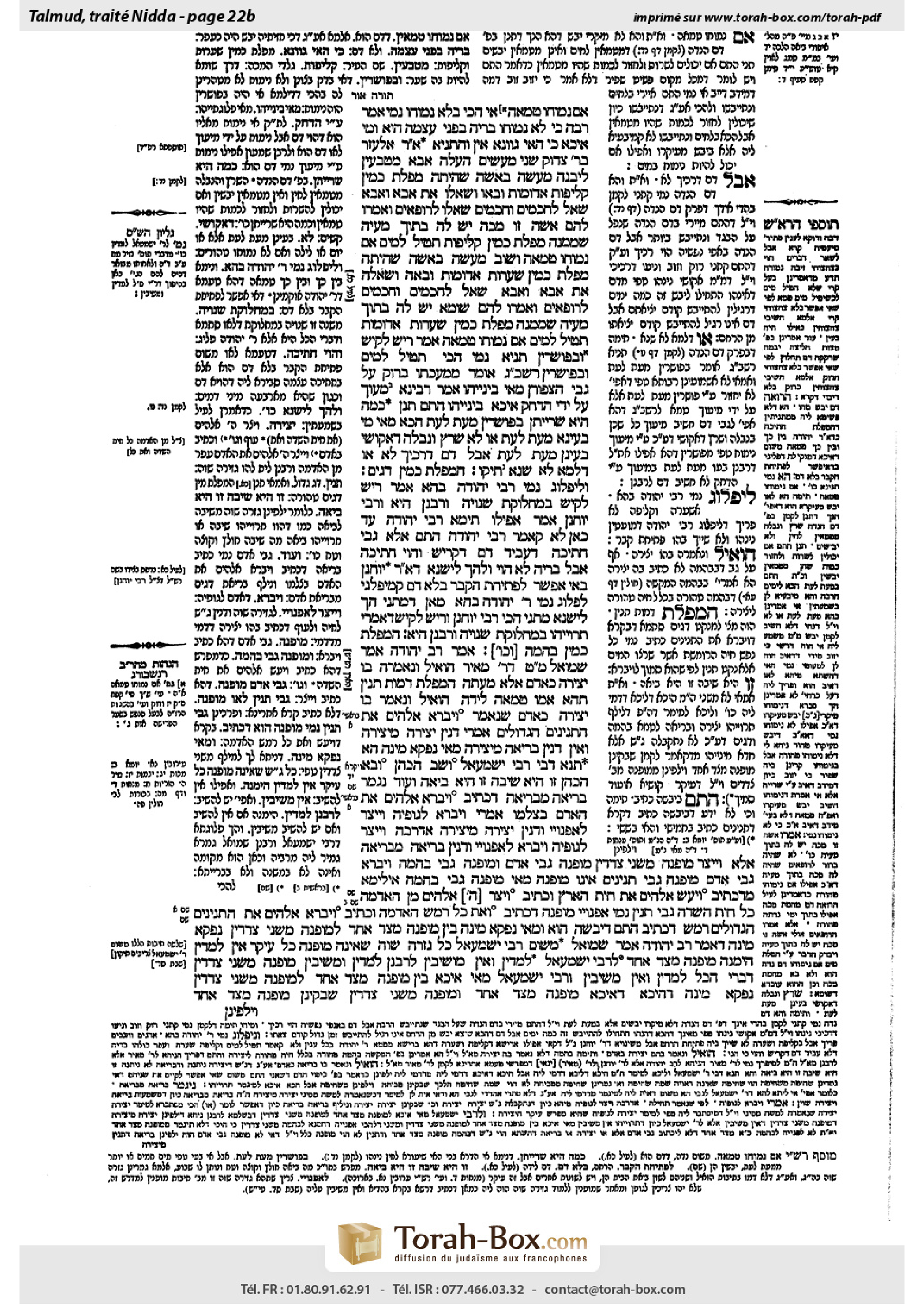
Niddah 22b: Talmud study for Daf Yomi
Daf Yomi is the daily study of one Talmud folio. Explore 37 tractates with scans, Hebrew text, Sefaria English and AI-generated French translations where annotated.
Passage selection and English or AI-generated French translation are available where the scan has annotations. Daf Study is independent of Torah-Box and Sefaria.
Browse Niddah · נידה · All tractatesNiddah 22b text and translations
This page of Niddah includes the Aramaic text, an English translation and an AI-generated French translation, alongside the scan above.
נידה כ״ב ב · Aramaic and Hebrew text
אִם נִמּוֹחוּ טְמֵאָה. אִי הָכִי, בְּלֹא נִמּוֹחוּ נָמֵי? אָמַר רַבָּה: כִּי לֹא נִמּוֹחוּ — בְּרִיָּה בִּפְנֵי עַצְמָהּ הִיא.
וּמִי אִיכָּא כִּי הַאי גַוְונָא? אִין, וְהָתַנְיָא: אָמַר רַבִּי אֶלְעָזָר בְּרַבִּי צָדוֹק: שְׁנֵי מַעֲשִׂים הֶעֱלָה אַבָּא מִטִּבְעִין לְיַבְנֶה.
מַעֲשֶׂה בְּאִשָּׁה שֶׁהָיְתָה מַפֶּלֶת כְּמִין קְלִיפּוֹת אֲדוּמּוֹת, וּבָאוּ וְשָׁאֲלוּ אֶת אַבָּא, וְאַבָּא שָׁאַל לַחֲכָמִים, וַחֲכָמִים שָׁאֲלוּ לָרוֹפְאִים, וְאָמְרוּ לָהֶם: אִשָּׁה זוֹ מַכָּה יֵשׁ לָהּ בְּתוֹךְ מֵעֶיהָ, שֶׁמִּמֶּנָּה מַפֶּלֶת כְּמִין קְלִיפּוֹת. תָּטִיל לַמַּיִם, אִם נִמּוֹחוּ — טְמֵאָה.
וְשׁוּב מַעֲשֶׂה בְּאִשָּׁה שֶׁהָיְתָה מַפֶּלֶת כְּמִין שְׂעָרוֹת אֲדוּמּוֹת, וּבָאָה וְשָׁאֲלָה אֶת אַבָּא, וְאַבָּא שָׁאַל לַחֲכָמִים, וַחֲכָמִים לָרוֹפְאִים, וְאָמְרוּ לָהֶם: שׁוּמָא יֵשׁ לָהּ בְּתוֹךְ מֵעֶיהָ, שֶׁמִּמֶּנָּה מַפֶּלֶת כְּמִין שְׂעָרוֹת אֲדוּמּוֹת. תָּטִיל לַמַּיִם, אִם נִמּוֹחוּ — טְמֵאָה.
אָמַר רֵישׁ לָקִישׁ: וּבְפוֹשְׁרִין. תַּנְיָא נָמֵי הָכִי: תָּטִיל לְמַיִם, וּבְפוֹשְׁרִין. רַבָּן שִׁמְעוֹן בֶּן גַּמְלִיאֵל אוֹמֵר: מְמַעַכְתּוֹ בְּרוֹק עַל גַּבֵּי הַצִּפּוֹרֶן. מַאי בֵּינַיְיהוּ? אָמַר רָבִינָא: מָעוּךְ עַל יְדֵי הַדְּחָק אִיכָּא בֵינַיְיהוּ.
הָתָם תְּנַן: כַּמָּה הִיא שְׁרִיָּיתָן בְּפוֹשְׁרִין? מֵעֵת לְעֵת. הָכָא מַאי? מִי בָּעֵינָא מֵעֵת לְעֵת, אוֹ לָא?
שֶׁרֶץ וּנְבֵלָה, דַּאֲקוֹשֵׁי — בָּעֵינַן מֵעֵת לְעֵת, אֲבָל דַּם דְּרַכִּיךְ — לָא. אוֹ דִלְמָא לָא שְׁנָא? תֵּיקוּ.
הַמַּפֶּלֶת כְּמִין דָּגִים. וְלִיפְלוֹג נָמֵי רַבִּי יְהוּדָה בְּהָא!
אָמַר רֵישׁ לָקִישׁ: בְּמַחְלוֹקֶת שְׁנוּיָה, וְרַבָּנַן הִיא. וְרַבִּי יוֹחָנָן אָמַר: אֲפִילּוּ תֵּימָא רַבִּי יְהוּדָה, עַד כַּאן לָא קָאָמַר רַבִּי יְהוּדָה הָתָם אֶלָּא גַּבֵּי חֲתִיכָה, דְּעָבֵיד דָּם דְּקָרֵישׁ וְהָוֵי חֲתִיכָה, אֲבָל בְּרִיָּה — לָא הָוֵי.
וּלְהָךְ לִישָּׁנָא דְּאָמַר רַבִּי יוֹחָנָן, בְּאִי אֶפְשָׁר לִפְתִיחַת הַקֶּבֶר בְּלֹא דָּם קָמִיפַּלְגִי, לִפְלוֹג נָמֵי רַבִּי יְהוּדָה בְּהָא!
מַאן דְּמַתְנֵי הָךְ לִישָּׁנָא, מַתְנֵי הָכִי: רַבִּי יוֹחָנָן וְרֵישׁ לָקִישׁ, דְּאָמְרִי תַּרְוַיְיהוּ, בְּמַחְלוֹקֶת שְׁנוּיָה, וְרַבָּנַן הִיא.
הַמַּפֶּלֶת כְּמִין בְּהֵמָה [וְכוּ׳].
אָמַר רַב יְהוּדָה אָמַר שְׁמוּאֵל: מַאי טַעְמָא דְּרַבִּי מֵאִיר? הוֹאִיל וְנֶאֶמְרָה בּוֹ יְצִירָה כְּאָדָם.
אֶלָּא מֵעַתָּה, הַמַּפֶּלֶת דְּמוּת תַּנִּין, תְּהֵא אִמּוֹ טְמֵאָה לֵידָה, הוֹאִיל (ונאמר) [וְנֶאֶמְרָה] בּוֹ יְצִירָה כְּאָדָם, שֶׁנֶּאֱמַר: ״וַיִּבְרָא אֱלֹהִים אֶת הַתַּנִּינִים הַגְּדוֹלִים״!
אָמְרִי: דָּנִין יְצִירָה מִיצִירָה, וְאֵין דָּנִין בְּרִיאָה מִיצִירָה.
מַאי נָפְקָא מִינַּהּ? הָא תָּנָא דְּבֵי רַבִּי יִשְׁמָעֵאל: ״וְשָׁב הַכֹּהֵן״ ״וּבָא הַכֹּהֵן״ — זוֹ הִיא שִׁיבָה זוֹ הִיא בִּיאָה!
וְעוֹד, נִגְמַר בְּרִיאָה מִבְּרִיאָה, דִּכְתִיב ״וַיִּבְרָא אֱלֹהִים אֶת הָאָדָם בְּצַלְמוֹ״!
אָמְרִי: ״וַיִּבְרָא״ לְגוּפֵיהּ, ״וַיִּיצֶר״ לְאַפְנוֹיֵי, וְדָנִין יְצִירָה מִיצִירָה.
אַדְּרַבָּה: ״וַיִּיצֶר״ לְגוּפֵיהּ, ״וַיִּבְרָא״ לְאַפְנוֹיֵי, וְדָנִין בְּרִיאָה מִבְּרִיאָה!
אֶלָּא: ״וַיִּיצֶר״ מוּפְנֶה מִשְּׁנֵי צְדָדִין, מוּפְנֶה גַּבֵּי אָדָם וּמוּפְנֶה גַּבֵּי בְּהֵמָה, ״וַיִּבְרָא״ גַּבֵּי אָדָם מוּפְנֶה, גַּבֵּי תַּנִּינִים אֵינוֹ מוּפְנֶה.
מַאי מוּפְנֶה גַּבֵּי בְּהֵמָה? אִילֵּימָא מִדִּכְתִיב ״וַיַּעַשׂ אֱלֹהִים אֶת חַיַּת הָאָרֶץ״, וּכְתִיב ״וַיִּיצֶר [ה׳] אֱלֹהִים מִן הָאֲדָמָה כׇּל חַיַּת הַשָּׂדֶה״, גַּבֵּי תַּנִּין נָמֵי אִפְּנוֹיֵי מוּפְנֶה, דִּכְתִיב ״וְאֵת כׇּל רֶמֶשׂ הָאֲדָמָה״, וּכְתִיב ״וַיִּבְרָא אֱלֹהִים אֶת הַתַּנִּינִים הַגְּדוֹלִים״!
״רֶמֶשׂ״ דִּכְתִיב הָתָם, דְּיַבָּשָׁה הוּא. וּמַאי נָפְקָא מִינַּהּ בֵּין מוּפְנֶה מִצַּד אֶחָד לְמוּפְנֶה מִשְּׁנֵי צְדָדִין?
נָפְקָא מִינַּהּ דְּאָמַר רַב יְהוּדָה אָמַר שְׁמוּאֵל מִשּׁוּם רַבִּי יִשְׁמָעֵאל: כׇּל גְּזֵרָה שָׁוָה שֶׁאֵינָהּ מוּפְנָה כׇּל עִיקָּר — אֵין לְמֵדִין הֵימֶנָּה. מוּפְנָה מִצַּד אֶחָד, לְרַבִּי יִשְׁמָעֵאל — לְמֵדִין וְאֵין מְשִׁיבִין, לְרַבָּנַן — לְמֵדִין וּמְשִׁיבִין. מוּפְנָה מִשְּׁנֵי צְדָדִין, דִּבְרֵי הַכֹּל — לְמֵדִין וְאֵין מְשִׁיבִין.
וְרַבִּי יִשְׁמָעֵאל, מַאי אִיכָּא בֵּין מוּפְנָה מִצַּד אֶחָד לְמוּפְנָה מִשְּׁנֵי צְדָדִין? נָפְקָא מִינַּהּ, דְּהֵיכָא דְּאִיכָּא מוּפְנָה מִצַּד אֶחָד וּמוּפְנָה מִשְּׁנֵי צְדָדִין — שָׁבְקִינַן מוּפְנָה מִצַּד אֶחָד
Niddah 22b · English translation
If they dissolved, it is blood, and the woman is impure; and if not, she is ritually pure. Evidently, dry blood is impure, as these items are all dry until they are soaked in water. The Gemara asks: If so, that dry blood is impure, these items are impure also in a case where they do not dissolve in water. Why is this examination necessary at all? Rabba says: In a case where they do not dissolve, this indicates that the item is not blood at all; rather, it is a distinct entity.
The Gemara asks with regard to these instances discussed in the mishna: But are there actually cases like this? The Gemara answers: Yes there are, and it is taught likewise in a baraita that Rabbi Elazar, son of Rabbi Tzadok, says: My father raised two incidents from Tivin to the Sages in Yavne for discussion.
The first was an incident involving a woman who would repeatedly discharge items similar to red shells, and the local residents came and asked my father whether this rendered the woman impure. And my father asked the other Sages, and the Sages asked the doctors what causes this to happen. And the doctors said to them: This woman has a wound in her womb from which she discharges red items similar to shells. The Sages therefore ruled that the woman should cast them into water to ascertain their nature. If they dissolved, it is blood and the woman is impure.
And again there was a similar incident involving a woman who would discharge items similar to red hairs, and she came and asked my father whether she was impure. And my father asked the other Sages, and the Sages asked the doctors, and the doctors said to them: The woman has a mole in her womb from which she discharges items similar to red hairs. The Sages therefore ruled that the woman should cast them into water, and if they dissolved, she is impure.
§ Reish Lakish says: And this examination is conducted only with lukewarm [uvefoshrin] water. This is also taught in a baraita: The woman should cast the item into water, and this examination is conducted only with lukewarm water. Rabban Shimon ben Gamliel says: The woman mashes the item with saliva, using the fingers of one hand on a fingernail of her other hand. The Gemara asks: What is the difference between the two opinions? Ravina says: The difference between them is whether an item is considered blood if it can be mashed by pressing on it, or only if the item dissolves by itself.
We learned in the mishna there (54b) with regard to an animal carcass or the carcass of a creeping animal that dried up, which is examined by soaking it in water to determine whether or not it still imparts impurity: For how long is its soaking in lukewarm water necessary? It is for a twenty-four-hour period. The Gemara asks: Here, with regard to the examination of an item discharged by a woman, what is the halakha? Do I need it to be soaked in lukewarm water for a twenty-four-hour period, or not?
The Gemara explains the question: Perhaps with regard to a carcass of a creeping animal and an unslaughtered animal carcass, which are hard when they dry up, we require soaking for a twenty-four-hour period, but blood, which is relatively soft after it dries up, does not need to be soaked for that long. In other words, if the item did not dissolve after even a shorter period of time, it is not blood. Or perhaps the examination of a discharged item is no different, and it also must be soaked for twenty-four hours. The Gemara concludes: The dilemma shall stand unresolved.
§ The mishna teaches: In the case of a woman who discharges an item similar to fish or to grasshoppers, repugnant creatures, or creeping animals, if blood emerges with it, the woman is impure, and if not, she is pure. The Gemara asks: But let Rabbi Yehuda disagree with the Rabbis with regard to this halakha as well, just as he disagrees with them in the first clause of the mishna, in the case where a woman discharges an amorphous piece of tissue, as he maintains that she is impure whether or not blood emerges with it.
Reish Lakish says: This case is also subject to the dispute between Rabbi Yehuda and the Rabbis, and the opinion cited in the mishna is that of the Rabbis. And Rabbi Yoḥanan says: You may even say that the ruling of the mishna is in accordance with the opinion of Rabbi Yehuda, as when Rabbi Yehuda says that the woman is impure even if blood does not emerge, it is only there, in the case of an amorphous piece of tissue, as the blood is likely to dry and turn into the form of a piece of tissue. But blood is not likely to become the form of a creature, such as a fish or a grasshopper.
The Gemara challenges: But this is difficult according to that version in which Rabbi Yoḥanan says that Rabbi Yehuda and the Rabbis disagree with regard to whether opening of the womb is impossible without a discharge of blood (see 21b). Since Rabbi Yehuda holds that blood automatically emerges whenever the womb opens, and therefore the woman is impure even if she did not notice any blood, he should disagree with the Rabbis in this case too, i.e., if a woman discharges an item similar to a fish or one of the other creatures.
The Gemara answers: The one who teaches that version of the above discussion teaches an alternative version of Rabbi Yoḥanan’s opinion here as well, like this: With regard to a woman who discharges an item similar to fish, or to grasshoppers, repugnant creatures, or creeping animals, Rabbi Yoḥanan and Reish Lakish both say that this case is subject to a dispute between Rabbi Yehuda and the Rabbis, and the opinion stated in the mishna is that of the Rabbis.
§ The mishna teaches: In the case of a woman who discharges tissue in the form of a type of domesticated animal, undomesticated animal, or bird, whether of a kosher or non-kosher species, if it is male, the woman observes the periods of impurity and purity for a woman who gives birth to a male. If it is female, the woman observes the periods of impurity and purity for a woman who gives birth to a female. And if its sex is unknown, the woman observes the strictures of a woman who gave birth to both a male and a female. This is the statement of Rabbi Meir.
Rav Yehuda says that Shmuel says: What is the reason for the opinion of Rabbi Meir, that a woman who discharges a fetus in the form of an animal has the same status as one who discharges a fetus with human form or gives birth to a human? It is since the Torah uses a similar formulation in the two cases, as a term of formation is stated with regard to the creation of these types of animals, in the verse: “And out of the ground the Lord God formed every animal of the field, and every fowl of the air” (Genesis 2:19), just as it is stated with regard to the creation of man: “And the Lord God formed man” (Genesis 2:7).
The Gemara asks: If that is so, then with regard to a woman who discharges an item with the form of a sea monster, its mother should be impure with the impurity of a woman after childbirth, since the concept of formation is stated with regard to its creation, just as it is stated with regard to the creation of man. As it is stated: “And God created the great sea monsters” (Genesis 1:21).
The Sages say in response: One derives halakhot of a matter with regard to which formation is stated by means of a verbal analogy from another matter with regard to which formation is stated, but one does not derive halakhot of a matter with regard to which creation is stated from a matter with regard to which formation is stated.
The Gemara asks: What difference is there between formation and creation? A verbal analogy can be drawn between different words with similar meanings. For example, the school of Rabbi Yishmael taught a verbal analogy with regard to leprosy of houses. The verse states: “And the priest shall return [veshav] on the seventh day” (Leviticus 14:39), and another verse with regard to the priest’s visit seven days later states: “And the priest shall come [uva] and look” (Leviticus 14:44). This returning and this coming have the same meaning, and one can therefore derive by verbal analogy that the halakha that applies if the leprosy had spread at the conclusion of the first week applies if it had spread again by the end of the following week.
And furthermore, the halakha of a woman who discharges an item similar to a sea monster, with regard to which creation is stated, can be derived by a different verbal analogy from the halakha of human offspring, since here it also states creation, as it is written: “And God created man in His own image” (Genesis 1:27).
The Sages say in response: The verse “And God created man” is necessary to teach the matter itself, i.e., the creation of man. By contrast, the term “And the Lord God formed man,” serves to render it free, i.e., the mention of the formation of man is superfluous in its context and was stated for the purpose of establishing a verbal analogy. And therefore one derives the halakhot of animals, with regard to which formation is stated, from the halakhot of man, with regard to which formation is stated.
The Gemara raises a difficulty: On the contrary, one can say that the verse “And the Lord God formed man” was stated to teach the matter itself, whereas the term “And God created man” serves to render it free; and therefore one derives the halakhot of sea monsters, with regard to which creation is stated, from the halakhot of man, with regard to which creation is stated.
The Gemara answers: Rather, the reason it is animals and not sea monsters that are compared to man is that the term “and…formed” is free on both sides, i.e., it is free with regard to man and it is free with regard to animals. By contrast, the term “and…created” is free with regard to man, but it is not free with regard to sea monsters.
The Gemara asks: What is the reason that the term “and…formed” that appears with regard to animals is considered free? If we say it is due to the fact that it is written: “And God made the animals of the earth after its kind, and the cattle after their kind, and everything that creeps on the ground after its kind” (Genesis 1:25), and it is similarly written: “And out of the ground the Lord God formed every animal of the field” (Genesis 2:19), and therefore this verse is superfluous, but with regard to the sea monster as well, the expression “and…created” is free, as it is written: “And God made…and everything that creeps on the ground after its kind” (Genesis 1:25), and it is also written: “And God created the great sea monsters.” Consequently, the term “and…created” is also free on both sides of the verbal analogy.
The Gemara answers: The creeping animal that is written there is referring to creeping animals of the land, not of the sea. Therefore, the term: “And…created,” stated with regard to sea monsters is not superfluous. The Gemara asks: But what difference is there between a verbal analogy that is free on one side and a verbal analogy that is free on both sides?
The Gemara answers: The difference is with regard to that which Rav Yehuda said that Shmuel says in the name of Rabbi Yishmael, with regard to the exegetical principle of verbal analogy: With regard to any verbal analogy that is not free at all, one cannot derive halakhot from it. If the verbal analogy is free on one side, according to Rabbi Yishmael one can derive halakhot from it, and one cannot refute it through logic, even if there are valid counterarguments. According to the Rabbis, one can derive halakhot from it, but one can also refute it logically if there are grounds to distinguish between the two cases. If a verbal analogy is free on both sides, everyone agrees that one can derive halakhot from it and one cannot refute it logically.
The Gemara asks: And according to Rabbi Yishmael, what difference is there between a verbal analogy that is free on one side and a verbal analogy that is free on both sides? In both cases, he holds that one can derive halakhot from it and one cannot refute it. The Gemara answers: He holds that the difference is that in a case where there are two mutually exclusive verbal analogies, one that is free on one side and one that is free on both sides, we disregard the analogy that is free on one side,
Niddah 22b · Traduction française (IA)
Si elles se sont dissoutes, c’est du sang et la femme est impure ; sinon, elle est rituellement pure. Il ressort de là que le sang sec est impur, puisque tous ces éléments sont secs jusqu’à ce qu’ils soient trempés dans l’eau. La Guemara demande : si le sang sec est impur, ces éléments devraient également être impurs lorsqu’ils ne se dissolvent pas dans l’eau. Pourquoi effectuer cet examen ? Rabba répond : lorsqu’ils ne se dissolvent pas, cela indique que l’élément n’est pas du sang, mais une entité distincte.
La Guemara demande au sujet des cas évoqués dans la Michna : existe-t-il réellement des cas de ce genre ? La Guemara répond : oui, et une baraïta enseigne également que Rabbi Elazar, fils de Rabbi Tzadok, dit : Mon père a soumis à la discussion des Sages de Yavné deux cas survenus à Tivin.
Le premier était le cas d’une femme qui expulsait régulièrement des éléments semblables à des écailles rouges. Les habitants de la localité vinrent demander à mon père si cela rendait la femme impure. Mon père interrogea les autres Sages, qui demandèrent aux médecins quelle en était la cause. Les médecins leur répondirent : Cette femme a une plaie dans l’utérus, d’où elle expulse des éléments rouges semblables à des écailles. Les Sages statuèrent donc que la femme devait les jeter dans l’eau afin d’en déterminer la nature. S’ils se dissolvaient, c’était du sang et la femme était impure.
Un autre cas semblable concernait une femme qui expulsait des éléments semblables à des cheveux rouges. Elle vint demander à mon père si elle était impure. Mon père interrogea les autres Sages, qui interrogèrent les médecins. Ceux-ci leur répondirent : Cette femme a un grain de beauté dans l’utérus, d’où elle expulse des éléments semblables à des cheveux rouges. Les Sages statuèrent donc que la femme devait les jeter dans l’eau ; s’ils se dissolvaient, elle était impure.
§ Reish Lakish dit : Cet examen se fait uniquement avec de l’eau tiède [uvefoshrin]. Une baraïta enseigne également : La femme doit jeter l’élément dans l’eau, et cet examen se fait uniquement avec de l’eau tiède. Rabban Shimon ben Gamliel dit : La femme écrase l’élément avec de la salive, en le pressant avec le doigt d’une main contre un ongle de l’autre main. La Guemara demande : Quelle est la différence entre ces deux avis ? Ravina répond : Ils divergent sur la question de savoir si l’élément est considéré comme du sang dès lors qu’il peut être écrasé par pression, ou seulement s’il se dissout de lui-même.
Nous avons appris dans la Michna, plus loin (54b), au sujet d’une carcasse d’animal ou d’un reptile mort qui a séché et qu’on examine en la faisant tremper dans l’eau pour déterminer si elle transmet encore ou non l’impureté : combien de temps faut-il la faire tremper dans de l’eau tiède ? Vingt-quatre heures. La Guemara demande : ici, pour l’examen d’un élément expulsé par une femme, quelle est la halakha ? Faut-il le faire tremper dans de l’eau tiède pendant vingt-quatre heures, ou non ?
La Guemara explique la question : peut-être faut-il faire tremper pendant vingt-quatre heures la carcasse d’un reptile et celle d’un animal non abattu, car elles deviennent dures en séchant, tandis que le sang, relativement mou après avoir séché, n’a pas besoin de tremper aussi longtemps. Autrement dit, si l’élément ne s’est pas dissous même au bout d’un délai plus court, ce n’est pas du sang. Ou peut-être l’examen d’un élément expulsé n’est-il pas différent et doit-il lui aussi tremper pendant vingt-quatre heures. La Guemara conclut : la question reste sans réponse.
§ La Michna enseigne : dans le cas d’une femme qui expulse un élément semblable à un poisson, à une sauterelle, à une créature répugnante ou à un reptile, si du sang en sort avec lui, la femme est impure, et sinon, elle est pure. La Guemara demande : pourquoi Rabbi Yehuda ne conteste-t-il pas également cette halakha aux Rabbins, comme il le fait dans la première partie de la Michna, au sujet d’une femme qui expulse un morceau de tissu informe ? En effet, il soutient qu’elle est impure, que du sang en sorte ou non.
Reish Lakish dit : ce cas aussi fait l’objet d’un désaccord entre Rabbi Yehuda et les Rabbins, et l’avis cité dans la Michna est celui des Rabbins. Rabbi Yoḥanan dit : on peut même dire que la décision de la Michna est conforme à l’avis de Rabbi Yehuda, car lorsque Rabbi Yehuda dit que la femme est impure même si aucun sang ne sort, cela ne vaut que dans le cas d’un morceau de tissu informe, puisque le sang est susceptible de sécher et de prendre la forme d’un morceau de tissu. En revanche, il est peu probable que le sang prenne la forme d’une créature, telle qu’un poisson ou une sauterelle.
La Guemara objecte : mais cela est difficile selon la version où Rabbi Yoḥanan dit que Rabbi Yehuda et les Rabbins sont en désaccord sur la question de savoir si l’ouverture de l’utérus peut se produire sans écoulement de sang (voir 21b). Puisque Rabbi Yehuda soutient que du sang sort automatiquement chaque fois que l’utérus s’ouvre, et que la femme est donc impure même si elle n’a remarqué aucun sang, il devrait également contester les Rabbins dans ce cas, c’est-à-dire lorsqu’une femme expulse un élément semblable à un poisson ou à l’une des autres créatures.
La Guemara répond : celui qui enseigne cette version de la discussion précédente enseigne également une autre version de l’avis de Rabbi Yoḥanan ici, comme suit : au sujet d’une femme qui expulse un élément semblable à un poisson, à une sauterelle, à une créature répugnante ou à un reptile, Rabbi Yoḥanan et Reish Lakish disent tous deux que ce cas fait l’objet d’un désaccord entre Rabbi Yehuda et les Rabbins, et que l’avis énoncé dans la Michna est celui des Rabbins.
§ La Michna enseigne : dans le cas d’une femme qui expulse du tissu ayant la forme d’un animal domestique, d’un animal sauvage ou d’un oiseau, qu’il s’agisse d’une espèce cachère ou non cachère, si le fœtus est mâle, la femme observe les périodes d’impureté et de pureté applicables à celle qui donne naissance à un garçon. S’il est femelle, elle observe les périodes d’impureté et de pureté applicables à celle qui donne naissance à une fille. Si son sexe est inconnu, elle observe les règles de rigueur applicables à celle qui a donné naissance à la fois à un garçon et à une fille. Telle est la déclaration de Rabbi Meir.
Rav Yehuda dit au nom de Shmuel : quelle est la raison de l’avis de Rabbi Meir, selon lequel une femme qui expulse un fœtus ayant la forme d’un animal a le même statut que celle qui expulse un fœtus de forme humaine ou qui donne naissance à un être humain ? C’est que la Torah emploie une formulation semblable dans les deux cas : un terme signifiant « former » est utilisé pour la création de ces sortes d’animaux, dans le verset : « Et de la terre, le Seigneur Dieu forma tous les animaux des champs et tous les oiseaux du ciel » (Genèse 2:19), tout comme il est utilisé pour la création de l’homme : « Et le Seigneur Dieu forma l’homme » (Genèse 2:7).
La Guemara demande : dans ce cas, la mère d’une femme qui expulse un élément ayant la forme d’un monstre marin devrait être impure de l’impureté d’une femme après l’accouchement, puisque le concept de formation est mentionné à propos de sa création, tout comme il l’est à propos de la création de l’homme. En effet, il est dit : « Et Dieu créa les grands monstres marins » (Genèse 1:21).
Les Sages répondent : on déduit les halakhot d’un sujet au sujet duquel il est question de formation par une analogie verbale avec un autre sujet au sujet duquel il est question de formation ; mais on ne déduit pas les halakhot d’un sujet au sujet duquel il est question de création à partir d’un sujet au sujet duquel il est question de formation.
La Guemara demande : quelle différence y a-t-il entre formation et création ? Une analogie verbale peut être établie entre des mots différents de sens semblable. Par exemple, l’école de Rabbi Yishmael a enseigné une analogie verbale à propos de la lèpre des maisons. Le verset dit : « Et le prêtre reviendra [veshav] le septième jour » (Lévitique 14:39), et un autre verset, à propos de la visite du prêtre sept jours plus tard, dit : « Et le prêtre viendra [uva] et regardera » (Lévitique 14:44). Ce « revenir » et ce « venir » ont le même sens ; on peut donc déduire par analogie verbale que la halakha applicable si la lèpre s’était étendue à la fin de la première semaine s’applique aussi si elle s’était de nouveau étendue à la fin de la semaine suivante.
En outre, la halakha concernant une femme qui expulse un élément semblable à un monstre marin, au sujet duquel il est question de création, peut être déduite par une autre analogie verbale de la halakha concernant la descendance humaine, puisque le terme « création » y figure également, comme il est écrit : « Et Dieu créa l’homme à son image » (Genèse 1:27).
Les Sages répondent : le verset « Et Dieu créa l’homme » est nécessaire pour enseigner la chose elle-même, c’est-à-dire la création de l’homme. En revanche, le terme « Et le Seigneur Dieu forma l’homme » est considéré comme libre, c’est-à-dire que la mention de la formation de l’homme est superflue dans son contexte et a été énoncée afin d’établir une analogie verbale. On déduit donc les halakhot concernant les animaux, au sujet desquels il est question de formation, des halakhot concernant l’homme, au sujet duquel il est également question de formation.
La Guemara soulève une difficulté : au contraire, on peut dire que le verset « Et le Seigneur Dieu forma l’homme » a été énoncé pour enseigner la chose elle-même, tandis que le terme « Et Dieu créa l’homme » est libre ; on déduit donc les halakhot concernant les monstres marins, au sujet desquels il est question de création, des halakhot concernant l’homme, au sujet duquel il est également question de création.
La Guemara répond : la raison pour laquelle ce sont les animaux, et non les monstres marins, qui sont comparés à l’homme est plutôt que le terme « et… forma » est libre des deux côtés, c’est-à-dire qu’il est libre à propos de l’homme et à propos des animaux. En revanche, le terme « et… créa » est libre à propos de l’homme, mais ne l’est pas à propos des monstres marins.
La Guemara demande : pourquoi le terme « et… forma », employé à propos des animaux, est-il considéré comme libre ? Si l’on dit que c’est parce qu’il est écrit : « Et Dieu fit les animaux de la terre selon leur espèce, le bétail selon son espèce, et tout ce qui rampe sur la terre selon son espèce » (Genèse 1:25), et qu’il est également écrit : « Et de la terre, le Seigneur Dieu forma tous les animaux des champs » (Genèse 2:19), de sorte que ce verset est superflu, alors, à propos du monstre marin aussi, l’expression « et… créa » est libre, puisqu’il est écrit : « Et Dieu fit… et tout ce qui rampe sur la terre selon son espèce » (Genèse 1:25), et qu’il est également écrit : « Et Dieu créa les grands monstres marins ». Par conséquent, le terme « et… créa » est lui aussi libre des deux côtés de l’analogie verbale.
La Guemara répond : le reptile mentionné là-bas désigne les reptiles terrestres, et non les animaux rampants de la mer. Le terme « et… créa », employé à propos des monstres marins, n’est donc pas superflu. La Guemara demande : mais quelle différence y a-t-il entre une analogie verbale libre d’un seul côté et une analogie verbale libre des deux côtés ?
La Guemara répond : la différence concerne ce que Rav Yehuda a dit au nom de Shmuel, au nom de Rabbi Yishmael, à propos du principe exégétique de l’analogie verbale : pour toute analogie verbale qui n’est nullement libre, on ne peut en déduire aucune halakha. Si l’analogie verbale est libre d’un côté, selon Rabbi Yishmael on peut en déduire des halakhot et on ne peut pas la réfuter par un raisonnement logique, même s’il existe des objections valables. Selon les Rabbins, on peut en déduire des halakhot, mais on peut aussi la réfuter par un raisonnement logique s’il existe des raisons de distinguer les deux cas. Si une analogie verbale est libre des deux côtés, tous conviennent qu’on peut en déduire des halakhot et qu’on ne peut pas la réfuter par un raisonnement logique.
La Guemara demande : et selon Rabbi Yishmael, quelle différence y a-t-il entre une analogie verbale libre d’un côté et une analogie verbale libre des deux côtés ? Dans les deux cas, il soutient qu’on peut en déduire des halakhot et qu’on ne peut pas la réfuter. La Guemara répond : selon lui, la différence est que, lorsqu’il existe deux analogies verbales mutuellement exclusives, l’une libre d’un côté et l’autre libre des deux côtés, on écarte l’analogie libre d’un seul côté,
Traduction française générée par IA à partir de l’édition anglaise de Sefaria. Vérifie toujours un passage avec le texte source.
Text from Sefaria: William Davidson Edition - Vocalized Aramaic (CC BY NC); William Davidson Edition - English (CC BY NC).