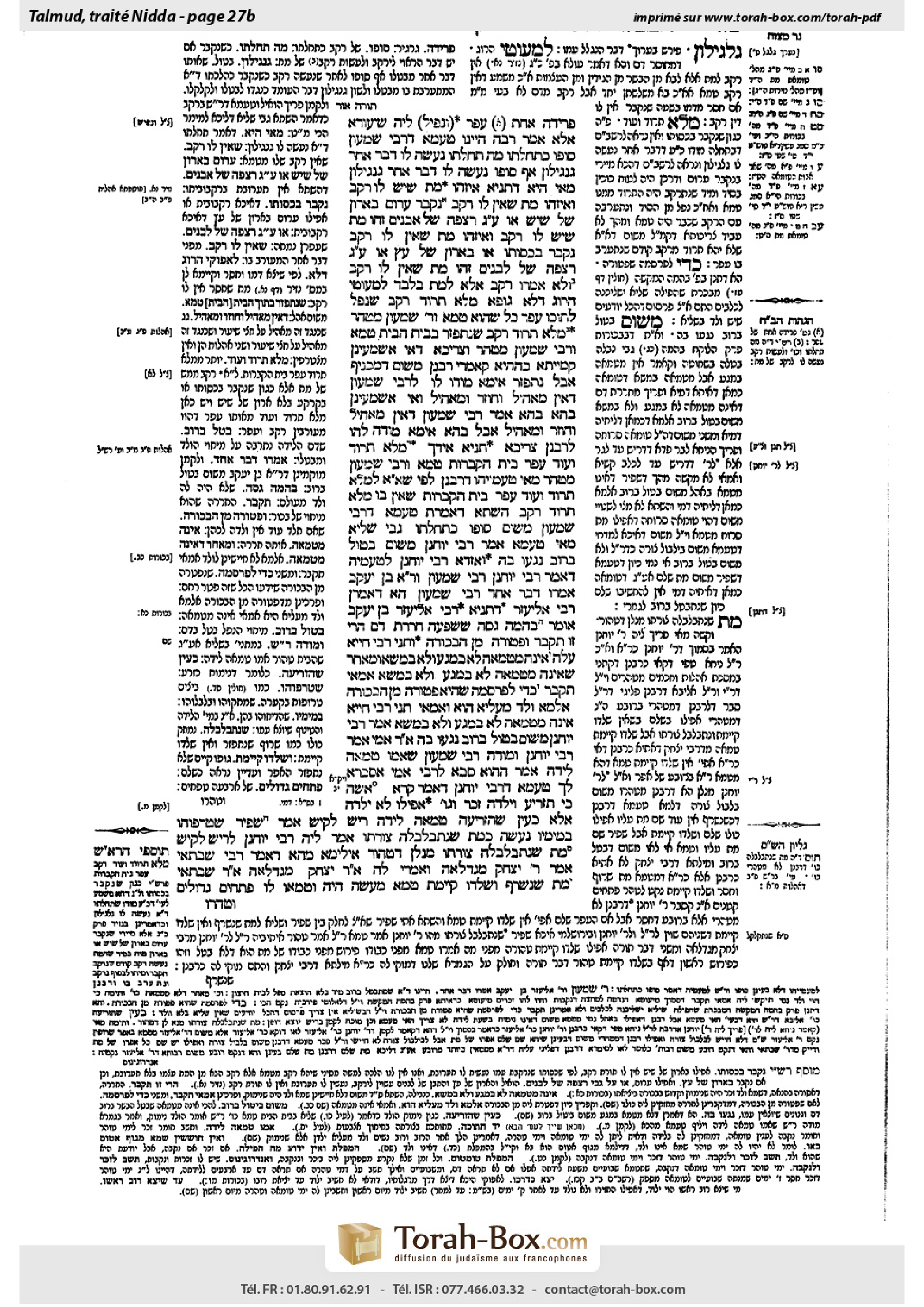
Niddah 27b: Talmud study for Daf Yomi
Daf Yomi is the daily study of one Talmud folio. Explore 37 tractates with scans, Hebrew text, Sefaria English and AI-generated French translations where annotated.
Passage selection and English or AI-generated French translation are available where the scan has annotations. Daf Study is independent of Torah-Box and Sefaria.
Browse Niddah · נידה · All tractatesNiddah 27b text and translations
This page of Niddah includes the Aramaic text, an English translation and an AI-generated French translation, alongside the scan above.
נידה כ״ז ב · Aramaic and Hebrew text
פְּרִידָה אַחַת עָפָר, וְנָפֵיל לֵיהּ שִׁיעוּרָא!
אֶלָּא אָמַר רַבָּה: הַיְינוּ טַעְמָא דְּרַבִּי שִׁמְעוֹן, סוֹפוֹ כִּתְחִלָּתוֹ — מָה תְּחִלָּתוֹ נַעֲשֶׂה לוֹ דָּבָר אַחֵר גַּנְגִּילוֹן, אַף סוֹפוֹ נַעֲשֶׂה לוֹ דָּבָר אַחֵר גַּנְגִּילוֹן.
מַאי הִיא? דְּתַנְיָא: אֵיזֶהוּ מֵת שֶׁיֵּשׁ לוֹ רָקָב, וְאֵיזֶהוּ מֵת שֶׁאֵין לוֹ רָקָב? נִקְבַּר עָרוֹם בְּאָרוֹן שֶׁל שַׁיִשׁ אוֹ עַל גַּבֵּי רִצְפָּה שֶׁל אֲבָנִים — זֶהוּ מֵת שֶׁיֵּשׁ לוֹ רָקָב.
וְאֵיזֶהוּ מֵת שֶׁאֵין לוֹ רָקָב? נִקְבַּר בִּכְסוּתוֹ, אוֹ בְּאָרוֹן שֶׁל עֵץ, אוֹ עַל גַּבֵּי רִצְפָּה שֶׁל לְבֵנִים — זֶהוּ מֵת שֶׁאֵין לוֹ רָקָב. וְלֹא אָמְרוּ רָקָב אֶלָּא לְמֵת בִּלְבַד, לְמַעוֹטֵי הָרוּג דְּלָא.
גּוּפָא: מְלֹא תַּרְוָד רָקָב שֶׁנָּפַל לְתוֹכוֹ עָפָר כֹּל שֶׁהוּא — טָמֵא, וְרַבִּי שִׁמְעוֹן מְטַהֵר. מְלֹא תַּרְוָד רָקָב שֶׁנִּתְפַּזֵּר בַּבַּיִת — הַבַּיִת טָמֵא, וְרַבִּי שִׁמְעוֹן מְטַהֵר.
וּצְרִיכָא, דְּאִי אַשְׁמְעִינַן קַמַּיְיתָא — בְּהַהִיא קָאָמְרִי רַבָּנַן מִשּׁוּם דְּמִכְּנִיף, אֲבָל נִתְפַּזֵּר — אֵימָא מוֹדוּ לֵיהּ לְרַבִּי שִׁמְעוֹן, דְּאֵין מַאֲהִיל וְחוֹזֵר וּמַאֲהִיל.
וְאִי אַשְׁמְעִינַן בְּהָא — בְּהָא אָמַר רַבִּי שִׁמְעוֹן דְּאֵין מַאֲהִיל וְחוֹזֵר וּמַאֲהִיל, אֲבָל בְּהָא — אֵימָא מוֹדֶה לְהוּ לְרַבָּנַן, צְרִיכָא.
תַּנְיָא אִידַּךְ: מְלֹא תַּרְוָד וְעוֹד עֲפַר בֵּית הַקְּבָרוֹת — טָמֵא, וְרַבִּי שִׁמְעוֹן מְטַהֵר. מַאי טַעְמַיְיהוּ דְּרַבָּנַן? לְפִי שֶׁאִי אֶפְשָׁר לִמְלֹא תַּרְוָד וְעוֹד עֲפַר בֵּית הַקְּבָרוֹת שֶׁאֵין בּוֹ מְלֹא תַּרְוָד רָקָב.
הַשְׁתָּא דְּאָמְרַתְּ טַעְמָא דְּרַבִּי שִׁמְעוֹן מִשּׁוּם סוֹפוֹ כִּתְחִלָּתוֹ, גַּבֵּי שִׁלְיָא מַאי טַעְמָא? אָמַר רַבִּי יוֹחָנָן: מִשּׁוּם בִּטּוּל בְּרוֹב נָגְעוּ בָּהּ.
וְאַזְדָּא רַבִּי יוֹחָנָן לְטַעְמֵיהּ, דְּאָמַר רַבִּי יוֹחָנָן: רַבִּי שִׁמְעוֹן וְרַבִּי אֱלִיעֶזֶר בֶּן יַעֲקֹב אָמְרוּ דָּבָר אֶחָד. רַבִּי שִׁמְעוֹן — הָא דַּאֲמַרַן, רַבִּי אֱלִיעֶזֶר — דְּתַנְיָא: רַבִּי אֱלִיעֶזֶר בֶּן יַעֲקֹב אוֹמֵר: בְּהֵמָה גַּסָּה שֶׁשָּׁפְעָה חֲרָרַת דָּם, הֲרֵי זוֹ תִּקָּבֵר, וּפְטוּרָה מִן הַבְּכוֹרָה.
וְתָנֵי רַבִּי חִיָּיא עֲלַהּ: אֵינָהּ מְטַמְּאָה לֹא בְּמַגָּע וְלֹא בְּמַשָּׂא, וּמֵאַחַר שֶׁאֵינָהּ מְטַמְּאָה לֹא בְּמַגָּע וְלֹא בְּמַשָּׂא, אַמַּאי תִּקָּבֵר? כְּדֵי לְפַרְסְמָהּ שֶׁהִיא פְּטוּרָה מִן הַבְּכוֹרָה.
אַלְמָא וָלָד מְעַלְּיָא הוּא, וְאַמַּאי תָּנֵי רַבִּי חִיָּיא: אֵינָהּ מְטַמְּאָה לֹא בְּמַגָּע וְלֹא בְּמַשָּׂא? אָמַר רַבִּי יוֹחָנָן: מִשּׁוּם בִּטּוּל בְּרוֹב נָגְעוּ בָּהּ.
אָמַר רַבִּי אַמֵּי, אָמַר רַבִּי יוֹחָנָן: וּמוֹדֶה רַבִּי שִׁמְעוֹן שֶׁאִמּוֹ טְמֵאָה לֵידָה.
אָמַר הָהוּא סָבָא לְרַבִּי אַמֵּי: אַסְבְּרַהּ לָךְ טַעְמָא דְּרַבִּי יוֹחָנָן, דְּאָמַר קְרָא: ״אִשָּׁה כִּי תַזְרִיעַ וְיָלְדָה זָכָר וְגוֹ׳״, אֲפִילּוּ לֹא יָלְדָה אֶלָּא כְּעֵין שֶׁהִזְרִיעָה — טְמֵאָה לֵידָה.
רֵישׁ לָקִישׁ אָמַר: שָׁפִיר שֶׁטְּרָפוּהוּ בְּמֵימָיו — נַעֲשֶׂה כְּמֵת שֶׁנִּתְבַּלְבְּלָה צוּרָתוֹ.
אֲמַר לֵיהּ רַבִּי יוֹחָנָן לְרֵישׁ לָקִישׁ: מֵת שֶׁנִּתְבַּלְבְּלָה צוּרָתוֹ מְנָלַן דְּטָהוֹר? אִילֵּימָא מֵהָא דְּאָמַר רַבִּי שַׁבְּתַאי אָמַר רַבִּי יִצְחָק מַגְדְּלָאָה, וְאָמְרִי לָהּ אָמַר רַבִּי יִצְחָק מַגְדְּלָאָה אָמַר רַבִּי שַׁבְּתַאי: מֵת שֶׁנִּשְׂרַף וְשִׁלְדּוֹ קַיֶּימֶת טָמֵא, מַעֲשֶׂה הָיָה וְטִמְּאוּ לוֹ פְּתָחִים גְּדוֹלִים
Niddah 27b · English translation
one grain of dirt in a certain place in the mixture. That grain of dirt is thereby nullified by the dust of the corpse, and consequently the measure of the dust increases.
Rather, Rabba said that this is the reason for the opinion of Rabbi Shimon: The halakha with regard to a corpse in its ultimate state of dust is like the halakha in its initial state of decomposition: Just as with regard to its initial state, if another matter is mixed with the decomposing corpse it serves as a nullification [gangilon] of the corpse’s impurity, as the dust of a decomposed corpse can impart impurity only if it is not mingled with the dust of any other substance, so too, in the corpse’s ultimate state of dust, if another matter is mixed with it, that serves as a nullification of the impurity of the dust.
The Gemara asks: What is the source for the halakha that the dust of a corpse imparts impurity only if it is not mingled with the dust of any other substance? The Gemara answers: As it is taught in a baraita: Which is a corpse that has the halakha of dust, i.e., whose dust imparts impurity; and which is a corpse that does not have the halakha of dust? If a corpse was buried naked in a marble coffin or on a stone floor, that is a corpse that has the halakha of dust that imparts impurity. Since any dust found there must have come from the corpse, it imparts impurity.
And what is a corpse that does not have the halakha of dust? If a corpse was buried in its cloak, or in a wooden coffin, or on a brick floor, that is a corpse that does not have the halakha of dust that imparts impurity, as it is assumed that some of the dust is from particles of the clothes, wood, or bricks, and the dust from a decomposed corpse imparts impurity only if it is not mingled with the dust of any other substance. The baraita adds another halakha with regard to the impurity of the dust of a corpse: And the Sages said that the dust of a corpse is impure only with regard to the corpse of a person who died naturally, excluding one who was killed, whose dust is not impure.
§ The Gemara returns to discuss the matter itself, i.e., the baraita cited above that clarifies the opinion of Rabbi Shimon: In the case of a ladleful of dust from a corpse into which any amount of dirt fell, the house is impure; and Rabbi Shimon deems it pure. The baraita continues: In the case of a ladleful of dust from a corpse that was scattered in the house, the house is impure. Provided that there is a sufficient amount of dust in the house, the house is impure, even if the dust is scattered. And Rabbi Shimon deems it pure.
The Gemara comments: And it is necessary for the baraita to state both of these halakhot. As, if the baraita had taught us only the first halakha, with regard to dust from a corpse in which dirt was mixed, one might have thought that it is specifically in that case that the Rabbis say the house is impure, because the dust is concentrated in one place; but if the dust was scattered, one might say that the Rabbis concede to Rabbi Shimon that the house is pure. The reasoning is that if an item overlies a collection of dust of a corpse that is insufficient to render it impure and also overlies another collection of similar size, where together these collections constitute a sufficient amount to render the item and everything under it impure, it is not impure.
And if the baraita had taught us the halakha only with regard to this second case, where the dust of the corpse was scattered, one might have thought that it is specifically in this case that Rabbi Shimon says that the house is pure, as an item that overlies an insufficient collection of the dust of a corpse and also overlies another collection, where together these collections constitute a sufficient amount to render the item impure, is not impure. But in that first case, where dirt was mixed with the dust of the corpse, one might say that Rabbi Shimon concedes to the Rabbis that the house is impure. Therefore, it is necessary for the baraita to teach both cases.
There is a different dispute between Rabbi Shimon and the Rabbis that is taught in another mishna (Oholot 2:2): If a house contains a ladleful of dirt from a cemetery and slightly more, the house is impure; and Rabbi Shimon deems it pure. The Gemara asks: What is the reason for the opinion of the Rabbis? The Gemara answers: They deem the house impure as it is impossible for slightly more than a ladleful of dirt from a cemetery not to contain a ladleful of dust from a corpse.
§ The Gemara asks: Now that you say that the reason that Rabbi Shimon deems the house pure, in a case where it contains dust from a corpse in which dirt was mixed, is that in his opinion the halakha of a corpse in its ultimate state of dust is like the halakha in its initial state of decomposition, then with regard to a case where there is an afterbirth in the house, what is the reason that Rabbi Shimon deems the house pure? Rabbi Yoḥanan says: The Sages touched upon it, i.e., deemed the house pure, due to the nullification of the disintegrated offspring by the majority of the blood that emerged during the miscarriage, in which the afterbirth was mixed.
And Rabbi Yoḥanan follows his line of reasoning in this regard, as Rabbi Yoḥanan says: Rabbi Shimon and Rabbi Eliezer ben Ya’akov both said the same thing, i.e., they both issued rulings based on the same principle. The relevant statement of Rabbi Shimon is that which we said, i.e., that if a woman discharged an afterbirth the house is pure, as the offspring is nullified by the blood that emerged during the miscarriage. Rabbi Eliezer ben Ya’akov said that which is taught in a mishna (Bekhorot 21a): Rabbi Eliezer ben Ya’akov says: In the case of a large animal that expelled a mass of congealed blood, that mass must be buried, as perhaps there was a male fetus there, which was consecrated as a firstborn when it emerged, and the animal is exempt from having any future offspring being counted a firstborn.
And Rabbi Ḥiyya teaches a baraita with regard to that halakha: The mass of congealed blood does not impart ritual impurity, neither through physical contact nor through carrying it. It does not have the status of an unslaughtered animal carcass, which does impart impurity in such manners. The Gemara asks: But since the mass does not impart impurity, neither through contact nor through carrying, which indicates that it is not considered a fetus, why must it be buried? The Gemara answers: It must be buried in order to publicize that the animal is exempt from having its future offspring being counted a firstborn.
The Gemara asks: If the animal’s subsequent offspring is not counted a firstborn, evidently the mass is treated like a full-fledged offspring. But if so, why does Rabbi Ḥiyya teach that it does not impart impurity, neither through physical contact nor through carrying? Rabbi Yoḥanan says: It is due to the halakhic nullification of a foreign substance in a majority of permitted substances that the Sages touched upon it, to exclude it from impurity through contact or carrying. In other words, the fetus is considered a full-fledged offspring, but it does not impart impurity, because it is nullified by the rest of the congealed mass.
§ The Gemara resumes its discussion of the opinion of Rabbi Shimon that if a woman discharges an afterbirth in a house, the house is pure. Rabbi Ami says that Rabbi Yoḥanan says: And Rabbi Shimon concedes that its mother is impure with the impurity of a woman after childbirth.
A certain elder said to Rabbi Ami: I will explain to you the reason for the statement of Rabbi Yoḥanan. As the verse states: “If a woman bears seed and gives birth to a male, she shall be impure seven days, as in the days of the menstruation of her sickness she shall be impure” (Leviticus 12:2). This indicates that even if a woman gives birth to an offspring that is similar only to the seed that she bore, i.e., if the offspring liquefied and became similar to semen, the woman is impure with the impurity of a woman after childbirth.
§ Reish Lakish says: In the case of a fetus in a gestational sac, that was mashed in its amniotic fluid by being shaken violently, it is rendered like a corpse that was deformed, and therefore it does not impart impurity to other items that are under the same roof.
Rabbi Yoḥanan said to Reish Lakish: From where do we derive that a corpse that was deformed is pure? If we say it is derived from that which Rabbi Shabbtai says that Rabbi Yitzḥak from Migdal [Migdala’a] says, and some say from that which Rabbi Yitzḥak from Migdal says that Rabbi Shabbtai says, that cannot be correct. The Gemara cites the relevant statement: With regard to a corpse that was burned but its form [veshildo] still exists, i.e., it still has the form of a human corpse, it is impure. There was an incident involving such a corpse, and the Sages deemed impure all items that were under the large openings of the house where the corpse was located, as these openings were fit for the removal of the corpse from the house through them.
Niddah 27b · Traduction française (IA)
un grain de terre à un endroit donné du mélange. Ce grain de terre est ainsi annulé par la poussière du cadavre et, par conséquent, la quantité de poussière augmente.
Rabba dit plutôt que telle est la raison de l’opinion de Rabbi Shimon : la halakha concernant un cadavre réduit à l’état ultime de poussière est la même que celle qui s’applique à son état initial de décomposition. De même qu’à l’état initial, si une autre substance est mêlée au cadavre en décomposition, elle entraîne l’annulation de son impureté [gangilon] — car la poussière d’un cadavre décomposé ne peut transmettre l’impureté que si elle n’est mêlée à la poussière d’aucune autre substance —, de même, lorsque le cadavre est réduit à l’état ultime de poussière, si une autre substance y est mêlée, elle entraîne l’annulation de l’impureté de la poussière.
La Guemara demande : Quelle est la source de la halakha selon laquelle la poussière d’un cadavre ne transmet l’impureté que si elle n’est mêlée à la poussière d’aucune autre substance ? La Guemara répond : Comme il est enseigné dans une baraïta : Quel cadavre relève de la halakha de la poussière, c’est-à-dire dont la poussière transmet l’impureté, et quel cadavre n’en relève pas ? Si un cadavre a été enterré nu dans un cercueil de marbre ou sur un sol de pierre, il relève de la halakha de la poussière qui transmet l’impureté. Puisque toute poussière qui s’y trouve doit provenir du cadavre, elle transmet l’impureté.
Et quel cadavre ne relève pas de la halakha de la poussière ? Si un cadavre a été enterré dans son linceul, dans un cercueil de bois ou sur un sol de briques, il ne relève pas de la halakha de la poussière qui transmet l’impureté, car on suppose qu’une partie de la poussière provient de particules de tissu, de bois ou de briques ; or la poussière d’un cadavre décomposé ne transmet l’impureté que si elle n’est mêlée à la poussière d’aucune autre substance. La baraïta ajoute une autre halakha concernant l’impureté de la poussière d’un cadavre : les Sages ont dit que la poussière d’un cadavre est impure uniquement s’il s’agit d’une personne morte naturellement ; cela exclut une personne qui a été tuée, dont la poussière n’est pas impure.
§ La Guemara revient sur le sujet lui-même, c’est-à-dire sur la baraïta citée plus haut, qui précise l’opinion de Rabbi Shimon : dans le cas d’une pleine louche de poussière provenant d’un cadavre, dans laquelle est tombée une quantité quelconque de terre, la maison est impure ; Rabbi Shimon la déclare pure. La baraïta poursuit : dans le cas d’une pleine louche de poussière provenant d’un cadavre, dispersée dans la maison, celle-ci est impure. Pourvu qu’il y ait dans la maison une quantité suffisante de poussière, elle est impure, même si la poussière est dispersée. Rabbi Shimon la déclare pure.
La Guemara fait remarquer que la baraïta devait enseigner ces deux halakhot. En effet, si elle nous avait enseigné seulement la première halakha, concernant de la poussière provenant d’un cadavre mêlée à de la terre, on aurait pu penser que les Rabbins déclarent la maison impure précisément dans ce cas, parce que la poussière est concentrée en un seul endroit ; mais si la poussière était dispersée, on aurait pu dire que les Rabbins concèdent à Rabbi Shimon que la maison est pure. La raison est que si un objet se trouve au-dessus d’un amas de poussière de cadavre insuffisant pour le rendre impur, et aussi au-dessus d’un autre amas de taille semblable, ces amas constituant ensemble une quantité suffisante pour rendre l’objet et tout ce qui se trouve au-dessous de lui impurs, l’objet n’est pas impur.
Et si la baraïta nous avait enseigné la halakha uniquement pour ce second cas, où la poussière du cadavre était dispersée, on aurait pu penser que Rabbi Shimon déclare la maison pure précisément dans ce cas, car un objet qui se trouve au-dessus d’un amas de poussière de cadavre insuffisant, et aussi au-dessus d’un autre amas, ces deux amas constituant ensemble une quantité suffisante pour rendre l’objet impur, n’est pas impur. Mais dans le premier cas, où de la terre était mêlée à la poussière du cadavre, on aurait pu dire que Rabbi Shimon concède aux Rabbins que la maison est impure. La baraïta devait donc enseigner les deux cas.
Il existe un autre désaccord entre Rabbi Shimon et les Rabbins, enseigné dans une autre Michna (Oholot 2:2) : si une maison contient une pleine louche de terre provenant d’un cimetière, et un peu plus, la maison est impure ; Rabbi Shimon la déclare pure. La Guemara demande : Quelle est la raison de l’opinion des Rabbins ? La Guemara répond : Ils déclarent la maison impure, car il est impossible qu’un peu plus d’une pleine louche de terre provenant d’un cimetière ne contienne pas une pleine louche de poussière de cadavre.
§ La Guemara demande : Puisque tu dis maintenant que Rabbi Shimon déclare pure une maison contenant de la poussière de cadavre mêlée à de la terre parce qu’à son avis la halakha concernant un cadavre réduit à l’état ultime de poussière est la même que celle qui s’applique à son état initial de décomposition, alors, dans le cas où il y a un placenta dans la maison, pourquoi Rabbi Shimon la déclare-t-il pure ? Rabbi Yoḥanan dit : Les Sages ont évoqué ce cas, c’est-à-dire qu’ils ont déclaré la maison pure, parce que le fœtus désintégré est annulé par la majorité du sang écoulé lors de la fausse couche, auquel le placenta était mêlé.
Et Rabbi Yoḥanan suit son raisonnement à cet égard, car il dit : Rabbi Shimon et Rabbi Eliezer ben Ya’akov ont dit la même chose, c’est-à-dire qu’ils ont tous deux rendu une décision fondée sur le même principe. La déclaration pertinente de Rabbi Shimon est celle que nous avons mentionnée : si une femme expulse un placenta, la maison est pure, car le fœtus est annulé par le sang écoulé lors de la fausse couche. Rabbi Eliezer ben Ya’akov a dit ce qui est enseigné dans une Michna (Bekhorot 21a) : « Rabbi Eliezer ben Ya’akov dit : Dans le cas d’un grand animal qui a expulsé une masse de sang coagulé, cette masse doit être enterrée, car il se peut qu’elle ait contenu un fœtus mâle, qui aurait été consacré comme premier-né au moment de son expulsion ; l’animal est alors exempt de l’obligation de faire compter comme premier-né l’un de ses futurs petits. »
Et Rabbi Ḥiyya enseigne une baraïta concernant cette halakha : la masse de sang coagulé ne transmet pas l’impureté rituelle, ni par contact ni par portage. Elle n’a pas le statut d’une carcasse d’animal non abattu, qui transmet l’impureté de ces deux manières. La Guemara demande : Mais puisque la masse ne transmet l’impureté ni par contact ni par portage, ce qui indique qu’elle n’est pas considérée comme un fœtus, pourquoi faut-il l’enterrer ? La Guemara répond : Il faut l’enterrer afin de faire savoir que l’animal est exempt de l’obligation de faire compter comme premier-né ses futurs petits.
La Guemara demande : Si le petit que l’animal mettra au monde par la suite ne compte pas comme premier-né, cela montre manifestement que la masse est traitée comme un petit à part entière. Mais si tel est le cas, pourquoi Rabbi Ḥiyya enseigne-t-il qu’elle ne transmet l’impureté ni par contact ni par portage ? Rabbi Yoḥanan dit : Les Sages ont évoqué ce cas en raison de l’annulation halakhique d’une substance étrangère par une majorité de substances permises, afin de l’exclure de l’impureté par contact ou par portage. Autrement dit, le fœtus est considéré comme un petit à part entière, mais il ne transmet pas l’impureté, car il est annulé par le reste de la masse de sang coagulé.
§ La Guemara reprend la discussion de l’opinion de Rabbi Shimon, selon laquelle, si une femme expulse un placenta dans une maison, celle-ci est pure. Rabbi Ami dit au nom de Rabbi Yoḥanan : Rabbi Shimon reconnaît que la mère est impure de l’impureté d’une femme après l’accouchement.
Un certain ancien dit à Rabbi Ami : Je vais t’expliquer la raison de la déclaration de Rabbi Yoḥanan. Le verset dit en effet : « Si une femme conçoit et enfante un garçon, elle sera impure pendant sept jours ; elle sera impure comme aux jours de l’impureté de ses règles » (Lévitique 12:2). Cela indique que même si une femme donne naissance à un petit qui ressemble seulement à la semence qu’elle a conçue, c’est-à-dire si le petit s’est liquéfié et est devenu semblable à du sperme, la femme est impure de l’impureté d’une femme après l’accouchement.
§ Reish Lakish dit : Dans le cas d’un fœtus dans une poche gestationnelle, broyé dans son liquide amniotique sous l’effet de violentes secousses, il est assimilé à un cadavre déformé et ne transmet donc pas l’impureté aux autres objets qui se trouvent sous le même toit.
Rabbi Yoḥanan dit à Reish Lakish : D’où déduisons-nous qu’un cadavre déformé est pur ? Si l’on dit que cela se déduit de ce que Rabbi Shabbtai dit au nom de Rabbi Yitzḥak de Migdal [Migdala’a] — et certains disent que cela se déduit de ce que Rabbi Yitzḥak de Migdal dit au nom de Rabbi Shabbtai —, cela ne peut être juste. La Guemara cite la déclaration pertinente : à propos d’un cadavre qui a été brûlé, mais dont la forme [veshildo] subsiste, c’est-à-dire qui conserve la forme d’un cadavre humain, il est impur. Il y eut un cas de ce genre, et les Sages déclarèrent impurs tous les objets qui se trouvaient sous les grandes ouvertures de la maison où se trouvait le cadavre, car celles-ci permettaient de le faire sortir de la maison.
Traduction française générée par IA à partir de l’édition anglaise de Sefaria. Vérifie toujours un passage avec le texte source.
Text from Sefaria: William Davidson Edition - Vocalized Aramaic (CC BY NC); William Davidson Edition - English (CC BY NC).