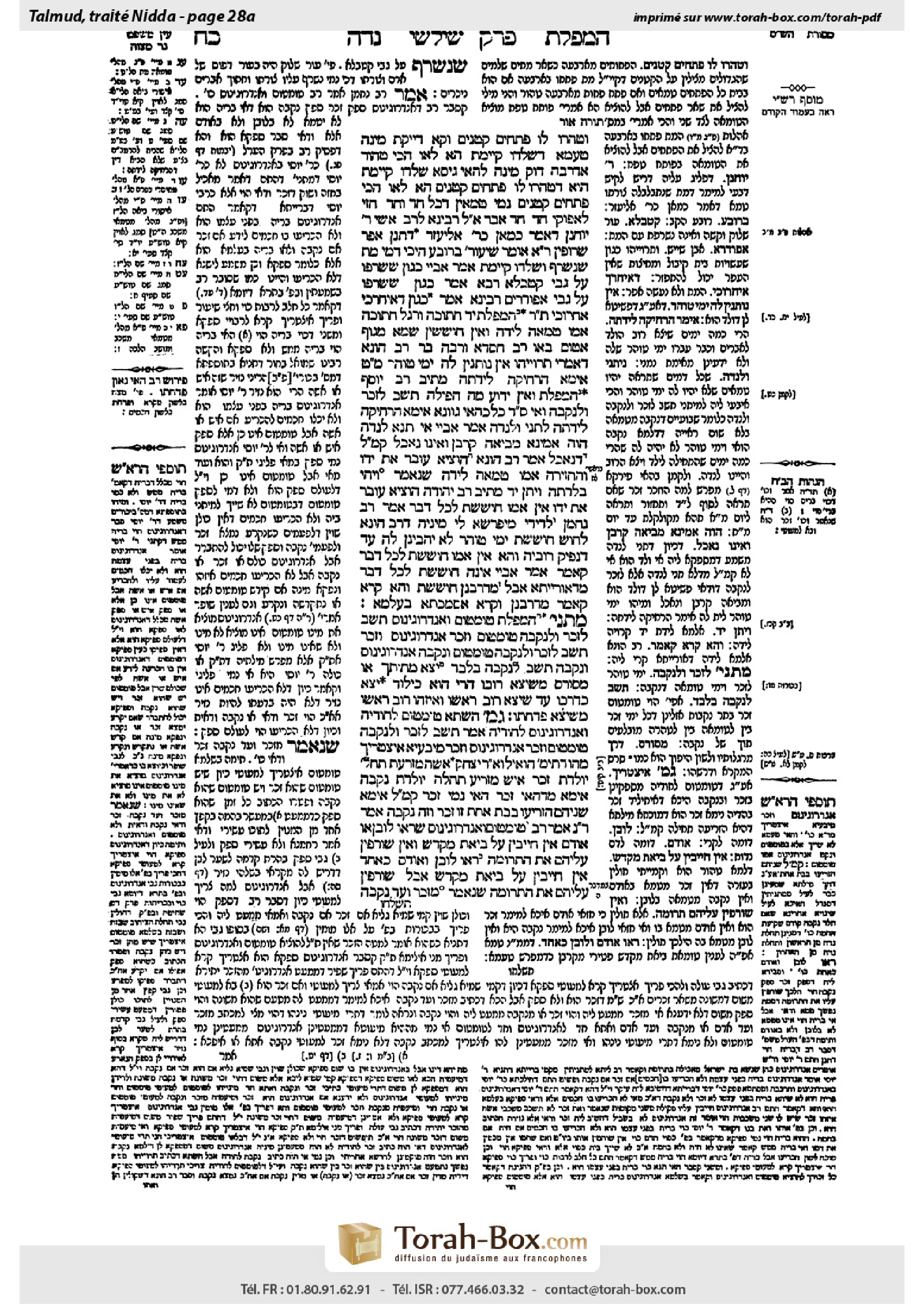
Niddah 28a: Talmud study for Daf Yomi
Daf Yomi is the daily study of one Talmud folio. Explore 37 tractates with scans, Hebrew text, Sefaria English and AI-generated French translations where annotated.
Passage selection and English or AI-generated French translation are available where the scan has annotations. Daf Study is independent of Torah-Box and Sefaria.
Browse Niddah · נידה · All tractatesNiddah 28a text and translations
This page of Niddah includes the Aramaic text, an English translation and an AI-generated French translation, alongside the scan above.
נידה כ״ח א · Aramaic and Hebrew text
וְטִהֲרוּ לוֹ פְּתָחִים קְטַנִּים. וְקָא דָיְיקַתְּ מִינַּהּ: טַעְמָא דְּשִׁלְדּוֹ קַיֶּימֶת, הָא לָאו הָכִי טָהוֹר.
אַדְּרַבָּה, דּוֹק מִינַּהּ לְהַאי גִּיסָא: שִׁלְדּוֹ קַיֶּימֶת הוּא דְּטִהֲרוּ לוֹ פְּתָחִים קְטַנִּים, הָא לָאו הָכִי — פְּתָחִים קְטַנִּים נָמֵי טְמֵאִין, דְּכֹל חַד וְחַד חֲזֵי לְאַפּוֹקֵי חַד חַד אֵבֶר!
אֲמַר לֵיהּ רָבִינָא לְרַב אָשֵׁי: רַבִּי יוֹחָנָן דְּאָמַר כְּמַאן? כְּרַבִּי אֱלִיעֶזֶר, דִּתְנַן: אֵפֶר שְׂרוּפִין, רַבִּי אֱלִיעֶזֶר אוֹמֵר: שִׁיעוּרָן בְּרוֹבַע.
הֵיכִי דָמֵי מֵת שֶׁנִּשְׂרַף וְשִׁלְדּוֹ קַיֶּימֶת? אָמַר אַבָּיֵי: כְּגוֹן שֶׁשְּׂרָפוֹ עַל גַּבֵּי קַטְבֻלְיָא. רָבָא אָמַר: כְּגוֹן שֶׁשְּׂרָפוֹ עַל גַּבֵּי אַפּוּדְרִים. רָבִינָא אָמַר: כְּגוֹן דְּאִיחֲרַךְ אִחֲרוֹכֵי.
תָּנוּ רַבָּנַן: הַמַּפֶּלֶת יָד חֲתוּכָה וְרֶגֶל חֲתוּכָה — אִמּוֹ טְמֵאָה לֵידָה, וְאֵין חוֹשְׁשִׁין שֶׁמָּא מִגּוּף אָטוּם בָּאוּ.
רַב חִסְדָּא וְרַבָּה בַּר רַב הוּנָא דְּאָמְרִי תַרְוַיְיהוּ: אֵין נוֹתְנִין לָהּ יְמֵי טוֹהַר. מַאי טַעְמָא? אֵימָא הִרְחִיקָה לֵידָתָהּ.
מֵתִיב רַב יוֹסֵף: הַמַּפֶּלֶת וְאֵין יָדוּעַ מָה הִפִּילָה תֵּשֵׁב לְזָכָר וְלִנְקֵבָה, וְאִי סָלְקָא דַעְתָּךְ כֹּל כְּהַאי גַּוְונָא אֵימָא הִרְחִיקָה לֵידָתָהּ, לִתְנֵי וּלְנִדָּה!
אָמַר אַבָּיֵי: אִי תְּנָא לְנִדָּה, הֲוָה אָמֵינָא מְבִיאָה קׇרְבָּן וְאֵינוֹ נֶאֱכָל, קָא מַשְׁמַע לַן דְּנֶאֱכָל.
אָמַר רַב הוּנָא: הוֹצִיא עוּבָּר אֶת יָדוֹ וְהֶחְזִירָהּ — אִמּוֹ טְמֵאָה לֵידָה, שֶׁנֶּאֱמַר: ״וַיְהִי בְלִדְתָּהּ וַיִּתֶּן יָד״.
מֵתִיב רַב יְהוּדָה: הוֹצִיא עוּבָּר אֶת יָדוֹ — אֵין אִמּוֹ חוֹשֶׁשֶׁת לְכׇל דָּבָר! אָמַר רַב נַחְמָן: לְדִידִי מִיפָּרְשָׁא לִי מִינֵּיהּ דְּרַב הוּנָא, לָחוֹשׁ חוֹשֶׁשֶׁת, יְמֵי טוֹהַר לָא יָהֲבִינַן לַהּ עַד דְּנָפֵיק רוּבֵּיהּ.
וְהָא אֵין ״אִמּוֹ חוֹשֶׁשֶׁת לְכׇל דָּבָר״ קָאָמַר! אָמַר אַבָּיֵי: אֵינָהּ חוֹשֶׁשֶׁת לְכׇל דָּבָר מִדְּאוֹרָיְיתָא, אֲבָל מִדְּרַבָּנַן חוֹשֶׁשֶׁת. וְהָא קְרָא קָאָמַר? מִדְּרַבָּנַן, וּקְרָא אַסְמַכְתָּא בְּעָלְמָא.
מַתְנִי' הַמַּפֶּלֶת טוּמְטוּם וְאַנְדְּרוֹגִינוֹס — תֵּשֵׁב לְזָכָר וְלִנְקֵבָה.
טוּמְטוּם וְזָכָר, אַנְדְּרוֹגִינוֹס וְזָכָר — תֵּשֵׁב לְזָכָר וְלִנְקֵבָה; טוּמְטוּם וּנְקֵבָה, אַנְדְּרוֹגִינוֹס וּנְקֵבָה — תֵּשֵׁב לִנְקֵבָה בִּלְבָד.
יָצָא מְחוּתָּךְ, אוֹ מְסוֹרָס — מִשֶּׁיֵּצֵא רוּבּוֹ הֲרֵי הוּא כְּיָלוּד. יָצָא כְּדַרְכּוֹ — עַד שֶׁיֵּצֵא רוֹב רֹאשׁוֹ. וְאֵיזֶהוּ רוֹב רֹאשׁוֹ? מִשֶּׁיֵּצֵא פַּדַּחְתּוֹ.
גְּמָ' הַשְׁתָּא טוּמְטוּם לְחוֹדֵיהּ וְאַנְדְּרוֹגִינוֹס לְחוֹדֵיהּ (אמר) [אָמְרַתְּ] תֵּשֵׁב לְזָכָר וְלִנְקֵבָה, טוּמְטוּם וְזָכָר, אַנְדְּרוֹגִינוֹס וְזָכָר מִיבַּעְיָא?
אִיצְטְרִיךְ, מַהוּ דְּתֵימָא, הוֹאִיל וְאָמַר רַבִּי יִצְחָק: אִשָּׁה מַזְרַעַת תְּחִלָּה — יוֹלֶדֶת זָכָר, אִישׁ מַזְרִיעַ תְּחִלָּה — יוֹלֶדֶת נְקֵבָה, אֵימָא מִדְּהַאי זָכָר — הַאי נָמֵי זָכָר? קָא מַשְׁמַע לַן. אֵימָא: שְׁנֵיהֶם הִזְרִיעוּ בְּבַת אַחַת, זוֹ זָכָר וְזֶה נְקֵבָה.
אָמַר רַב נַחְמָן אָמַר רַב: טוּמְטוּם וְאַנְדְּרוֹגִינוֹס שֶׁרָאוּ לוֹבֶן אוֹ אוֹדֶם — אֵין חַיָּיבִין עַל בִּיאַת מִקְדָּשׁ, וְאֵין שׂוֹרְפִין עֲלֵיהֶם אֶת הַתְּרוּמָה.
רָאוּ לוֹבֶן וְאוֹדֶם כְּאֶחָד — אֵין חַיָּיבִין עַל בִּיאַת מִקְדָּשׁ, אֲבָל שׂוֹרְפִין עֲלֵיהֶם אֶת הַתְּרוּמָה, שֶׁנֶּאֱמַר ״מִזָּכָר וְעַד נְקֵבָה
Niddah 28a · English translation
But they deemed pure all items that were under the small openings to the house, i.e., those whose width was less than four handbreadths. And you infer from this statement that the reason the large openings are impure in such a case is that the form of the corpse still exists; but otherwise, i.e., if the corpse was deformed, then even the large openings are pure.
The Gemara explains why one cannot infer from here that a deformed corpse does not impart impurity to other items that are under the same roof: On the contrary, one can infer from this statement in the opposite manner: It is only because the form of the corpse still exists that the Sages deemed pure the small openings of the house; but otherwise, the small openings are also impure, as each and every one of them is fit for taking out the corpse through them, each limb one by one. Consequently, no proof can be derived from this statement in support of the opinion of Reish Lakish.
Ravina said to Rav Ashi: In accordance with whose opinion did Rabbi Yoḥanan say that a deformed corpse imparts impurity to items that are under the same roof? It is in accordance with the opinion of Rabbi Eliezer, as we learned in a mishna (Oholot 2:2): With regard to the ashes of burned corpses that are not mixed with other types of ashes or dirt, Rabbi Eliezer says that its measure for imparting impurity to items that are under the same roof is a quarter of a kav. Clearly, Rabbi Eliezer maintains that a deformed corpse imparts impurity to items that are under the same roof.
The Gemara asks: What are the circumstances of this case of a corpse that was burned but its form still exists? How is this possible? Abaye says: It is possible in a case where one burned the corpse on top of a hard leather spread [katavla], which does not burn, and therefore the corpse retains its shape even after it is burned. Rava says: It is possible in a case where one burned the corpse on top of a marble slate [apoderim]. Ravina says: It is possible in a case where the corpse was charred without being reduced to ashes.
§ The Sages taught in a baraita: In the case of a woman who discharges a shaped hand, i.e., its fingers are discernible, or a shaped foot, its mother is impure with the impurity of a woman after childbirth, as the hand or foot certainly came from a full-fledged fetus. And we are not concerned that perhaps they came from a fetus with a sealed, i.e., deficient, body, in which case the miscarriage does not have the status of childbirth with regard to ritual impurity. The reason is that most pregnant women give birth to a fully formed fetus, and therefore it is presumed that the hand or foot came from a whole fetus that was squashed during childbirth.
Rav Ḥisda and Rabba bar Rav Huna both say: Although the woman observes the period of impurity of a woman after childbirth, we do not give her the days of purity following the period of impurity. What is the reason? Although it is presumed that the discharged limbs came from a full-fledged fetus, it is unknown whether or when the woman discharged the rest of the fetus, and the principle is that a woman who discharges observes her periods of impurity and purity when the majority of the limbs of the fetus emerge. Therefore, one can say that perhaps her childbirth was distant, i.e., the woman discharged the majority of the limbs of the fetus long before she discharged this hand or foot, and consequently her period of purity has already ended.
Rav Yosef raises an objection from a mishna (29a): In the case of a woman who discharges and it is not known what sex fetus she discharged, she shall observe the strictures of a woman who gave birth both to a male and to a female. And if it enters your mind that in any case like this one should say that perhaps the woman’s childbirth was distant, let the mishna teach that the woman shall observe the strictures of a woman who gave birth to both a male and a female, and also observes the strictures of a menstruating woman. Since it is possible that the item she discharged was a limb from a fetus the majority of which she discharged a long time beforehand, then she must forgo the period of purity observed by a woman who gave birth, and treat any blood that emerges during this period like the blood of a menstruating woman.
Abaye says in response: If the mishna had taught that the woman observes the strictures of a menstruating woman, I would say that as her status as a woman after childbirth is uncertain, since she observes the strictures of a menstruating woman with regard to any blood that emerges, she brings an offering like any woman after childbirth, but it is not eaten by the priests. It might be thought that perhaps the woman did not give birth at all and is not obligated to bring the offering, and therefore her bird sin offering cannot be eaten. By omitting the halakha that the woman observes the strictures of a menstruating woman, the mishna teaches us that her offering is eaten. This indicates that she certainly discharged an offspring; the uncertainty is only about when she discharged it.
§ Rav Huna says: If a fetus extended its hand out of the womb and then returned it, its mother is impure with the impurity of a woman after childbirth. This is considered childbirth, as it is stated with regard to Tamar, Judah’s daughter-in-law: “And it happened when she gave birth that one put out a hand…and it happened that as he drew back his hand, his brother came out” (Genesis 38:28–29). Evidently, the fetus extending out its hand was considered childbirth, despite the fact that it subsequently drew back the hand.
Rav Yehuda raises an objection from a baraita: If a fetus extended its hand out of the womb, its mother need not be concerned that she is considered a woman after childbirth with regard to any matter. Rav Naḥman says in response: The meaning of this statement was explained to me personally by Rav Huna himself: With regard to being concerned that she has the status of a woman after childbirth, the woman must be concerned, i.e., she must observe the strictures of a woman after childbirth. But we do not give her a period of days of purity like any woman after childbirth, until most of the fetus emerges.
The Gemara asks: But doesn’t the baraita say that its mother need not be concerned that she is considered a woman after childbirth with regard to any matter? Abaye says: The baraita means that the woman need not be concerned with regard to any matter by Torah law; but by rabbinic law she must be concerned, i.e., she is required to observe the strictures of a woman after childbirth. The Gemara asks: But doesn’t Rav Huna cite a verse as proof for his statement that if a fetus extended its hand out it is considered childbirth? The Gemara answers: This halakha applies by rabbinic law, and the verse is cited as mere support for it, i.e., it is not an actual source.
MISHNA: A woman who discharges or gives birth to a tumtum, whose sexual organs are obscured, or to a hermaphrodite [ve’androginos], who has both male and female sexual organs, shall observe the strictures of a woman who gave birth both to a male and to a female. She is impure for fourteen days like a woman who gave birth to a female, but blood that she sees thereafter is pure only until forty days after birth, like for a woman who gave birth to a male.
In a case where she gave birth to twins, if they are a tumtum and a male, or a hermaphrodite and a male, she observes the strictures of a woman who gave birth both to a male and to a female. But if the twins are a tumtum and a female, or a hermaphrodite and a female, she shall observe the periods of purity and impurity established by the Torah for a woman who gives birth to a female alone. Regardless of the status of the tumtum and the hermaphrodite, the woman’s seven days of impurity and her succeeding thirty-three days of purity are subsumed in the fourteen days of impurity and sixty-six days of purity for a female.
If the fetus emerged in pieces, or if it emerged reversed, i.e., feetfirst rather than headfirst, when most of its limbs emerge, its status is like that of a child born, with regard to the impurity of a woman after childbirth. If the fetus emerged in the usual manner, headfirst, it is not considered born until most of its head emerges. And what is considered most of its head? It is from when its forehead emerges.
GEMARA: The Gemara asks: Now that with regard to a woman who gives birth to a tumtum alone, or a hermaphrodite alone, the mishna states that she shall observe the strictures of a woman who gave birth both to a male and to a female, as the sex of the offspring is uncertain, is it necessary for the mishna to rule that if a woman gives birth to twins, a tumtum and a male, or a hermaphrodite and a male, she shall observe the strictures of a woman who gave birth to both a male and a female?
The Gemara answers: It was necessary for the mishna to state this halakha, lest you say that since Rabbi Yitzḥak says that the sex of a fetus is determined at the moment of conception, in that if the woman emits seed first she gives birth to a male, and if the man emits seed first she gives birth to a female, therefore one might say that since this offspring that was born with the tumtum or hermaphrodite is male, that tumtum or hermaphrodite is also male. Consequently, the mishna teaches us that the woman shall observe the strictures of a woman who gave birth to a female as well, as one can say that perhaps both the man and the woman emitted seed at the same time, which would mean that this offspring is male and that tumtum or hermaphrodite is female.
§ Rav Naḥman says that Rav says: In the case of a tumtum and a hermaphrodite who saw a white gonorrhea-like discharge [ziva], for which a man is impure, or who emitted a red discharge that had the appearance of menstrual blood, for which a woman is impure, if they entered the Temple they are not liable for entering the Temple in a state of impurity, as perhaps they are pure, in accordance with their true sex. And if they touched teruma after such a discharge, one does not burn the teruma due to their contact, as although impure teruma must be burned, the impurity in this case is uncertain.
If a tumtum and a hermaphrodite saw white ziva and red blood as one, i.e., they emitted both ziva and blood and are therefore impure regardless of their sex, they are still not liable for entering the Temple, but one does burn teruma due to their contact. The reason they are not liable for entering the Temple, despite the fact that they are definitely impure, is that it is stated: “Both male and female
Niddah 28a · Traduction française (IA)
Mais ils ont déclaré purs tous les objets qui se trouvaient sous les petites ouvertures de la maison, c’est-à-dire celles dont la largeur était inférieure à quatre palmes. On déduit de cette déclaration que si les grandes ouvertures sont impures dans un tel cas, c’est parce que la forme du cadavre existe encore ; autrement, c’est-à-dire si le cadavre était déformé, même les grandes ouvertures seraient pures.
La Guemara explique pourquoi on ne peut pas en déduire qu’un cadavre déformé ne transmet pas l’impureté aux objets qui se trouvent sous le même toit. Au contraire, on peut déduire de cette déclaration l’inverse : c’est uniquement parce que la forme du cadavre existe encore que les Sages ont déclaré pures les petites ouvertures de la maison ; autrement, les petites ouvertures seraient elles aussi impures, puisque chacune permettrait de faire sortir le cadavre en faisant passer ses membres un par un. Par conséquent, cette déclaration ne prouve pas que l’opinion de Reish Lakish est fondée.
Ravina dit à Rav Ashi : Selon l’opinion de qui Rabbi Yoḥanan a-t-il déclaré qu’un cadavre déformé transmet l’impureté aux objets qui se trouvent sous le même toit ? Selon celle de Rabbi Eliezer, comme nous l’avons appris dans une Michna (Oholot 2:2) : au sujet des cendres de cadavres brûlés qui ne sont mélangées ni à d’autres sortes de cendres ni à de la terre, Rabbi Eliezer dit que la mesure requise pour transmettre l’impureté aux objets qui se trouvent sous le même toit est d’un quart de kav. De toute évidence, Rabbi Eliezer considère qu’un cadavre déformé transmet l’impureté aux objets qui se trouvent sous le même toit.
La Guemara demande : Dans quelles circonstances un cadavre a-t-il pu être brûlé tout en conservant sa forme ? Comment cela est-il possible ? Abaye dit : c’est possible si l’on a brûlé le cadavre sur une peau dure étendue [katavla], qui ne brûle pas ; le cadavre conserve donc sa forme même après avoir été brûlé. Rava dit : c’est possible si l’on a brûlé le cadavre sur une dalle de marbre [apoderim]. Ravina dit : c’est possible si le cadavre a été carbonisé sans être réduit en cendres.
§ Les Sages ont enseigné dans une baraïta : dans le cas d’une femme qui expulse une main dont les doigts sont reconnaissables, ou un pied reconnaissable, sa mère est impure de l’impureté d’une femme après l’accouchement, car la main ou le pied provient certainement d’un fœtus pleinement formé. On ne craint pas qu’ils proviennent d’un fœtus au corps fermé, c’est-à-dire incomplet, auquel cas la fausse couche n’aurait pas le statut d’un accouchement en matière d’impureté rituelle. La raison en est que la plupart des femmes enceintes accouchent d’un fœtus pleinement formé ; on présume donc que la main ou le pied provient d’un fœtus entier qui a été écrasé au cours de l’accouchement.
Rav Ḥisda et Rabba bar Rav Huna disent tous deux : bien que la femme observe la période d’impureté d’une femme après l’accouchement, on ne lui accorde pas les jours de pureté qui suivent cette période. Pour quelle raison ? Bien que l’on présume que les membres expulsés proviennent d’un fœtus pleinement formé, on ignore si la femme a expulsé le reste du fœtus et à quel moment. Or, le principe est qu’une femme qui expulse un fœtus observe ses périodes d’impureté et de pureté à partir du moment où la majorité des membres du fœtus est sortie. On peut donc dire que son accouchement remonte peut-être à longtemps, c’est-à-dire qu’elle a expulsé la majorité des membres du fœtus bien avant cette main ou ce pied ; sa période de pureté est par conséquent déjà terminée.
Rav Yosef soulève une objection à partir d’une Michna (29a) : dans le cas d’une femme qui expulse un fœtus dont le sexe est inconnu, elle observe les règles de rigueur applicables à une femme ayant accouché aussi bien d’un garçon que d’une fille. Et si tu penses que, dans tout cas de ce genre, il faut dire que l’accouchement de la femme remonte peut-être à longtemps, que la Michna enseigne qu’elle observe les règles de rigueur applicables à une femme ayant accouché aussi bien d’un garçon que d’une fille, ainsi que celles d’une femme menstruée. Puisqu’il est possible que ce qu’elle a expulsé soit un membre d’un fœtus dont elle avait expulsé la majorité longtemps auparavant, elle doit renoncer à la période de pureté observée par une femme qui a accouché et traiter tout sang qui apparaît durant cette période comme le sang d’une femme menstruée.
Abaye répond : si la Michna avait enseigné que la femme observe les règles de rigueur applicables à une femme menstruée, j’aurais dit que, puisque son statut de femme après l’accouchement est incertain et qu’elle observe les règles de rigueur d’une femme menstruée à l’égard de tout sang qui apparaît, elle apporte une offrande comme toute femme après l’accouchement, mais que les prêtres ne la consomment pas. On pourrait penser que la femme n’a peut-être pas accouché du tout et qu’elle n’est donc pas tenue d’apporter l’offrande ; son sacrifice expiatoire d’oiseau ne pourrait alors pas être consommé. En omettant la halakha selon laquelle la femme observe les règles de rigueur applicables à une femme menstruée, la Michna nous enseigne que son offrande est consommée. Cela indique qu’elle a certainement expulsé un fœtus ; seule la date de cette expulsion est incertaine.
§ Rav Huna dit : si un fœtus a tendu la main hors de l’utérus puis l’a rentrée, sa mère est impure de l’impureté d’une femme après l’accouchement. Cela est considéré comme un accouchement, comme il est dit au sujet de Tamar, la belle-fille de Juda : « Et il arriva, lorsqu’elle accoucha, que l’un d’eux tendit la main… et il arriva que, lorsqu’il retira sa main, son frère sortit » (Genèse 38:28-29). Il ressort de là que le fait que le fœtus tende la main à l’extérieur est considéré comme un accouchement, bien qu’il l’ait ensuite rentrée.
Rav Yehuda soulève une objection à partir d’une baraïta : si un fœtus a tendu la main hors de l’utérus, sa mère n’a pas à craindre d’être considérée comme une femme après l’accouchement, quel que soit le domaine concerné. Rav Naḥman répond : Rav Huna lui-même m’a expliqué le sens de cette déclaration. La femme doit craindre d’avoir le statut d’une femme après l’accouchement, c’est-à-dire qu’elle doit observer les règles de rigueur applicables à une femme après l’accouchement. Mais on ne lui accorde pas une période de jours de pureté comme à toute femme après l’accouchement, jusqu’à ce que la majeure partie du fœtus soit sortie.
La Guemara demande : Mais la baraïta ne dit-elle pas que sa mère n’a pas à craindre d’être considérée comme une femme après l’accouchement, quel que soit le domaine concerné ? Abaye dit : la baraïta signifie que la femme n’a pas à s’en inquiéter au regard de la Torah écrite ; mais, selon le droit rabbinique, elle doit s’en inquiéter, c’est-à-dire qu’elle est tenue d’observer les règles de rigueur applicables à une femme après l’accouchement. La Guemara demande : Mais Rav Huna ne cite-t-il pas un verset à l’appui de son affirmation selon laquelle, si un fœtus a tendu la main à l’extérieur, cela est considéré comme un accouchement ? La Guemara répond : cette halakha relève du droit rabbinique, et le verset n’est cité qu’à titre d’appui, c’est-à-dire qu’il n’en constitue pas la véritable source.
MICHNA : Une femme qui expulse ou met au monde un tumtum, dont les organes sexuels sont cachés, ou un hermaphrodite [ve’androginos], qui possède à la fois des organes sexuels masculins et féminins, observe les règles de rigueur applicables à une femme ayant accouché aussi bien d’un garçon que d’une fille. Elle est impure pendant quatorze jours, comme une femme qui a accouché d’une fille ; mais le sang qu’elle voit ensuite n’est pur que jusqu’au quarantième jour après l’accouchement, comme dans le cas d’une femme qui a accouché d’un garçon.
Dans le cas où elle a accouché de jumeaux, si l’un est un tumtum et l’autre un garçon, ou si l’un est un hermaphrodite et l’autre un garçon, elle observe les règles de rigueur applicables à une femme ayant accouché aussi bien d’un garçon que d’une fille. Mais si les jumeaux sont un tumtum et une fille, ou un hermaphrodite et une fille, elle observe les périodes de pureté et d’impureté que la Torah a fixées pour une femme qui a accouché uniquement d’une fille. Quel que soit le statut du tumtum et de l’hermaphrodite, les sept jours d’impureté de la femme et les trente-trois jours de pureté qui suivent sont compris dans les quatorze jours d’impureté et les soixante-six jours de pureté prévus pour une fille.
Si le fœtus est sorti en morceaux, ou s’il est sorti à l’envers, c’est-à-dire les pieds en premier plutôt que la tête, il est considéré comme né, en matière d’impureté de la femme après l’accouchement, dès que la majeure partie de ses membres est sortie. Si le fœtus est sorti de la manière habituelle, la tête en premier, il n’est pas considéré comme né avant que la majeure partie de sa tête soit sortie. Et qu’entend-on par la majeure partie de sa tête ? À partir du moment où son front sort.
GUEMARA : La Guemara demande : Puisque, à propos d’une femme qui met au monde un tumtum seul ou un hermaphrodite seul, la Michna dit qu’elle observe les règles de rigueur applicables à une femme ayant accouché aussi bien d’un garçon que d’une fille, car le sexe de l’enfant est incertain, était-il nécessaire que la Michna statue qu’une femme qui met au monde des jumeaux, un tumtum et un garçon ou un hermaphrodite et un garçon, observe les règles de rigueur applicables à une femme ayant accouché aussi bien d’un garçon que d’une fille ?
La Guemara répond : il était nécessaire que la Michna énonce cette halakha, de peur que tu ne dises que, puisque Rabbi Yitzḥak affirme que le sexe d’un fœtus est déterminé au moment de la conception — si la femme émet sa semence la première, elle accouche d’un garçon, et si l’homme émet sa semence le premier, elle accouche d’une fille —, on pourrait dire que, puisque l’autre enfant né avec le tumtum ou l’hermaphrodite est un garçon, ce tumtum ou cet hermaphrodite est également un garçon. La Michna nous enseigne donc que la femme doit aussi observer les règles de rigueur applicables à une femme ayant accouché d’une fille, car il se peut que l’homme et la femme aient émis leur semence en même temps ; cela signifierait que cet enfant est un garçon et que ce tumtum ou cet hermaphrodite est une fille.
§ Rav Naḥman dit au nom de Rav : dans le cas d’un tumtum ou d’un hermaphrodite qui a vu un écoulement blanc de ziva, semblable à celui de la gonorrhée [ziva], qui rend un homme impur, ou qui a émis un écoulement rouge ayant l’apparence du sang menstruel, qui rend une femme impure, s’ils sont entrés dans le Temple, ils ne sont pas passibles pour y être entrés en état d’impureté, car il se peut qu’ils soient purs selon leur sexe véritable. S’ils ont touché de la terouma après un tel écoulement, on ne brûle pas la terouma à cause de leur contact ; en effet, bien que la terouma impure doive être brûlée, l’impureté est ici incertaine.
Si un tumtum et un hermaphrodite ont vu à la fois une ziva blanche et du sang rouge, c’est-à-dire s’ils ont émis à la fois de la ziva et du sang et sont donc impurs quel que soit leur sexe, ils ne sont toujours pas passibles pour être entrés dans le Temple, mais on brûle la terouma à cause de leur contact. La raison pour laquelle ils ne sont pas passibles d’être entrés dans le Temple, bien qu’ils soient certainement impurs, est qu’il est dit : « Mâle et femelle
Traduction française générée par IA à partir de l’édition anglaise de Sefaria. Vérifie toujours un passage avec le texte source.
Text from Sefaria: William Davidson Edition - Vocalized Aramaic (CC BY NC); William Davidson Edition - English (CC BY NC).