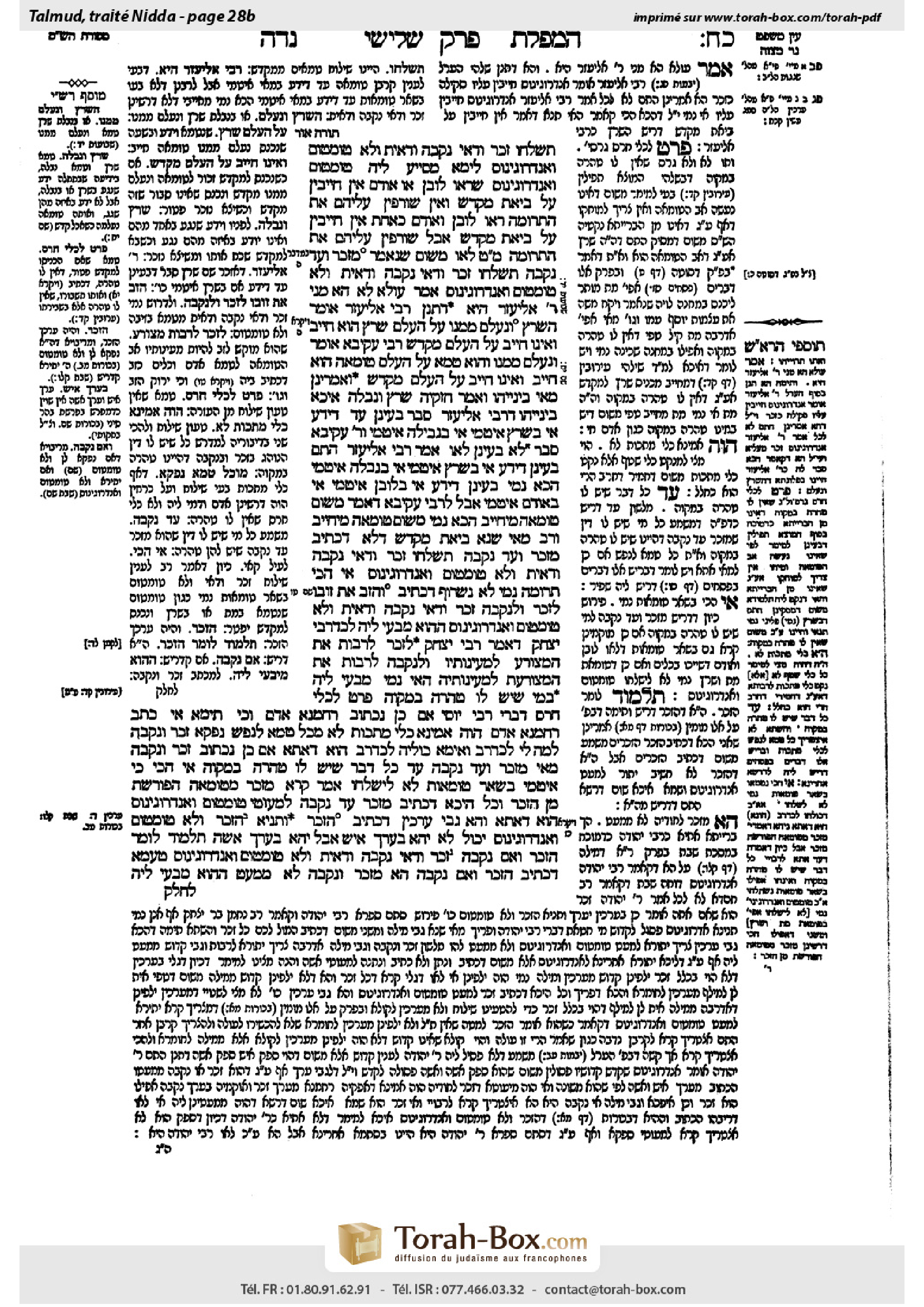
Niddah 28b: Talmud study for Daf Yomi
Daf Yomi is the daily study of one Talmud folio. Explore 37 tractates with scans, Hebrew text, Sefaria English and AI-generated French translations where annotated.
Passage selection and English or AI-generated French translation are available where the scan has annotations. Daf Study is independent of Torah-Box and Sefaria.
Browse Niddah · נידה · All tractatesNiddah 28b text and translations
This page of Niddah includes the Aramaic text, an English translation and an AI-generated French translation, alongside the scan above.
נידה כ״ח ב · Aramaic and Hebrew text
תְּשַׁלֵּחוּ״ — זָכָר וַדַּאי נְקֵבָה וַדָּאִית, וְלֹא טוּמְטוּם וְאַנְדְּרוֹגִינוֹס.
לֵימָא מְסַיַּיע לֵיהּ: טוּמְטוּם וְאַנְדְּרוֹגִינוֹס שֶׁרָאוּ לוֹבֶן אוֹ אוֹדֶם — אֵין חַיָּיבִין עַל בִּיאַת מִקְדָּשׁ, וְאֵין שׂוֹרְפִין עֲלֵיהֶם אֶת הַתְּרוּמָה. רָאוּ לוֹבֶן וְאוֹדֶם כְּאַחַת — אֵין חַיָּיבִין עַל בִּיאַת מִקְדָּשׁ, אֲבָל שׂוֹרְפִין עֲלֵיהֶם אֶת הַתְּרוּמָה.
מַאי טַעְמָא, לָאו מִשּׁוּם שֶׁנֶּאֱמַר ״מִזָּכָר וְעַד נְקֵבָה תְּשַׁלֵּחוּ״, זָכָר וַדַּאי, נְקֵבָה וַדָּאִית, וְלֹא טוּמְטוּם וְאַנְדְּרוֹגִינוֹס? אָמַר עוּלָּא: לָא, הָא מַנִּי? רַבִּי אֱלִיעֶזֶר הִיא.
דִּתְנַן, רַבִּי אֱלִיעֶזֶר אוֹמֵר: הַ״שֶּׁרֶץ... וְנֶעְלַם מִמֶּנּוּ״ — עַל הֶעְלֵם שֶׁרֶץ הוּא חַיָּיב, וְאֵינוֹ חַיָּיב עַל הֶעְלֵם מִקְדָּשׁ.
רַבִּי עֲקִיבָא אוֹמֵר: ״וְנֶעְלַם מִמֶּנּוּ וְהוּא טָמֵא״ — עַל הֶעְלֵם טוּמְאָה הוּא חַיָּיב, וְאֵינוֹ חַיָּיב עַל הֶעְלֵם מִקְדָּשׁ.
וְאָמְרִינַן: מַאי בֵּינַיְיהוּ? וְאָמַר חִזְקִיָּה: שֶׁרֶץ וּנְבֵלָה אִיכָּא בֵּינַיְיהוּ, דְּרַבִּי אֱלִיעֶזֶר סָבַר: בָּעֵינַן עַד דְּיָדַע אִי בְּשֶׁרֶץ אִיטַּמִּי אִי בִּנְבֵילָה אִיטַּמִּי, וְרַבִּי עֲקִיבָא סָבַר: לָא בָּעֵינַן.
לָאו אָמַר רַבִּי אֱלִיעֶזֶר הָתָם בָּעֵינַן דְּיָדַע אִי בְּשֶׁרֶץ אִיטַּמִּי, אִי בִּנְבֵלָה אִיטַּמִּי; הָכָא נָמֵי בָּעֵינַן דְּיָדַע אִי בְּלוֹבֶן אִיטַּמִּי, אִי בְּאוֹדֶם אִיטַּמִּי.
אֲבָל לְרַבִּי עֲקִיבָא, דְּאָמַר מִשּׁוּם טוּמְאָה מִיחַיַּיב, הָכָא נָמֵי מִשּׁוּם טוּמְאָה מִיחַיַּיב.
וְרַב, מַאי שְׁנָא בִּיאַת מִקְדָּשׁ דְּלָא, דִּכְתִיב: ״מִזָּכָר וְעַד נְקֵבָה תְּשַׁלֵּחוּ״ — זָכָר וַדַּאי, נְקֵבָה וַדָּאִית, וְלֹא טוּמְטוּם וְאַנְדְּרוֹגִינוֹס.
אִי הָכִי, תְּרוּמָה נָמֵי לָא נִשְׂרוֹף, דִּכְתִיב: ״וְהַזָּב אֶת זוֹבוֹ לַזָּכָר וְלַנְּקֵבָה״ — זָכָר וַדַּאי, נְקֵבָה וַדָּאִית, וְלֹא טוּמְטוּם וְאַנְדְּרוֹגִינוֹס!
הַהוּא מִבָּעֵי לֵיהּ לְכִדְרַבִּי יִצְחָק, דְּאָמַר רַבִּי יִצְחָק: ״לַזָּכָר״ — לְרַבּוֹת אֶת הַמְּצוֹרָע לְמַעְיְנוֹתָיו, ״וְלִנְקֵבָה״ — לְרַבּוֹת אֶת הַמְצוֹרַעַת לְמַעְיְנוֹתֶיהָ.
הַאי נָמֵי מִבְּעֵי לֵיהּ, בְּמִי שֶׁיֵּשׁ לוֹ טׇהֳרָה בַּמִּקְוֶה — פְּרָט לִכְלִי חֶרֶס, דִּבְרֵי רַבִּי יוֹסֵי!
אִם כֵּן, נִכְתּוֹב רַחֲמָנָא ״אָדָם״.
וְכִי תֵימָא, אִי כְּתַב רַחֲמָנָא ״אָדָם״ הֲוָה אָמֵינָא כְּלֵי מַתָּכוֹת לָא, מִ״כֹּל טָמֵא לָנָפֶשׁ״ נָפְקָא! ״זָכָר״ וּ״נְקֵבָה״ לְמָה לִי? לְכִדְרַב.
וְאֵימָא, כּוּלֵּיהּ לְכִדְרַב הוּא דַּאֲתָא? אִם כֵּן, נִכְתּוֹב ״זָכָר וּנְקֵבָה״! מַאי ״מִזָּכָר וְעַד נְקֵבָה״? עַד כׇּל דָּבָר שֶׁיֵּשׁ לוֹ טׇהֳרָה בַּמִּקְוֶה.
אִי הָכִי, כִּי אִיטַּמִּי בִּשְׁאָר טוּמְאוֹת, לָא לִישַׁלְּחוּ? אָמַר קְרָא ״מִזָּכָר״ — מִטּוּמְאָה הַפּוֹרֶשֶׁת מִן הַזָּכָר.
וְכֹל הֵיכָא דִּכְתִיב ״מִזָּכָר עַד נְקֵבָה״ לְמַעוֹטֵי טוּמְטוּם וְאַנְדְּרוֹגִינוֹס הוּא דַּאֲתָא? וְהָא גַּבֵּי עֲרָכִין דִּכְתִיב ״הַזָּכָר״.
וְתַנְיָא: ״הַזָּכָר״ — וְלֹא טוּמְטוּם וְאַנְדְּרוֹגִינוֹס. יָכוֹל לֹא יְהֵא בְּעֵרֶךְ אִישׁ, אֲבָל יְהֵא בְּעֵרֶךְ אִשָּׁה? תַּלְמוּד לוֹמַר: ״הַזָּכָר... וְאִם נְקֵבָה״ — זָכָר וַדַּאי, נְקֵבָה וַדָּאִית, וְלֹא טוּמְטוּם וְאַנְדְּרוֹגִינוֹס.
טַעְמָא דִּכְתִיב ״הַזָּכָר... וְאִם נְקֵבָה״, הָא מִ״זָּכָר״ וּ״נְקֵבָה״ לָא מְמַעֵט. הַהוּא מִבָּעֵי לֵיהּ
Niddah 28b · English translation
you shall send out, out of the camp you shall send them, so that they not impurify their camp, in the midst of which I dwell” (Numbers 5:3). It is derived from the verse that only a definite male or a definite female is liable for entering the Temple in a state of impurity, but not a tumtum or a hermaphrodite.
The Gemara suggests: Let us say that the following baraita supports the opinion of Rav: In the case of a tumtum and a hermaphrodite who saw white ziva or red blood, they are not liable for entering the Temple in a state of impurity, and if they touch teruma, one does not burn the teruma due to their contact. If they saw white ziva and red blood as one, i.e., they emitted both ziva and blood, they are still not liable for entering the Temple, but one burns teruma due to their contact.
The Gemara reasons: What is the reason that they are not liable for entering the Temple despite the fact that they are definitely impure? Is it not because it is stated in the verse: “Both male and female you shall send out,” from which it is derived that only a definite male or a definite female could be liable for entering the Temple in a state of impurity, but not a tumtum or a hermaphrodite? Ulla says: No, Rav’s opinion cannot be proved from this baraita, as in accordance with whose opinion is this baraita? It is in accordance with the opinion of Rabbi Eliezer.
As we learned in a mishna (Shevuot 14b) that Rabbi Eliezer says: With regard to the sliding-scale offering the verse states: “Or if a person touches any impure thing…or the carcass of a non-kosher creeping animal, and it is hidden from him” (Leviticus 5:2). A precise reading of this verse indicates that if one has a lapse of awareness that he contracted ritual impurity by touching a carcass of a creeping animal, he is liable to bring a sliding-scale offering for defiling the Temple or the sacrificial food, but he is not liable to bring such an offering for a lapse of awareness that he is entering the Temple or partaking of sacrificial food.
Rabbi Akiva says that it is derived from the phrase: “And it is hidden from him, so that he is impure” (Leviticus 5:2), that for a lapse of awareness that one had contracted ritual impurity, he is liable to bring a sliding-scale offering, but he is not liable to bring an offering for a lapse of awareness that he is entering the Temple or partaking of sacrificial food.
And we say with regard to this mishna: What is the difference between the opinions of Rabbi Eliezer and Rabbi Akiva? They are apparently stating the same halakha. And Ḥizkiyya says: There is a practical difference between them in a case where one initially knew that he had contracted ritual impurity, but he did not know whether the impurity was contracted from a carcass of a creeping animal or from the carcass of an unslaughtered animal. As Rabbi Eliezer holds that for one to be liable to bring an offering, we require that he initially know whether he contracted impurity from a carcass of a creeping animal or whether he contracted impurity from an unslaughtered animal carcass, and if he never knew this, he does not bring an offering. And Rabbi Akiva holds that for him to be liable to bring an offering, we do not require that he know this detail, since he knows in general terms that he contracted impurity.
The Gemara infers: Doesn’t Rabbi Eliezer say there, in that mishna, that we require one to bring an offering for entering the Temple in a state of impurity only if he knew initially whether he contracted impurity from a carcass of a creeping animal or whether he contracted impurity from an unslaughtered animal carcass? Here, too, with regard to a hermaphrodite or a tumtum who emitted both ziva and blood, they are not obligated to bring an offering according to Rabbi Eliezer, as we require one to bring an offering only if he knew whether he became impure due to the white ziva he emitted or whether he became impure due to the red blood he emitted.
But according to Rabbi Akiva, who said that one is obligated to bring an offering due to his initial knowledge of his impurity even if he did not know the exact cause of his impurity, here too, in the case of a hermaphrodite or a tumtum who emitted both ziva and blood, he is obligated to bring an offering due to his initial knowledge of his impurity, despite the fact that he does not know whether he is impure due to the blood or the ziva.
The Gemara asks: And according to Rav, who holds that an impure tumtum or hermaphrodite is not liable for entering the Temple but that any teruma that he touches is burned, what is different with regard to entering the Temple, for which he is not liable? The reason it is different is that it is written: “Both male and female you shall send out,” from which it is derived that a definite male or a definite female is liable for entering the Temple in a state of impurity, but not a tumtum or a hermaphrodite.
If so, we should not burn teruma that he touches either, as it is written in a verse dealing with these types of impurity: “This is the law of the zav, and of one from whom the flow of semen emerges, so that he is thereby impure; and of her that is sick with her menstrual status, and they who have an issue, whether a male or a female” (Leviticus 15:32–33). It can similarly be derived from this verse that these types of impurity apply only to a definite male or a definite female, but not to a tumtum or a hermaphrodite.
The Gemara answers: That verse is necessary for the halakha of Rabbi Yitzḥak, as Rabbi Yitzḥak said: The term “whether a male” serves to include a male leper as a primary source of impurity with regard to the sources of his bodily emissions. In other words, the various emissions of a leper, e.g., his saliva and urine, have the status of a primary source of impurity, and therefore they transmit impurity to a person or utensil that touches them. And the term “or a female” serves to include a female as a primary source of impurity with regard to the sources of her bodily emissions.
The Gemara raises a difficulty: This verse: “Both male and female you shall send out” (Numbers 5:3), from which Rav derives that the prohibition against an impure person entering the Temple does not apply to one whose sex is uncertain, is also necessary for another halakha. That halakha is that the obligation to remove from the Temple any impure person or item applies only to one that has the option of attaining ritual purity by immersing in a ritual bath; this excludes an impure earthenware vessel, which cannot be purified by immersing it in a ritual bath. This is the statement of Rabbi Yosei. Consequently, Rav’s halakha cannot be derived from that verse.
The Gemara answers: If so, that the verse serves to teach Rabbi Yosei’s halakha alone, let the Merciful One write: Any person you shall send out, as this would also exclude earthenware vessels. Rav’s halakha is derived from the fact that the wording of the verse is: “Both male and female.”
And if you would say in response that if the Merciful One had written: Any person you shall send out, I would say that impure metal vessels need not be removed from the Temple either, as they are not included in the term: Any person, this is not correct. The Gemara elaborates: The halakha that impure metal vessels must be removed from the Temple is derived from the previous verse: “That they put out of the camp every leper, and every one that has an issue, and whatever is impure by the dead” (Numbers 5:2). Therefore, why do I need the verse to write: “Both male and female you shall send out,” instead of simply stating: Any person you shall send out? Clearly, the phrase: “Both male and female,” is necessary for the halakha of Rav.
The Gemara asks: But if so, one can say that the entire phrase comes for Rav’s halakha, and not the halakha of Rabbi Yosei. The Gemara answers: If so, let the verse write: Male and female. What is the meaning of the phrase: “Both male and female”? The verse is referring to any ritually impure item that has the same halakha that applies to both males and females, i.e., it can attain purity by being immersed in a ritual bath; this excludes earthenware vessels.
With regard to Rav’s halakha that the prohibition of entering the Temple in a state of ritual impurity does not apply to one who is a tumtum or a hermaphrodite, the Gemara asks: If so, then even when they become impure with other types of impurity, in addition to the impurity of a zav or a menstruating woman, a tumtum and a hermaphrodite should likewise not be sent out of the Temple, as the passage from which a tumtum and a hermaphrodite are excluded is also referring to other types of impurity: “That they put out of the camp every leper, and every one that has an issue, and whatever is impure by the dead” (Numbers 5:2). The Gemara answers: The next verse states: “Both male,” which is referring to impurity caused by a substance that is emitted from the male organ, i.e., ziva.
The Gemara raises a difficulty with regard to Rav’s derivation: And is it correct that anywhere that the phrase “both male and female” is written in the Torah, this comes to exclude a tumtum and a hermaphrodite? But isn’t a similar expression stated with regard to valuations, as it is written: “For the male…fifty shekels of silver, after the shekel of the Sanctuary. And if she is a female, then your valuation shall be thirty shekels” (Leviticus 27:3–4).
And it is taught in a baraita that it is derived from the term “the male”: But not a tumtum or a hermaphrodite. One might have thought that a tumtum or a hermaphrodite shall not be valuated according to the valuation of a man, which is fifty shekels, but shall be valuated according to the valuation of a woman, which is thirty shekels. Therefore, the verse states: “The male,” and the following verse states: “And if she is a female,” indicating that these halakhot apply only to a definite male or a definite female, but not to a tumtum or a hermaphrodite.
The Gemara explains the difficulty: The reason a tumtum and a hermaphrodite are excluded is that it is written: “The male…and if she is a female,” which indicates that if the verse had written: Male and female, without the superfluous words “the” and “if,” it would not have been derived that the verse excludes a tumtum and a hermaphrodite. This apparently contradicts the opinion of Rav, who excludes a tumtum and a hermaphrodite from the prohibition of entering the Temple in a state of impurity merely due to the phrase: “Male and female” (Numbers 5:3). The Gemara answers: In that verse with regard to valuations, the words “male” and “female” are themselves necessary
Niddah 28b · Traduction française (IA)
« Vous les renverrez ; hors du camp, vous les renverrez, afin qu’ils ne souillent pas leur camp, au milieu duquel Je réside » (Nombres 5:3). On déduit de ce verset que seul un mâle avéré ou une femelle avérée est passible d’entrer dans le Temple en état d’impureté, mais pas un tumtum ni un androgyne.
La Guemara propose : Disons que la baraïta suivante appuie l’avis de Rav : un tumtum et un androgyne qui ont constaté un écoulement de ziva blanche ou de sang rouge ne sont pas passibles pour être entrés dans le Temple en état d’impureté ; s’ils touchent de la terouma, on ne la brûle pas à cause de leur contact. S’ils ont constaté à la fois un écoulement de ziva blanche et de sang rouge, c’est-à-dire qu’ils ont émis à la fois de la ziva et du sang, ils ne sont toujours pas passibles pour être entrés dans le Temple, mais on brûle la terouma à cause de leur contact.
La Guemara raisonne ainsi : Pourquoi ne sont-ils pas passibles pour être entrés dans le Temple, bien qu’ils soient certainement impurs ? N’est-ce pas parce qu’il est écrit dans le verset : « Mâle et femelle, vous les renverrez », d’où l’on déduit que seul un mâle avéré ou une femelle avérée peut être passible pour être entré dans le Temple en état d’impureté, mais pas un tumtum ni un androgyne ? Oulla dit : Non, on ne peut pas prouver l’avis de Rav à partir de cette baraïta, car de qui cette baraïta suit-elle l’avis ? De Rabbi Eliezer.
Comme nous l’avons appris dans une Michna (Shevouot 14b) : Rabbi Eliezer dit, au sujet de l’offrande à valeur variable, que le verset déclare : « Ou si quelqu’un touche quelque chose d’impur… ou la carcasse d’un animal rampant impur, et que cela lui soit caché » (Lévitique 5:2). Une lecture précise de ce verset indique que si quelqu’un a oublié qu’il avait contracté l’impureté rituelle en touchant la carcasse d’un animal rampant, il est tenu d’apporter une offrande à valeur variable pour avoir rendu impur le Temple ou les aliments consacrés ; en revanche, il n’est pas tenu d’apporter une telle offrande s’il a oublié qu’il entrait dans le Temple ou consommait des aliments consacrés.
Rabbi Akiva dit que l’on déduit de l’expression « et que cela lui soit caché, de sorte qu’il soit impur » (Lévitique 5:2) que celui qui a oublié avoir contracté l’impureté rituelle est tenu d’apporter une offrande à valeur variable, mais qu’il n’est pas tenu d’apporter une offrande s’il a oublié qu’il entrait dans le Temple ou consommait des aliments consacrés.
Et à propos de cette Michna, nous demandons : Quelle est la différence entre les avis de Rabbi Eliezer et de Rabbi Akiva ? Apparemment, ils énoncent la même halakha. Hizkiya dit : Une différence pratique les distingue dans le cas où quelqu’un a su initialement qu’il avait contracté l’impureté rituelle, mais ignorait si elle provenait de la carcasse d’un animal rampant ou de celle d’un animal mort qui n’avait pas été abattu rituellement. Rabbi Eliezer estime que, pour être tenu d’apporter une offrande, il faut qu’il ait su au départ s’il avait contracté l’impureté par la carcasse d’un animal rampant ou par celle d’un animal mort non abattu rituellement ; s’il ne l’a jamais su, il n’apporte pas d’offrande. Rabbi Akiva estime, lui, qu’il n’est pas nécessaire qu’il connaisse ce détail pour être tenu d’apporter une offrande, puisqu’il sait en général qu’il a contracté l’impureté.
La Guemara déduit : Rabbi Eliezer ne dit-il pas là, dans cette Michna, qu’on n’est tenu d’apporter une offrande pour être entré dans le Temple en état d’impureté que si l’on savait initialement si l’on avait contracté l’impureté par la carcasse d’un animal rampant ou par celle d’un animal mort non abattu rituellement ? De même ici, dans le cas d’un androgyne ou d’un tumtum qui a émis à la fois de la ziva et du sang, ils ne sont pas tenus d’apporter une offrande selon Rabbi Eliezer, car on n’est tenu d’en apporter une que si l’on savait si l’on était devenu impur à cause de la ziva blanche émise ou du sang rouge émis.
Mais selon Rabbi Akiva, qui a dit que l’on est tenu d’apporter une offrande en raison de la connaissance initiale de son impureté, même sans en connaître la cause exacte, il en va de même ici : dans le cas d’un androgyne ou d’un tumtum qui a émis à la fois de la ziva et du sang, il est tenu d’apporter une offrande en raison de sa connaissance initiale de son impureté, bien qu’il ignore s’il est impur à cause du sang ou de la ziva.
La Guemara demande : Selon Rav, qui estime qu’un tumtum ou un androgyne impur n’est pas passible pour être entré dans le Temple, mais que toute terouma qu’il touche est brûlée, pourquoi en va-t-il autrement pour l’entrée dans le Temple ? C’est parce qu’il est écrit : « Mâle et femelle, vous les renverrez », d’où l’on déduit qu’un mâle avéré ou une femelle avérée est passible pour être entré dans le Temple en état d’impureté, mais pas un tumtum ni un androgyne.
Dans ce cas, on ne devrait pas non plus brûler la terouma qu’il touche, car il est écrit dans un verset traitant de ces types d’impureté : « Telle est la loi concernant le zav et celui dont s’écoule le sperme, qui est ainsi impur, ainsi que celle qui souffre de son état menstruel et ceux qui ont un écoulement, qu’ils soient mâles ou femelles » (Lévitique 15:32–33). On pourrait de même déduire de ce verset que ces types d’impureté ne s’appliquent qu’à un mâle avéré ou à une femelle avérée, mais pas à un tumtum ni à un androgyne.
La Guemara répond : Ce verset est nécessaire pour la halakha de Rabbi Yitzḥak, car Rabbi Yitzḥak a dit : L’expression « qu’ils soient mâles » sert à inclure un homme lépreux parmi les sources primaires d’impureté en ce qui concerne ses sécrétions corporelles. Autrement dit, les divers écoulements d’un lépreux, par exemple sa salive et son urine, ont le statut de sources primaires d’impureté et transmettent donc l’impureté à une personne ou à un ustensile qui les touche. Et l’expression « ou femelles » sert à inclure une femme parmi les sources primaires d’impureté en ce qui concerne ses sécrétions corporelles.
La Guemara soulève une difficulté : Le verset « Mâle et femelle, vous les renverrez » (Nombres 5:3), dont Rav déduit que l’interdiction faite à une personne impure d’entrer dans le Temple ne s’applique pas à une personne dont le sexe est incertain, est également nécessaire pour une autre halakha. Selon cette halakha, l’obligation d’éloigner du Temple toute personne ou tout objet impur ne concerne que ce qui peut être rendu rituellement pur par immersion dans un bain rituel ; cela exclut un ustensile en terre cuite impur, qui ne peut pas être purifié par immersion dans un bain rituel. Telle est l’opinion de Rabbi Yossi. Par conséquent, la halakha de Rav ne peut pas être déduite de ce verset.
La Guemara répond : Si le verset ne devait enseigner que la halakha de Rabbi Yossi, que le Miséricordieux écrive : « Toute personne, vous la renverrez », car cela exclurait également les ustensiles en terre cuite. La halakha de Rav se déduit de la formulation du verset : « Mâle et femelle ».
Et si l’on répond que, si le Miséricordieux avait écrit : « Toute personne, vous la renverrez », on aurait pensé que les ustensiles en métal impurs ne doivent pas non plus être éloignés du Temple, puisqu’ils ne sont pas inclus dans l’expression « toute personne », ce n’est pas exact. La Guemara précise : La halakha selon laquelle les ustensiles en métal impurs doivent être éloignés du Temple se déduit du verset précédent : « Qu’ils fassent sortir du camp tout lépreux, toute personne ayant un écoulement et tout ce qui est impur à cause d’un mort » (Nombres 5:2). Par conséquent, pourquoi le verset doit-il dire : « Mâle et femelle, vous les renverrez », au lieu de simplement dire : « Toute personne, vous la renverrez » ? Il est clair que l’expression « Mâle et femelle » est nécessaire pour la halakha de Rav.
La Guemara demande : Mais dans ce cas, on peut dire que toute l’expression vient enseigner la halakha de Rav, et non celle de Rabbi Yossi. La Guemara répond : Si tel était le cas, que le verset écrive : « Mâle et femelle ». Que signifie alors l’expression « Mâle et femelle, vous les renverrez » ? Le verset parle de tout objet rituellement impur soumis à la même halakha pour les mâles et les femelles, c’est-à-dire qu’il peut être purifié par immersion dans un bain rituel ; cela exclut les ustensiles en terre cuite.
Au sujet de la halakha de Rav, selon laquelle l’interdiction d’entrer dans le Temple en état d’impureté rituelle ne s’applique pas à un tumtum ou à un androgyne, la Guemara demande : Dans ce cas, même lorsqu’ils deviennent impurs par d’autres types d’impureté, en plus de l’impureté d’un zav ou d’une femme menstruée, un tumtum et un androgyne ne devraient-ils pas non plus être renvoyés du Temple, puisque le passage qui permet d’exclure le tumtum et l’androgyne traite aussi d’autres types d’impureté : « Qu’ils fassent sortir du camp tout lépreux, toute personne ayant un écoulement et tout ce qui est impur à cause d’un mort » (Nombres 5:2) ? La Guemara répond : Le verset suivant dit : « Mâle », ce qui se rapporte à l’impureté causée par une substance émise par l’organe mâle, c’est-à-dire la ziva.
La Guemara soulève une difficulté concernant la déduction de Rav : Est-il exact que partout où l’expression « mâle et femelle » apparaît dans la Torah, elle sert à exclure un tumtum et un androgyne ? Or, une expression semblable apparaît à propos des évaluations, comme il est écrit : « Pour le mâle… cinquante sicles d’argent, selon le sicle du Sanctuaire. Et si c’est une femelle, ton évaluation sera de trente sicles » (Lévitique 27:3–4).
Et une baraïta enseigne que l’on déduit de l’expression « le mâle » : mais pas un tumtum ni un androgyne. On aurait pu penser qu’un tumtum ou un androgyne ne serait pas évalué selon l’évaluation d’un homme, qui est de cinquante sicles, mais selon celle d’une femme, qui est de trente sicles. Le verset dit donc « le mâle », puis le verset suivant dit « et si c’est une femelle », indiquant que ces halakhot ne s’appliquent qu’à un mâle avéré ou à une femelle avérée, mais pas à un tumtum ni à un androgyne.
La Guemara explique la difficulté : Le tumtum et l’androgyne sont exclus parce qu’il est écrit : « Le mâle… et si c’est une femelle », ce qui indique que si le verset avait écrit « mâle et femelle », sans les mots superflus « le » et « si », on n’aurait pas déduit que le verset exclut un tumtum et un androgyne. Cela semble contredire l’avis de Rav, qui exclut un tumtum et un androgyne de l’interdiction d’entrer dans le Temple en état d’impureté uniquement sur la base de l’expression « Mâle et femelle » (Nombres 5:3). La Guemara répond : Dans ce verset concernant les évaluations, les mots « mâle » et « femelle » sont eux-mêmes nécessaires
Traduction française générée par IA à partir de l’édition anglaise de Sefaria. Vérifie toujours un passage avec le texte source.
Text from Sefaria: William Davidson Edition - Vocalized Aramaic (CC BY NC); William Davidson Edition - English (CC BY NC).