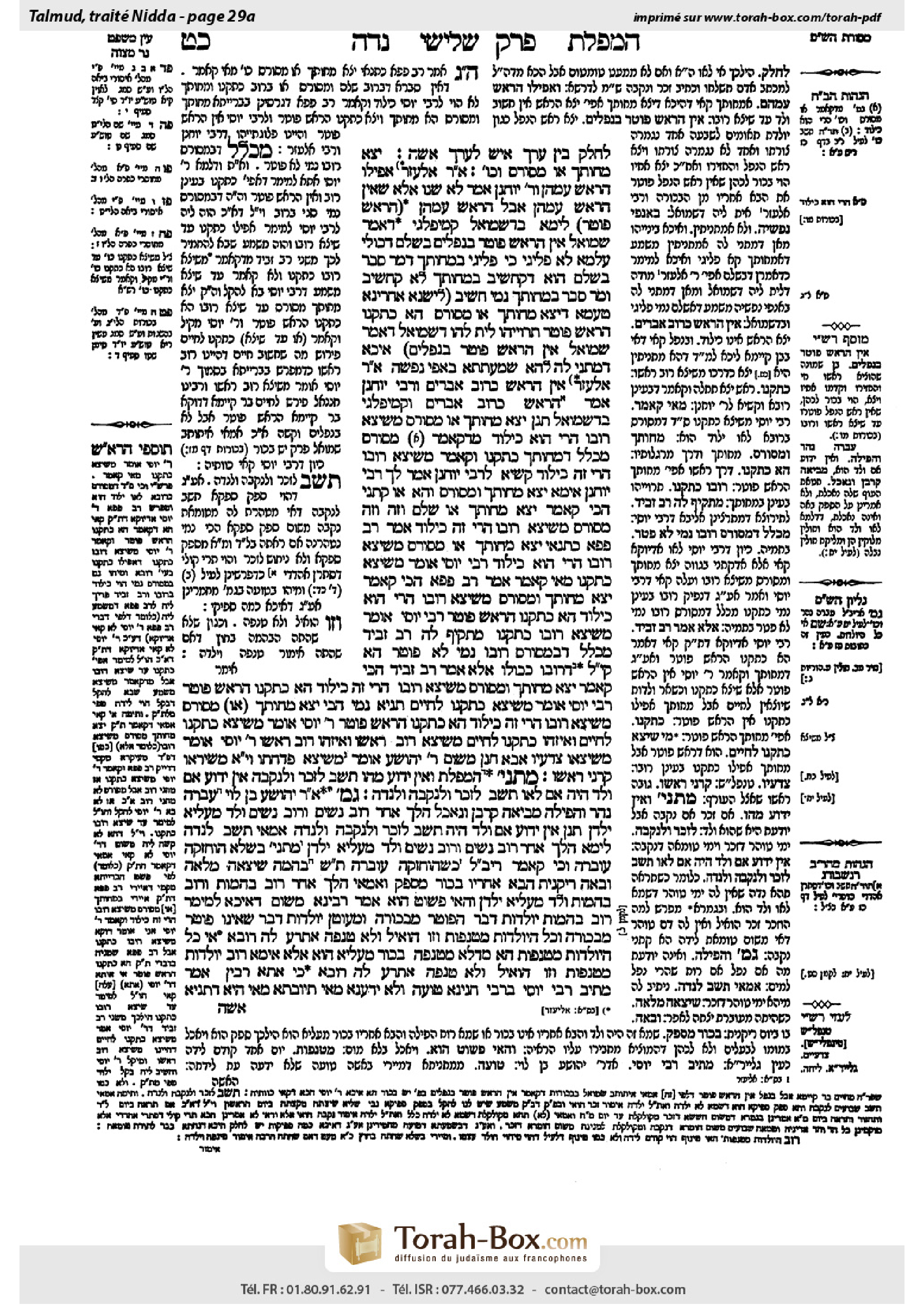
Niddah 29a: Talmud study for Daf Yomi
Daf Yomi is the daily study of one Talmud folio. Explore 37 tractates with scans, Hebrew text, Sefaria English and AI-generated French translations where annotated.
Passage selection and English or AI-generated French translation are available where the scan has annotations. Daf Study is independent of Torah-Box and Sefaria.
Browse Niddah · נידה · All tractatesNiddah 29a text and translations
This page of Niddah includes the Aramaic text, an English translation and an AI-generated French translation, alongside the scan above.
נידה כ״ט א · Aramaic and Hebrew text
לְחַלֵּק בֵּין עֵרֶךְ אִישׁ לְעֵרֶךְ אִשָּׁה.
יָצָא מְחוּתָּךְ אוֹ מְסוֹרָס וְכוּ׳. אָמַר רַבִּי אֶלְעָזָר: אֲפִילּוּ הָרֹאשׁ עִמָּהֶן.
וְרַבִּי יוֹחָנָן אָמַר: לֹא שָׁנוּ אֶלָּא שֶׁאֵין הָרֹאשׁ עִמָּהֶן, אֲבָל הָרֹאשׁ עִמָּהֶן — הָרֹאשׁ פּוֹטֵר.
לֵימָא בְּדִשְׁמוּאֵל קָמִיפַּלְגִי, דְּאָמַר שְׁמוּאֵל: אֵין הָרֹאשׁ פּוֹטֵר בִּנְפָלִים.
בְּשָׁלֵם — דְּכוּלֵּי עָלְמָא לָא פְּלִיגִי, כִּי פְּלִיגִי בִּמְחוּתָּךְ, דְּמָר סָבַר: בְּשָׁלֵם הוּא דְּקָחָשֵׁיב, בִּמְחוּתָּךְ לָא קָחָשֵׁיב, וּמָר סָבַר: בַּמְחוּתָּךְ נָמֵי חָשֵׁיב.
לִישָּׁנָא אַחֲרִינָא: טַעְמָא דְּיָצָא מְחוּתָּךְ אוֹ מְסוֹרָס, הָא כְּתִקְנוֹ — הָרֹאשׁ פּוֹטֵר. תַּרְוַיְיהוּ לֵית לְהוּ דִּשְׁמוּאֵל, דְּאָמַר שְׁמוּאֵל: אֵין הָרֹאשׁ פּוֹטֵר בִּנְפָלִים.
אִיכָּא דְמַתְנֵי לַהּ לְהָא שְׁמַעְתְּתָא בְּאַפֵּי נַפְשַׁהּ, אָמַר רַבִּי אֶלְעָזָר: אֵין הָרֹאשׁ כְּרוֹב אֵבָרִים, וְרַבִּי יוֹחָנָן אָמַר: הָרֹאשׁ כְּרוֹב אֵבָרִים, וְקָמִיפַּלְגִי בְּדִשְׁמוּאֵל.
תְּנַן: יָצָא מְחוּתָּךְ אוֹ מְסוֹרָס, מִשֶּׁיֵּצֵא רוּבּוֹ — הֲרֵי הוּא כְּיָלוּד. מִדְּקָאָמַר ״מְסוֹרָס״, מִכְּלָל דִּמְחוּתָּךְ כְּתִקְנוֹ, וְקָאָמַר מִשֶּׁיֵּצֵא רוּבּוֹ הֲרֵי זֶה כְּיָלוּד — קַשְׁיָא לְרַבִּי יוֹחָנָן!
אָמַר לָךְ רַבִּי יוֹחָנָן, אֵימָא: יָצָא מְחוּתָּךְ וּמְסוֹרָס.
וְהָא ״אוֹ״ קָתָנֵי! הָכִי קָאָמַר: יָצָא מְחוּתָּךְ אוֹ שָׁלֵם, וְזֶה וָזֶה מְסוֹרָס — מִשֶּׁיֵּצֵא רוּבּוֹ הֲרֵי זֶה כְּיָלוּד.
אָמַר רַב פָּפָּא: כְּתַנָּאֵי, יָצָא מְחוּתָּךְ אוֹ מְסוֹרָס — מִשֶּׁיֵּצֵא רוּבּוֹ הֲרֵי הוּא כְּיָלוּד. רַבִּי יוֹסֵי אוֹמֵר: מִשֶּׁיֵּצֵא כְּתִקְנוֹ. מַאי קָאָמַר?
אָמַר רַב פָּפָּא, הָכִי קָאָמַר: יָצָא מְחוּתָּךְ וּמְסוֹרָס — מִשֶּׁיֵּצֵא רוּבּוֹ הֲרֵי הוּא כְּיָלוּד, הָא כְּתִקְנוֹ — הָרֹאשׁ פּוֹטֵר. רַבִּי יוֹסֵי אוֹמֵר: מִשֶּׁיֵּצֵא רוּבּוֹ כְּתִקְנוֹ.
מַתְקֵיף לַהּ רַב זְבִיד: מִכְּלָל דְּבִמְסוֹרָס, רוּבּוֹ נָמֵי לֹא פּוֹטֵר? הָא קַיְימָא לַן דְּרוּבּוֹ כְּכוּלּוֹ!
אֶלָּא אָמַר רַב זְבִיד, הָכִי קָאָמַר: יָצָא מְחוּתָּךְ וּמְסוֹרָס — מִשֶּׁיֵּצֵא רוּבּוֹ הֲרֵי זֶה כְּיָלוּד, הָא כְּתִקְנוֹ — הָרֹאשׁ פּוֹטֵר. רַבִּי יוֹסֵי אוֹמֵר: מִשֶּׁיֵּצֵא כְּתִקְנוֹ לְחַיִּים.
תַּנְיָא נָמֵי הָכִי: יָצָא מְחוּתָּךְ (אוֹ) מְסוֹרָס — מִשֶּׁיֵּצֵא רוּבּוֹ הֲרֵי זֶה כְּיָלוּד, הָא כְּתִקְנוֹ — הָרֹאשׁ פּוֹטֵר. רַבִּי יוֹסֵי אוֹמֵר: מִשֶּׁיֵּצֵא כְּתִקְנוֹ לְחַיִּים.
וְאֵיזֶהוּ כְּתִקְנוֹ לְחַיִּים? מִשֶּׁיֵּצֵא רוֹב רֹאשׁוֹ. וְאֵיזֶהוּ רוֹב רֹאשׁוֹ? רַבִּי יוֹסֵי אוֹמֵר: מִשֶּׁיֵּצְאוּ צְדָעָיו. אַבָּא חָנָן מִשּׁוּם רַבִּי יְהוֹשֻׁעַ אוֹמֵר: (מִשֶּׁיֵּצֵא) [מִשֶּׁתֵּצֵא] פַּדַּחְתּוֹ. וְיֵשׁ אוֹמְרִים: מִשֶּׁיֵּרָאוּ קַרְנֵי רֹאשׁוֹ.
מַתְנִי' הַמַּפֶּלֶת וְאֵין יָדוּעַ מַהוּ — תֵּשֵׁב לְזָכָר וְלִנְקֵבָה. אֵין יָדוּעַ אִם וָלָד הָיָה אִם לָאו — תֵּשֵׁב לְזָכָר וְלִנְקֵבָה וּלְנִדָּה.
גְּמָ' אָמַר רַבִּי יְהוֹשֻׁעַ בֶּן לֵוִי: עָבְרָה נָהָר וְהִפִּילָה — מְבִיאָה קׇרְבָּן וְנֶאֱכָל, הַלֵּךְ אַחַר רוֹב נָשִׁים, וְרוֹב נָשִׁים וָלָד מְעַלְּיָא יָלְדָן.
תְּנַן: אֵין יָדוּעַ אִם וָלָד הָיָה, תֵּשֵׁב לְזָכָר וְלִנְקֵבָה וּלְנִדָּה. אַמַּאי תֵּשֵׁב לְנִדָּה? לֵימָא: הַלֵּךְ אַחַר רוֹב נָשִׁים, וְרוֹב נָשִׁים וָלָד מְעַלְּיָא יָלְדָן.
מַתְנִיתִין בְּשֶׁלֹּא הוּחְזְקָה עוּבָּרָה, וְכִי קָאָמַר רַבִּי יְהוֹשֻׁעַ בֶּן לֵוִי — כְּשֶׁהוּחְזְקָה עוּבָּרָה.
תָּא שְׁמַע: בְּהֵמָה שֶׁיָּצְאָה מְלֵאָה, וּבָאָה רֵיקָנִית — הַבָּא אַחֲרָיו בְּכוֹר מִסָּפֵק.
וְאַמַּאי? הַלֵּךְ אַחַר רוֹב בְּהֵמוֹת, וְרוֹב בְּהֵמוֹת וָלָד מְעַלְּיָא יָלְדָן, וְהַאי פָּשׁוּט הוּא!
אָמַר רָבִינָא, מִשּׁוּם דְּאִיכָּא לְמֵימַר: רוֹב בְּהֵמוֹת יוֹלְדוֹת דָּבָר הַפּוֹטֵר מִבְּכוֹרָה, וּמִעוּטָן יוֹלְדוֹת דָּבָר שֶׁאֵינוֹ פּוֹטֵר מִבְּכוֹרָה, וְכׇל הַיּוֹלְדוֹת מְטַנְּפוֹת, וְזוֹ הוֹאִיל וְלֹא טִנְּפָה — אִתְּרַע לֵהּ רוּבָּא.
אִי כׇּל הַיּוֹלְדוֹת מְטַנְּפוֹת, הָא מִדְּלָא מְטַנְּפָה בְּכוֹר מְעַלְּיָא הוּא! אֶלָּא אֵימָא: רוֹב יוֹלְדוֹת מְטַנְּפוֹת, וְזוֹ הוֹאִיל וְלֹא טִנְּפָה — אִתְּרַע לֵהּ רוּבָּא.
כִּי אֲתָא רַבִּין אָמַר: מֵתִיב רַבִּי יוֹסֵי בְּרַבִּי חֲנִינָא טוֹעָה, וְלָא יָדַעְנָא מַאי תְּיוּבְתָּא. מַאי הִיא? דְּתַנְיָא:
Niddah 29a · English translation
in order to differentiate between the valuation of a man and the valuation of a woman. Therefore, it could not have been derived from that verse that a tumtum and a hermaphrodite are excluded from the halakha of valuations, were it not for the superfluous words “the” and “if.”
§ The mishna teaches that if the fetus emerged in pieces, or if it emerged reversed, i.e., feetfirst rather than headfirst; when most of its limbs emerge, its status is like that of a child born, with regard to the impurity of a woman after childbirth. Rabbi Elazar says: Even if the head is among the limbs that emerged, provided that the majority of the limbs did not yet emerge, the fetus is not considered born.
And Rabbi Yoḥanan says: They taught in the mishna that the woman is not impure unless most of the fetus’s limbs emerged only in a case where the head is not among the limbs that emerged; but if the head is among them, the head exempts the woman’s future offspring from the obligation of primogeniture, as the fetus is considered born.
The Gemara asks: Shall we say that these Sages disagree with regard to the opinion of Shmuel? As Shmuel said that if a woman is pregnant with twins, and the head of one of the fetuses emerges and then disappears back into the womb, this does not exempt the other fetus from the obligation of primogeniture should it be born first. Shmuel says this specifically in a case of non-viable newborns, i.e., where the fetus whose head emerged was a non-viable newborn and the one that was eventually born first is a viable offspring. But if both are viable offspring, the emergence of the head is considered birth. The suggestion is that Rabbi Elazar agrees with the opinion of Shmuel, whereas Rabbi Yoḥanan disagrees with the opinion of Shmuel and maintains that the emergence of the head is considered birth even in the case of a non-viable newborn.
The Gemara rejects this suggestion, as it is possible that in the case of a whole non-viable newborn, everyone, i.e., Rabbi Elazar and Rabbi Yoḥanan, agrees that the emergence of the head is considered a birth, contrary to the opinion of Shmuel. When they disagree, it is in the case of a fetus that emerged in pieces. As one Sage, Rabbi Elazar, holds that it is specifically in the case of a whole non-viable newborn that the emergence of the head is considered birth, whereas with regard to a fetus that emerged in pieces it is not considered birth; and one Sage, Rabbi Yoḥanan, holds that in the case of a fetus that emerged in pieces as well, the emergence of the head is considered birth.
The Gemara cites another version of this discussion. The reason it is necessary for most of the limbs of the fetus to emerge for it to be considered born is that it emerged in pieces, or that it emerged reversed, i.e., feet first. It may be inferred from here that if it emerged in its proper manner, headfirst and whole, it is considered born, even according to Rabbi Elazar. Therefore, if the woman is pregnant with twins, the emergence of the head exempts the other twin from the obligations of primogeniture. Evidently, both Rabbi Yoḥanan and Rabbi Elazar do not hold in accordance with the opinion of Shmuel, as Shmuel said that the emergence of the head of one of the twins does not exempt the other in a case of non-viable newborns.
There are those who teach this halakha by itself, i.e., not in reference to the mishna: Rabbi Elazar says: The emergence of the head of a non-viable newborn is not considered like the emergence of most of the limbs; and Rabbi Yoḥanan says: The emergence of the head of a non-viable newborn is considered like the emergence of most of the limbs. And they disagree with regard to the opinion of Shmuel; Rabbi Elazar holds in accordance with Shmuel’s opinion, whereas Rabbi Yoḥanan does not accept the opinion of Shmuel.
The Gemara raises a difficulty: We learned in the mishna that if the fetus emerged in pieces or if it emerged reversed, when most of its limbs emerge, its status is like that of a child born. The Gemara infers: From the fact that the mishna states: Or reversed, by inference in the case of a fetus that emerged in pieces it emerged in its proper manner, i.e., the head first and then the body, and nevertheless the mishna states that it is only when most of its limbs emerge that its status is like that of a child born. This is difficult for the opinion of Rabbi Yoḥanan, as he maintains that once the head emerges, the fetus is considered born.
The Gemara explains that Rabbi Yoḥanan could have said to you: Say that the mishna is referring to a case where the fetus emerged in pieces and reversed, whereas if it emerged with its head first, it is considered born even if most of its limbs did not emerge yet.
The Gemara asks: But doesn’t the mishna teach that the fetus emerged in pieces or reversed? If so, it cannot be explained as referring to a case where the fetus emerged both in pieces and reversed. The Gemara answers that this is what the mishna is saying: If the fetus emerged in pieces or whole, and in both this case and that case it emerged reversed, then when most of its limbs emerge, its status is like that of a child born.
Rav Pappa says: This dispute between Rabbi Elazar and Rabbi Yoḥanan is parallel to a dispute between tanna’im, as it is stated in a baraita: If the fetus emerged in pieces or reversed, when most of its limbs emerge its status is like that of a child born. Rabbi Yosei says: Its status is like that of a child born when it emerges in its proper manner. The Gemara asks: What is Rabbi Yosei saying? His statement apparently indicates that if a fetus emerges with its feet first, then even after most of its limbs emerge it is not considered born.
Rav Pappa says that this is what the baraita is saying: If the fetus emerged in pieces or reversed, when most of its limbs emerge its status is like that of a child born; but by inference, if the fetus emerged in its proper manner, then the emergence of the head exempts its twin, should it eventually be born first, from the obligations of primogeniture. And Rabbi Yosei says: The status of a fetus that emerged in pieces is like that of a child born when most of its limbs emerge, provided that it emerged in its proper manner, i.e., both requirements are necessary. The suggestion is that the opinion of Rabbi Yoḥanan is in accordance with the ruling of the first tanna, that even if a fetus emerges in pieces, once its head emerges it is considered born; whereas the opinion of Rabbi Elazar follows the ruling of Rabbi Yosei that even if such a fetus emerges headfirst, it is not considered born.
Rav Zevid objects to Rav Pappa’s interpretation of the baraita: Since Rabbi Yosei issued his statement that both requirements are necessary, i.e., a majority of limbs and emergence in the proper manner, with regard to the two cases mentioned by the first tanna, by inference in the other case, where the fetus emerged reversed, even when most of its limbs emerge it does not exempt its twin from the obligations of primogeniture. But this is difficult, as we maintain that the majority of an item is considered like all of it. Accordingly, when most of the fetus’s limbs emerge it should be considered born even if it came out feetfirst.
Rather, Rav Zevid says that this is what the baraita is saying: If the fetus emerged in pieces and reversed, when most of its limbs emerge its status is like that of a child born; but by inference, if the fetus emerged in its proper manner then the emergence of the head exempts its twin from the obligations of primogeniture, even if it was born in pieces. Rabbi Yosei says: The fetus is considered born once its head emerges only in a case when it emerges in its proper manner alive; if it emerges in pieces, the fetus is considered born only when most of its limbs emerge.
This explanation is also taught explicitly in another baraita: If the fetus emerged in pieces and reversed, then when most of its limbs emerge its status is like that of a child born; but if the fetus emerged in its proper manner, the emergence of the head exempts its twin. Rabbi Yosei says: The fetus is considered born once its head emerges only in a case where it emerges in its proper manner alive.
And what is the exact stage when a fetus that emerged in its proper manner alive is considered born? When most of its head emerges. And what is the stage when most of its head emerges? Rabbi Yosei says: When its temples emerge. Abba Ḥanan says in the name of Rabbi Yehoshua: When its forehead emerges. And some say: When the corners of its head, i.e., the projection of the head above the neck, are visible.
MISHNA: In the case of a woman who discharges and it is not known what is the fetus’s sex, she shall observe the strictures of a woman who gave birth both to a male and to a female. She is impure for fourteen days, like a woman who gave birth to a female, and any blood the woman sees only until forty days after birth, not eighty days thereafter, is pure, like a woman who gave birth to a male. If it is unknown whether it was a male or female offspring or whether it was not an offspring at all, she shall observe the period of impurity for a woman who gave birth to a male and for a woman who gave birth to a female; and for any blood that she sees, she observes the halakhot of a menstruating woman. Since it is possible that what she discharged was not an offspring at all, any blood she sees might be due to menstruation, not childbirth.
GEMARA: Rabbi Yehoshua ben Levi says: With regard to a pregnant woman who passed across a river and she discharged her fetus into the river, and she does not know whether the fetus was fully formed, she brings the offering of a woman after childbirth, which is a burnt offering and a sin offering. And the sin offering, which is a bird, is eaten after the nape of its neck has been pinched, in the manner of a regular bird sin offering. This is the halakha despite the uncertainty that this fetus might not have been fully formed, in which case the woman would not be obligated to bring this offering, and a bird that is not an offering may not be eaten if its nape was pinched. Rabbi Yehoshua ben Levi explains the reasoning behind this ruling: One must follow the majority of pregnant women, and most pregnant women give birth to full-fledged offspring.
The Gemara analyzes this claim. We learned in the mishna: If it is unknown whether what the woman discharged was a male or female offspring or whether it was not an offspring at all, she shall observe the period of impurity for a woman who gave birth to a male and for a woman who gave birth to a female; and for any blood that she sees, she observes the halakhot of a menstruating woman. The Gemara asks: According to the statement of Rabbi Yehoshua ben Levi, why must the woman observe the halakhot of a menstruating woman? Let us say that one must follow the majority of women, and the majority of women give birth to full-fledged offspring. If so, she should observe a period of purity, during which any blood she sees is pure, after her period of impurity, like all women after childbirth.
The Gemara answers: The halakha in the mishna is referring to a case where the woman had not been presumed to be pregnant prior to her miscarriage; and when Rabbi Yehoshua ben Levi says that a woman who discharges is presumed to have discharged an offspring, he was speaking of a case where the woman had been presumed to be pregnant prior to her miscarriage.
The Gemara suggests: Come and hear a difficulty with regard to the opinion of Rabbi Yehoshua ben Levi from a baraita: There is the case of a kosher animal that had not yet given birth, which went to the pasture full, i.e., pregnant, and came back the same day empty, i.e., with no live offspring.It clearly discharged, but it is unknown whether or not it discharged an offspring, which would exempt the animal’s subsequent offspring from the status of a firstborn. In this case, the offspring that comes after it is a firstborn of uncertain status.
The Gemara asks: But why is this the halakha? According to Rabbi Yehoshua ben Levi, one should follow the reality among the majority of animals, and the majority of animals give birth to full-fledged offspring. And if so, this subsequent offspring of the animal is a regular offspring, i.e., it is definitely not a firstborn.
Ravina says in response: In this case, the halakha does not follow the majority of animals, because it can be said that the majority of animals give birth to an item that exempts the animal’s subsequent offspring from firstborn status, but a minority of animals give birth to an item that does not exempt the animal’s subsequent offspring from firstborn status, i.e., an item that is not a full-fledged offspring. And an additional factor is that all animals that give birth to full-fledged offspring discharge turbid liquids one day before giving birth, and since this animal did not discharge turbid liquids before going to the pasture, the effect of the majority is undermined. Consequently, the status of the animal’s birth is uncertain, and for this reason its subsequent offspring is considered a firstborn of uncertain status.
The Gemara raises a difficulty: If all animals that give birth to full-fledged offspring discharge turbid liquids before giving birth, then it should be concluded from the fact that this animal did not discharge turbid liquids that it did not discharge a full-fledged offspring, and therefore the animal’s subsequent offspring is a proper firstborn, not a firstborn of uncertain status. Rather, one should say that Ravina meant the following: The majority of animals that give birth discharge turbid liquids beforehand, and therefore, since this animal did not discharge turbid liquids, the effect of the majority is undermined.
§ When Ravin came from Eretz Yisrael to Babylonia, he said: Rabbi Yosei, son of Rabbi Ḥanina, raises an objection to the opinion of Rabbi Yehoshua ben Levi from the halakha of a forgetful woman; but I do not know what the objection is. The Gemara asks: This halakha of a forgetful woman, which forms the basis of the objection, what is it? The Gemara explains: As it is taught in a baraita:
Niddah 29a · Traduction française (IA)
afin de distinguer entre l’évaluation d’un homme et celle d’une femme. Par conséquent, sans les mots superflus « le » et « si », on n’aurait pas pu déduire de ce verset qu’un tumtum et un androgyne sont exclus de la halakha des évaluations.
§ La Michna enseigne que si le fœtus est sorti en morceaux ou à l’envers, c’est-à-dire les pieds en premier plutôt que la tête, dès que la majorité de ses membres est sortie, son statut est celui d’un enfant né, en ce qui concerne l’impureté de la femme après l’accouchement. Rabbi Elazar dit : même si la tête fait partie des membres qui sont sortis, tant que la majorité des membres n’est pas encore sortie, le fœtus n’est pas considéré comme né.
Et Rabbi Yoḥanan dit : la Michna enseigne que la femme n’est impure que lorsque la majorité des membres du fœtus est sortie uniquement dans le cas où la tête ne fait pas partie des membres qui sont sortis ; mais si la tête en fait partie, celle-ci dispense les enfants ultérieurs de la femme de l’obligation de primogéniture, car le fœtus est considéré comme né.
La Guemara demande : Faut-il en conclure que ces Sages sont en désaccord sur l’opinion de Shmuel ? En effet, Shmuel a dit que si une femme est enceinte de jumeaux et que la tête de l’un des fœtus sort, puis rentre dans la matrice, cela ne dispense pas l’autre fœtus de l’obligation de primogéniture s’il naît en premier. Shmuel ne dit cela que dans le cas de fœtus non viables : le fœtus dont la tête est sortie était non viable, tandis que celui qui naît finalement en premier est viable. Mais si les deux sont viables, la sortie de la tête est considérée comme une naissance. On suggère donc que Rabbi Elazar est d’accord avec Shmuel, tandis que Rabbi Yoḥanan est en désaccord avec lui et estime que la sortie de la tête est considérée comme une naissance même dans le cas d’un fœtus non viable.
La Guemara rejette cette hypothèse : il est possible que, dans le cas d’un fœtus non viable sorti entier, tous, c’est-à-dire Rabbi Elazar et Rabbi Yoḥanan, conviennent que la sortie de la tête est considérée comme une naissance, contrairement à l’opinion de Shmuel. Leur désaccord porte sur le cas d’un fœtus sorti en morceaux. Rabbi Elazar estime que c’est uniquement dans le cas d’un fœtus non viable sorti entier que la sortie de la tête est considérée comme une naissance, tandis que, dans le cas d’un fœtus sorti en morceaux, elle ne l’est pas. Rabbi Yoḥanan, lui, estime que même dans le cas d’un fœtus sorti en morceaux, la sortie de la tête est considérée comme une naissance.
La Guemara rapporte une autre version de cette discussion. Si la majorité des membres du fœtus doit sortir pour qu’il soit considéré comme né, c’est parce qu’il est sorti en morceaux ou à l’envers, c’est-à-dire les pieds en premier. On peut en déduire que s’il est sorti dans l’ordre normal, la tête en premier et entier, il est considéré comme né, même selon Rabbi Elazar. Par conséquent, si la femme est enceinte de jumeaux, la sortie de la tête dispense l’autre jumeau des obligations de primogéniture. Il apparaît donc que ni Rabbi Yoḥanan ni Rabbi Elazar ne suivent l’opinion de Shmuel, qui a dit que, dans le cas de fœtus non viables, la sortie de la tête de l’un des jumeaux ne dispense pas l’autre.
Certains enseignent cette halakha indépendamment, c’est-à-dire sans la rattacher à la Michna : Rabbi Elazar dit que la sortie de la tête d’un fœtus non viable n’est pas considérée comme équivalant à la sortie de la majorité de ses membres ; et Rabbi Yoḥanan dit qu’elle est considérée comme équivalant à la sortie de la majorité de ses membres. Ils sont en désaccord sur l’opinion de Shmuel : Rabbi Elazar suit l’opinion de Shmuel, tandis que Rabbi Yoḥanan ne l’accepte pas.
La Guemara soulève une difficulté : nous avons appris dans la Michna que si le fœtus est sorti en morceaux ou à l’envers, dès que la majorité de ses membres est sortie, son statut est celui d’un enfant né. La Guemara en déduit que, puisque la Michna dit « ou à l’envers », dans le cas d’un fœtus sorti en morceaux, il est sorti dans l’ordre normal, c’est-à-dire la tête en premier, puis le corps. Pourtant, la Michna dit que son statut n’est celui d’un enfant né que lorsque la majorité de ses membres est sortie. Cela pose une difficulté à l’opinion de Rabbi Yoḥanan, qui estime que dès que la tête sort, le fœtus est considéré comme né.
La Guemara explique que Rabbi Yoḥanan aurait pu répondre : il faut comprendre que la Michna parle d’un cas où le fœtus est sorti en morceaux et à l’envers ; en revanche, s’il est sorti la tête en premier, il est considéré comme né même si la majorité de ses membres n’est pas encore sortie.
La Guemara demande : Mais la Michna n’enseigne-t-elle pas que le fœtus est sorti en morceaux ou à l’envers ? On ne peut donc pas expliquer qu’elle parle d’un cas où le fœtus est sorti à la fois en morceaux et à l’envers. La Guemara répond que voici ce que dit la Michna : si le fœtus est sorti en morceaux ou entier, et que, dans les deux cas, il est sorti à l’envers, dès que la majorité de ses membres est sortie, son statut est celui d’un enfant né.
Rav Pappa dit : ce désaccord entre Rabbi Elazar et Rabbi Yoḥanan correspond à un désaccord entre des tannaïm, comme il est enseigné dans une baraïta : si le fœtus est sorti en morceaux ou à l’envers, dès que la majorité de ses membres est sortie, son statut est celui d’un enfant né. Rabbi Yosei dit : son statut est celui d’un enfant né lorsqu’il sort dans l’ordre normal. La Guemara demande : Que veut dire Rabbi Yosei ? Sa déclaration semble indiquer que si un fœtus sort les pieds en premier, même après la sortie de la majorité de ses membres, il n’est pas considéré comme né.
Rav Pappa dit que voici ce que dit la baraïta : si le fœtus est sorti en morceaux ou à l’envers, dès que la majorité de ses membres est sortie, son statut est celui d’un enfant né. On peut en déduire que si le fœtus est sorti dans l’ordre normal, la sortie de la tête dispense son jumeau des obligations de primogéniture, s’il naît finalement en premier. Rabbi Yosei dit que le fœtus sorti en morceaux n’a le statut d’un enfant né que lorsque la majorité de ses membres est sortie, à condition qu’il soit sorti dans l’ordre normal ; les deux conditions sont donc nécessaires. On suggère que l’opinion de Rabbi Yoḥanan est conforme à celle du premier tanna : même si un fœtus sort en morceaux, dès que sa tête sort, il est considéré comme né. L’opinion de Rabbi Elazar suit celle de Rabbi Yosei, selon laquelle, même si un tel fœtus sort la tête en premier, il n’est pas considéré comme né.
Rav Zevid objecte à l’interprétation de la baraïta proposée par Rav Pappa : puisque Rabbi Yosei a déclaré que les deux conditions sont nécessaires — la sortie de la majorité des membres et la sortie dans l’ordre normal — à propos des deux cas mentionnés par le premier tanna, on peut en déduire que, dans l’autre cas, celui d’un fœtus sorti à l’envers, même la sortie de la majorité de ses membres ne dispense pas son jumeau des obligations de primogéniture. Or cela pose une difficulté, car nous tenons qu’une majorité est considérée comme équivalant à la totalité. Par conséquent, lorsque la majorité des membres du fœtus est sortie, il devrait être considéré comme né, même s’il est sorti les pieds en premier.
Rav Zevid dit plutôt que voici ce que dit la baraïta : si le fœtus est sorti en morceaux et à l’envers, dès que la majorité de ses membres est sortie, son statut est celui d’un enfant né. On peut en déduire que si le fœtus est sorti dans l’ordre normal, la sortie de la tête dispense son jumeau des obligations de primogéniture, même si le fœtus est sorti en morceaux. Rabbi Yosei dit que le fœtus est considéré comme né dès que sa tête sort uniquement s’il sort vivant et dans l’ordre normal ; s’il sort en morceaux, il n’est considéré comme né que lorsque la majorité de ses membres est sortie.
Cette explication est également enseignée explicitement dans une autre baraïta : si le fœtus est sorti en morceaux et à l’envers, dès que la majorité de ses membres est sortie, son statut est celui d’un enfant né ; mais si le fœtus est sorti dans l’ordre normal, la sortie de la tête dispense son jumeau. Rabbi Yosei dit que le fœtus est considéré comme né dès que sa tête sort uniquement s’il sort vivant et dans l’ordre normal.
Et à quel stade précis un fœtus sorti vivant et dans l’ordre normal est-il considéré comme né ? Lorsque la majorité de sa tête est sortie. Et à quel stade la majorité de sa tête est-elle sortie ? Rabbi Yosei dit : lorsque ses tempes sont sorties. Abba Ḥanan dit au nom de Rabbi Yehoshua : lorsque son front est sorti. Certains disent : lorsque les angles de sa tête, c’est-à-dire la saillie de la tête au-dessus du cou, sont visibles.
MICHNA : Dans le cas d’une femme qui expulse un fœtus dont le sexe est inconnu, elle observe les règles de rigueur applicables à une femme ayant donné naissance à la fois à un garçon et à une fille. Elle est impure pendant quatorze jours, comme une femme ayant donné naissance à une fille, et tout sang qu’elle voit jusqu’au quarantième jour après l’accouchement est pur — mais pas celui qu’elle voit au cours des quatre-vingts jours suivants — comme pour une femme ayant donné naissance à un garçon. Si l’on ignore si elle a expulsé un enfant de sexe masculin ou féminin, ou si elle n’a pas expulsé un enfant du tout, elle observe les périodes d’impureté applicables à une femme ayant donné naissance à un garçon et à une femme ayant donné naissance à une fille ; pour tout sang qu’elle voit, elle observe les halakhot d’une femme menstruée. Puisqu’il est possible que ce qu’elle a expulsé ne fût pas un enfant, le sang qu’elle voit peut être dû aux règles et non à l’accouchement.
GUEMARA : Rabbi Yehoshua ben Levi dit : une femme enceinte traverse une rivière et y expulse son fœtus, sans savoir si celui-ci était entièrement formé ; elle apporte l’offrande d’une femme après l’accouchement, composée d’un holocauste et d’un sacrifice expiatoire. Le sacrifice expiatoire est un oiseau, que l’on mange après lui avoir pincé la nuque, comme pour un sacrifice expiatoire ordinaire offert avec un oiseau. Telle est la halakha malgré l’incertitude quant au fait que le fœtus n’ait peut-être pas été entièrement formé, auquel cas la femme ne serait pas tenue d’apporter cette offrande ; or un oiseau qui n’est pas offert en sacrifice ne peut pas être mangé si on lui a pincé la nuque. Rabbi Yehoshua ben Levi explique le raisonnement qui sous-tend cette décision : il faut suivre la majorité des femmes enceintes, et la plupart donnent naissance à des enfants pleinement formés.
La Guemara examine cette affirmation. Nous avons appris dans la Michna : si l’on ignore si ce que la femme a expulsé était un enfant de sexe masculin ou féminin, ou si elle n’a pas expulsé un enfant du tout, elle observe les périodes d’impureté applicables à une femme ayant donné naissance à un garçon et à une femme ayant donné naissance à une fille ; pour tout sang qu’elle voit, elle observe les halakhot d’une femme menstruée. La Guemara demande : selon Rabbi Yehoshua ben Levi, pourquoi la femme doit-elle observer les halakhot d’une femme menstruée ? Disons qu’il faut suivre la majorité des femmes, et que la majorité donnent naissance à des enfants pleinement formés. Dans ce cas, après sa période d’impureté, elle devrait observer une période de pureté, durant laquelle tout sang qu’elle voit est pur, comme toutes les femmes après l’accouchement.
La Guemara répond : la halakha de la Michna concerne un cas où la femme n’était pas présumée enceinte avant sa fausse couche ; en revanche, lorsque Rabbi Yehoshua ben Levi dit qu’une femme qui expulse un fœtus est présumée avoir expulsé un enfant, il parle d’un cas où la femme était présumée enceinte avant sa fausse couche.
La Guemara propose d’examiner une difficulté concernant l’opinion de Rabbi Yehoshua ben Levi à partir d’une baraïta : il est question d’un animal domestique casher qui n’avait pas encore mis bas, qui est allé au pâturage plein, c’est-à-dire enceinte, et qui est revenu le même jour vide, c’est-à-dire sans petit vivant. Il est clair qu’il a expulsé quelque chose, mais on ignore s’il a expulsé un petit, ce qui dispenserait son petit ultérieur du statut de premier-né. Dans ce cas, le petit qui naît ensuite a un statut incertain de premier-né.
La Guemara demande : Mais pourquoi est-ce la halakha ? Selon Rabbi Yehoshua ben Levi, il faut suivre la majorité des animaux, et la majorité donnent naissance à des petits pleinement formés. Dans ce cas, le petit ultérieur de cet animal est un petit ordinaire, c’est-à-dire qu’il n’est certainement pas un premier-né.
Ravina répond : dans ce cas, la halakha ne suit pas la majorité des animaux, car on peut dire que la majorité donnent naissance à un petit qui dispense leurs petits ultérieurs du statut de premier-né, tandis qu’une minorité donnent naissance à un petit qui ne les en dispense pas, c’est-à-dire à un fœtus qui n’est pas pleinement formé. De plus, tous les animaux qui donnent naissance à des petits pleinement formés expulsent des liquides troubles un jour avant la mise bas. Or, puisque cet animal n’a pas expulsé de liquides troubles avant d’aller au pâturage, l’effet de la majorité est affaibli. Par conséquent, le statut de la mise bas de l’animal est incertain, et son petit ultérieur est donc considéré comme un premier-né de statut incertain.
La Guemara soulève une difficulté : si tous les animaux qui donnent naissance à des petits pleinement formés expulsent des liquides troubles avant la mise bas, on devrait conclure du fait que cet animal n’a pas expulsé de liquides troubles qu’il n’a pas expulsé de petit pleinement formé ; son petit ultérieur serait donc un véritable premier-né, et non un premier-né de statut incertain. Il faut plutôt dire que Ravina voulait dire ceci : la majorité des animaux qui mettent bas expulsent auparavant des liquides troubles. Par conséquent, puisque cet animal n’a pas expulsé de liquides troubles, l’effet de la majorité est affaibli.
§ Lorsque Ravin vint d’Eretz Yisrael en Babylonie, il dit : Rabbi Yosei, fils de Rabbi Ḥanina, soulève une objection à l’opinion de Rabbi Yehoshua ben Levi à partir de la halakha relative à une femme qui a oublié ; mais j’ignore quelle est cette objection. La Guemara demande : quelle est cette halakha relative à une femme qui a oublié, sur laquelle se fonde l’objection ? La Guemara explique : comme il est enseigné dans une baraïta :
Traduction française générée par IA à partir de l’édition anglaise de Sefaria. Vérifie toujours un passage avec le texte source.
Text from Sefaria: William Davidson Edition - Vocalized Aramaic (CC BY NC); William Davidson Edition - English (CC BY NC).