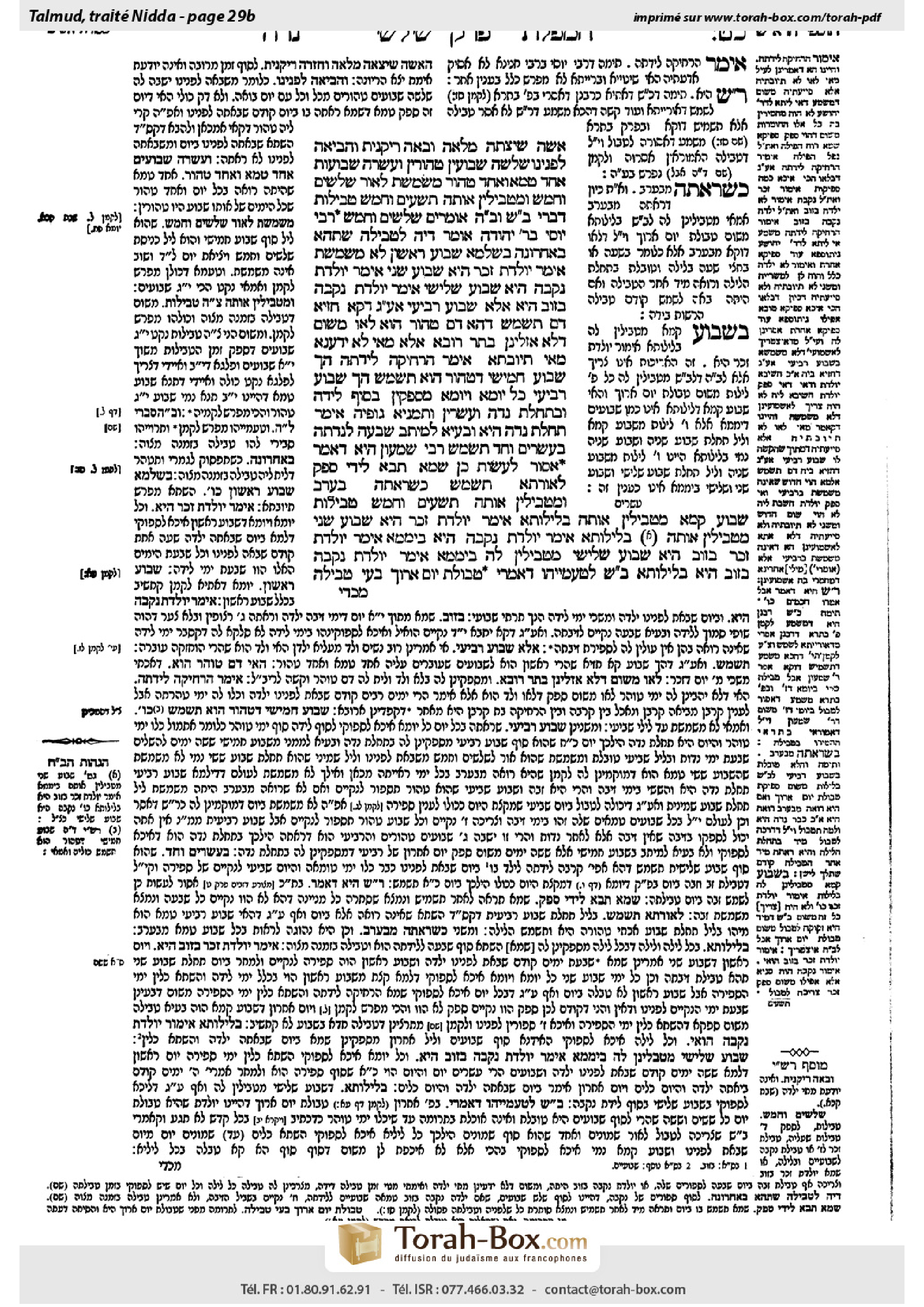
Niddah 29b: Talmud study for Daf Yomi
Daf Yomi is the daily study of one Talmud folio. Explore 37 tractates with scans, Hebrew text, Sefaria English and AI-generated French translations where annotated.
Passage selection and English or AI-generated French translation are available where the scan has annotations. Daf Study is independent of Torah-Box and Sefaria.
Browse Niddah · נידה · All tractatesNiddah 29b text and translations
This page of Niddah includes the Aramaic text, an English translation and an AI-generated French translation, alongside the scan above.
נידה כ״ט ב · Aramaic and Hebrew text
אִשָּׁה שֶׁיָּצְתָה מְלֵאָה וּבָאָה רֵיקָנִית, וְהֵבִיאָה לְפָנֵינוּ שְׁלֹשָׁה שָׁבוּעִין טְהוֹרִין, וַעֲשָׂרָה שְׁבוּעוֹת אֶחָד טָמֵא וְאֶחָד טָהוֹר.
מְשַׁמֶּשֶׁת לְאוֹר שְׁלֹשִׁים וְחָמֵשׁ, וּמַטְבִּילִין אוֹתָהּ תִּשְׁעִים וְחָמֵשׁ טְבִילוֹת, דִּבְרֵי בֵּית שַׁמַּאי. וּבֵית הִלֵּל אוֹמְרִים: שְׁלֹשִׁים וְחָמֵשׁ. רַבִּי יוֹסֵי בְּרַבִּי יְהוּדָה אוֹמֵר: דַּיָּהּ לַטְּבִילָה שֶׁתְּהֵא בָּאַחֲרוֹנָה.
בִּשְׁלָמָא שָׁבוּעַ רִאשׁוֹן לֹא מְשַׁמֶּשֶׁת, אֵימַר: יוֹלֶדֶת זָכָר הִיא; שָׁבוּעַ שֵׁנִי, אֵימַר: יוֹלֶדֶת נְקֵבָה הִיא;
שָׁבוּעַ שְׁלִישִׁי, אֵימַר: יוֹלֶדֶת נְקֵבָה בְּזוֹב הִיא;
אֶלָּא שָׁבוּעַ רְבִיעִי, אַף עַל גַּב דְּקָא חָזְיָא דָּם — תְּשַׁמֵּשׁ, דְּהָא דָּם טָהוֹר הוּא. לָאו מִשּׁוּם דְּלָא אָזְלִינַן בָּתַר רוּבָּא?
אֶלָּא מַאי ״לָא יָדַעְנָא מַאי תְּיוּבְתָּא״? אֵימַר: הִרְחִיקָה לֵידָתָהּ.
הָךְ שְׁבוּעַ חֲמִישִׁי דְּטָהוֹר הוּא, תְּשַׁמֵּשׁ!
הָךְ שָׁבוּעַ רְבִיעִי, כֹּל יוֹמָא וְיוֹמָא מַסְפְּקִינַן בְּסוֹף לֵידָה וּבִתְחִלַּת נִדָּה, וְעֶשְׂרִין וּתְמָנְיָא גּוּפֵיהּ אֵימַר תְּחִלַּת נִדָּה הִיא, וּבָעֲיָא לְמֵיתַב שִׁבְעָה לְנִדָּתָהּ.
בְּעֶשְׂרִים וְחַד תְּשַׁמֵּשׁ!
רַבִּי שִׁמְעוֹן הִיא, דְּאָמַר: ״אָסוּר לַעֲשׂוֹת כֵּן״, שֶׁמָּא תָּבֹא לִידֵי סָפֵק. לְאוּרְתָּא תְּשַׁמֵּשׁ? כְּשֶׁרָאֲתָה בָּעֶרֶב.
וּמַטְבִּילִין אוֹתָהּ תִּשְׁעִים וְחָמֵשׁ טְבִילוֹת. שָׁבוּעַ קַמָּא מַטְבִּילִין אוֹתָהּ בְּלֵילָוָתָא, אֵימַר יוֹלֶדֶת זָכָר הִיא.
שָׁבוּעַ שֵׁנִי, מַטְבִּילִין אוֹתָהּ בְּלֵילָוָתָא, אֵימַר: יוֹלֶדֶת נְקֵבָה הִיא. (בִּימָמָא) [בִּימָמֵי], אֵימַר: יוֹלֶדֶת זָכָר בְּזוֹב הִיא.
שָׁבוּעַ שְׁלִישִׁי מַטְבִּילִין לַהּ (בִּימָמָא) [בִּימָמֵי], אֵימַר: יוֹלֶדֶת נְקֵבָה בְּזוֹב הִיא.
בְּלֵילָוָתָא, בֵּית שַׁמַּאי לְטַעְמַיְיהוּ, דְּאָמְרִי: טְבוּלַת יוֹם אָרוֹךְ בָּעֵי טְבִילָה.
Niddah 29b · English translation
A woman left home for an extended period of time while she was full, i.e., pregnant, and came back when she was empty, as she discharged the fetus, but it is unknown exactly when and what she discharged; and she spent three weeks in our presence during which she was pure, i.e., she did not experience any bleeding, and for the following ten weeks she alternated between one impure week, in which she experienced bleeding every day, and one pure week, in which she did not experience bleeding at all.
In such a case, the woman may engage in intercourse with her husband at the end of the fifth week following her return, on the eve of the thirty-fifth day, after which she is again prohibited from engaging in intercourse with her husband. And we require her to immerse in a ritual bath a total of ninety-five immersions. This is the statement of Beit Shammai. And Beit Hillel say that she is required to immerse thirty-five times. Rabbi Yosei, son of Rabbi Yehuda, says: She is required to immerse only once, as it is sufficient for the immersion to be at the end of the period when she is required to immerse every day. The entire baraita will be explained below.
The Gemara explains the objection from the baraita to the opinion of Rabbi Yehoshua ben Levi: Granted in the first week following her arrival the woman may not engage in intercourse with her husband, despite the fact that she did not experience bleeding during that week, as one can say that perhaps she is a woman who gave birth to a male just before her arrival, which would mean that the first week is her seven-day period of impurity. Likewise, it is clear that the woman may not engage in intercourse with her husband during the second week after her arrival, as one can say that she is a woman who gave birth to a female, and consequently her period of impurity is two weeks long.
It is also clear why she may not engage in intercourse during the third week, as one can say that perhaps she is a woman who gave birth to a female as a zava, i.e., a woman who experienced a discharge of uterine blood after her menstrual period for three days without the pain of labor, and therefore assumed the status of a zava before giving birth. If so, she must count seven clean days after her two-week period of impurity, and subsequently immerse.
But in the fourth week, even though the woman sees blood during that period, let her engage in intercourse with her husband, as it is pure blood. At this stage the woman’s period of purity is certainly underway. Why does the baraita state that she may not engage in intercourse with her husband in this week? Is it not due to the concern that she might have discharged an item that was not a full-fledged offspring? Evidently, although most pregnant women give birth to full-fledged offspring, we do not follow the majority, which contradicts the opinion of Rabbi Yehoshua ben Levi.
The Gemara asks: Rather, as this is apparently a valid objection, what is the reason that Ravin said: I do not know what the objection to the opinion of Rabbi Yehoshua ben Levi is? The Gemara explains: Perhaps it is in fact assumed that the woman gave birth to a full-fledged offspring, in accordance with the opinion of Rabbi Yehoshua ben Levi, and the reason she is not considered pure in the fourth week after her arrival is that one can say that her birth was distant, i.e., she gave birth a long time before her arrival, and therefore her period of purity had already ended before the fourth week.
§ The Gemara further analyzes the above baraita: During this fifth week, when the woman is pure, as she did not experience any bleeding, let her engage in intercourse with her husband. Why is she permitted to do so only on the eve of the thirty-fifth day, at the end of the fifth week?
The Gemara answers: During this fourth week, when she experiences bleeding every day, we are uncertain with regard to each and every day as to whether it is the end of the woman’s period of purity as a woman after childbirth, and that it is therefore the beginning of the seven-day period that she must observe as a menstruating woman. And with regard to the twenty-eighth day itself, the last day of the fourth week, one can also say that it is after the last day of her period of purity and the beginning of her period as a menstruating woman, and therefore she is required to observe seven days for her menstruation, which end on the thirty-fourth day after her arrival. Consequently, the woman may engage in intercourse with her husband only on the eve of the thirty-fifth day.
The Gemara further inquires: As explained above, the reason it is prohibited for the woman to engage in intercourse during the third week is that she might have given birth just before arriving and had been a zava at the time, and therefore after observing the two weeks of impurity of a woman after childbirth, she must observe an additional seven days of impurity as a zava. A zava may undergo her purification process on the seventh day of her impurity, following which she is permitted to engage in intercourse. Accordingly, let the woman engage in intercourse on the twenty-first day after her arrival.
The Gemara answers: The halakha in this baraita is in accordance with the opinion of Rabbi Shimon, who said that it is prohibited for a woman to do so, i.e., to engage in intercourse on the seventh day of her ziva after immersing in a ritual bath, lest she come to a case of uncertainty. If she engages in intercourse on that seventh day after immersion, and subsequently experiences bleeding on that same day, it retroactively nullifies her entire seven clean days, and it turns out that she engaged in intercourse while she was impure. The Gemara continues to ask: Even so, let her engage in intercourse that night, after having completed seven clean days. The Gemara answers: The baraita is referring to a case when the woman saw blood in the evening, i.e., her fourth week of experiencing bleeding started in the nighttime.
§ The Gemara analyzes the statement of Beit Shammai: And we require the woman to immerse in a ritual bath for a total of ninety-five immersions. The Gemara explains: During the first week she is required to immerse at night, every night of the week. The reason is that as the date of her childbirth and the sex of the offspring are unknown, one can say that she is a woman who gave birth to a male. If so, the seven days of impurity might have ended on any night of the first week, and therefore she must immerse in a ritual bath on each night.
During the second week, she is required to immerse at night, every night, as one can say that she is a woman who gave birth to a female, and therefore it is possible that her fourteen-day period of impurity ended on any of the nights of the second week. She must also immerse every day of the second week in the daytime, as one can say that she is a woman who gave birth to a male as a zava. If so, it is possible that her seven-day period of impurity as a woman after childbirth ended on any given day during the first week, after which she must start to count seven clean days as a zava. These seven days necessarily culminate during the second week, and the halakha is that a woman must immerse in a ritual bath on the morning when her seven clean days of ziva conclude.
During the third week, she is required to immerse every day in the daytime, as one can say that she is a woman who gave birth to a female as a zava, and consequently her fourteen-day period of impurity as a woman after childbirth ended during the second week. Therefore, the woman’s seven clean days as a zava might end on any day of the third week, and she is obligated to immerse on that morning.
She is also required to immerse on every night of the third week, according to Beit Shammai. Beit Shammai conform to their line of reasoning, as they say in a mishna (71b) that a woman who finished her period of purity after childbirth, referred to as a woman who immersed that long day and is waiting for her purification process to be completed, requires immersion at the end of this period. The woman must therefore immerse on every night of the third week, in case that night is the end of her period of purity, for a total of thirty-five immersions by the end of the week. She must continue to immerse every night until her period of purity is certainly over, no matter when she gave birth, i.e., until the eightieth day since her arrival.
Niddah 29b · Traduction française (IA)
Une femme est partie de chez elle pour une longue période alors qu’elle était pleine, c’est-à-dire enceinte, et elle est revenue alors qu’elle était vide, après avoir expulsé le fœtus, mais on ignore exactement quand et ce qu’elle a expulsé. Elle a passé trois semaines en notre présence pendant lesquelles elle était pure, c’est-à-dire qu’elle n’a eu aucun saignement, puis, durant les dix semaines suivantes, elle a alterné entre une semaine d’impureté, au cours de laquelle elle a eu des saignements chaque jour, et une semaine de pureté, au cours de laquelle elle n’a eu aucun saignement.
Dans un tel cas, la femme peut avoir des relations conjugales avec son mari à la fin de la cinquième semaine suivant son retour, la veille du trente-cinquième jour ; après quoi, il lui est de nouveau interdit d’avoir des relations conjugales avec lui. On lui impose de s’immerger au bain rituel un total de quatre-vingt-quinze fois. Telle est la déclaration de Beit Shammaï. Beit Hillel disent qu’elle doit s’immerger trente-cinq fois. Rabbi Yosei, fils de Rabbi Yehuda, dit : « Elle ne doit s’immerger qu’une seule fois, car il suffit qu’elle s’immerge à la fin de la période durant laquelle elle est tenue de s’immerger chaque jour. » Toute la baraïta sera expliquée plus loin.
La Guemara explique l’objection que la baraïta oppose à l’avis de Rabbi Yehoshua ben Levi : il est compréhensible que la femme ne puisse pas avoir de relations conjugales avec son mari durant la première semaine suivant son arrivée, bien qu’elle n’ait eu aucun saignement pendant cette semaine, car on peut dire qu’elle a accouché d’un garçon juste avant son arrivée, auquel cas la première semaine correspond à ses sept jours d’impureté. De même, il est clair qu’elle ne peut pas avoir de relations conjugales avec son mari durant la deuxième semaine après son arrivée, car on peut dire qu’elle a accouché d’une fille et que, par conséquent, sa période d’impureté dure deux semaines.
Il est également clair pourquoi elle ne peut pas avoir de relations conjugales durant la troisième semaine : on peut dire qu’elle a accouché d’une fille alors qu’elle était zava, c’est-à-dire qu’elle a eu un écoulement de sang utérin pendant trois jours après sa période menstruelle, sans les douleurs de l’accouchement, et qu’elle a donc acquis le statut de zava avant d’accoucher. Dans ce cas, elle doit compter sept jours purs après ses deux semaines d’impureté, puis s’immerger.
Mais durant la quatrième semaine, bien que la femme voie du sang pendant cette période, qu’elle ait des relations conjugales avec son mari, puisque ce sang est pur. À ce stade, la période de pureté de la femme a certainement commencé. Pourquoi la baraïta dit-elle qu’elle ne peut pas avoir de relations conjugales avec son mari cette semaine-là ? N’est-ce pas par crainte qu’elle ait expulsé quelque chose qui ne soit pas un véritable fœtus ? De toute évidence, bien que la plupart des femmes enceintes accouchent d’un enfant viable, nous ne suivons pas la majorité, ce qui contredit l’avis de Rabbi Yehoshua ben Levi.
La Guemara demande : Dès lors, puisque cette objection semble valable, pourquoi Ravin a-t-il dit : « Je ne sais pas quelle est l’objection à l’avis de Rabbi Yehoshua ben Levi » ? La Guemara explique : peut-être considère-t-on en fait que la femme a accouché d’un enfant viable, conformément à l’avis de Rabbi Yehoshua ben Levi ; si elle n’est pas considérée comme pure durant la quatrième semaine après son arrivée, c’est parce qu’on peut dire que son accouchement remonte à longtemps, c’est-à-dire qu’elle a accouché bien avant son arrivée, de sorte que sa période de pureté était déjà terminée avant la quatrième semaine.
§ La Guemara examine plus avant la baraïta citée précédemment : durant cette cinquième semaine, alors que la femme est pure puisqu’elle n’a eu aucun saignement, qu’elle ait des relations conjugales avec son mari. Pourquoi ne lui est-il permis de le faire que la veille du trente-cinquième jour, à la fin de la cinquième semaine ?
La Guemara répond : durant cette quatrième semaine, où elle a des saignements chaque jour, nous doutons, pour chacun des jours, qu’il marque la fin de la période de pureté de la femme après l’accouchement et, par conséquent, le début des sept jours qu’elle doit observer en tant que femme menstruée. On peut également dire que le vingt-huitième jour lui-même, dernier jour de la quatrième semaine, survient après le dernier jour de sa période de pureté et marque le début de sa période menstruelle ; elle doit donc observer sept jours de menstruation, qui s’achèvent le trente-quatrième jour après son arrivée. Par conséquent, elle ne peut avoir des relations conjugales avec son mari que la veille du trente-cinquième jour.
La Guemara pose une autre question : comme expliqué précédemment, il est interdit à la femme d’avoir des relations conjugales durant la troisième semaine parce qu’elle pourrait avoir accouché juste avant son arrivée et avoir alors été zava ; après avoir observé les deux semaines d’impureté de la femme après l’accouchement, elle doit donc observer sept jours d’impureté supplémentaires en tant que zava. Une zava peut entamer son processus de purification le septième jour de son impureté, après quoi elle est autorisée à avoir des relations conjugales. En conséquence, qu’elle ait des relations conjugales le vingt et unième jour après son arrivée.
La Guemara répond : la halakha de cette baraïta est conforme à l’avis de Rabbi Shimon, qui a dit qu’il est interdit à une femme de le faire, c’est-à-dire d’avoir des relations conjugales le septième jour de sa période de ziva après s’être immergée au bain rituel, de peur qu’elle ne se trouve confrontée à une situation douteuse. Si elle a des relations conjugales ce septième jour après l’immersion, puis a des saignements le même jour, cela annule rétroactivement l’ensemble de ses sept jours purs, et il s’avère qu’elle a eu des relations conjugales alors qu’elle était impure. La Guemara poursuit : malgré tout, qu’elle ait des relations conjugales cette nuit-là, après avoir achevé sept jours purs. La Guemara répond : la baraïta traite d’un cas où la femme a vu du sang le soir, c’est-à-dire que sa quatrième semaine de saignements a commencé pendant la nuit.
§ La Guemara examine la déclaration de Beit Shammaï : « On impose à la femme de s’immerger au bain rituel un total de quatre-vingt-quinze fois. » La Guemara explique : durant la première semaine, elle doit s’immerger chaque nuit. En effet, puisque la date de son accouchement et le sexe de l’enfant sont inconnus, on peut dire qu’elle a accouché d’un garçon. Dans ce cas, ses sept jours d’impureté pourraient s’être achevés n’importe quelle nuit de la première semaine ; elle doit donc s’immerger au bain rituel chaque nuit.
Durant la deuxième semaine, elle doit s’immerger chaque nuit, car on peut dire qu’elle a accouché d’une fille et que sa période de quatorze jours d’impureté s’est donc achevée n’importe laquelle des nuits de la deuxième semaine. Elle doit également s’immerger chaque jour de la deuxième semaine, pendant la journée, car on peut dire qu’elle a accouché d’un garçon alors qu’elle était zava. Dans ce cas, il est possible que sa période de sept jours d’impureté en tant que femme après l’accouchement se soit achevée un jour quelconque de la première semaine, après quoi elle doit commencer à compter sept jours purs en tant que zava. Ces sept jours s’achèvent nécessairement durant la deuxième semaine, et la halakha veut qu’une femme s’immerge au bain rituel le matin où s’achèvent ses sept jours purs de ziva.
Durant la troisième semaine, elle doit s’immerger chaque jour pendant la journée, car on peut dire qu’elle a accouché d’une fille alors qu’elle était zava et que sa période de quatorze jours d’impureté en tant que femme après l’accouchement s’est donc achevée durant la deuxième semaine. Par conséquent, les sept jours purs de la femme en tant que zava pourraient s’achever n’importe quel jour de la troisième semaine, et elle est tenue de s’immerger ce matin-là.
Selon Beit Shammaï, elle doit également s’immerger chaque nuit de la troisième semaine. Beit Shammaï restent cohérents avec leur raisonnement, car ils disent dans une Michna (71b) qu’une femme dont la période de pureté après l’accouchement est terminée — désignée comme une femme qui s’est immergée durant cette longue journée et attend que son processus de purification soit achevé — doit s’immerger à la fin de cette période. La femme doit donc s’immerger chaque nuit de la troisième semaine, au cas où cette nuit marquerait la fin de sa période de pureté, ce qui porte le total à trente-cinq immersions à la fin de la semaine. Elle doit continuer à s’immerger chaque nuit jusqu’à ce que sa période de pureté soit certainement terminée, quelle que soit la date de son accouchement, c’est-à-dire jusqu’au quatre-vingtième jour après son arrivée.
Traduction française générée par IA à partir de l’édition anglaise de Sefaria. Vérifie toujours un passage avec le texte source.
Text from Sefaria: William Davidson Edition - Vocalized Aramaic (CC BY NC); William Davidson Edition - English (CC BY NC).