Niddah 30a: Talmud study for Daf Yomi
Daf Yomi is the daily study of one Talmud folio. Explore 37 tractates with scans, Hebrew text, Sefaria English and AI-generated French translations where annotated.
Passage selection and English or AI-generated French translation are available where the scan has annotations. Daf Study is independent of Torah-Box and Sefaria.
Browse Niddah · נידה · All tractatesNiddah 30a text and translations
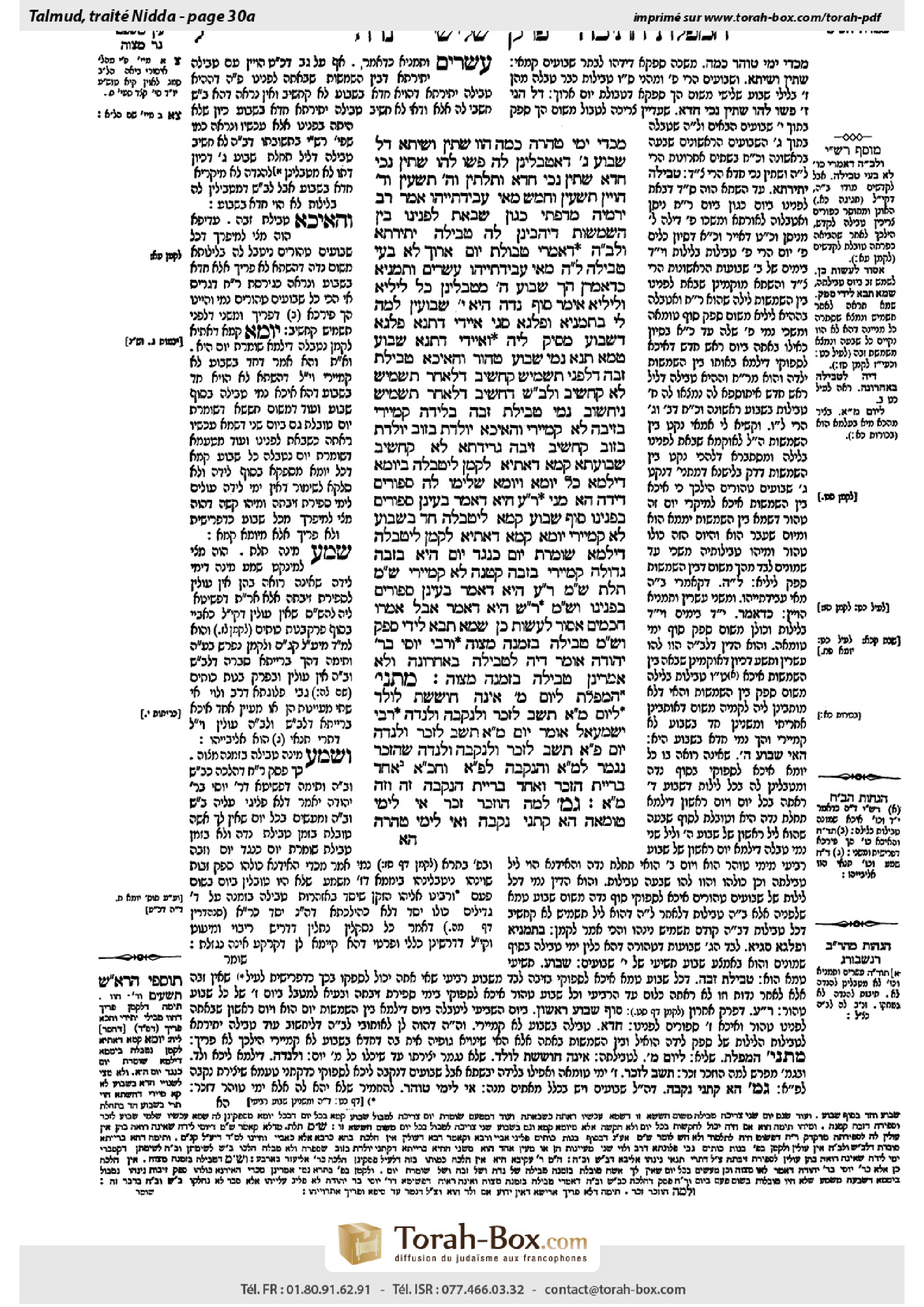
This page of Niddah includes the Aramaic text, an English translation and an AI-generated French translation, alongside the scan above.
נידה ל׳ א · Aramaic and Hebrew text
מִכְּדֵי יְמֵי טׇהֳרָה כַּמָּה הָווּ? שִׁתִּין וְשִׁיתָּא. דַּל שָׁבוּעַ שְׁלִישִׁי דְּאַטְבְּלִינַן לַהּ, פָּשׁוּ לְהוּ שִׁתִּין נְכֵי חֲדָא. שִׁתִּין נְכֵי חֲדָא וּתְלָתִין וַחֲמֵשׁ — תִּשְׁעִין וְאַרְבַּע הָוְיָין, תִּשְׁעִין וַחֲמֵשׁ מַאי עֲבִידְתַּיְיהוּ?
אָמַר רַב יִרְמְיָה מִדִּפְתִּי: כְּגוֹן שֶׁבָּאת לְפָנֵינוּ בֵּין הַשְּׁמָשׁוֹת, דְּיָהֲבִינַן לַהּ טְבִילָה יַתִּירְתָּא.
וּלְבֵית הִלֵּל, דְּאָמְרִי: טְבוּלַת יוֹם אָרוֹךְ לָא בָּעֵי טְבִילָה, תְּלָתִין וַחֲמֵשׁ מַאי עֲבִידְתַּיְיהוּ?
עֶשְׂרִים וּתְמָנְיָא, כְּדַאֲמַרַן. הָךְ שָׁבוּעַ חֲמִישִׁי מַטְבְּלִינַן כֹּל לֵילְיָא וְלֵילְיָא, אֵימַר: סוֹף נִדָּה הִיא.
עַשְׂרָה שָׁבוּעִין לְמָה לִי? בִּתְמָנְיָא וּפַלְגָא סַגִּי!
אַיְּידֵי דִּתְנָא פַּלְגָא דְּשָׁבוּעַ, מַסֵּיק לֵיהּ, וְאַיְּידֵי דִּתְנָא ״שָׁבוּעַ טָמֵא״, תְּנָא נָמֵי ״שָׁבוּעַ טָהוֹר״.
וְהָאִיכָּא טְבִילַת זָבָה!
דְּלִפְנֵי תַּשְׁמִישׁ קָחָשֵׁיב, דִּלְאַחַר תַּשְׁמִישׁ לָא קָחָשֵׁיב.
וּלְבֵית שַׁמַּאי, דְּחָשֵׁיב דִּלְאַחַר תַּשְׁמִישׁ, נִיחְשׁוֹב נָמֵי טְבִילַת זָבָה! בְּלֵידָה קָמַיְירֵי, בְּזִיבָה לָא קָמַיְירֵי.
וְהָאִיכָּא יוֹלֶדֶת בְּזוֹב? יוֹלֶדֶת בְּזוֹב קָחָשֵׁיב, זִיבָה גְּרֵידְתָּא לָא קָחָשֵׁיב.
(שבועתא) [שָׁבוּעַ] קַמָּא דְּאָתְיָא לְקַמַּן, לַיטְבְּלַהּ בְּיוֹמָא, דִּילְמָא כֹּל יוֹמָא וְיוֹמָא שְׁלִימוּ לַהּ סְפוּרִים דִּידַהּ!
הָא מַנִּי? רַבִּי עֲקִיבָא הִיא, דְּאָמַר: בָּעֵינַן סְפוּרִים בְּפָנֵינוּ.
סוֹף שָׁבוּעַ קַמָּא לַיטְבְּלַהּ! חַד בְּשָׁבוּעַ לָא קָמַיְירֵי.
יוֹמָא קַמָּא דְּאָתְיָא לְקַמַּן לַיטְבְּלַהּ, דִּילְמָא שׁוֹמֶרֶת יוֹם כְּנֶגֶד יוֹם הִיא! בְּזָבָה גְּדוֹלָה קָמַיְירֵי, בְּזָבָה קְטַנָּה — לָא קָמַיְירֵי.
שְׁמַע מִינַּהּ תְּלָת, שְׁמַע מִינַּהּ: רַבִּי עֲקִיבָא הִיא, דְּאָמַר: בָּעֵינַן סְפוּרִים בְּפָנֵינוּ.
וּשְׁמַע מִינַּהּ: רַבִּי שִׁמְעוֹן הִיא, דְּאָמַר: אֲבָל אָמְרוּ חֲכָמִים אָסוּר לַעֲשׂוֹת כֵּן, שֶׁמָּא תָּבֹא לִידֵי סָפֵק.
וּשְׁמַע מִינַּהּ: טְבִילָה בִּזְמַנָּהּ מִצְוָה, וְרַבִּי יוֹסֵי בְּרַבִּי יְהוּדָה אוֹמֵר: דַּיָּהּ לִטְבִילָה בָּאַחֲרוֹנָה, וְלָא אָמְרִינַן טְבִילָה בִּזְמַנָּהּ מִצְוָה.
מַתְנִי' הַמַּפֶּלֶת לְיוֹם אַרְבָּעִים — אֵינָהּ חוֹשֶׁשֶׁת לְוָלָד, לְיוֹם אַרְבָּעִים וְאֶחָד — תֵּשֵׁב לְזָכָר וְלִנְקֵבָה וּלְנִדָּה.
רַבִּי יִשְׁמָעֵאל אוֹמֵר: יוֹם אַרְבָּעִים וְאֶחָד תֵּשֵׁב לְזָכָר וּלְנִדָּה, יוֹם שְׁמוֹנִים וְאֶחָד תֵּשֵׁב לְזָכָר וְלִנְקֵבָה וּלְנִדָּה, שֶׁהַזָּכָר נִגְמָר לְאַרְבָּעִים וְאֶחָד, וְהַנְּקֵבָה לִשְׁמוֹנִים וְאֶחָד. וַחֲכָמִים אוֹמְרִים: אֶחָד בְּרִיַּית הַזָּכָר וְאֶחָד בְּרִיַּית הַנְּקֵבָה — זֶה וָזֶה אַרְבָּעִים וְאֶחָד.
גְּמָ' לָמָּה הוּזְכַּר זָכָר?
אִי לִימֵי טוּמְאָה — הָא קָתָנֵי נְקֵבָה, וְאִי לִימֵי טׇהֳרָה
Niddah 30a · English translation
The Gemara asks: Now consider, how many days of purity are there, in the case of a woman who gave birth to a female? There are sixty-six days. Therefore, in order to account for all of the nights that might occur immediately after the woman’s period of purity, she must immerse on sixty-six nights, according to Beit Shammai. Remove from this sum the immersions of the third week, when we require the woman to immerse seven times, and sixty less one are left. These sixty-less-one times she immerses after the third week and the thirty-five times she immerses during the first three weeks are together ninety-four immersions. If so, those ninety-five immersions, required by Beit Shammai, what is their purpose? Why do they require an extra immersion?
Rav Yirmeya of Difti says: The baraita is referring to a case where the woman came before us, i.e., she returned from her journey, during twilight, when it is halakhically uncertain whether it is day or night. The ruling is that in this case we give her another immersion, i.e., she is obligated to immerse on an additional day, in case she completed her days of impurity on the day she arrived, and that night is the night she must immerse.
The Gemara asks: And according to Beit Hillel, who say that a woman who immersed that long day, i.e., a woman observing her period of purity after childbirth, does not require immersion once her period of purity is over, those thirty-five immersions that they require, what is their purpose?
The Gemara answers: Twenty-eight immersions are required as we said above, i.e., due to the end of the period of impurity in case the woman gave birth to a male or to a female, and due to the completion of the woman’s seven clean days in case she gave birth as a zava. In addition, during this fifth week we require the woman to immerse each and every night, as one can say that it is the end of her seven-day period as a menstruating woman.
The Gemara raises a further difficulty: Why do I need the baraita to state that after the woman did not experience any bleeding for the first three weeks after arriving, she alternated for ten weeks between experiencing bleeding every day for a week and not experiencing any bleeding for a week. How does this detail contribute to Beit Shammai’s ruling that the woman must immerse ninety-five times? After all, eight and a half weeks are sufficient. Combined with the first three weeks after the woman’s arrival, this period amounts to eighty days, which is the number of days on which the woman must immerse according to Beit Shammai, as each day might be the last of her period of purity.
The Gemara answers: Although eight and a half weeks are sufficient, since the baraita must teach half a week, it completes that week, for a total of nine weeks. And since the baraita teaches with regard to the ninth week that the woman is impure, it also taught with regard to the tenth week that the woman is pure, in accordance with the pattern of a week of purity following every week of impurity.
With regard to the opinion of Beit Hillel that the woman immerses only thirty-five times, the Gemara asks: But isn’t there the immersion that the woman is obligated to perform due to the possibility that she is a zava? It is possible that by the fourth week, the woman’s period of purity after childbirth has already ended, and the bleeding she experiences that week is menstrual blood, in which case the next week that she sees blood renders her a zava. If so, she must immerse at the end of that week, after counting seven clean days. The same applies to all the other weeks on which she experiences bleeding, apart from the fourth. Consequently, there are additional immersions not counted by Beit Hillel.
The Gemara answers: Beit Hillel count only the times that the woman is obligated to immerse before she is permitted to engage in intercourse with her husband, which amount to thirty-five. They do not count the times that she must immerse after she is permitted to engage in intercourse with her husband.
The Gemara asks: But according to Beit Shammai, who count the times that the woman is obligated to immerse after she is permitted to engage in intercourse in their total of ninety-five immersions, let them also count those immersions in which the woman is obligated due to the possibility that she is a zava. The Gemara answers: Beit Shammai deal with immersions that are due to the woman’s childbirth; they do not deal with immersions that are due to the possibility of ziva.
The Gemara questions this response: But there are immersions counted by Beit Shammai that are due to the possibility that she is a woman who gave birth as a zava. These immersions serve to purify the woman from her status as a zava, not as a woman after childbirth. The Gemara answers: Beit Shammai count immersions that are due to the possibility that she is a woman who gave birth as a zava. In such a scenario, immersion is delayed due to the childbirth, and is performed when the woman’s impurity period of ziva following childbirth is over. Therefore, these immersions are considered as connected to the childbirth. But Beit Shammai do not count immersions that are due to ziva alone.
§ With regard to the statement of the baraita that the woman immerses on every night of the first week in case her period of impurity after childbirth just ended, the Gemara asks: Besides immersing on every night of the first week after she came before us, let the woman immerse during the daytime of every day of that week as well, as perhaps she is a zava, and on each and every day it is possible that her counting of clean days are completed, and she must therefore immerse that morning. Accordingly, seven more immersions should be added to the count.
The Gemara answers: In accordance with whose opinion is this statement? It is in accordance with the opinion of Rabbi Akiva, who said that we require that the seven clean days of a zava must be counted in our presence, i.e., they must actually be counted. Since she did not know she should count before she arrived, she did not begin counting prior to her arrival. Therefore, her seven clean days begin only once she arrives, and she cannot immerse from her status as a zava of uncertain status before the end of the first week.
The Gemara raises a further difficulty: Even so, let her immerse at the end of the first week, on the morning of the seventh day, after counting seven clean days following her return. This adds one more immersion to the count. The Gemara answers: The baraita is not dealing with immersions that the woman is obligated to perform once a week.
The Gemara further inquires: Let the woman immerse on the first day that she came before us, as perhaps she is a lesser zava, i.e., a woman who experienced a discharge of uterine blood after her menstrual period for one or two consecutive days, and who therefore observes a clean day for a day she experiences a discharge. The Gemara answers: The baraita is dealing with a greater zava alone, i.e., one who experienced a discharge for three consecutive days and must therefore count seven clean days before immersing; it is not dealing with a lesser zava.
§ The Gemara summarizes its analysis of the baraita: Conclude from it three conclusions. Conclude from it that the baraita is in accordance with the opinion of Rabbi Akiva, who said that we require that the seven clean days of a zava must be counted in our presence.
And conclude from it that the baraita is in accordance with the opinion of Rabbi Shimon, who says that it is permitted in principle for a zava to engage in intercourse with her husband on her seventh clean day after immersing in a ritual bath, but that the Sages said that it is prohibited for her to do so, lest she come to a case of uncertainty, i.e., in case she experiences a discharge of blood after engaging in intercourse, which retroactively nullifies her entire seven clean days and renders her impure.
And finally, conclude from it that immersion at its proper time is a mitzva, which is why the woman immerses every day despite the fact it remains prohibited for her to engage in intercourse. But Rabbi Yosei, son of Rabbi Yehuda, says: It is sufficient for the immersion to be at the end, and we do not say that immersion at its proper time is a mitzva in its own right. Consequently, the woman is obligated to perform only one immersion.
MISHNA: A woman who discharges on the fortieth day since she immersed herself and engaged in intercourse with her husband need not be concerned that it might have been an offspring and she became impure with its miscarriage, as the formation of the offspring in the womb occurs only forty days after conception. But in the case of a woman who discharges on the forty-first day after immersion, there is concern that perhaps it was an offspring. Since its sex is unknown, she shall observe the period of impurity for a woman who gave birth to a male and for a woman who gave birth to a female; and for any blood that she sees, she observes the halakhot of a menstruating woman.
Rabbi Yishmael says: A woman who discharges on the forty-first day after immersion observes the seven days of impurity for a woman who gave birth to a male; and for any blood that she sees after seven days, she observes the halakhot of a menstruating woman. But a woman who discharges on the eighty-first day after immersion observes the strictures of a woman who gave birth both to a male and to a female, and also the strictures of a menstruating woman, as the formation of the male offspring concludes on the forty-first day and the formation of the female offspring concludes on the eighty-first day. And the Rabbis say: With regard to both the formation of the male and the formation of the female, this and that conclude on the forty-first day.
GEMARA: The Gemara discusses the statement of the mishna that a woman who discharges on the forty-first day after immersion observes the strictures of a woman who gave birth to both a male and a female, and the strictures of a menstruating woman. Why are the strictures of a woman who gave birth to a male mentioned in this statement? What additional strictures must the woman observe due to the possibility that she gave birth to a male, over and above those she observes for the birth of a female?
If these strictures are mentioned due to the days of impurity that a woman who gave birth to a male must observe, doesn’t the mishna in any case teach that the woman observes the strictures of a woman who gave birth to a female? The seven days of impurity that are observed by a woman who gave birth to a male are included in the fourteen days of impurity that she observes for a female. And if these strictures are mentioned due to the days of purity that are observed by a woman who gave birth to a male, which are fewer than the days of purity that are observed for the birth of a female,
Niddah 30a · Traduction française (IA)
La Guemara demande : Considérons maintenant le nombre de jours de pureté dans le cas d’une femme qui a donné naissance à une fille : il y en a soixante-six. Par conséquent, pour tenir compte de toutes les nuits qui peuvent survenir immédiatement après sa période de pureté, elle doit s’immerger pendant soixante-six nuits, selon Beit Chammaï. Retranchons de ce total les immersions de la troisième semaine, où l’on exige qu’elle s’immerge sept fois : il en reste cinquante-neuf. Ces cinquante-neuf immersions, qu’elle effectue après la troisième semaine, et les trente-cinq immersions qu’elle effectue pendant les trois premières semaines donnent ensemble quatre-vingt-quatorze immersions. Si tel est le cas, à quoi servent les quatre-vingt-quinze immersions exigées par Beit Chammaï ? Pourquoi exigent-ils une immersion supplémentaire ?
Rav Yirmeya de Difti dit : La baraïta traite d’un cas où la femme s’est présentée devant nous, c’est-à-dire qu’elle est revenue de son voyage, au crépuscule, moment où il existe une incertitude halakhique quant au fait qu’il fasse jour ou nuit. Dans ce cas, on lui impose une immersion supplémentaire, c’est-à-dire qu’elle doit s’immerger un jour de plus, au cas où elle aurait achevé ses jours d’impureté le jour de son arrivée et où cette nuit serait celle où elle doit s’immerger.
La Guemara demande : Et selon Beit Hillel, qui disent qu’une femme qui s’est immergée pendant ce long jour, c’est-à-dire une femme qui observe sa période de pureté après un accouchement, n’a pas besoin de s’immerger une fois cette période de pureté terminée, à quoi servent les trente-cinq immersions qu’ils exigent ?
La Guemara répond : Vingt-huit immersions sont exigées, comme nous l’avons dit plus haut, en raison de la fin de la période d’impureté au cas où la femme aurait donné naissance à un garçon ou à une fille, et en raison de l’achèvement de ses sept jours de pureté au cas où elle aurait accouché en tant que zava. En outre, pendant cette cinquième semaine, on exige qu’elle s’immerge chaque nuit, car on peut supposer que sa période de sept jours de menstruation s’achève alors.
La Guemara soulève une autre difficulté : Pourquoi la baraïta précise-t-elle qu’après n’avoir eu aucun saignement pendant les trois premières semaines suivant son arrivée, la femme a alterné pendant dix semaines entre une semaine où elle saignait chaque jour et une semaine sans aucun saignement ? En quoi ce détail contribue-t-il à l’explication de la décision de Beit Chammaï selon laquelle la femme doit s’immerger quatre-vingt-quinze fois ? Après tout, huit semaines et demie suffisent. Ajoutée aux trois premières semaines suivant l’arrivée de la femme, cette période totalise quatre-vingts jours où elle doit s’immerger selon Beit Chammaï, puisque chacun de ces jours peut être le dernier de sa période de pureté.
La Guemara répond : Bien que huit semaines et demie suffisent, puisque la baraïta doit mentionner une demi-semaine, elle complète cette semaine, ce qui fait un total de neuf semaines. Et puisque la baraïta enseigne qu’au cours de la neuvième semaine la femme est impure, elle enseigne également qu’au cours de la dixième semaine elle est pure, conformément au schéma d’une semaine de pureté suivant chaque semaine d’impureté.
À propos de l’opinion de Beit Hillel, selon laquelle la femme s’immerge seulement trente-cinq fois, la Guemara demande : Mais ne faut-il pas compter l’immersion que la femme doit accomplir en raison de la possibilité qu’elle soit une zava ? Il est possible qu’à la quatrième semaine, sa période de pureté après l’accouchement soit déjà terminée et que le saignement qu’elle connaît cette semaine-là soit du sang menstruel ; dans ce cas, le saignement de la semaine suivante fait d’elle une zava. Elle doit donc s’immerger à la fin de cette semaine, après avoir compté sept jours de pureté. Il en va de même pour toutes les autres semaines où elle saigne, à l’exception de la quatrième. Par conséquent, il y a des immersions supplémentaires que Beit Hillel n’a pas comptées.
La Guemara répond : Beit Hillel ne comptent que les immersions que la femme doit effectuer avant d’être autorisée à avoir des relations conjugales avec son mari, soit trente-cinq. Ils ne comptent pas celles qu’elle doit effectuer après avoir été autorisée à avoir des relations conjugales avec son mari.
La Guemara demande : Mais selon Beit Chammaï, qui incluent dans leur total de quatre-vingt-quinze immersions celles que la femme doit effectuer après avoir été autorisée à avoir des relations conjugales, qu’ils comptent également les immersions qu’elle doit effectuer en raison de la possibilité qu’elle soit une zava. La Guemara répond : Beit Chammaï traite des immersions liées à l’accouchement de la femme ; ils ne traitent pas des immersions liées à la possibilité de ziva.
La Guemara conteste cette réponse : Mais certaines des immersions comptées par Beit Chammaï sont dues à la possibilité qu’elle soit une femme ayant accouché en tant que zava. Ces immersions servent à la purifier de son statut de zava, et non de son statut de femme après l’accouchement. La Guemara répond : Beit Chammaï comptent les immersions dues à la possibilité qu’elle soit une femme ayant accouché en tant que zava. Dans un tel cas, l’immersion est reportée à cause de l’accouchement et a lieu lorsque prend fin sa période d’impureté due à la ziva après l’accouchement. Ces immersions sont donc considérées comme liées à l’accouchement. En revanche, Beit Chammaï ne comptent pas les immersions dues à la ziva seule.
§ À propos de l’énoncé de la baraïta selon lequel la femme s’immerge chaque nuit de la première semaine au cas où sa période d’impureté après l’accouchement viendrait tout juste de se terminer, la Guemara demande : En plus de s’immerger chaque nuit de la première semaine suivant le moment où elle s’est présentée devant nous, qu’elle s’immerge également pendant la journée, chaque jour de cette semaine. Peut-être est-elle une zava, et il est possible que son décompte des jours de pureté soit achevé chacun de ces jours, de sorte qu’elle doit alors s’immerger le matin. Il faudrait donc ajouter sept immersions au compte.
La Guemara répond : De l’avis de qui est cet énoncé ? De celui de Rabbi Akiva, qui a dit qu’il faut que les sept jours de pureté d’une zava soient comptés en notre présence, c’est-à-dire qu’ils soient effectivement comptés. Comme elle ne savait pas qu’elle devait compter avant son arrivée, elle n’a pas commencé le décompte avant de se présenter devant nous. Ses sept jours de pureté ne commencent donc qu’à son arrivée, et elle ne peut pas s’immerger pour sortir de son statut incertain de zava avant la fin de la première semaine.
La Guemara soulève une autre difficulté : Malgré cela, qu’elle s’immerge à la fin de la première semaine, le matin du septième jour, après avoir compté sept jours de pureté depuis son retour. Cela ajoute encore une immersion au compte. La Guemara répond : La baraïta ne traite pas des immersions que la femme doit effectuer une fois par semaine.
La Guemara demande encore : Que la femme s’immerge le premier jour où elle s’est présentée devant nous, car peut-être est-elle une petite zava, c’est-à-dire une femme qui a eu un écoulement de sang utérin après ses règles pendant un ou deux jours consécutifs et qui observe donc un jour de pureté pour chaque jour où elle a eu un écoulement. La Guemara répond : La baraïta traite uniquement d’une grande zava, c’est-à-dire d’une femme qui a eu un écoulement pendant trois jours consécutifs et doit donc compter sept jours de pureté avant de s’immerger ; elle ne traite pas d’une petite zava.
§ La Guemara résume son analyse de la baraïta : On peut en tirer trois conclusions. On peut en conclure que la baraïta est conforme à l’opinion de Rabbi Akiva, qui a dit qu’il faut que les sept jours de pureté d’une zava soient comptés en notre présence.
On peut également en conclure que la baraïta est conforme à l’opinion de Rabbi Shimon, qui dit qu’en principe une zava peut avoir des relations conjugales avec son mari le septième jour de pureté, après s’être immergée dans un bain rituel, mais que les Sages lui ont interdit de le faire, de peur qu’une situation d’incertitude ne survienne, c’est-à-dire au cas où elle aurait un écoulement de sang après avoir eu des relations conjugales, ce qui annulerait rétroactivement ses sept jours de pureté et la rendrait impure.
Enfin, on peut en conclure que l’immersion au moment approprié est une mitsva, ce qui explique pourquoi la femme s’immerge chaque jour, bien qu’il lui soit toujours interdit d’avoir des relations conjugales. Mais Rabbi Yosei, fils de Rabbi Yehuda, dit : Il suffit que l’immersion ait lieu à la fin ; nous ne disons pas que l’immersion au moment approprié constitue une mitsva en soi. Par conséquent, la femme n’est tenue d’effectuer qu’une seule immersion.
MICHNA : Une femme qui expulse un produit de conception le quarantième jour après s’être immergée et avoir eu des relations conjugales avec son mari n’a pas à craindre qu’il s’agisse d’un fœtus et qu’elle soit devenue impure à la suite de sa fausse couche, car la formation du fœtus dans l’utérus n’a lieu que quarante jours après la conception. Mais si une femme expulse un produit de conception le quarante et unième jour après son immersion, il y a lieu de craindre qu’il s’agisse d’un fœtus. Comme son sexe est inconnu, elle observe la période d’impureté applicable à une femme ayant donné naissance à un garçon et à une femme ayant donné naissance à une fille ; et, pour tout sang qu’elle voit, elle observe les halakhot d’une femme menstruée.
Rabbi Yishmael dit : Une femme qui expulse un produit de conception le quarante et unième jour après son immersion observe les sept jours d’impureté applicables à une femme ayant donné naissance à un garçon ; et, pour tout sang qu’elle voit après ces sept jours, elle observe les halakhot d’une femme menstruée. Mais une femme qui expulse un produit de conception le quatre-vingt-unième jour après son immersion observe les restrictions applicables à une femme ayant donné naissance aussi bien à un garçon qu’à une fille, ainsi que celles applicables à une femme menstruée, car la formation du fœtus mâle s’achève le quarante et unième jour, tandis que celle du fœtus femelle s’achève le quatre-vingt-unième jour. Et les Sages disent : Pour la formation aussi bien du mâle que de la femelle, les deux s’achèvent le quarante et unième jour.
GUEMARA : La Guemara examine l’énoncé de la Michna selon lequel une femme qui expulse un produit de conception le quarante et unième jour après son immersion observe les restrictions applicables à une femme ayant donné naissance aussi bien à un garçon qu’à une fille, ainsi que celles applicables à une femme menstruée. Pourquoi mentionner les restrictions applicables à une femme ayant donné naissance à un garçon ? Quelles restrictions supplémentaires la femme doit-elle observer du fait de la possibilité qu’elle ait donné naissance à un garçon, par rapport à celles qu’elle observe dans le cas d’une naissance d’une fille ?
Si ces restrictions sont mentionnées en raison des jours d’impureté qu’une femme ayant donné naissance à un garçon doit observer, la Michna n’enseigne-t-elle pas de toute façon que la femme observe les restrictions applicables à une femme ayant donné naissance à une fille ? Les sept jours d’impureté observés par une femme ayant donné naissance à un garçon sont inclus dans les quatorze jours d’impureté qu’elle observe pour une fille. Et si ces restrictions sont mentionnées en raison des jours de pureté observés par une femme ayant donné naissance à un garçon, qui sont moins nombreux que les jours de pureté observés après la naissance d’une fille,
Traduction française générée par IA à partir de l’édition anglaise de Sefaria. Vérifie toujours un passage avec le texte source.
Text from Sefaria: William Davidson Edition - Vocalized Aramaic (CC BY NC); William Davidson Edition - English (CC BY NC).