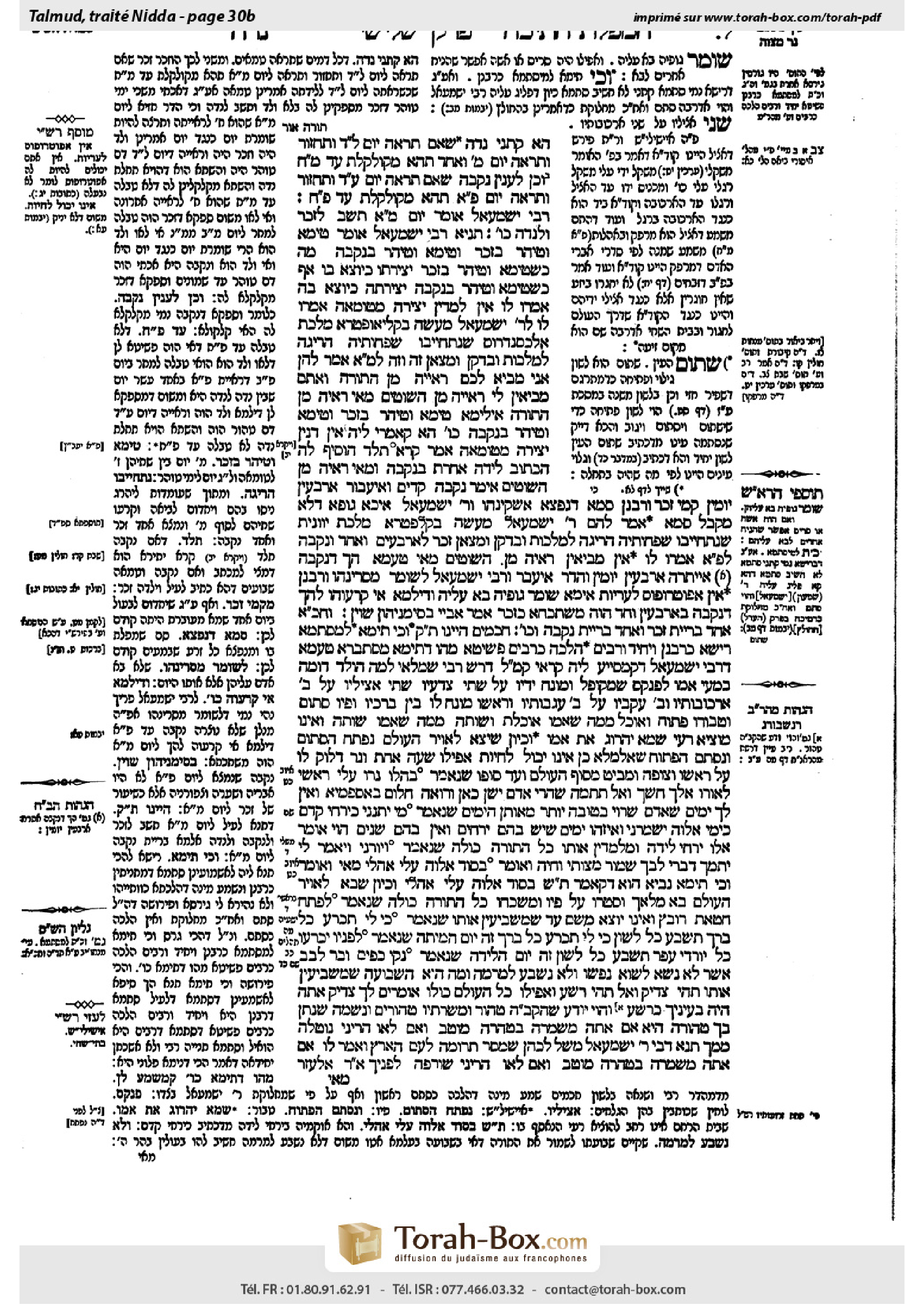
Niddah 30b: Talmud study for Daf Yomi
Daf Yomi is the daily study of one Talmud folio. Explore 37 tractates with scans, Hebrew text, Sefaria English and AI-generated French translations where annotated.
Passage selection and English or AI-generated French translation are available where the scan has annotations. Daf Study is independent of Torah-Box and Sefaria.
Browse Niddah · נידה · All tractatesNiddah 30b text and translations
This page of Niddah includes the Aramaic text, an English translation and an AI-generated French translation, alongside the scan above.
נידה ל׳ ב · Aramaic and Hebrew text
הָא קָתָנֵי נִדָּה!
שֶׁאִם תִּרְאֶה יוֹם שְׁלוֹשִׁים וְאַרְבָּעָה, וְתַחְזוֹר וְתִרְאֶה יוֹם אַרְבָּעִים וְאֶחָד — תְּהֵא מְקוּלְקֶלֶת עַד אַרְבָּעִים וּשְׁמוֹנָה.
וְכֵן לְעִנְיַן נְקֵבָה, שֶׁאִם תִּרְאֶה יוֹם שִׁבְעִים וְאַרְבָּעָה, וְתַחְזוֹר וְתִרְאֶה יוֹם שְׁמוֹנִים וְאֶחָד, תְּהֵא מְקוּלְקֶלֶת עַד שְׁמוֹנִים וּשְׁמוֹנָה.
רַבִּי יִשְׁמָעֵאל אוֹמֵר: יוֹם אַרְבָּעִים וְאֶחָד תֵּשֵׁב לְזָכָר וּלְנִדָּה כּוּ׳. תַּנְיָא, רַבִּי יִשְׁמָעֵאל אוֹמֵר: טִימֵּא וְטִיהֵר בְּזָכָר, וְטִימֵּא וְטִיהֵר בִּנְקֵבָה.
מָה כְּשֶׁטִּימֵּא וְטִיהֵר בְּזָכָר יְצִירָתוֹ כְּיוֹצֵא בוֹ, אַף כְּשֶׁטִּימֵּא וְטִיהֵר בִּנְקֵבָה יְצִירָתָהּ כַּיּוֹצֵא בָּהּ. אָמְרוּ לוֹ: אֵין לְמֵדִין יְצִירָה מִטּוּמְאָה.
אָמְרוּ לוֹ לְרַבִּי יִשְׁמָעֵאל: מַעֲשֶׂה בִּקְלֵיאוֹפַּטְרָא מַלְכַּת אֲלֶכְּסַנְדְּרוֹס, שֶׁנִּתְחַיְּיבוּ שִׁפְחוֹתֶיהָ הֲרִיגָה לַמַּלְכוּת, וּבְדָקָן וּמְצָאָן זֶה וָזֶה לְאַרְבָּעִים וְאֶחָד! אָמַר לָהֶן: אֲנִי מֵבִיא לָכֶם רְאָיָיה מִן הַתּוֹרָה, וְאַתֶּם מְבִיאִין לִי רְאָיָיה מִן הַשּׁוֹטִים?!
מַאי רְאָיָה מִן הַתּוֹרָה? אִילֵּימָא טִימֵּא וְטִיהֵר בְּזָכָר וְטִימֵּא וְטִיהֵר בִּנְקֵבָה כּוּ׳. הָא קָאָמְרִי לֵיהּ: אֵין דָּנִין יְצִירָה מִטּוּמְאָה!
אָמַר קְרָא ״תֵּלֵד״, הוֹסִיף לָהּ הַכָּתוּב לֵידָה אַחֶרֶת בִּנְקֵבָה.
וּמַאי רְאָיָה מִן הַשּׁוֹטִים? אֵימַר: נְקֵבָה קְדִים, וְאִיעַבּוּר אַרְבְּעִין יוֹמִין קַמֵּי זָכָר.
וְרַבָּנַן: סַמָּא דְּנָפְצָא אַשְׁקִינְהוּ. וְרַבִּי יִשְׁמָעֵאל: אִיכָּא גּוּפָא דְּלָא מְקַבֵּל סַמָּא.
אָמַר לָהֶם רַבִּי יִשְׁמָעֵאל: מַעֲשֶׂה בִּקְלֵפַּטְרָא מַלְכַּת יְוָונִים, שֶׁנִּתְחַיְּיבוּ שִׁפְחוֹתֶיהָ הֲרִיגָה לַמַּלְכוּת, וּבְדָקָן וּמְצָאָן זָכָר לְאַרְבָּעִים וְאֶחָד, וּנְקֵבָה לִשְׁמוֹנִים וְאֶחָד. אָמְרוּ לוֹ: אֵין מְבִיאִין רְאָיָה מִן הַשּׁוֹטִים.
מַאי טַעְמָא? הָךְ דִּנְקֵבָה אִיַּיתַּרָה אַרְבְּעִין יוֹמִין, וַהֲדַר אִיעַבַּר.
וְרַבִּי יִשְׁמָעֵאל: לְשׁוֹמֵר מַסְרִינְהוּ. וְרַבָּנַן: אֵין אַפּוֹטְרוֹפּוֹס לַעֲרָיוֹת, אֵימָא שׁוֹמֵר גּוּפֵיהּ בָּא עָלֶיהָ.
וְדִילְמָא: אִי קַרְעוּהוּ לְהָךְ דִּנְקֵבָה בְּאַרְבְּעִין וְחַד, הֲוָה מִשְׁתַּכְחָא כְּזָכָר? אָמַר אַבָּיֵי: בְּסִימָנֵיהוֹן שָׁוִין.
וַחֲכָמִים אוֹמְרִים: אֶחָד בְּרִיַּית זָכָר וְאֶחָד בְּרִיַּית נְקֵבָה וְכוּ׳. חֲכָמִים הַיְינוּ תַּנָּא קַמָּא!
וְכִי תֵימָא לְמִסְתְּמַהּ רֵישָׁא כְּרַבָּנַן, וְיָחִיד וְרַבִּים — הֲלָכָה כְּרַבִּים, פְּשִׁיטָא!
מַהוּ דְּתֵימָא: מִסְתַּבְּרָא טַעְמָא דְּרַבִּי יִשְׁמָעֵאל, (דקמסייע) [דְּקָמְסַיְּיעִי] לֵיהּ קְרָאֵי, קָא מַשְׁמַע לַן.
דָּרֵשׁ רַבִּי שִׂמְלַאי: לְמָה הַוָּלָד דּוֹמֶה בִּמְעֵי אִמּוֹ — לְפִנְקָס שֶׁמְּקוּפָּל, וּמוּנָּח יָדָיו עַל שְׁתֵּי צְדָעָיו, שְׁתֵּי אֲצִילָיו עַל שְׁתֵּי אַרְכוּבּוֹתָיו, וּשְׁנֵי עֲקֵבָיו עַל שְׁתֵּי עַגְבוֹתָיו, וְרֹאשׁוֹ מוּנָּח לוֹ בֵּין בִּרְכָּיו, וּפִיו סָתוּם, וְטַבּוּרוֹ פָּתוּחַ. וְאוֹכֵל מִמַּה שֶּׁאִמּוֹ אוֹכֶלֶת, וְשׁוֹתָה מִמַּה שֶּׁאִמּוֹ שׁוֹתָה, וְאֵינוֹ מוֹצִיא רְעִי שֶׁמָּא יַהֲרוֹג אֶת אִמּוֹ. וְכֵיוָן שֶׁיָּצָא לַאֲוִיר הָעוֹלָם — נִפְתָּח הַסָּתוּם, וְנִסְתָּם הַפָּתוּחַ, שֶׁאִלְמָלֵא כֵּן אֵינוֹ יָכוֹל לִחְיוֹת אֲפִילּוּ שָׁעָה אַחַת.
וְנֵר דָּלוּק לוֹ עַל רֹאשׁוֹ, וְצוֹפֶה וּמַבִּיט מִסּוֹף הָעוֹלָם וְעַד סוֹפוֹ, שֶׁנֶּאֱמַר: ״בְּהִלּוֹ נֵרוֹ עֲלֵי רֹאשִׁי לְאוֹרוֹ אֵלֶךְ חֹשֶׁךְ״, וְאַל תִּתְמַהּ, שֶׁהֲרֵי אָדָם יָשֵׁן כָּאן וְרוֹאֶה חֲלוֹם בְּאַסְפַּמְיָא.
וְאֵין לְךָ יָמִים שֶׁאָדָם שָׁרוּי בְּטוֹבָה יוֹתֵר מֵאוֹתָן הַיָּמִים, שֶׁנֶּאֱמַר: ״מִי יִתְּנֵנִי כְיַרְחֵי קֶדֶם כִּימֵי אֱלוֹהַּ יִשְׁמְרֵנִי״, וְאֵיזֶהוּ יָמִים שֶׁיֵּשׁ בָּהֶם יְרָחִים וְאֵין בָּהֶם שָׁנִים? הֱוֵי אוֹמֵר: אֵלּוּ יַרְחֵי לֵידָה.
וּמְלַמְּדִין אוֹתוֹ כָּל הַתּוֹרָה כּוּלָּהּ, שֶׁנֶּאֱמַר: ״וַיּוֹרֵנִי וַיֹּאמֶר לִי יִתְמׇךְ דְּבָרַי לִבֶּךָ שְׁמוֹר מִצְוֹתַי וֶחְיֵה״, וְאוֹמֵר: ״בְּסוֹד אֱלוֹהַּ עֲלֵי אׇהֳלִי״.
מַאי ״וְאוֹמֵר״? וְכִי תֵימָא נָבִיא הוּא דְּקָאָמַר, תָּא שְׁמַע ״בְּסוֹד אֱלוֹהַּ עֲלֵי אׇהֳלִי״.
וְכֵיוָן שֶׁבָּא לַאֲוִיר הָעוֹלָם, בָּא מַלְאָךְ וְסֹטְרוֹ עַל פִּיו, וּמְשַׁכְּחוֹ כׇּל הַתּוֹרָה כּוּלָּהּ, שֶׁנֶּאֱמַר: ״לַפֶּתַח חַטָּאת רוֹבֵץ״.
וְאֵינוֹ יוֹצֵא מִשָּׁם עַד שֶׁמַּשְׁבִּיעִין אוֹתוֹ, שֶׁנֶּאֱמַר: ״כִּי לִי תִּכְרַע כׇּל בֶּרֶךְ תִּשָּׁבַע כׇּל לָשׁוֹן״. ״כִּי לִי תִּכְרַע כׇּל בֶּרֶךְ״ — זֶה יוֹם הַמִּיתָה, שֶׁנֶּאֱמַר: ״לְפָנָיו יִכְרְעוּ כׇּל יוֹרְדֵי עָפָר״. ״תִּשָּׁבַע כׇּל לָשׁוֹן״ — זֶה יוֹם הַלֵּידָה, שֶׁנֶּאֱמַר: ״נְקִי כַפַּיִם וּבַר לֵבָב אֲשֶׁר לֹא נָשָׂא לַשָּׁוְא נַפְשׁוֹ וְלֹא נִשְׁבַּע לְמִרְמָה״.
וּמָה הִיא הַשְּׁבוּעָה שֶׁמַּשְׁבִּיעִין אוֹתוֹ? תְּהִי צַדִּיק וְאַל תְּהִי רָשָׁע, וַאֲפִילּוּ כׇּל הָעוֹלָם כּוּלּוֹ אוֹמְרִים לְךָ ״צַדִּיק אַתָּה״ — הֱיֵה בְּעֵינֶיךָ כְּרָשָׁע. וֶהֱוֵי יוֹדֵעַ שֶׁהַקָּדוֹשׁ בָּרוּךְ הוּא טָהוֹר, וּמְשָׁרְתָיו טְהוֹרִים, וּנְשָׁמָה שֶׁנָּתַן בְּךָ טְהוֹרָה הִיא. אִם אַתָּה מְשַׁמְּרָהּ בְּטׇהֳרָה — מוּטָב, וְאִם לָאו — הֲרֵינִי נוֹטְלָהּ מִמְּךָ.
תָּנָא דְּבֵי רַבִּי יִשְׁמָעֵאל: מָשָׁל לְכֹהֵן שֶׁמָּסַר תְּרוּמָה לְעַם הָאָרֶץ, וְאָמַר לוֹ: אִם אַתָּה מְשַׁמְּרָהּ בְּטׇהֳרָה — מוּטָב, וְאִם לָאו — הֲרֵינִי שׂוֹרְפָהּ לְפָנֶיךָ.
אָמַר רַבִּי אֶלְעָזָר:
Niddah 30b · English translation
doesn’t the mishna teach that the woman observes the strictures of a menstruating woman, i.e., she is considered ritually impure every time she experiences bleeding, and does not observe any period of purity at all?
The Gemara answers: The mishna mentions that the woman observes the strictures of a woman who gave birth to a male to teach that if she sees blood on the thirty-fourth day after her miscarriage and again sees blood on the forty-first day, her purity status shall be ruined, i.e., she shall be prohibited from engaging in intercourse, until the forty-eighth day. If she were not observing the strictures of a woman who gave birth to a male, but only those of a menstruating woman and one who gave birth to a female, she would not have to wait seven days after seeing blood on the forty-first day. Instead, she would wait only one day, as her possible seven-day period of menstruation began on the thirty-fourth day and ended on the fortieth. Yet, as she might have given birth to a male, the forty-first day might be the first day after her period of purity, and therefore the first of her seven days of menstruation. Consequently, she must consider herself impure until the forty-eighth day.
And similarly, with regard to the halakha that she observes the strictures of a woman who gave birth to a female, one ramification is that if she sees blood on the seventy-fourth day and again sees blood on the eighty-first day, her purity status shall be ruined until the eighty-eighth day. Although she observes ritual impurity after discovering bleeding on the seventy-fourth day, as perhaps she has the status of a menstruating woman, when she discovers bleeding on the eighty-first day she must begin the count of seven days of menstruation again, in case the seventy-fourth day was during her period of purity after having given birth to a female.
§ The mishna teaches that Rabbi Yishmael says: A woman who discharges on the forty-first day after immersion observes both the strictures of a woman who gave birth to a male, and those of a menstruating woman, but not the strictures of a woman who gave birth to a female, as the formation of a male offspring takes forty-one days, whereas the formation of a female offspring takes eighty-one days. It is taught in a baraita that Rabbi Yishmael says, in explanation of his opinion: In the case of a woman who gave birth to a male, the verse deems her impure for seven days and deems her pure for an additional thirty-three days, for a total of forty days; and with regard to a woman who gave birth to a female, the verse deems her impure for fourteen days and deems her pure for another sixty-six days, for a total of eighty days.
It can therefore be inferred that just as when the verse deems a woman impure and then deems her pure for a total of forty days in the case of a male, its amount of time is parallel to the time of the formation of a male embryo; so too, when the verse deems a woman impure and deems her pure for a total of eighty days in the case of a female, its amount of time is parallel to the time of the formation of a female embryo. Accordingly, the formation of a female ends on the eighty-first day after conception. The Rabbis said to Rabbi Yishmael in response: One cannot derive the amount of time of the formation of an embryo from the extent of a woman’s period of impurity after giving birth.
Furthermore, the Rabbis said to Rabbi Yishmael that there is a proof against his opinion from an incident involving Cleopatra, Queen of Alexandria. Since her maidservants were sentenced to death by the government, she took advantage of the opportunity and experimented on them in order to examine the amount of time it takes for an embryo to develop. She had her maidservants engage in intercourse and operated on them following their execution in order to determine the stage at which an embryo is fully formed, and found that both in this case, when the embryo is male, and that case, when it is female, the formation is complete on the forty-first day after conception. Rabbi Yishmael said to them in response: I bring you proof from the Torah, and you bring me proof from the fools?
The Gemara asks: What proof from the Torah does Rabbi Yishmael bring for his opinion? If we say that his proof is the aforementioned derivation that in the case of a woman who gave birth to a male, the verse deems her impure for seven days and deems her pure for an additional thirty-three days, for a total of forty days; and in the case of a female, the verse deems her impure for fourteen days and deems her pure for an additional sixty-six days, for a total of eighty days, didn’t the Rabbis say to him in response that one cannot derive the amount of time that the formation of an embryo takes from the extent of a woman’s period of impurity after giving birth?
The Gemara answers: Rabbi Yishmael’s derivation is that the verse states: “If a woman bears seed and gives birth to a male…and if she gives birth to a female” (Leviticus 12:2–5). The verse adds another explicit mention of childbirth with regard to a female, besides the mention of childbirth in the case of a male, when it could have simply stated: And if it is a female. Rabbi Yishmael derives from here that not only are the periods of ritual impurity and purity of one who gives birth to a female double those of a woman who gives birth to a male, but the formation of a female embryo also takes twice the time.
The Gemara asks: And for what reason does Rabbi Yishmael refer to the proof that the Rabbis cited from Cleopatra’s experiment as a proof from the fools? The Gemara answers: One can say that the maidservant who was pregnant with a female embryo became pregnant first, forty days before the maidservant who was pregnant with a male embryo. Consequently, it took the female embryo eighty days to be develop, not forty.
The Gemara asks: And how would the Rabbis respond to this claim? The Gemara answers: Cleopatra gave the maidservants a purgative medicine to drink before they engaged in intercourse, which would have terminated any previous pregnancy. And Rabbi Yishmael would respond that there are bodies that are not affected by this medicine, i.e., certain pregnancies are not terminated by the medicine. Consequently, the maidservant who was pregnant with a female embryo might have been pregnant prior to the experiment.
The Gemara cites another baraita that presents a different version of this exchange between Rabbi Yishmael and the Rabbis: Rabbi Yishmael said to the Rabbis that there is a proof for his opinion from an incident involving Cleopatra, the Greek queen, as her maidservants were sentenced to death by the government, and she experimented on them and found that a male embryo is fully formed on the forty-first day after conception, and a female embryo is formed on the eighty-first day. The Rabbis said to him: One does not bring proof from the fools.
The Gemara explains: What is the reason the Rabbis consider this a proof from the fools? They claim that it is possible that this woman who was pregnant with a female embryo did not conceive when Cleopatra had her engage in intercourse; rather, she waited forty days, and then became pregnant when she again engaged in intercourse. Therefore, the embryo was formed in forty days.
And how would Rabbi Yishmael respond to this claim? He would claim that the maidservants could not have conceived on a later date, as Cleopatra transferred them to the custody of a steward, who made sure that they did not engage in intercourse during the experiment. And the Rabbis would say that there is no steward [apotropos] for restraining sexual intercourse, and therefore one can say that the warden himself engaged in intercourse with the maidservant.
The Gemara raises a difficulty with regard to Rabbi Yishmael’s proof: But how can one be sure that the female embryo was formed after eighty-one days? Perhaps if the womb of the woman carrying this female embryo would have been torn open on the forty-first day after conception, the female embryo would have already been found in it, just as in the case of a male embryo. Abaye says in response: It was a case where the indications of the ages of the two embryos, e.g., their hairs and fingernails, were identical. Evidently, the female embryo developed in eighty days to the same degree that the male embryo developed in forty days.
§ The mishna teaches: And the Rabbis say: Both the formation of the male and the formation of the female conclude on the forty-first day. The Gemara asks: The statement of the Rabbis is identical to the statement of the first tanna. Why does the mishna repeat this opinion in the name of the Rabbis?
And if you would say that the purpose is to teach that the unattributed opinion mentioned in the first clause of the mishna is in accordance with the opinion of the Rabbis, and therefore it is the halakha, as when there is a disagreement between an individual Sage and many Sages, the halakha is in accordance with the opinion of the many, this cannot be the reason. The Gemara explains: It is obvious that the halakha is in accordance with the unattributed opinion mentioned in the first clause of the mishna, as this is a general halakhic principle.
The Gemara answers: Lest you say that from the fact that the explanation of the opinion of Rabbi Yishmael stands to reason, as the verses apparently support it, the halakha should be in accordance with his opinion, therefore the mishna teaches us that the majority of Sages agree with the unattributed opinion mentioned in the first clause of the mishna.
§ Rabbi Samlai taught: To what is a fetus in its mother’s womb comparable? To a folded notebook [lefinkas]. And it rests with its hands on its two sides of its head, at the temples, its two arms [atzilav] on its two knees, and its two heels on its two buttocks, and its head rests between its knees, and its mouth is closed, and its umbilicus is open. And it eats from what its mother eats, and it drinks from what its mother drinks, and it does not emit excrement lest it kill its mother. But once it emerges into the airspace of the world, the closed limb, i.e., its mouth, opens, and the open limb, its umbilicus, closes, as otherwise it cannot live for even one hour.
And a candle is lit for it above its head, and it gazes from one end of the world to the other, as it is stated: “When His lamp shined above my head, and by His light I walked through darkness” (Job 29:3). And do not wonder how one can see from one end of the world to the other, as a person can sleep here, in this location, and see a dream that takes place in a place as distant as Spain [beAspamya].
And there are no days when a person is in a more blissful state than those days when he is a fetus in his mother’s womb, as it is stated in the previous verse: “If only I were as in the months of old, as in the days when God watched over me” (Job 29:2). And the proof that this verse is referring to gestation is as follows: Which are the days that have months but do not have years? You must say that these are the months of gestation.
And a fetus is taught the entire Torah while in the womb, as it is stated: “And He taught me and said to me: Let your heart hold fast My words; keep My commandments, and live” (Proverbs 4:4). And it also states: “As I was in the days of my youth, when the converse of God was upon my tent” (Job 29:4).
The Gemara asks: What is the purpose of the statement: And it also states: “When the converse of God was upon my tent”? Why is it necessary to cite this verse in addition to the previously quoted verse from Proverbs? The Gemara explains: And if you would say that the verse in Proverbs is insufficient, as it is a prophet who is saying that he was taught the entire Torah in his mother’s womb, but this does not apply to ordinary people, come and hear the verse in Job: “When the converse of God was upon my tent.”
And once the fetus emerges into the airspace of the world, an angel comes and slaps it on its mouth, causing it to forget the entire Torah, as it is stated: “Sin crouches at the entrance” (Genesis 4:7), i.e., when a person enters the world he is immediately liable to sin due to his loss of Torah knowledge.
And a fetus does not leave the womb until the angels administer an oath to it, as it is stated: “That to Me every knee shall bow, every tongue shall swear” (Isaiah 45:23). The verse is interpreted as follows: “That to Me every knee shall bow”; this is referring to the day of one’s death, as it is stated: “All those who go down to the dust shall kneel before Him” (Psalms 22:30). “Every tongue shall swear”; this is referring to the day of one’s birth, as it is stated in description of a righteous person: “He who has clean hands, and a pure heart, who has not taken My name in vain, and has not sworn deceitfully” (Psalms 24:4), i.e., he has kept the oath that he took before he was born.
And what is the oath that the angels administer to the fetus? Be righteous and do not be wicked. And even if the entire world says to you: You are righteous, consider yourself wicked. And know that the Holy One, Blessed be He, is pure, and His ministers are pure, and the soul that He gave you is pure. If you preserve it in a state of purity, all is well, but if you do not keep it pure, I, the angel, shall take it from you.
The school of Rabbi Yishmael taught a parable: This matter is comparable to a priest who gave teruma, the portion of the produce designated for the priest, to one who is unreliable with regard to ritual impurity [am ha’aretz], and therefore it is suspected that he might not maintain the purity of the teruma. And the priest said to him: If you keep it in a state of ritual purity, all is well, but if you do not keep it pure, I shall burn it before you.
Rabbi Elazar said:
Niddah 30b · Traduction française (IA)
La Michna n’enseigne-t-elle pas que la femme observe les règles strictes d’une femme menstruée, c’est-à-dire qu’elle est considérée comme rituellement impure chaque fois qu’elle saigne et qu’elle n’observe aucune période de pureté ?
La Guemara répond : La Michna mentionne que la femme observe les règles strictes d’une femme ayant accouché d’un garçon pour enseigner que, si elle voit du sang le trente-quatrième jour après sa fausse couche, puis de nouveau le quarante et unième jour, son statut de pureté est compromis, c’est-à-dire qu’elle doit s’abstenir de relations sexuelles jusqu’au quarante-huitième jour. Si elle n’observait pas les règles strictes d’une femme ayant accouché d’un garçon, mais seulement celles d’une femme menstruée et d’une femme ayant accouché d’une fille, elle n’aurait pas à attendre sept jours après avoir vu du sang le quarante et unième jour. Elle n’attendrait qu’un jour, puisque sa période de menstruation possible de sept jours aurait commencé le trente-quatrième jour et se serait achevée le quarantième. Cependant, comme elle a peut-être accouché d’un garçon, le quarante et unième jour pourrait être le premier jour suivant sa période de pureté, et donc le premier de ses sept jours de menstruation. Par conséquent, elle doit se considérer comme impure jusqu’au quarante-huitième jour.
De même, concernant la halakha selon laquelle elle observe les règles strictes d’une femme ayant accouché d’une fille, l’une des conséquences est que, si elle voit du sang le soixante-quatorzième jour, puis de nouveau le quatre-vingt-unième jour, son statut de pureté est compromis jusqu’au quatre-vingt-huitième jour. Bien qu’elle soit rituellement impure après avoir constaté un saignement le soixante-quatorzième jour, puisqu’elle pourrait avoir le statut d’une femme menstruée, lorsqu’elle constate un saignement le quatre-vingt-unième jour, elle doit recommencer à compter les sept jours de menstruation, au cas où le soixante-quatorzième jour serait tombé pendant sa période de pureté après avoir accouché d’une fille.
§ La Michna enseigne que Rabbi Yishmael dit : Une femme qui expulse le produit de sa conception le quarante et unième jour après l’immersion observe à la fois les règles strictes d’une femme ayant accouché d’un garçon et celles d’une femme menstruée, mais pas celles d’une femme ayant accouché d’une fille, car la formation d’un embryon masculin prend quarante et un jours, tandis que celle d’un embryon féminin prend quatre-vingt-un jours. Une baraïta enseigne que Rabbi Yishmael dit, pour expliquer son opinion : Dans le cas d’une femme ayant accouché d’un garçon, le verset la déclare impure pendant sept jours et pure pendant trente-trois jours supplémentaires, soit quarante jours au total ; et, dans le cas d’une femme ayant accouché d’une fille, le verset la déclare impure pendant quatorze jours et pure pendant soixante-six jours supplémentaires, soit quatre-vingts jours au total.
On peut donc en déduire que, de même que, dans le cas d’un garçon, lorsque le verset déclare une femme impure puis pure pendant quarante jours au total, cette durée correspond à celle de la formation d’un embryon masculin, de même, dans le cas d’une fille, lorsque le verset déclare une femme impure puis pure pendant quatre-vingts jours au total, cette durée correspond à celle de la formation d’un embryon féminin. Par conséquent, la formation d’un embryon féminin s’achève le quatre-vingt-unième jour après la conception. Les Sages répondirent à Rabbi Yishmael : On ne peut pas déduire la durée de la formation d’un embryon de la durée de l’impureté d’une femme après l’accouchement.
En outre, les Sages dirent à Rabbi Yishmael qu’un épisode impliquant Cléopâtre, reine d’Alexandrie, réfutait son opinion. Comme ses servantes avaient été condamnées à mort par le gouvernement, elle profita de l’occasion pour faire des expériences sur elles afin d’examiner le temps nécessaire au développement d’un embryon. Elle fit en sorte que ses servantes aient des relations sexuelles, puis les opéra après leur exécution afin de déterminer à quel stade un embryon est complètement formé. Elle constata que, dans les deux cas, qu’il s’agisse d’un embryon masculin ou féminin, sa formation s’achevait le quarante et unième jour après la conception. Rabbi Yishmael leur répondit : « Je vous apporte une preuve tirée de la Torah, et vous m’apportez une preuve tirée des insensés ? »
La Guemara demande : Quelle preuve tirée de la Torah Rabbi Yishmael apporte-t-il à l’appui de son opinion ? Si l’on dit que sa preuve est la déduction déjà mentionnée selon laquelle, dans le cas d’une femme ayant accouché d’un garçon, le verset la déclare impure pendant sept jours et pure pendant trente-trois jours supplémentaires, soit quarante jours au total, et que, dans le cas d’une fille, le verset la déclare impure pendant quatorze jours et pure pendant soixante-six jours supplémentaires, soit quatre-vingts jours au total, les Sages ne lui ont-ils pas répondu qu’on ne peut pas déduire la durée de la formation d’un embryon de la durée de l’impureté d’une femme après l’accouchement ?
La Guemara répond : La déduction de Rabbi Yishmael repose sur le verset qui dit : « Si une femme conçoit et enfante un garçon… et si elle enfante une fille » (Lévitique 12:2-5). Le verset mentionne explicitement une nouvelle fois l’accouchement à propos d’une fille, en plus de la mention concernant un garçon, alors qu’il aurait pu simplement dire : « Et si c’est une fille. » Rabbi Yishmael en déduit que non seulement les périodes d’impureté et de pureté rituelles d’une femme ayant accouché d’une fille sont deux fois plus longues que celles d’une femme ayant accouché d’un garçon, mais que la formation d’un embryon féminin prend également deux fois plus de temps.
La Guemara demande : Et pourquoi Rabbi Yishmael qualifie-t-il de preuve tirée des insensés celle que les Sages ont avancée à partir de l’expérience de Cléopâtre ? La Guemara répond : On peut dire que la servante qui portait un embryon féminin était tombée enceinte quarante jours avant celle qui portait un embryon masculin. Par conséquent, l’embryon féminin a mis quatre-vingts jours à se développer, et non quarante.
La Guemara demande : Et comment les Sages répondraient-ils à cette affirmation ? La Guemara répond : Cléopâtre fit boire aux servantes un purgatif avant qu’elles aient des relations sexuelles, ce qui aurait interrompu toute grossesse antérieure. Rabbi Yishmael répondrait que certains organismes ne sont pas affectés par ce médicament, c’est-à-dire que certaines grossesses ne sont pas interrompues par celui-ci. Par conséquent, la servante qui portait un embryon féminin pouvait déjà être enceinte avant l’expérience.
La Guemara cite une autre baraïta qui présente une version différente de cet échange entre Rabbi Yishmael et les Sages : Rabbi Yishmael dit aux Sages qu’un épisode impliquant Cléopâtre, la reine grecque, apporte une preuve à l’appui de son opinion. Comme ses servantes avaient été condamnées à mort par le gouvernement, elle fit des expériences sur elles et constata qu’un embryon masculin est complètement formé le quarante et unième jour après la conception, tandis qu’un embryon féminin l’est le quatre-vingt-unième jour. Les Sages lui dirent : « On ne tire pas de preuve des insensés. »
La Guemara explique : Pour quelle raison les Sages considèrent-ils qu’il s’agit d’une preuve tirée des insensés ? Ils soutiennent qu’il est possible que cette femme qui portait un embryon féminin ne soit pas tombée enceinte lorsqu’on lui fit avoir des relations sexuelles sur l’ordre de Cléopâtre ; elle attendit plutôt quarante jours, puis tomba enceinte lorsqu’elle eut de nouveau des relations sexuelles. Le fœtus s’est donc formé en quarante jours.
Et comment Rabbi Yishmael répondrait-il à cette affirmation ? Il soutiendrait que les servantes n’ont pas pu concevoir à une date ultérieure, puisque Cléopâtre les confia à un intendant, qui veilla à ce qu’elles n’aient pas de relations sexuelles pendant l’expérience. Les Sages diraient qu’il n’existe pas d’intendant [apotropos] capable d’empêcher les relations sexuelles ; on peut donc dire que le gardien lui-même a eu des relations sexuelles avec la servante.
La Guemara soulève une difficulté concernant la preuve de Rabbi Yishmael : Mais comment peut-on être certain que l’embryon féminin s’est formé en quatre-vingt-un jours ? Peut-être que, si l’on avait ouvert l’utérus de la femme qui portait cet embryon féminin le quarante et unième jour après la conception, on l’y aurait déjà trouvé, comme dans le cas d’un embryon masculin. Abaye répond : Il s’agissait d’un cas où les signes indiquant l’âge des deux embryons, par exemple leurs cheveux et leurs ongles, étaient identiques. Il apparaît donc que l’embryon féminin s’est développé en quatre-vingts jours jusqu’au même degré que l’embryon masculin en quarante jours.
§ La Michna enseigne : Et les Sages disent que la formation de l’embryon masculin comme celle de l’embryon féminin s’achève le quarante et unième jour. La Guemara demande : La déclaration des Sages est identique à celle du premier tanna. Pourquoi la Michna répète-t-elle cette opinion en l’attribuant aux Sages ?
Et si tu dis que le but est d’enseigner que l’opinion anonyme mentionnée dans la première partie de la Michna correspond à celle des Sages, et qu’elle constitue donc la halakha, puisque, lorsqu’un Sage isolé est en désaccord avec plusieurs Sages, la halakha suit l’opinion de la majorité, cela ne peut pas être la raison. La Guemara explique : Il est évident que la halakha suit l’opinion anonyme mentionnée dans la première partie de la Michna, puisque c’est un principe halakhique général.
La Guemara répond : De peur que tu ne dises que, puisque l’explication de l’opinion de Rabbi Yishmael semble logique, les versets paraissant l’appuyer, la halakha devrait suivre son opinion, la Michna nous enseigne que la majorité des Sages adhère à l’opinion anonyme mentionnée dans sa première partie.
§ Rabbi Samlaï enseigna : À quoi un fœtus dans le ventre de sa mère est-il comparable ? À un carnet plié [lefinkas]. Il repose les mains de part et d’autre de sa tête, au niveau des tempes, les deux bras [atzilav] sur ses deux genoux et les deux talons sur ses deux fesses ; sa tête repose entre ses genoux, sa bouche est fermée et son nombril est ouvert. Il se nourrit de ce que mange sa mère et boit ce qu’elle boit, et il n’évacue pas ses excréments, de peur de tuer sa mère. Mais dès qu’il sort dans l’air du monde, l’organe fermé, c’est-à-dire sa bouche, s’ouvre, et l’organe ouvert, son nombril, se ferme, car autrement il ne pourrait pas vivre ne serait-ce qu’une heure.
Une bougie est allumée au-dessus de sa tête, et il regarde d’un bout à l’autre du monde, comme il est dit : « Quand Sa lampe brillait au-dessus de ma tête, et que par Sa lumière je marchais dans les ténèbres » (Job 29:3). Et ne t’étonne pas qu’on puisse voir d’un bout à l’autre du monde, car une personne peut dormir ici, en ce lieu, et voir un rêve qui se déroule dans un endroit aussi éloigné que l’Espagne [beAspamya].
Il n’est pas de jours où l’homme soit dans un état de félicité plus grand que lorsqu’il est fœtus dans le ventre de sa mère, comme il est dit dans le verset précédent : « Si seulement j’étais comme aux mois d’autrefois, comme aux jours où Dieu veillait sur moi » (Job 29:2). Voici la preuve que ce verset fait référence à la gestation : quels sont les jours qui se comptent en mois, mais pas en années ? Il faut dire qu’il s’agit des mois de gestation.
Un fœtus reçoit l’enseignement de toute la Torah alors qu’il se trouve dans le ventre de sa mère, comme il est dit : « Il m’enseignait et me disait : Que ton cœur retienne mes paroles ; garde mes commandements et tu vivras » (Proverbes 4:4). Il est également dit : « Comme j’étais aux jours de ma jeunesse, quand la parole de Dieu était sur ma tente » (Job 29:4).
La Guemara demande : Pourquoi est-il également dit : « Quand la parole de Dieu était sur ma tente » ? Pourquoi faut-il citer ce verset en plus du verset des Proverbes cité précédemment ? La Guemara explique : Et si tu dis que le verset des Proverbes ne suffit pas, puisqu’un prophète affirme qu’on lui a enseigné toute la Torah dans le ventre de sa mère, mais que cela ne s’applique pas aux gens ordinaires, viens entendre le verset de Job : « Quand la parole de Dieu était sur ma tente. »
Dès que le fœtus sort dans l’air du monde, un ange vient et le frappe sur la bouche, ce qui lui fait oublier toute la Torah, comme il est dit : « Le péché est tapi à la porte » (Genèse 4:7), c’est-à-dire qu’en entrant dans le monde, l’homme est immédiatement exposé au péché du fait qu’il a perdu la connaissance de la Torah.
Le fœtus ne quitte pas le ventre avant que les anges lui fassent prêter serment, comme il est dit : « Devant Moi tout genou fléchira, toute langue jurera » (Isaïe 45:23). Le verset s’interprète ainsi : « Devant Moi tout genou fléchira » fait référence au jour de la mort, comme il est dit : « Tous ceux qui descendent dans la poussière s’agenouilleront devant Lui » (Psaumes 22:30). « Toute langue jurera » fait référence au jour de la naissance, comme il est dit au sujet d’un juste : « Celui qui a les mains innocentes et le cœur pur, qui ne livre pas Mon nom au mensonge et ne jure pas avec perfidie » (Psaumes 24:4), c’est-à-dire qu’il a respecté le serment qu’il a prêté avant sa naissance.
Et quel est le serment que les anges font prêter au fœtus ? « Sois juste et ne sois pas méchant. Même si le monde entier te dit : “Tu es juste”, considère-toi comme méchant. Sache que le Saint, béni soit-Il, est pur, que Ses serviteurs sont purs et que l’âme qu’Il t’a donnée est pure. Si tu la préserves dans sa pureté, tout va bien ; mais si tu ne la gardes pas pure, moi, l’ange, je te la reprendrai. »
L’école de Rabbi Yishmael enseigna une parabole : Cette situation est comparable à celle d’un prêtre qui donne de la terouma, la part de la récolte réservée au prêtre, à une personne peu fiable en matière d’impureté rituelle [am ha’aretz], dont on soupçonne donc qu’elle ne préservera peut-être pas la pureté de la terouma. Le prêtre lui dit : « Si tu la gardes dans un état de pureté rituelle, tout va bien ; mais si tu ne la gardes pas pure, je la brûlerai devant toi. »
Rabbi Elazar dit :
Traduction française générée par IA à partir de l’édition anglaise de Sefaria. Vérifie toujours un passage avec le texte source.
Text from Sefaria: William Davidson Edition - Vocalized Aramaic (CC BY NC); William Davidson Edition - English (CC BY NC).