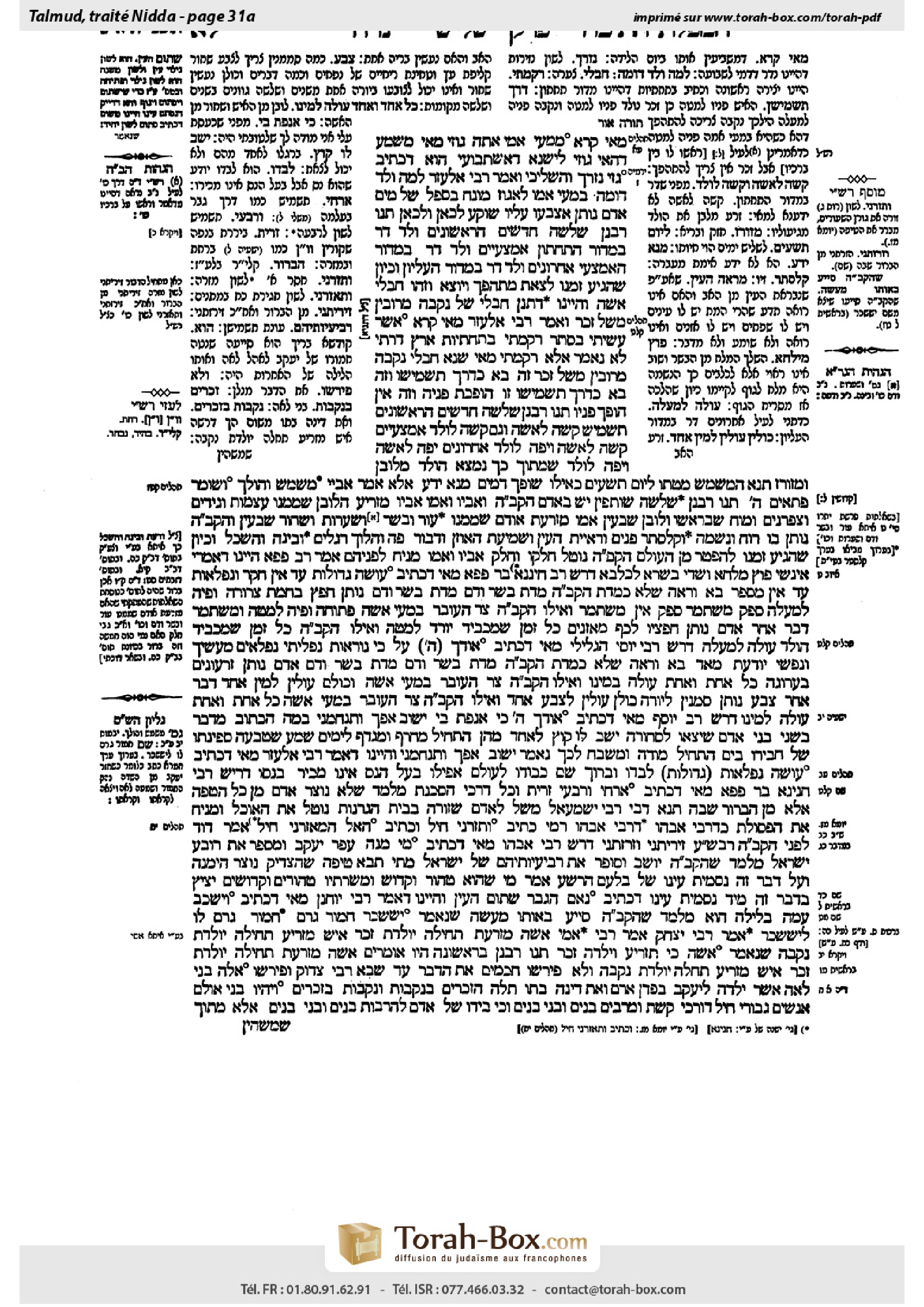
Niddah 31a: Talmud study for Daf Yomi
Daf Yomi is the daily study of one Talmud folio. Explore 37 tractates with scans, Hebrew text, Sefaria English and AI-generated French translations where annotated.
Passage selection and English or AI-generated French translation are available where the scan has annotations. Daf Study is independent of Torah-Box and Sefaria.
Browse Niddah · נידה · All tractatesNiddah 31a text and translations
This page of Niddah includes the Aramaic text, an English translation and an AI-generated French translation, alongside the scan above.
נידה ל״א א · Aramaic and Hebrew text
מַאי קְרָא? ״מִמְּעֵי אִמִּי אַתָּה גוֹזִי״. מַאי מַשְׁמַע דְּהַאי ״גּוֹזִי״ לִישָּׁנָא דְּאִשְׁתְּבוֹעֵי הוּא? דִּכְתִיב: ״גׇּזִּי נִזְרֵךְ וְהַשְׁלִיכִי״.
וְאָמַר רַבִּי אֶלְעָזָר: לְמָה וָלָד דּוֹמֶה בִּמְעֵי אִמּוֹ? לֶאֱגוֹז מוּנָּח בְּסֵפֶל שֶׁל מַיִם, אָדָם נוֹתֵן אֶצְבָּעוֹ עָלָיו — שׁוֹקֵעַ לְכָאן וּלְכָאן.
תָּנוּ רַבָּנַן: שְׁלֹשָׁה חֳדָשִׁים הָרִאשׁוֹנִים — וָלָד דָּר בְּמָדוֹר הַתַּחְתּוֹן, אֶמְצָעִיִּים — וָלָד דָּר בְּמָדוֹר הָאֶמְצָעִי, אַחֲרוֹנִים — וָלָד דָּר בְּמָדוֹר הָעֶלְיוֹן, וְכֵיוָן שֶׁהִגִּיעַ זְמַנּוֹ לָצֵאת — מִתְהַפֵּךְ וְיוֹצֵא, וְזֶהוּ ״חֶבְלֵי אִשָּׁה״.
וְהַיְינוּ דִּתְנַן: חֶבְלֵי (שֶׁל) נְקֵבָה מְרוּבִּין מִשֶּׁל זָכָר.
וְאָמַר רַבִּי אֶלְעָזָר: מַאי קְרָא? ״אֲשֶׁר עֻשֵּׂיתִי בַסֵּתֶר רֻקַּמְתִּי בְּתַחְתִּיּוֹת אָרֶץ״. ״דַּרְתִּי״ לֹא נֶאֱמַר, אֶלָּא ״רֻקַּמְתִּי״.
מַאי שְׁנָא חֶבְלֵי נְקֵבָה מְרוּבִּין מִשֶּׁל זָכָר? זֶה בָּא כְּדֶרֶךְ תַּשְׁמִישׁוֹ, וְזֶה בָּא כְּדֶרֶךְ תַּשְׁמִישׁוֹ, זוֹ הוֹפֶכֶת פָּנֶיהָ, וְזֶה אֵין הוֹפֵךְ פָּנָיו.
תָּנוּ רַבָּנַן: שְׁלֹשָׁה חֳדָשִׁים הָרִאשׁוֹנִים — תַּשְׁמִישׁ קָשֶׁה לָאִשָּׁה, וְגַם קָשֶׁה לַוָּלָד. אֶמְצָעִיִּים — קָשֶׁה לָאִשָּׁה וְיָפֶה לַוָּלָד. אַחֲרוֹנִים — יָפֶה לְאִשָּׁה וְיָפֶה לַוָּלָד, שֶׁמִּתּוֹךְ כָּךְ נִמְצָא הַוָּלָד מְלוּבָּן וּמְזוֹרָז.
תָּנָא: הַמְשַׁמֵּשׁ מִטָּתוֹ לְיוֹם תִּשְׁעִים — כְּאִילּוּ שׁוֹפֵךְ דָּמִים. מְנָא יָדַע? אֶלָּא אָמַר אַבָּיֵי: מְשַׁמֵּשׁ וְהוֹלֵךְ, וְ״שׁוֹמֵר פְּתָאיִם ה׳״.
תָּנוּ רַבָּנַן: שְׁלֹשָׁה שׁוּתָּפִין יֵשׁ בָּאָדָם — הַקָּדוֹשׁ בָּרוּךְ הוּא, וְאָבִיו, וְאִמּוֹ. אָבִיו מַזְרִיעַ הַלּוֹבֶן, שֶׁמִּמֶּנּוּ עֲצָמוֹת, וְגִידִים, וְצִפׇּרְנַיִם, וּמוֹחַ שֶׁבְּרֹאשׁוֹ, וְלוֹבֶן שֶׁבָּעַיִן. אִמּוֹ מַזְרַעַת אוֹדֶם, שֶׁמִּמֶּנּוּ עוֹר, וּבָשָׂר, וּשְׂעָרוֹת, וְשָׁחוֹר שֶׁבָּעַיִן. וְהַקָּדוֹשׁ בָּרוּךְ הוּא נוֹתֵן בּוֹ רוּחַ, וּנְשָׁמָה, וּקְלַסְתֵּר פָּנִים, וּרְאִיַּית הָעַיִן, וּשְׁמִיעַת הָאוֹזֶן, וְדִבּוּר פֶּה, וְהִלּוּךְ רַגְלַיִם, וּבִינָה, וְהַשְׂכֵּל.
וְכֵיוָן שֶׁהִגִּיעַ זְמַנּוֹ לְהִפָּטֵר מִן הָעוֹלָם, הַקָּדוֹשׁ בָּרוּךְ הוּא נוֹטֵל חֶלְקוֹ וְחֵלֶק אָבִיו וְאִמּוֹ, מַנִּיחַ לִפְנֵיהֶם. אָמַר רַב פָּפָּא: הַיְינוּ דְּאָמְרִי אִינָשֵׁי ״פּוּץ מִלְחָא וּשְׁדִי בִּשְׂרָא לְכַלְבָּא״.
דָּרֵשׁ רַב חִינָּנָא בַּר פָּפָּא: מַאי דִכְתִיב ״עוֹשֶׂה גְּדוֹלוֹת עַד אֵין חֵקֶר וְנִפְלָאוֹת עַד אֵין מִסְפָּר״? בֹּא וּרְאֵה שֶׁלֹּא כְּמִדַּת הַקָּדוֹשׁ בָּרוּךְ הוּא מִדַּת בָּשָׂר וָדָם. מִדַּת בָּשָׂר וָדָם, נוֹתֵן חֵפֶץ בְּחֵמֶת צְרוּרָה וּפִיהָ לְמַעְלָה — סָפֵק מִשְׁתַּמֵּר, סְפֵק אֵין מִשְׁתַּמֵּר. וְאִילּוּ הַקָּדוֹשׁ בָּרוּךְ הוּא, צָר הָעוּבָּר בִּמְעֵי אִשָּׁה פְּתוּחָה וּפִיהָ לְמַטָּה, וּמִשְׁתַּמֵּר.
דָּבָר אַחֵר: אָדָם נוֹתֵן חֲפָצָיו לְכַף מֹאזְנַיִם, כׇּל זְמַן שֶׁמַּכְבִּיד יוֹרֵד לְמַטָּה, וְאִילּוּ הַקָּדוֹשׁ בָּרוּךְ הוּא, כׇּל זְמַן שֶׁמַּכְבִּיד הַוָּלָד עוֹלֶה לְמַעְלָה.
דָּרֵשׁ רַבִּי יוֹסֵי הַגְּלִילִי: מַאי דִכְתִיב ״אוֹדְךָ (ה׳) עַל כִּי נוֹרָאוֹת נִפְלֵיתִי נִפְלָאִים מַעֲשֶׂיךָ וְנַפְשִׁי יוֹדַעַת מְאֹד״? בֹּא וּרְאֵה שֶׁלֹּא כְּמִדַּת הַקָּדוֹשׁ בָּרוּךְ הוּא מִדַּת בָּשָׂר וָדָם. מִדַּת בָּשָׂר וָדָם, אָדָם נוֹתֵן זֵרְעוֹנִים בַּעֲרוּגָה כׇּל (אַחַת וְאַחַת) [אֶחָד וְאֶחָד] עוֹלֶה בְּמִינוֹ, וְאִילּוּ הַקָּדוֹשׁ בָּרוּךְ הוּא צָר הָעוּבָּר בִּמְעֵי אִשָּׁה, וְכוּלָּם עוֹלִין לְמִין אֶחָד.
דָּבָר אַחֵר: צַבָּע נוֹתֵן סַמָּנִין לַיּוֹרָה — כּוּלָּן עוֹלִין לְצֶבַע אֶחָד, וְאִילּוּ הַקָּדוֹשׁ בָּרוּךְ הוּא צָר הָעוּבָּר בִּמְעֵי אִשָּׁה, כׇּל (אַחַת וְאַחַת) [אֶחָד וְאֶחָד] עוֹלֶה לְמִינוֹ.
דָּרֵשׁ רַב יוֹסֵף: מַאי דִכְתִיב ״אוֹדְךָ ה׳ כִּי אָנַפְתָּ בִּי יָשׁוֹב אַפְּךָ וּתְנַחֲמֵנִי״, בַּמֶּה הַכָּתוּב מְדַבֵּר?
בִּשְׁנֵי בְּנֵי אָדָם שֶׁיָּצְאוּ לִסְחוֹרָה. יָשַׁב לוֹ קוֹץ לְאֶחָד מֵהֶן, הִתְחִיל מְחָרֵף וּמְגַדֵּף. לְיָמִים שָׁמַע שֶׁטָּבְעָה סְפִינָתוֹ שֶׁל חֲבֵירוֹ בַּיָּם, הִתְחִיל מוֹדֶה וּמְשַׁבֵּחַ. לְכָךְ נֶאֱמַר: ״יָשׁוֹב אַפְּךָ וּתְנַחֲמֵנִי״.
וְהַיְינוּ דְּאָמַר רַבִּי אֶלְעָזָר: מַאי דִכְתִיב ״עוֹשֶׂה נִפְלָאוֹת (גְּדוֹלוֹת) לְבַדּוֹ וּבָרוּךְ שֵׁם כְּבוֹדוֹ לְעוֹלָם״? אֲפִילּוּ בַּעַל הַנֵּס אֵינוֹ מַכִּיר בְּנִסּוֹ.
דָּרֵישׁ רַבִּי חֲנִינָא בַּר פָּפָּא: מַאי דִכְתִיב ״אׇרְחִי וְרִבְעִי זֵרִיתָ וְכׇל דְּרָכַי הִסְכַּנְתָּה״? מְלַמֵּד שֶׁלֹּא נוֹצַר אָדָם מִן כׇּל הַטִּפָּה, אֶלָּא מִן הַבָּרוּר שֶׁבָּהּ. תָּנָא דְּבֵי רַבִּי יִשְׁמָעֵאל: מָשָׁל לְאָדָם שֶׁזּוֹרֶה בְּבֵית הַגְּרָנוֹת, נוֹטֵל אֶת הָאוֹכֶל וּמַנִּיחַ אֶת הַפְּסוֹלֶת.
כִּדְרַבִּי אֲבָהוּ, דְּרַבִּי אֲבָהוּ רָמֵי: כְּתִיב ״וַתַּזְרֵנִי חַיִל״, וּכְתִיב ״הָאֵל הַמְאַזְּרֵנִי חָיִל״. אָמַר דָּוִד לִפְנֵי הַקָּדוֹשׁ בָּרוּךְ הוּא: רִבּוֹנוֹ שֶׁל עוֹלָם, זֵירִיתַנִי וְזֵרַזְתַּנִי.
דָּרֵשׁ רַבִּי אֲבָהוּ: מַאי דִכְתִיב ״מִי מָנָה עֲפַר יַעֲקֹב וּמִסְפָּר אֶת רוֹבַע יִשְׂרָאֵל״? מְלַמֵּד שֶׁהַקָּדוֹשׁ בָּרוּךְ הוּא יוֹשֵׁב וְסוֹפֵר אֶת רְבִיעִיּוֹתֵיהֶם שֶׁל יִשְׂרָאֵל, מָתַי תָּבֹא טִיפָּה שֶׁהַצַּדִּיק נוֹצָר הֵימֶנָּה.
וְעַל דָּבָר זֶה נִסְמֵית עֵינוֹ שֶׁל בִּלְעָם הָרָשָׁע, אָמַר: מִי שֶׁהוּא טָהוֹר וְקָדוֹשׁ, וּמְשָׁרְתָיו טְהוֹרִים וּקְדוֹשִׁים, יָצִיץ בְּדָבָר זֶה?! מִיָּד נִסְמֵית עֵינוֹ, דִּכְתִיב: ״נְאֻם הַגֶּבֶר שְׁתוּם הָעָיִן״.
וְהַיְינוּ דְּאָמַר רַבִּי יוֹחָנָן: מַאי דִכְתִיב ״וַיִּשְׁכַּב עִמָּהּ בַּלַּיְלָה הוּא״? מְלַמֵּד שֶׁהַקָּדוֹשׁ בָּרוּךְ הוּא סִיֵּיעַ בְּאוֹתוֹ מַעֲשֶׂה, שֶׁנֶּאֱמַר: ״יִשָּׂשׂכָר חֲמוֹר גָּרֶם״ — חֲמוֹר גָּרַם לוֹ לְיִשָּׂשׂכָר.
אָמַר רַבִּי יִצְחָק, אָמַר רַבִּי אַמֵּי: אִשָּׁה מַזְרַעַת תְּחִילָּה — יוֹלֶדֶת זָכָר, אִישׁ מַזְרִיעַ תְּחִילָּה — יוֹלֶדֶת נְקֵבָה, שֶׁנֶּאֱמַר: ״אִשָּׁה כִּי תַזְרִיעַ וְיָלְדָה זָכָר״.
תָּנוּ רַבָּנַן: בָּרִאשׁוֹנָה הָיוּ אוֹמְרִים — אִשָּׁה מַזְרַעַת תְּחִילָּה יוֹלֶדֶת זָכָר, אִישׁ מַזְרִיעַ תְּחִלָּה יוֹלֶדֶת נְקֵבָה, וְלֹא פֵּירְשׁוּ חֲכָמִים אֶת הַדָּבָר, עַד שֶׁבָּא רַבִּי צָדוֹק וּפֵירְשׁוֹ: ״אֵלֶּה בְּנֵי לֵאָה אֲשֶׁר יָלְדָה לְיַעֲקֹב בְּפַדַּן אֲרָם וְאֵת דִּינָה בִתּוֹ״ — תָּלָה הַזְּכָרִים בַּנְּקֵבוֹת וּנְקֵבוֹת בַּזְּכָרִים.
״וַיִּהְיוּ בְנֵי אוּלָם אֲנָשִׁים גִּבּוֹרֵי חַיִל דּוֹרְכֵי קֶשֶׁת וּמַרְבִּים בָּנִים וּבְנֵי בָנִים״ — וְכִי בְּיָדוֹ שֶׁל אָדָם לְהַרְבּוֹת בָּנִים וּבְנֵי בָּנִים? אֶלָּא מִתּוֹךְ
Niddah 31a · English translation
What is the verse from which it is derived that a fetus is administered an oath on the day of its birth? “Upon You I have relied from birth; You are He Who took me out [gozi] of my mother’s womb” (Psalms 71:6). From where may it be inferred that this word: “Gozi,” is a term of administering an oath? As it is written: “Cut off [gozi] your hair and cast it away” (Jeremiah 7:29), which is interpreted as a reference to the vow of a nazirite, who must cut off his hair at the end of his term of naziriteship.
And Rabbi Elazar says: To what is a fetus in its mother’s womb comparable? It is comparable to a nut placed in a basin full of water, floating on top of the water. If a person puts his finger on top of the nut, it sinks either in this direction or in that direction.
§ The Sages taught in a baraita: During the first three months of pregnancy, the fetus resides in the lower compartment of the womb; in the middle three months, the fetus resides in the middle compartment; and during the last three months of pregnancy the fetus resides in the upper compartment. And once its time to emerge arrives, it turns upside down and emerges; and this is what causes labor pains.
With regard to the assertion that labor pains are caused by the fetus turning upside down, the Gemara notes: And this is the explanation for that which we learned in a baraita: The labor pains experienced by a woman who gives birth to a female are greater than those experienced by a woman who gives birth to a male. The Gemara will explain this below.
And Rabbi Elazar says: What is the verse from which it is derived that a fetus initially resides in the lower part of the womb? “When I was made in secret, and I was woven together in the lowest parts of the earth” (Psalms 139:15). Since it is not stated: I resided in the lowest parts of the earth, but rather: “I was woven together in the lowest parts of the earth,” this teaches that during the initial stage of a fetus’s development, when it is woven together, its location is in the lower compartment of the womb.
The Gemara asks: What is different about the labor pains experienced by a woman who gives birth to a female, that they are greater than those experienced by a woman who gives birth to a male? The Gemara answers: This one, a male fetus, emerges in the manner in which it engages in intercourse. Just as a male engages in intercourse facing downward, so too, it is born while facing down. And that one, a female fetus, emerges in the manner in which it engages in intercourse, i.e., facing upward. Consequently, that one, a female fetus, turns its face around before it is born, but this one, a male fetus, does not turn its face around before it is born.
§ The Sages taught in a baraita: During the first three months of pregnancy, sexual intercourse is difficult and harmful for the woman and is also difficult for the offspring. During the middle three months, intercourse is difficult for the woman but is beneficial for the offspring. During the last three months, sexual intercourse is beneficial for the woman and beneficial for the offspring; as a result of it the offspring is found to be strong and fair skinned.
The Sages taught in a baraita: With regard to one who engages in intercourse with his wife on the ninetieth day of her pregnancy, it is as though he spills her blood. The Gemara asks: How does one know that it is the ninetieth day of her pregnancy? Rather, Abaye says: One should go ahead and engage in intercourse with his wife even if it might be the ninetieth day, and rely on God to prevent any ensuing harm, as the verse states: “The Lord preserves the simple” (Psalms 116:6).
§ The Sages taught: There are three partners in the creation of a person: The Holy One, Blessed be He, and his father, and his mother. His father emits the white seed, from which the following body parts are formed: The bones, the sinews, the nails, the brain that is in its head, and the white of the eye. His mother emits red seed, from which are formed the skin, the flesh, the hair, and the black of the eye. And the Holy One, Blessed be He, inserts into him a spirit, a soul, his countenance [ukelaster], eyesight, hearing of the ear, the capability of speech of the mouth, the capability of walking with the legs, understanding, and wisdom.
And when a person’s time to depart from the world arrives, the Holy One, Blessed be He, retrieves His part, and He leaves the part of the person’s father and mother before them. Rav Pappa said: This is in accordance with the adage that people say: Remove the salt from a piece of meat, and you may then toss the meat to a dog, as it has become worthless.
§ Rav Ḥinnana bar Pappa taught: What is the meaning of that which is written: “Who does great deeds beyond comprehension, wondrous deeds without number” (Job 9:10)? Come and see that the attribute of flesh and blood is unlike the attribute of the Holy One, Blessed be He. The attribute of flesh and blood is that if one puts an article in a flask, even if the flask is tied and its opening faces upward, it is uncertain whether the item is preserved from getting lost, and it is uncertain whether it is not preserved from being lost. But the Holy One, Blessed be He, forms the fetus in a woman’s open womb, and its opening faces downward, and yet the fetus is preserved.
Another matter that demonstrates the difference between the attributes of God and the attributes of people is that when a person places his articles on a scale to be measured, the heavier the item is, the more it descends. But when the Holy One, Blessed be He, forms a fetus, the heavier the offspring gets, the more it ascends upward in the womb.
Rabbi Yosei HaGelili taught: What is the meaning of that which is written: “I will give thanks to You, for I am fearfully and wonderfully made; wonderful are Your works, and that my soul knows very well” (Psalms 139:14)? Come and see that the attribute of flesh and blood is unlike the attribute of the Holy One, Blessed be He. The attribute of flesh and blood is that when a person plants seeds of different species in one garden bed, each and every one of the seeds emerges as a grown plant according to its species. But the Holy One, Blessed be He, forms the fetus in a woman’s womb, and all of the seeds, i.e., those of both the father and the mother, emerge when the offspring is formed as one sex.
Alternatively, when a dyer puts herbs in a cauldron [leyora], they all emerge as one color of dye, whereas the Holy One, Blessed be He, forms the fetus in a woman’s womb, and each and every one of the seeds emerges as its own type. In other words, the seed of the father form distinct elements, such as the white of the eye, and the seed of the mother forms other elements, such as the black of the eye, as explained above.
Rav Yosef taught: What is the meaning of that which is written: “And on that day you shall say: I will give thanks to You, Lord, for You were angry with me; Your anger is turned away, and You comfort me” (Isaiah 12:1)? With regard to what matter is the verse speaking?
It is referring, for example, to two people who left their homes to go on a business trip. A thorn penetrated the body of one of them, and he was consequently unable to go with his colleague. He started blaspheming and cursing in frustration. After a period of time, he heard that the ship of the other person had sunk in the sea, and realized that the thorn had saved him from death. He then started thanking God and praising Him for his delivery due to the slight pain caused to him by the thorn. This is the meaning of the statement: I will give thanks to You, Lord, for You were angry with me. Therefore, it is stated at the end of the verse: “Your anger is turned away, and You comfort me.”
And this statement is identical to that which Rabbi Elazar said: What is the meaning of that which is written: “Blessed be the Lord God, the God of Israel, Who does wondrous things alone; and blessed be His glorious name forever” (Psalms 72:18–19)? What does it mean that God “does wondrous things alone”? It means that even the one for whom the miracle was performed does not recognize the miracle that was performed for him.
Rabbi Ḥanina bar Pappa taught: What is the meaning of that which is written: “You measure [zerita] my going about [orḥi] and my lying down [riv’i], and are acquainted with all my ways” (Psalms 139:3)? This verse teaches that a person is not created from the entire drop of semen, but from its clear part. Zerita can mean to winnow, while orḥi and riv’i can both be explained as references to sexual intercourse. Therefore the verse is interpreted homiletically as saying that God separates the procreative part of the semen from the rest. The school of Rabbi Yishmael taught a parable: This matter is comparable to a person who winnows grain in the granary; he takes the food and leaves the waste.
This is in accordance with a statement of Rabbi Abbahu, as Rabbi Abbahu raises a contradiction: It is written in one of King David’s psalms: “For You have girded me [vatazreni] with strength for battle” (II Samuel 22:40), without the letter alef in vatazreni; and it is written in another psalm: “Who girds me [hame’azreni] with strength” (Psalms 18:33), with an alef in hame’azreini. What is the difference between these two expressions? David said before the Holy One, Blessed be He: Master of the Universe, You selected me [zeiritani], i.e., You separated between the procreative part and the rest of the semen in order to create me, and You have girded me [zeraztani] with strength.
Rabbi Abbahu taught: What is the meaning of that which is written in Balaam’s blessing: “Who has counted the dust of Jacob, or numbered the stock [rova] of Israel” (Numbers 23:10)? The verse teaches that the Holy One, Blessed be He, sits and counts the times that the Jewish people engage in intercourse [revi’iyyoteihem], anticipating the time when the drop from which the righteous person will be created will arrive.
And it was due to this matter that the eye of wicked Balaam went blind. He said: Should God, who is pure and holy, and whose ministers are pure and holy, peek at this matter? Immediately his eye was blinded as a divine punishment, as it is written: “The saying of the man whose eye is shut” (Numbers 24:3).
And this statement is the same as that which Rabbi Yoḥanan said: What is the meaning of that which is written, with regard to Leah’s conceiving Issachar: “And he lay with her that night” (Genesis 30:16)? The verse teaches that the Holy One, Blessed be He, contributed to that act. The manner in which God contributed to this act is derived from another verse, as it is stated: “Issachar is a large-boned [garem] donkey” (Genesis 49:14). This teaches that God directed Jacob’s donkey toward Leah’s tent so that he would engage in intercourse with her, thereby causing [garam] Leah’s conceiving Issachar.
§ Rabbi Yitzḥak says that Rabbi Ami says: The sex of a fetus is determined at the moment of conception. If the woman emits seed first, she gives birth to a male, and if the man emits seed first, she gives birth to a female, as it is stated: “If a woman bears seed and gives birth to a male” (Leviticus 12:2).
The Sages taught: At first, people would say that if the woman emits seed first she gives birth to a male, and if the man emits seed first, she gives birth to a female. But the Sages did not explain from which verse this matter is derived, until Rabbi Tzadok came and explained that it is derived from the following verse: “These are the sons of Leah, whom she bore to Jacob in Paddan Aram, with his daughter Dinah” (Genesis 46:15). From the fact that the verse attributes the males to the females, as the males are called: The sons of Leah, and it attributes the females to the males,in that Dinah is called: His daughter, it is derived that if the woman emits seed first she gives birth to a male, whereas if the man emits seed first, she bears a female.
This statement is also derived from the following verse: “And the sons of Ulam were mighty men of valor, archers, and had many sons and sons’ sons” (I Chronicles 8:40). Is it in a person’s power to have many sons and sons’ sons? Rather, because
Niddah 31a · Traduction française (IA)
De quel verset déduit-on qu’un fœtus reçoit un serment le jour de sa naissance ? « C’est en toi que je me suis confié dès ma naissance ; tu es celui qui m’a fait sortir [gozi] du sein de ma mère » (Psaumes 71:6). D’où déduit-on que le mot « gozi » désigne l’administration d’un serment ? Du verset : « Coupe [gozi] tes cheveux et jette-les » (Jérémie 7:29), interprété comme une référence au vœu du nazir, qui doit se couper les cheveux à la fin de sa période de naziréat.
Et Rabbi Elazar dit : À quoi peut-on comparer un fœtus dans le ventre de sa mère ? À une noix placée dans un bassin rempli d’eau, où elle flotte à la surface. Si quelqu’un pose le doigt sur la noix, celle-ci s’enfonce d’un côté ou de l’autre.
§ Les Sages ont enseigné dans une baraïta : Pendant les trois premiers mois de la grossesse, le fœtus se trouve dans la partie inférieure de l’utérus ; pendant les trois mois du milieu, il se trouve dans la partie centrale ; et pendant les trois derniers mois de la grossesse, il se trouve dans la partie supérieure. Lorsque vient le moment de sortir, il se retourne et sort la tête en bas ; c’est ce qui provoque les douleurs de l’accouchement.
À propos de l’affirmation selon laquelle les douleurs de l’accouchement sont provoquées par le retournement du fœtus, la Guemara remarque : Cela explique ce que nous avons appris dans une baraïta : Les douleurs de l’accouchement éprouvées par une femme qui donne naissance à une fille sont plus fortes que celles éprouvées par une femme qui donne naissance à un garçon. La Guemara l’expliquera plus loin.
Et Rabbi Elazar dit : De quel verset déduit-on que le fœtus se trouve initialement dans la partie inférieure de l’utérus ? « Quand j’étais formé dans le secret, tissé dans les profondeurs de la terre » (Psaumes 139:15). Il n’est pas dit : « Je résidais dans les profondeurs de la terre », mais plutôt : « J’étais tissé dans les profondeurs de la terre ». Cela enseigne qu’au stade initial du développement du fœtus, lorsqu’il se tisse, il se trouve dans la partie inférieure de l’utérus.
La Guemara demande : Qu’est-ce qui explique que les douleurs de l’accouchement éprouvées par une femme qui donne naissance à une fille soient plus fortes que celles éprouvées par une femme qui donne naissance à un garçon ? La Guemara répond : Le fœtus mâle sort dans la position qu’il adopte lors des rapports sexuels. De même que le mâle a des rapports sexuels tourné vers le bas, de même naît-il tourné vers le bas. Le fœtus femelle, quant à lui, sort dans la position qu’il adopte lors des rapports sexuels, c’est-à-dire tournée vers le haut. Par conséquent, le fœtus femelle tourne son visage avant de naître, tandis que le fœtus mâle ne tourne pas son visage avant de naître.
§ Les Sages ont enseigné dans une baraïta : Pendant les trois premiers mois de la grossesse, les rapports sexuels sont difficiles et nuisibles pour la femme, et également difficiles pour l’enfant. Pendant les trois mois du milieu, ils sont difficiles pour la femme, mais bénéfiques pour l’enfant. Pendant les trois derniers mois, les rapports sexuels sont bénéfiques pour la femme comme pour l’enfant ; celui-ci est alors vigoureux et a le teint clair.
Les Sages ont enseigné dans une baraïta : Celui qui a des rapports sexuels avec sa femme le quatre-vingt-dixième jour de sa grossesse, c’est comme s’il versait son sang. La Guemara demande : Comment savoir qu’il s’agit du quatre-vingt-dixième jour de sa grossesse ? Abaye dit plutôt : On peut avoir des rapports sexuels avec sa femme même si c’est peut-être le quatre-vingt-dixième jour, et s’en remettre à Dieu pour prévenir tout préjudice qui pourrait en résulter, comme le dit le verset : « Le Seigneur protège les simples » (Psaumes 116:6).
§ Les Sages ont enseigné : Trois associés participent à la création d’une personne : le Saint, béni soit-Il, son père et sa mère. Son père émet la semence blanche, dont sont formées les parties du corps suivantes : les os, les tendons, les ongles, le cerveau qui se trouve dans la tête et le blanc de l’œil. Sa mère émet la semence rouge, dont sont formés la peau, la chair, les cheveux et le noir de l’œil. Et le Saint, béni soit-Il, insuffle en lui un esprit, une âme, son apparence [ukelaster], la vue, l’ouïe, la capacité de parler, celle de marcher, l’intelligence et la sagesse.
Lorsque vient pour une personne le moment de quitter ce monde, le Saint, béni soit-Il, reprend sa part et laisse devant le père et la mère leur part. Rav Pappa dit : Cela correspond au dicton populaire : Retire le sel d’un morceau de viande, et tu peux ensuite jeter la viande à un chien, puisqu’elle est devenue sans valeur.
§ Rav Ḥinnana bar Pappa enseigna : Que signifie ce qui est écrit : « Il accomplit de grandes choses insondables, des merveilles sans nombre » (Job 9:10) ? Viens et vois combien la nature de la chair et du sang diffère de celle du Saint, béni soit-Il. Si un être humain met un objet dans une fiole, même si celle-ci est fermée et que son ouverture est tournée vers le haut, il est incertain que l’objet soit préservé de la perte, tout comme il est incertain qu’il ne le soit pas. Mais le Saint, béni soit-Il, forme le fœtus dans le ventre ouvert d’une femme, dont l’ouverture est tournée vers le bas, et pourtant le fœtus y est préservé.
Une autre chose démontre la différence entre la nature de Dieu et celle des humains : lorsqu’une personne place ses objets sur une balance pour les peser, plus l’objet est lourd, plus il descend. Mais lorsque le Saint, béni soit-Il, forme un fœtus, plus l’enfant devient lourd, plus il monte dans l’utérus.
Rabbi Yosei HaGelili enseigna : Que signifie ce qui est écrit : « Je te rends grâce, car je suis merveilleusement et redoutablement façonné ; tes œuvres sont merveilleuses, et mon âme le sait très bien » (Psaumes 139:14) ? Viens et vois combien la nature de la chair et du sang diffère de celle du Saint, béni soit-Il. Lorsqu’un être humain sème des graines d’espèces différentes dans une même plate-bande, chacune pousse en une plante adulte de son espèce. Mais le Saint, béni soit-Il, forme le fœtus dans le ventre d’une femme, et toutes les semences, celles du père comme celles de la mère, donnent ensemble, lors de la formation de l’enfant, un seul sexe.
Autre explication : lorsqu’un teinturier met des herbes dans une cuve [leyora], elles donnent toutes une seule et même couleur de teinture. Mais le Saint, béni soit-Il, forme le fœtus dans le ventre d’une femme, et chacune des semences produit son propre type d’élément. Autrement dit, la semence du père forme des éléments distincts, comme le blanc de l’œil, et celle de la mère en forme d’autres, comme le noir de l’œil, ainsi qu’il a été expliqué plus haut.
Rav Yosef enseigna : Que signifie ce qui est écrit : « En ce jour, tu diras : Je te rends grâce, Seigneur, car tu étais irrité contre moi ; ta colère s’est détournée et tu m’as consolé » (Isaïe 12:1) ? À quel sujet ce verset fait-il référence ?
Il fait référence, par exemple, à deux personnes qui quittèrent leur maison pour partir en voyage d’affaires. Une épine pénétra dans le corps de l’une d’elles, l’empêchant ainsi de partir avec son compagnon. Frustrée, elle se mit à blasphémer et à maudire. Quelque temps plus tard, elle apprit que le navire de l’autre personne avait sombré en mer et comprit que l’épine l’avait sauvée de la mort. Elle se mit alors à remercier Dieu et à le louer de l’avoir délivrée, malgré la légère douleur que l’épine lui avait causée. Tel est le sens des mots : « Je te rends grâce, Seigneur, car tu étais irrité contre moi. » C’est pourquoi la fin du verset dit : « Ta colère s’est détournée et tu m’as consolé. »
Cette déclaration est identique à celle de Rabbi Elazar : Que signifie ce qui est écrit : « Béni soit le Seigneur Dieu, le Dieu d’Israël, qui seul accomplit des merveilles ; et béni soit son nom glorieux à jamais » (Psaumes 72:18–19) ? Que signifie le fait que Dieu « seul accomplit des merveilles » ? Cela signifie que même celui pour qui le miracle a été accompli ne reconnaît pas le miracle qui a été accompli pour lui.
Rabbi Ḥanina bar Pappa enseigna : Que signifie ce qui est écrit : « Tu examines [zerita] mes allées et venues [orḥi] et mon repos [riv’i], et tu connais toutes mes voies » (Psaumes 139:3) ? Ce verset enseigne qu’une personne n’est pas créée à partir de toute la goutte de sperme, mais de sa partie claire. Zerita peut signifier « vanner », tandis que orḥi et riv’i peuvent tous deux être compris comme des références aux rapports sexuels. Le verset est donc interprété de manière homilétique comme signifiant que Dieu sépare la partie fécondante du sperme du reste. L’école de Rabbi Yishmael enseigna une parabole : Cela ressemble à un homme qui vanne le grain dans le grenier ; il garde la nourriture et laisse les déchets.
Cela correspond à une déclaration de Rabbi Abbahu, car Rabbi Abbahu soulève une contradiction : dans un psaume du roi David, il est écrit : « Tu m’as ceint [vatazreni] de force pour le combat » (II Samuel 22:40), sans la lettre alef dans vatazreni ; et dans un autre psaume, il est écrit : « Celui qui me ceint [hame’azreni] de force » (Psaumes 18:33), avec un alef dans hame’azreni. Quelle est la différence entre ces deux expressions ? David dit devant le Saint, béni soit-Il : Maître de l’univers, tu m’as choisi [zeiritani], c’est-à-dire que tu as séparé la partie fécondante du reste du sperme afin de me créer, et tu m’as ceint [zeraztani] de force.
Rabbi Abbahu enseigna : Que signifie ce qui est écrit dans la bénédiction de Balaam : « Qui a compté la poussière de Jacob ou dénombré la semence [rova] d’Israël » (Nombres 23:10) ? Le verset enseigne que le Saint, béni soit-Il, s’assied et compte les fois où le peuple juif a des rapports sexuels [revi’iyyoteihem], dans l’attente du moment où arrivera la goutte à partir de laquelle sera créé un juste.
C’est à cause de cette affaire que l’œil du méchant Balaam devint aveugle. Il dit : Dieu, qui est pur et saint, et dont les serviteurs sont purs et saints, pourrait-il regarder cette affaire ? Aussitôt, son œil fut aveuglé à titre de punition divine, comme il est écrit : « Oracle de l’homme à l’œil fermé » (Nombres 24:3).
Cette déclaration est identique à celle de Rabbi Yoḥanan : Que signifie ce qui est écrit au sujet de la conception d’Issachar par Léa : « Et il coucha avec elle cette nuit-là » (Genèse 30:16) ? Le verset enseigne que le Saint, béni soit-Il, contribua à cet acte. La manière dont Dieu y contribua se déduit d’un autre verset, comme il est dit : « Issachar est un âne aux os puissants [garem] » (Genèse 49:14). Cela enseigne que Dieu dirigea l’âne de Jacob vers la tente de Léa, afin qu’il ait des rapports sexuels avec elle, provoquant ainsi [garam] la conception d’Issachar par Léa.
§ Rabbi Yitzḥak dit au nom de Rabbi Ami : Le sexe d’un fœtus est déterminé au moment de la conception. Si la femme émet sa semence en premier, elle donne naissance à un garçon ; si l’homme émet la sienne en premier, elle donne naissance à une fille, comme il est dit : « Si une femme émet sa semence et donne naissance à un garçon » (Lévitique 12:2).
Les Sages ont enseigné : Au début, les gens disaient que si la femme émet sa semence en premier, elle donne naissance à un garçon, et que si l’homme émet sa semence en premier, elle donne naissance à une fille. Mais les Sages n’expliquèrent pas de quel verset cette règle se déduisait, jusqu’à ce que Rabbi Tzadok vienne et explique qu’elle se déduit du verset suivant : « Voici les fils de Léa, qu’elle enfanta à Jacob à Paddan-Aram, ainsi que Dina, sa fille » (Genèse 46:15). Puisque le verset attribue les garçons aux femmes, en les appelant « les fils de Léa », et les filles aux hommes, Dina étant appelée « sa fille », on en déduit que si la femme émet sa semence en premier, elle donne naissance à un garçon, tandis que si l’homme émet sa semence en premier, elle donne naissance à une fille.
Cette déclaration se déduit également du verset suivant : « Les fils d’Ulam furent des hommes vaillants, des archers, et eurent de nombreux fils et petits-fils » (I Chroniques 8:40). Est-il au pouvoir d’une personne d’avoir de nombreux fils et petits-fils ? Au contraire, parce que
Traduction française générée par IA à partir de l’édition anglaise de Sefaria. Vérifie toujours un passage avec le texte source.
Text from Sefaria: William Davidson Edition - Vocalized Aramaic (CC BY NC); William Davidson Edition - English (CC BY NC).