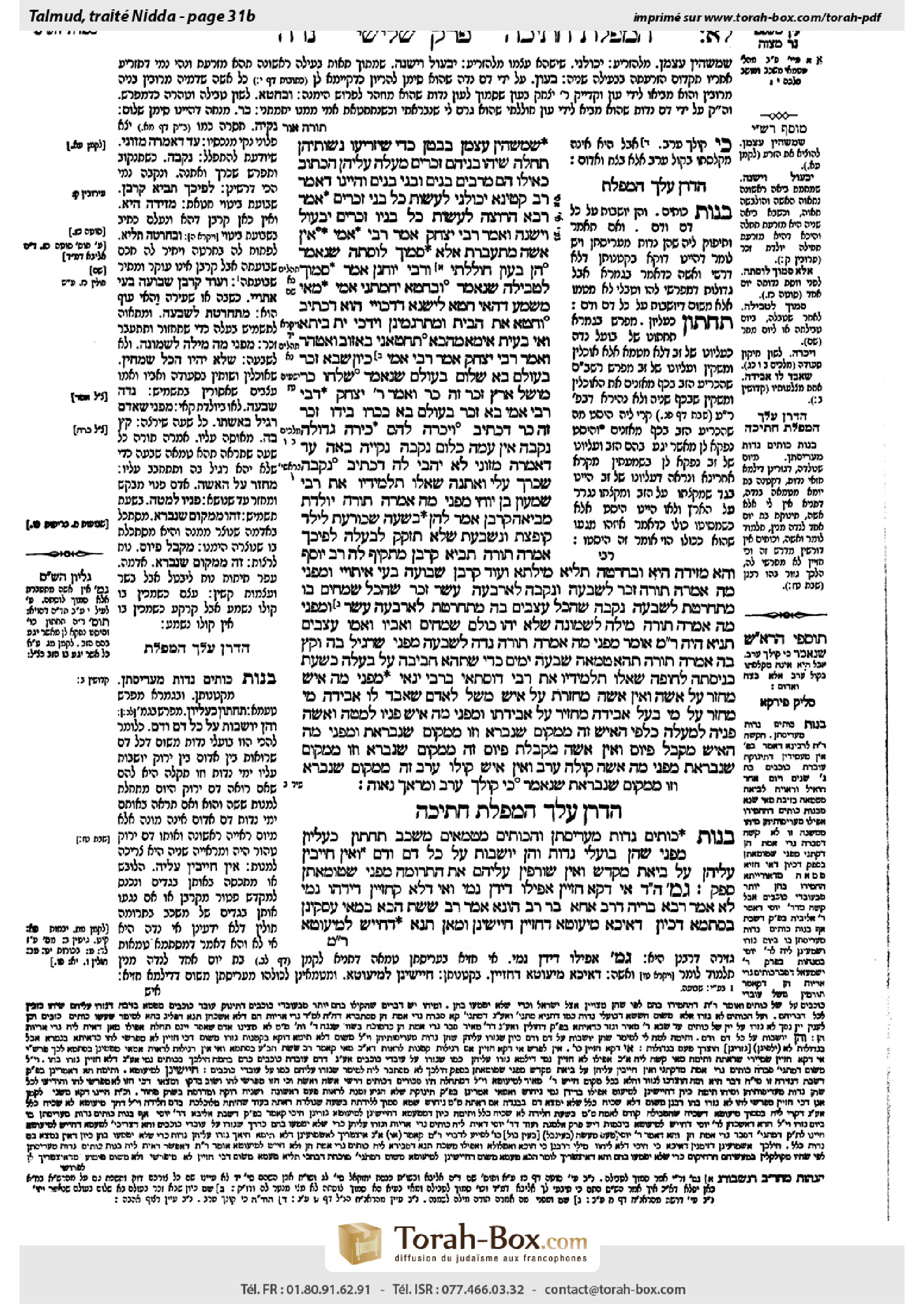
Niddah 31b: Talmud study for Daf Yomi
Daf Yomi is the daily study of one Talmud folio. Explore 37 tractates with scans, Hebrew text, Sefaria English and AI-generated French translations where annotated.
Passage selection and English or AI-generated French translation are available where the scan has annotations. Daf Study is independent of Torah-Box and Sefaria.
Browse Niddah · נידה · All tractatesNiddah 31b text and translations
This page of Niddah includes the Aramaic text, an English translation and an AI-generated French translation, alongside the scan above.
נידה ל״א ב · Aramaic and Hebrew text
שֶׁמְּשַׁהִין עַצְמָן בַּבֶּטֶן כְּדֵי שֶׁיַּזְרִיעוּ נְשׁוֹתֵיהֶן תְּחִלָּה, שֶׁיְּהוּ בְּנֵיהֶם זְכָרִים — מַעֲלֶה עֲלֵיהֶן הַכָּתוּב כְּאִילּוּ הֵם מַרְבִּים בָּנִים וּבְנֵי בָּנִים. וְהַיְינוּ דְּאָמַר רַב קַטִּינָא: יָכוֹלְנִי לַעֲשׂוֹת כׇּל בָּנַי זְכָרִים. אָמַר רָבָא: הָרוֹצֶה לַעֲשׂוֹת כׇּל בָּנָיו זְכָרִים — יִבְעוֹל וְיִשְׁנֶה.
וְאָמַר רַבִּי יִצְחָק, אָמַר רַבִּי אַמֵּי: אֵין אִשָּׁה מִתְעַבֶּרֶת אֶלָּא סָמוּךְ לְוִסְתָּהּ, שֶׁנֶּאֱמַר ״הֵן בְּעוֹוֹן חוֹלָלְתִּי״.
וְרַבִּי יוֹחָנָן אָמַר: סָמוּךְ (לטבילה) [לִטְבִילָתָהּ], שֶׁנֶּאֱמַר: ״וּבְחֵטְא יֶחֱמַתְנִי אִמִּי״.
מַאי מַשְׁמַע דְּהַאי ״חֵטְא״ לִישָּׁנָא דְּדַכּוֹיֵי הוּא? דִּכְתִיב ״וְחִטֵּא אֶת הַבַּיִת״, וּמְתַרְגְּמִינַן ״וִידַכֵּי יָת בֵּיתָא״. וְאִי בָּעֵית אֵימָא מֵהָכָא: ״תְּחַטְּאֵנִי בְּאֵזוֹב וְאֶטְהָר״.
וְאָמַר רַבִּי יִצְחָק, אָמַר רַבִּי אַמֵּי: כֵּיוָן שֶׁבָּא זָכָר בָּעוֹלָם — בָּא שָׁלוֹם בָּעוֹלָם, שֶׁנֶּאֱמַר ״שִׁלְחוּ כַר מוֹשֵׁל אֶרֶץ״. ״זָכָר״ — זֶה כַּר.
וְאָמַר רַבִּי יִצְחָק דְּבֵי רַבִּי אַמֵּי: בָּא זָכָר בָּעוֹלָם — בָּא כִּכָּרוֹ בְּיָדוֹ, ״זָכָר״ — זֶה כַּר, דִּכְתִיב: ״וַיִּכְרֶה לָהֶם כֵּרָה גְדוֹלָה״.
נְקֵבָה — אֵין עִמָּהּ כְּלוּם, נְקֵבָה — נְקִיָּיה בָּאָה, עַד דְּאָמְרָה: ״מְזוֹנֵי״ — לָא יָהֲבִי לַהּ, דִּכְתִיב: ״נׇקְבָה שְׂכָרְךָ עָלַי וְאֶתֵּנָה״.
שָׁאֲלוּ תַּלְמִידָיו אֶת רַבִּי שִׁמְעוֹן בֶּן יוֹחַי: מִפְּנֵי מָה אָמְרָה תּוֹרָה יוֹלֶדֶת מְבִיאָה קׇרְבָּן? אָמַר לָהֶן: בְּשָׁעָה שֶׁכּוֹרַעַת לֵילֵד, קוֹפֶצֶת וְנִשְׁבַּעַת שֶׁלֹּא תִּזָּקֵק לְבַעְלָהּ, לְפִיכָךְ אָמְרָה תּוֹרָה תָּבִיא קׇרְבָּן.
מַתְקֵיף לַהּ רַב יוֹסֵף: וְהָא מְזִידָה הִיא, וּבַחֲרָטָה תַּלְיָא מִילְּתָא! וְעוֹד — קׇרְבַּן שְׁבוּעָה (בעי) [בָּעֲיָא] אֵיתוֹיֵי!
וּמִפְּנֵי מָה אָמְרָה תּוֹרָה זָכָר לְשִׁבְעָה וּנְקֵבָה לְאַרְבָּעָה עָשָׂר? זָכָר, שֶׁהַכֹּל שְׂמֵחִים בּוֹ — מִתְחָרֶטֶת לְשִׁבְעָה. נְקֵבָה, שֶׁהַכֹּל עֲצֵבִים בָּהּ — מִתְחָרֶטֶת לְאַרְבָּעָה עָשָׂר.
וּמִפְּנֵי מָה אָמְרָה תּוֹרָה מִילָה לִשְׁמוֹנָה? שֶׁלֹּא יְהוּ כּוּלָּם שְׂמֵחִים וְאָבִיו וְאִמּוֹ עֲצֵבִים.
תַּנְיָא, הָיָה רַבִּי מֵאִיר אוֹמֵר: מִפְּנֵי מָה אָמְרָה תּוֹרָה נִדָּה לְשִׁבְעָה? מִפְּנֵי שֶׁרָגִיל בָּהּ וְקָץ בָּהּ. אָמְרָה תּוֹרָה: ״תְּהֵא טְמֵאָה שִׁבְעָה יָמִים״, כְּדֵי שֶׁתְּהֵא חֲבִיבָה עַל בַּעְלָהּ כִּשְׁעַת כְּנִיסָתָהּ לַחוּפָּה.
שָׁאֲלוּ תַּלְמִידָיו אֶת רַבִּי דּוֹסְתַּאי בְּרַבִּי יַנַּאי: מִפְּנֵי מָה אִישׁ מְחַזֵּר עַל אִשָּׁה, וְאֵין אִשָּׁה מְחַזֶּרֶת עַל אִישׁ? מָשָׁל לְאָדָם (שאבד) [שֶׁאָבְדָה] לוֹ אֲבֵידָה — מִי מְחַזֵּר עַל מִי? בַּעַל אֲבֵידָה מְחַזֵּר עַל אֲבֵידָתוֹ.
וּמִפְּנֵי מָה אִישׁ פָּנָיו לְמַטָּה, וְאִשָּׁה פָּנֶיהָ לְמַעְלָה כְּלַפֵּי הָאִישׁ? זֶה מִמְּקוֹם שֶׁנִּבְרָא, וְזוֹ מִמְּקוֹם שֶׁנִּבְרֵאת.
וּמִפְּנֵי מָה הָאִישׁ מְקַבֵּל פִּיּוּס, וְאֵין אִשָּׁה מְקַבֶּלֶת פִּיּוּס? זֶה מִמְּקוֹם שֶׁנִּבְרָא, וְזוֹ מִמְּקוֹם שֶׁנִּבְרֵאת.
מִפְּנֵי מָה אִשָּׁה קוֹלָהּ עָרֵב, וְאֵין אִישׁ קוֹלוֹ עָרֵב? זֶה מִמְּקוֹם שֶׁנִּבְרָא, וְזוֹ מִמְּקוֹם שֶׁנִּבְרֵאת, שֶׁנֶּאֱמַר: ״כִּי קוֹלֵךְ עָרֵב וּמַרְאֵךְ נָאוֶה״.
הֲדַרַן עֲלָךְ הַמַּפֶּלֶת חֲתִיכָה.
מַתְנִי' בְּנוֹת כּוּתִים נִדּוֹת מֵעֲרִיסָתָן, וְהַכּוּתִים מְטַמְּאִים מִשְׁכָּב תַּחְתּוֹן כָּעֶלְיוֹן, מִפְּנֵי שֶׁהֵן בּוֹעֲלֵי נִדּוֹת,
וְהֵן יוֹשְׁבוֹת עַל כׇּל דָּם וָדָם.
וְאֵין חַיָּיבִין עֲלֵיהֶן עַל בִּיאַת מִקְדָּשׁ, וְאֵין שׂוֹרְפִין עֲלֵיהֶם אֶת הַתְּרוּמָה, מִפְּנֵי שֶׁטּוּמְאָתָן סָפֵק.
גְּמָ' הֵיכִי דָּמֵי? אִי דְּקָא חָזְיָין — אֲפִילּוּ דִּידַן נָמֵי, וְאִי דְּלָא קָחָזְיָין — דִּידְהוּ נָמֵי לָא.
אָמַר רָבָא בְּרֵיהּ דְּרַב אַחָא בַּר רַב הוּנָא אָמַר רַב שֵׁשֶׁת: הָכָא בְמַאי עָסְקִינַן? בִּסְתָמָא, דְּכֵיוָן דְּאִיכָּא מִיעוּטָא דְּחָזְיָין — חָיְישִׁינַן. וּמַאן תַּנָּא דְּחָיֵישׁ לְמִיעוּטָא?
Niddah 31b · English translation
they delay while in their wives’ abdomen, initially refraining from emitting semen so that their wives will emit seed first, in order that their children will be male, the verse ascribes them credit as though they have many sons and sons’ sons. And this statement is the same as that which Rav Ketina said: I could have made all of my children males, by refraining from emitting seed until my wife emitted seed first. Rava says another method through which one can cause his children to be males: One who wishes to make all of his children males should engage in intercourse with his wife and repeat the act.
§ And Rabbi Yitzḥak says that Rabbi Ami says: A woman becomes pregnant only by engaging in intercourse close to the onset of her menstrual cycle, as it is stated: “Behold, I was brought forth in iniquity” (Psalms 51:7). This iniquity is referring to intercourse close to the woman’s menstrual cycle, when intercourse is prohibited. Accordingly, David is saying that his mother presumably conceived him at this time.
And Rabbi Yoḥanan says: A woman becomes pregnant only by engaging in intercourse near the time of her immersion in a ritual bath, through which she is purified from her status as a menstruating woman, as it is stated in the continuation of the same verse: “And in sin [uvḥet] did my mother conceive me” (Psalms 51:7).
The Gemara explains this derivation: From where may it be inferred that this term “ḥet” is a reference to purity? The Gemara answers: As it is written with regard to leprosy of houses: “Veḥittei the house” (Leviticus 14:52), and we translate the verse into Aramaic as: And he shall purify the house. And if you wish, say that the interpretation is derived from here: “Purge me [teḥatte’eni] with hyssop, and I shall be pure” (Psalms 51:9). Evidently, the root ḥet, tet, alef refers to purification.
§ And Rabbi Yitzḥak says that Rabbi Ami says: When a male comes into the world, i.e., when a male baby is born, peace comes to the world, as it is stated: “Send the lambs [khar] for the ruler of the land” (Isaiah 16:1). This khar, or kar, a gift one sends the ruler, contributes to the stability of the government and peace, and the word male [zakhar] can be interpreted homiletically as an abbreviation of: This is a kar [zeh kar].
And Rabbi Yitzḥak from the school of Rabbi Ami says: When a male comes into the world, his loaf of bread, i.e., his sustenance, comes into his possession. In other words, a male can provide for himself. This is based on the aforementioned interpretation of the word male [zakhar] as an abbreviation of: This is a kar [zeh kar], and the term kar refers to sustenance, as it is written: “And he prepared great provision [kera] for them” (II Kings 6:23).
By contrast, when a female comes into the world, nothing, i.e., no sustenance, comes with her. This is derived from the homiletic interpretation of the word female [nekeva] as an abbreviation of the phrase: She comes clean [nekiya ba’a], i.e., empty. Furthermore, until she says: Give me sustenance, people do not give her, as it is written in Laban’s request of Jacob: “Appoint me [nokva] your wages, and I will give it” (Genesis 30:28). Laban used the word nokva, similar to nekeva, when he said that he would pay Jacob only if he explicitly demanded his wages.
The students of Rabbi Shimon ben Yoḥai asked him: For what reason does the Torah say that a woman after childbirth brings an offering? He said to them: At the time that a woman crouches to give birth, her pain is so great that she impulsively takes an oath that she will not engage in intercourse with her husband ever again, so that she will never again experience this pain. Therefore, the Torah says that she must bring an offering for violating her oath and continuing to engage in intercourse with her husband.
Rav Yosef objects to this answer: But isn’t the woman an intentional violator of her oath? And if she wishes that her oath be dissolved, so that she may engage in intercourse with her husband, the matter depends on her regret of her oath. One is obligated to bring an offering for violating an oath of an utterance only if his transgression is unwitting. And furthermore, if the purpose of the offering that a woman brings after childbirth is to atone for violating an oath, then she should be required to bring a female lamb or goat as an offering, which is the requirement of one who violated an oath, rather than the bird offering brought by a woman after childbirth.
And the students of Rabbi Shimon ben Yoḥai further inquired of him: For what reason does the Torah say that a woman who gives birth to a male is ritually impure for seven days, but a woman who gives birth to a female is impure for fourteen days? Rabbi Shimon ben Yoḥai answered them: When a woman gives birth to a male, over which everyone is happy, she regrets her oath, that she will never again engage in intercourse with her husband, already seven days after giving birth. By contrast, after giving birth to a female, over which everyone is unhappy, she regrets her oath only fourteen days after giving birth.
And the students further asked him: For what reason does the Torah say that circumcision is performed only on the eighth day of the baby’s life, and not beforehand? He answered them: It is so that there will not be a situation where everyone is happy at the circumcision ceremony but the father and mother of the infant are unhappy, as they are still prohibited from engaging in intercourse.
It is taught in a baraita that Rabbi Meir would say: For what reason does the Torah say that a menstruating woman is prohibited from engaging in intercourse with her husband for seven days? It is because if a woman were permitted to engage in intercourse with her husband all the time, her husband would be too accustomed to her, and would eventually be repulsed by her. Therefore, the Torah says that a menstruating woman shall be ritually impure for seven days, during which she is prohibited from engaging in intercourse with her husband, so that when she becomes pure again she will be dear to her husband as at the time when she entered the wedding canopy with him.
§ The students of Rabbi Dostai, son of Rabbi Yannai, asked him: For what reason is it the norm that a man pursues a woman for marriage, but a woman does not pursue a man? Rabbi Dostai answered them by citing a parable of a person who lost an item. Who searches for what? Certainly the owner of the lost item searches for his item; the item does not search for its owner. Since the first woman was created from the body of the first man, the man seeks that which he has lost.
And the students of Rabbi Dostai further asked him: For what reason does a man engage in intercourse facing down, and a woman engage in intercourse facing up toward the man? Rabbi Dostai answered them: This man faces the place from which he was created, i.e., the earth, and that woman faces the place from which she was created, namely man.
And the students also inquired: For what reason is a man who is angry likely to accept appeasement, but a woman is not as likely to accept appeasement? Rabbi Dostai answered them: It is because this man behaves like the place from which he was created, i.e., the earth, which yields to pressure, and that woman behaves like the place from which she was created, i.e., from bone, which cannot be molded easily.
The students continued to ask Rabbi Dostai: For what reason is a woman’s voice pleasant, but a man’s voice is not pleasant? He answered: This man is similar to the place from which he was created, the earth, which does not issue a sound when it is struck, and that woman is similar to the place from which she was created, a bone, which makes a sound when it is struck. The proof that a woman’s voice is pleasant is that it is stated in Song of Songs that the man says to his beloved: “For sweet is your voice, and your countenance is beautiful” (Song of Songs 2:14).
MISHNA: Samaritan girls are considered menstruating women from the time they lie in their cradle. And the Samaritan men impart ritual impurity to the lower bedding like the upper bedding, i.e., all layers of bedding beneath them are impure, and their status is like the bedding above a man who experiences a gonorrhea-like discharge [zav]: The status of both levels of bedding is that of first-degree ritual impurity, which can impart impurity to food and drink. This is due to the fact that Samaritan men are considered men who engage in intercourse with menstruating women.
And they are considered men who engage in intercourse with menstruating women because Samaritan women observe the seven-day menstrual period of ritual impurity for each and every emission of blood, even for blood that does not render them impure. Accordingly, if a Samaritan woman has an emission of impure blood during the seven-day period, she will nevertheless continue counting seven days from the first emission. It is therefore possible that the Samaritan men will engage in intercourse with their wives while they are still halakhically considered menstruating women, as the seven-day period of impurity should have been counted from the emission of the impure blood.
But one who enters the Temple while wearing those garments upon which a Samaritan had lain is not liable to bring an offering for entering the Temple in a status of impurity, nor does one burn teruma that came into contact with those garments, because their impurity is uncertain.
GEMARA: The mishna teaches that Samaritan girls are considered menstruating women from the time they lie in their cradle. The Gemara asks: What are the circumstances of this statement? If the mishna is referring to girls who already see menstrual blood, then even our own, i.e., Jewish girls, are also considered menstruating women under such circumstances. And if it is referring to girls who do not yet see menstrual blood, then their girls, i.e., those of the Samaritans, should also not have the status of menstruating women.
Rava, son of Rav Aḥa bar Rav Huna, says that Rav Sheshet says: Here we are dealing with an unspecified case, i.e., it is unknown whether these girls have experienced their first menstrual period. Since there is a minority of girls who see menstrual blood, we are concerned with regard to each Samaritan girl that she might be from this minority. The Gemara asks: And who is the tanna who taught that one must be concerned for the minority?
Niddah 31b · Traduction française (IA)
Ils retardent [l'émission] alors qu'ils sont dans le ventre de leurs épouses, en s'abstenant initialement d'émettre la semence afin que leurs épouses émettent la semence en premier, de sorte que leurs enfants soient des garçons ; le verset leur attribue le mérite comme s'ils avaient de nombreux fils et petits-fils. Et cette déclaration est identique à celle que Rav Ketina a dite : J'aurais pu faire de tous mes enfants des garçons, en m'abstenant d'émettre la semence jusqu'à ce que ma femme émette la semence en premier. Rava dit qu'il existe une autre méthode par laquelle on peut faire en sorte que ses enfants soient des garçons : Celui qui souhaite que tous ses enfants soient des garçons doit avoir des rapports avec sa femme et répéter l'acte.
§ Et Rabbi Yitzḥak dit que Rabbi Ami dit : Une femme ne conçoit qu'en ayant des rapports proches du début de son cycle menstruel, car il est écrit : « Voici, je suis né dans l'iniquité » (Psaumes 51:7). Cette iniquité fait référence aux rapports proches du cycle menstruel de la femme, lorsque les rapports sont interdits. En conséquence, David dit que sa mère a probablement conçu à ce moment-là.
Et Rabbi Yoḥanan dit : Une femme ne conçoit qu'en ayant des rapports proches du moment de son immersion dans un bain rituel, par laquelle elle est purifiée de son statut de femme en période menstruelle, car il est écrit dans la suite du même verset : « Et dans le péché [uvḥet] ma mère m'a conçu » (Psaumes 51:7).
La Guemara explique cette déduction : D'où peut-on inférer que ce terme « ḥet » fait référence à la pureté ? La Guemara répond : Comme il est écrit à propos de la lèpre des maisons : « Veḥittei la maison » (Lévitique 14:52), et nous traduisons le verset en araméen par : Et il purifiera la maison. Et si vous le souhaitez, dites que l'interprétation est déduite d'ici : « Purifie-moi [teḥatte'eni] avec de l'hysope, et je serai pur » (Psaumes 51:9). Évidemment, la racine ḥet, tet, alef fait référence à la purification.
§ Et Rabbi Yitzḥak dit que Rabbi Ami dit : Quand un mâle vient au monde, c'est-à-dire quand un bébé garçon naît, la paix vient au monde, car il est écrit : « Envoie les agneaux [khar] au gouverneur du pays » (Ésaïe 16:1). Ce khar, ou kar, un cadeau qu'on envoie au gouverneur, contribue à la stabilité du gouvernement et à la paix, et le mot mâle [zakhar] peut être interprété homilétiquement comme une abréviation de : Ceci est un kar [zeh kar].
Et Rabbi Yitzḥak de l'école de Rabbi Ami dit : Quand un mâle vient au monde, son pain, c'est-à-dire sa subsistance, entre en sa possession. En d'autres termes, un mâle peut pourvoir à ses besoins. Cela se base sur l'interprétation susmentionnée du mot mâle [zakhar] comme abréviation de : Ceci est un kar [zeh kar], et le terme kar fait référence à la subsistance, car il est écrit : « Et il leur prépara une grande provision [kera] » (II Rois 6:23).
En revanche, lorsqu'une femme vient au monde, rien, c'est-à-dire aucune subsistance, ne vient avec elle. Cela est déduit de l'interprétation homilétique du mot femme [nekeva] comme abréviation de la phrase : Elle vient pure [nekiya ba'a], c'est-à-dire vide. De plus, jusqu'à ce qu'elle dise : Donne-moi ma subsistance, les gens ne lui donnent rien, car il est écrit dans la demande de Laban à Jacob : « Fixe-moi [nokva] ton salaire, et je te le donnerai » (Genèse 30:28). Laban a utilisé le mot nokva, similaire à nekeva, lorsqu'il a dit qu'il paierait Jacob seulement si celui-ci demandait explicitement son salaire.
Les disciples de Rabbi Shimon ben Yoḥai lui ont demandé : Pour quelle raison la Torah dit-elle qu'une femme après l'accouchement apporte un sacrifice ? Il leur a dit : Au moment où une femme se penche pour accoucher, sa douleur est si grande qu'elle jure impulsivement qu'elle n'aura plus jamais de rapports avec son mari, afin de ne plus jamais ressentir cette douleur. Par conséquent, la Torah dit qu'elle doit apporter un sacrifice pour avoir violé son serment et avoir continué à avoir des rapports avec son mari.
Rav Yosef objecte à cette réponse : Mais n'est-elle pas une violatrice intentionnelle de son serment ? Et si elle souhaite que son serment soit dissous, afin qu'elle puisse avoir des rapports avec son mari, la chose dépend de son regret de son serment. On est obligé d'apporter un sacrifice pour avoir violé un serment de parole seulement si sa transgression est involontaire. Et de plus, si le but du sacrifice qu'une femme apporte après l'accouchement est d'expier la violation d'un serment, alors elle devrait être tenue d'apporter une brebis ou une chèvre femelle en sacrifice, ce qui est l'exigence de celui qui a violé un serment, plutôt que le sacrifice d'oiseaux apporté par une femme après l'accouchement.
Et les disciples de Rabbi Shimon ben Yoḥai lui ont demandé en outre : Pour quelle raison la Torah dit-elle qu'une femme qui accouche d'un garçon est rituellement impure pendant sept jours, mais qu'une femme qui accouche d'une fille est impure pendant quatorze jours ? Rabbi Shimon ben Yoḥai leur a répondu : Quand une femme accouche d'un garçon, dont tout le monde est heureux, elle regrette son serment, qu'elle n'aura plus jamais de rapports avec son mari, déjà sept jours après l'accouchement. En revanche, après avoir accouché d'une fille, dont tout le monde est malheureux, elle regrette son serment seulement quatorze jours après l'accouchement.
Et les disciples lui ont demandé en outre : Pour quelle raison la Torah dit-elle que la circoncision est effectuée seulement le huitième jour de la vie du bébé, et non avant ? Il leur a répondu : C'est afin qu'il n'y ait pas de situation où tout le monde est heureux lors de la cérémonie de circoncision mais où le père et la mère du nourrisson sont malheureux, car ils sont encore interdits d'avoir des rapports.
Il est enseigné dans une baraïta que Rabbi Meïr disait : Pour quelle raison la Torah déclare-t-elle qu'une femme en période menstruelle est interdite à la relation conjugale avec son mari pendant sept jours ? C'est parce que si une femme était autorisée à avoir des rapports avec son mari en tout temps, son mari s'y habituerait trop et finirait par en être répugné. Par conséquent, la Torah déclare qu'une femme en période menstruelle est rituellement impure pendant sept jours, durant lesquels elle est interdite à la relation conjugale avec son mari, afin que lorsqu'elle redeviendra pure, elle soit chère à son mari comme au moment où elle est entrée sous le dais nuptial avec lui.
§ Les disciples de Rabbi Dostai, fils de Rabbi Yannai, lui demandèrent : Pour quelle raison est-il la norme qu'un homme poursuive une femme en vue du mariage, mais qu'une femme ne poursuive pas un homme ? Rabbi Dostai leur répondit en citant une parabole sur une personne qui a perdu un objet. Qui cherche quoi ? Certainement le propriétaire de l'objet perdu cherche son objet ; l'objet ne cherche pas son propriétaire. Puisque la première femme a été créée à partir du corps du premier homme, l'homme cherche ce qu'il a perdu.
Et les disciples de Rabbi Dostai lui demandèrent encore : Pour quelle raison un homme a-t-il des rapports en se tenant face vers le bas, et une femme en se tenant face vers le haut, vers l'homme ? Rabbi Dostai leur répondit : Cet homme fait face à l'endroit dont il a été créé, c'est-à-dire la terre, et cette femme fait face à l'endroit dont elle a été créée, à savoir l'homme.
Et les disciples demandèrent également : Pour quelle raison un homme en colère est-il susceptible d'accepter des excuses, mais une femme ne l'est-elle pas autant ? Rabbi Dostai leur répondit : C'est parce que cet homme se comporte comme l'endroit dont il a été créé, c'est-à-dire la terre, qui cède sous la pression, et que cette femme se comporte comme l'endroit dont elle a été créée, c'est-à-dire l'os, qui ne peut pas être facilement façonné.
Les disciples continuèrent à demander à Rabbi Dostai : Pour quelle raison la voix d'une femme est-elle agréable, mais la voix d'un homme ne l'est-elle pas ? Il répondit : Cet homme est semblable à l'endroit dont il a été créé, la terre, qui ne produit pas de son lorsqu'elle est frappée, et cette femme est semblable à l'endroit dont elle a été créée, un os, qui produit un son lorsqu'il est frappé. La preuve que la voix d'une femme est agréable est qu'il est écrit dans le Cantique des Cantiques que l'homme dit à son aimée : « Car ta voix est douce, et ton visage est beau » (Cantique des Cantiques 2:14).
Michna : Les filles samaritaines sont considérées comme des femmes en période menstruelle dès le moment où elles sont couchées dans leur berceau. Et les hommes samaritains transmettent l'impureté rituelle au linge de lit inférieur comme au linge de lit supérieur, c'est-à-dire que toutes les couches de linge de lit situées sous eux sont impures, et leur statut est celui du linge de lit situé au-dessus d'un homme qui a un écoulement de type gonorrhée [zav] : Le statut des deux niveaux de linge de lit est celui d'une impureté rituelle de premier degré, qui peut transmettre l'impureté à la nourriture et aux boissons. Cela est dû au fait que les hommes samaritains sont considérés comme des hommes qui ont des rapports avec des femmes en période menstruelle.
Et ils sont considérés comme des hommes qui ont des rapports avec des femmes en période menstruelle parce que les femmes samaritaines observent la période de sept jours d'impureté rituelle pour chaque écoulement de sang, même pour un sang qui ne les rend pas impures. En conséquence, si une femme samaritaine a un écoulement de sang impur pendant la période de sept jours, elle continuera néanmoins à compter sept jours à partir du premier écoulement. Il est donc possible que les hommes samaritains aient des rapports avec leurs épouses alors qu'elles sont encore considérées halakhiquement comme des femmes en période menstruelle, car la période de sept jours d'impureté aurait dû être comptée à partir de l'écoulement du sang impur.
Mais celui qui entre dans le Temple en portant ces vêtements sur lesquels un Samaritain s'est couché n'est pas tenu d'apporter une offrande pour être entré dans le Temple dans un état d'impureté, ni ne brûle-t-on la terouma qui a été en contact avec ces vêtements, parce que leur impureté est incertaine.
Guemara : La Michna enseigne que les filles samaritaines sont considérées comme des femmes en période menstruelle dès le moment où elles sont couchées dans leur berceau. La Guemara demande : Quelles sont les circonstances de cette déclaration ? Si la Michna fait référence à des filles qui voient déjà du sang menstruel, alors même les nôtres, c'est-à-dire les filles juives, sont également considérées comme des femmes en période menstruelle dans de telles circonstances. Et si elle fait référence à des filles qui ne voient pas encore de sang menstruel, alors leurs filles, c'est-à-dire celles des Samaritains, ne devraient pas non plus avoir le statut de femmes en période menstruelle.
Rava, fils de Rav Aḥa bar Rav Huna, dit que Rav Chéchet dit : Ici, nous avons affaire à un cas non spécifié, c'est-à-dire qu'il est inconnu si ces filles ont eu leurs premières règles. Comme il y a une minorité de filles qui voient du sang menstruel, nous sommes préoccupés par le fait que chaque fille samaritaine puisse appartenir à cette minorité. La Guemara demande : Et qui est le tanna qui a enseigné qu'il faut se préoccuper de la minorité ?
Traduction française générée par IA à partir de l’édition anglaise de Sefaria. Vérifie toujours un passage avec le texte source.
Text from Sefaria: William Davidson Edition - Vocalized Aramaic (CC BY NC); William Davidson Edition - English (CC BY NC).