Niddah 32a: Talmud study for Daf Yomi
Daf Yomi is the daily study of one Talmud folio. Explore 37 tractates with scans, Hebrew text, Sefaria English and AI-generated French translations where annotated.
Passage selection and English or AI-generated French translation are available where the scan has annotations. Daf Study is independent of Torah-Box and Sefaria.
Browse Niddah · נידה · All tractatesNiddah 32a text and translations
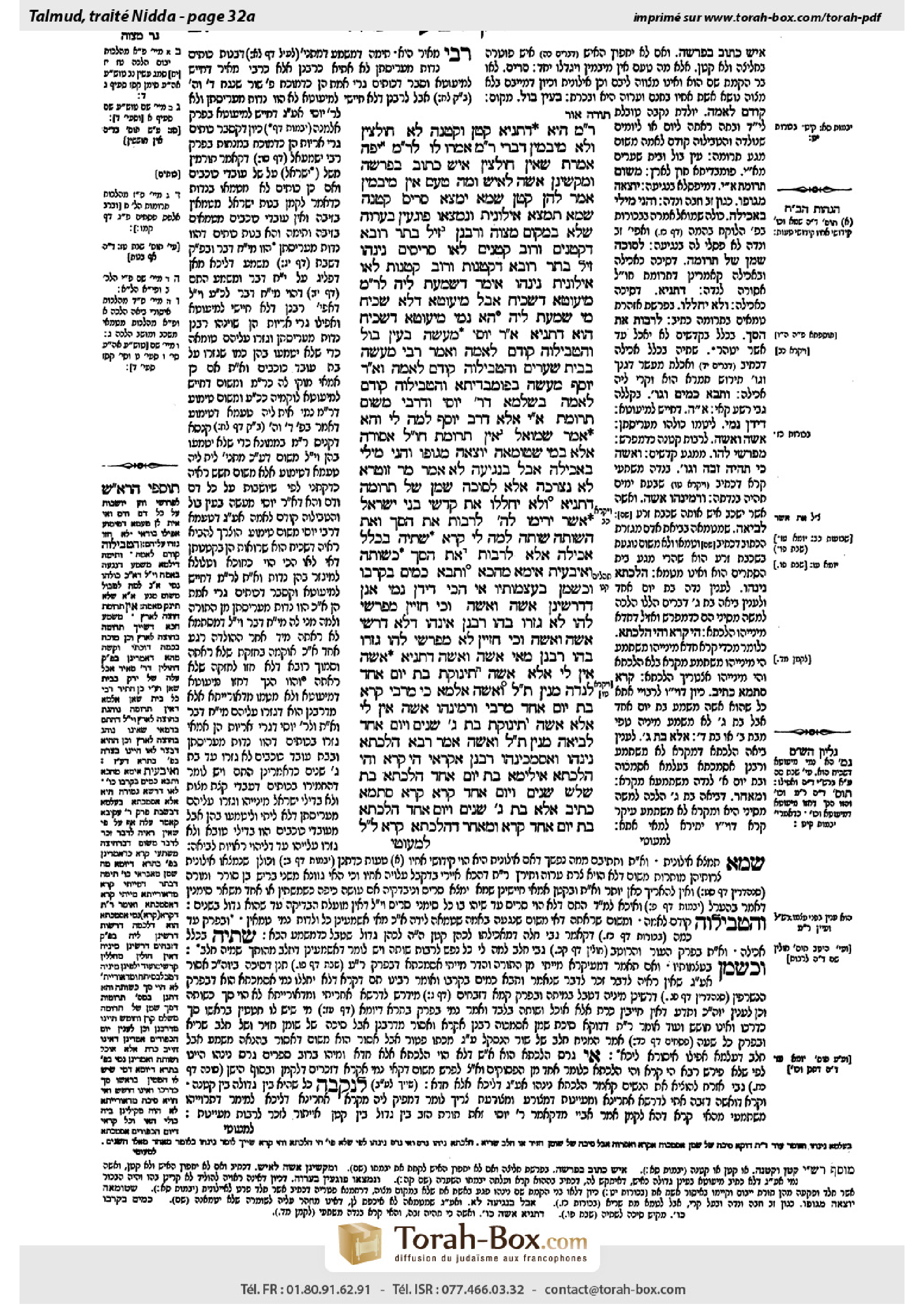
This page of Niddah includes the Aramaic text, an English translation and an AI-generated French translation, alongside the scan above.
נידה ל״ב א · Aramaic and Hebrew text
רַבִּי מֵאִיר הִיא, דְּתַנְיָא: קָטָן וּקְטַנָּה לֹא חוֹלְצִין וְלֹא מְיַבְּמִין, דִּבְרֵי רַבִּי מֵאִיר.
אָמְרוּ לוֹ לְרַבִּי מֵאִיר: יָפֶה אָמַרְתָּ שֶׁאֵין חוֹלְצִין, ״אִישׁ״ כָּתוּב בַּפָּרָשָׁה, וּמַקְּשִׁינַן אִשָּׁה לְאִישׁ. וּמָה טַעַם אֵין מְיַבְּמִין?
אָמַר לָהֶן: קָטָן — שֶׁמָּא יִמָּצֵא סָרִיס, קְטַנָּה — שֶׁמָּא תִּמָּצֵא אַיְלוֹנִית, וְנִמְצְאוּ פּוֹגְעִין בְּעֶרְוָה שֶׁלֹּא בִּמְקוֹם מִצְוָה.
וְרַבָּנַן? זִיל בָּתַר רוּבָּא דִּקְטַנִּים, וְרוֹב קְטַנִּים לָאו סָרִיסִים נִינְהוּ; זִיל בָּתַר רוּבָּא דִּקְטַנּוֹת, וְרוֹב קְטַנּוֹת לָאו אַיְלוֹנִיּוֹת נִינְהוּ.
אֵימַר דְּשָׁמְעַתְּ לֵיהּ לְרַבִּי מֵאִיר מִיעוּטָא דִּשְׁכִיחַ, אֲבָל מִיעוּטָא דְּלָא שְׁכִיחַ — מִי שָׁמְעַתְּ לֵיהּ?
הָא נָמֵי מִיעוּטָא דִּשְׁכִיחַ הוּא. דְּתַנְיָא: אָמַר רַבִּי יוֹסֵי: מַעֲשֶׂה בְּעֵין בּוּל וְהִטְבִּילוּהָ קוֹדֶם לְאִמָּהּ, וְאָמַר רַבִּי: מַעֲשֶׂה בְּבֵית שְׁעָרִים וְהִטְבִּילוּהָ קוֹדֶם לְאִמָּהּ. וְאָמַר רַב יוֹסֵף: מַעֲשֶׂה בְּפוּמְבְּדִיתָא וְהִטְבִּילוּהָ קוֹדֶם לְאִמָּהּ.
בִּשְׁלָמָא דְּרַבִּי יוֹסֵי וּדְרַבִּי — מִשּׁוּם תְּרוּמַת אֶרֶץ יִשְׂרָאֵל, אֶלָּא דְּרַב יוֹסֵף לְמָה לִי? וְהָא אָמַר שְׁמוּאֵל: אֵין תְּרוּמַת חוּץ לָאָרֶץ אֲסוּרָה אֶלָּא בְּמִי שֶׁטּוּמְאָה יוֹצְאָה מִגּוּפוֹ, וְהָנֵי מִילֵּי בַּאֲכִילָה, אֲבָל בִּנְגִיעָה לָא!
אָמַר מָר זוּטְרָא: לֹא נִצְרְכָה אֶלָּא לְסוּכָהּ שֶׁמֶן שֶׁל תְּרוּמָה, דְּתַנְיָא: ״וְלֹא יְחַלְּלוּ אֶת קׇדְשֵׁי בְּנֵי יִשְׂרָאֵל אֲשֶׁר יָרִימוּ לַה׳״ — לְרַבּוֹת אֶת הַסָּךְ וְאֶת הַשּׁוֹתֶה.
שׁוֹתָה לְמָה לִי קְרָא? שְׁתִיָּה בִּכְלַל אֲכִילָה! אֶלָּא, לְרַבּוֹת אֶת הַסָּךְ כַּשּׁוֹתֶה. וְאִיבָּעֵית אֵימָא מֵהָכָא: ״וַתָּבֹא כַמַּיִם בְּקִרְבּוֹ וְכַשֶּׁמֶן בְּעַצְמוֹתָיו״.
אִי הָכִי דִּידַן נָמֵי?
אֲנַן, דְּדָרְשִׁינַן ״אִשָּׁה״ ״וְאִשָּׁה״, וְכִי חָזְיָין (מפרשי) [מַפְרְשִׁינַן] לְהוּ — לָא גְּזַרוּ בְּהוּ רַבָּנַן. אִינְהוּ דְּלָא דָּרְשִׁי ״אִשָּׁה״ ״וְאִשָּׁה״, וְכִי חָזְיָין לָא מַפְרְשִׁי לְהוּ — גְּזַרוּ בְּהוּ רַבָּנַן.
מַאי ״אִשָּׁה״ ״וְאִשָּׁה״? דְּתַנְיָא: ״אִשָּׁה״ — אֵין לִי אֶלָּא אִשָּׁה, תִּינוֹקֶת בַּת יוֹם אֶחָד לְנִדָּה מִנַּיִן? תַּלְמוּד לוֹמַר: ״וְאִשָּׁה״.
אַלְמָא, כִּי מְרַבֵּי קְרָא בַּת יוֹם אֶחָד מְרַבֵּי, וּרְמִינְהוּ: ״אִשָּׁה״ — אֵין לִי אֶלָּא אִשָּׁה, תִּינוֹקֶת בַּת שָׁלֹשׁ שָׁנִים וְיוֹם אֶחָד לְבִיאָה מִנַּיִן? תַּלְמוּד לוֹמַר: ״וְאִשָּׁה״!
אָמַר רָבָא: הִלְכְתָא נִינְהוּ, וְאַסְמְכִינְהוּ רַבָּנַן אַקְּרָאֵי. הֵי קְרָא וְהֵי הִלְכְתָא? אִילֵּימָא בַּת יוֹם אֶחָד — הִלְכְתָא, בַּת שָׁלֹשׁ שָׁנִים וְיוֹם אֶחָד — קְרָא, קְרָא סְתָמָא כְּתִיב!
אֶלָּא בַּת שָׁלֹשׁ שָׁנִים וְיוֹם אֶחָד — הִלְכְתָא, בַּת יוֹם אֶחָד — קְרָא, וּמֵאַחַר דְּהִלְכְתָא, קְרָא לָמָּה לִי?
Niddah 32a · English translation
The Gemara responds: It is Rabbi Meir, as it is taught in a baraita: A minor boy and a minor girl may not perform the ritual through which a yavam frees a yevama of her levirate bonds [ḥalitza], nor may they enter into levirate marriage. In other words, a minor boy whose brother died childless may not perform ḥalitza with his brother’s widow, nor may he enter into levirate marriage with her, even if she is an adult. Likewise, a minor girl whose husband died childless may not perform ḥalitza with her husband’s brother, nor may she enter into levirate marriage with him, even if he is an adult. This is the statement of Rabbi Meir.
The Rabbis said to Rabbi Meir: You have aptly stated that they may not perform ḥalitza, since “man” is written in the passage of the Torah discussing ḥalitza (Deuteronomy 25:7), and we compare a woman to a man, as the aforementioned verse states: “And if the man does not want to take his brother’s wife.” Consequently, neither a minor boy nor a minor girl may perform ḥalitza. But what is the reason that they may not enter into levirate marriage?
Rabbi Meir said to them: A minor boy may not enter into levirate marriage lest, once he is older, he be found to be a sexually underdeveloped man, who is incapable of fathering children. Likewise, a minor girl may not enter into levirate marriage lest, once she is older, she be found to be a sexually underdeveloped woman. And if a sexually underdeveloped boy or girl enters into levirate marriage they will be found to be infringing upon prohibitions against forbidden sexual intercourse where no mitzva applies, as the entire purpose of levirate marriage is to bear children in the name of the deceased.
The Gemara notes: And the Rabbis maintain that one follows the majority of minor boys, and most minor boys are not going to be sexually underdeveloped men; likewise, one follows the majority of minor girls, and most minor girls are not going to be sexually underdeveloped women. In any event, the baraita indicates that Rabbi Meir is concerned for the minority.
The Gemara objects: You can say that you heard that Rabbi Meir is concerned for a common minority, e.g., the minority of sexually underdeveloped men and sexually underdeveloped women. But did you hear him say that one is concerned for an uncommon minority, such as the minority of young girls who menstruate?
The Gemara explains: This minority of young girls who menstruate is also a common minority. As it is taught in a baraita that Rabbi Yosei said: There was an incident in the town of Ein Bul where they immersed a baby girl in a ritual bath before her mother. In other words, the baby girl experienced bleeding so soon after birth that her immersion in a ritual bath occurred before her mother immersed fourteen days after giving birth. And Rabbi Yehuda HaNasi likewise said: There was an incident in Beit She’arim where they immersed a baby girl before her mother. And Rav Yosef said: There was an incident in Pumbedita where they immersed a baby girl before her mother.
The Gemara asks: Granted, the immersions reported by Rabbi Yosei and by Rabbi Yehuda HaNasi are understandable, due to the teruma of Eretz Yisrael, i.e., these incidents occurred in Eretz Yisrael, where the touch of a menstruating girl disqualifies teruma. But in the incident reported by Rav Yosef, which occurred in Babylonia, why do I need to immerse the baby girl? But doesn’t Shmuel say: The teruma of outside of Eretz Yisrael is prohibited only to one whose impurity is due to an emission from his body, e.g., a menstruating woman, or one who experiences a gonorrhea-like discharge [zav]. And this statement applies only with regard to eating teruma, but with regard to touching teruma, there is no prohibition. Since the touch of a menstruating woman does not disqualify teruma outside Eretz Yisrael, why was it necessary to immerse the baby girl in the incident reported by Rav Yosef?
Mar Zutra says: That immersion was necessary only for smearing oil of teruma of outside of Eretz Yisrael. Since smearing is equivalent to eating, it would have been prohibited to smear such oil on the baby girl, were it not for her immersion in a ritual bath. And from where is it derived that smearing is like eating with regard to teruma? As it is taught in a baraita: The verse discussing the prohibition against consuming teruma in a state of ritual impurity states: “And they shall not desecrate the sacred items of the children of Israel, which they set apart for the Lord” (Leviticus 22:15). The verse serves to include in this prohibition one who smears and one who drinks.
Mar Zutra continues: Why do I need a verse to teach that one who drinks teruma in a state of impurity is liable? Isn’t drinking included in the category of eating? Rather, the baraita means that the verse serves to include one who smears, teaching that he is like one who drinks. And if you wish, say that one may derive that smearing is like drinking from here: “And it came into his innards like water, and like oil into his bones” (Psalms 109:18).
As it stands, the halakha that Samaritan girls are considered menstruating women from the time they lie in their cradle is in accordance with the opinion of Rabbi Meir, who is concerned for the minority of young girls who menstruate. The Gemara objects: If so, let us be concerned for the same minority with regard to our girls as well.
The Gemara explains: There is no need to be concerned with regard to our young girls, as we interpret the verse: “And if a woman has an issue” (Leviticus 15:19), and derive from the fact that the verse does not merely state: “A woman,” but: “And if a woman,” that even minor girls are included in the halakhot of a menstruating woman. And consequently, when our girls see menstrual blood, we separate them in the manner of all menstruating women. Therefore, the Sages did not decree with regard to them that all young Jewish girls assume the status of menstruating women. By contrast, with regard to them, Samaritans, who do not interpret the difference between “a woman” and “and if a woman,” when their girls see menstrual blood they do not separate them, and therefore the Sages decreed with regard to them that all Samaritan girls assume the status of menstruating women.
§ The Gemara asks: What is this interpretation of the difference between “a woman” and “and if a woman”? As it is taught in a baraita that from “a woman” I have derived only that the halakhot of menstruation apply to an adult woman. From where do I derive that the halakhot of a menstruating woman also apply to a one-day-old girl? The verse states: “And if a woman.”
The Gemara asks: Apparently, when the verse includes young girls through the word “and” it includes even a one-day-old. But you can raise a contradiction from another baraita, which discusses the verse: “And the woman with whom a man shall lie carnally, they shall both bathe themselves in water, and be impure until the evening” (Leviticus 15:18). From the word “woman” I have derived only that the sexual intercourse of an adult woman is considered intercourse that renders her impure. From where do I derive that the sexual intercourse of a girl aged three years and one day is also classified as intercourse? The verse states: And the woman. Evidently, the word “and” includes only a girl aged three years and one day.
Rava said: These are halakhot transmitted to Moses from Sinai, and the Sages merely supported them with verses. There is therefore no contradiction. The Gemara asks: Which halakha is derived from a verse and which is a halakha transmitted to Moses from Sinai? If we say that the halakha that the status of a menstruating woman may apply to a one-day-old girl is a halakha transmitted to Moses from Sinai, and the halakha that the intercourse of a girl aged three years and one day is considered intercourse is derived from a verse, then one may object: But the verse is written in an unspecified manner; consequently, a one-day-old girl should be included by the verse in the same manner as a three-year-old girl.
Rather, the halakha with regard to the intercourse of a girl aged three years and one day is a halakha transmitted to Moses from Sinai, whereas the halakha with regard to the menstruation of a one-day-old girl is derived from a verse. The Gemara asks: And now that it has been established that the halakha with regard to the intercourse of a three-year-old girl is a halakha transmitted to Moses from Sinai, why do I need a verse?
Niddah 32a · Traduction française (IA)
La Guemara répond : Il s'agit de Rabbi Meïr, comme l'enseigne une baraïta : Un garçon mineur et une fille mineure ne peuvent pas accomplir le rituel par lequel un yavam libère une yevama de ses liens de lévirat [ḥalitza], ni contracter un mariage lévirat. Autrement dit, un garçon mineur dont le frère est mort sans enfant ne peut pas accomplir la ḥalitza avec la veuve de son frère, ni contracter un mariage lévirat avec elle, même si elle est majeure. De même, une fille mineure dont le mari est mort sans enfant ne peut pas accomplir la ḥalitza avec le frère de son mari, ni contracter un mariage lévirat avec lui, même s'il est majeur. C'est l'avis de Rabbi Meïr.
Les Sages dirent à Rabbi Meïr : Vous avez judicieusement affirmé qu'ils ne peuvent pas accomplir la ḥalitza, puisque le terme « homme » est écrit dans le passage de la Torah traitant de la ḥalitza (Deutéronome 25:7), et nous comparons une femme à un homme, comme l'indique le verset susmentionné : « Et si l'homme ne veut pas prendre la femme de son frère ». Par conséquent, ni un garçon mineur ni une fille mineure ne peuvent accomplir la ḥalitza. Mais quelle est la raison pour laquelle ils ne peuvent pas contracter un mariage lévirat ?
Rabbi Meïr leur répondit : Un garçon mineur ne peut pas contracter un mariage lévirat, de peur qu'une fois plus âgé, il ne s'avère être un homme sexuellement sous-développé, incapable de procréer. De même, une fille mineure ne peut pas contracter un mariage lévirat, de peur qu'une fois plus âgée, elle ne s'avère être une femme sexuellement sous-développée. Et si un garçon ou une fille sexuellement sous-développé(e) contracte un mariage lévirat, ils seront considérés comme transgressant les interdictions relatives aux rapports sexuels interdits là où aucune mitsva ne s'applique, car le but entier du mariage lévirat est de procréer au nom du défunt.
La Guemara note : Les Sages soutiennent qu'on suit la majorité des garçons mineurs, et la plupart des garçons mineurs ne deviendront pas des hommes sexuellement sous-développés ; de même, on suit la majorité des filles mineures, et la plupart des filles mineures ne deviendront pas des femmes sexuellement sous-développées. En tout état de cause, la baraïta indique que Rabbi Meïr se préoccupe de la minorité.
La Guemara objecte : Vous pouvez dire que vous avez entendu que Rabbi Meïr se préoccupe d'une minorité courante, par exemple la minorité des hommes sexuellement sous-développés et des femmes sexuellement sous-développées. Mais avez-vous entendu dire qu'il se préoccupe d'une minorité peu courante, telle que la minorité de jeunes filles qui ont leurs règles ?
La Guemara explique : Cette minorité de jeunes filles qui ont leurs règles est également une minorité courante. Comme l'enseigne une baraïta que Rabbi Yosse a dit : Il y a eu un incident dans la ville d'Ein Bol où ils ont immergé une bébé fille dans un bain rituel avant sa mère. Autrement dit, la bébé fille a eu des saignements si peu après la naissance que son immersion dans un bain rituel a eu lieu avant que sa mère ne s'immurge quatorze jours après l'accouchement. Et Rabbi Yehouda HaNassi a également dit : Il y a eu un incident à Beit Che'arim où ils ont immergé une bébé fille avant sa mère. Et Rav Yossef a dit : Il y a eu un incident à Pumbedita où ils ont immergé une bébé fille avant sa mère.
La Guemara demande : Admettons que les immersions rapportées par Rabbi Yosse et par Rabbi Yehouda HaNasi sont compréhensibles, en raison de la terouma d'Eretz Yisraël, c'est-à-dire que ces incidents se sont produits en Eretz Yisraël, où le toucher d'une femme en état de menstruation rend la terouma non valide. Mais dans l'incident rapporté par Rav Yossef, qui s'est produit en Babylone, pourquoi ai-je besoin d'immerger la bébé fille ? Mais n'est-ce pas Shmouël qui dit : La terouma d'en dehors d'Eretz Yisraël est interdite seulement à celui dont l'impureté est due à une émission de son corps, par exemple une femme en état de menstruation, ou à celui qui subit un écoulement de type gonorrhée [zav]. Et cet avis ne s'applique qu'en ce qui concerne la consommation de terouma, mais en ce qui concerne le toucher de la terouma, il n'y a pas d'interdiction. Puisque le toucher d'une femme en état de menstruation ne rend pas la terouma non valide en dehors d'Eretz Yisraël, pourquoi était-il nécessaire d'immerger la bébé fille dans l'incident rapporté par Rav Yossef ?
Mar Zoutra dit : Cette immersion était nécessaire uniquement pour l'application d'huile de terouma d'en dehors d'Eretz Yisraël. Puisque l'application est équivalente à la consommation, il aurait été interdit d'appliquer cette huile sur la bébé fille, n'eût été son immersion dans un bain rituel. Et d'où est-il dérivé que l'application est comme la consommation en ce qui concerne la terouma ? Comme l'enseigne une baraïta : Le verset traitant de l'interdiction de consommer la terouma dans un état d'impureté rituelle dit : « Et ils ne profaneront pas les choses saintes des enfants d'Israël, qu'ils ont mises à part pour l'Éternel » (Lévitique 22:15). Le verset sert à inclure dans cette interdiction celui qui applique et celui qui boit.
Mar Zutra poursuit : Pourquoi ai-je besoin d'un verset pour enseigner que celui qui boit de la terouma dans un état d'impureté est passible de sanction ? N'est-ce pas que boire est inclus dans la catégorie de manger ? Plutôt, la baraïta signifie que le verset sert à inclure celui qui applique [de la nourriture sur la peau], enseignant qu'il est assimilé à celui qui boit. Et si vous le souhaitez, dites qu'on peut déduire que l'application est assimilée au boire d'ici : « Et il est entré dans ses entrailles comme de l'eau, et comme de l'huile dans ses os » (Psaumes 109:18).
En l'état actuel, la halakha selon laquelle les filles samaritaines sont considérées comme des femmes en état de menstruation à partir du moment où elles sont dans leur berceau est conforme à l'avis de Rabbi Meïr, qui se préoccupe de la minorité de jeunes filles qui ont leurs règles. La Guemara objecte : Si c'est le cas, soyons préoccupés par la même minorité en ce qui concerne nos filles également.
La Guemara explique : Il n'est pas nécessaire de se préoccuper de nos jeunes filles, car nous interprétons le verset : « Et si une femme a un écoulement » (Lévitique 15:19), et nous déduisons du fait que le verset ne dit pas simplement : « Une femme », mais : « Et si une femme », que même les jeunes filles sont incluses dans les halakhot de la femme en période menstruelle. Par conséquent, lorsque nos filles voient du sang menstruel, nous les isolons de la même manière que toutes les femmes en période menstruelle. C'est pourquoi les Sages n'ont pas décrété à leur égard que toutes les jeunes filles juives acquièrent le statut de femmes en période menstruelle. En revanche, à l'égard des Samaritains, qui n'interprètent pas la différence entre « une femme » et « et si une femme », lorsque leurs filles voient du sang menstruel, elles ne les isolent pas, et c'est pourquoi les Sages ont décrété à leur égard que toutes les filles samaritaines acquièrent le statut de femmes en période menstruelle.
§ La Guemara demande : Quelle est cette interprétation de la différence entre « une femme » et « et si une femme » ? Comme il est enseigné dans une baraïta : De « une femme », je n'ai déduit que les halakhot de la menstruation s'appliquent à une femme adulte. D'où déduis-je que les halakhot de la femme en période menstruelle s'appliquent également à une fille âgée d'un jour ? Le verset dit : « Et si une femme ».
La Guemara demande : Apparemment, lorsque le verset inclut les jeunes filles par le mot « et », il inclut même une fille âgée d'un jour. Mais on peut soulever une contradiction à partir d'une autre baraïta, qui discute du verset : « Et la femme avec laquelle un homme couchera charnellement, ils se laveront tous deux d'eau, et seront impurs jusqu'au soir » (Lévitique 15:18). Du mot « femme », je n'ai déduit que les rapports sexuels d'une femme adulte sont considérés comme des rapports qui la rendent impure. D'où déduis-je que les rapports sexuels d'une fille âgée de trois ans et un jour sont également classés comme des rapports ? Le verset dit : Et la femme. Évidemment, le mot « et » n'inclut qu'une fille âgée de trois ans et un jour.
Rava a dit : Ce sont des halakhot transmises à Moïse depuis le Sinaï, et les Sages se sont simplement appuyés sur des versets pour les soutenir. Il n'y a donc aucune contradiction. La Guemara demande : Quelle halakha est déduite d'un verset et quelle est une halakha transmise à Moïse depuis le Sinaï ? Si nous disons que la halakha selon laquelle le statut de femme en période menstruelle peut s'appliquer à une fille âgée d'un jour est une halakha transmise à Moïse depuis le Sinaï, et que la halakha selon laquelle les rapports d'une fille âgée de trois ans et un jour sont considérés comme des rapports sont déduits d'un verset, alors on peut objecter : Mais le verset est écrit de manière non spécifiée ; par conséquent, une fille âgée d'un jour devrait être incluse par le verset de la même manière qu'une fille âgée de trois ans.
Au contraire, la halakha concernant les rapports sexuels d'une fille âgée de trois ans et un jour est une halakha transmise à Moïse depuis le Sinaï, tandis que la halakha concernant les menstruations d'une fille âgée d'un jour est déduite d'un verset. La Guemara demande : Or, maintenant que cela a été établi que la halakha concernant les rapports sexuels d'une fille âgée de trois ans est une halakha transmise à Moïse depuis le Sinaï, pourquoi ai-je besoin d'un verset ?
Traduction française générée par IA à partir de l’édition anglaise de Sefaria. Vérifie toujours un passage avec le texte source.
Text from Sefaria: William Davidson Edition - Vocalized Aramaic (CC BY NC); William Davidson Edition - English (CC BY NC).