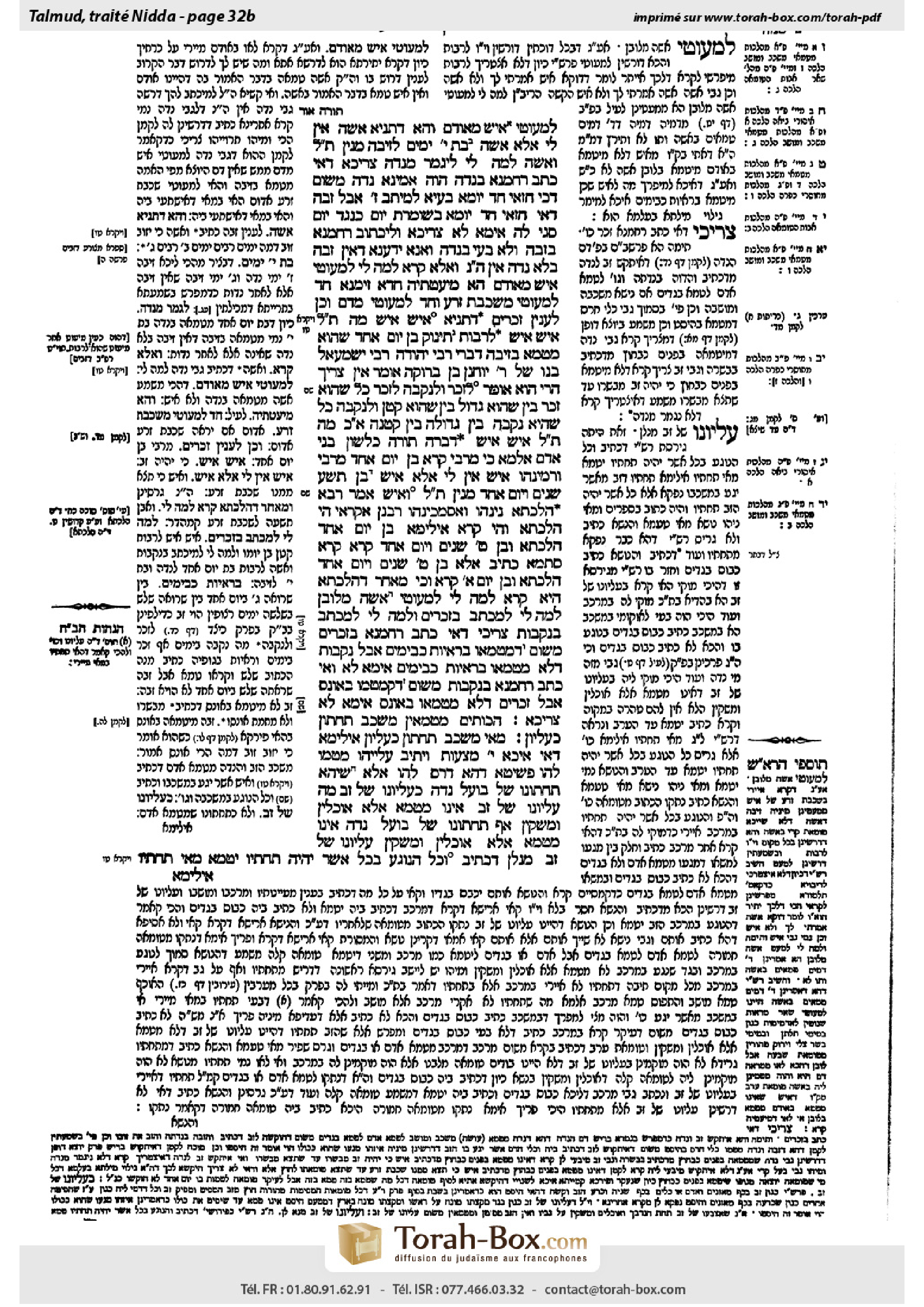
Niddah 32b: Talmud study for Daf Yomi
Daf Yomi is the daily study of one Talmud folio. Explore 37 tractates with scans, Hebrew text, Sefaria English and AI-generated French translations where annotated.
Passage selection and English or AI-generated French translation are available where the scan has annotations. Daf Study is independent of Torah-Box and Sefaria.
Browse Niddah · נידה · All tractatesNiddah 32b text and translations
This page of Niddah includes the Aramaic text, an English translation and an AI-generated French translation, alongside the scan above.
נידה ל״ב ב · Aramaic and Hebrew text
לְמַעוֹטֵי אִישׁ מֵאוֹדֶם.
וְהָא דְּתַנְיָא: אִשָּׁה — אֵין לִי אֶלָּא אִשָּׁה, בַּת עֲשָׂרָה יָמִים לְזִיבָה מִנַּיִן? תַּלְמוּד לוֹמַר ״וְאִשָּׁה״. לְמָה לִי? לִיגְמַר מִנִּדָּה!
צְרִיכָא, דְּאִי כְּתַב רַחֲמָנָא בְּנִדָּה — הֲוָה אָמֵינָא: נִדָּה, מִשּׁוּם דְּכִי חֲזַאי חַד יוֹמָא בָּעֲיָא לְמֵיתַב שִׁבְעָה; אֲבָל זָבָה, דְּאִי חֲזַאי חַד יוֹמָא — בְּשׁוֹמֶרֶת יוֹם כְּנֶגֶד יוֹם סַגִּי לַהּ, אֵימָא לָא. צְרִיכָא.
וְלִיכְתּוֹב רַחֲמָנָא בְּזָבָה, וְלָא בָּעֵי בְּנִדָּה, וַאֲנָא יָדַעְנָא דְּאֵין זָבָה בְּלֹא נִדָּה. אִין הָכִי נָמֵי! וְאֶלָּא קְרָא לְמָה לִי? לְמַעוֹטֵי אִישׁ מֵאוֹדֶם.
הָא מַיעֵטְתֵּיהּ חֲדָא זִימְנָא? חַד לְמַעוֹטֵי מִשִּׁכְבַת זֶרַע, וְחַד לְמַעוֹטֵי מִדָּם.
וְכֵן לְעִנְיַן זְכָרִים. דְּתַנְיָא: ״אִישׁ אִישׁ״ — מָה תַּלְמוּד לוֹמַר ״אִישׁ אִישׁ״? לְרַבּוֹת תִּינוֹק בִּן יוֹם אֶחָד שֶׁהוּא מְטַמֵּא בְּזִיבָה, דִּבְרֵי רַבִּי יְהוּדָה.
רַבִּי יִשְׁמָעֵאל בְּנוֹ שֶׁל רַבִּי יוֹחָנָן בֶּן בְּרוֹקָה אוֹמֵר: אֵין צָרִיךְ, הֲרֵי הוּא אוֹמֵר: ״לַזָּכָר וְלַנְּקֵבָה״ — ״לַזָּכָר״ כֹּל שֶׁהוּא זָכָר, בֵּין שֶׁהוּא גָּדוֹל בֵּין שֶׁהוּא קָטָן, ״וְלַנְּקֵבָה״ כֹּל שֶׁהִיא נְקֵבָה, בֵּין גְּדוֹלָה בֵּין קְטַנָּה. אִם כֵּן, מָה תַּלְמוּד לוֹמַר ״אִישׁ אִישׁ״? דִּבְּרָה תּוֹרָה כִלְשׁוֹן בְּנֵי אָדָם.
אַלְמָא, כִּי מְרַבֵּי קְרָא — בֶּן יוֹם אֶחָד מְרַבֵּי. וּרְמִינְהוּ: ״אִישׁ״ — אֵין לִי אֶלָּא אִישׁ, בֶּן תֵּשַׁע שָׁנִים וְיוֹם אֶחָד מִנַּיִן? תַּלְמוּד לוֹמַר: ״וְאִישׁ״.
אָמַר רָבָא: הִלְכְתָא נִינְהוּ, וְאַסְמְכִינְהוּ רַבָּנַן אַקְּרָאֵי. הֵי הִלְכְתָא וְהֵי קְרָא? אִילֵּימָא בֶּן יוֹם אֶחָד — הִלְכְתָא, וּבֶן תֵּשַׁע שָׁנִים וְיוֹם אֶחָד — קְרָא, קְרָא סְתָמָא כְּתִיב!
אֶלָּא בֶּן תֵּשַׁע שָׁנִים וְיוֹם אֶחָד — הִלְכְתָא, וּבֶן יוֹם אֶחָד — קְרָא. וְכִי מֵאַחַר דְּהִלְכְתָא הִיא, קְרָא לְמָה לִי? לְמַעוֹטֵי אִשָּׁה מִלּוֹבֶן.
לְמָה לִי לְמִכְתַּב בִּזְכָרִים, וּלְמָה לִי לְמִכְתַּב בִּנְקֵבוֹת?
צְרִיכִי, דְּאִי כְּתַב רַחֲמָנָא בִּזְכָרִים — מִשּׁוּם דִּמְטַמּוּ בִּרְאִיּוֹת כִּבְיָמִים, אֲבָל נְקֵבוֹת דְּלָא מְטַמּוּ בִּרְאִיּוֹת כִּבְיָמִים — אֵימָא לָא.
וְאִי כְּתַב רַחֲמָנָא בִּנְקֵבוֹת — מִשּׁוּם דְּקָמְטַמּוּ בְּאוֹנֶס, אֲבָל זְכָרִים דְּלָא מְטַמּוּ בְּאוֹנֶס — אֵימָא לָא, צְרִיכָא.
הַכּוּתִים מְטַמְּאִין מִשְׁכָּב תַּחְתּוֹן כָּעֶלְיוֹן. מַאי ״מִשְׁכָּב תַּחְתּוֹן כָּעֶלְיוֹן״? אִילֵּימָא דְּאִי אִיכָּא עֲשָׂרָה מַצָּעוֹת וְיָתֵיב עֲלַיְיהוּ (מְטַמּוּ) [מְטַמֵּי] לְהוּ, פְּשִׁיטָא! דְּהָא דָּרֵס לְהוּ.
אֶלָּא, שֶׁיְּהֵא תַּחְתּוֹנוֹ שֶׁל בּוֹעֵל נִדָּה כְּעֶלְיוֹנוֹ שֶׁל זָב, מָה עֶלְיוֹנוֹ שֶׁל זָב אֵינוֹ מְטַמֵּא אֶלָּא אוֹכְלִין וּמַשְׁקִין, אַף תַּחְתּוֹנוֹ שֶׁל בּוֹעֵל נִדָּה אֵינוֹ מְטַמֵּא אֶלָּא אֳוכָלִין וּמַשְׁקִין.
עֶלְיוֹנוֹ שֶׁל זָב מְנָלַן? דִּכְתִיב: ״וְכׇל הַנּוֹגֵעַ בְּכֹל אֲשֶׁר יִהְיֶה תַחְתָּיו יִטְמָא״, מַאי ״תַּחְתָּיו״?
Niddah 32b · English translation
The Gemara responds: The verse serves to exclude a man from contracting ritual impurity due to red semen.
The Gemara objects: But what about that which is taught in a baraita with regard to a woman who experiences a discharge of uterine blood after her menstrual period [zava]: The verse states: “And if a woman has an issue of her blood many days” (Leviticus 15:25). From the word “woman” I have derived only that ziva applies to an adult woman. From where do I derive that a ten-day-old girl is included in the halakhot of ziva? The verse states: “And if a woman.” Why do I need the verse? Let one derive that a ten-day-old girl is included in the halakhot of ziva from the fact that a one-day-old girl is included in the halakhot of a menstruating woman, as a woman may become a zava only after seven days of menstruation and three subsequent days of experiencing uterine discharge.
The Gemara responds: It was necessary for the verse to teach that the halakhot of ziva apply to a ten-day-old girl. As, if the Merciful One had written only that a one-day-old girl is included in the halakhot of a menstruating woman, I would say: The halakhot of a menstruating woman apply to a one-day-old girl because of their stringency, as when a woman sees blood on only one day she is required to sit for the seven days of menstruation. But with regard to a zava, since the halakha is that if a woman sees blood on only one day she has the status of a lesser zava, and it is enough for her to observe a clean day for a day she experiences a discharge, one might say that the halakhot of ziva do not apply to a ten-day-old girl. It was therefore necessary for the verse to indicate otherwise.
The Gemara objects: And let the Merciful One write that a ten-day-old girl is included in the halakhot of a zava, and it would not be required to write that a one-day-old girl is included in the halakhot of a menstruating woman, and I would know that as a girl cannot become a zava without first assuming the status of a menstruating woman, she must also be included in the halakhot of a menstruating woman. The Gemara responds: Yes, it is indeed so; the fact that a one-day-old girl is included in the halakhot of a menstruating woman can be derived from the fact that a ten-day-old girl is included in the halakhot of a zava. Rather, why do I need the verse: “And if a woman,” that is stated with regard to a menstruating woman? The verse serves to exclude a man from contracting ritual impurity due to red semen.
The Gemara objects: But the Torah already excluded this case on another occasion, as stated earlier. The Gemara explains: One verse serves to exclude a man from contracting ritual impurity due to red semen, and one verse serves to exclude a man from being rendered a zav due to blood that emanates from his penis.
§ The Gemara discusses the halakha of ziva with regard to a male: And so with regard to males, the halakhot of a zav apply even to minor boys. As it is taught in a baraita: The verse states concerning a zav: “When any man has an issue out of his flesh, his issue is impure” (Leviticus 15:2). What is the meaning when the verse states “any man”? The verse serves to include a one-day-old baby, teaching that even he is susceptible to impurity of ziva. This is the statement of Rabbi Yehuda.
Rabbi Yishmael, son of Rabbi Yoḥanan ben Beroka, says: This derivation is not necessary, as the verse states: “And of them that have an issue, whether it be a male or a female” (Leviticus 15:33). “Whether it be a male” includes anyone who is a male, whether he is an adult or whether he is a minor; “or a female” includes anyone who is a female, whether she is an adult or whether she is a minor. If so, what is the meaning when the verse states “any man”? The Torah spoke in the language of people, and one is not meant to derive anything from this verse.
The Gemara asks: Apparently, when the verse includes a minor boy it includes even a one-day-old. But raise a contradiction from another baraita, which addresses the verse: “And if the flow of seed go out from a man, then he shall bathe all his flesh in water and be impure until the evening” (Leviticus 15:16). From the word “man” I have derived only that a man is rendered ritually impure through a seminal emission. From where do I derive that the seminal emission of a boy aged nine years and one day renders him impure as well? The verse states: “And a man.” Evidently, the verse does not include a one-day-old boy.
Rava said: These are halakhot transmitted to Moses from Sinai, and the Sages merely supported them with verses. Therefore, there is no contradiction. The Gemara asks: Which is a halakha transmitted to Moses from Sinai, and which halakha is derived from a verse? If we say that the halakha that a one-day-old boy is included in the halakhot of a zav is a halakha transmitted to Moses from Sinai, and the halakha that the seminal emission of a boy aged nine years and one day renders him impure is derived from a verse, then one may object: But the verse is written in an unspecified manner; consequently, even a one-day-old boy should be included in the verse.
Rather, the halakha with regard to the seminal emission of a boy aged nine years and one day is a halakha transmitted to Moses from Sinai, and the halakha that a one-day-old boy is included in the halakhot of a zav is derived from a verse. The Gemara asks: And now that the halakha with regard to the seminal emission of a boy aged nine years and one day renders is a halakha transmitted to Moses from Sinai, why do I need a verse? The Gemara answers: The verse serves to exclude a woman from contracting the impurity of a zava due to a white discharge.
The Gemara asks: Why do I need for the Merciful One to write that a one-day-old is included in the halakhot of ziva with regard to males, and why do I need for the Merciful One to write that a one-day-old is included in the halakhot of a menstruating woman and a ten-day-old is included in the halakhot of ziva with regard to females?
The Gemara answers that both verses are necessary. As, if the Merciful One had written only concerning males, one might say: A one-day-old boy is included in the halakhot of ziva because the halakha is more stringent with regard to males, as they are rendered impure through three sightings of ziva on one day just like through sightings on three consecutive days. But with regard to females, who are not rendered impure through three sightings on one day as they are through sightings on three consecutive days, one might say that the halakhot of ziva do not apply to ten-day-old girls.
And by contrast, if the Merciful One had written only with regard to females, one might say: The halakhot of ziva apply to ten-day-old girls, because of the fact that they are rendered impure even on account of sightings that occur due to circumstances beyond their control. But with regard to males, who are not rendered impure on account of sightings that occur due to circumstances beyond their control, one might say that one-day-old boys are not included in the halakhot of ziva. Therefore, both verses are necessary.
§ The mishna teaches: And the Samaritan men impart ritual impurity to the lower bedding like the upper bedding. The Gemara asks: What is the meaning of the clause: The lower bedding like the upper bedding? If we say it means that if there are ten mattresses stacked one upon the other and a Samaritan man sat upon them, the lowest mattress, like the upper mattresses, is rendered impure, this halakha is obvious, since he presses on all of them when he sits on them. In other words, since Samaritan men impart impurity to the bedding beneath them because they are considered men who engage in intercourse with menstruating women, there is no reason to distinguish between the lowest mattress and the other mattresses above it.
Rather, the mishna means that the status of the lowest mattress beneath a man who engages in intercourse with a menstruating woman is like that of the bedding above a zav, i.e., the bedding beneath a Samaritan man assumes first-degree ritual impurity and does not become a primary source of impurity like the bedding beneath a zav. That is, just as the upper bedding of a zav is not a primary source of impurity and imparts impurity only to food and drink but not people or vessels, so too, the bedding beneath a man who engages in intercourse with a menstruating woman imparts ritual impurity only to food and drink.
The Gemara asks: From where do we derive that the bedding above a zav imparts ritual impurity only to food and drink? As it is written with regard to a zav: “And whoever touches any thing that was under him shall be impure” (Leviticus 15:10). What is the meaning of the expression “under him”?
Niddah 32b · Traduction française (IA)
La Guemara répond : Le verset sert à exclure un homme de l’impureté rituelle due au sperme rouge.
La Guemara objecte : Mais qu’en est-il de ce qui est enseigné dans une baraïta au sujet d’une femme qui présente un écoulement de sang utérin après ses règles [zava] ? Le verset dit : « Si une femme a un écoulement de sang pendant de nombreux jours » (Lévitique 15,25). Du mot « femme », j’ai déduit que la ziva s’applique uniquement à une femme adulte. D’où déduis-je qu’une fillette âgée de dix jours est également soumise aux halakhot de la ziva ? Le verset dit : « Si une femme ». Pourquoi ai-je besoin de ce verset ? Ne peut-on pas déduire qu’une fillette âgée de dix jours est soumise aux halakhot de la ziva du fait qu’une fillette âgée d’un jour est soumise aux halakhot d’une femme menstruée, puisqu’une femme ne peut devenir zava qu’après sept jours de menstruation, puis trois jours consécutifs d’écoulement utérin ?
La Guemara répond : Le verset était nécessaire pour enseigner que les halakhot de la ziva s’appliquent à une fillette âgée de dix jours. En effet, si le Miséricordieux avait seulement écrit qu’une fillette âgée d’un jour est soumise aux halakhot d’une femme menstruée, j’aurais dit que ces halakhot s’appliquent à une fillette âgée d’un jour en raison de leur rigueur : lorsqu’une femme voit du sang un seul jour, elle doit observer les sept jours de menstruation. Mais en ce qui concerne une zava, puisque la halakha est que, si une femme voit du sang un seul jour, elle a le statut de petite zava et doit seulement observer un jour de pureté pour chaque jour d’écoulement, on aurait pu dire que les halakhot de la ziva ne s’appliquent pas à une fillette âgée de dix jours. Le verset devait donc indiquer le contraire.
La Guemara objecte : Que le Miséricordieux écrive donc qu’une fillette âgée de dix jours est soumise aux halakhot d’une zava ; il ne serait alors pas nécessaire d’écrire qu’une fillette âgée d’un jour est soumise aux halakhot d’une femme menstruée, car je saurais que, puisqu’une fillette ne peut devenir zava sans avoir d’abord le statut de femme menstruée, elle doit également être soumise aux halakhot d’une femme menstruée. La Guemara répond : Oui, c’est bien ainsi ; on peut déduire qu’une fillette âgée d’un jour est soumise aux halakhot d’une femme menstruée du fait qu’une fillette âgée de dix jours est soumise aux halakhot d’une zava. Alors, pourquoi ai-je besoin du verset « Si une femme », énoncé au sujet d’une femme menstruée ? Le verset sert à exclure un homme de l’impureté rituelle due au sperme rouge.
La Guemara objecte : Mais la Torah avait déjà exclu ce cas à une autre occasion, comme cela a été dit précédemment. La Guemara explique : Un verset sert à exclure un homme de l’impureté rituelle due au sperme rouge, et un autre verset sert à exclure un homme du statut de zav en raison du sang qui émane de son pénis.
§ La Guemara examine la halakha de la ziva chez les hommes : de même, les halakhot du zav s’appliquent même aux garçons mineurs. En effet, il est enseigné dans une baraïta : Au sujet d’un zav, le verset dit : « Lorsqu’un homme a un écoulement provenant de sa chair, son écoulement est impur » (Lévitique 15,2). Que signifie le mot « tout » dans l’expression « tout homme » ? Le verset sert à inclure un nourrisson âgé d’un jour et enseigne que lui aussi peut contracter l’impureté de la ziva. Telle est la déclaration de Rabbi Yehouda.
Rabbi Yishmael, fils de Rabbi Yoḥanan ben Beroka, dit : Cette déduction n’est pas nécessaire, car le verset dit : « Parmi ceux qui ont un écoulement, qu’il s’agisse d’un homme ou d’une femme » (Lévitique 15,33). « Qu’il s’agisse d’un homme » inclut tout individu de sexe masculin, adulte ou mineur ; « ou d’une femme » inclut tout individu de sexe féminin, adulte ou mineure. Si tel est le cas, que signifie l’expression « tout homme » ? La Torah s’est exprimée dans le langage courant ; il ne faut rien déduire de ce verset.
La Guemara demande : Apparemment, lorsque le verset inclut un garçon mineur, il inclut même un nourrisson âgé d’un jour. Mais opposons à cela une autre baraïta, qui traite du verset : « Si un écoulement de semence sort d’un homme, celui-ci baignera toute sa chair dans l’eau et sera impur jusqu’au soir » (Lévitique 15,16). Du mot « homme », j’ai déduit seulement qu’un homme devient rituellement impur à la suite d’une émission séminale. D’où déduis-je que l’émission séminale d’un garçon âgé de neuf ans et un jour le rend également impur ? Le verset dit : « Et un homme ». Il apparaît donc que le verset n’inclut pas un garçon âgé d’un jour.
Rava dit : Ce sont des halakhot transmises à Moïse au Sinaï, que les Sages n’ont fait qu’étayer au moyen de versets. Il n’y a donc pas de contradiction. La Guemara demande : Quelle halakha a été transmise à Moïse au Sinaï, et quelle halakha est déduite d’un verset ? Si nous disons que la halakha selon laquelle un nourrisson âgé d’un jour est soumis aux halakhot d’un zav a été transmise à Moïse au Sinaï, tandis que la halakha selon laquelle l’émission séminale d’un garçon âgé de neuf ans et un jour le rend impur est déduite d’un verset, on peut objecter : Mais le verset est formulé sans précision ; par conséquent, même un garçon âgé d’un jour devrait être inclus dans le verset.
Il faut plutôt dire que la halakha concernant l’émission séminale d’un garçon âgé de neuf ans et un jour a été transmise à Moïse au Sinaï, tandis que la halakha selon laquelle un nourrisson âgé d’un jour est soumis aux halakhot d’un zav est déduite d’un verset. La Guemara demande : Et maintenant que la halakha concernant l’émission séminale d’un garçon âgé de neuf ans et un jour est une halakha transmise à Moïse au Sinaï, pourquoi ai-je besoin d’un verset ? La Guemara répond : Le verset sert à exclure une femme de l’impureté d’une zava due à un écoulement blanc.
La Guemara demande : Pourquoi le Miséricordieux doit-il écrire qu’un nourrisson âgé d’un jour est soumis aux halakhot de la ziva chez les hommes, et pourquoi doit-il écrire qu’une fillette âgée d’un jour est soumise aux halakhot d’une femme menstruée et qu’une fillette âgée de dix jours est soumise aux halakhot de la ziva chez les femmes ?
La Guemara répond que les deux versets sont nécessaires. En effet, si le Miséricordieux avait écrit uniquement au sujet des hommes, on aurait pu dire : Un garçon âgé d’un jour est soumis aux halakhot de la ziva parce que la halakha est plus stricte à l’égard des hommes : ils deviennent impurs à la suite de trois écoulements de ziva au cours d’une même journée, comme à la suite d’écoulements survenus pendant trois jours consécutifs. Mais concernant les femmes, qui ne deviennent pas impures à la suite de trois écoulements au cours d’une même journée comme elles le deviennent à la suite d’écoulements survenus pendant trois jours consécutifs, on aurait pu dire que les halakhot de la ziva ne s’appliquent pas aux fillettes âgées de dix jours.
À l’inverse, si le Miséricordieux avait écrit uniquement au sujet des femmes, on aurait pu dire : Les halakhot de la ziva s’appliquent aux fillettes âgées de dix jours parce qu’elles deviennent impures même à la suite d’écoulements dus à des circonstances indépendantes de leur volonté. Mais concernant les hommes, qui ne deviennent pas impurs à la suite d’écoulements dus à des circonstances indépendantes de leur volonté, on aurait pu dire que les garçons âgés d’un jour ne sont pas soumis aux halakhot de la ziva. Les deux versets sont donc nécessaires.
§ La Michna enseigne : Et les hommes samaritains transmettent l’impureté rituelle à la literie inférieure comme à la literie supérieure. La Guemara demande : Que signifie l’expression « la literie inférieure comme la literie supérieure » ? Si nous disons qu’il s’agit du cas où dix matelas sont empilés les uns sur les autres et où un homme samaritain s’assoit dessus, de sorte que le matelas du bas, comme ceux du dessus, devient impur, cette halakha va de soi, puisqu’il exerce une pression sur tous les matelas en s’asseyant dessus. Autrement dit, puisque les hommes samaritains transmettent l’impureté à la literie qui se trouve sous eux parce qu’ils sont considérés comme des hommes qui ont des relations sexuelles avec des femmes menstruées, il n’y a aucune raison de distinguer le matelas du bas des autres matelas placés au-dessus.
Il faut plutôt comprendre que le statut du matelas le plus bas placé sous un homme qui a des relations sexuelles avec une femme menstruée est semblable à celui de la literie située au-dessus d’un zav : la literie placée sous un homme samaritain acquiert une impureté rituelle de premier degré et ne devient pas une source primaire d’impureté comme la literie placée sous un zav. Autrement dit, tout comme la literie supérieure d’un zav n’est pas une source primaire d’impureté et ne transmet l’impureté qu’aux aliments et aux boissons, mais pas aux personnes ni aux ustensiles, de même, la literie placée sous un homme qui a des relations sexuelles avec une femme menstruée ne transmet l’impureté rituelle qu’aux aliments et aux boissons.
La Guemara demande : D’où déduisons-nous que la literie située au-dessus d’un zav ne transmet l’impureté rituelle qu’aux aliments et aux boissons ? Car il est écrit au sujet d’un zav : « Quiconque touchera une chose qui était sous lui sera impur » (Lévitique 15,10). Que signifie l’expression « sous lui » ?
Traduction française générée par IA à partir de l’édition anglaise de Sefaria. Vérifie toujours un passage avec le texte source.
Text from Sefaria: William Davidson Edition - Vocalized Aramaic (CC BY NC); William Davidson Edition - English (CC BY NC).