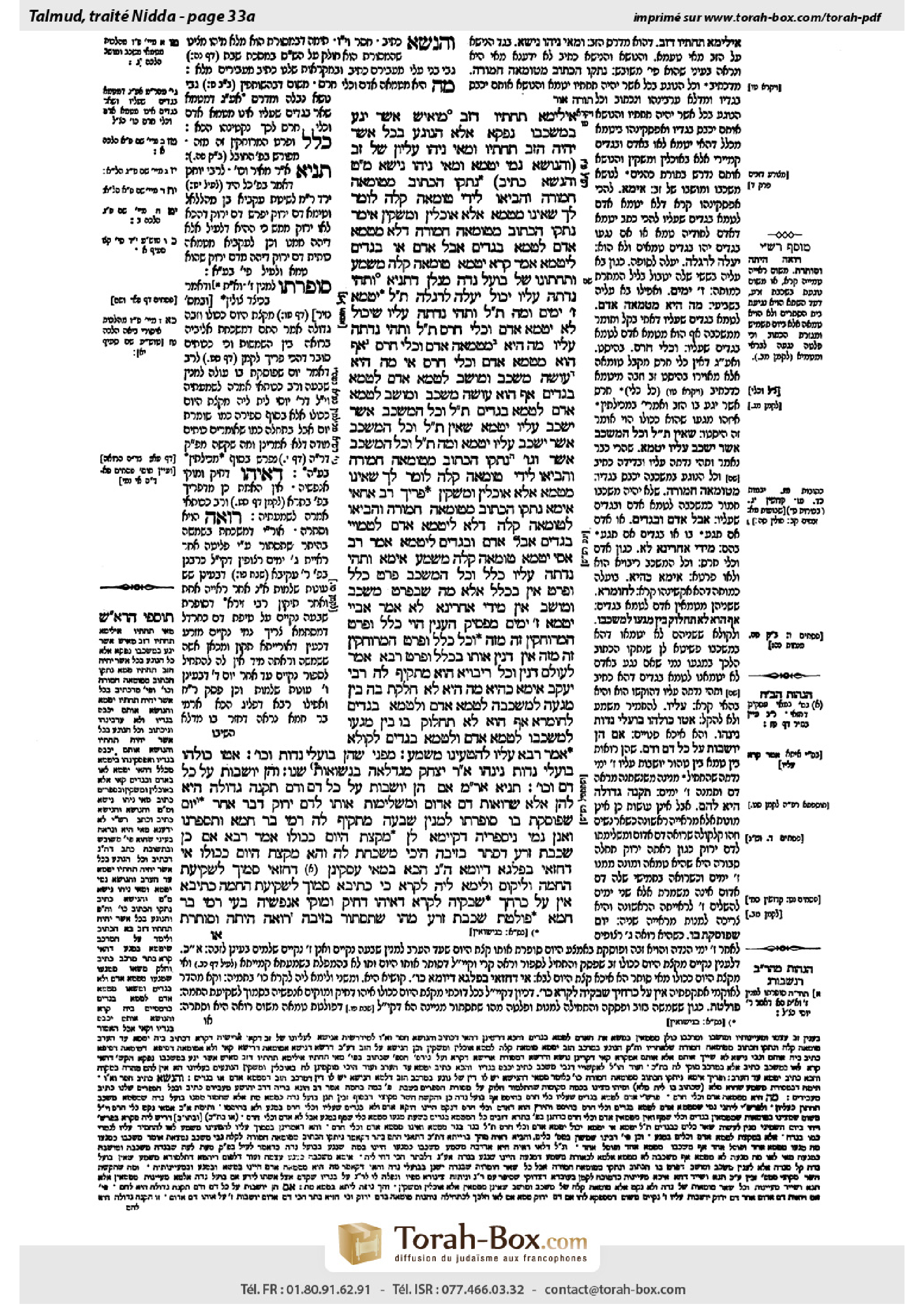
Niddah 33a: Talmud study for Daf Yomi
Daf Yomi is the daily study of one Talmud folio. Explore 37 tractates with scans, Hebrew text, Sefaria English and AI-generated French translations where annotated.
Passage selection and English or AI-generated French translation are available where the scan has annotations. Daf Study is independent of Torah-Box and Sefaria.
Browse Niddah · נידה · All tractatesNiddah 33a text and translations
This page of Niddah includes the Aramaic text, an English translation and an AI-generated French translation, alongside the scan above.
נידה ל״ג א · Aramaic and Hebrew text
אִילֵּימָא תַּחְתָּיו דְּזָב — מִ״וְּאִישׁ אֲשֶׁר יִגַּע בְּמִשְׁכָּבוֹ״ נָפְקָא! אֶלָּא: הַנּוֹגֵעַ בְּכֹל אֲשֶׁר יִהְיֶה הַזָּב תַּחְתָּיו, וּמַאי נִיהוּ — עֶלְיוֹן שֶׁל זָב.
״וְהַנּוֹשֵׂא״ נָמֵי יִטְמָא, וּמַאי נִיהוּ — נִישָּׂא. מַאי טַעְמָא? ״וְהַנִּשָּׂא״ כְּתִיב.
נִתְּקוֹ הַכָּתוּב מִטּוּמְאָה חֲמוּרָה, וֶהֱבִיאוֹ לִידֵי טוּמְאָה קַלָּה, לוֹמַר לָךְ שֶׁאֵינוֹ מְטַמֵּא אֶלָּא אֳוכָלִין וּמַשְׁקִין.
אֵימַר נִתְּקוֹ הַכָּתוּב מִטּוּמְאָה חֲמוּרָה, דְּלֹא מְטַמֵּא אָדָם לְטַמֵּא בְּגָדִים, אֲבָל אָדָם אוֹ בְּגָדִים לִיטַמֵּא? אָמַר קְרָא ״יִטְמָא״, טוּמְאָה קַלָּה מַשְׁמַע.
וְתַחְתּוֹנוֹ שֶׁל בּוֹעֵל נִדָּה מְנָלַן? דְּתַנְיָא: ״וּתְהִי נִדָּתָהּ עָלָיו״,
יָכוֹל יַעֲלֶה לְרַגְלָהּ? תַּלְמוּד לוֹמַר ״יִטְמָא שִׁבְעַת יָמִים״.
וּמָה תַּלְמוּד לוֹמַר ״וּתְהִי נִדָּתָהּ עָלָיו״? שֶׁיָּכוֹל לֹא יְטַמֵּא אָדָם וּכְלִי חֶרֶס, תַּלְמוּד לוֹמַר ״וּתְהִי נִדָּתָהּ עָלָיו״ — מָה הִיא מְטַמְּאָה אָדָם וּכְלִי חֶרֶס, אַף הוּא מְטַמֵּא אָדָם וּכְלִי חֶרֶס.
אִי מָה הִיא עוֹשָׂה מִשְׁכָּב וּמוֹשָׁב לְטַמֵּא אָדָם לְטַמֵּא בְּגָדִים, אַף הוּא עוֹשֶׂה מִשְׁכָּב וּמוֹשָׁב לְטַמֵּא אָדָם לְטַמֵּא בְּגָדִים? תַּלְמוּד לוֹמַר ״וְכׇל הַמִּשְׁכָּב אֲשֶׁר יִשְׁכַּב עָלָיו יִטְמָא״.
שֶׁאֵין תַּלְמוּד לוֹמַר ״וְכׇל הַמִּשְׁכָּב אֲשֶׁר יִשְׁכַּב עָלָיו יִטְמָא״, וּמָה תַּלְמוּד לוֹמַר ״וְכׇל הַמִּשְׁכָּב אֲשֶׁר וְגוֹ׳״ — נִתְּקוֹ הַכָּתוּב מִטּוּמְאָה חֲמוּרָה וֶהֱבִיאוֹ לִידֵי טוּמְאָה קַלָּה, לוֹמַר לְךָ שֶׁאֵינוֹ מְטַמֵּא אֶלָּא אֳוכָלִין וּמַשְׁקִין.
פָּרֵיךְ רַב אַחַאי: אֵימָא נִתְּקוֹ הַכָּתוּב מִטּוּמְאָה חֲמוּרָה וֶהֱבִיאוֹ לְטוּמְאָה קַלָּה — דְּלָא לִיטַמֵּא אָדָם לְטַמּוֹיֵי בְּגָדִים, אֲבָל אָדָם וּבְגָדִים לִיטַמֵּא! אָמַר רַב אַסִּי: ״יִטְמָא״ — טוּמְאָה קַלָּה מַשְׁמַע.
אֵימָא: ״וּתְהִי נִדָּתָהּ עָלָיו״ — כָּלַל, ״וְכׇל הַמִּשְׁכָּב״ — פָּרַט, כְּלָל וּפְרָט אֵין בַּכְּלָל אֶלָּא מַה שֶּׁבַּפְּרָט, מִשְׁכָּב וּמוֹשָׁב — אִין, מִידֵּי אַחֲרִינָא — לָא!
אָמַר אַבָּיֵי: ״יִטְמָא שִׁבְעַת יָמִים״ מַפְסֵיק הָעִנְיָן, הָוֵי כְּלָל וּפְרָט הַמְרוּחָקִין זֶה מִזֶּה, וְכׇל כְּלָל וּפְרָט הַמְרוּחָקִין זֶה מִזֶּה אֵין דָּנִין אוֹתוֹ בִּכְלָל וּפְרָט.
רָבָא אָמַר: לְעוֹלָם דָּנִין, ״וְכׇל״ — רִיבּוּיָא הוּא.
מַתְקֵיף לַהּ רַבִּי יַעֲקֹב: אֵימָא כְּהִיא, מָה הִיא — לֹא חִלַּקְתָּ בָּהּ בֵּין מַגָּעָהּ לְמִשְׁכָּבָהּ, לְטַמֵּא אָדָם וּלְטַמֵּא בְּגָדִים לְחוּמְרָא, אַף הוּא — לֹא תַּחְלוֹק בּוֹ בֵּין מַגָּעוֹ לְמִשְׁכָּבוֹ, לְטַמֵּא אָדָם וּלְטַמֵּא בְּגָדִים לְקוּלָּא!
אָמַר רָבָא: ״עָלָיו״ — לְהַטְעִינוֹ מַשְׁמַע.
מִפְּנֵי שֶׁהֵן בּוֹעֲלֵי נִדּוֹת וְכוּ׳. אַטּוּ כּוּלְּהוּ בּוֹעֲלֵי נִדּוֹת נִינְהוּ? אָמַר רַבִּי יִצְחָק מַגְדְּלָאָה: בִּנְשׂוּאוֹת שָׁנוּ.
וְהֵן יוֹשְׁבוֹת עַל דָּם וְכוּ׳. תַּנְיָא, אָמַר רַבִּי מֵאִיר: אִם הֵן יוֹשְׁבוֹת עַל כׇּל דָּם וָדָם — תַּקָּנָה גְּדוֹלָה הִיא לָהֶן,
אֶלָּא שֶׁרוֹאוֹת דָּם אָדוֹם וּמַשְׁלִימוֹת אוֹתוֹ לְדָם יָרוֹק.
דָּבָר אַחֵר: יוֹם שֶׁפּוֹסֶקֶת בּוֹ — סוֹפַרְתּוֹ לְמִנְיַן שִׁבְעָה.
מַתְקֵיף לַהּ רָמֵי בַּר חָמָא: וְתִסְפְּרֶנּוּ, וַאֲנַן נָמֵי נִיסְפְּרֵיהּ, דְּקַיְימָא לַן מִקְצָת הַיּוֹם כְּכוּלּוֹ!
אָמַר רָבָא: אִם כֵּן, שִׁכְבַת זֶרַע (דסתר) [דְּסָתְרָה] בְּזִיבָה הֵיכִי מַשְׁכַּחַתְּ לַהּ? וְהָא מִקְצָת הַיּוֹם כְּכוּלּוֹ!
אִי דַּחֲזַאי בְּפַלְגָא דְּיוֹמָא — הָכִי נָמֵי, הָכָא בְמַאי עָסְקִינַן? דַּחֲזַאי סָמוּךְ לִשְׁקִיעַת הַחַמָּה.
וְלֵיקוּם וְלֵימָא לֵיהּ לִקְרָא, כִּי כְּתִיבָא — סָמוּךְ לִשְׁקִיעַת הַחַמָּה כְּתִיבָא? אִין, עַל כׇּרְחָךְ שִׁבְקֵיהּ לִקְרָא, דְּאִיהוּ דָּחֵיק וּמוֹקֵי אַנַּפְשֵׁיהּ.
בָּעֵי רָמֵי בַּר חָמָא: פּוֹלֶטֶת שִׁכְבַת זֶרַע, מַהוּ שֶׁתִּסְתּוֹר בְּזִיבָה? רוֹאָה הָיְתָה וְסוֹתֶרֶת,
Niddah 33a · English translation
If we say the verse is teaching that a mattress beneath a zav is impure, this is already derived from the verse: “And whoever touches his bed” (Leviticus 15:5). Rather, the verse is referring to that which touches any item under which the zav will be. And what is this item? It is the bedding above a zav. The verse teaches that the bedding above a zav imparts ritual impurity.
The verse further states: “And he who bears [vehanoseh] these things shall wash his clothes and bathe himself in water, and be impure until the evening” (Leviticus 15:10), indicating that he who bears also becomes impure. And what is this? This is an item borne [nisa] by a zav. What is the reason, i.e., how is this indicated by the verse? The term vehanisa is written in the verse.
The Gemara continues: The verse removed the halakha of the bedding above a zav from the status of severe impurity and brought it to the status of lesser impurity, to tell you that it imparts impurity only to food and drink, but not to people or garments.
The Gemara objects: Say that the verse removed the bedding above a zav from severe impurity, in the sense that it does not impart impurity to a person to the extent that he may in turn impart impurity to the garments he is wearing. But let the bedding above a zav impart impurity to people or garments. The Gemara explains that the verse states: “And whoever touches anything that was under him shall be impure” (Leviticus 15:10), which indicates lesser impurity.
§ The mishna teaches that Samaritan men are considered men who engage in intercourse with menstruating women, and consequently they impart impurity to the bedding beneath them. The Gemara asks: And from where do we derive that the bedding beneath one who engages in intercourse with a menstruating woman is impure? As it is taught in a baraita: The verse states with regard to a menstruating woman: “And if any man lie with her, and her impurity be upon him, he shall be impure seven days, and every bed upon which he lies shall be impure” (Leviticus 15:24).
The baraita explains: One might have thought that the phrase: “And her impurity be upon him,” indicates that the man assumes the impure status of the menstruating woman with whom he engaged in intercourse, such that if they were together on the sixth day of her menstruation he may elevate himself at her time, i.e., he may immerse in a ritual bath the next day, just like the menstruating woman. Therefore, the verse states: “He shall be impure seven days.”
But if so, what is the meaning when the verse states: “And her impurity be upon him”? As, one might have thought that a man who engages in intercourse with a menstruating woman will not impart impurity to people and earthenware vessels. Therefore, the verse states: “And her impurity be upon him,” to teach that he imparts impurity like a menstruating woman. In other words, just as she imparts impurity to people and earthenware vessels, so too, he imparts impurity to people and earthenware vessels.
If so, i.e., that one who engages in intercourse with a menstruating woman is compared to the woman herself, then say: Just as she renders the bedding beneath her and the seat upon which she sits impure to the extent that they impart impurity to a person to in turn impart impurity to the garments he is wearing, so too, he renders the bedding beneath him and the seat upon which he sits impure to the extent that they impart impurity to a person to in turn impart impurity to the garments he is wearing. Therefore, the verse states: “And every bed upon which he lies shall be impure” (Leviticus 15:24).
The baraita elaborates: As, there is no need for the verse to state: “And every bed upon which he lies shall be impure,” since it is already written: “And her impurity be upon him,” which indicates that just as a menstruating woman imparts impurity to her bedding, so too does one who has intercourse with her. And if so, what is the meaning when the verse states: “And every bed upon which he lies shall be impure”? The verse separated the halakha of one who has intercourse with a menstruating woman from the severe impurity of the menstruating woman herself, and brought him to lesser impurity, to tell you that he imparts impurity only to food and drink, but not to people or garments.
Rav Aḥai refutes this derivation: Say that the verse removed the halakha of one who has intercourse with a menstruating woman from severe impurity and brought it to lesser impurity, in the sense that his bedding does not impart impurity to a person to in turn impart impurity to the garments upon him. But let his bedding impart impurity to people or garments. Rav Asi says: The verse states: “And every bed upon which he lies shall be impure,” which indicates a lesser impurity.
The Gemara objects: But say that the phrase: “And her impurity be upon him,” is a generalization, and the phrase: “And every bed upon which he lies shall be impure,” is a detail. If so, the verse constitutes a generalization and a detail, and it is a hermeneutical principle that in such a case the generalization is referring only to that which is specified in the detail. Accordingly, with regard to the bedding and seat upon which the man rests, yes, they are rendered impure, but other items are not.
Abaye says that when the verse states: “He shall be impure seven days,” between the generalization and the detail, this interrupts the matter. Accordingly, this is a case of a generalization and a detail that are distant from one another, and with regard to any generalization and detail that are distant from one another, one does not derive a halakha from them in accordance with the principle of a generalization and a detail.
Rava says: Actually, one may derive a halakha from a generalization and a detail that are distant from one another. But this verse does not constitute a case of a generalization and a detail, as the verse states: “And every bed upon which he lies.” The term “and every” is an amplification.
Rabbi Ya’akov objects to this: Say that as the verse compares a man who engages in intercourse with a menstruating woman to the woman herself, the man should be like her, i.e., just as with regard to her you did not differentiate between her touch and her bedding in terms of imparting impurity to a person and imparting impurity to garments, as the halakha is stringent concerning both in that her touch and her bedding impart impurity to people to in turn impart impurity to their garments; so too, with regard to him, you shall not differentiate between his touch and his bedding in terms of imparting impurity to a person and imparting impurity to garments, and the halakha should be lenient in both cases: Neither his bedding nor his touch should impart impurity to people to in turn impart impurity to their garments.
Rava says in response that when the verse states: “And her impurity be upon him,” this indicates that the Torah intends for the impurity to weigh upon him, i.e., in a stringent manner.
§ The mishna teaches that the impurity of Samaritan men is due to the fact that Samaritan men are considered men who engage in intercourse with menstruating women, and this is because they observe the seven-day menstrual period of impurity for each and every emission of blood. The Gemara asks: Is this to say that all Samaritan men are considered men who engage in intercourse with menstruating women? Aren’t there some unmarried men who do not engage in intercourse with menstruating women? Rabbi Yitzḥak of Migdal says: They taught this halakha only with regard to men to whom women are married.
The mishna further teaches: And Samaritan men are considered men who engage in intercourse with menstruating women because they observe the seven-day menstrual period of impurity for each and every emission of blood. In this regard it is taught in a baraita that Rabbi Meir said: If Samaritan women would begin observing a seven-day period of impurity for each and every emission of blood, it would be a great remedy for them, i.e., this practice would not lead to sin, as they would observe a seven-day period from each emission. But this is not their practice.
Rather, when Samaritan women see green blood, which does not render them impure, they begin counting seven days of impurity from that emission. As, if they see red blood, which is impure, during that period, they do not begin observing another seven days. Instead, they consider it an additional emission of blood and they complete the remaining days from the seven days they began observing for the green blood. Consequently, the women will have immersed in a ritual bath while still impure.
Alternatively, a Samaritan woman is considered ritually impure because she counts the day on which she ceases to experience three consecutive days of emissions of ziva toward the total of seven clean days that a zava must experience before being able to immerse in a ritual bath. Accordingly, she does not wait seven full days, as is required by halakha.
Rami bar Ḥama objects to this: And let her count that day on which she ceases to experience emissions of ziva, and we, i.e., Jewish women, shall also count it, as we maintain that the halakhic status of part of the day is like that of an entire day.
Rava says in response: If so, that even with regard to ziva the halakhic status of part of the day is like that of an entire day, one can object: It is taught in a baraita that if a zav experiences an emission of semen while counting seven clean days toward his purity, the seminal emission negates the day on which he experiences it. How can you find the circumstances of this halakha with regard to ziva? Isn’t the halakhic status of part of the day is like that of an entire day? If so, let the remainder of the day on which he experiences the emission count as a day.
The Gemara rejects this suggestion: Perhaps even with regard to ziva the halakhic status of part of the day is like that of an entire day, and if the zav sees the seminal emission in the middle of the day, the remainder of the day is indeed counted as a whole day. But here we are dealing with a zav who sees a seminal emission adjacent to sunset, when there is no remaining time in the day that can be counted as an entire day.
The Gemara objects: But the halakha that a seminal emission negates a day from the count of a zav is derived from the verse: “This is the law of the zav, and of him from whom the flow of seed goes out, so that he is impure thereby” (Leviticus 15:32). Is it right that one will stand and say about the verse that when it is written, it is written specifically with regard to a seminal emission that occurs adjacent to sunset? The Gemara explains: Yes, perforce you must leave aside the plain meaning of this verse, as it compels itself to be established as referring to such limited circumstances because it must conform to the principle that the halakhic status of part of the day is like that of an entire day.
§ The Gemara mentioned earlier that if a zav experiences a seminal emission while counting seven clean days toward his purity, the seminal emission negates the day on which he experiences it. On a similar note, Rami bar Ḥama raises a dilemma: In the case of a woman who discharges semen after engaging in intercourse with her husband, what is the halakha as to whether she negates her counting with regard to ziva? Rami bar Ḥama elaborates: In general, a woman who discharges semen is impure, but the reason for this halakha is uncertain. Is it because she was considered one who saw semen, i.e., the emission of semen itself renders her impure just like a man who experiences a seminal emission? And if so, this woman negates her count.
Niddah 33a · Traduction française (IA)
Si l’on dit que le verset enseigne qu’un matelas placé sous un zav est impur, cela se déduit déjà du verset : « Quiconque touche son lit » (Lévitique 15, 5). Le verset fait plutôt référence à ce qui touche tout objet sous lequel se trouve le zav. De quel objet s’agit-il ? De la literie placée au-dessus d’un zav. Le verset enseigne que la literie placée au-dessus d’un zav transmet l’impureté rituelle.
Le verset poursuit : « Et celui qui porte [vehanoseh] ces choses lavera ses vêtements et se baignera dans l’eau, et sera impur jusqu’au soir » (Lévitique 15, 10), ce qui indique que celui qui porte devient lui aussi impur. De quoi s’agit-il ? D’un objet porté [nisa] par un zav. Quelle en est la raison, c’est-à-dire comment cela ressort-il du verset ? Le terme vehanisa figure dans le verset.
La Guemara poursuit : Le verset a soustrait la halakha de la literie placée au-dessus d’un zav au statut d’impureté grave et l’a ramenée au statut d’impureté moindre, pour t’enseigner qu’elle ne transmet l’impureté qu’aux aliments et aux boissons, mais pas aux personnes ni aux vêtements.
La Guemara objecte : Dis plutôt que le verset a soustrait la literie placée au-dessus d’un zav à l’impureté grave en ce sens qu’elle ne transmet pas l’impureté à une personne au point que celle-ci puisse ensuite transmettre l’impureté aux vêtements qu’elle porte. Mais que la literie placée au-dessus d’un zav transmette l’impureté aux personnes ou aux vêtements. La Guemara explique que le verset dit : « Quiconque touche quoi que ce soit qui se trouvait sous lui sera impur » (Lévitique 15, 10), ce qui indique une impureté moindre.
§ La Michna enseigne que les hommes samaritains sont considérés comme ayant des rapports avec des femmes menstruées et que, par conséquent, ils transmettent l’impureté à la literie placée sous eux. La Guemara demande : D’où déduit-on que la literie placée sous celui qui a des rapports avec une femme menstruée est impure ? Comme il est enseigné dans une baraïta : Au sujet d’une femme menstruée, le verset dit : « Et si un homme couche avec elle, et que son impureté soit sur lui, il sera impur pendant sept jours, et tout lit sur lequel il couchera sera impur » (Lévitique 15, 24).
La baraïta explique : On aurait pu penser que l’expression « et que son impureté soit sur lui » indique que l’homme prend le statut d’impureté de la femme menstruée avec laquelle il a eu des rapports, de sorte que, s’ils ont eu des rapports le sixième jour de sa menstruation, il peut se purifier en même temps qu’elle, c’est-à-dire s’immerger dans un mikvé le lendemain, comme la femme menstruée. Le verset dit donc : « Il sera impur pendant sept jours ».
Mais alors, que signifie l’expression « et que son impureté soit sur lui » ? On aurait pu penser qu’un homme qui a des rapports avec une femme menstruée ne transmet pas l’impureté aux personnes ni aux récipients en terre cuite. Le verset dit donc : « Et que son impureté soit sur lui », pour enseigner qu’il transmet l’impureté comme une femme menstruée. Autrement dit, de même qu’elle transmet l’impureté aux personnes et aux récipients en terre cuite, lui aussi transmet l’impureté aux personnes et aux récipients en terre cuite.
Dans ce cas, c’est-à-dire si celui qui a des rapports avec une femme menstruée est comparé à la femme elle-même, dis donc : de même qu’elle rend impurs la literie sur laquelle elle repose et le siège sur lequel elle s’assied, au point qu’ils transmettent l’impureté à une personne, qui la transmet à son tour aux vêtements qu’elle porte, lui aussi rend impurs la literie sur laquelle il repose et le siège sur lequel il s’assied, au point qu’ils transmettent l’impureté à une personne, qui la transmet à son tour aux vêtements qu’elle porte. Le verset dit donc : « Et tout lit sur lequel il couchera sera impur » (Lévitique 15, 24).
La baraïta développe : Le verset n’avait pas besoin de dire « et tout lit sur lequel il couchera sera impur », puisque le verset dit déjà : « et que son impureté soit sur lui », ce qui indique que, de même qu’une femme menstruée transmet l’impureté à sa literie, celui qui a des rapports avec elle le fait également. Que signifie donc l’expression « et tout lit sur lequel il couchera sera impur » ? Le verset a séparé la halakha de celui qui a des rapports avec une femme menstruée de l’impureté grave de la femme menstruée elle-même et l’a ramenée à une impureté moindre, pour t’enseigner qu’il ne transmet l’impureté qu’aux aliments et aux boissons, mais pas aux personnes ni aux vêtements.
Rav Aḥai réfute cette déduction : Dis plutôt que le verset a soustrait la halakha de celui qui a des rapports avec une femme menstruée à l’impureté grave et l’a ramenée à une impureté moindre, en ce sens que sa literie ne transmet pas l’impureté à une personne qui la transmettrait ensuite aux vêtements qu’elle porte. Mais que sa literie transmette l’impureté aux personnes ou aux vêtements. Rav Asi dit : Le verset dit « et tout lit sur lequel il couchera sera impur », ce qui indique une impureté moindre.
La Guemara objecte : Mais dis plutôt que l’expression « et que son impureté soit sur lui » est une règle générale, et que l’expression « et tout lit sur lequel il couchera sera impur » est une précision. Le verset constitue alors une règle générale suivie d’une précision ; or, selon un principe d’exégèse, dans un tel cas, la règle générale ne concerne que ce qui est spécifié dans la précision. Ainsi, la literie et le siège sur lesquels l’homme repose sont bien rendus impurs, mais pas les autres objets.
Abayé dit que les mots « il sera impur pendant sept jours », lorsque le verset les énonce entre la règle générale et la précision, interrompent l’enchaînement. Il s’agit donc d’une règle générale et d’une précision éloignées l’une de l’autre ; or, lorsque la règle générale et la précision sont éloignées l’une de l’autre, on n’en déduit pas de halakha selon le principe de la règle générale et de la précision.
Rava dit : En réalité, on peut déduire une halakha d’une règle générale et d’une précision éloignées l’une de l’autre. Mais ce verset ne constitue pas un cas de règle générale et de précision, car il dit : « Et tout lit sur lequel il couchera. » L’expression « et tout » est une amplification.
Rabbi Ya’akov objecte : Puisque le verset compare un homme qui a des rapports avec une femme menstruée à la femme elle-même, dis donc que l’homme doit être comme elle. De même qu’en ce qui la concerne, tu n’as pas distingué entre son contact et sa literie quant à la transmission de l’impureté aux personnes, puis aux vêtements qu’elles portent, puisque la halakha est rigoureuse dans les deux cas : son contact et sa literie transmettent l’impureté aux personnes, qui la transmettent à leur tour à leurs vêtements ; de même, en ce qui le concerne, tu ne dois pas distinguer entre son contact et sa literie quant à la transmission de l’impureté aux personnes, puis aux vêtements qu’elles portent. La halakha doit être indulgente dans les deux cas : ni sa literie ni son contact ne doivent transmettre l’impureté aux personnes, qui la transmettraient ensuite à leurs vêtements.
Rava répond que, lorsque le verset dit : « Et que son impureté soit sur lui », cela indique que la Torah entend faire peser l’impureté sur lui, c’est-à-dire de manière rigoureuse.
§ La Michna enseigne que l’impureté des hommes samaritains tient au fait qu’ils sont considérés comme ayant des rapports avec des femmes menstruées, car ils observent les sept jours d’impureté menstruelle à chaque écoulement de sang. La Guemara demande : Faut-il en conclure que tous les hommes samaritains sont considérés comme ayant des rapports avec des femmes menstruées ? N’y a-t-il pas des hommes célibataires qui n’ont pas de rapports avec des femmes menstruées ? Rabbi Yitzḥak de Migdal dit : Cette halakha n’a été enseignée qu’au sujet des hommes mariés à des femmes.
La Michna enseigne encore que les hommes samaritains sont considérés comme ayant des rapports avec des femmes menstruées parce qu’ils observent les sept jours d’impureté menstruelle à chaque écoulement de sang. À ce sujet, une baraïta enseigne que Rabbi Meir a dit : Si les femmes samaritaines commençaient à observer sept jours d’impureté à chaque écoulement de sang, ce serait pour elles un grand remède, c’est-à-dire que cette pratique ne les conduirait pas au péché, puisqu’elles observeraient sept jours à compter de chaque écoulement. Mais ce n’est pas leur pratique.
En réalité, lorsque les femmes samaritaines voient du sang vert, qui ne les rend pas impures, elles commencent à compter sept jours d’impureté à partir de cet écoulement. Si elles voient du sang rouge, qui est impur, durant cette période, elles ne commencent pas à observer sept nouveaux jours. Au lieu de cela, elles le considèrent comme un écoulement de sang supplémentaire et achèvent les jours restants des sept jours qu’elles avaient commencé à observer à cause du sang vert. Par conséquent, ces femmes se sont immergées dans un mikvé alors qu’elles étaient encore impures.
Autre explication : une femme samaritaine est considérée comme rituellement impure parce qu’elle compte le jour où cessent les trois jours consécutifs d’écoulements de ziva dans le total des sept jours de pureté qu’une zava doit connaître avant de pouvoir s’immerger dans un mikvé. Elle n’attend donc pas sept jours entiers, comme l’exige la halakha.
Rami bar Ḥama objecte : Qu’elle compte donc le jour où cessent ses écoulements de ziva, et nous aussi, c’est-à-dire les femmes juives, nous le compterons, puisque nous soutenons que le statut halakhique d’une partie de la journée est celui d’une journée entière.
Rava répond : Si c’est le cas, si même en matière de ziva le statut halakhique d’une partie de la journée est celui d’une journée entière, on peut objecter : une baraïta enseigne que si un zav a une émission de sperme alors qu’il compte sept jours de pureté, cette émission annule le jour où elle a lieu. Comment comprendre cette halakha en matière de ziva ? Le statut halakhique d’une partie de la journée n’est-il pas celui d’une journée entière ? Dans ce cas, que le reste du jour où survient l’émission compte comme une journée.
La Guemara rejette cette proposition : Peut-être que, même en matière de ziva, le statut halakhique d’une partie de la journée est celui d’une journée entière ; si le zav a une émission de sperme au milieu de la journée, le reste de cette journée compte effectivement comme une journée entière. Mais ici, il s’agit d’un zav qui a une émission de sperme à l’approche du coucher du soleil, alors qu’il ne reste plus de temps dans la journée susceptible de compter comme une journée entière.
La Guemara objecte : Mais la halakha selon laquelle une émission de sperme annule un jour du compte d’un zav se déduit du verset : « Telle est la loi du zav et de celui de qui s’écoule une semence, ce qui le rend impur » (Lévitique 15, 32). Est-il raisonnable de soutenir que le verset a été écrit précisément au sujet d’une émission de sperme survenant à l’approche du coucher du soleil ? La Guemara explique : Oui. Il faut nécessairement écarter le sens littéral de ce verset, car il doit être interprété comme se rapportant à des circonstances aussi restreintes afin de se conformer au principe selon lequel le statut halakhique d’une partie de la journée est celui d’une journée entière.
§ La Guemara a mentionné précédemment que si un zav a une émission de sperme alors qu’il compte sept jours de pureté, cette émission annule le jour où elle a lieu. Dans le même ordre d’idées, Rami bar Ḥama soulève une question : Dans le cas d’une femme qui expulse du sperme après avoir eu des rapports avec son mari, quelle est la halakha quant à savoir si cela annule son compte en matière de ziva ? Rami bar Ḥama développe : En général, une femme qui expulse du sperme est impure, mais la raison de cette halakha est incertaine. Est-ce parce qu’elle est considérée comme ayant eu une émission de sperme, c’est-à-dire que l’émission de sperme elle-même la rend impure, comme un homme qui a une émission de sperme ? Si c’est le cas, cette femme annule son compte.
Traduction française générée par IA à partir de l’édition anglaise de Sefaria. Vérifie toujours un passage avec le texte source.
Text from Sefaria: William Davidson Edition - Vocalized Aramaic (CC BY NC); William Davidson Edition - English (CC BY NC).