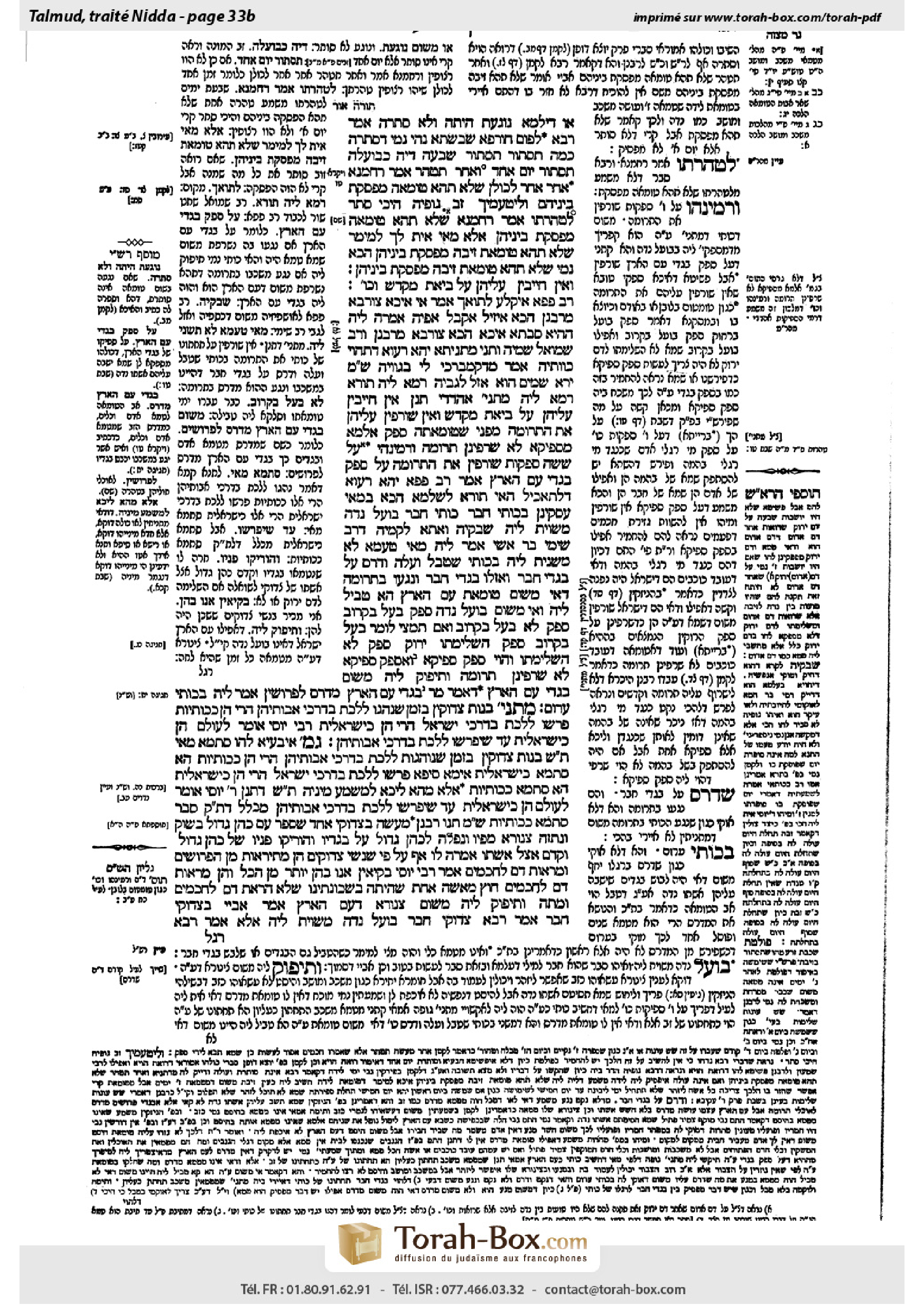
Niddah 33b: Talmud study for Daf Yomi
Daf Yomi is the daily study of one Talmud folio. Explore 37 tractates with scans, Hebrew text, Sefaria English and AI-generated French translations where annotated.
Passage selection and English or AI-generated French translation are available where the scan has annotations. Daf Study is independent of Torah-Box and Sefaria.
Browse Niddah · נידה · All tractatesNiddah 33b text and translations
This page of Niddah includes the Aramaic text, an English translation and an AI-generated French translation, alongside the scan above.
נידה ל״ג ב · Aramaic and Hebrew text
אוֹ דִילְמָא נוֹגַעַת הָיְתָה וְלָא סָתְרָה?
אָמַר רָבָא: לְפוּם חוּרְפָּא שַׁבֶּשְׁתָּא! נְהִי נָמֵי דְּסָתְרָה, כְּמָה תִּסְתּוֹר? תִּסְתּוֹר שִׁבְעָה? דַּיָּה כְּבוֹעֲלָהּ!
תִּסְתּוֹר יוֹם אֶחָד ״וְאַחַר תִּטְהָר״? אֲמַר רַחֲמָנָא: ״אַחַר״ — אַחַר לְכוּלָּן, שֶׁלֹּא תְּהֵא טוּמְאָה מַפְסֶקֶת בֵּינֵיהֶם.
וְלִיטַעְמָיךְ, זָב גּוּפֵיהּ הֵיכִי סָתַר? ״לְטׇהֳרָתוֹ״ אָמַר רַחֲמָנָא: שֶׁלֹּא תְּהֵא טוּמְאָה מַפְסֶקֶת בֵּינֵיהֶן!
אֶלָּא מַאי אִית לָךְ לְמֵימַר? שֶׁלֹּא תְּהֵא טוּמְאַת זִיבָה מַפְסֶקֶת בֵּינֵיהֶן, הָכָא נָמֵי שֶׁלֹּא תְּהֵא טוּמְאַת זִיבָה מַפְסֶקֶת בֵּינֵיהֶן.
וְאֵין חַיָּיבִין עֲלֵיהֶן עַל בִּיאַת מִקְדָּשׁ וְכוּ׳. רַב פָּפָּא אִיקְּלַע לִתְוָאךְ, אֲמַר: אִי אִיכָּא צוּרְבָּא מֵרַבָּנַן הָכָא, אֵיזִיל אֲקַבֵּל אַפֵּיהּ. אֲמַרָה לֵיהּ הָהִיא סַבְתָּא: אִיכָּא הָכָא צוּרְבָּא מֵרַבָּנַן, וְרַב שְׁמוּאֵל שְׁמֵיהּ, וְתָנֵי מַתְנְיָתָא. יְהֵא רַעֲוָא דְּתֶהְוֵי כְּוָותֵיהּ!
אֲמַר: מִדְּקָמְבָרְכִי לִי בְּגַוֵּויהּ, שְׁמַע מִינַּהּ יְרֵא שָׁמַיִם הוּא. אֲזַל לְגַבֵּיהּ, רְמָא לֵיהּ תּוֹרָא, רְמָא לֵיהּ מַתְנְיָתָא אַהֲדָדֵי: תְּנַן ״אֵין חַיָּיבִין עֲלֵיהֶן עַל בִּיאַת מִקְדָּשׁ, וְאֵין שׂוֹרְפִין עֲלֵיהֶן אֶת הַתְּרוּמָה, מִפְּנֵי שֶׁטּוּמְאָתָהּ סָפֵק״ — אַלְמָא מִסְּפֵיקָא לָא שָׂרְפִינַן תְּרוּמָה.
וּרְמִינְהִי: עַל שִׁשָּׁה סְפֵקוֹת שׂוֹרְפִין אֶת הַתְּרוּמָה, עַל סְפֵק בִּגְדֵי עַם הָאָרֶץ!
אָמַר רַב פָּפָּא: יְהֵא רַעֲוָא דְּלִתְאֲכִיל הַאי תּוֹרָא לִשְׁלָמָא, הָכָא בְמַאי עָסְקִינַן? בְּכוּתִי חָבֵר.
כּוּתִי חָבֵר — בּוֹעֵל נִדָּה מְשַׁוֵּית לֵיהּ?
שַׁבְקֵיהּ, וַאֲתָא לְקַמֵּיהּ דְּרַב שִׁימִי בַּר אָשֵׁי. אֲמַר לֵיהּ: מַאי טַעְמָא לָא מְשַׁנֵּית לֵיהּ בְּכוּתִי שֶׁטָּבַל וְעָלָה, וְדָרַס עַל בִּגְדֵי חָבֵר, וַאֲזוּל בִּגְדֵי חָבֵר וּנְגַעוּ בִּתְרוּמָה?
דְּאִי מִשּׁוּם טוּמְאַת עַם הָאָרֶץ — הָא טְבֵיל לֵיהּ, וְאִי מִשּׁוּם בּוֹעֵל נִדָּה — סָפֵק בָּעַל בְּקָרוֹב, סָפֵק לֹא בָּעַל בְּקָרוֹב.
וְאִם תִּמְצֵי לוֹמַר בָּעַל בְּקָרוֹב, סָפֵק הִשְׁלִימַתּוּ יָרוֹק, סָפֵק לֹא הִשְׁלִימַתּוּ, וְהָוֵי סְפֵק סְפֵיקָא, וְאַסְּפֵק סְפֵיקָא לָא שָׂרְפִינַן תְּרוּמָה.
וְתִיפּוֹק לֵיהּ מִשּׁוּם בִּגְדֵי עַם הָאָרֶץ, דְּאָמַר מָר: בִּגְדֵי עַם הָאָרֶץ מִדְרָס לַפְּרוּשִׁין! אֲמַר לֵיהּ: בְּכוּתִי עָרוֹם.
מַתְנִי' בְּנוֹת צַדּוּקִין, בִּזְמַן שֶׁנָּהֲגוּ לָלֶכֶת בְּדַרְכֵי אֲבוֹתֵיהֶן — הֲרֵי הֵן כְּכוּתִיּוֹת. פָּרְשׁוּ לָלֶכֶת בְּדַרְכֵי יִשְׂרָאֵל — הֲרֵי הֵן כְּיִשְׂרְאֵלִיּוֹת. רַבִּי יוֹסֵי אוֹמֵר: לְעוֹלָם הֵן כְּיִשְׂרְאֵלִיּוֹת, עַד שֶׁיִּפְרְשׁוּ לָלֶכֶת בְּדַרְכֵי אֲבוֹתֵיהֶן.
גְּמָ' אִיבַּעְיָא לְהוּ: סְתָמָא מַאי? תָּא שְׁמַע: בְּנוֹת צַדּוּקִין, בִּזְמַן שֶׁנּוֹהֲגוֹת לָלֶכֶת בְּדַרְכֵי אֲבוֹתֵיהֶן — הֲרֵי הֵן כְּכוּתִיּוֹת. הָא סְתָמָא — כְּיִשְׂרְאֵלִיּוֹת! אֵימָא סֵיפָא: פֵּרְשׁוּ לָלֶכֶת בְּדַרְכֵי יִשְׂרָאֵל — הֲרֵי הֵן כְּיִשְׂרְאֵלִיּוֹת. הָא סְתָמָא — כְּכוּתִיּוֹת! אֶלָּא מֵהָא לֵיכָּא לְמִשְׁמַע מִינַּהּ.
תָּא שְׁמַע, דִּתְנַן: רַבִּי יוֹסֵי אוֹמֵר, לְעוֹלָם הֵן כְּיִשְׂרְאֵלִיּוֹת, עַד שֶׁיִּפְרְשׁוּ לָלֶכֶת בְּדַרְכֵי אֲבוֹתֵיהֶן. מִכְּלָל דְּתַנָּא קַמָּא סָבַר: סְתָמָא כְּכוּתִיּוֹת. שְׁמַע מִינַּהּ.
תָּנוּ רַבָּנַן: מַעֲשֶׂה בְּצַדּוּקִי אֶחָד שֶׁסִּפֵּר עִם כֹּהֵן גָּדוֹל בַּשּׁוּק, וְנִתְּזָה צִנּוֹרָא מִפִּיו וְנָפְלָה לְכֹהֵן גָּדוֹל עַל בְּגָדָיו, וְהוֹרִיקוּ פָּנָיו שֶׁל כֹּהֵן גָּדוֹל, וְקָדַם אֵצֶל אִשְׁתּוֹ.
אָמְרָה לוֹ: אַף עַל פִּי שֶׁנְּשֵׁי צַדּוּקִים הֵן, מִתְיָרְאוֹת מִן הַפְּרוּשִׁים, וּמַרְאוֹת דָּם לַחֲכָמִים.
אָמַר רַבִּי יוֹסֵי: בְּקִיאִין אָנוּ בָּהֶן יוֹתֵר מִן הַכֹּל, וְהֵן מַרְאוֹת דָּם לַחֲכָמִים, חוּץ מֵאִשָּׁה אַחַת שֶׁהָיְתָה בִּשְׁכוּנָתֵינוּ, שֶׁלֹּא הֶרְאָת דָּם לַחֲכָמִים וּמֵתָה.
וְתִיפּוֹק לֵיהּ מִשּׁוּם צִנּוֹרָא דְּעַם הָאָרֶץ! אָמַר אַבָּיֵי: בְּצַדּוּקִי חָבֵר. אָמַר רָבָא: צַדּוּקִי חָבֵר בּוֹעֵל נִדָּה מְשַׁוֵּית לֵיהּ? אֶלָּא אָמַר רָבָא:
Niddah 33b · English translation
Or perhaps it is because she was touching the semen, and if so she has not thereby negated her count, just as a zav does not negate his count if he touches semen.
Rava says: Commensurate with the sharpness of Rami bar Ḥama is the extent of his error, as this is not a dilemma at all, since even if one could suggest that a zava who discharges semen has indeed negated her count, one must ask: How much should she negate? If one suggests she should negate all seven days of her counting, this is untenable, as it is enough for her that she should negate her count like the man who engages in intercourse with her, i.e., like a zav who discharges semen, who negates only one day.
And if one suggests that she should negate one day alone, this too is untenable, as the Merciful One states: “But if she is purified from her ziva then she shall count to herself seven days, and after that she shall be pure” (Leviticus 15:28). The word “after” indicates that she shall be pure only after all of them, i.e., after seven consecutive clean days, such that there should be no impurity separating between them. If so, there cannot be a situation where a zava negates a single day, and consequently it cannot be that a zava who discharges semen negates any part of her count.
The Gemara rejects Rava’s response: And according to your reasoning, how does a zav himself negate only one day from his count due to a seminal emission? After all, the Merciful One states: “And when the zav is purified of his ziva, then he shall count for himself seven days for his purification, and wash his clothes, and bathe his flesh in running water, and he shall be pure” (Leviticus 15:13). The phrase: “Seven days for his purification,” indicates that there should be no impurity separating between them.
Rather, what have you to say? The verse means only that there should not be an impurity of ziva separating between them. Here too, with regard to a zava, the verse means only that there should not be an impurity of ziva separating between them; a discharge of semen is not included in this restriction. It is therefore possible that a discharge of semen from a zava negates only one day from her count. Accordingly, the dilemma raised by Rami bar Ḥama remains in place.
§ The mishna teaches: But one who enters the Temple while wearing those garments upon which a Samaritan had lain is not liable to bring an offering for entering the Temple, nor does one burn teruma that came into contact with those garments, because their impurity is uncertain. In connection to these halakhot, the Gemara relates that Rav Pappa happened to come to the city of Tavakh. He said: If there is a Torah scholar here I will go and greet him. A certain elderly woman said to him: There is a Torah scholar here and Rav Shmuel is his name, and he teaches mishnayot; may it be God’s will that you should be like him.
Rav Pappa said to himself: From the fact that they bless me through this Rav Shmuel that I should be like him, I may conclude from it that he is a God-fearing individual. Rav Pappa went to visit him, and Rav Shmuel raised a bull for him, i.e., he slaughtered a bull in honor of Rav Pappa, and he also raised a difficulty between two mishnayot that apparently contradict one another: We learn in the mishna: One who enters the Temple while wearing those garments upon which a Samaritan had lain is not liable to bring an offering for entering the Temple, nor does one burn teruma that came into contact with those garments, because their impurity is uncertain. Evidently, we do not burn teruma due to uncertain impurity.
And one can raise a contradiction from another mishna (Teharot 4:5): For six cases of uncertain impurity one burns the teruma if it came into contact with them, or if a person came into contact with them and subsequently touched the teruma. One of these is for the uncertain case of the garments of one who is unreliable with regard to ritual impurity [am ha’aretz]. Such garments impart impurity through contact and through carrying, due to a concern that the wife of the am ha’aretz might have sat on them while she was menstruating. Evidently, one burns teruma due to uncertain impurity.
Rav Pappa began his response with a supplication and said: May it be God’s will that this bull shall be eaten peacefully, i.e., that I will provide a satisfactory resolution of this contradiction. Since the bull was slaughtered in my honor, failing to resolve the contradiction might spoil the meal. Rav Pappa continued: Here we are dealing with a Samaritan who is devoted to the meticulous observance of mitzvot, especially halakhot of ritual purity, teruma, and tithes [ḥaver]. There is therefore less concern with regard to his ritual purity than that of an am ha’aretz. Consequently, the mishna here states that teruma is not burned on account of him.
Rav Shmuel rejected this response: Since the mishna is referring to men who engage in intercourse with menstruating women, are you equating a Samaritan ḥaver with a man who engages in intercourse with a menstruating woman?
Rav Pappa left Rav Shmuel in embarrassment and came before Rav Shimi bar Ashi, to whom he related this incident. Rav Shimi bar Ashi said to him: What is the reason that you did not respond to him that the ruling of the mishna is stated with regard to a Samaritan who immersed in a ritual bath and arose from his impure status, and subsequently trod on the garments of a ḥaver, which means they are now considered the bedding of the Samaritan, and then those garments of the ḥaver went and touched teruma? In such a case one does not burn the teruma.
As, if one would say to burn it due to the impurity of an am ha’aretz, he has immersed in a ritual bath. And if one were to suggest that it should be burned because the Samaritan is one who engages in intercourse with a menstruating woman, this too is an unsatisfactory reason. This is because it is uncertain whether he recently engaged in intercourse with his wife, in which case his immersion does not remove his impurity; and it is uncertain whether he did not recently engage in intercourse with his wife, in which case he is in fact pure.
And even if you say that he recently engaged in intercourse with his wife, another uncertainty remains: It is uncertain whether his wife began counting seven days from an emission of green blood and ignored any subsequent emission of red blood and completed her count for the green blood, which would mean that she was in fact a menstruating woman when she engaged in sexual intercourse with her husband; and it is uncertain whether she did not complete a count of seven days from the emission of the green blood, rather from the emission of red blood, in which case she was not a menstruating woman when her husband engaged in intercourse with her. And therefore this is a compound uncertainty, and there is a principle that one does not burn teruma on account of a compound uncertainty.
Rav Pappa raised an objection to Rav Shimi bar Ashi: And let one derive that the garments of the ḥaver are impure because they came into contact with the garments of an am ha’aretz. As the Master said: The garments of an am ha’aretz are considered impure with the ritual impurity imparted by the treading of a zav, which means they impart impurity to people and to garments, for individuals who are scrupulous with regard to impurity [perushin]. Rav Shimi bar Ashi said to Rav Pappa: The mishna is referring to a naked Samaritan. Consequently, none of his garments came into contact with the garments of the ḥaver.
MISHNA: With regard to Sadducee girls, when they were accustomed to follow in the ways of their Sadducee ancestors their status is like that of Samaritan women, whose halakha was discussed in the previous mishna. If the Sadducee women abandoned the customs of their ancestors in order to follow in the ways of the Jewish people their status is like that of a Jewish woman. Rabbi Yosei says: Their status is always like that of a Jewish woman, until they will abandon the ways of the Jewish people in order to follow in the ways of their Sadducee ancestors.
GEMARA: A dilemma was raised before the Sages: What is the halakha in an unspecified case, i.e., when the custom of a Sadducee woman is unknown? The Gemara suggests: Come and hear evidence from the mishna: With regard to Sadducee girls, when they are accustomed to follow in the ways of their Sadducee ancestors their status is like that of Samaritan women. It can be inferred from the mishna that in an unspecified case their status is like that of a Jewish woman. The Gemara rejects this suggestion: Say the latter clause: If the Sadducee women abandoned the customs of their ancestors in order to follow in the ways of the Jewish people their status is like that of a Jewish woman. One may infer from this that in an unspecified case their status is like that of Samaritan women. Rather, no inference is to be learned from this mishna.
The Gemara suggests: Come and hear the last clause of the mishna, as we learned in the mishna that Rabbi Yosei says: Their status is always like that of a Jewish woman, until they will abandon the ways of the Jewish people in order to follow in the ways of their Sadducee ancestors. By inference, one may conclude that the first tanna holds that in an unspecified case their status is like that of Samaritan women. The Gemara affirms: Conclude from it that this is the case.
§ The Sages taught: There was an incident involving a certain Sadducee who was conversing with the High Priest in the marketplace, and as he was speaking, saliva [tzinora] sprayed from his mouth and fell onto the garments of the High Priest. And the face of the High Priest turned green, as he feared that his garments had been rendered ritually impure. And he rushed to the Sadducee’s wife to inquire whether she properly observed the halakhot of menstruation, in which case his garments were not rendered impure by the saliva of her husband, as he is not considered one who engages in intercourse with a menstruating woman.
She said to him: Even though women such as myself are the wives of Sadducees, who do not follow in the ways of the perushim, they are scared of the perushim and they show their blood to the Sages when an uncertainty arises. The garments of the High Priest are therefore pure, as the Sadducee wives properly observe the halakhot of menstruation.
Rabbi Yosei says: We are familiar with the wives of Sadducees more so than everyone else, as they are our neighbors, and I can testify that they all show their blood to the Sages, except for a certain woman who was living in our neighborhood who did not show her blood to the Sages, and she died, as a punishment for her behavior.
The Gemara objects: And let the High Priest derive that his garments are impure due to the saliva of an am ha’aretz, which imparts impurity. Abaye said: That case involved a Sadducee ḥaver, who was particular with regard to the halakhot of ritual purity. Rava said: Are you equating a Sadducee ḥaver with a man who engages in intercourse with a menstruating woman? After all, the High Priest was initially concerned that the Sadducee might engage in intercourse with his wife while she is still menstruating. Rather, Rava said:
Niddah 33b · Traduction française (IA)
Ou peut-être est-ce parce qu’elle touchait le sperme ; dans ce cas, elle n’a pas invalidé son compte, tout comme un zav n’invalide pas le sien lorsqu’il touche du sperme.
Rava dit : À la mesure de la subtilité de Rami bar Ḥama est l’ampleur de son erreur, car il n’y a là aucun dilemme. En effet, même si l’on pouvait suggérer qu’une zava qui émet du sperme invalide effectivement son compte, il faut demander : Combien de jours doit-elle invalider ? Si l’on suggère qu’elle doit invalider les sept jours entiers de son compte, cela ne tient pas, car il suffit qu’elle invalide son compte comme l’homme qui a des rapports avec elle, c’est-à-dire comme un zav qui émet du sperme et n’invalide qu’un seul jour.
Et si l’on suggère qu’elle n’invalide qu’un seul jour, cela ne tient pas non plus, car le Miséricordieux dit : « Mais si elle est purifiée de son flux, elle comptera pour elle-même sept jours, après quoi elle sera pure » (Lévitique 15,28). Le mot « après » indique qu’elle ne sera pure qu’après tous ces jours, c’est-à-dire après sept jours consécutifs de pureté, sans qu’aucune impureté s’interpose entre eux. Il ne peut donc y avoir de situation où une zava invalide un seul jour ; par conséquent, il est impossible qu’une zava qui émet du sperme invalide une partie quelconque de son compte.
La Guemara rejette la réponse de Rava : Selon ton raisonnement, comment un zav lui-même peut-il n’invalider qu’un seul jour de son compte à cause d’une émission de sperme ? Après tout, le Miséricordieux dit : « Lorsque le zav sera purifié de son flux, il comptera pour lui-même sept jours en vue de sa purification, lavera ses vêtements, baignera son corps dans une eau courante, et il sera pur » (Lévitique 15,13). L’expression « sept jours en vue de sa purification » indique qu’aucune impureté ne doit s’interposer entre eux.
Mais alors, que faut-il dire ? Le verset signifie seulement qu’aucune impureté due au flux ne doit s’interposer entre ces jours. Ici aussi, à propos d’une zava, le verset signifie seulement qu’aucune impureté due au flux ne doit s’interposer entre ces jours ; une émission de sperme n’est pas incluse dans cette restriction. Il est donc possible qu’une émission de sperme chez une zava n’invalide qu’un seul jour de son compte. Le dilemme soulevé par Rami bar Ḥama demeure donc entier.
§ La Michna enseigne : Celui qui entre dans le Temple en portant des vêtements sur lesquels un Samaritain s’est couché n’est pas tenu d’apporter un sacrifice pour être entré dans le Temple ; on ne brûle pas non plus la terouma qui a été en contact avec ces vêtements, car leur impureté est incertaine. À propos de ces halakhot, la Guemara rapporte que Rav Pappa arriva par hasard dans la ville de Tavakh. Il dit : « S’il y a ici un sage de la Torah, j’irai le saluer. » Une vieille femme lui dit : « Il y a ici un sage de la Torah qui s’appelle Rav Shmuel et enseigne des michnayot ; puisse Dieu faire que tu sois comme lui. »
Rav Pappa se dit : « Puisqu’ils me bénissent en souhaitant que je sois comme ce Rav Shmuel, j’en conclus qu’il craint Dieu. » Rav Pappa alla lui rendre visite. Rav Shmuel fit préparer un taureau pour lui, c’est-à-dire qu’il abattit un taureau en son honneur, et lui soumit aussi une difficulté portant sur deux michnayot qui semblent se contredire : « Nous apprenons dans la Michna que celui qui entre dans le Temple en portant des vêtements sur lesquels un Samaritain s’est couché n’est pas tenu d’apporter un sacrifice pour être entré dans le Temple ; on ne brûle pas non plus la terouma qui a été en contact avec ces vêtements, car leur impureté est incertaine. Il apparaît donc qu’on ne brûle pas la terouma en raison d’une impureté incertaine. »
On peut opposer à cela une autre Michna (Teharot 4,5) : dans six cas d’impureté incertaine, on brûle la terouma si elle a été en contact avec les objets en question, ou si une personne a été en contact avec eux puis a touché la terouma. L’un de ces cas concerne l’incertitude relative aux vêtements d’une personne peu fiable en matière d’impureté rituelle [am ha’aretz]. Ces vêtements transmettent l’impureté par contact et par port, car on craint que la femme de l’am ha’aretz se soit assise dessus alors qu’elle était menstruée. Il apparaît donc qu’on brûle la terouma en raison d’une impureté incertaine.
Rav Pappa commença sa réponse par une supplication et dit : « Puisse Dieu faire que ce taureau soit mangé en paix », c’est-à-dire que je parvienne à résoudre cette contradiction de manière satisfaisante. Puisque le taureau a été abattu en mon honneur, ne pas résoudre la contradiction risquerait de gâcher le repas. Rav Pappa poursuivit : « Ici, il s’agit d’un Samaritain qui s’applique avec minutie à l’observance des mitsvot, en particulier aux halakhot de pureté rituelle, de terouma et de dîmes [ḥaver]. On a donc moins de raisons de s’inquiéter de sa pureté rituelle que de celle d’un am ha’aretz. C’est pourquoi la Michna enseigne ici qu’on ne brûle pas la terouma à cause de lui. »
Rav Shmuel rejeta cette réponse : « Puisque la Michna parle d’hommes qui ont des rapports avec des femmes menstruées, assimiles-tu un ḥaver samaritain à un homme qui a des rapports avec une femme menstruée ? »
Rav Pappa quitta Rav Shmuel, honteux, et se rendit auprès de Rav Shimi bar Ashi, à qui il raconta cet incident. Rav Shimi bar Ashi lui dit : « Pourquoi ne lui as-tu pas répondu que la règle de la Michna concerne un Samaritain qui s’est immergé dans un mikvé et est sorti de son état d’impureté, puis a piétiné les vêtements d’un ḥaver, qui sont ainsi considérés comme la literie du Samaritain, après quoi ces vêtements du ḥaver ont touché de la terouma ? Dans un tel cas, on ne brûle pas la terouma. »
En effet, si l’on disait qu’il faut la brûler à cause de l’impureté d’un am ha’aretz, il s’est immergé dans un mikvé. Et si l’on suggérait qu’il faut la brûler parce que le Samaritain a des rapports avec une femme menstruée, ce ne serait pas non plus une raison suffisante. On ne sait pas s’il a récemment eu des rapports avec sa femme, auquel cas son immersion n’a pas levé son impureté ; et l’on ne sait pas non plus s’il n’a pas récemment eu de rapports avec elle, auquel cas il est effectivement pur.
Et même si tu dis qu’il a récemment eu des rapports avec sa femme, une autre incertitude subsiste : on ne sait pas si sa femme a commencé à compter sept jours à partir de l’émission de sang vert, en ignorant toute émission ultérieure de sang rouge, et a achevé son compte pour le sang vert — ce qui signifierait qu’elle était effectivement menstruée lorsqu’elle a eu des rapports avec son mari —, ou si elle n’a pas achevé un compte de sept jours à partir de l’émission de sang vert, mais plutôt à partir de l’émission de sang rouge, auquel cas elle n’était pas menstruée lorsque son mari a eu des rapports avec elle. Il s’agit donc d’une incertitude composée, et le principe veut qu’on ne brûle pas la terouma à cause d’une incertitude composée.
Rav Pappa souleva une objection contre Rav Shimi bar Ashi : « Ne faut-il pas conclure que les vêtements du ḥaver sont impurs parce qu’ils ont été en contact avec les vêtements d’un am ha’aretz ? Car le Maître a dit que les vêtements d’un am ha’aretz sont considérés comme atteints de l’impureté transmise par le piétinement d’un zav, ce qui signifie qu’ils transmettent l’impureté aux personnes et aux vêtements, selon l’avis de ceux qui sont scrupuleux en matière d’impureté [perushin]. » Rav Shimi bar Ashi dit à Rav Pappa : « La Michna parle d’un Samaritain nu. Par conséquent, aucun de ses vêtements n’est entré en contact avec les vêtements du ḥaver. »
MICHNA : Quant aux filles sadducéennes, lorsqu’elles avaient coutume de suivre les voies de leurs ancêtres sadducéens, leur statut était celui des femmes samaritaines, dont la halakha a été discutée dans la Michna précédente. Si les femmes sadducéennes abandonnaient les coutumes de leurs ancêtres pour suivre les voies du peuple juif, leur statut était celui d’une femme juive. Rabbi Yosei dit : Leur statut est toujours celui d’une femme juive, jusqu’à ce qu’elles abandonnent les voies du peuple juif pour suivre celles de leurs ancêtres sadducéens.
GUEMARA : Les Sages soulevèrent la question suivante : Quelle est la halakha dans un cas non précisé, c’est-à-dire lorsque les coutumes d’une femme sadducéenne sont inconnues ? La Guemara suggère : « Viens entendre » un indice tiré de la Michna : « Quant aux filles sadducéennes, lorsqu’elles ont coutume de suivre les voies de leurs ancêtres sadducéens, leur statut est celui des femmes samaritaines. » On peut en déduire que, dans un cas non précisé, leur statut est celui d’une femme juive. La Guemara rejette cette suggestion : Considère la clause suivante : « Si les femmes sadducéennes abandonnaient les coutumes de leurs ancêtres pour suivre les voies du peuple juif, leur statut était celui d’une femme juive. » On peut en déduire que, dans un cas non précisé, leur statut est celui des femmes samaritaines. Il ne faut donc tirer aucune conclusion de cette Michna.
La Guemara suggère : « Viens entendre » la dernière clause de la Michna, où nous avons appris que Rabbi Yosei dit : « Leur statut est toujours celui d’une femme juive, jusqu’à ce qu’elles abandonnent les voies du peuple juif pour suivre celles de leurs ancêtres sadducéens. » On peut en déduire que le premier tanna estime que, dans un cas non précisé, leur statut est celui des femmes samaritaines. La Guemara confirme : Conclus-en que c’est bien le cas.
§ Les Sages ont enseigné : Il arriva qu’un certain Sadducéen conversait avec le grand prêtre sur la place du marché. Tandis qu’il parlait, de la salive [tzinora] jaillit de sa bouche et tomba sur les vêtements du grand prêtre. Le visage de celui-ci devint livide, car il craignait que ses vêtements aient été rendus rituellement impurs. Il se hâta d’aller voir la femme du Sadducéen pour lui demander si elle observait correctement les halakhot relatives à la menstruation ; dans ce cas, les vêtements du grand prêtre n’avaient pas été rendus impurs par la salive de son mari, car celui-ci n’était pas considéré comme un homme qui a des rapports avec une femme menstruée.
Elle lui dit : « Bien que des femmes comme moi soient les épouses de Sadducéens, qui ne suivent pas les voies des perushin, elles craignent les perushin et, lorsqu’un doute se présente, elles montrent leur sang aux Sages. » Les vêtements du grand prêtre étaient donc purs, car les épouses des Sadducéens observent correctement les halakhot relatives à la menstruation.
Rabbi Yosei dit : « Nous connaissons mieux que quiconque les épouses des Sadducéens, car elles sont nos voisines, et je peux témoigner qu’elles montrent toutes leur sang aux Sages, à l’exception d’une certaine femme qui vivait dans notre voisinage et ne leur montrait pas son sang ; elle mourut en punition de son comportement. »
La Guemara objecte : Le grand prêtre ne devrait-il pas conclure que ses vêtements sont impurs à cause de la salive d’un am ha’aretz, qui transmet l’impureté ? Abaye dit : « Ce cas concernait un ḥaver sadducéen, scrupuleux quant aux halakhot de pureté rituelle. » Rava dit : « Assimiles-tu un ḥaver sadducéen à un homme qui a des rapports avec une femme menstruée ? Après tout, le grand prêtre craignait au départ que le Sadducéen ait des rapports avec sa femme alors qu’elle était encore menstruée. » Au contraire, Rava dit :
Traduction française générée par IA à partir de l’édition anglaise de Sefaria. Vérifie toujours un passage avec le texte source.
Text from Sefaria: William Davidson Edition - Vocalized Aramaic (CC BY NC); William Davidson Edition - English (CC BY NC).