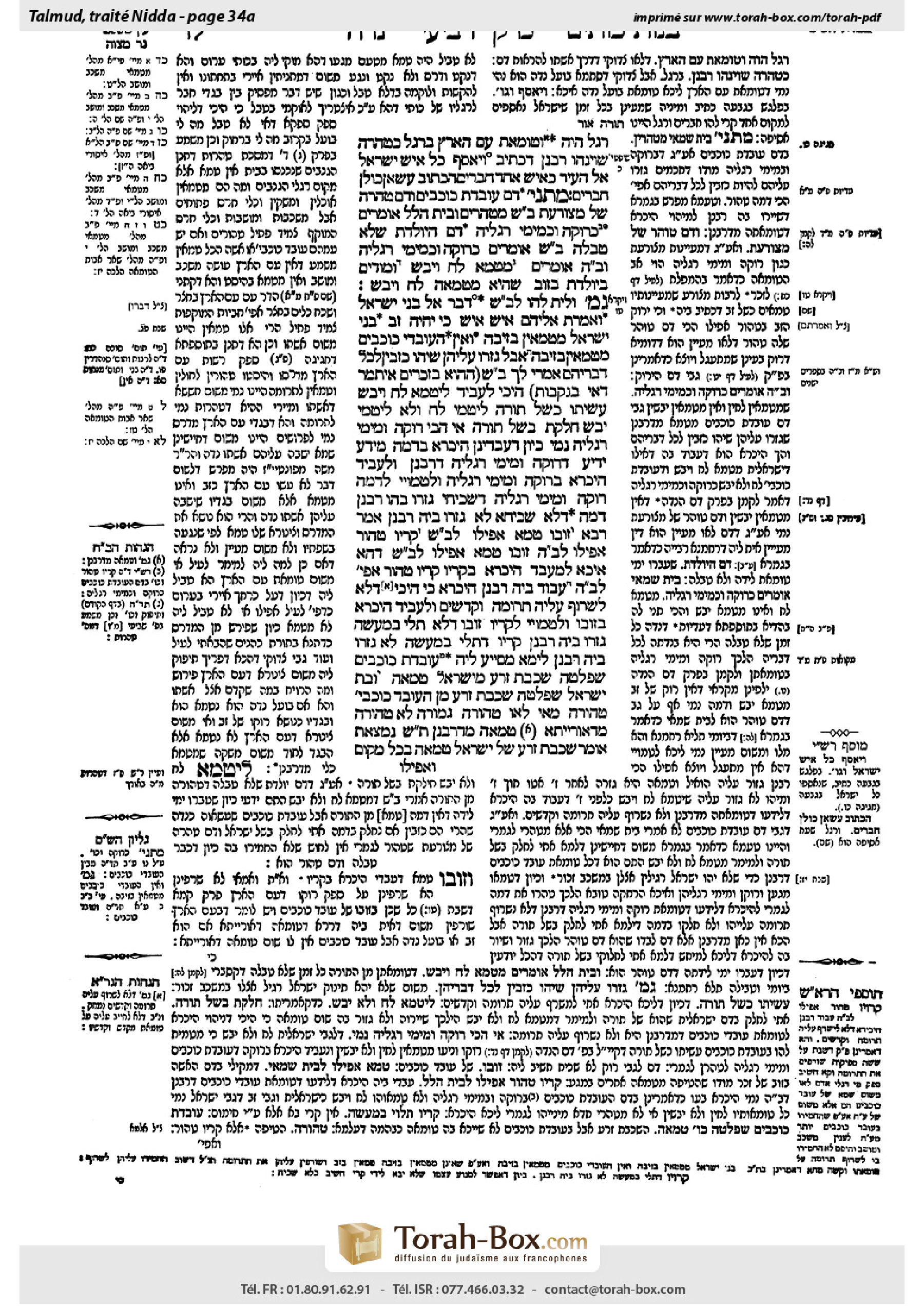
Niddah 34a: Talmud study for Daf Yomi
Daf Yomi is the daily study of one Talmud folio. Explore 37 tractates with scans, Hebrew text, Sefaria English and AI-generated French translations where annotated.
Passage selection and English or AI-generated French translation are available where the scan has annotations. Daf Study is independent of Torah-Box and Sefaria.
Browse Niddah · נידה · All tractatesNiddah 34a text and translations
This page of Niddah includes the Aramaic text, an English translation and an AI-generated French translation, alongside the scan above.
נידה ל״ד א · Aramaic and Hebrew text
רֶגֶל הֲוָה, וְטוּמְאַת עַם הָאָרֶץ בָּרֶגֶל כְּטׇהֳרָה שַׁוְּיוּהָ רַבָּנַן, דִּכְתִיב: ״וַיֵּאָסֵף כׇּל אִישׁ יִשְׂרָאֵל אֶל הָעִיר כְּאִישׁ אֶחָד חֲבֵרִים״, הַכָּתוּב עֲשָׂאָן כּוּלָּן חֲבֵרִים.
מַתְנִי' דַּם נׇכְרִית וְדַם טׇהֳרָה שֶׁל מְצוֹרַעַת, בֵּית שַׁמַּאי מְטַהֲרִים, וּבֵית הִלֵּל אוֹמְרִים: כְּרוּקָּהּ וּכְמֵימֵי רַגְלֶיהָ.
דַּם הַיּוֹלֶדֶת שֶׁלֹּא טָבְלָה, בֵּית שַׁמַּאי אוֹמְרִים: כְּרוּקָּהּ וּכְמֵימֵי רַגְלֶיהָ, וּבֵית הִלֵּל אוֹמְרִים: מְטַמֵּא לַח וְיָבֵשׁ.
וּמוֹדִים בְּיוֹלֶדֶת בְּזוֹב שֶׁהִיא מְטַמְּאָה לַח וְיָבֵשׁ.
גְּמָ' וְלֵית לְהוּ לְבֵית שַׁמַּאי ״דַּבֵּר אֶל בְּנֵי יִשְׂרָאֵל וְאָמַרְתָּ אֲלֵיהֶם אִישׁ אִישׁ כִּי יִהְיֶה זָב״ — בְּנֵי יִשְׂרָאֵל מְטַמְּאִין בְּזִיבָה, וְאֵין הַגּוֹיִם מְטַמְּאִין בְּזִיבָה, אֲבָל גָּזְרוּ עֲלֵיהֶן שֶׁיְּהוּ כְּזָבִין לְכׇל דִּבְרֵיהֶם?
אָמְרִי לָךְ בֵּית שַׁמַּאי: (הָהוּא בִּזְכָרִים אִיתְּמַר, דְּאִי בִּנְקֵבוֹת) הֵיכִי לַעֲבֵיד? לִיטַמֵּא לַח וְיָבֵשׁ — עֲשִׂיתוֹ כְּשֶׁל תּוֹרָה, לִיטַּמֵּי לַח וְלָא לִיטַּמֵּי יָבֵשׁ — חִלַּקְתָּ בְּשֶׁל תּוֹרָה.
אִי הָכִי, רוּקָּהּ וּמֵימֵי רַגְלֶיהָ נָמֵי! כֵּיוָן דְּעָבְדִינַן הֶיכֵּרָא בְּדָמָהּ, מִידָּע יְדִיעַ דְּרוּקָּהּ וּמֵימֵי רַגְלֶיהָ דְּרַבָּנַן.
וְלַעֲבֵיד הֶיכֵּרָא בְּרוּקָּהּ וּמֵימֵי רַגְלֶיהָ, וּלְטַמּוֹיֵי לְדָמָהּ? רוּקָּהּ וּמֵימֵי רַגְלֶיהָ דִּשְׁכִיחִי — גְּזַרוּ בְּהוּ רַבָּנַן, דָּמָהּ דְּלָא שְׁכִיחַ — לָא גְּזַרוּ בֵּיהּ רַבָּנַן.
אָמַר רָבָא: זוֹבוֹ טָמֵא, אֲפִילּוּ לְבֵית שַׁמַּאי; קִרְיוֹ טָהוֹר, אֲפִילּוּ לְבֵית הִלֵּל.
זוֹבוֹ טָמֵא, אֲפִילּוּ לְבֵית שַׁמַּאי — דְּהָא אִיכָּא לְמֶעְבַּד הֶיכֵּרָא בְּקִרְיוֹ.
קִרְיוֹ טָהוֹר, אֲפִילּוּ לְבֵית הִלֵּל — עֲבוּד בֵּיהּ רַבָּנַן הֶיכֵּרָא, כִּי הֵיכִי דְּלָא לִשְׂרוֹף עֲלֵיהּ תְּרוּמָה וְקָדָשִׁים.
וְלַעֲבֵיד הֶיכֵּרָא בְּזוֹבוֹ, וּלְטַמּוֹיֵי לְקִרְיוֹ? זוֹבוֹ דְּלָא תְּלֵי בְּמַעֲשֶׂה — גְּזַרוּ בֵּיהּ רַבָּנַן, קִרְיוֹ דִּתְלֵי בְּמַעֲשֶׂה — לָא גְּזַרוּ בֵּיהּ רַבָּנַן.
לֵימָא מְסַיַּיע לֵיהּ: נׇכְרִית שֶׁפָּלְטָה שִׁכְבַת זֶרַע מִיִּשְׂרָאֵל — טְמֵאָה, וּבַת יִשְׂרָאֵל שֶׁפָּלְטָה שִׁכְבַת זֶרַע מִן הַנׇּכְרִי — טְהוֹרָה. מַאי לַָאו טְהוֹרָה גְּמוּרָה? לָא, טְהוֹרָה מִדְּאוֹרָיְיתָא, טְמֵאָה מִדְּרַבָּנַן.
תָּא שְׁמַע: נִמְצֵאתָ אוֹמֵר, שִׁכְבַת זֶרַע שֶׁל יִשְׂרָאֵל טְמֵאָה בְּכׇל מָקוֹם,
Niddah 34a · English translation
This incident occurred during a pilgrimage Festival, either Passover, Sukkot, or Shavuot, and the Sages rendered the ritual impurity of an am ha’aretz during a pilgrimage Festival as purity. As it is written: “And all the men of Israel gathered to the city, like one man, united [ḥaverim]” (Judges 20:11). Whenever all the Jewish people gather in a single place, such as on a pilgrimage Festival, the verse renders all of them ḥaverim, even one who is an am ha’aretz. There was therefore no concern for impurity due to the saliva of an am ha’aretz. Yet, the High Priest was concerned that this Sadducee was one who engages in intercourse with a menstruating woman.
MISHNA: With regard to the blood of a menstruating gentile woman or a gentile zava, and the blood discharged by a female Jewish leper during the days of purity of a woman who gives birth, Beit Shammai deem them ritually pure, and Beit Hillel say: The halakhic status of the blood of the gentile woman is like that of her saliva and her urine, which impart impurity only while moist. Likewise, the blood discharged by a Jewish leper during the days of purity imparts impurity only when moist.
With regard to the blood of a woman who gave birth and reached the conclusion of her days of impurity, i.e., seven days after giving birth to a male or fourteen days after giving birth to a female, but who did not yet immerse in a ritual bath, Beit Shammai say: Although she has yet to immerse in a ritual bath, the blood does not retain the halakhic status of menstrual blood. Rather, the status of the blood is like that of her saliva and her urine, and it imparts impurity only while moist. And Beit Hillel say: Since she did not immerse in a ritual bath, her blood is considered like that of a menstruating woman, and it imparts impurity whether it is moist or dry.
And Beit Shammai concede to Beit Hillel in the case of a woman who gives birth as a zava, where the woman must count seven clean days from the conclusion of her days of impurity, that any blood she sees during those seven days imparts impurity whether it is moist or dry.
GEMARA: The mishna teaches that according to Beit Shammai the blood of a gentile woman does not impart impurity. The Gemara objects: And do Beit Shammai not accept that which is taught with regard to the verse: “Speak to the children of Israel and say to them, when any man has an issue [zav] out of his flesh, his issue is impure” (Leviticus 15:2), from which it is inferred: By Torah law, the children of Israel become impure through ziva and gentiles do not become impure through ziva, but the Sages decreed concerning them that they shall be like zavin in all their matters of ritual purity.
The Gemara responds: Beit Shammai could say to you that this was stated only with regard to males, not females. As, if it was stated even with regard to females, how should one act with regard to this impurity? Should their blood impart impurity whether it is moist or dry? If so, you have rendered it like blood that imparts impurity by Torah law, and people will mistakenly come to burn teruma that comes into contact with it. Perhaps one will suggest that it should impart impurity only while it is moist and it should not impart impurity when it is dry. But if so, you will have differentiated between moist and dry blood even with regard to blood that is impure by Torah law, i.e., one might mistakenly conclude that the blood of Jewish women imparts impurity only when it is moist, when in fact it imparts impurity whether it is moist or dry.
The Gemara objects: If so, then with regard to the saliva and urine of a gentile zava, which impart impurity by rabbinic law only when moist, Beit Shammai should also rule that they do not impart impurity at all, in order to distinguish their saliva and urine from that of a Jewish zava, which by Torah law impart impurity only when moist (see 54b). The Gemara responds: Since we implement a conspicuous marker with regard to the blood of a gentile woman, i.e., it is clear that her status is different from that of a Jewish woman in that her blood does not impart impurity whatsoever, everyone will know that the impurity of her saliva and her urine is only by rabbinic law, and there is no concern that people might come to mistakenly burn teruma that comes into contact with the saliva and urine of a gentile zava.
The Gemara persists: And let them implement a conspicuous marker with regard to the saliva and urine of a gentile woman, that they should not impart impurity whatsoever, and let them deem her blood impure even when dry. In this manner, everyone will know that the impurity of a gentile woman applies only by rabbinic law, and they will not come to treat that which is impure by Torah law in the same manner. The Gemara responds: With regard to her saliva and her urine, which are relatively common, the Sages decreed that they are impure, but with regard to her blood, which is not as common, the Sages did not decree that it is impure.
§ With regard to a gentile man, Rava says: The ziva of a gentile man is ritually impure, even according to the opinion of Beit Shammai, who maintain that the ziva of a gentile woman does not impart impurity whatsoever. By contrast, the semen of a gentile is pure, even according to the opinion of Beit Hillel, who hold that the blood of menstruating gentiles and the blood of their ziva imparts impurity when it is moist.
Rava elaborates: The ziva of a gentile man is impure, even according to the opinion of Beit Shammai, as it is possible to implement a conspicuous marker with his semen, i.e., since his semen does not impart impurity whatsoever, everyone will know that the impurity imparted by the ziva of a gentile applies by rabbinic law, and they will not come to burn teruma that comes in contact with the ziva of a gentile.
And the semen of a gentile is ritually pure, even according to the opinion of Beit Hillel. This is because the Sages had to implement a conspicuous marker with regard to it to indicate that the ziva of a gentile imparts impurity only by rabbinic law in order that they will not come to burn teruma and consecrated items that come into contact with their ziva, as must be performed with teruma and consecrated items that contract impurity by Torah law.
The Gemara objects: And let the Sages implement a conspicuous marker with regard to the ziva of a gentile man, that it should not impart impurity whatsoever, and let them deem his semen impure. The Gemara explains: With regard to his ziva, which is not dependent on an action he performs but is emitted on its own, the Sages decreed that it is impure; with regard to his semen, which is dependent on an action he performs, the Sages did not decree that it is impure.
The Gemara suggests: Let us say that the following mishna (Mikvaot 8:4) supports Rava’s opinion: In the case of a gentile woman who discharged semen that came from a Jew who engaged in intercourse with her, the semen is impure, as it came from a Jew. And in the case of a Jewish woman who discharged semen that came from a gentile, the semen is pure. What, is it not correct to say that the mishna means the semen of the gentile is entirely pure, in accordance with the opinion of Rava? The Gemara refutes this suggestion: No, perhaps the mishna means that the semen of a gentile is pure by Torah law but impure by rabbinic law, whereas according to Rava, the semen of a gentile is pure even by rabbinic law.
The Gemara cites another source that possibly supports Rava’s opinion: Come and hear a baraita: You are found to say the semen of a Jew is impure wherever it is found,
Niddah 34a · Traduction française (IA)
Cet incident s’est produit lors d’une fête de pèlerinage, soit Pessa’h, Souccot ou Chavouot. Les Sages considéraient alors comme pure l’impureté rituelle d’un am ha’aretz. En effet, il est écrit : « Tous les hommes d’Israël se rassemblèrent dans la ville, comme un seul homme, unis [ḥaverim] » (Juges 20,11). Chaque fois que tout le peuple juif se rassemble en un même lieu, par exemple lors d’une fête de pèlerinage, le verset les qualifie tous de ḥaverim, même ceux qui sont des amei ha’aretz. Il n’y avait donc pas lieu de craindre l’impureté due à la salive d’un am ha’aretz. Cependant, le grand prêtre craignait que ce sadducéen n’ait des rapports avec une femme menstruée.
MICHNA : Concernant le sang d’une femme non juive menstruée ou zava, ainsi que le sang écoulé d’une femme juive lépreuse pendant les jours de pureté d’une femme qui a accouché, Beit Chammaï les déclarent rituellement purs, tandis que Beit Hillel disent : le statut halakhique du sang de la femme non juive est semblable à celui de sa salive et de son urine, qui ne transmettent l’impureté que lorsqu’elles sont humides. De même, le sang écoulé d’une femme juive lépreuse pendant les jours de pureté ne transmet l’impureté que lorsqu’il est humide.
Concernant le sang d’une femme qui a accouché et qui est arrivée au terme de ses jours d’impureté, c’est-à-dire sept jours après avoir donné naissance à un garçon ou quatorze jours après avoir donné naissance à une fille, mais qui ne s’est pas encore immergée dans un bain rituel, Beit Chammaï disent : bien qu’elle ne se soit pas encore immergée dans un bain rituel, le sang ne conserve pas le statut halakhique du sang menstruel. Son statut est plutôt semblable à celui de sa salive et de son urine, et il ne transmet l’impureté que lorsqu’il est humide. Beit Hillel disent : puisqu’elle ne s’est pas immergée dans un bain rituel, son sang est considéré comme celui d’une femme menstruée et transmet l’impureté, qu’il soit humide ou sec.
Et Beit Chammaï reconnaissent à Beit Hillel que, dans le cas d’une femme qui accouche alors qu’elle est zava et qui doit compter sept jours de pureté à partir de la fin de ses jours d’impureté, tout sang qu’elle voit pendant ces sept jours transmet l’impureté, qu’il soit humide ou sec.
GUEMARA : La Michna enseigne que, selon Beit Chammaï, le sang d’une femme non juive ne transmet pas l’impureté. La Guemara objecte : Beit Chammaï n’acceptent-ils donc pas l’enseignement relatif au verset : « Parle aux enfants d’Israël et dis-leur : lorsqu’un homme a un écoulement [zav] de sa chair, son écoulement est impur » (Lévitique 15,2), dont on déduit que, selon la Torah, les enfants d’Israël deviennent impurs à cause de la ziva, mais pas les non-Juifs, tandis que les Sages ont décrété à leur sujet qu’ils seraient considérés comme des zavin pour toutes les questions de pureté rituelle ?
La Guemara répond : Beit Chammaï pourraient te dire que cet enseignement ne concerne que les hommes, et non les femmes. Car, s’il concernait aussi les femmes, que faudrait-il faire face à cette impureté ? Leur sang devrait-il transmettre l’impureté, qu’il soit humide ou sec ? Dans ce cas, on l’aurait rendu semblable à un sang qui transmet l’impureté selon la Torah, et les gens en viendraient par erreur à brûler la terouma entrée en contact avec lui. Peut-être proposera-t-on qu’il ne transmette l’impureté que lorsqu’il est humide, et non lorsqu’il est sec. Mais alors, on ferait une distinction entre le sang humide et le sang sec même pour le sang impur selon la Torah, c’est-à-dire qu’on pourrait en conclure par erreur que le sang des femmes juives ne transmet l’impureté que lorsqu’il est humide, alors qu’en réalité il la transmet qu’il soit humide ou sec.
La Guemara objecte : Dans ce cas, concernant la salive et l’urine d’une zava non juive, qui ne transmettent l’impureté par décret rabbinique que lorsqu’elles sont humides, Beit Chammaï devraient aussi statuer qu’elles ne transmettent jamais l’impureté, afin de distinguer sa salive et son urine de celles d’une zava juive, qui, selon la Torah, ne transmettent l’impureté que lorsqu’elles sont humides (voir 54b). La Guemara répond : Puisqu’on établit un signe manifeste concernant le sang d’une femme non juive, c’est-à-dire qu’il est clair que son statut diffère de celui d’une femme juive en ce que son sang ne transmet absolument aucune impureté, tout le monde saura que l’impureté de sa salive et de son urine découle uniquement d’un décret rabbinique. Il n’y a donc pas à craindre que les gens en viennent par erreur à brûler la terouma entrée en contact avec la salive et l’urine d’une zava non juive.
La Guemara insiste : Qu’ils établissent donc un signe manifeste concernant la salive et l’urine d’une femme non juive, en décrétant qu’elles ne transmettent absolument aucune impureté, et qu’ils déclarent son sang impur même lorsqu’il est sec. Ainsi, tout le monde saura que l’impureté d’une femme non juive ne découle que d’un décret rabbinique, et l’on ne traitera pas de la même manière ce qui est impur selon la Torah. La Guemara répond : Concernant sa salive et son urine, qui sont relativement courantes, les Sages ont décrété qu’elles sont impures ; mais concernant son sang, qui est moins courant, les Sages n’ont pas décrété qu’il était impur.
§ Concernant un homme non juif, Rava dit : la ziva d’un homme non juif est rituellement impure, même selon l’opinion de Beit Chammaï, qui soutiennent que la ziva d’une femme non juive ne transmet absolument aucune impureté. À l’inverse, la semence d’un non-Juif est pure, même selon l’opinion de Beit Hillel, qui considèrent que le sang menstruel des femmes non juives et le sang de leur ziva transmettent l’impureté lorsqu’ils sont humides.
Rava précise : la ziva d’un homme non juif est impure, même selon l’opinion de Beit Chammaï, car il est possible d’établir un signe manifeste au moyen de sa semence : puisque celle-ci ne transmet absolument aucune impureté, tout le monde saura que l’impureté transmise par la ziva d’un non-Juif découle d’un décret rabbinique, et l’on ne brûlera pas par erreur la terouma entrée en contact avec la ziva d’un non-Juif.
Et la semence d’un non-Juif est rituellement pure, même selon l’opinion de Beit Hillel. En effet, les Sages devaient établir à son sujet un signe manifeste indiquant que la ziva d’un non-Juif ne transmet l’impureté qu’en vertu d’un décret rabbinique, afin que l’on ne brûle pas la terouma ni les objets consacrés entrés en contact avec leur ziva, comme on doit le faire pour la terouma et les objets consacrés qui contractent une impureté selon la Torah.
La Guemara objecte : Que les Sages établissent donc un signe manifeste concernant la ziva d’un homme non juif, en décrétant qu’elle ne transmette absolument aucune impureté, et qu’ils déclarent sa semence impure. La Guemara explique : Concernant sa ziva, qui ne dépend pas d’un acte qu’il accomplit mais s’écoule d’elle-même, les Sages ont décrété qu’elle est impure ; concernant sa semence, qui dépend d’un acte qu’il accomplit, les Sages n’ont pas décrété qu’elle était impure.
La Guemara propose : Disons que la Michna suivante (Mikvaot 8,4) appuie l’opinion de Rava : dans le cas d’une femme non juive qui expulse de la semence provenant d’un Juif ayant eu des rapports avec elle, la semence est impure, puisqu’elle provient d’un Juif. Et dans le cas d’une femme juive qui expulse de la semence provenant d’un non-Juif, la semence est pure. N’est-il pas juste de dire que la Michna veut signifier que la semence du non-Juif est entièrement pure, conformément à l’opinion de Rava ? La Guemara réfute cette proposition : Non, peut-être la Michna veut-elle dire que la semence d’un non-Juif est pure selon la Torah, mais impure en vertu d’un décret rabbinique, tandis que, selon Rava, la semence d’un non-Juif est pure même en vertu d’un décret rabbinique.
La Guemara cite une autre source susceptible d’appuyer l’opinion de Rava : Écoute cette baraïta : On en conclut que la semence d’un Juif est impure partout où elle se trouve,
Traduction française générée par IA à partir de l’édition anglaise de Sefaria. Vérifie toujours un passage avec le texte source.
Text from Sefaria: William Davidson Edition - Vocalized Aramaic (CC BY NC); William Davidson Edition - English (CC BY NC).