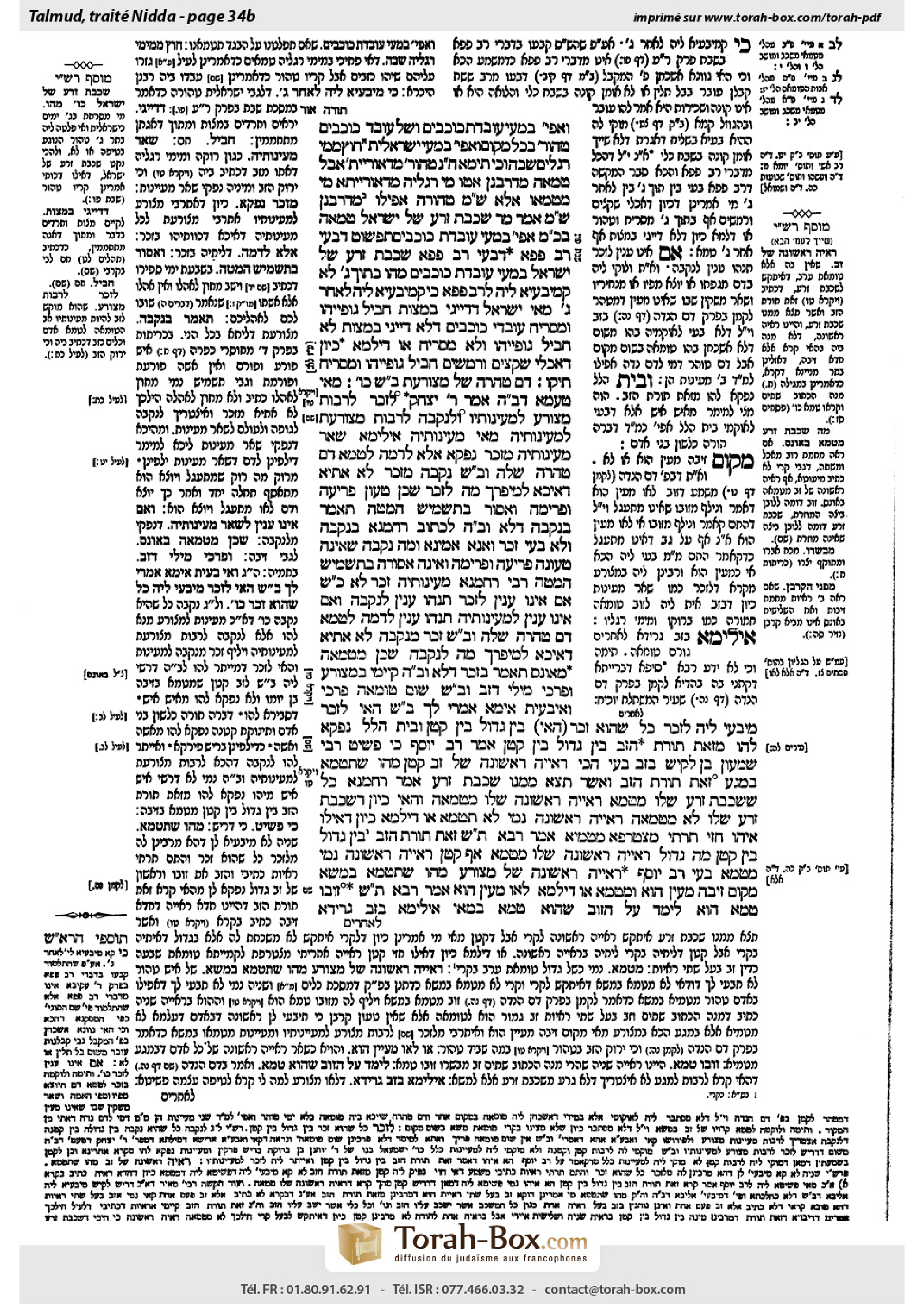
Niddah 34b: Talmud study for Daf Yomi
Daf Yomi is the daily study of one Talmud folio. Explore 37 tractates with scans, Hebrew text, Sefaria English and AI-generated French translations where annotated.
Passage selection and English or AI-generated French translation are available where the scan has annotations. Daf Study is independent of Torah-Box and Sefaria.
Browse Niddah · נידה · All tractatesNiddah 34b text and translations
This page of Niddah includes the Aramaic text, an English translation and an AI-generated French translation, alongside the scan above.
נידה ל״ד ב · Aramaic and Hebrew text
וַאֲפִילּוּ בִּמְעֵי גּוֹיָה. וְשֶׁל נׇכְרִי טְהוֹרָה בְּכׇל מָקוֹם, וַאֲפִילּוּ בִּמְעֵי יִשְׂרְאֵלִית, חוּץ מִמֵּי רַגְלַיִם שֶׁבָּהּ.
וְכִי תֵּימָא, הָכִי נָמֵי טְהוֹרָה מִדְּאוֹרָיְיתָא, אֲבָל טְמֵאָה מִדְּרַבָּנַן. אַטּוּ מֵי רַגְלֶיהָ מִדְּאוֹרָיְיתָא מִי מְטַמְּאוּ? אֶלָּא שְׁמַע מִינָּה: טְהוֹרָה אֲפִילּוּ מִדְּרַבָּנַן. שְׁמַע מִינָּה.
אָמַר מָר: שִׁכְבַת זֶרַע שֶׁל יִשְׂרָאֵל טְמֵאָה בְּכׇל מָקוֹם, אֲפִילּוּ בִּמְעֵי גּוֹיָה. תִּפְשׁוֹט דְּבָעֵי רַב פָּפָּא, דְּבָעֵי רַב פָּפָּא: שִׁכְבַת זֶרַע שֶׁל יִשְׂרָאֵל בִּמְעֵי גּוֹיָה מַהוּ?
בְּתוֹךְ שְׁלֹשָׁה — לָא קָמִיבַּעְיָא לֵיהּ לְרַב פָּפָּא, כִּי קָמִיבַּעְיָא לֵיהּ — לְאַחַר שְׁלֹשָׁה מַאי?
יִשְׂרָאֵל דְּדָיְּיגִי בְּמִצְוֹת — חֲבִיל גּוּפַיְיהוּ וּמַסְרִיחַ, גּוֹיִם דְּלָא דָּיְיגִי בְּמִצְוֹת — לָא חֲבִיל גּוּפַיְיהוּ וְלֹא מַסְרִיחַ, אוֹ דִילְמָא: כֵּיוָן דְּאָכְלִי שְׁקָצִים וּרְמָשִׂים — חֲבִיל גּוּפַיְיהוּ וּמַסְרִיחַ? תֵּיקוּ.
דַּם טׇהֳרָה שֶׁל מְצוֹרַעַת, בֵּית שַׁמַּאי כּוּ׳. מַאי טַעְמָא דְּבֵית הִלֵּל? אָמַר רַבִּי יִצְחָק: ״לַזָּכָר״ — לְרַבּוֹת מְצוֹרָע לְמַעְיְנוֹתָיו, ״וְלַנְּקֵבָה״ — לְרַבּוֹת מְצוֹרַעַת לְמַעְיְנוֹתֶיהָ.
מַאי מַעְיְנוֹתֶיהָ? אִילֵּימָא שְׁאָר מַעְיְנוֹתֶיהָ — מִזָּכָר נָפְקָא! אֶלָּא לְדָמָהּ, לְטַמֵּא דַּם טׇהֳרָה שֶׁלָּהּ.
וּבֵית שַׁמַּאי? נְקֵבָה מִזָּכָר לָא אָתְיָא, דְּאִיכָּא לְמִיפְרַךְ: מָה לְזָכָר שֶׁכֵּן טָעוּן פְּרִיעָה וּפְרִימָה, וְאָסוּר בְּתַשְׁמִישׁ הַמִּטָּה, תֹּאמַר בַּנְּקֵבָה דְּלָא.
וּבֵית הִלֵּל? לִכְתּוֹב רַחֲמָנָא בִּנְקֵבָה וְלָא בָּעֵי זָכָר, וַאֲנָא אָמֵינָא: וּמָה נְקֵבָה, שֶׁאֵינָהּ טְעוּנָה פְּרִיעָה וּפְרִימָה, וְאֵינָהּ אֲסוּרָה בְּתַשְׁמִישׁ הַמִּטָּה — רַבִּי רַחֲמָנָא מַעְיְנוֹתֶיהָ, זָכָר — לֹא כׇּל שֶׁכֵּן?
אִם אֵינוֹ עִנְיָן ״לְזָכָר״ — תְּנֵהוּ עִנְיָן לִנְקֵבָה, וְאִם אֵינוֹ עִנְיָן לְמַעְיְנוֹתֶיהָ — תְּנֵהוּ עִנְיָן לְדָמָהּ, לְטַמֵּא דַּם טׇהֳרָה שֶׁלָּהּ.
וּבֵית שַׁמַּאי? זָכָר מִנְּקֵבָה לָא אָתֵיא, דְּאִיכָּא לְמִיפְרַךְ: מָה לִנְקֵבָה שֶׁכֵּן מְטַמְּאָה מֵאוֹנֶס, תֹּאמַר בְּזָכָר דְּלָא.
וּבֵית הִלֵּל? קָיְימִי בִּמְצוֹרָע, וּפָרְכִי מִילֵּי דְּזָב? וּבֵית שַׁמַּאי? שׁוּם טוּמְאָה פָּרְכִי.
וְאִיבָּעֵית אֵימָא, אָמְרִי לָךְ בֵּית שַׁמַּאי: הַאי ״לְזָכָר״ מִיבְּעֵי לֵיהּ, ״לְזָכָר״ — כֹּל שֶׁהוּא זָכָר, (הַאי), בֵּין גָּדוֹל בֵּין קָטָן. וּבֵית הִלֵּל, נָפְקָא לְהוּ מִ״זֹּאת תּוֹרַת הַזָּב״ — בֵּין גָּדוֹל בֵּין קָטָן.
אָמַר רַב יוֹסֵף: כִּי פָשֵׁיט רַבִּי שִׁמְעוֹן בֶּן לָקִישׁ בְּזָב, בָּעֵי הָכִי: רְאִיָּיה רִאשׁוֹנָה שֶׁל זָב קָטָן מַהוּ שֶׁתְּטַמֵּא בְּמַגָּע? ״זֹאת תּוֹרַת הַזָּב וַאֲשֶׁר תֵּצֵא מִמֶּנּוּ שִׁכְבַת זָרַע״ אֲמַר רַחֲמָנָא.
כֹּל שֶׁשִּׁכְבַת זֶרַע שֶׁלּוֹ (מטמא) [מְטַמְּאָה] — רְאִיָּיה רִאשׁוֹנָה שֶׁלּוֹ מְטַמְּאָה, וְהַאי כֵּיוָן דְּשִׁכְבַת זֶרַע שֶׁלּוֹ לֹא מְטַמְּאָה — רְאִיָּיה רִאשׁוֹנָה נָמֵי לֹא תְּטַמֵּא. אוֹ דִילְמָא, כֵּיוָן דְּאִילּוּ אִיהוּ חָזֵי תַּרְתֵּי — מִצְטַרְפָא, מְטַמְּיָא?
אָמַר רָבָא: תָּא שְׁמַע, ״זֹאת תּוֹרַת הַזָּב״ — בֵּין גָּדוֹל בֵּין קָטָן, מָה גָּדוֹל — רְאִיָּיה רִאשׁוֹנָה שֶׁלּוֹ מְטַמְּאָה, אַף קָטָן — רְאִיָּיה רִאשׁוֹנָה נָמֵי מְטַמְּאָה.
בָּעֵי רַב יוֹסֵף: רְאִיָּיה רִאשׁוֹנָה שֶׁל מְצוֹרָע מַהוּ שֶׁתְּטַמֵּא בְּמַשָּׂא? מְקוֹם זִיבָה מַעְיָן הוּא וּמְטַמֵּא, אוֹ דִילְמָא לָאו מַעְיָן הוּא?
אָמַר רָבָא: תָּא שְׁמַע, ״זוֹבוֹ טָמֵא הוּא״ — לִימֵּד עַל הַזּוֹב שֶׁהוּא טָמֵא. בְּמַאי? אִילֵימָא בְּזָב גְּרֵידָא
Niddah 34b · English translation
even if it is in the womb of a gentile woman. If she discharges this semen, it imparts ritual impurity. And by contrast, the semen of a gentile is ritually pure wherever it is found, even if it is in the womb of a Jewish woman, except for any urine that intermingled with it. In other words, if the semen of a gentile intermingled with his urine, the mixture is impure due to the urine it contains, as the Sages decreed that a gentile is considered like a zav in all matters. Consequently, his urine imparts impurity.
The Gemara continues: And if you would say in rejection of this proof: Here as well, the baraita means that the semen of a gentile is ritually pure by Torah law but impure by rabbinic law, one may respond: Since the baraita states that the urine of a gentile is impure, is that to say that her urine, i.e., the urine of the gentile that intermingled with his semen and is now inside the womb of the Jewish woman, is ritually impure by Torah law? Isn’t it impure only by rabbinic law? Rather, conclude from the baraita that the semen of a gentile is pure even by rabbinic law. The Gemara concludes: Indeed, conclude from it that this is so.
The Master said above in a baraita: The semen of a Jew is impure wherever it is found, even if it is in the womb of a gentile woman. The Gemara suggests: Let one resolve from this baraita a dilemma that Rav Pappa raises. As Rav Pappa raises a dilemma: What is the halakha with regard to the semen of a Jew in the womb of a gentile woman? Let one conclude from the baraita that the semen is impure.
The Gemara rejects this suggestion: Rav Pappa does not raise his dilemma with regard to the semen of a Jew that is in the womb of a gentile woman within three days of their intercourse, as such semen is impure. Rather, when Rav Pappa raises his dilemma it is with regard to semen in the womb of the gentile more than three days after their intercourse. What is the halakha in such a case?
The Gemara explains the sides of the dilemma: Do we say that as Jewish women are concerned about the proper fulfillment of mitzvot, their bodies are hot and semen in their wombs becomes foul within three days, whereas gentile women are not concerned about the proper fulfillment of mitzvot and therefore their bodies are not hot and semen in their wombs does not become foul within three days? Or perhaps, since gentiles eat repugnant creatures and creeping animals, their bodies are also hot and semen in their wombs becomes foul within three days? Since no resolution is found, the Gemara concludes: The dilemma shall stand unresolved.
§ The mishna teaches: With regard to blood discharged by a female Jewish leper during the days of purity of a woman who gives birth, Beit Shammai deem it ritually pure and Beit Hillel say it imparts impurity only while moist. The Gemara asks: What is the reasoning of Beit Hillel, i.e., from where is their opinion derived? Rabbi Yitzḥak says: The verse states at the conclusion of the passage discussing impure individuals: “Whether it be a male or a female” (Leviticus 15:33). “Whether it be a male” serves to include the sources of bodily emissions of a male leper, teaching that they also impart impurity. Likewise, the phrase “or a female” serves to include the sources of bodily emissions of a female leper, teaching that they too impart impurity.
What is meant by the sources of bodily emissions of a female leper? If we say that this is referring to the rest of her sources, e.g., her saliva and urine, this can be derived from the halakha of a male leper. Rather, it is referring to her blood, and the verse serves to render impure the blood of a leper discharged during the days of her purity.
The Gemara asks: And how do Beit Shammai, who maintain the blood is ritually pure, interpret the verse? They contend that the halakha with regard to the emissions of a female leper cannot be derived from that of a male leper, as such a comparison can be refuted as follows: What is unique about a male leper? He is unique in that he is required to let his hair grow and rend his garments, and he is prohibited to engage in sexual intercourse. Can you say, then, that the same halakhot should apply to the emissions of a female leper, to whom all the aforementioned requirements do not apply? Consequently, the verse is necessary to teach that the saliva and urine of a female leper are impure.
The Gemara asks: And how do Beit Hillel respond? They respond as follows: If the verse serves to include only the saliva and urine of a female leper, then let the Merciful One write this halakha only with regard to a female leper. And there will be no need to write it with regard to a male leper, as I will say that the saliva and urine of a male leper are impure by an a fortiori inference: And what, if with regard to a female leper, who is not required to let her hair grow and rend her garments, and it is not prohibited for her to engage in sexual intercourse, the Merciful One nevertheless includes her sources of bodily emissions as impure, then in the case of a male leper, to whom all the aforementioned requirements apply, is it not all the more so that his emissions are impure?
Therefore, if the phrase “whether it be a male” is not needed for the matter of a male leper, as this halakha may be derived by an a fortiori inference, apply it to the matter of a female leper. And if it is not needed for the matter of her other sources of bodily emissions, as they are derived from the phrase “or a female,” apply it to the matter of her blood, i.e., to render impure the blood of her days of purity.
The Gemara asks: And how do Beit Shammai respond? They would answer that the halakha with regard to the emissions of a male leper cannot be derived by an a fortiori inference from the halakha of a female leper, as it can be refuted as follows: What is unique about a female? She is unique in that she is rendered impure as a zava even by sightings that occur due to circumstances beyond her control. Can you say that the same halakhot should apply to the emissions of a male, for whom this is not the case?
The Gemara asks: And how do Beit Hillel respond? They respond as follows: Can it be that we are standing and dealing with the halakhot of a leper, and Beit Shammai are attempting to refute the a fortiori inference by citing matters pertaining to a zav? The Gemara asks: And as for Beit Shammai? According to Beit Shammai, this is a legitimate refutation of the a fortiori inference, as they refute it through the common name of impurity that applies to both a leper and a zav.
And if you wish, say that Beit Shammai could say to you: That phrase “whether it be a male” is necessary to teach another halakha, that the phrase “whether it be a male” serves to include anyone who is a male, whether an adult or a minor, in the halakhot of a zav. And how do Beit Hillel respond? They derive this halakha from the following verse: “This is the law of the zav, and of him from whom the flow of seed goes out, so that he is unclean through it” (Leviticus 15:32). The verse indicates that the halakhot of a zav apply to any male, whether he is an adult or whether he is a minor.
§ The Gemara mentioned earlier that a minor is included in the halakhot of a zav. In this regard Rav Yosef says: When Rabbi Shimon ben Lakish taught the halakhot of a zav, he raised this dilemma: With regard to the first sighting of ziva of a zav who is a minor, what is the halakha as to whether it imparts impurity through contact? Does one say that as the Merciful One states: “This is the law of the zav, and of him from whom the flow of seed goes out” (Leviticus 15:32), one’s ziva is thereby compared to his semen?
Accordingly, with regard to any male whose semen imparts impurity, his first sighting of ziva imparts impurity. And with regard to this minor, since his semen does not impart impurity, his first sighting does not impart impurity either. Or perhaps, since if this minor sees two emissions of ziva the first sighting combines with the second sighting to render him impure as a zav for seven days, this indicates that the first sighting of a minor is significant, and consequently it should render him impure until the evening, just like an adult male.
Rava says: Come and hear a proof from a baraita: “This is the law of the zav,” whether he is an adult or whether he is a minor. Since the verse equates an adult and a minor, just as with regard to an adult his first sighting imparts impurity, so too, with regard to a minor, his first sighting imparts impurity as well.
The Gemara earlier stated that the phrase “whether it be a male” serves to include the sources of bodily emissions of a male leper, teaching that they impart impurity. In this regard Rav Yosef raises a dilemma: Granted, the first sighting of ziva of an otherwise ritually pure individual imparts impurity only through contact, as stated above, and only the second sighting imparts impurity through carrying. But with regard to the first sighting of ziva of a leper, what is the halakha as to whether it imparts impurity even through carrying? Does one say that the place of ziva in one’s body is considered a source, and therefore his ziva imparts impurity through carrying, like all the sources of bodily emissions of a leper? Or perhaps the place of ziva is not considered a source, in which case the first sighting of ziva does not impart impurity through carrying.
Rava says: Come and hear proof from a baraita: The verse states: “When any man has an issue out of his flesh, his issue [zovo] is unclean” (Leviticus 15:2). The verse teaches with regard to the zov that it is impure, and that it imparts impurity through carrying. To what case is the verse referring? If we say it is referring to one who is just a zav and not a leper as well, and the verse is teaching that any drop of ziva emitted by him imparts impurity through carrying,
Niddah 34b · Traduction française (IA)
même si elle se trouve dans l’utérus d’une femme non juive. Si elle expulse ce sperme, il transmet l’impureté rituelle. À l’inverse, le sperme d’un non-Juif est rituellement pur partout où il se trouve, même dans l’utérus d’une femme juive, à l’exception de l’urine qui s’y serait mêlée. Autrement dit, si le sperme d’un non-Juif s’est mêlé à son urine, le mélange est impur en raison de l’urine qu’il contient, car les Sages ont décrété qu’un non-Juif est considéré comme un zav à tous égards. Par conséquent, son urine transmet l’impureté.
La Guemara poursuit : Et si l’on voulait rejeter cette preuve en disant qu’ici aussi, la baraïta signifie que le sperme d’un non-Juif est rituellement pur selon la Torah, mais impur selon la loi rabbinique, on pourrait répondre : Puisque la baraïta affirme que l’urine d’un non-Juif est impure, cela signifie-t-il que son urine — c’est-à-dire l’urine du non-Juif qui s’est mêlée à son sperme et se trouve maintenant dans l’utérus de la femme juive — est rituellement impure selon la Torah ? N’est-elle pas impure uniquement selon la loi rabbinique ? Conclus plutôt de la baraïta que le sperme d’un non-Juif est pur même selon la loi rabbinique. La Guemara conclut : En effet, conclus qu’il en est ainsi.
Le Maître a dit plus haut dans une baraïta : Le sperme d’un Juif est impur partout où il se trouve, même dans l’utérus d’une femme non juive. La Guemara suggère : Résolvons, à partir de cette baraïta, une question que Rav Pappa soulève. Rav Pappa pose en effet la question suivante : Quelle est la halakha concernant le sperme d’un Juif dans l’utérus d’une femme non juive ? Concluons de la baraïta que ce sperme est impur.
La Guemara rejette cette proposition : Rav Pappa ne pose pas sa question au sujet du sperme d’un Juif qui se trouve dans l’utérus d’une femme non juive dans les trois jours suivant leur rapport, car un tel sperme est impur. Rav Pappa pose plutôt sa question au sujet du sperme qui se trouve dans l’utérus de la non-Juive plus de trois jours après leur rapport. Quelle est la halakha dans ce cas ?
La Guemara expose les termes de la question : Dit-on que, comme les femmes juives se soucient d’accomplir correctement les mitsvot, leur corps est chaud et le sperme présent dans leur utérus se détériore en trois jours, tandis que les femmes non juives ne se soucient pas d’accomplir correctement les mitsvot et que, par conséquent, leur corps n’est pas chaud et le sperme présent dans leur utérus ne se détériore pas en trois jours ? Ou peut-être, puisque les non-Juifs mangent des créatures répugnantes et des reptiles, leur corps est lui aussi chaud et le sperme présent dans leur utérus se détériore en trois jours ? Comme aucune réponse n’est trouvée, la Guemara conclut : La question reste sans réponse.
§ La Michna enseigne : À propos du sang expulsé par une femme juive lépreuse durant les jours de pureté d’une femme qui a accouché, Beit Shammaï le déclarent rituellement pur, tandis que Beit Hillel disent qu’il ne transmet l’impureté que tant qu’il est humide. La Guemara demande : Quel est le raisonnement de Beit Hillel, c’est-à-dire de quel verset tirent-ils leur opinion ? Rabbi Yitzḥak dit : Le verset énonce, à la fin du passage consacré aux personnes impures : « Qu’il s’agisse d’un homme ou d’une femme » (Lévitique 15, 33). Les mots « qu’il s’agisse d’un homme » servent à inclure les sources des écoulements corporels d’un homme lépreux, enseignant qu’elles transmettent elles aussi l’impureté. De même, les mots « ou d’une femme » servent à inclure les sources des écoulements corporels d’une femme lépreuse, enseignant qu’elles transmettent elles aussi l’impureté.
Que désignent les sources des écoulements corporels d’une femme lépreuse ? Si l’on dit qu’il s’agit de ses autres sources, par exemple sa salive et son urine, cela peut être déduit de la halakha concernant un homme lépreux. Il s’agit donc de son sang, et le verset a pour fonction de rendre impur le sang expulsé par une lépreuse durant les jours de pureté.
La Guemara demande : Comment Beit Shammaï, qui soutiennent que le sang est rituellement pur, interprètent-ils le verset ? Selon eux, la halakha concernant les écoulements d’une femme lépreuse ne peut pas être déduite de celle concernant un homme lépreux, car on peut réfuter cette comparaison comme suit : Qu’a de particulier un homme lépreux ? Il doit laisser pousser ses cheveux et déchirer ses vêtements, et il lui est interdit d’avoir des relations sexuelles. Peut-on alors dire que les mêmes halakhot s’appliquent aux écoulements d’une femme lépreuse, à laquelle aucune des exigences susmentionnées ne s’applique ? Par conséquent, le verset est nécessaire pour enseigner que la salive et l’urine d’une femme lépreuse sont impures.
La Guemara demande : Et comment Beit Hillel répondent-ils ? Ils répondent ainsi : Si le verset sert uniquement à inclure la salive et l’urine d’une femme lépreuse, que le Miséricordieux n’énonce cette halakha qu’à propos d’une femme lépreuse. Il ne serait alors pas nécessaire de l’énoncer à propos d’un homme lépreux, car on pourrait déduire par raisonnement a fortiori que la salive et l’urine d’un homme lépreux sont impures : si, dans le cas d’une femme lépreuse, qui n’est pas tenue de laisser pousser ses cheveux ni de déchirer ses vêtements et à qui il n’est pas interdit d’avoir des relations sexuelles, le Miséricordieux inclut néanmoins ses sources d’écoulements corporels parmi les éléments impurs, alors, dans le cas d’un homme lépreux, auquel s’appliquent toutes les exigences susmentionnées, n’est-il pas d’autant plus évident que ses écoulements sont impurs ?
Par conséquent, si les mots « qu’il s’agisse d’un homme » ne sont pas nécessaires pour le cas d’un homme lépreux, puisque cette halakha peut être déduite par raisonnement a fortiori, appliquons-les au cas d’une femme lépreuse. Et s’ils ne sont pas nécessaires pour ses autres sources d’écoulements corporels, puisque celles-ci se déduisent des mots « ou d’une femme », appliquons-les à son sang, c’est-à-dire pour rendre impur le sang des jours de pureté.
La Guemara demande : Et comment Beit Shammaï répondent-ils ? Ils répondraient que la halakha concernant les écoulements d’un homme lépreux ne peut pas être déduite par raisonnement a fortiori de la halakha concernant une femme lépreuse, car on peut réfuter cette déduction comme suit : Qu’a de particulier une femme ? Elle se distingue par le fait qu’elle devient impure comme une zava même à la suite d’émissions survenues indépendamment de sa volonté. Peut-on dire que les mêmes halakhot s’appliquent aux écoulements d’un homme, pour lequel ce n’est pas le cas ?
La Guemara demande : Et comment Beit Hillel répondent-ils ? Ils répondent ainsi : Peut-on être en train d’examiner les halakhot d’un lépreux, tandis que Beit Shammaï tentent de réfuter le raisonnement a fortiori en invoquant des considérations relatives à un zav ? La Guemara demande : Et qu’en est-il de Beit Shammaï ? Selon Beit Shammaï, il s’agit d’une réfutation valable du raisonnement a fortiori, car ils le réfutent en invoquant la catégorie d’impureté commune au lépreux et au zav.
Et si tu veux, dis que Beit Shammaï pourraient te répondre : Les mots « qu’il s’agisse d’un homme » sont nécessaires pour enseigner une autre halakha : ils servent à inclure tout individu de sexe masculin, adulte ou mineur, dans les halakhot du zav. Et comment Beit Hillel répondent-ils ? Ils tirent cette halakha du verset suivant : « Telle est la loi du zav et de celui dont l’écoulement de sperme le rend impur » (Lévitique 15, 32). Le verset indique que les halakhot du zav s’appliquent à tout individu de sexe masculin, qu’il soit adulte ou mineur.
§ La Guemara a mentionné plus haut qu’un mineur est inclus dans les halakhot du zav. À ce propos, Rav Yosef dit : Lorsque Rabbi Shimon ben Lakish enseignait les halakhot du zav, il souleva la question suivante : concernant la première émission de ziva d’un zav mineur, quelle est la halakha quant à sa capacité à transmettre l’impureté par contact ? Dit-on que, puisque le Miséricordieux énonce : « Telle est la loi du zav et de celui dont l’écoulement de sperme le rend impur » (Lévitique 15, 32), la ziva est ainsi comparée à son sperme ?
Par conséquent, pour tout individu de sexe masculin dont le sperme transmet l’impureté, sa première émission de ziva transmet l’impureté. Et pour ce mineur, puisque son sperme ne transmet pas l’impureté, sa première émission ne la transmet pas non plus. Ou peut-être, puisque si ce mineur a deux émissions de ziva, la première s’associe à la seconde pour le rendre impur comme un zav pendant sept jours, cela indique que sa première émission est significative et devrait donc le rendre impur jusqu’au soir, tout comme un homme adulte.
Rava dit : Viens et entends une preuve tirée d’une baraïta : « Telle est la loi du zav », qu’il soit adulte ou mineur. Puisque le verset met un adulte et un mineur sur un pied d’égalité, de même que la première émission d’un adulte transmet l’impureté, de même celle d’un mineur la transmet.
La Guemara a déclaré plus haut que les mots « qu’il s’agisse d’un homme » servent à inclure les sources des écoulements corporels d’un homme lépreux, enseignant qu’elles transmettent l’impureté. À ce propos, Rav Yosef soulève la question suivante : Il est admis que la première émission de ziva d’une personne qui, par ailleurs, est rituellement pure ne transmet l’impureté que par contact, comme indiqué plus haut, et que seule la deuxième émission transmet l’impureté par portage. Mais concernant la première émission de ziva d’un lépreux, quelle est la halakha quant à sa capacité à transmettre l’impureté même par portage ? Dit-on que l’endroit du corps d’où provient la ziva est considéré comme une source, et que sa ziva transmet donc l’impureté par portage, comme toutes les sources des écoulements corporels d’un lépreux ? Ou peut-être cet endroit n’est-il pas considéré comme une source, auquel cas la première émission de ziva ne transmet pas l’impureté par portage ?
Rava dit : Viens et entends une preuve tirée d’une baraïta : Le verset énonce : « Lorsqu’un homme a un écoulement sortant de sa chair, son écoulement [zovo] est impur » (Lévitique 15, 2). Le verset enseigne que le zov est impur et qu’il transmet l’impureté par portage. À quel cas le verset se rapporte-t-il ? Si l’on dit qu’il concerne une personne qui est seulement un zav, et non aussi un lépreux, et que le verset enseigne que toute goutte de ziva qu’il émet transmet l’impureté par portage,
Traduction française générée par IA à partir de l’édition anglaise de Sefaria. Vérifie toujours un passage avec le texte source.
Text from Sefaria: William Davidson Edition - Vocalized Aramaic (CC BY NC); William Davidson Edition - English (CC BY NC).