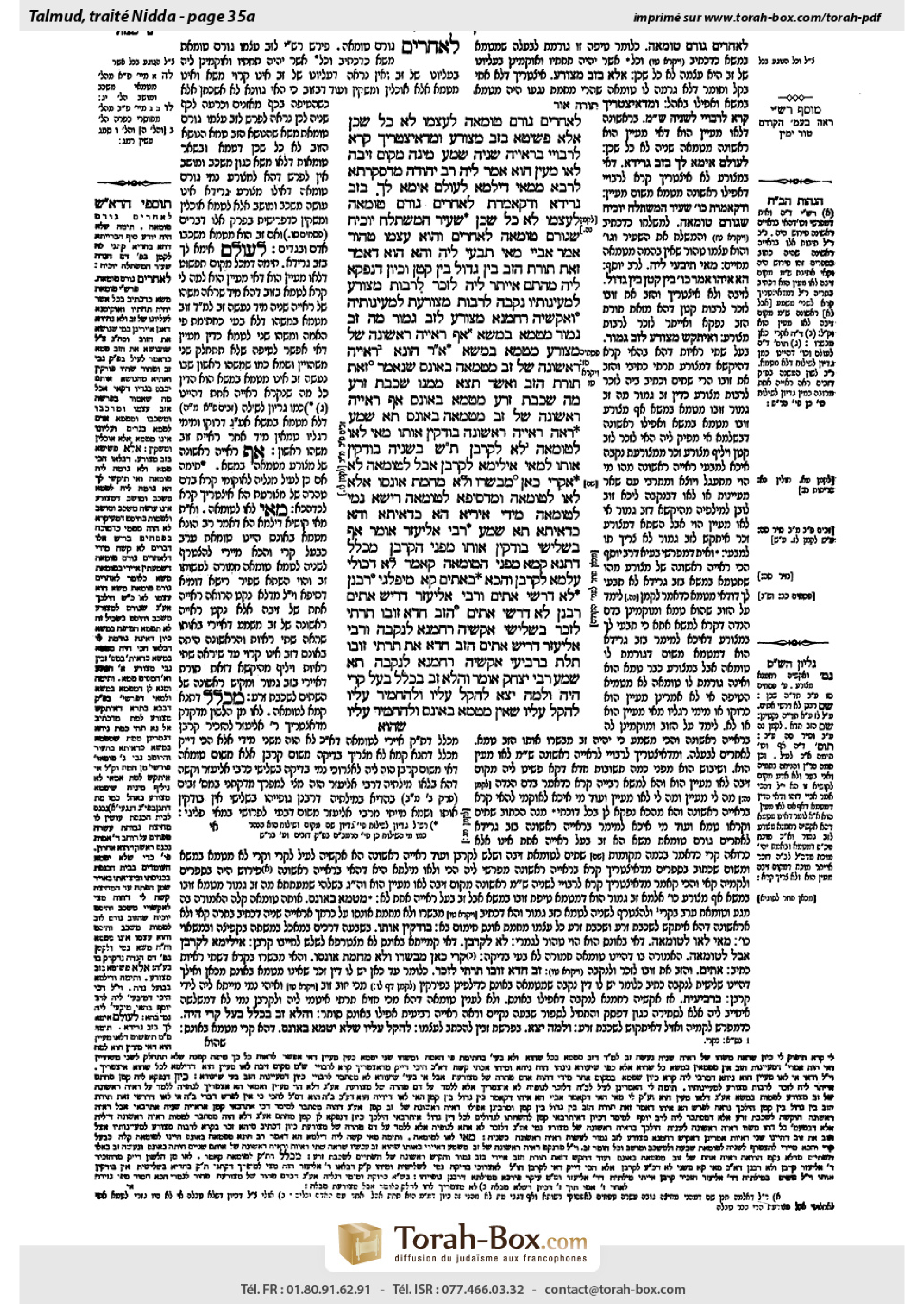
Niddah 35a: Talmud study for Daf Yomi
Daf Yomi is the daily study of one Talmud folio. Explore 37 tractates with scans, Hebrew text, Sefaria English and AI-generated French translations where annotated.
Passage selection and English or AI-generated French translation are available where the scan has annotations. Daf Study is independent of Torah-Box and Sefaria.
Browse Niddah · נידה · All tractatesNiddah 35a text and translations
This page of Niddah includes the Aramaic text, an English translation and an AI-generated French translation, alongside the scan above.
נידה ל״ה א · Aramaic and Hebrew text
לַאֲחֵרִים גּוֹרֵם טוּמְאָה, לְעַצְמוֹ לֹא כׇּל שֶׁכֵּן? אֶלָּא פְּשִׁיטָא בְּזָב מְצוֹרָע,
וּמִדְּאִיצְטְרִיךְ קְרָא לְרַבּוֹיֵי בִּרְאִיָּיה שְׁנִיָּה, שְׁמַע מִינַּהּ: מְקוֹם זִיבָה לָאו מַעְיָן הוּא.
אֲמַר לֵיהּ רַב יְהוּדָה מִדִּסְקַרְתָּא לְרָבָא: מִמַּאי? דִּילְמָא לְעוֹלָם אֵימָא לָךְ בְּזָב גְּרֵידָא, וּדְקָאָמְרַתְּ לַאֲחֵרִים גּוֹרֵם טוּמְאָה, לְעַצְמוֹ לֹא כׇּל שֶׁכֵּן — שָׂעִיר הַמִּשְׁתַּלֵּחַ יוֹכִיחַ, שֶׁגּוֹרֵם טוּמְאָה לַאֲחֵרִים, וְהוּא עַצְמוֹ טָהוֹר!
אָמַר אַבָּיֵי: מַאי תִּבְּעֵי לֵיהּ, וְהָא הוּא דְּאָמַר ״זֹאת תּוֹרַת הַזָּב״ — בֵּין גָּדוֹל בֵּין קָטָן, וְכֵיוָן דְּנָפְקָא לֵיהּ מֵהָתָם, אִיַּיתַּר לֵיהּ ״לַזָּכָר״ לְרַבּוֹת מְצוֹרָע לְמַעְיְנוֹתָיו, (נקבה) [״וְלַנְּקֵבָה״] לְרַבּוֹת מְצוֹרַעַת לְמַעְיְנוֹתֶיהָ.
וְאַקְּשֵׁיהּ רַחֲמָנָא מְצוֹרָע לְזָב גָּמוּר — מָה זָב גָּמוּר מְטַמֵּא בְּמַשָּׂא, אַף רְאִיָּיה רִאשׁוֹנָה שֶׁל מְצוֹרָע מְטַמֵּא בְּמַשָּׂא.
אָמַר רַב הוּנָא: רְאִיָּיה רִאשׁוֹנָה שֶׁל זָב מְטַמְּאָה בְּאוֹנֶס, שֶׁנֶּאֱמַר: ״זֹאת תּוֹרַת הַזָּב וַאֲשֶׁר תֵּצֵא מִמֶּנּוּ שִׁכְבַת זָרַע״, מָה שִׁכְבַת זֶרַע מְטַמֵּא בְּאוֹנֶס, אַף רְאִיָּיה רִאשׁוֹנָה שֶׁל זָב מְטַמְּאָה בְּאוֹנֶס.
תָּא שְׁמַע: רָאָה רְאִיָּיה רִאשׁוֹנָה — בּוֹדְקִין אוֹתוֹ. מַאי לַָאו לְטוּמְאָה? לָא, לְקׇרְבָּן.
תָּא שְׁמַע: בַּשְּׁנִיָּה בּוֹדְקִין אוֹתוֹ. לְמַאי? אִילֵימָא לְקׇרְבָּן, אֲבָל לְטוּמְאָה לָא? אִקְּרִי כָּאן ״מִבְּשָׂרוֹ״ וְלֹא מֵחֲמַת אוֹנְסוֹ! אֶלָּא לָאו לְטוּמְאָה, וּמִדְּסֵיפָא לְטוּמְאָה — רֵישָׁא נָמֵי לְטוּמְאָה?
מִידֵּי אִירְיָא? הָא כִּדְאִיתַאּ, וְהָא כִּדְאִיתַאּ.
תָּא שְׁמַע: רַבִּי אֱלִיעֶזֶר אוֹמֵר, אַף בַּשְּׁלִישִׁי בּוֹדְקִין אוֹתוֹ מִפְּנֵי הַקׇּרְבָּן, מִכְּלָל דְּתַנָּא קַמָּא מִפְּנֵי הַטּוּמְאָה קָאָמַר!
לָא, דְּכוּלֵּי עָלְמָא לְקׇרְבָּן, וְהָכָא בְּ״אֶתִּים״ קָא מִיפַּלְגִי: רַבָּנַן לָא דָּרְשִׁי ״אֶתִּים״, וְרַבִּי אֱלִיעֶזֶר דָּרֵישׁ ״אֶתִּים״.
רַבָּנַן לָא דָּרְשִׁי ״אֶתִּים״: ״הַזָּב״ — חֲדָא, ״זוֹבוֹ״ — תַּרְתֵּי, ״לַזָּכָר״ — בַּשְּׁלִישִׁי אַקְּשֵׁיהּ רַחֲמָנָא לִנְקֵבָה.
וְרַבִּי אֱלִיעֶזֶר דָּרֵישׁ ״אֶתִּים״: ״הַזָּב״ — חֲדָא, ״אֶת״ — תַּרְתֵּי, ״זוֹבוֹ״ — תְּלָת, בָּרְבִיעִי אַקְּשֵׁיהּ רַחֲמָנָא לִנְקֵבָה.
תָּא שְׁמַע: רַבִּי יִצְחָק אוֹמֵר, וַהֲלֹא זָב בִּכְלַל בַּעַל קֶרִי הָיָה, וְלָמָּה יָצָא — לְהָקֵל עָלָיו וּלְהַחְמִיר עָלָיו; לְהָקֵל עָלָיו — שֶׁאֵין מְטַמֵּא בְּאוֹנֶס, וּלְהַחְמִיר עָלָיו —
Niddah 35a · English translation
there is no need for the verse to teach this. After all, if this drop of ziva causes impurity for others, i.e., if the person emitting the drop imparts impurity through carrying, is it not all the more so that the drop itself imparts impurity through carrying? Rather, it is obvious that the verse is referring to a drop of ziva from a zav who is also a leper. And it was necessary for the verse to teach this halakha, as it could not be derived by means of the a fortiori inference. This is because this drop of ziva is not what causes the leper to impart impurity through carrying; rather, it is his leprosy that causes him to impart impurity through carrying.
Rava concludes: And as the verse mentions the word “issue” twice, it is evident that it is referring to a second sighting of ziva. From the fact that a verse was necessary to include a second sighting of ziva of a leper, teaching that his ziva imparts impurity through carrying, conclude from it that the place of ziva is not considered a source. If it were a source, then even the first sighting of ziva would impart impurity through carrying.
Rav Yehuda of Diskarta said to Rava: From where do you know that the verse is referring to a zav who is also a leper? Actually, perhaps I will say to you that the verse is referring to the ziva of one who is just a zav. And as for that a fortiori inference that you said: If this drop of ziva causes impurity for others, is it not all the more so that the drop itself imparts impurity through carrying, one can counter that inference. The case of the scapegoat brought on Yom Kippur will prove that this a fortiori inference is not valid, as it causes impurity to others, since the dispatcher of the scapegoat is rendered ritually impure, and yet the goat itself is pure, as a living animal cannot be rendered impure.
With regard to the dilemma raised by Rav Yosef about the first sighting of ziva of a leper, Abaye said: What is the reason he raises such a dilemma? But it was he who said that when the verse states: “This is the law of the zav” (Leviticus 15:32), it thereby teaches that the halakhot of a zav apply whether he is an adult or whether he is a minor. And since he derives this halakha from there, the verse: “And of them that have an issue [vehazav] of ziva, whether it be a male or a female” (Leviticus 15:33), remains available for him to derive as follows: “Whether it be a male” serves to include a male leper with regard to his sources of bodily emissions, and “or a female” serves to include a female leper with regard to her sources of bodily emissions.
And as this verse discusses a full-fledged zav, and the word “issue” is mentioned twice, the Merciful One compares a leper to a full-fledged zav: Just as a full-fledged zav imparts impurity through carrying, so too, the first sighting of ziva of a leper imparts impurity through carrying.
§ Rav Huna says: The first sighting of ziva of a zav imparts ritual impurity to one who comes into contact with it, even if the emission occurred due to circumstances beyond his control, as it is stated: “This is the law of the zav, and of him from whom the flow of seed goes out” (Leviticus 15:32). The verse compares the first sighting of ziva to a seminal emission: Just as semen imparts impurity even if it occurs due to circumstances beyond his control, so too, the first sighting of a zav imparts impurity even if it occurs due to circumstances beyond his control.
The Gemara analyzes the statement of Rav Huna: Come and hear a mishna (Zavim 2:2): With regard to a man who saw a first sighting of ziva, one examines him to determine whether the discharge was caused by circumstances beyond his control. What, is it not that the purpose of this examination is to clarify that he does not have ritual impurity, i.e., if the discharge was due to circumstances beyond his control he remains pure, which contradicts the statement of Rav Huna? The Gemara responds: No, the purpose of this examination is to determine whether he will be obligated to bring an offering if he experiences another two discharges of ziva. If the first sighting was caused by circumstances beyond his control, it is not counted toward the three sightings that render one liable to bring an offering.
The Gemara suggests: Come and hear the latter clause of the same mishna: When he experiences the second sighting of ziva, one examines him to determine whether the discharge was caused by circumstances beyond his control. For what purpose does one examine him? If we say that it is to exempt him from bringing an offering in the event that he experiences a third discharge but not to clarify that he does not have ritual impurity, this is untenable, as one may read here the verse: “An issue out of his flesh” (Leviticus 15:2), from which it is derived that one is not rendered a zav if the discharge occurred due to circumstances beyond his control. Rather, is it not that the examination serves to clarify that he does not have ritual impurity? And from the fact that the examination in the latter clause is for purposes of impurity, one may conclude that the examination of the first clause is also for purposes of impurity.
The Gemara rejects this: Are the cases comparable? This case is as it is, and that case is as it is. In other words, it is possible that each examination is intended for a different purpose. In particular, the first examination is meant to exempt him from bringing an offering, and the second examination pertains to both the offering and ritual impurity.
The Gemara suggests: Come and hear the same mishna, which states that Rabbi Eliezer says: Even after the third discharge one examines him, because of the offering. In other words, if the third discharge occurred due to circumstances beyond his control, he is not liable to bring an offering. From the fact that according to Rabbi Eliezer the examination is due to the offering, one may conclude by inference that the first tanna is saying the examinations are for ritual impurity. If so, then according to the mishna one who has an initial discharge of ziva due to circumstances beyond his control remains pure.
The Gemara rejects this suggestion: No, this is not the proper explanation of the mishna. Rather, everyone agrees that the examination serves to exempt him from bringing an offering. And here they disagree with regard to whether one interprets instances of the word “et” in a verse. With regard to a zav, the verse states: “And of them that have an issue of ziva [vehazav et zovo], whether it be a male or a female” (Leviticus 15:33). The Rabbis do not interpret instances of the word “et,” and Rabbi Eliezer interprets instances of the word “et.”
The Gemara elaborates: The Rabbis do not interpret instances of the word “et.” Therefore, they explain the verse as follows: “Hazav” is referring to one sighting; “zovo” makes two sightings, and when the verse states: “Whether it be a male,” this indicates that for the third sighting the Merciful One compares the halakha of a male to that of a female, i.e., just as a woman is rendered impure even through an emission of ziva due to circumstances beyond her control, so too, the third sighting of ziva by a man renders him impure even if it occurs due to circumstances beyond his control. Accordingly, the Rabbis maintain that there is no need for an examination after the third sighting.
And Rabbi Eliezer interprets instances of the word “et.” Therefore, he explains the verse as follows: “Hazav” is referring to one sighting; “et” makes two sightings; “zovo” totals three sightings. Accordingly, even for the third sighting of ziva one must examine whether it was caused due to circumstances beyond his control. If it was, he is not liable to bring an offering. When the verse states: “Whether it be a male,” this indicates that for the fourth sighting the Merciful One compares the halakha of a male to that of a female, in that it is counted as a sighting even if it occurred due to circumstances beyond his control.
The Gemara attempts to refute the statement of Rav Huna: Come and hear that which Rabbi Yitzḥak says: But wasn’t a zav included in the category of one who experienced a seminal emission? Why, then, was he taken out and discussed in a separate passage? In order to be lenient with him and to be stringent with him relative to the halakhot of one who experienced a seminal emission. Rabbi Yitzḥak elaborates: The separate passage serves to be lenient with him, as he is not rendered impure through an emission that occurs due to circumstances beyond his control, unlike one who experienced a seminal emission. And the separate passage serves to be stringent with him,
Niddah 35a · Traduction française (IA)
Il n’est pas nécessaire que le verset enseigne cela. En effet, si cette goutte de ziva rend les autres impurs — c’est-à-dire si celui qui émet la goutte transmet l’impureté par le portage —, à plus forte raison la goutte elle-même transmet-elle l’impureté par le portage ! Il est donc évident que le verset parle d’une goutte de ziva émise par un zav qui est également lépreux. Le verset devait enseigner cette halakha, car on ne pouvait pas la déduire par raisonnement a fortiori. En effet, cette goutte de ziva n’est pas ce qui fait que le lépreux transmet l’impureté par le portage ; c’est sa lèpre qui le rend impur par le portage.
Rava conclut : puisque le verset mentionne deux fois le mot « écoulement », il est évident qu’il s’agit d’une deuxième émission de ziva. Du fait qu’un verset était nécessaire pour inclure la deuxième émission de ziva d’un lépreux et enseigner que sa ziva transmet l’impureté par le portage, déduis-en que le lieu où s’écoule la ziva n’est pas considéré comme une source d’impureté. S’il était considéré comme une source, même la première émission de ziva transmettrait l’impureté par le portage.
Rav Yehouda de Diskarta dit à Rava : D’où sais-tu que le verset parle d’un zav qui est également lépreux ? Peut-être le verset parle-t-il en réalité de la ziva d’un homme qui est simplement zav. Quant au raisonnement a fortiori que tu as avancé — si cette goutte de ziva rend les autres impurs, à plus forte raison la goutte elle-même transmet-elle l’impureté par le portage —, on peut le réfuter. Le cas du bouc émissaire envoyé le jour de Yom Kippour prouve que ce raisonnement a fortiori n’est pas valable : il rend les autres impurs, puisque celui qui l’envoie est rendu rituellement impur, et pourtant le bouc lui-même reste pur, car un animal vivant ne peut pas être rendu impur.
À propos de la question soulevée par Rav Yossef concernant la première émission de ziva d’un lépreux, Abayé dit : Pourquoi soulève-t-il une telle question ? N’est-ce pas lui qui a dit que lorsque le verset énonce : « Telle est la loi du zav » (Lévitique 15,32), il enseigne ainsi que les halakhot du zav s’appliquent qu’il soit adulte ou mineur ? Puisqu’il déduit cette halakha de là, le verset « Et celui qui a un écoulement [vehazav] de ziva, qu’il soit homme ou femme » (Lévitique 15,33) reste disponible pour en déduire ceci : « Qu’il soit homme » sert à inclure un lépreux de sexe masculin en ce qui concerne les sources de ses écoulements corporels, et « ou femme » sert à inclure une lépreuse en ce qui concerne les sources de ses écoulements corporels.
Et puisque ce verset parle d’un zav à part entière et que le mot « écoulement » y est mentionné deux fois, le Miséricordieux assimile le lépreux à un zav à part entière : de même qu’un zav à part entière transmet l’impureté par le portage, de même la première émission de ziva d’un lépreux transmet l’impureté par le portage.
§ Rav Houna dit : La première émission de ziva d’un zav transmet l’impureté rituelle à celui qui la touche, même si l’émission est survenue indépendamment de sa volonté, comme il est dit : « Telle est la loi du zav et de celui dont s’écoule une émission de semence » (Lévitique 15,32). Le verset assimile la première émission de ziva à une émission de semence : de même que la semence transmet l’impureté même lorsqu’elle survient indépendamment de la volonté de l’intéressé, de même la première émission de ziva d’un zav transmet l’impureté même lorsqu’elle survient indépendamment de sa volonté.
La Guemara examine la déclaration de Rav Houna : Viens et entends une Michna (Zavim 2,2) : lorsqu’un homme a une première émission de ziva, on l’examine pour déterminer si l’écoulement est survenu indépendamment de sa volonté. N’est-ce pas afin d’établir, par cet examen, qu’il n’est pas rituellement impur — c’est-à-dire que si l’écoulement est survenu indépendamment de sa volonté, il reste pur —, ce qui contredirait la déclaration de Rav Houna ? La Guemara répond : Non, cet examen vise à déterminer s’il sera tenu d’apporter un sacrifice s’il connaît deux autres émissions de ziva. Si la première émission est survenue indépendamment de sa volonté, elle ne compte pas parmi les trois émissions qui rendent l’intéressé redevable d’un sacrifice.
La Guemara propose : Viens et entends la dernière partie de la même Michna : lorsqu’il connaît une deuxième émission de ziva, on l’examine pour déterminer si l’écoulement est survenu indépendamment de sa volonté. Dans quel but l’examine-t-on ? Si l’on dit que c’est pour l’exempter d’apporter un sacrifice au cas où il connaîtrait une troisième émission, et non pour établir qu’il n’est pas rituellement impur, cela ne tient pas, car on peut appliquer ici le verset : « Un écoulement sortant de sa chair » (Lévitique 15,2), dont on déduit qu’un homme n’est pas considéré comme zav si l’écoulement est survenu indépendamment de sa volonté. N’est-ce pas plutôt que l’examen vise à établir qu’il n’est pas rituellement impur ? Et puisque, dans la dernière partie, l’examen porte sur l’impureté, on peut conclure que celui de la première partie porte lui aussi sur l’impureté.
La Guemara rejette cette conclusion : les cas sont-ils comparables ? Chaque cas est différent. Autrement dit, il est possible que chaque examen ait un objectif différent. Plus précisément, le premier examen vise à l’exempter d’apporter un sacrifice, tandis que le deuxième concerne à la fois le sacrifice et l’impureté rituelle.
La Guemara propose : Viens et entends cette même Michna, où Rabbi Eliezer dit : même après la troisième émission, on l’examine, en raison du sacrifice. Autrement dit, si la troisième émission est survenue indépendamment de sa volonté, il n’est pas redevable d’un sacrifice. Du fait que, selon Rabbi Eliezer, l’examen est motivé par le sacrifice, on peut en déduire que, selon le premier tanna, les examens portent sur l’impureté rituelle. Si tel est le cas, selon la Michna, celui qui a une première émission de ziva survenue indépendamment de sa volonté reste pur.
La Guemara rejette cette proposition : Non, ce n’est pas là la bonne explication de la Michna. Au contraire, tous conviennent que l’examen vise à l’exempter d’apporter un sacrifice. Le désaccord porte ici sur la question de savoir si l’on interprète les occurrences du mot « et » dans un verset. À propos du zav, le verset dit : « Et celui qui a un écoulement de ziva [vehazav et zovo], qu’il soit homme ou femme » (Lévitique 15,33). Les Rabbins n’interprètent pas les occurrences du mot « et », tandis que Rabbi Eliezer les interprète.
La Guemara développe : les Rabbins n’interprètent pas les occurrences du mot « et ». Ils expliquent donc le verset ainsi : « Hazav » désigne une émission ; « zovo » en indique une deuxième. Et lorsque le verset dit : « Qu’il soit homme », cela indique que, pour la troisième émission, le Miséricordieux assimile la halakha de l’homme à celle de la femme : de même qu’une femme est rendue impure même par une émission de ziva survenue indépendamment de sa volonté, de même la troisième émission de ziva d’un homme le rend impur, même si elle survient indépendamment de sa volonté. Par conséquent, les Rabbins estiment qu’il n’est pas nécessaire de procéder à un examen après la troisième émission.
Et Rabbi Eliezer interprète les occurrences du mot « et ». Il explique donc le verset ainsi : « Hazav » désigne une émission ; « et » en indique une deuxième ; « zovo » porte le total à trois émissions. Par conséquent, même pour la troisième émission de ziva, il faut examiner si elle est survenue indépendamment de sa volonté. Si tel est le cas, il n’est pas redevable d’un sacrifice. Lorsque le verset dit : « Qu’il soit homme », cela indique que, pour la quatrième émission, le Miséricordieux assimile la halakha de l’homme à celle de la femme, en ce qu’elle est comptée comme une émission même si elle est survenue indépendamment de sa volonté.
La Guemara tente de réfuter la déclaration de Rav Houna : Viens et entends ce que dit Rabbi Yitsḥak : N’est-ce pas qu’un zav était déjà inclus dans la catégorie de celui qui a connu une émission de semence ? Pourquoi, alors, a-t-il été retiré de cette catégorie et traité dans un passage distinct ? Afin de se montrer indulgent envers lui sur un point et rigoureux envers lui sur un autre, par rapport aux halakhot de celui qui a connu une émission de semence. Rabbi Yitsḥak développe : le passage distinct se montre indulgent envers lui, car il n’est pas rendu impur par une émission survenue indépendamment de sa volonté, contrairement à celui qui a connu une émission de semence. Et le passage distinct se montre rigoureux envers lui,
Traduction française générée par IA à partir de l’édition anglaise de Sefaria. Vérifie toujours un passage avec le texte source.
Text from Sefaria: William Davidson Edition - Vocalized Aramaic (CC BY NC); William Davidson Edition - English (CC BY NC).