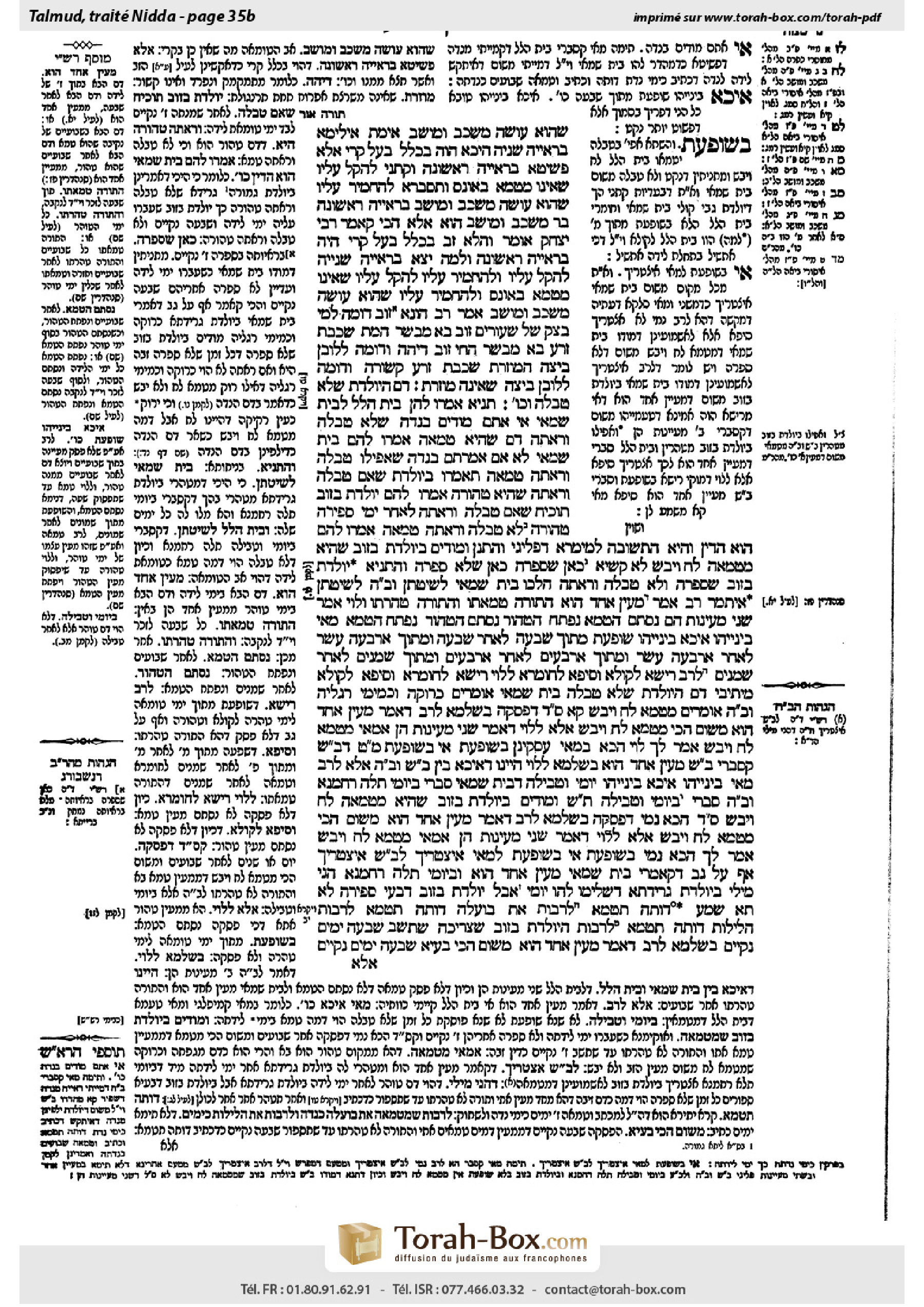
Niddah 35b: Talmud study for Daf Yomi
Daf Yomi is the daily study of one Talmud folio. Explore 37 tractates with scans, Hebrew text, Sefaria English and AI-generated French translations where annotated.
Passage selection and English or AI-generated French translation are available where the scan has annotations. Daf Study is independent of Torah-Box and Sefaria.
Browse Niddah · נידה · All tractatesNiddah 35b text and translations
This page of Niddah includes the Aramaic text, an English translation and an AI-generated French translation, alongside the scan above.
נידה ל״ה ב · Aramaic and Hebrew text
שֶׁהוּא עוֹשֶׂה מִשְׁכָּב וּמוֹשָׁב.
אֵימַת? אִילֵּימָא בִּרְאִיָּיה שְׁנִיָּה — הֵיכָא הֲוָה בִּכְלַל בַּעַל קֶרִי? אֶלָּא פְּשִׁיטָא בִּרְאִיָּיה רִאשׁוֹנָה, וְקָתָנֵי לְהָקֵל עָלָיו שֶׁאֵינוֹ מְטַמֵּא בְּאוֹנֶס!
וְתִסְבְּרָא לְהַחְמִיר עָלָיו שֶׁהוּא עוֹשֶׂה מִשְׁכָּב וּמוֹשָׁב, בִּרְאִיָּיה רִאשׁוֹנָה בַּר מִשְׁכָּב וּמוֹשָׁב הוּא?
אֶלָּא הָכִי קָאָמַר, רַבִּי יִצְחָק אוֹמֵר: וַהֲלֹא זָב בִּכְלַל בַּעַל קֶרִי הָיָה בִּרְאִיָּיה רִאשׁוֹנָה, וְלָמָּה יָצָא בִּרְאִיָּיה שְׁנִיָּיה — לְהָקֵל עָלָיו וּלְהַחְמִיר עָלָיו, לְהָקֵל עָלָיו — שֶׁאֵינוֹ מְטַמֵּא בְּאוֹנֶס, וּלְהַחְמִיר עָלָיו — שֶׁהוּא עוֹשֶׂה מִשְׁכָּב וּמוֹשָׁב.
אָמַר רַב הוּנָא: זוֹב דּוֹמֶה לְמֵי בָצֵק שֶׁל שְׂעוֹרִים. זוֹב בָּא מִבְּשַׂר הַמֵּת, שִׁכְבַת זֶרַע בָּא מִבְּשַׂר הַחַי. זוֹב — דֵּיהֶה, וְדוֹמֶה לְלוֹבֶן בֵּיצָה הַמּוּזֶרֶת, שִׁכְבַת זֶרַע קְשׁוּרָה, וְדוֹמָה לְלוֹבֶן בֵּיצָה שֶׁאֵינָהּ מוּזֶרֶת.
דַּם הַיּוֹלֶדֶת שֶׁלֹּא טָבְלָה וְכוּ׳.
תַּנְיָא, אָמְרוּ לָהֶן בֵּית הִלֵּל לְבֵית שַׁמַּאי: אִי אַתֶּם מוֹדִים בְּנִדָּה שֶׁלֹּא טָבְלָה וְרָאֲתָה דָּם, שֶׁהִיא טְמֵאָה? אָמְרוּ לָהֶם בֵּית שַׁמַּאי: לֹא, אִם אֲמַרְתֶּם בְּנִדָּה שֶׁאֲפִילּוּ טָבְלָה וְרָאֲתָה טְמֵאָה, תֹּאמְרוּ בְּיוֹלֶדֶת שֶׁאִם טָבְלָה וְרָאֲתָה שֶׁהִיא טְהוֹרָה.
אָמְרוּ לָהֶם: יוֹלֶדֶת בְּזוֹב תּוֹכִיחַ, שֶׁאִם טָבְלָה וְרָאֲתָה לְאַחַר יְמֵי סְפִירָה — טְהוֹרָה, לֹא טָבְלָה וְרָאֲתָה — טְמֵאָה!
אָמְרוּ לָהֶם: הוּא הַדִּין, וְהִיא הַתְּשׁוּבָה.
לְמֵימְרָא דִּפְלִיגִי? וְהָתְנַן: וּמוֹדִים בְּיוֹלֶדֶת בְּזוֹב שֶׁהִיא מְטַמְּאָה לַח וְיָבֵשׁ!
לָא קַשְׁיָא — כָּאן שֶׁסָּפְרָה, כָּאן שֶׁלֹּא סָפְרָה.
וְהָתַנְיָא: יוֹלֶדֶת בְּזוֹב שֶׁסָּפְרָה וְלֹא טָבְלָה וְרָאֲתָה, הָלְכוּ בֵּית שַׁמַּאי לְשִׁיטָתָן, וּבֵית הִלֵּל לְשִׁיטָתָן.
אִיתְּמַר: רַב אָמַר: מַעְיָן אֶחָד הוּא — הַתּוֹרָה טִמְּאַתּוּ וְהַתּוֹרָה טִהֲרַתּוּ.
וְלֵוִי אָמַר: שְׁנֵי מַעְיָנוֹת הֵם — נִסְתָּם הַטָּמֵא נִפְתָּח הַטָּהוֹר, נִסְתָּם הַטָּהוֹר נִפְתָּח הַטָּמֵא.
מַאי בֵּינַיְיהוּ? אִיכָּא בֵינַיְיהוּ: שׁוֹפַעַת מִתּוֹךְ שִׁבְעָה לְאַחַר שִׁבְעָה, וּמִתּוֹךְ אַרְבָּעָה עָשָׂר לְאַחַר אַרְבָּעָה עָשָׂר, וּמִתּוֹךְ אַרְבָּעִים לְאַחַר אַרְבָּעִים, וּמִתּוֹךְ שְׁמֹנִים לְאַחַר שְׁמֹנִים.
לְרַב — רֵישָׁא לְקוּלָּא, וְסֵיפָא לְחוּמְרָא;
לְלֵוִי — רֵישָׁא לְחוּמְרָא, וְסֵיפָא לְקוּלָּא.
מֵיתִיבִי: דַּם הַיּוֹלֶדֶת שֶׁלֹּא טָבְלָה, בֵּית שַׁמַּאי אוֹמְרִים: כְּרוּקָּהּ וּכְמֵימֵי רַגְלֶיהָ, וּבֵית הִלֵּל אוֹמְרִים: מְטַמֵּא לַח וְיָבֵשׁ.
קָא סָלְקָא דַעְתָּךְ דְּפָסְקָה. בִּשְׁלָמָא לְרַב, דְּאָמַר: מַעְיָן אֶחָד הוּא, מִשּׁוּם הָכִי מְטַמֵּא לַח וְיָבֵשׁ. אֶלָּא לְלֵוִי, דְּאָמַר: שְׁנֵי מַעְיָנוֹת הֵן, אַמַּאי מְטַמֵּא לַח וְיָבֵשׁ?
אָמַר לָךְ לֵוִי: הָכָא בְמַאי עָסְקִינַן? בְּשׁוֹפַעַת, אִי בְּשׁוֹפַעַת, מַאי טַעְמָא דְּבֵית שַׁמַּאי? קָסָבְרִי בֵּית שַׁמַּאי: מַעְיָן אֶחָד הוּא.
בִּשְׁלָמָא לְלֵוִי, הַיְינוּ דְּאִיכָּא בֵּין בֵּית שַׁמַּאי וּבֵית הִלֵּל, אֶלָּא לְרַב מַאי בֵּינַיְיהוּ?
אִיכָּא בֵּינַיְיהוּ יוֹמֵי וּטְבִילָה, דְּבֵית שַׁמַּאי סָבְרִי: בְּיוֹמֵי תְּלָה רַחֲמָנָא, וּבֵית הִלֵּל סָבְרִי: בְּיוֹמֵי וּטְבִילָה.
תָּא שְׁמַע, וּמוֹדִים בְּיוֹלֶדֶת בְּזוֹב שֶׁהִיא מְטַמְּאָה לַח וְיָבֵשׁ. סָלְקָא דַעְתָּךְ הָכָא נָמֵי דְּפָסְקָה.
בִּשְׁלָמָא לְרַב, דְּאָמַר: מַעְיָן אֶחָד הוּא, מִשּׁוּם הָכִי מְטַמֵּא לַח וְיָבֵשׁ. אֶלָּא לְלֵוִי, דְּאָמַר: שְׁנֵי מַעְיָנוֹת הֵן, אַמַּאי מְטַמֵּא לַח וְיָבֵשׁ?
אָמַר לָךְ: הָכָא נָמֵי — בְּשׁוֹפַעַת. אִי בְּשׁוֹפַעַת, לְמַאי אִיצְטְרִיךְ?
לְבֵית שַׁמַּאי אִיצְטְרִיךְ, אַף עַל גַּב דְּקָאָמְרִי בֵּית שַׁמַּאי: מַעְיָן אֶחָד הוּא, וּבְיוֹמֵי תְּלָה רַחֲמָנָא — הָנֵי מִילֵּי בְּיוֹלֶדֶת גְּרֵידְתָּא, דִּשְׁלִימוּ לְהוּ יוֹמֵי, אֲבָל יוֹלֶדֶת בְּזוֹב דְּבָעֵי סְפִירָה — לָא.
תָּא שְׁמַע: ״דְּוֹתָהּ תִּטְמָא״ — לְרַבּוֹת אֶת בּוֹעֲלָהּ.
״דְּוֹתָהּ תִּטְמָא״ — לְרַבּוֹת הַלֵּילוֹת, ״דְּוֹתָהּ תִּטְמָא״ — לְרַבּוֹת הַיּוֹלֶדֶת בְּזוֹב שֶׁצְּרִיכָה שֶׁתֵּשֵׁב שִׁבְעָה יָמִים נְקִיִּים. בִּשְׁלָמָא לְרַב דְּאָמַר מַעְיָן אֶחָד הוּא, מִשּׁוּם הָכִי בָּעֲיָא שִׁבְעָה יָמִים נְקִיִּים,
Niddah 35b · English translation
as he renders impure the bedding upon which he lies and the seat upon which he sits, like a primary source of ritual impurity, which is not the case for one who experienced a seminal emission.
The Gemara analyzes Rabbi Yitzḥak’s statement: When does this statement apply, i.e., to which sighting of ziva is Rabbi Yitzḥak referring? If we say he is referring to the second sighting this is untenable, for where in the verse was such a person included in the category of one who experienced a seminal emission? After the second sighting one is considered a full-fledged zav. Rather, it is obvious that he is referring to the first sighting. And yet Rabbi Yitzḥak teaches: The separate passage discussing a zav serves to be lenient with him, as a zav is not rendered impure through an emission that occurs due to circumstances beyond his control. This contradicts the statement of Rav Huna.
The Gemara rejects this: And how can you understand that Rabbi Yitzḥak is referring to the first sighting of ziva? But Rabbi Yitzḥak also says: The separate passage serves to be stringent with him, as he renders impure the bedding upon which he lies and the seat upon which he sits. With the first sighting of ziva is one fit to render impure his bedding or his seat?
Rather, this is what he is saying: Rabbi Yitzḥak says: But wasn’t a zav with his first sighting included in the category of one who experienced a seminal emission? Why, then, was he taken out and discussed in a separate passage with regard to his second sighting? In order to be lenient with him and to be stringent with him. In other words, the passage serves to be lenient with him, as he is not rendered impure through an emission that occurs due to circumstances beyond his control. And it serves to be stringent with him, as he renders impure the bedding upon which he lies and the seat upon which he sits.
With regard to ziva, Rav Huna says: The discharge of ziva is similar to water of barley dough. Whereas the discharge of ziva comes from dead flesh, i.e., when one’s penis is flaccid, semen comes from living flesh, when one’s penis is erect. Moreover, the discharge of ziva is runny, and is similar in appearance to the white of a unfertilized egg. By contrast, semen is viscous, and it is similar in appearance to the white of an egg that is not unfertilized, i.e., a fertilized egg.
§ The mishna teaches that Beit Shammai and Beit Hillel disagree with regard to the blood of a woman who gave birth and reached the conclusion of her days of impurity, but did not yet immerse in a ritual bath. Beit Shammai say: The blood does not retain the halakhic status of menstrual blood; rather, it imparts impurity only while moist. And Beit Hillel say: Since she did not immerse in a ritual bath, her blood is considered like that of a menstruating woman, and it imparts impurity whether it is moist or dry.
With regard to this dispute, it is taught in a baraita that Beit Hillel said to Beit Shammai: Do you not concede with regard to a menstruating woman who did not immerse after seven days and thereafter saw blood, that she is impure as a menstruating woman in every sense? If so, a woman who failed to immerse after childbirth should likewise be impure as a menstruating woman. Beit Shammai said to them: No, this is not a legitimate comparison. Even if you say this is true with regard to a menstruating woman, there the halakha is that even in a case where she immersed and immediately saw blood thereafter, she is impure. Will you say that this halakha applies with regard to a woman who gave birth, where the halakha is that if she immersed and then saw blood she is pure? Therefore, even if a woman who gave birth neglected to immerse and experienced bleeding, she is not considered a full-fledged menstruating woman, and the blood does not impart impurity whether it is moist or dry.
Beit Hillel said to Beit Shammai: The halakha of a woman who gives birth as a zava will prove this is in fact a legitimate comparison. A woman who gives birth as a zava may immerse only after experiencing seven clean days. The halakha is that if she immersed in her days of purity and then saw blood after the seven days of counting for ziva, she is pure, as she is in her days of purity. But if she did not immerse and she saw blood, she is impure. If so, the same should apply to a woman who gave birth and did not immerse at the conclusion of her days of impurity: She should be considered a full-fledged menstruating woman as long as she has not immersed.
Beit Shammai said to them: The same is true and this is the refutation, i.e., we maintain that even in the case of a woman who gave birth as a zava and failed to immerse after seven clean days, her blood imparts impurity only while moist. Accordingly, one cannot compare this case to that of a typical menstruating woman.
The Gemara asks: Is this to say that Beit Shammai and Beit Hillel disagree with regard to a woman who gave birth as a zava and counted seven clean days but did not immerse? But didn’t we learn in the mishna: And Beit Shammai concede to Beit Hillel in the case of a woman who gives birth as a zava, that any blood she sees imparts impurity whether it is moist or dry?
The Gemara responds: This is not difficult. Here, in the baraita, Beit Hillel and Beit Shammai disagree with regard to a woman who counted seven clean days for her ziva. In such a case Beit Shammai maintain that any blood she sees imparts impurity only when moist. There, in the mishna, they agree with regard to a woman who did not yet count seven clean days for her ziva. In such an instance, even Beit Shammai concede that her blood imparts impurity whether it is moist or dry.
The Gemara notes: And it is taught likewise in a baraita: With regard to a woman who gives birth as a zava, who counted seven clean days after the conclusion of her days of impurity but did not yet immerse, and she subsequently saw blood, Beit Shammai follow their opinion with regard to any woman who gave birth and concluded her days of impurity but did not yet immerse, and Beit Hillel likewise follow their opinion. In other words, according to Beit Shammai her blood imparts impurity only while moist, whereas according to Beit Hillel it imparts impurity whether moist or dry.
§ With regard to blood emitted by a woman during her days of purity after childbirth, it was stated that there is a dispute between the Sages. Rav says: It is from one source in a woman’s body that pure and impure blood are emitted, but the Torah rendered impure the blood emitted during her days of impurity and the Torah rendered pure the blood emitted during her days of purity.
And Levi says: There are two sources in a woman’s body. Blood emitted during her days of impurity emerges from one source, while blood emitted during her days of purity emerges from the other, and these two sources are not active simultaneously. Rather, when the source of the impure blood is closed, i.e., following her days of impurity, the source of the pure blood opens, and when the source of the pure blood is closed, at the conclusion of her days of purity, either thirty-three days for a male child or sixty-six days for a female child, the source of the impure blood is opened.
The Gemara asks: What is the practical difference between the opinions of Rav and Levi? The Gemara responds: There is a practical difference between them with regard to the following cases: A woman who continuously discharges menstrual blood from within seven days of giving birth to a male until sometime after those seven days, during her days of purity; and likewise, a woman who continuously discharges menstrual blood from within fourteen days of giving birth to a female until sometime after those fourteen days, during her days of purity; and a woman who continuously discharges menstrual blood from within forty days of giving birth to a male until sometime after those forty days, i.e., after the conclusion of her days of purity; and a woman who continuously discharges menstrual blood from within eighty days of giving birth to a female until sometime after those eighty days, i.e., after the conclusion of her days of purity.
The Gemara elaborates: According to Rav, who maintains that both pure and impure blood emerge from the same source, in the cases described in the first clause, i.e., if she continuously discharged menstrual blood from within her days of impurity until sometime during her days of purity, one is to be lenient, In other words, any blood emitted during her days of purity is pure, since the Torah rendered it pure. And in the cases described in the latter clause, when the discharge begins during her days of purity and continues until after the conclusion of her days of purity, one is to be stringent, as the Torah deemed impure any blood emitted after her days of purity.
According to Levi, who says that there are two different sources in the body, in the cases described in the first clause one is to be stringent, as the continuous flow of blood indicates this blood is emanating from the source of the impure blood, and the Torah deemed pure only the blood that emerges from the source of the pure blood. And in the cases described in the latter clause one is to be lenient, as the continuous flow of blood indicates this blood is from the source of the pure blood.
The Gemara raises an objection from the mishna: With regard to the blood of a woman who gave birth and reached the conclusion of her days of impurity but did not yet immerse, Beit Shammai say: The blood is like her saliva and urine, and it imparts impurity only while moist. And Beit Hillel say: Her blood is considered like that of a menstruating woman, and it imparts impurity whether moist or dry.
It enters your mind to explain that the mishna is referring to a case where a woman’s discharge of menstrual blood ceased during her days of impurity, and she subsequently experienced bleeding after the conclusion of her days of impurity. If so, granted the mishna is clear according to the opinion of Rav, who said pure and impure blood emanate from one source, as it is due to that reason that Beit Hillel maintain that the blood imparts impurity whether it is moist or dry, since she did not yet immerse. But according to the opinion of Levi, who said there are two separate sources, why do Beit Hillel maintain that the blood imparts impurity whether it is moist or dry? After all, blood emitted during her days of purity comes from the source of pure blood.
The Gemara explains that Levi could say to you: Here we are dealing with a woman who continuously discharges menstrual blood from within her days of impurity until sometime during her days of purity. Since the continuous flow of blood indicates that this blood emanates from the source of the impure blood, Beit Hillel rule that it imparts impurity whether it is moist or dry. The Gemara asks: If the mishna is dealing with a woman who continuously discharges menstrual blood, what is the reason that Beit Shammai maintain this blood imparts impurity only while moist? Isn’t it evident that it is impure menstrual blood? The Gemara responds: Beit Shammai hold that it is from one source that pure and impure blood emanate, and the Torah deemed pure any blood emitted during her days of purity.
The Gemara questions the opinion of Rav: Granted, the mishna is clear according to Levi, who maintains there are two separate sources, as that is how there is a practical difference between the opinions of Beit Shammai and Beit Hillel. Beit Hillel hold there are two sources, and the continuous flow of blood from her days of impurity into her days of purity indicates that the blood emanates from the source of the impure blood, whereas Beit Shammai contend that pure and impure blood emanate from one source, and the Torah deemed pure the blood of her days of purity. But according to Rav, what is the reason for the difference between them?
The Gemara responds: The difference between them is due to their opinions with regard to the significance of the days and the immersion at the conclusion of her days of impurity. As, Beit Shammai hold that the Merciful One rendered the purity of her blood dependent on days, which means that once she begins her days of purity her blood is pure regardless of whether or not she immersed. And Beit Hillel hold that it is dependent on both days and immersion. Accordingly, if she fails to immerse after her days of impurity, any blood she sees is impure.
The Gemara suggests: Come and hear proof from the continuation of the mishna: And Beit Shammai concede to Beit Hillel in the case of a woman who gives birth as a zava, that any blood she sees imparts impurity whether it is moist or dry. It enters your mind to explain that here too, the mishna is referring to a case where a woman’s discharge of menstrual blood ceased during her days of impurity, and she then experienced bleeding during her days of purity. Since she is still a zava at the beginning of her days of purity, the blood imparts impurity whether it is moist or dry.
The Gemara continues: If so, granted, the mishna is clear according to Rav, who said that pure and impure blood emanate from one source, as it is due to that reason that the blood imparts impurity whether it is moist or dry, since she is still a zava and the Torah has not yet deemed her pure. But according to Levi, who said there are two sources, why does the blood impart impurity whether it is moist or dry? Let it be considered like the saliva or urine of a zava, which imparts impurity only when moist.
The Gemara explains that Levi could say to you: Here too, we are dealing with a woman who continuously discharges menstrual blood from within her days of impurity until her days of purity. The continuous flow of blood indicates that the blood emanates from the source of the impure blood. The Gemara asks: If the mishna is dealing with a woman who continuously discharges menstrual blood, for what purpose was it necessary for the mishna to teach this halakha? It is obvious that this blood is impure.
The Gemara answers that it was necessary for the opinion of Beit Shammai. The mishna is teaching that even though Beit Shammai say there is one source, and the Merciful One rendered the purity of her blood dependent on days alone, that statement applies only in the case of a woman who only gave birth, as her days of impurity have been completed at this point. But with regard to a woman who gives birth as a zava, who requires the counting of seven clean days from the end of her days of impurity, that statement does not apply, and blood emitted before she counted seven clean days imparts impurity whether moist or dry, like the blood of a menstruating woman.
The Gemara suggests: Come and hear a baraita, which addresses the verse: “If a woman be delivered, and bear a male, then she shall be impure seven days; as in the days of her menstrual sickness she shall be impure” (Leviticus 12:2). The superfluous phrase “her menstrual sickness she shall be impure” serves to include a man who engages in intercourse with her, teaching that he is rendered impure like a menstruating woman and imparts impurity like her.
Furthermore, the phrase “Her menstrual sickness she shall be impure” serves to include the nights; although the verse states: “As in the days,” she is impure during the night as well. Finally, “her menstrual sickness she shall be impure” serves to include a woman who gives birth as a zava, teaching that she must observe seven clean days. The Gemara analyzes this baraita: Granted, the baraita is clear according to Rav, who said there is one source, as it is due to that reason that a woman who gives birth as a zava requires seven clean days.
Niddah 35b · Traduction française (IA)
car il rend impurs la literie sur laquelle il est couché et le siège sur lequel il est assis, comme le ferait une source primaire d’impureté rituelle, contrairement à celui qui a eu une émission séminale.
La Guemara analyse la déclaration de Rabbi Yitzḥak : à quelle émission cette déclaration s’applique-t-elle, c’est-à-dire de quelle émission de ziva Rabbi Yitzḥak parle-t-il ? Si l’on dit qu’il parle de la deuxième émission, cela ne tient pas, car où le verset a-t-il inclus une telle personne dans la catégorie de celui qui a eu une émission séminale ? Après la deuxième émission, on est considéré comme un zav à part entière. Il est donc évident qu’il parle de la première émission. Pourtant, Rabbi Yitzḥak enseigne que le passage distinct consacré au zav sert à l’indulgence envers lui, puisqu’un zav ne devient pas impur à cause d’une émission survenue indépendamment de sa volonté. Cela contredit la déclaration de Rav Houna.
La Guemara rejette cette interprétation : comment peux-tu comprendre que Rabbi Yitzḥak parle de la première émission de ziva ? Rabbi Yitzḥak dit aussi que le passage distinct sert à le rendre plus strict, puisqu’il rend impurs la literie sur laquelle il est couché et le siège sur lequel il est assis. La première émission de ziva suffit-elle à rendre impurs sa literie ou son siège ?
Voici plutôt ce qu’il dit : Rabbi Yitzḥak déclare : un zav qui a eu sa première émission n’était-il pas inclus dans la catégorie de celui qui a eu une émission séminale ? Pourquoi, alors, a-t-il été distingué et traité dans un passage à part à propos de sa deuxième émission ? Afin d’être indulgent envers lui et strict à son égard. Autrement dit, le passage sert à être indulgent envers lui, puisqu’il ne devient pas impur à cause d’une émission survenue indépendamment de sa volonté. Et il sert à être strict à son égard, puisqu’il rend impurs la literie sur laquelle il est couché et le siège sur lequel il est assis.
À propos de la ziva, Rav Houna dit : l’écoulement de ziva ressemble à de l’eau de pâte d’orge. L’écoulement de ziva provient de chair morte, c’est-à-dire lorsque le pénis est flasque, tandis que le sperme provient de chair vivante, lorsque le pénis est en érection. De plus, l’écoulement de ziva est fluide et ressemble, par son aspect, au blanc d’un œuf non fécondé. Le sperme, en revanche, est visqueux et ressemble, par son aspect, au blanc d’un œuf fécondé.
§ La Michna enseigne que Beit Shammaï et Beit Hillel sont en désaccord au sujet du sang d’une femme qui a accouché, dont les jours d’impureté sont achevés, mais qui ne s’est pas encore immergée dans un bain rituel. Beit Shammaï disent que le sang ne conserve pas le statut halakhique du sang menstruel : il ne transmet l’impureté que lorsqu’il est humide. Beit Hillel disent que, puisqu’elle ne s’est pas immergée dans un bain rituel, son sang est considéré comme celui d’une femme menstruée et transmet l’impureté, qu’il soit humide ou sec.
À propos de ce désaccord, une baraïta enseigne que Beit Hillel ont dit à Beit Shammaï : Ne reconnaissez-vous pas que, lorsqu’une femme menstruée ne s’est pas immergée au terme des sept jours et voit ensuite du sang, elle est impure comme une femme menstruée à tous égards ? Si oui, une femme qui ne s’est pas immergée après avoir accouché devrait elle aussi être impure comme une femme menstruée. Beit Shammaï leur répondirent : Non, la comparaison n’est pas valable. Même si vous dites que c’est vrai pour une femme menstruée, dans son cas, la halakha est que même si elle s’est immergée et a vu du sang aussitôt après, elle est impure. Direz-vous que cette halakha s’applique à une femme qui a accouché, alors que, dans son cas, la halakha est que si elle s’est immergée puis a vu du sang, elle est pure ? Par conséquent, même si une femme qui a accouché a négligé de s’immerger et a eu un saignement, elle n’est pas considérée comme une femme menstruée à part entière, et le sang ne transmet pas l’impureté, qu’il soit humide ou sec.
Beit Hillel dirent à Beit Shammaï : Le cas d’une femme qui a accouché alors qu’elle était zava prouve que la comparaison est effectivement valable. Une femme qui a accouché alors qu’elle était zava ne peut s’immerger qu’après avoir observé sept jours purs. La halakha est que si elle s’est immergée pendant ses jours de pureté, puis a vu du sang après les sept jours de décompte de la ziva, elle est pure, puisqu’elle se trouve dans ses jours de pureté. Mais si elle ne s’est pas immergée et qu’elle a vu du sang, elle est impure. Si oui, il devrait en être de même pour une femme qui a accouché et ne s’est pas immergée à la fin de ses jours d’impureté : elle devrait être considérée comme une femme menstruée à part entière tant qu’elle ne s’est pas immergée.
Beit Shammaï leur dirent : C’est également vrai, et c’est là la réfutation, c’est-à-dire que nous soutenons que même dans le cas d’une femme qui a accouché alors qu’elle était zava et a négligé de s’immerger après sept jours purs, son sang ne transmet l’impureté que lorsqu’il est humide. On ne peut donc pas comparer ce cas à celui d’une femme menstruée ordinaire.
La Guemara demande : Cela signifie-t-il que Beit Shammaï et Beit Hillel sont en désaccord au sujet d’une femme qui a accouché alors qu’elle était zava, a compté sept jours purs, mais ne s’est pas immergée ? N’avons-nous pas appris dans la Michna : Beit Shammaï reconnaissent à Beit Hillel que, dans le cas d’une femme qui a accouché alors qu’elle était zava, tout sang qu’elle voit transmet l’impureté, qu’il soit humide ou sec ?
La Guemara répond : Il n’y a pas de difficulté. Ici, dans la baraïta, Beit Hillel et Beit Shammaï sont en désaccord au sujet d’une femme qui a compté sept jours purs pour sa ziva. Dans ce cas, Beit Shammaï soutiennent que le sang qu’elle voit ne transmet l’impureté que lorsqu’il est humide. Là, dans la Michna, ils sont d’accord au sujet d’une femme qui n’a pas encore compté sept jours purs pour sa ziva. Dans ce cas, même Beit Shammaï reconnaissent que son sang transmet l’impureté, qu’il soit humide ou sec.
La Guemara relève qu’une baraïta enseigne également ce qui suit : au sujet d’une femme qui a accouché alors qu’elle était zava, qui a compté sept jours purs après la fin de ses jours d’impureté mais ne s’est pas encore immergée, et qui a ensuite vu du sang, Beit Shammaï suivent leur opinion concernant toute femme qui a accouché et dont les jours d’impureté sont achevés, mais qui ne s’est pas encore immergée ; Beit Hillel suivent eux aussi leur opinion. Autrement dit, selon Beit Shammaï, son sang ne transmet l’impureté que lorsqu’il est humide, tandis que, selon Beit Hillel, il la transmet, qu’il soit humide ou sec.
§ Au sujet du sang émis par une femme durant ses jours de pureté après un accouchement, un désaccord entre les Sages a été rapporté. Rav dit : le sang pur et le sang impur sont émis d’une même source dans le corps de la femme ; mais la Torah a déclaré impur le sang émis pendant ses jours d’impureté et pur celui émis pendant ses jours de pureté.
Et Levi dit : il y a deux sources dans le corps de la femme. Le sang émis pendant ses jours d’impureté sort de l’une, tandis que le sang émis pendant ses jours de pureté sort de l’autre ; ces deux sources ne sont pas actives simultanément. Au contraire, lorsque la source du sang impur se ferme, c’est-à-dire après ses jours d’impureté, la source du sang pur s’ouvre ; et lorsque celle-ci se ferme, à la fin de ses jours de pureté — trente-trois jours pour un enfant mâle ou soixante-six jours pour une enfant femelle —, la source du sang impur s’ouvre.
La Guemara demande : Quelle différence pratique y a-t-il entre les opinions de Rav et de Levi ? La Guemara répond qu’une différence pratique apparaît dans les cas suivants : une femme qui perd continuellement du sang menstruel depuis un moment au cours des sept jours suivant la naissance d’un garçon jusqu’à un moment ultérieur, pendant ses jours de pureté ; de même, une femme qui perd continuellement du sang menstruel depuis un moment au cours des quatorze jours suivant la naissance d’une fille jusqu’à un moment ultérieur, pendant ses jours de pureté ; une femme qui perd continuellement du sang menstruel depuis un moment au cours des quarante jours suivant la naissance d’un garçon jusqu’à un moment ultérieur, c’est-à-dire après la fin de ses jours de pureté ; et une femme qui perd continuellement du sang menstruel depuis un moment au cours des quatre-vingts jours suivant la naissance d’une fille jusqu’à un moment ultérieur, c’est-à-dire après la fin de ses jours de pureté.
La Guemara précise : selon Rav, qui soutient que le sang pur et le sang impur sortent de la même source, dans les cas mentionnés dans la première partie, c’est-à-dire si elle a perdu continuellement du sang menstruel depuis un moment au cours de ses jours d’impureté jusqu’à un moment pendant ses jours de pureté, on adopte une position indulgente. Autrement dit, tout sang émis pendant ses jours de pureté est pur, puisque la Torah l’a déclaré pur. Dans les cas mentionnés dans la dernière partie, lorsque l’écoulement commence pendant ses jours de pureté et se poursuit après la fin de ses jours de pureté, on adopte une position stricte, car la Torah a déclaré impur tout sang émis après ses jours de pureté.
Selon Levi, qui dit qu’il y a deux sources distinctes dans le corps, dans les cas mentionnés dans la première partie, on adopte une position stricte, car l’écoulement continu du sang indique que celui-ci provient de la source du sang impur, et la Torah n’a déclaré pur que le sang sortant de la source du sang pur. Dans les cas mentionnés dans la dernière partie, on adopte une position indulgente, car l’écoulement continu du sang indique que celui-ci provient de la source du sang pur.
La Guemara soulève une objection à partir de la Michna : au sujet du sang d’une femme qui a accouché et dont les jours d’impureté sont achevés, mais qui ne s’est pas encore immergée, Beit Shammaï disent : le sang est comme sa salive et son urine et ne transmet l’impureté que lorsqu’il est humide. Beit Hillel disent : son sang est considéré comme celui d’une femme menstruée et transmet l’impureté, qu’il soit humide ou sec.
On pourrait comprendre que la Michna parle du cas où l’écoulement de sang menstruel d’une femme s’est interrompu pendant ses jours d’impureté, puis où elle a eu un saignement après la fin de ses jours d’impureté. Si tel est le cas, la Michna s’explique bien selon l’opinion de Rav, qui a dit que le sang pur et le sang impur proviennent d’une même source : c’est pour cette raison que Beit Hillel soutiennent que le sang transmet l’impureté, qu’il soit humide ou sec, puisqu’elle ne s’est pas encore immergée. Mais selon l’opinion de Levi, qui a dit qu’il existe deux sources distinctes, pourquoi Beit Hillel soutiennent-ils que le sang transmet l’impureté, qu’il soit humide ou sec ? Après tout, le sang émis pendant ses jours de pureté provient de la source du sang pur.
La Guemara explique que Levi pourrait te répondre : ici, nous parlons d’une femme qui perd continuellement du sang menstruel depuis un moment au cours de ses jours d’impureté jusqu’à un moment pendant ses jours de pureté. Puisque l’écoulement continu du sang indique que celui-ci provient de la source du sang impur, Beit Hillel statuent qu’il transmet l’impureté, qu’il soit humide ou sec. La Guemara demande : si la Michna parle d’une femme qui perd continuellement du sang menstruel, pourquoi Beit Shammaï soutiennent-ils que ce sang ne transmet l’impureté que lorsqu’il est humide ? N’est-il pas évident qu’il s’agit de sang menstruel impur ? La Guemara répond : Beit Shammaï soutiennent que le sang pur et le sang impur proviennent d’une même source et que la Torah a déclaré pur tout sang émis pendant ses jours de pureté.
La Guemara met en question l’opinion de Rav : certes, la Michna s’explique bien selon Levi, qui soutient qu’il existe deux sources distinctes, car c’est ainsi qu’il y a une différence pratique entre les opinions de Beit Shammaï et de Beit Hillel. Beit Hillel soutiennent qu’il y a deux sources et que l’écoulement continu du sang, de ses jours d’impureté à ses jours de pureté, indique que le sang provient de la source du sang impur. Beit Shammaï, quant à eux, soutiennent que le sang pur et le sang impur proviennent d’une même source et que la Torah a déclaré pur le sang de ses jours de pureté. Mais selon Rav, quelle est la raison de leur désaccord ?
La Guemara répond : leur désaccord tient à leurs opinions sur l’importance des jours et de l’immersion à la fin de ses jours d’impureté. Beit Shammaï soutiennent que le Miséricordieux a fait dépendre la pureté de son sang des jours : dès qu’elle entame ses jours de pureté, son sang est pur, qu’elle se soit immergée ou non. Beit Hillel soutiennent que cela dépend à la fois des jours et de l’immersion. Par conséquent, si elle ne s’immerge pas après ses jours d’impureté, tout sang qu’elle voit est impur.
La Guemara suggère : viens entendre une preuve tirée de la suite de la Michna : Beit Shammaï reconnaissent à Beit Hillel que, dans le cas d’une femme qui a accouché alors qu’elle était zava, tout sang qu’elle voit transmet l’impureté, qu’il soit humide ou sec. On pourrait comprendre qu’ici aussi, la Michna parle du cas où l’écoulement de sang menstruel d’une femme s’est interrompu pendant ses jours d’impureté, puis où elle a eu un saignement pendant ses jours de pureté. Puisqu’elle est encore zava au début de ses jours de pureté, le sang transmet l’impureté, qu’il soit humide ou sec.
La Guemara poursuit : si tel est le cas, la Michna s’explique bien selon Rav, qui a dit que le sang pur et le sang impur proviennent d’une même source ; c’est pour cette raison que le sang transmet l’impureté, qu’il soit humide ou sec, puisqu’elle est encore zava et que la Torah ne l’a pas encore déclarée pure. Mais selon Levi, qui a dit qu’il existe deux sources, pourquoi le sang transmet-il l’impureté, qu’il soit humide ou sec ? Qu’il soit considéré comme la salive ou l’urine d’une zava, qui ne transmettent l’impureté que lorsqu’elles sont humides.
La Guemara explique que Levi pourrait te répondre : ici aussi, nous parlons d’une femme qui perd continuellement du sang menstruel depuis ses jours d’impureté jusqu’à ses jours de pureté. L’écoulement continu du sang indique que celui-ci provient de la source du sang impur. La Guemara demande : si la Michna parle d’une femme qui perd continuellement du sang menstruel, pourquoi était-il nécessaire qu’elle enseigne cette halakha ? Il est évident que ce sang est impur.
La Guemara répond que cela était nécessaire selon l’opinion de Beit Shammaï. La Michna enseigne que, même si Beit Shammaï disent qu’il existe une seule source et que le Miséricordieux a fait dépendre la pureté de son sang des seuls jours, cela ne s’applique qu’au cas d’une femme qui a seulement accouché, puisque ses jours d’impureté sont alors achevés. Mais, pour une femme qui a accouché alors qu’elle était zava et doit compter sept jours purs à partir de la fin de ses jours d’impureté, cette règle ne s’applique pas ; le sang émis avant qu’elle ait compté sept jours purs transmet l’impureté, qu’il soit humide ou sec, comme le sang d’une femme menstruée.
La Guemara suggère : viens entendre une baraïta qui traite du verset : « Si une femme accouche et met au monde un garçon, elle sera impure pendant sept jours ; elle sera impure comme aux jours de son indisposition menstruelle » (Lévitique 12:2). L’expression superflue « elle sera impure comme aux jours de son indisposition menstruelle » sert à inclure l’homme qui a des rapports sexuels avec elle, enseignant qu’il devient impur comme une femme menstruée et transmet l’impureté comme elle.
De plus, l’expression « elle sera impure comme aux jours de son indisposition menstruelle » sert à inclure les nuits : bien que le verset dise « comme aux jours », elle est également impure pendant la nuit. Enfin, cette même expression sert à inclure une femme qui a accouché alors qu’elle était zava, enseignant qu’elle doit observer sept jours purs. La Guemara analyse cette baraïta : certes, elle s’explique bien selon Rav, qui a dit qu’il existe une seule source, car c’est pour cette raison qu’une femme qui a accouché alors qu’elle était zava doit compter sept jours purs.
Traduction française générée par IA à partir de l’édition anglaise de Sefaria. Vérifie toujours un passage avec le texte source.
Text from Sefaria: William Davidson Edition - Vocalized Aramaic (CC BY NC); William Davidson Edition - English (CC BY NC).