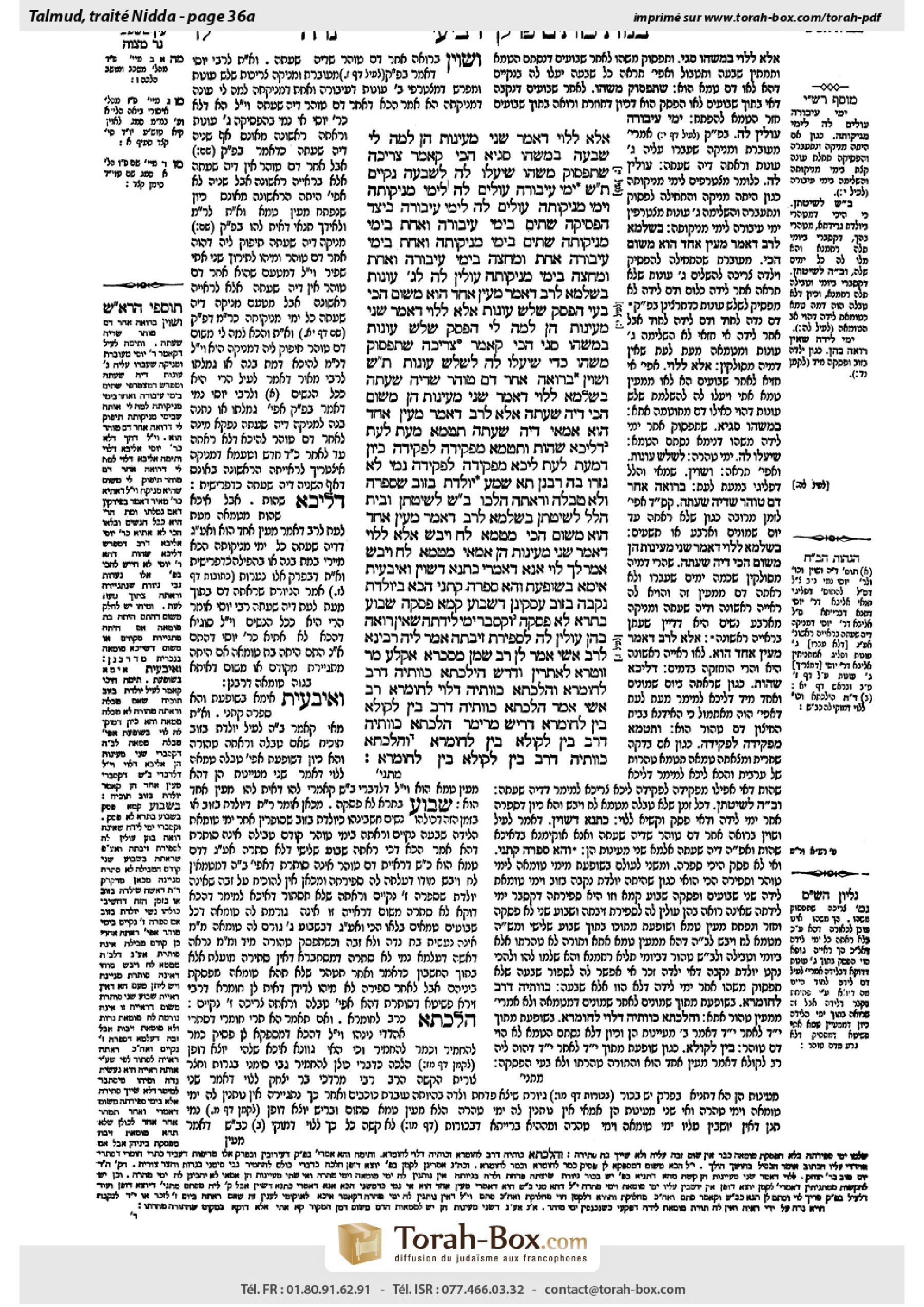
Niddah 36a: Talmud study for Daf Yomi
Daf Yomi is the daily study of one Talmud folio. Explore 37 tractates with scans, Hebrew text, Sefaria English and AI-generated French translations where annotated.
Passage selection and English or AI-generated French translation are available where the scan has annotations. Daf Study is independent of Torah-Box and Sefaria.
Browse Niddah · נידה · All tractatesNiddah 36a text and translations
This page of Niddah includes the Aramaic text, an English translation and an AI-generated French translation, alongside the scan above.
נידה ל״ו א · Aramaic and Hebrew text
אֶלָּא לְלֵוִי דְּאָמַר שְׁנֵי מַעְיָנוֹת הֵן, לְמָה לִי שִׁבְעָה? בְּמַשֶּׁהוּ סַגִּיא!
הָכִי קָאָמַר: צְרִיכָה שֶׁתִּפְסוֹק מַשֶּׁהוּ, שֶׁיַּעֲלוּ לָהּ לְשִׁבְעָה נְקִיִּים.
תָּא שְׁמַע: יְמֵי עִיבּוּרָהּ עוֹלִים לָהּ לִימֵי מְנִיקוּתָהּ, וִימֵי מְנִיקוּתָהּ עוֹלִים לָהּ לִימֵי עִיבּוּרָהּ.
כֵּיצַד הִפְסִיקָה שְׁתַּיִם בִּימֵי עִיבּוּרָהּ, וְאַחַת בִּימֵי מְנִיקוּתָהּ; שְׁתַּיִם בִּימֵי מְנִיקוּתָהּ, וְאַחַת בִּימֵי עִיבּוּרָהּ; אַחַת וּמֶחֱצָה בִּימֵי עִיבּוּרָהּ, וְאַחַת וּמֶחֱצָה בִּימֵי מְנִיקוּתָהּ — עוֹלִין לָהּ לְשָׁלֹשׁ עוֹנוֹת.
בִּשְׁלָמָא לְרַב דְּאָמַר: מַעְיָן אֶחָד הוּא, מִשּׁוּם הָכִי בָּעֵי הֶפְסֵק שָׁלֹשׁ עוֹנוֹת, אֶלָּא לְלֵוִי דְּאָמַר: שְׁנֵי מַעְיָנוֹת הֵן, לְמָה לִי הֶפְסֵק שָׁלֹשׁ עוֹנוֹת? בְּמַשֶּׁהוּ סַגִּי!
הָכִי קָאָמַר: צְרִיכָה שֶׁתִּפְסוֹק מַשֶּׁהוּ, כְּדֵי שֶׁיַּעֲלוּ לָהּ לְשָׁלֹשׁ עוֹנוֹת.
תָּא שְׁמַע: וְשָׁוִין בְּרוֹאָה אַחַר דַּם טוֹהַר, שֶׁדַּיָּהּ שְׁעָתָהּ.
בִּשְׁלָמָא לְלֵוִי דְּאָמַר: שְׁנֵי מַעְיָנוֹת הֵן, מִשּׁוּם הָכִי דַּיָּהּ שְׁעָתָהּ, אֶלָּא לְרַב דְּאָמַר: מַעְיָן אֶחָד הוּא, אַמַּאי דַּיָּה שְׁעָתָהּ? תְּטַמֵּא מֵעֵת לְעֵת!
דְּלֵיכָּא שְׁהוּת.
וּתְטַמֵּא מִפְּקִידָה לִפְקִידָה! כֵּיוָן דִּמְעֵת לְעֵת לֵיכָּא, מִפְּקִידָה לִפְקִידָה נָמֵי לָא גְּזַרוּ בַּהּ רַבָּנַן.
תָּא שְׁמַע: יוֹלֶדֶת בְּזוֹב שֶׁסָּפְרָה וְלֹא טָבְלָה וְרָאֲתָה, הָלְכוּ בֵּית שַׁמַּאי לְשִׁיטָתָן, וּבֵית הִלֵּל לְשִׁיטָתָן.
בִּשְׁלָמָא לְרַב, דְּאָמַר: מַעְיָן אֶחָד הוּא, מִשּׁוּם הָכִי מְטַמֵּא לַח וְיָבֵשׁ. אֶלָּא לְלֵוִי, דְּאָמַר: שְׁנֵי מַעְיָנוֹת הֵן, אַמַּאי מְטַמֵּא לַח וְיָבֵשׁ?
אָמַר לָךְ לֵוִי: אֲנָא דַּאֲמַרִי — כְּתַנָּא דְּשָׁוִין.
וְאִיבָּעֵית אֵימָא: בְּשׁוֹפַעַת, וְהָא ״סָפְרָה״ קָתָנֵי!
הָכָא בְּיוֹלֶדֶת נְקֵבָה בְּזוֹב עָסְקִינַן, דְּשָׁבוּעַ קַמָּא פָּסְקָה, שָׁבוּעַ בָּתְרָא לָא פָּסְקָה, וְקָסָבַר: יְמֵי לֵידָתָהּ שֶׁאֵין רוֹאֶה בָּהֶן — עוֹלִין לָהּ לִסְפִירַת זִיבָתָהּ.
אֲמַר לֵיהּ רָבִינָא לְרַב אָשֵׁי: אָמַר לַן רַב שֶׁמֶן מִסִּכְרָא: אִקְּלַע מָר זוּטְרָא לְאַתְרִין, וּדְרַשׁ: הִילְכְתָא כְּוָותֵיהּ דְּרַב לְחוּמְרָא, וְהִלְכְתָא כְּוָותֵיהּ דְּלֵוִי לְחוּמְרָא.
רַב אָשֵׁי אָמַר: הִלְכְתָא כְּוָותֵיהּ דְּרַב, בֵּין לְקוּלָּא בֵּין לְחוּמְרָא. דָּרֵישׁ מָרִימָר: הִלְכְתָא כְּוָותֵיהּ דְּרַב, בֵּין לְקוּלָּא בֵּין לְחוּמְרָא. וְהִלְכְתָא כְּוָותֵיהּ דְּרַב, בֵּין לְקוּלָּא בֵּין לְחוּמְרָא.
Niddah 36a · English translation
But according to Levi, who said there are two sources, why do I need this woman to wait seven clean days? It should be enough for her to wait seven days after experiencing any amount of cleanliness from the conclusion of her days of impurity. After all, according to Levi, once the blood ceases to flow from her days of impurity, any blood emitted thereafter is from the source of pure blood. Consequently, even if she experiences a flow of blood during the seven clean days this should not negate her count.
The Gemara explains that this is what the baraita is saying: She requires that the blood flow should stop for any amount of time after her days of impurity, so that she will have entered her days of purity, and consequently, the next seven days will be considered for her as the seven clean days required by a zava.
The Gemara suggests: Come and hear a baraita: There are certain women with regard to whom the halakha is that if they notice an emission of menstrual blood they are deemed impure only from when they saw the blood, and one is not concerned they might have experienced the emission from an earlier time. Two such women are one who is pregnant and one who is nursing. This applies only to a pregnant woman who has been noticeably pregnant for three periods, each thirty days in length, and has not experienced bleeding during the three periods; and to a nursing woman who has been nursing for three periods, each also thirty days in length, and did not experience bleeding during that time. With regard to this the baraita teaches: The days of her pregnancy in which she saw no blood count for her toward the days of her nursing in which she saw no blood, to complete three periods, and likewise, the days of her nursing count for her toward the days of her pregnancy.
The baraita elaborates: How so? If a woman stopped experiencing bleeding for two periods during her days of pregnancy and one period during her days of nursing; or if she did not experience bleeding for two periods during her days of nursing and one period during her days of pregnancy; or if she did not experience bleeding for one and a half periods during her days of pregnancy and one and a half periods during her days of nursing, the days count for her as three periods in which she did not experience bleeding, and if she experiences bleeding she is deemed impure only from the hour that she saw the blood.
The Gemara analyzes this baraita: Granted, the baraita is clear according to Rav, who said there is one source, as it is due to that reason that the woman requires a cessation of menstrual emissions for three periods in order that she may be considered a woman whose menstrual emissions have ceased. But according to Levi, who said there are two sources, why do I need a cessation of menstrual emissions for three periods? Provided the woman’s menstrual emissions cease for any amount of time at the completion of her days of impurity, it should be enough, as any blood she may emit thereafter is pure and should not negate her count of three periods.
The Gemara explains that this is what the baraita is saying: She requires that the blood flow should stop for any amount of time at the conclusion of her days of impurity, in order that her days of purity will be counted for her as part of the three periods, even if she experiences bleeding during her days of purity.
The Gemara suggests: Come and hear a baraita: And although Shammai and Hillel disagree with regard to all women who experience bleeding (see 2a), as Shammai maintains they are impure only from when they saw the blood while Hillel holds that they assume ritual impurity status retroactively from the last time they examined themselves and were found to be pure, they agree with regard to a woman who sees blood after seeing blood during her days of purity, that it is sufficient for her to be considered impure from the hour of her seeing the blood.
The Gemara analyzes the baraita: Granted, the baraita is clear according to Levi, who said there are two sources, as it is due to that reason that it is sufficient for her to be considered impure from the hour of her seeing the blood. In other words, although she experienced bleeding during her days of purity, until this emission she was still considered a woman whose menstrual emissions have ceased. But according to Rav, who said there is one source, if this woman experienced bleeding during her days of purity, she cannot be considered a woman whose menstrual emissions have ceased. If so, why is it sufficient for her to be considered impure from the hour of her seeing the blood? She should be considered impure retroactively for a twenty-four-hour period, like all other women.
The Gemara responds: The baraita is referring to a case where there is no time between the conclusion of her days of purity and the subsequent emission of blood. In such a situation, she cannot be considered impure retroactively for a twenty-four-hour period, as the previous twenty-four hours are part of her days of purity.
The Gemara raises a difficulty: But still, why is she impure only from when she sees the blood? She should be considered impure from examination to examination, i.e., from the last time she examined herself and found that she was pure. The Gemara responds: Since there is no possibility of her being impure retroactively for a twenty-four-hour period, with regard to impurity from examination to examination as well, the Sages did not decree impurity with regard to her.
The Gemara further suggests: Come and hear a baraita: With regard to a woman who gives birth as a zava, who counted seven clean days after the conclusion of her days of impurity but did not yet immerse, and subsequently saw blood, Beit Shammai follow their opinion with regard to any woman who gave birth and concluded her days of impurity but did not yet immerse, and Beit Hillel likewise follow their opinion. In other words, according to Beit Shammai her blood imparts impurity only while moist, whereas according to Beit Hillel it imparts impurity whether it is moist or dry.
The Gemara analyzes the baraita: Granted, the baraita is clear according to Rav, who said there is one source, as it is due to that reason Beit Hillel maintain that the blood imparts impurity whether it is moist or dry. In other words, as she has not yet immersed, the Torah does not deem pure her menstrual emissions. But according to Levi, who said there are two sources, any blood she may emit after counting seven clean days must have come from the source of pure blood. If so, why does it impart impurity whether it is moist or dry?
The Gemara explains that Levi could say to you: I say my opinion in accordance with the opinion of the tanna of the baraita cited above, that Shammai and Hillel agree that with regard to a woman who experiences bleeding after experiencing bleeding during her days of purity, it is sufficient for her to be considered impure from the hour that she saw the blood. That baraita apparently indicates that there are in fact two sources.
And if you wish, say instead that this baraita is referring to a woman who continuously discharges menstrual blood from within her days of impurity into her days of purity. Accordingly, the blood she sees during her days of purity is still from the source of impure blood. The Gemara objects: But the baraita teaches that the woman counted seven clean days.
The Gemara explains: Here we are dealing with a woman who gave birth to a female as a zava, and therefore her days of impurity are two weeks in length. And this is a case where in the first week her menstrual emissions ceased, and in the latter week her menstrual emissions did not cease, and they continued until her days of purity. And the tanna of this baraita holds: The days of her birth, i.e., the days of impurity, in which she does not see blood, count for her toward the counting of her ziva. Accordingly, although she is considered to have counted seven clean days, the blood emitted during her days of purity is from the source of impure blood.
§ With regard to the dispute between Rav and Levi, Ravina said to Rav Ashi: Rav Shemen from Sikhra said to us: Mar Zutra happened to come to our locale, and he taught that the halakha is in accordance with the opinion of Rav as a stringency, and the halakha is in accordance with the opinion of Levi as a stringency. In other words, if a woman continuously discharges menstrual blood from within her days of purity until sometime after the conclusion of her days of purity, the blood emitted after her days of purity is impure, in accordance with the opinion of Rav. By contrast, if she continuously discharges menstrual blood from within her days of impurity into her days of purity, the blood emitted during her days of purity is impure, in accordance with the opinion of Levi.
Rav Ashi said: The halakha is in accordance with the opinion of Rav, whether as a leniency or as a stringency. Likewise, Mareimar taught: The halakha is in accordance with the opinion of Rav, whether as a leniency or as a stringency. The Gemara concludes: And the halakha is in accordance with the opinion of Rav, whether as a leniency or as a stringency.
Niddah 36a · Traduction française (IA)
Mais selon Levi, qui affirme qu’il existe deux sources, pourquoi cette femme doit-elle attendre sept jours propres ? Il devrait lui suffire d’attendre sept jours après avoir connu une période, aussi brève soit-elle, sans écoulement, à la fin de ses jours d’impureté. En effet, selon Levi, dès que le sang cesse de s’écouler pendant ses jours d’impureté, tout sang émis par la suite provient de la source de sang pur. Par conséquent, même si elle a un écoulement de sang pendant les sept jours propres, cela ne devrait pas interrompre son décompte.
La Guemara explique que voici ce que dit la baraïta : il faut que l’écoulement de sang cesse pendant un certain temps après ses jours d’impureté, afin qu’elle entre dans ses jours de pureté. Ainsi, les sept jours suivants seront considérés pour elle comme les sept jours propres requis d’une zava.
La Guemara propose : « Viens et entends » une baraïta : certaines femmes, lorsqu’elles constatent un écoulement de sang menstruel, ne sont considérées comme impures qu’à partir du moment où elles voient le sang, sans craindre qu’elles en aient eu un auparavant. Il s’agit notamment d’une femme enceinte et d’une femme qui allaite. Cela ne s’applique qu’à une femme dont la grossesse est visible depuis trois périodes de trente jours chacune et qui n’a pas eu de saignement pendant ces trois périodes, ainsi qu’à une femme qui allaite depuis trois périodes de trente jours chacune et qui n’a pas eu de saignement pendant cette durée. À ce sujet, la baraïta enseigne : les jours de sa grossesse durant lesquels elle n’a vu aucun sang sont comptés pour elle avec les jours de son allaitement durant lesquels elle n’a vu aucun sang, afin de compléter trois périodes. De même, les jours de son allaitement sont comptés pour elle avec les jours de sa grossesse.
La baraïta précise : comment cela ? Si une femme n’a pas eu de saignement pendant deux périodes au cours de sa grossesse et une période au cours de son allaitement ; ou si elle n’a pas eu de saignement pendant deux périodes au cours de son allaitement et une période au cours de sa grossesse ; ou si elle n’a pas eu de saignement pendant une période et demie au cours de sa grossesse et une période et demie au cours de son allaitement, ces jours comptent pour elle comme trois périodes sans saignement. Si elle a ensuite un saignement, elle n’est considérée comme impure qu’à partir de l’heure où elle a vu le sang.
La Guemara analyse cette baraïta : certes, elle s’explique selon Rav, qui affirme qu’il existe une seule source, car c’est pour cette raison que la femme doit rester trois périodes sans émission menstruelle afin d’être considérée comme une femme dont les émissions menstruelles ont cessé. Mais selon Levi, qui affirme qu’il existe deux sources, pourquoi faut-il que les émissions menstruelles cessent pendant trois périodes ? Il devrait suffire que les émissions menstruelles de la femme cessent pendant un certain temps à la fin de ses jours d’impureté, puisque tout sang qu’elle pourrait émettre par la suite est pur et ne devrait pas interrompre son décompte des trois périodes.
La Guemara explique que voici ce que dit la baraïta : il faut que l’écoulement de sang cesse pendant un certain temps à la fin de ses jours d’impureté, afin que ses jours de pureté soient comptés pour elle dans les trois périodes, même si elle a un saignement pendant ses jours de pureté.
La Guemara propose : « Viens et entends » une baraïta : bien que Chammaï et Hillel soient en désaccord au sujet de toutes les femmes qui ont un saignement (voir 2a) — Chammaï soutenant qu’elles ne sont impures qu’à partir du moment où elles voient le sang, tandis que Hillel considère qu’elles sont rétroactivement impures depuis la dernière fois où elles se sont examinées et ont été trouvées pures —, ils s’accordent au sujet d’une femme qui voit du sang après avoir eu un saignement pendant ses jours de pureté : il suffit de la considérer comme impure à partir de l’heure où elle a vu le sang.
La Guemara analyse cette baraïta : certes, elle s’explique selon Levi, qui affirme qu’il existe deux sources, car c’est pour cette raison qu’il suffit de la considérer comme impure à partir de l’heure où elle a vu le sang. Autrement dit, bien qu’elle ait eu un saignement pendant ses jours de pureté, jusqu’à cet écoulement elle était toujours considérée comme une femme dont les émissions menstruelles avaient cessé. Mais selon Rav, qui affirme qu’il existe une seule source, si cette femme a eu un saignement pendant ses jours de pureté, elle ne peut pas être considérée comme une femme dont les émissions menstruelles ont cessé. Dans ce cas, pourquoi suffit-il de la considérer comme impure à partir de l’heure où elle a vu le sang ? Elle devrait être considérée comme impure rétroactivement pendant vingt-quatre heures, comme toutes les autres femmes.
La Guemara répond : la baraïta parle d’un cas où aucun intervalle ne sépare la fin de ses jours de pureté de l’écoulement de sang qui suit. Dans une telle situation, elle ne peut pas être considérée comme impure rétroactivement pendant vingt-quatre heures, puisque les vingt-quatre heures précédentes font partie de ses jours de pureté.
La Guemara soulève une difficulté : mais malgré tout, pourquoi est-elle impure seulement à partir du moment où elle voit le sang ? Elle devrait être considérée comme impure depuis le dernier examen où elle s’est trouvée pure jusqu’à celui où elle a constaté le sang. La Guemara répond : puisqu’il est impossible qu’elle soit impure rétroactivement pendant vingt-quatre heures, les Sages n’ont pas non plus décrété qu’elle soit impure depuis un examen jusqu’au suivant.
La Guemara propose encore : « Viens et entends » une baraïta : au sujet d’une femme qui accouche en tant que zava, qui a compté sept jours propres après la fin de ses jours d’impureté mais ne s’est pas encore immergée, puis a vu du sang, Beth Chammaï s’en tiennent à leur opinion concernant toute femme qui a accouché et terminé ses jours d’impureté sans encore s’être immergée, et Beth Hillel s’en tiennent également à leur opinion. Autrement dit, selon Beth Chammaï, son sang ne transmet l’impureté que lorsqu’il est humide, tandis que selon Beth Hillel, il la transmet qu’il soit humide ou sec.
La Guemara analyse cette baraïta : certes, elle s’explique selon Rav, qui affirme qu’il existe une seule source, car c’est pour cette raison que Beth Hillel soutiennent que le sang transmet l’impureté qu’il soit humide ou sec. Autrement dit, puisqu’elle ne s’est pas encore immergée, la Torah ne considère pas ses émissions menstruelles comme pures. Mais selon Levi, qui affirme qu’il existe deux sources, tout sang qu’elle pourrait émettre après avoir compté sept jours propres doit provenir de la source de sang pur. Dans ce cas, pourquoi transmet-il l’impureté qu’il soit humide ou sec ?
La Guemara explique que Levi pourrait te répondre : j’énonce mon opinion conformément à celle du tanna de la baraïta citée plus haut, selon laquelle Chammaï et Hillel s’accordent au sujet d’une femme qui a un saignement après en avoir eu un pendant ses jours de pureté : il suffit de la considérer comme impure à partir de l’heure où elle a vu le sang. Cette baraïta semble indiquer qu’il existe effectivement deux sources.
Et si tu préfères, dis plutôt que cette baraïta parle d’une femme qui continue à évacuer du sang menstruel depuis ses jours d’impureté jusque dans ses jours de pureté. Par conséquent, le sang qu’elle voit pendant ses jours de pureté provient encore de la source de sang impur. La Guemara objecte : mais la baraïta enseigne que la femme a compté sept jours propres.
La Guemara explique : il s’agit ici d’une femme qui a accouché d’une fille en tant que zava ; ses jours d’impureté durent donc deux semaines. Dans ce cas, ses émissions menstruelles ont cessé pendant la première semaine, mais pas pendant la seconde, et elles se sont poursuivies jusque dans ses jours de pureté. Le tanna de cette baraïta soutient que les jours de son accouchement, c’est-à-dire ses jours d’impureté, durant lesquels elle ne voit pas de sang, comptent pour elle dans le décompte de sa ziva. Par conséquent, bien qu’elle soit considérée comme ayant compté sept jours propres, le sang émis pendant ses jours de pureté provient de la source de sang impur.
§ Au sujet du désaccord entre Rav et Levi, Ravina dit à Rav Ashi : « Rav Shemen de Sikhra nous a dit : Mar Zutra est venu dans notre localité et a enseigné que la halakha suit l’opinion de Rav lorsqu’elle conduit à la rigueur, et celle de Levi lorsqu’elle conduit à la rigueur. » Autrement dit, si une femme continue à évacuer du sang menstruel depuis ses jours de pureté jusqu’à un moment situé après la fin de ses jours de pureté, le sang émis après ses jours de pureté est impur, conformément à l’opinion de Rav. En revanche, si elle continue à évacuer du sang menstruel depuis ses jours d’impureté jusque dans ses jours de pureté, le sang émis pendant ses jours de pureté est impur, conformément à l’opinion de Levi.
Rav Ashi dit : la halakha suit l’opinion de Rav, qu’elle conduise à la clémence ou à la rigueur. De même, Mareimar enseigna : la halakha suit l’opinion de Rav, qu’elle conduise à la clémence ou à la rigueur. La Guemara conclut : la halakha suit l’opinion de Rav, qu’elle conduise à la clémence ou à la rigueur.
Traduction française générée par IA à partir de l’édition anglaise de Sefaria. Vérifie toujours un passage avec le texte source.
Text from Sefaria: William Davidson Edition - Vocalized Aramaic (CC BY NC); William Davidson Edition - English (CC BY NC).