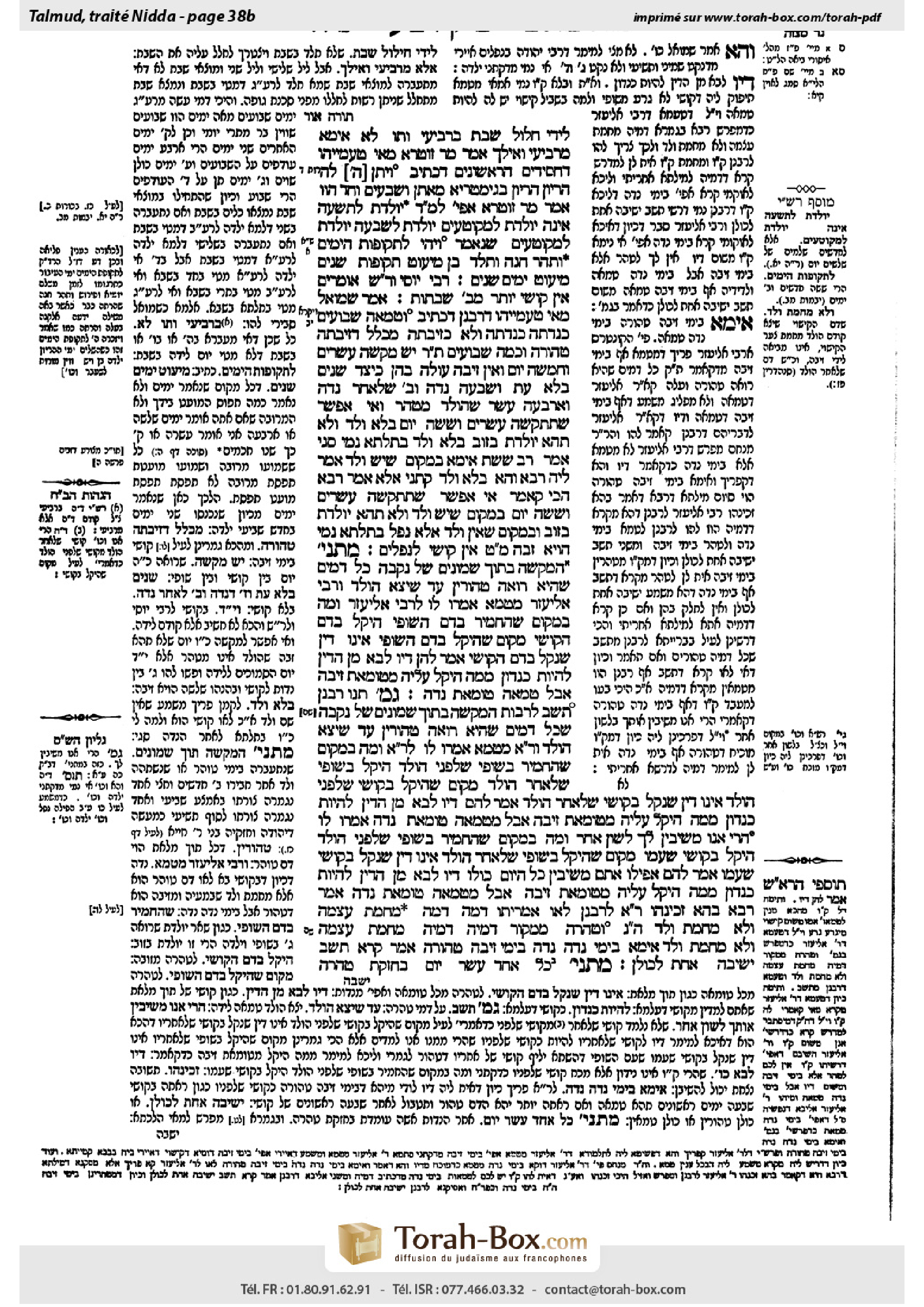
Niddah 38b: Talmud study for Daf Yomi
Daf Yomi is the daily study of one Talmud folio. Explore 37 tractates with scans, Hebrew text, Sefaria English and AI-generated French translations where annotated.
Passage selection and English or AI-generated French translation are available where the scan has annotations. Daf Study is independent of Torah-Box and Sefaria.
Browse Niddah · נידה · All tractatesNiddah 38b text and translations
This page of Niddah includes the Aramaic text, an English translation and an AI-generated French translation, alongside the scan above.
נידה ל״ח ב · Aramaic and Hebrew text
לִידֵי חִלּוּל שַׁבָּת. בִּרְבִיעִי וְתוּ לָא? אֵימָא: מֵרְבִיעִי וְאֵילָךְ.
אָמַר מָר זוּטְרָא: מַאי טַעְמַיְיהוּ דַּחֲסִידִים הָרִאשׁוֹנִים? דִּכְתִיב ״וַיִּתֵּן [ה׳] לָהּ הֵרָיוֹן״ — ״הֵרָיוֹן״ בְּגִימַטְרִיָּא מָאתַן וְשִׁבְעִים וְחַד הָווּ.
אָמַר מָר זוּטְרָא: אֲפִילּוּ לְמַאן דְּאָמַר יוֹלֶדֶת לְתִשְׁעָה אֵינָהּ יוֹלֶדֶת לִמְקוּטָּעִים, יוֹלֶדֶת לְשִׁבְעָה יוֹלֶדֶת לִמְקוּטָּעִים, שֶׁנֶּאֱמַר ״וַיְהִי לִתְקוּפוֹת הַיָּמִים וַתַּהַר חַנָּה וַתֵּלֶד בֵּן״, מִיעוּט ״תְּקוּפוֹת״ — שְׁנַיִם, מִיעוּט ״יָמִים״ — שְׁנַיִם.
רַבִּי יוֹסֵי וְרַבִּי שִׁמְעוֹן אוֹמְרִים: אֵין קוֹשִׁי יוֹתֵר מִשְּׁתֵּי שַׁבָּתוֹת. אָמַר שְׁמוּאֵל: מַאי טַעְמַיְיהוּ דְּרַבָּנַן? דִּכְתִיב: ״וְטָמְאָה שְׁבוּעַיִם כְּנִדָּתָהּ״ — כְּנִדָּתָהּ וְלֹא כְּזִיבָתָהּ, מִכְּלָל דְּזִיבָתָהּ טְהוֹרָה. וְכַמָּה שְׁבוּעַיִם?
תָּנוּ רַבָּנַן: יֵשׁ מְקַשָּׁה עֶשְׂרִים וַחֲמִשָּׁה יוֹם, וְאֵין זִיבָה עוֹלָה בָּהֶן. כֵּיצַד? שְׁנַיִם בְּלֹא עֵת, וְשִׁבְעָה נִדָּה, וּשְׁנַיִם שֶׁלְּאַחַר נִדָּה, וְאַרְבָּעָה עָשָׂר שֶׁהַוָּלָד מְטַהֵר.
וְאִי אֶפְשָׁר שֶׁתִּתְקַשֶּׁה עֶשְׂרִים וְשִׁשָּׁה יוֹם בְּלֹא וָלָד, וְלֹא תְּהֵא יוֹלֶדֶת בְּזוֹב.
בְּלֹא וָלָד? בִּתְלָתָא נָמֵי סַגִּי! אָמַר רַב שֵׁשֶׁת: אֵימָא ״בִּמְקוֹם שֶׁיֵּשׁ וָלָד״. אֲמַר לֵיהּ רָבָא: וְהָא ״בְּלֹא וָלָד״ קָתָנֵי!
אֶלָּא אָמַר רָבָא, הָכִי קָאָמַר: אִי אֶפְשָׁר שֶׁתִּתְקַשֶּׁה עֶשְׂרִים וְשִׁשָּׁה יוֹם בִּמְקוֹם שֶׁיֵּשׁ וָלָד וְלֹא תְּהֵא יוֹלֶדֶת בְּזוֹב, וּבִמְקוֹם שֶׁאֵין וָלָד אֶלָּא נֵפֶל — בִּתְלָתָא נָמֵי הָוְיָא זָבָה, מַאי טַעְמָא? אֵין קוֹשִׁי לִנְפָלִים.
מַתְנִי' הַמְקַשָּׁה בְּתוֹךְ שְׁמוֹנִים שֶׁל נְקֵבָה — כׇּל דָּמִים שֶׁהִיא רוֹאָה טְהוֹרִין עַד שֶׁיֵּצֵא הַוָּלָד, וְרַבִּי אֱלִיעֶזֶר מְטַמֵּא.
אָמְרוּ לוֹ לְרַבִּי אֱלִיעֶזֶר: וּמָה בִּמְקוֹם שֶׁהֶחְמִיר בְּדַם הַשּׁוֹפִי, הֵיקֵל בְּדַם הַקּוֹשִׁי; מְקוֹם שֶׁהֵיקֵל בְּדַם הַשּׁוֹפִי, אֵינוֹ דִּין שֶׁנָּקֵל בְּדַם הַקּוֹשִׁי?
אָמַר לָהֶן: דַּיּוֹ לַבָּא מִן הַדִּין לִהְיוֹת כַּנִּדּוֹן, מִמָּה הֵיקֵל עָלֶיהָ? מִטּוּמְאַת זִיבָה, אֲבָל טְמֵאָה טוּמְאַת נִדָּה.
גְּמָ' תָּנוּ רַבָּנַן: ״תֵּשֵׁב״ — לְרַבּוֹת הַמְקַשָּׁה בְּתוֹךְ שְׁמוֹנִים שֶׁל נְקֵבָה, שֶׁכׇּל דָּמִים שֶׁהִיא רוֹאָה טְהוֹרִין עַד שֶׁיָּצָא הַוָּלָד, וְרַבִּי אֱלִיעֶזֶר מְטַמֵּא.
אָמְרוּ לוֹ לְרַבִּי אֱלִיעֶזֶר: וּמָה בִּמְקוֹם שֶׁהֶחְמִיר בְּשׁוֹפִי שֶׁלִּפְנֵי הַוָּלָד, הֵיקֵל בְּשׁוֹפִי שֶׁלְּאַחַר הַוָּלָד; מְקוֹם שֶׁהֵיקֵל בְּקוֹשִׁי שֶׁלִּפְנֵי הַוָּלָד, אֵינוֹ דִּין שֶׁנָּקֵל בְּקוֹשִׁי שֶׁלְּאַחַר הַוָּלָד?
אָמַר לָהֶם: דַּיּוֹ לַבָּא מִן הַדִּין לִהְיוֹת כַּנִּדּוֹן, מִמָּה הֵיקֵל עָלֶיהָ? מִטּוּמְאַת זִיבָה, אֲבָל מְטַמְּאָה טוּמְאַת נִדָּה.
אָמְרוּ לוֹ: הֲרֵי אָנוּ מְשִׁיבִין לְךָ לָשׁוֹן אַחֵר, וּמָה בִּמְקוֹם שֶׁהֶחְמִיר בְּשׁוֹפִי שֶׁלִּפְנֵי הַוָּלָד — הֵיקֵל בְּקוֹשִׁי שֶׁעִמּוֹ. מָקוֹם שֶׁהֵיקֵל בְּשׁוֹפִי שֶׁלְּאַחַר הַוָּלָד — אֵינוֹ דִּין שֶׁנָּקֵל בְּקוֹשִׁי שֶׁעִמּוֹ?
אָמַר לָהֶם: אֲפִילּוּ אַתֶּם מְשִׁיבִין כׇּל הַיּוֹם כּוּלּוֹ, דַּיּוֹ לַבָּא מִן הַדִּין לִהְיוֹת כַּנִּדּוֹן, מִמָּה הֵיקֵל עָלֶיהָ מִטּוּמְאַת זִיבָה, אֲבָל מְטַמְּאָה טוּמְאַת נִדָּה.
אָמַר רָבָא: בְּהָא זַכִּינְהוּ רַבִּי אֱלִיעֶזֶר לְרַבָּנַן, לָאו אָמְרִיתוּ ״דָּמָהּ״ — דָּמָה מֵחֲמַת עַצְמָהּ וְלֹא מֵחֲמַת וָלָד, הָכִי נָמֵי ״וְטָהֲרָה מִמְּקוֹר דָּמֶיהָ״ — דָּמֶיהָ מֵחֲמַת עַצְמָהּ וְלֹא מֵחֲמַת וָלָד.
אֵימָא: בִּימֵי נִדָּה — נִדָּה, בִּימֵי זִיבָה — טְהוֹרָה? אָמַר קְרָא ״תֵּשֵׁב״ — יְשִׁיבָה אַחַת לְכוּלָּן.
מַתְנִי' כׇּל אַחַד עָשָׂר יוֹם בְּחֶזְקַת טׇהֳרָה.
Niddah 38b · English translation
to a desecration of Shabbat. If they were to engage in sexual intercourse on a Sunday, Monday, or Tuesday, their wives might give birth on Shabbat, either 271, 272, or 273 days after conception either. The Gemara asks: If this was indeed the concern of the early generations of pious men, why would they engage in intercourse only on a Wednesday, and nothing more? After all, if they engaged in intercourse on a Thursday, Friday, or Shabbat, they would likewise avoid any desecration of Shabbat. The Gemara answers: Say that the baraita means that the early generations of pious men would engage in intercourse each week only from Wednesday onward.
Mar Zutra said: What is the reasoning of the early generations of pious men, who state that a woman does not give birth before 271 days have passed from the time of insemination? As it is written with regard to Boaz and Ruth: “And he went in unto her, and the Lord gave her conception [herayon]” (Ruth 4:13). The letters that constitute the word herayon are 271 in numerical value.
Mar Zutra says: Even according to the one who said, e.g., Shmuel and the early generations of pious men, that a woman who gives birth at nine months does not give birth after an incomplete number of months, i.e., she carries for a full nine months, nevertheless, a woman who gives birth at seven months can give birth after an incomplete number of months. As it is stated with regard to the birth of Samuel: “And it came to pass, when the seasons of the days had come, that Hannah conceived, and bore a son” (I Samuel 1:20). The minimal number of “seasons” is two, and as each season of the year is three months, this amounts to six months. And the minimal number of “days” is two. If so, Samuel was born in the seventh month of Hannah’s pregnancy.
§ The mishna teaches that Rabbi Yosei and Rabbi Shimon say: Labor pains do not occur more than two weeks before birth. Shmuel said: What is the reasoning of the Rabbis, i.e., Rabbi Yosei and Rabbi Shimon? As it is written with regard to a woman who gives birth to a female: “And she shall be impure two weeks, as in her menstruation” (Leviticus 12:5). The verse indicates that she is impure as in her menstruation but not as in her ziva. By inference, one may conclude that her ziva is pure, i.e., if she emits blood accompanied by labor pains she is not rendered a zava. And for how long is this the case? For two weeks.
With regard to the halakha that blood emitted due to labor pains does not impart impurity of ziva, the Sages taught: There is a scenario in which a woman experiences labor pains accompanied by emissions of blood for twenty-five days before birth, and the impurity of greater ziva is not included in them. How so? She emits blood for two days not at the time of her menstruation, i.e., on the tenth and eleventh days of ziva, and then for the seven days of menstruation, and then for the first two days of ziva that come after the days of menstruation. And this period is followed by fourteen days during which the impending birth of a child renders pure the blood she sees.
The baraita continues: And it is impossible for a woman to experience labor pains accompanied by emissions of blood for twenty-six days without a child, such that she will not be a woman who gives birth as a zava. Since a span of twenty-six days includes at least five days of ziva, there will inevitably be three consecutive days of ziva during which she experienced bleeding, therefore rendering her a greater zava.
The Gemara analyzes the baraita: Is the baraita really dealing with a case without a child, i.e., where she is not even pregnant? If there is no child, then experiencing bleeding on three consecutive days after the days of menstruation is also sufficient to render her a greater zava. Rav Sheshet said one should say the baraita as follows: Twenty-six days in a case where there is a child, i.e., where she is pregnant. Rava said to Rav Sheshet: But the baraita explicitly teaches: Without a child.
Rather, Rava said that this is what the baraita is saying: It is impossible for a woman to experience labor pains accompanied by emissions of blood for twenty-six days in a case where there is a child, such that she will not be a woman who gives birth as a zava. And in a case where there is no child born but there is a non-viable newborn, with three consecutive days of emissions she also becomes a zava. What is the reason? The halakha that blood emitted due to labor pains does not render a woman a zava does not apply to non-viable newborns.
MISHNA: A woman who experiences labor pains within eighty days of giving birth to a female, e.g., she conceived during the sixty-six days of purity, or she initially conceived twins and she gave birth to a female and the birth of the second fetus was delayed, all blood that she sees is ritually pure, as she is currently within her days of purity. And this remains the halakha until the child emerges from the womb, at which point she is rendered impure as a woman who gives birth. And Rabbi Eliezer deems ritually impure the blood that occurs due to these labor pains.
The Rabbis said to Rabbi Eliezer: And what, if in an instance where the verse was stringent with regard to blood emitted while resting, namely if a pregnant woman emits blood after her days of purity without any labor pains she is rendered impure, the verse was lenient with regard to blood that accompanies the labor pains; then in an instance where the verse was lenient with regard to blood emitted while resting, i.e., during a woman’s days of purity, is it not right that we will be lenient with regard to blood that accompanies the labor pains?
Rabbi Eliezer said to them: When deriving a halakha by means of an a fortiori inference, there is a principle that it is sufficient for the conclusion that emerges from an a fortiori inference to be like its source. In other words, the status of blood emitted due to labor pains during her days of purity should not be more lenient than that of blood emitted due to labor pains after her days of purity. Rabbi Eliezer elaborates: Concerning what type of impurity was the verse lenient with regard to a woman who experiences an emission of blood due to labor pains? Concerning the impurity of ziva. But she may still be rendered ritually impure with the impurity of a menstruating woman. So too, if a woman experiences emissions of blood due to labor pains during her days of purity, she is rendered a menstruating woman.
GEMARA: With regard to the dispute between Rabbi Eliezer and the Rabbis concerning a woman who emits blood due to labor pains during her days of purity, the Sages taught a baraita that addresses a verse discussing a woman who gives birth to a female: “And sixty-six days she shall observe the blood of purity” (Leviticus 12:5). The term “She shall observe” serves to include a woman who experiences labor pains within eighty days of giving birth to a female, teaching that all blood that she sees is ritually pure. And this remains the case until the child emerges from the womb. And Rabbi Eliezer deems ritually impure the blood that occurs due to these labor pains.
The Rabbis said to Rabbi Eliezer: And what, if in an instance where the verse was stringent with regard to blood that is emitted while resting before the birth of the child, as such blood renders her a zava, the verse was lenient with regard to blood that is emitted while resting after the birth of the child, i.e., during her days of purity; then in an instance where the verse was lenient with regard to blood emitted due to labor pains before the birth of the child, is it not right that we will be lenient with regard to blood that is emitted due to labor pains after the birth of the child?
Rabbi Eliezer said to them: It is sufficient for the conclusion that emerges from an a fortiori inference to be like its source. Rabbi Eliezer elaborates: Concerning what type of impurity was the verse lenient with regard to a woman who experiences an emission of blood due to labor pains? Concerning the impurity of ziva. But an emission of blood renders her impure with the impurity of a menstruating woman. So too, if a woman experiences emissions of blood due to labor pains during her days of purity, she is rendered a menstruating woman.
The Rabbis said to him: But we will respond to you with another version of the a fortiori inference: And what, if in an instance where the verse was stringent with regard to blood that is emitted while resting before the birth of the child the verse was lenient with regard to blood that is emitted due to labor pains that come with it, i.e., which precede the birth of the child; then in an instance where the verse was lenient with regard to blood emitted while resting, namely during a woman’s days of purity, is it not right that we will be lenient with regard to blood that accompanies the labor pains that come with it?
Rabbi Eliezer said to them: Even if you respond by citing a fortiori inferences of that type throughout the entire day, the principle remains that it is sufficient for the conclusion that emerges from an a fortiori inference to be like its source. Concerning what type of impurity was the verse lenient with regard to a woman who experiences an emission of blood due to labor pains? Concerning the impurity of ziva. But an emission of blood renders her impure with the impurity of a menstruating woman.
Rava said: With this response Rabbi Eliezer triumphed over the Rabbis: Didn’t you say that the reason why a woman is not rendered a zava on account of blood that is emitted due to labor pains before birth is because the verse states: “And if a woman has an issue of her blood many days” (Leviticus 15:25)? The term “her blood” indicates that only her blood that comes due to herself is impure due to ziva, but not blood that comes due to her child. So too, one can say that as the verse states with regard to a woman who gives birth: “And she shall be purified from the fountain of her blood” (Leviticus 12:7), this indicates that only her blood that comes due to herself is pure from ziva, but not blood that comes due to her child.
This Gemara raises a difficulty against the opinion of Rabbi Eliezer: If so, one can say that if she emits blood due to labor pains during the days of menstruation she is a menstruating woman, but if she emits blood in the days of ziva, i.e., after the days of menstruation, she is pure. The Gemara explains that the verse states: “She shall observe the blood of purity” (Leviticus 12:5), which indicates that there is one observance for all the days of her purity, i.e., all the blood she emits due to labor pains during her days of purity is either pure or impure.
MISHNA: For all the eleven days of ziva that follow the seven days of menstruation, a woman has the presumptive status of ritual purity, as it is unusual for her to experience bleeding on these days.
Niddah 38b · Traduction française (IA)
qui entraînerait une profanation du Chabbat. Si elles avaient des relations sexuelles un dimanche, un lundi ou un mardi, leurs femmes auraient pu accoucher le Chabbat, respectivement 271, 272 ou 273 jours après la conception. La Guemara demande : si telle était bien la préoccupation des premières générations d’hommes pieux, pourquoi n’avaient-ils de relations que le mercredi ? Après tout, s’ils en avaient eu le jeudi, le vendredi ou le Chabbat, ils auraient également évité toute profanation du Chabbat. La Guemara répond : dis plutôt que la baraïta signifie que les premières générations d’hommes pieux n’avaient de relations, chaque semaine, qu’à partir du mercredi.
Mar Zutra dit : Quel est le raisonnement des premières générations d’hommes pieux, qui affirment qu’une femme n’accouche pas avant que 271 jours se soient écoulés depuis l’insémination ? Car il est écrit à propos de Boaz et de Ruth : « Il alla vers elle, et le Seigneur lui accorda de concevoir [herayon] » (Ruth 4:13). Les lettres qui composent le mot herayon ont une valeur numérique de 271.
Mar Zutra dit : Même selon celui qui affirme, comme Shmuel et les premières générations d’hommes pieux, qu’une femme qui accouche après neuf mois n’accouche pas au terme d’un nombre incomplet de mois, c’est-à-dire qu’elle porte sa grossesse pendant neuf mois complets, une femme qui accouche après sept mois peut néanmoins accoucher au terme d’un nombre incomplet de mois. Car il est dit à propos de la naissance de Samuel : « Et il arriva, lorsque le cycle des jours fut accompli, qu’Anne conçut et enfanta un fils » (I Samuel 1:20). Le nombre minimal de « cycles » est deux ; puisque chaque saison de l’année dure trois mois, cela fait six mois. Le nombre minimal de « jours » est deux. Samuel serait donc né au cours du septième mois de la grossesse d’Anne.
§ La Michna enseigne que Rabbi Yosei et Rabbi Shimon disent : les douleurs de l’enfantement ne surviennent pas plus de deux semaines avant l’accouchement. Shmuel dit : Quel est le raisonnement des Rabbins, c’est-à-dire de Rabbi Yosei et de Rabbi Shimon ? Car il est écrit à propos d’une femme qui accouche d’une fille : « Elle sera impure pendant deux semaines, comme pendant sa menstruation » (Lévitique 12:5). Le verset indique qu’elle est impure comme pendant sa menstruation, mais pas comme en cas de ziva. On peut en déduire que son sang relève du statut de pureté de la ziva, c’est-à-dire que si elle perd du sang accompagné de douleurs de l’enfantement, elle n’est pas considérée comme une zava. Et pendant combien de temps en est-il ainsi ? Pendant deux semaines.
Au sujet de la halakha selon laquelle le sang écoulé en raison des douleurs de l’enfantement ne confère pas l’impureté de ziva, les Sages enseignèrent : il existe un cas où une femme éprouve des douleurs de l’enfantement accompagnées de pertes de sang pendant vingt-cinq jours avant l’accouchement, sans que l’impureté de grande ziva soit incluse dans cette période. Comment cela ? Elle perd du sang pendant deux jours en dehors de sa période menstruelle, c’est-à-dire les dixième et onzième jours de ziva, puis pendant les sept jours de menstruation, puis pendant les deux premiers jours de ziva qui suivent les jours de menstruation. Cette période est ensuite suivie de quatorze jours durant lesquels, en raison de la naissance imminente de l’enfant, le sang qu’elle voit est pur.
La baraïta poursuit : il est impossible qu’une femme éprouve des douleurs de l’enfantement accompagnées de pertes de sang pendant vingt-six jours sans qu’un enfant naisse, sans qu’elle soit pour autant une femme qui accouche en état de ziva. Puisqu’une période de vingt-six jours comprend au moins cinq jours de ziva, il y aura inévitablement trois jours consécutifs de ziva pendant lesquels elle aura saigné ; elle sera donc considérée comme une grande zava.
La Guemara analyse la baraïta : traite-t-elle vraiment d’un cas sans enfant, c’est-à-dire d’un cas où la femme n’est même pas enceinte ? S’il n’y a pas d’enfant, des saignements pendant trois jours consécutifs après les jours de menstruation suffisent également à faire d’elle une grande zava. Rav Sheshet dit qu’il faut plutôt lire la baraïta ainsi : vingt-six jours dans un cas où il y a un enfant, c’est-à-dire où elle est enceinte. Rava dit à Rav Sheshet : mais la baraïta enseigne explicitement : « sans enfant ».
Rava dit plutôt que voici ce que signifie la baraïta : il est impossible qu’une femme éprouve des douleurs de l’enfantement accompagnées de pertes de sang pendant vingt-six jours dans un cas où il y a un enfant, sans qu’elle soit une femme qui accouche en état de ziva. Et dans un cas où aucun enfant n’est né, mais où il y a un nouveau-né non viable, trois jours consécutifs de pertes la rendent également zava. Pour quelle raison ? La halakha selon laquelle le sang écoulé en raison des douleurs de l’enfantement ne rend pas une femme zava ne s’applique pas aux nouveau-nés non viables.
MICHNA : Une femme qui éprouve des douleurs de l’enfantement dans les quatre-vingts jours suivant la naissance d’une fille — par exemple, si elle a conçu pendant les soixante-six jours de pureté, ou si elle avait d’abord conçu des jumeaux, a donné naissance à une fille et que la naissance du second fœtus a été retardée — voit tout son sang déclaré rituellement pur, puisqu’elle se trouve alors dans ses jours de pureté. Il en est ainsi jusqu’à ce que l’enfant sorte de l’utérus ; à ce moment-là, elle devient impure en tant que femme qui accouche. Rabbi Eliezer considère comme rituellement impur le sang qui survient en raison de ces douleurs de l’enfantement.
Les Rabbins dirent à Rabbi Eliezer : si, dans un cas où le verset s’est montré rigoureux à l’égard du sang écoulé au repos — à savoir, si une femme enceinte perd du sang après ses jours de pureté sans éprouver de douleurs de l’enfantement, elle devient impure —, le verset s’est montré indulgent à l’égard du sang accompagné de douleurs de l’enfantement, alors, dans un cas où le verset s’est montré indulgent à l’égard du sang écoulé au repos, c’est-à-dire pendant les jours de pureté d’une femme, n’est-il pas juste que nous soyons indulgents à l’égard du sang accompagné de douleurs de l’enfantement ?
Rabbi Eliezer leur dit : lorsqu’on déduit une halakha au moyen d’un raisonnement a fortiori, le principe veut que la conclusion ne soit pas plus étendue que le cas qui sert de point de départ. Autrement dit, le statut du sang écoulé en raison des douleurs de l’enfantement pendant ses jours de pureté ne devrait pas être plus indulgent que celui du sang écoulé en raison des douleurs de l’enfantement après ses jours de pureté. Rabbi Eliezer précise : de quel type d’impureté le verset a-t-il exempté une femme qui perd du sang en raison des douleurs de l’enfantement ? De l’impureté de ziva. Mais elle peut encore être rendue rituellement impure comme une femme menstruante. De même, si une femme perd du sang en raison des douleurs de l’enfantement pendant ses jours de pureté, elle est considérée comme menstruante.
GUEMARA : Au sujet du désaccord entre Rabbi Eliezer et les Rabbins concernant une femme qui perd du sang en raison des douleurs de l’enfantement pendant ses jours de pureté, les Sages enseignèrent une baraïta portant sur un verset qui parle d’une femme qui accouche d’une fille : « Elle observera le sang de sa pureté pendant soixante-six jours » (Lévitique 12:5). Les termes « Elle observera » incluent le cas d’une femme qui éprouve des douleurs de l’enfantement dans les quatre-vingts jours suivant la naissance d’une fille et enseignent que tout le sang qu’elle voit est rituellement pur. Il en est ainsi jusqu’à ce que l’enfant sorte de l’utérus. Rabbi Eliezer considère comme rituellement impur le sang qui survient en raison de ces douleurs de l’enfantement.
Les Rabbins dirent à Rabbi Eliezer : si, dans un cas où le verset s’est montré rigoureux à l’égard du sang écoulé au repos avant la naissance de l’enfant, car ce sang la rend zava, le verset s’est montré indulgent à l’égard du sang écoulé au repos après la naissance de l’enfant, c’est-à-dire pendant ses jours de pureté, alors, dans un cas où le verset s’est montré indulgent à l’égard du sang écoulé en raison des douleurs de l’enfantement avant la naissance de l’enfant, n’est-il pas juste que nous soyons indulgents à l’égard du sang écoulé en raison des douleurs de l’enfantement après la naissance de l’enfant ?
Rabbi Eliezer leur dit : la conclusion d’un raisonnement a fortiori ne doit pas être plus étendue que son point de départ. Rabbi Eliezer précise : de quel type d’impureté le verset a-t-il exempté une femme qui perd du sang en raison des douleurs de l’enfantement ? De l’impureté de ziva. Mais une perte de sang la rend impure comme une femme menstruante. De même, si une femme perd du sang en raison des douleurs de l’enfantement pendant ses jours de pureté, elle est considérée comme menstruante.
Les Rabbins lui dirent : mais nous allons te répondre par une autre formulation du raisonnement a fortiori : si, dans un cas où le verset s’est montré rigoureux à l’égard du sang écoulé au repos avant la naissance de l’enfant, il s’est montré indulgent à l’égard du sang écoulé en raison des douleurs de l’enfantement qui l’accompagnent, c’est-à-dire celles qui précèdent la naissance de l’enfant, alors, dans un cas où le verset s’est montré indulgent à l’égard du sang écoulé au repos, à savoir pendant les jours de pureté d’une femme, n’est-il pas juste que nous soyons indulgents à l’égard du sang qui accompagne les douleurs de l’enfantement ?
Rabbi Eliezer leur dit : même si vous invoquez des raisonnements a fortiori de ce type toute la journée, le principe demeure que la conclusion d’un raisonnement a fortiori ne doit pas être plus étendue que son point de départ. De quel type d’impureté le verset a-t-il exempté une femme qui perd du sang en raison des douleurs de l’enfantement ? De l’impureté de ziva. Mais une perte de sang la rend impure comme une femme menstruante.
Rava dit : par cette réponse, Rabbi Eliezer l’emporta sur les Rabbins. N’avez-vous pas dit que la raison pour laquelle une femme n’est pas rendue zava à cause du sang écoulé en raison des douleurs de l’enfantement avant la naissance tient à ce que le verset dit : « Si une femme a un écoulement de son sang pendant de nombreux jours » (Lévitique 15:25) ? L’expression « son sang » indique que seul le sang qui provient d’elle-même est impur au titre de la ziva, et non le sang qui provient de son enfant. De même, puisque le verset dit à propos d’une femme qui accouche : « Elle sera purifiée de la source de son sang » (Lévitique 12:7), on peut dire que seul le sang qui provient d’elle-même est pur de ziva, et non celui qui provient de son enfant.
La Guemara soulève une difficulté contre l’opinion de Rabbi Eliezer : dans ce cas, on pourrait dire que si elle perd du sang en raison des douleurs de l’enfantement pendant les jours de menstruation, elle est menstruante, mais que si elle perd du sang pendant les jours de ziva, c’est-à-dire après les jours de menstruation, elle est pure. La Guemara explique que le verset dit : « Elle observera le sang de sa pureté » (Lévitique 12:5), ce qui indique qu’il n’y a qu’une seule règle pour l’ensemble de ses jours de pureté : tout le sang qu’elle perd en raison des douleurs de l’enfantement pendant ses jours de pureté est soit pur, soit impur.
MICHNA : Pendant les onze jours de ziva qui suivent les sept jours de menstruation, une femme est présumée rituellement pure, car il est inhabituel qu’elle saigne pendant ces jours.
Traduction française générée par IA à partir de l’édition anglaise de Sefaria. Vérifie toujours un passage avec le texte source.
Text from Sefaria: William Davidson Edition - Vocalized Aramaic (CC BY NC); William Davidson Edition - English (CC BY NC).