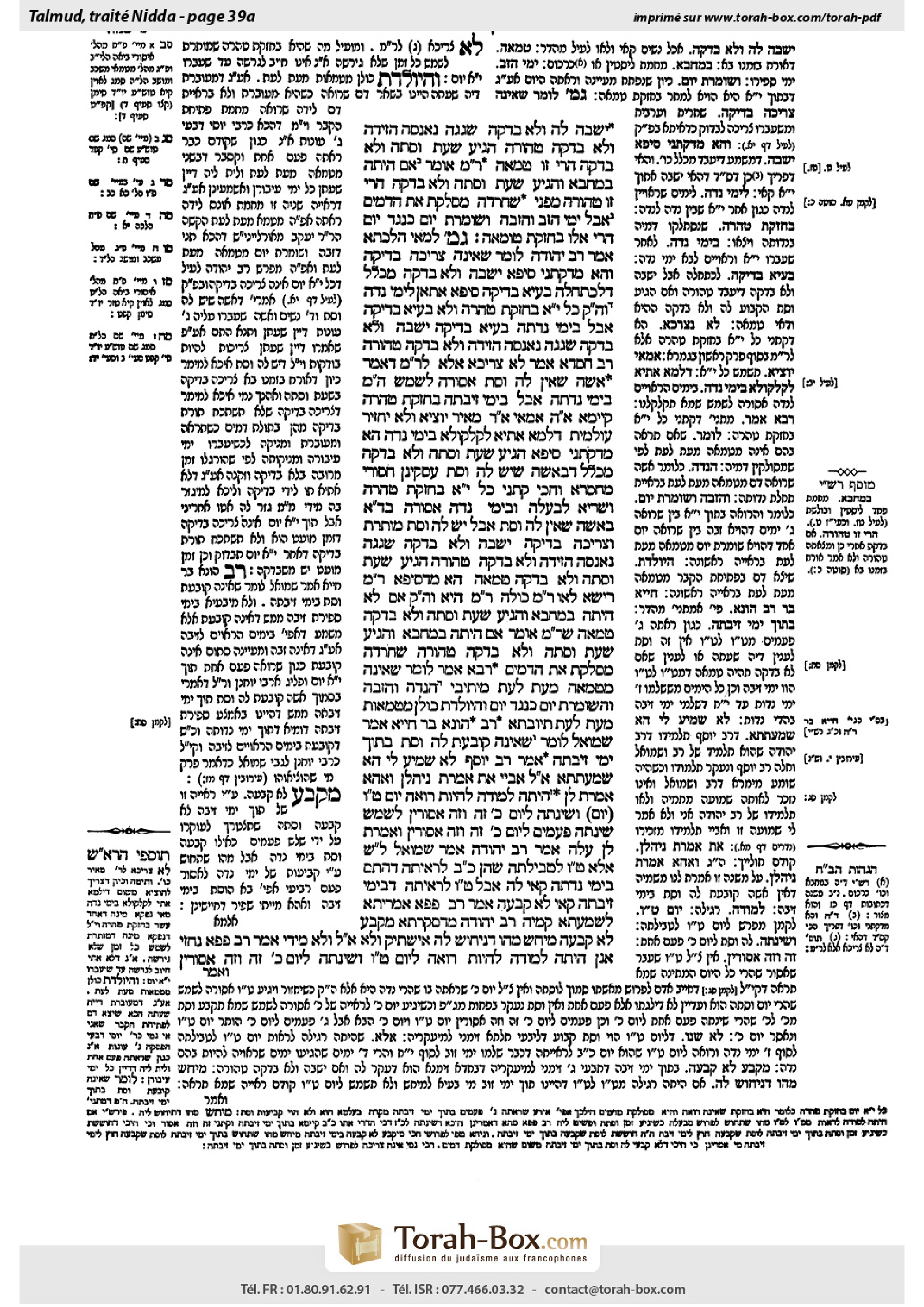
Niddah 39a: Talmud study for Daf Yomi
Daf Yomi is the daily study of one Talmud folio. Explore 37 tractates with scans, Hebrew text, Sefaria English and AI-generated French translations where annotated.
Passage selection and English or AI-generated French translation are available where the scan has annotations. Daf Study is independent of Torah-Box and Sefaria.
Browse Niddah · נידה · All tractatesNiddah 39a text and translations
This page of Niddah includes the Aramaic text, an English translation and an AI-generated French translation, alongside the scan above.
נידה ל״ט א · Aramaic and Hebrew text
יָשְׁבָה לָהּ וְלֹא בָּדְקָה, שָׁגְגָה, נֶאֶנְסָה, הֵזִידָה וְלֹא בָּדְקָה — טְהוֹרָה.
הִגִּיעַ שְׁעַת וִסְתָּהּ, וְלֹא בָּדְקָה — הֲרֵי זוֹ טְמֵאָה. רַבִּי מֵאִיר אוֹמֵר: אִם הָיְתָה בְּמַחֲבֵא, וְהִגִּיעַ שְׁעַת וִסְתָּהּ, וְלֹא בָּדְקָה — הֲרֵי זוֹ טְהוֹרָה, מִפְּנֵי שֶׁחֲרָדָה מְסַלֶּקֶת אֶת הַדָּמִים.
אֲבָל יְמֵי הַזָּב וְהַזָּבָה, וְשׁוֹמֶרֶת יוֹם כְּנֶגֶד יוֹם — הֲרֵי אֵלּוּ בְּחֶזְקַת טוּמְאָה.
גְּמָ' לְמַאי הִלְכְתָא? אָמַר רַב יְהוּדָה: לוֹמַר שֶׁאֵינָהּ צְרִיכָה בְּדִיקָה. וְהָא מִדְּקָתָנֵי סֵיפָא: ״יָשְׁבָה וְלֹא בָּדְקָה״ — מִכְּלָל דִּלְכַתְּחִלָּה בָּעֲיָא בְּדִיקָה!
סֵיפָא אֲתָאן לִימֵי נִדָּה, וְהָכִי קָאָמַר: כׇּל אַחַד עָשָׂר בְּחֶזְקַת טׇהֳרָה, וְלָא בָּעֲיָא בְּדִיקָה, אֲבָל בִּימֵי נִדָּתָהּ — בָּעֲיָא בְּדִיקָה. יָשְׁבָה וְלֹא בָּדְקָה, שָׁגְגָה, נֶאֶנְסָה, הֵזִידָה וְלֹא בָּדְקָה — טְהוֹרָה.
רַב חִסְדָּא אָמַר: לָא צְרִיכָא אֶלָּא לְרַבִּי מֵאִיר, דְּאָמַר: אִשָּׁה שֶׁאֵין לָהּ וֶסֶת אֲסוּרָה לְשַׁמֵּשׁ. הָנֵי מִילֵּי בִּימֵי נִדָּתָהּ, אֲבָל בִּימֵי זִיבָתָהּ בְּחֶזְקַת טׇהֳרָה קָיְימָא.
אִי הָכִי, אַמַּאי אָמַר רַבִּי מֵאִיר: יוֹצִיא וְלֹא יַחְזִיר עוֹלָמִית? דִּלְמָא אָתְיָא לְקַלְקוֹלֵאּ בִּימֵי נִדָּה.
הָא מִדְּקָתָנֵי סֵיפָא: ״הִגִּיעַ שְׁעַת וִסְתָּהּ וְלֹא בָּדְקָה״ — מִכְּלָל דִּבְאִשָּׁה שֶׁיֵּשׁ לָהּ וֶסֶת עָסְקִינַן! חַסּוֹרֵי מִחַסְּרָא וְהָכִי קָתָנֵי: כׇּל אַחַד עָשָׂר בְּחֶזְקַת טׇהֳרָה, וְשַׁרְיָא לְבַעְלָהּ, וּבִימֵי נִדָּה אֲסוּרָה.
בַּמֶּה דְבָרִים אֲמוּרִים? בְּאִשָּׁה שֶׁאֵין לָהּ וֶסֶת, אֲבָל יֵשׁ לָהּ וֶסֶת מוּתֶּרֶת, וּצְרִיכָה בְּדִיקָה. יָשְׁבָה וְלֹא בָּדְקָה, שָׁגְגָה, נֶאֶנְסָה, הֵזִידָה וְלֹא בָּדְקָה — טְהוֹרָה. הִגִּיעַ שְׁעַת וִסְתָּהּ וְלֹא בָּדְקָה — טְמֵאָה.
הָא מִדְּסֵיפָא רַבִּי מֵאִיר, רֵישָׁא לָאו רַבִּי מֵאִיר! כּוּלַּהּ רַבִּי מֵאִיר הִיא, וְהָכִי קָאָמַר: אִם לֹא הָיְתָה בְּמַחֲבֵא וְהִגִּיעַ שְׁעַת וִסְתָּהּ וְלֹא בָּדְקָה — טְמֵאָה, שֶׁרַבִּי מֵאִיר אוֹמֵר: אִם הָיְתָה בְּמַחֲבֵא וְהִגִּיעַ שְׁעַת וִסְתָּהּ וְלֹא בָּדְקָה — טְהוֹרָה, שֶׁחֲרָדָה מְסַלֶּקֶת אֶת הַדָּמִים.
רָבָא אָמַר: לוֹמַר שֶׁאֵינָהּ מְטַמְּאָה מֵעֵת לְעֵת.
מֵיתִיבִי: הַנִּדָּה, וְהַזָּבָה, וְהַשּׁוֹמֶרֶת יוֹם כְּנֶגֶד יוֹם, וְהַיּוֹלֶדֶת — כּוּלָּן מְטַמְּאוֹת מֵעֵת לְעֵת. תְּיוּבְתָּא!
רַב הוּנָא בַּר חִיָּיא אָמַר שְׁמוּאֵל: לוֹמַר שֶׁאֵינָהּ קוֹבַעַת לָהּ וֶסֶת בְּתוֹךְ יְמֵי זִיבָתָהּ. אָמַר רַב יוֹסֵף: לָא שְׁמִיעַ לִי הָא שְׁמַעְתְּתָא.
אֲמַר לֵיהּ אַבָּיֵי: אַתְּ אֲמַרְתְּ נִיהֲלַן, וְאַהָא אֲמַרְתְּ לַן: הָיְתָה לְמוּדָה לִהְיוֹת רוֹאָה יוֹם חֲמִשָּׁה עָשָׂר (יוֹם), וְשִׁינְּתָה לְיוֹם עֶשְׂרִים — זֶה וָזֶה אֲסוּרִין לְשַׁמֵּשׁ. שִׁינְּתָה פַּעֲמַיִם לְיוֹם עֶשְׂרִים — זֶה וָזֶה אֲסוּרִין.
וַאֲמַרְתְּ לַן עֲלַהּ, אָמַר רַב יְהוּדָה אָמַר שְׁמוּאֵל: לָא שְׁנָא אֶלָּא חֲמִשָּׁה עָשָׂר לִטְבִילָתָהּ, שֶׁהֵן עֶשְׂרִים וּשְׁנַיִם לִרְאִיָּתָהּ, דְּהָתָם בִּימֵי נִדָּתָהּ קָאֵי לַהּ, אֲבָל חֲמִשָּׁה עָשָׂר לִרְאִיָּתָהּ, דְּבִימֵי זִיבָתָהּ קָאֵי — לָא קָבְעָה.
אָמַר רַב פָּפָּא: אַמְרִיתַהּ לִשְׁמַעְתָּא קַמֵּיהּ רַב יְהוּדָה מִדִּסְקַרְתָּא, מִקְבָּע לָא קָבְעָה, מֵיחָשׁ מַהוּ דְּנֵיחוּשׁ לַהּ?
אִישְׁתִּיק וְלָא אֲמַר לֵיהּ וְלָא מִידֵי. אָמַר רַב פָּפָּא: ״נֶחְזֵי אֲנַן״, הָיְתָה לְמוּדָה לִהְיוֹת רוֹאָה לְיוֹם חֲמִשָּׁה עָשָׂר וְשִׁינְּתָה לְיוֹם עֶשְׂרִים — זֶה וָזֶה אֲסוּרִין.
Niddah 39a · English translation
If a woman sat and did not examine herself every morning and evening to determine whether she emitted blood and is impure, it makes no difference whether she failed to examine herself unwittingly or due to circumstances beyond her control, or even if she acted intentionally and did not examine herself; she remains ritually pure. She is rendered impure only if she examined herself and was found to have emitted blood.
By contrast, if the time of her menstrual cycle arrived, when she is required to examine herself, and she did not examine herself, that woman is ritually impure, as it is typical for a woman to discharge blood at that time. Rabbi Meir says: If a woman was in hiding from danger, and the time of her menstrual cycle arrived and she did not examine herself on that day, that woman is pure, because fear drives away blood. There is therefore no concern that she might have emitted blood.
But with regard to the seven clean days of the zav and the zava, and with regard to a woman who observes a clean day for a day she experiences a discharge during her days of ziva, if she fails to examine herself on those days, these women have a presumptive status of ritual impurity, as they already experienced a discharge.
GEMARA: The mishna teaches that throughout the eleven days of ziva that follow the seven days of menstruation, a woman has the presumptive status of ritual purity. The Gemara asks: With regard to what halakha is this stated? Rav Yehuda says: This serves to say that she does not require an examination during these days. The Gemara objects: But from the fact that the latter clause teaches: If she sat and did not examine herself she remains ritually pure, it can be inferred that she requires examination ab initio.
The Gemara explains: In the latter clause we arrive at the case of a woman who is in the days of menstruation, not in the days of ziva. And this is what the mishna is saying: For all the eleven days of ziva that follow the days of menstruation, a woman has the presumptive status of ritual purity and she does not require examination. But during the days of her menstruation she requires examination. Nevertheless, if she sat and did not examine herself, whether unwittingly or due to circumstances beyond her control, or even if she acted intentionally and did not examine herself, she remains ritually pure.
Rav Ḥisda said a different answer: The first clause of the mishna is necessary only for the opinion of Rabbi Meir, who said: With regard to a woman who does not have a fixed menstrual cycle, she is forbidden to engage in intercourse, lest she emit blood during intercourse. The mishna is teaching that this statement applies only during the days of her menstruation, but during the days of her ziva even Rabbi Meir concedes that she stands in her presumptive status of purity and may engage in intercourse with her husband.
The Gemara asks: If so, that even according to Rabbi Meir there are days in which a woman who does not have a fixed menstrual cycle is permitted to engage in sexual intercourse with her husband, why did Rabbi Meir say that her husband must divorce her and he may never take her back, even if she eventually develops a fixed menstrual cycle? Let them engage in intercourse during the eleven days of ziva. The Gemara answers: He must divorce her lest the matter lead to failure during the days of menstruation, i.e., in case they come to engage in intercourse during the days of menstruation, when she might experience regular menstrual bleeding.
The Gemara objects: But from the fact that the latter clause teaches: If the time of her menstrual cycle arrived and she did not examine herself, that woman is ritually impure, it can be inferred that we are dealing with a woman who has a fixed menstrual cycle. The Gemara explains: The mishna is incomplete and this is what it is teaching: For all the eleven days of ziva that follow the days of menstruation, a woman has the presumptive status of ritual purity and she is permitted to her husband, but during the days of menstruation she is prohibited to her husband.
In what case is this statement said? In the case of a woman who does not have a fixed menstrual cycle, where there is a concern she might experience bleeding during any of the days of menstruation. But in the case of a woman who has a fixed menstrual cycle, she is permitted to engage in sexual intercourse with her husband, and she requires examination. Nevertheless, if she sat and did not examine herself, whether unwittingly or due to circumstances beyond her control, or even if she acted intentionally and did not examine herself, she remains ritually pure. If the time of her menstrual cycle arrived and she did not examine herself, she is impure.
The Gemara objects: But from the fact that the last clause is in accordance with the opinion of Rabbi Meir, it can be inferred that the first clause is not in accordance with the opinion of Rabbi Meir. The Gemara explains that the entire mishna is in accordance with the opinion of Rabbi Meir, and this is what it is saying: If she was not in hiding and the time of her menstrual cycle arrived and she did not examine herself, she is impure, as Rabbi Meir says: If a woman was in hiding and the time of her menstrual cycle arrived and she did not examine herself, she is pure, as fear drives away blood.
Rava says a different explanation of the first clause of the mishna: The mishna is coming to say that if a woman experiences bleeding during the eleven days of ziva, as she previously had the presumptive status of purity she does not impart impurity retroactively for a twenty-four-hour period to any ritually pure items she touched. It is assumed that she did not emit any blood before this emission.
The Gemara raises an objection from a baraita: With regard to a menstruating woman, and a zava, and a woman who observes a day for a day, and a woman who gave birth, they all impart impurity retroactively for a twenty-four-hour period. A woman who observes a day for a day is one who experiences bleeding for one or two days during her days of ziva, and the baraita teaches that even such a woman imparts impurity retroactively for a twenty-four-hour period. If so, this is a conclusive refutation of Rava’s explanation.
Rav Huna bar Ḥiyya says another explanation of the first clause of the mishna in the name of Shmuel: The mishna is coming to say that a woman does not fix a menstrual cycle for herself during the days of her ziva. In other words, a sighting during these days does not combine with sightings during the previous two periods of ziva to establish a fixed menstrual cycle. The Gemara relates that this statement was recited before Rav Yosef, who said: I did not hear this halakha from Shmuel.
Abaye said to him: But you yourself told us this halakha, and it was with regard to that mishna you told it to us, as we learned in a mishna (63b): If the woman was accustomed to see an emission of blood on the fifteenth day, so that this was her fixed menstrual cycle, and she deviated from her cycle to see an emission on the twentieth day, then on both this day, the fifteenth, and that day, the twentieth, it is prohibited for her to engage in sexual intercourse due to the concern that she might have an emission on either day. If she deviated from her cycle twice, to see an emission on the twentieth day, then on both this day and that day it is prohibited for her to engage in intercourse. If she deviates a third time to see on the twentieth she has established for herself a new fixed menstrual cycle.
Abaye continues: And you said to us with regard to this mishna that Rav Yehuda said that Shmuel said: They taught this halakha only with regard to a woman who normally experiences bleeding fifteen days from her immersion, which are twenty-two days from her sighting of menstrual blood. This means that there, she stands in her days of menstruation. But if she normally experiences bleeding fifteen days from her sighting of menstrual blood, so that she stands in her days of ziva, she has not fixed a menstrual cycle, and the previous cycle is uprooted even if she deviates from it only once.
§ With regard to the ruling that a woman’s menstrual cycle cannot be fixed during her days of ziva, Rav Pappa said: I said this halakha before Rav Yehuda of Diskarta, and I asked him for a clarification of the following matter: Granted, she does not fix a menstrual cycle during the days of ziva, and there is no need for three deviations to uproot her cycle; rather, it is uprooted by even one deviation. But what is the halakha with regard to whether we should be concerned that she might experience bleeding? In other words, if she normally experiences bleeding on a particular day during her days of ziva, must she avoid engaging in sexual intercourse with her husband on that day out of concern that she might emit blood?
Rav Yehuda of Diskarta was silent and did not say anything to Rav Pappa. Therefore, Rav Pappa said: Let us see and try to resolve this ourselves. The mishna cited above states: If the woman was accustomed to see an emission of blood on the fifteenth day, and she deviated from her cycle to see an emission on the twentieth day, then on both this day and that day it is prohibited for her to engage in sexual intercourse.
Niddah 39a · Traduction française (IA)
Si une femme s’est assise sans s’examiner chaque matin et chaque soir pour déterminer si elle avait émis du sang et était devenue impure, peu importe qu’elle ait omis de s’examiner par inadvertance, en raison de circonstances indépendantes de sa volonté, ou même intentionnellement : elle reste rituellement pure. Elle ne devient impure que si elle s’est examinée et qu’il a été constaté qu’elle avait émis du sang.
En revanche, si le moment de son cycle menstruel est arrivé, moment où elle est tenue de s’examiner, et qu’elle ne l’a pas fait, cette femme est rituellement impure, car il est habituel qu’une femme émette du sang à ce moment-là. Rabbi Meïr dit : Si une femme se cachait pour échapper à un danger et que le moment de son cycle menstruel est arrivé sans qu’elle s’examine ce jour-là, elle est pure, car la peur éloigne le sang. Il n’y a donc pas lieu de craindre qu’elle ait émis du sang.
Mais, en ce qui concerne les sept jours de pureté du zav et de la zava, ainsi que la femme qui observe un jour de pureté pour chaque jour où elle a eu un écoulement pendant ses jours de ziva, si ces femmes ne s’examinent pas ces jours-là, elles ont un statut présomptif d’impureté rituelle, puisqu’elles ont déjà eu un écoulement.
GUEMARA : La Michna enseigne que, pendant les onze jours de ziva qui suivent les sept jours de menstruation, une femme a un statut présomptif de pureté rituelle. La Guemara demande : De quelle halakha s’agit-il ? Rav Yehouda dit : Cela signifie qu’elle n’a pas besoin de s’examiner pendant ces jours. La Guemara objecte : Mais puisque la clause suivante enseigne : « Si elle s’est assise sans s’examiner, elle reste rituellement pure », on peut en déduire qu’elle est tenue de s’examiner a priori.
La Guemara explique : Dans la clause suivante, il s’agit du cas d’une femme qui se trouve pendant ses jours de menstruation, et non pendant ses jours de ziva. Voici donc ce qu’enseigne la Michna : Pendant les onze jours de ziva qui suivent les jours de menstruation, une femme a un statut présomptif de pureté rituelle et n’a pas besoin de s’examiner. Mais pendant ses jours de menstruation, elle est tenue de s’examiner. Néanmoins, si elle s’est assise sans s’examiner, que ce soit par inadvertance, en raison de circonstances indépendantes de sa volonté ou même intentionnellement, elle reste rituellement pure.
Rav Ḥisda donne une autre réponse : la première clause de la Michna est nécessaire uniquement selon l’opinion de Rabbi Meïr, qui a dit qu’une femme qui n’a pas de cycle menstruel fixe n’a pas le droit d’avoir des rapports sexuels, de crainte qu’elle n’émette du sang pendant le rapport. La Michna enseigne que cette règle ne s’applique que pendant ses jours de menstruation ; pendant ses jours de ziva, même Rabbi Meïr reconnaît qu’elle conserve son statut présomptif de pureté et peut avoir des rapports avec son mari.
La Guemara demande : Si tel est le cas, si même selon Rabbi Meïr il y a des jours où une femme sans cycle menstruel fixe peut avoir des rapports sexuels avec son mari, pourquoi Rabbi Meïr a-t-il dit que son mari doit la répudier et ne peut jamais la reprendre, même si elle finit par avoir un cycle menstruel fixe ? Qu’ils aient des rapports pendant les onze jours de ziva ! La Guemara répond : Il doit la répudier, de peur que cela ne conduise à une transgression pendant les jours de menstruation, c’est-à-dire qu’ils en viennent à avoir des rapports pendant ces jours, où elle pourrait avoir des saignements menstruels réguliers.
La Guemara objecte : Mais puisque la clause suivante enseigne : « Si le moment de son cycle menstruel est arrivé sans qu’elle s’examine, cette femme est rituellement impure », on peut en déduire qu’il s’agit d’une femme qui a un cycle menstruel fixe. La Guemara explique : La Michna est incomplète ; voici ce qu’elle enseigne : Pendant les onze jours de ziva qui suivent les jours de menstruation, une femme a un statut présomptif de pureté rituelle et elle est permise à son mari, mais pendant ses jours de menstruation, elle lui est interdite.
Dans quel cas cette règle est-elle énoncée ? Dans le cas d’une femme qui n’a pas de cycle menstruel fixe, pour laquelle on craint qu’elle ait des saignements pendant n’importe lequel de ses jours de menstruation. Mais, dans le cas d’une femme qui a un cycle menstruel fixe, elle peut avoir des rapports sexuels avec son mari et elle est tenue de s’examiner. Néanmoins, si elle s’est assise sans s’examiner, que ce soit par inadvertance, en raison de circonstances indépendantes de sa volonté ou même intentionnellement, elle reste rituellement pure. Si le moment de son cycle menstruel est arrivé sans qu’elle s’examine, elle est impure.
La Guemara objecte : Mais puisque la dernière clause suit l’opinion de Rabbi Meïr, on peut en déduire que la première clause ne suit pas son opinion. La Guemara explique que toute la Michna suit l’opinion de Rabbi Meïr. Voici ce qu’elle enseigne : Si elle ne se trouvait pas cachée et que le moment de son cycle menstruel est arrivé sans qu’elle s’examine, elle est impure ; car Rabbi Meïr dit que si une femme se trouvait cachée et que le moment de son cycle menstruel est arrivé sans qu’elle s’examine, elle est pure, car la peur éloigne le sang.
Rava donne une autre explication de la première clause de la Michna : celle-ci vient enseigner que si une femme a des saignements pendant les onze jours de ziva, puisqu’elle avait auparavant un statut présomptif de pureté, elle ne transmet pas rétroactivement l’impureté, pour une période de vingt-quatre heures, aux objets rituellement purs qu’elle a touchés. On présume qu’elle n’avait pas émis de sang avant cet écoulement.
La Guemara soulève une objection à partir d’une baraïta : Une femme menstruée, une zava, une femme qui observe un jour de pureté pour chaque jour d’écoulement et une femme qui a accouché transmettent toutes rétroactivement l’impureté pour une période de vingt-quatre heures. Une femme qui observe un jour de pureté pour chaque jour d’écoulement est une femme qui a des saignements pendant un ou deux jours de ses jours de ziva, et la baraïta enseigne qu’une telle femme transmet elle aussi rétroactivement l’impureté pour une période de vingt-quatre heures. Il s’agit donc d’une réfutation concluante de l’explication de Rava.
Rav Houna bar Ḥiyya donne une autre explication de la première clause de la Michna au nom de Chmouel : celle-ci vient enseigner qu’une femme ne fixe pas de cycle menstruel pendant ses jours de ziva. Autrement dit, un saignement survenu pendant ces jours ne s’ajoute pas aux saignements des deux périodes de ziva précédentes pour établir un cycle menstruel fixe. La Guemara rapporte que cette déclaration fut récitée devant Rav Yossef, qui dit : « Je n’ai pas entendu cette halakha de Chmouel. »
Abayé lui dit : Mais tu nous as toi-même enseigné cette halakha, à propos de cette Michna que tu nous as citée, comme nous l’avons appris dans une Michna (63b) : Si la femme avait l’habitude d’avoir un écoulement de sang le quinzième jour, de sorte que ce jour constituait son cycle menstruel fixe, et qu’elle s’est écartée de son cycle en ayant un écoulement le vingtième jour, il lui est interdit d’avoir des rapports sexuels tant le quinzième jour, « ce jour-ci », que le vingtième, « ce jour-là », car on craint qu’elle ait un écoulement l’un ou l’autre de ces jours. Si elle s’est écartée de son cycle à deux reprises en ayant un écoulement le vingtième jour, il lui est interdit d’avoir des rapports tant « ce jour-ci » que « ce jour-là ». Si, une troisième fois, elle s’écarte de son cycle et a un écoulement le vingtième jour, elle a établi pour elle-même un nouveau cycle menstruel fixe.
Abayé poursuit : Et tu nous as dit, à propos de cette Michna, que Rav Yehouda a dit au nom de Chmouel : « Ils n’ont enseigné cette halakha que dans le cas d’une femme qui a habituellement des saignements quinze jours après son immersion », ce qui correspond à vingt-deux jours après avoir constaté du sang menstruel. Cela signifie que, dans ce cas, elle se trouve pendant ses jours de menstruation. Mais si elle a habituellement des saignements quinze jours après avoir constaté du sang menstruel, de sorte qu’elle se trouve pendant ses jours de ziva, elle n’a pas fixé de cycle menstruel, et le cycle précédent est annulé même si elle ne s’en écarte qu’une seule fois.
§ À propos de la règle selon laquelle le cycle menstruel d’une femme ne peut pas être fixé pendant ses jours de ziva, Rav Pappa dit : J’ai énoncé cette halakha devant Rav Yehouda de Diskarta et lui ai demandé de clarifier le point suivant : Il est entendu qu’elle ne fixe pas de cycle menstruel pendant ses jours de ziva et qu’il n’est pas nécessaire qu’elle s’en écarte trois fois pour annuler son cycle ; une seule déviation suffit. Mais quelle est la halakha quant à la nécessité de craindre qu’elle ait des saignements ? Autrement dit, si elle a habituellement des saignements un jour particulier de ses jours de ziva, doit-elle éviter d’avoir des rapports sexuels avec son mari ce jour-là, de crainte qu’elle n’émette du sang ?
Rav Yehouda de Diskarta garda le silence et ne répondit rien à Rav Pappa. Rav Pappa dit donc : « Réfléchissons et essayons de résoudre nous-mêmes la question. » La Michna citée précédemment enseigne : Si la femme avait l’habitude d’avoir un écoulement de sang le quinzième jour et qu’elle s’est écartée de son cycle en ayant un écoulement le vingtième jour, il lui est interdit d’avoir des rapports sexuels tant « ce jour-ci » que « ce jour-là ».
Traduction française générée par IA à partir de l’édition anglaise de Sefaria. Vérifie toujours un passage avec le texte source.
Text from Sefaria: William Davidson Edition - Vocalized Aramaic (CC BY NC); William Davidson Edition - English (CC BY NC).