Niddah 42b: Talmud study for Daf Yomi
Daf Yomi is the daily study of one Talmud folio. Explore 37 tractates with scans, Hebrew text, Sefaria English and AI-generated French translations where annotated.
Passage selection and English or AI-generated French translation are available where the scan has annotations. Daf Study is independent of Torah-Box and Sefaria.
Browse Niddah · נידה · All tractatesNiddah 42b text and translations
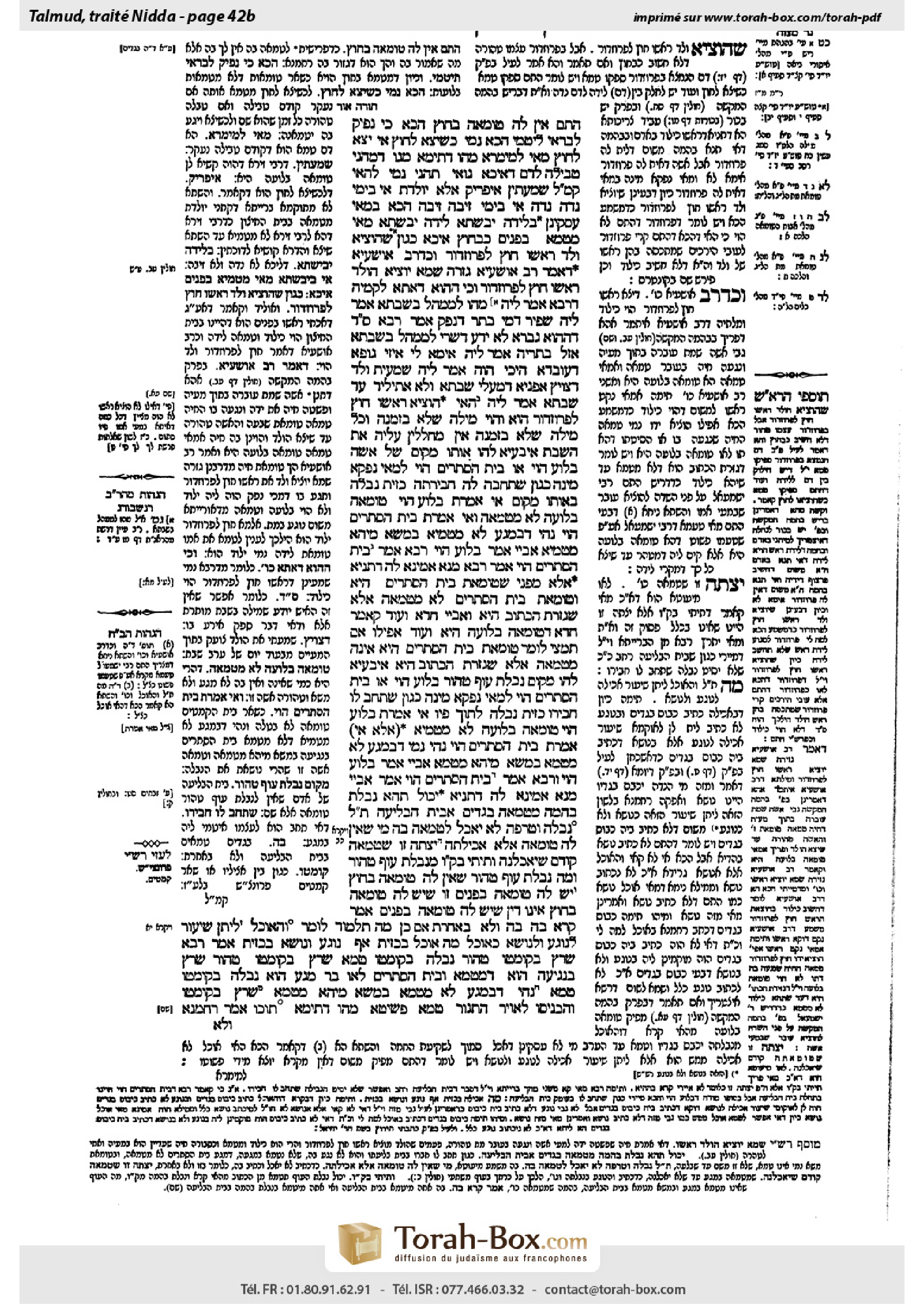
This page of Niddah includes the Aramaic text, an English translation and an AI-generated French translation, alongside the scan above.
נידה מ״ב ב · Aramaic and Hebrew text
הָתָם אֵין לָהּ טוּמְאָה בַּחוּץ, הָכָא כִּי נָפֵיק לְבָרַאי לִיטַמֵּי! הָכָא נָמֵי כְּשֶׁיָּצָא לַחוּץ.
אִי יָצָא לַחוּץ — מַאי לְמֵימְרָא? מַהוּ דְּתֵימָא: מִגּוֹ דְּמַהֲנֵי טְבִילָה לְדָם דְּאִיכָּא גַּוַּאי, תַּהֲנֵי נָמֵי לְהַאי — קָא מַשְׁמַע לַן.
שְׁמַעְתִּין אִיפְּרִיק, אֶלָּא יוֹלֶדֶת: אִי בִּימֵי נִדָּה — נִדָּה, אִי בִּימֵי זִיבָה — זִיבָה.
הָכָא בְּמַאי עָסְקִינַן? בְּלֵידָה יַבִּשְׁתָּא. לֵידָה יַבִּשְׁתָּא, מַאי מְטַמֵּא בִּפְנִים כְּבַחוּץ אִיכָּא?
כְּגוֹן שֶׁהוֹצִיא וָלָד רֹאשׁוֹ חוּץ לַפְּרוֹזְדוֹר, וְכִדְרַב אוֹשַׁעְיָא, דְּאָמַר רַב אוֹשַׁעְיָא: גְּזֵרָה שֶׁמָּא יוֹצִיא הַוָּלָד רֹאשׁוֹ חוּץ לַפְּרוֹזְדוֹר.
וְכִי הָהוּא דַּאֲתָא לְקַמֵּיהּ דְּרָבָא, אֲמַר לֵיהּ: מַהוּ לְמִמְהַל בְּשַׁבְּתָא? אֲמַר לֵיהּ: שַׁפִּיר דָּמֵי. בָּתַר דִּנְפַק, אָמַר רָבָא: סָלְקָא דַעְתָּךְ דְּהַהוּא גַבְרָא לָא יָדַע דִּשְׁרֵי לְמִמְהַל בְּשַׁבְּתָא?! אֲזַל בָּתְרֵיהּ, אֲמַר לֵיהּ: אֵימָא לִי אִיזִי, גּוּפָא דְּעוֹבָדָא הֵיכִי הֲוָה?
אֲמַר לֵיהּ: שְׁמַעִית וָלָד דְּצָוֵיץ אַפַּנְיָא דְּמַעֲלֵי שַׁבְּתָא, וְלָא אִתְיְלִיד עַד שַׁבְּתָא. אֲמַר לֵיהּ: הַאי הוֹצִיא רֹאשׁוֹ חוּץ לַפְּרוֹזְדוֹר הוּא, וְהָוֵי מִילָה שֶׁלֹּא בִּזְמַנָּהּ, וְכׇל מִילָה שֶׁלֹּא בִּזְמַנָּהּ אֵין מְחַלְּלִין עָלֶיהָ אֶת הַשַּׁבָּת.
אִיבַּעְיָא לְהוּ: אוֹתוֹ מָקוֹם שֶׁל אִשָּׁה, בָּלוּעַ הָוֵי אוֹ בֵּית הַסְּתָרִים הָוֵי?
לְמַאי נָפְקָא מִינַּהּ — כְּגוֹן שֶׁתָּחֲבָה לָהּ חֲבֶירְתָּהּ כְּזַיִת נְבֵלָה בְּאוֹתוֹ מָקוֹם. אִי אָמְרַתְּ בָּלוּעַ הָוֵי — טוּמְאָה בְּלוּעָה לָא מְטַמְּאָה, וְאִי אָמְרַתְּ בֵּית הַסְּתָרִים הָוֵי — נְהִי דִּבְמַגָּע לָא מְטַמְּיָא, בְּמַשָּׂא מִיהָא מְטַמְּיָא!
אַבָּיֵי אָמַר: בָּלוּעַ הָוֵי, רָבָא אָמַר: בֵּית הַסְּתָרִים הָוֵי. אָמַר רָבָא: מְנָא אָמֵינָא לַהּ? דְּתַנְיָא: ״אֶלָּא מִפְּנֵי שֶׁטּוּמְאַת בֵּית הַסְּתָרִים הִיא״.
וְטוּמְאַת בֵּית הַסְּתָרִים לֹא מְטַמְּאָה, אֶלָּא שֶׁגְּזֵרַת הַכָּתוּב הִיא.
וְאַבַּיֵּי, חֲדָא וְעוֹד קָאָמַר: חֲדָא, דְּטוּמְאָה בְּלוּעָה הִיא; וְעוֹד, אֲפִילּוּ אִם תִּמְצֵי לוֹמַר טוּמְאַת בֵּית הַסְּתָרִים הִיא — אֵינָהּ מְטַמְּאָה, אֶלָּא שֶׁגְּזֵרַת הַכָּתוּב הִיא.
אִיבַּעְיָא לְהוּ: מְקוֹם נִבְלַת עוֹף טָהוֹר — בָּלוּעַ הָוֵי, אוֹ בֵּית הַסְּתָרִים הָוֵי?
לְמַאי נָפְקָא מִינַּהּ? כְּגוֹן שֶׁתָּחַב לוֹ חֲבֵירוֹ כְּזַיִת נְבֵלָה לְתוֹךְ פִּיו. אִי אָמְרַתְּ בָּלוּעַ הָוֵי — טוּמְאָה בְּלוּעָה לָא מְטַמְּיָא, (אֶלָּא אי) [וְאִי] אָמְרַתְּ בֵּית הַסְּתָרִים הָוֵי — נְהִי נָמֵי דִּבְמַגָּע לֹא מְטַמֵּא, בְּמַשָּׂא מִיהָא מְטַמֵּא.
אַבָּיֵי אָמַר: בָּלוּעַ הָוֵי, וְרָבָא אָמַר: בֵּית הַסְּתָרִים הָוֵי. אָמַר אַבָּיֵי: מְנָא אָמֵינָא לַהּ? דְּתַנְיָא: יָכוֹל תְּהֵא נִבְלַת בְּהֵמָה מְטַמְּאָה בְּגָדִים אַבֵּית הַבְּלִיעָה? תַּלְמוּד לוֹמַר: ״נְבֵלָה וּטְרֵפָה לֹא יֹאכַל לְטׇמְאָה בָהּ״.
מִי שֶׁאֵין לָהּ טוּמְאָה אֶלָּא אֲכִילָתָהּ — יָצְתָה זוֹ שֶׁטְּמֵאָה קוֹדֶם שֶׁיֹּאכְלֶנָּה.
וְתֵיתֵי בְּקַל וָחוֹמֶר מִנִּבְלַת עוֹף טָהוֹר, וּמָה נִבְלַת עוֹף טָהוֹר שֶׁאֵין לָהּ טוּמְאָה בַּחוּץ — יֵשׁ לָהּ טוּמְאָה בִּפְנִים, זוֹ שֶׁיֵּשׁ לָהּ טוּמְאָה בַּחוּץ — אֵינוֹ דִּין שֶׁיֵּשׁ לָהּ טוּמְאָה בִּפְנִים?
אָמַר קְרָא: ״בָּהּ״ — בָּהּ וְלֹא בְּאַחֶרֶת.
אִם כֵּן, מָה תַּלְמוּד לוֹמַר ״וְהָאוֹכֵל״?
לִיתֵּן שִׁיעוּר לְנוֹגֵעַ וּלְנוֹשֵׂא, כְּאוֹכֵל — מָה אוֹכֵל בִּכְזַיִת, אַף נוֹגֵעַ וְנוֹשֵׂא בִּכְזַיִת.
אָמַר רָבָא: שֶׁרֶץ בְּקוּמְּטוֹ — טָהוֹר, נְבֵלָה בְּקוּמְּטוֹ — טָמֵא.
שֶׁרֶץ בְּקוּמְּטוֹ, טָהוֹר — שֶׁרֶץ בִּנְגִיעָה הוּא דִּמְטַמֵּא, וּבֵית הַסְּתָרִים לָאו בַּר מַגָּע הוּא. נְבֵלָה בְּקוּמְּטוֹ, טָמֵא — נְהִי דִּבְמַגָּע לָא מְטַמֵּא, בְּמַשָּׂא מִיהָא מְטַמֵּא.
שֶׁרֶץ בְּקוּמְּטוֹ, וְהִכְנִיסוֹ לַאֲוִיר הַתַּנּוּר — טָמֵא. פְּשִׁיטָא! מַהוּ דְּתֵימָא: ״תּוֹכוֹ״ אָמַר רַחֲמָנָא,
Niddah 42b · English translation
Rabbi Yirmeya elaborates: There, with regard to the impurity contracted by swallowing an unslaughtered bird carcass, this unusual type of impurity does not have an equivalent form of impurity outside, since if one merely touches an unslaughtered bird carcass, he and his garments remain pure. By contrast, here, with regard to the blood of a woman after childbirth, let it become impure only when it emerges outside her body, like all other items that impart impurity by contact once they are no longer encapsulated. Rather, due to this difficulty one must explain that here too, Rabbi Zeira is referring to a case where the blood emerged outside her body after her immersion; otherwise she remains pure.
The Gemara asks: If the reason that the woman is pure is that the blood emerged outside her body, what is the purpose of stating this halakha? Certainly, this blood renders the woman impure upon contact. The Gemara answers that this ruling is necessary, lest you say: Since the woman’s immersion is effective for any blood that is inside her, i.e., it prevents that blood from rendering her impure, let it also be effective for this blood, which did not leave her body until after the immersion. Therefore, Rabbi Zeira teaches us that this is not the halakha.
The Gemara objects: We have resolved our halakha, the statement of Rabbi Zeira, but the difficulty remains with regard to the case of a woman after childbirth. In light of the explanation of Rabbi Zeira’s opinion, the baraita cited at the beginning of the discussion, which states that a woman after childbirth becomes impure by blood that is still inside her body, cannot be interpreted in accordance with his opinion, as Rabbi Zeira maintains that the blood does not render her impure unless it emerges outside her body. Accordingly, the original difficulty remains: If the baraita is referring to blood that she discharges in her days of menstruation, then she is a menstruating woman, and if the baraita is referring to her days of ziva, it has the status of ziva, both are which are already listed in the baraita.
The Gemara explains: Here we are dealing with a dry birth, without the emission of blood, and the baraita is teaching that the woman is rendered impure despite the fact that no blood emerged. The Gemara asks: If the baraita is referring to a dry birth, what blood is there that becomes impure while still inside the woman’s body just as it would when emerging outside her body? There is no blood at all in the case of a dry birth.
The Gemara answers that this clause is not referring to blood; rather, this is a situation where the offspring put his head out of the corridor, in which case it is considered born and renders its mother impure, despite the fact that the rest of its body has not emerged. And this is in accordance with the statement of Rav Oshaya, as Rav Oshaya said: If a midwife inserted her hand into the womb of a woman whose fetus is dead, she is rendered impure due to contact with a corpse. This is a rabbinic decree lest the midwife touch it after the offspring puts his head out of the corridor and it dies afterward, in which case the fetus is considered born and therefore she would be ritually impure by Torah law.
The Gemara adds: And this is similar to an incident involving a certain man who came before Rava and said to him: What is the halakha with regard to whether one may circumcise on Shabbat? Rava said to him: One may well do so. After that man left, Rava said to himself, perplexed: Can it enter your mind that that man did not know that it is permitted to circumcise on Shabbat, and he approached me to inquire about such a basic matter? There must be an unstated aspect to his question. Rava therefore went after him and said to him: Say to me, my friend [izi], how did the incident itself happen?
The man said to Rava: I heard the child making a noise at nightfall on Shabbat eve, before Shabbat began, but it was not born until Shabbat. Rava said to him: This is a baby who put his head out of the corridor, as otherwise his voice would not have been heard. Consequently, it is considered born already on Friday, which means that it should be circumcised on the following Friday, the eighth day after its birth. And if it is circumcised afterward, this is a circumcision performed not at its appointed time, and there is a halakha that although circumcision on the eighth day overrides Shabbat, nevertheless, with regard to any circumcision performed not at its appointed time, one does not desecrate Shabbat for its performance.
§ A dilemma was raised before the Sages: With regard to that place in a woman, i.e., her vagina, how is it defined? Is an impure substance located there considered encapsulated, or is it considered to be located in a concealed part of the body?
The Gemara explains: What is the practical difference as to whether it is considered encapsulated or concealed? The difference is in a case where another woman inserted an olive-bulk of an animal carcass, which is the size that imparts impurity, into that place. If you say that it is considered encapsulated, an encapsulated source of impurity does not impart impurity. But if you say that it is considered located in a concealed part of the body, although the woman does not become impure by contact, she at least becomes impure by carrying the olive-bulk of the carcass.
Abaye said: It is considered encapsulated. Rava said: It is considered located in a concealed part of the body. Rava further said: From where do I say this? As it is taught in a baraita: The verse states: “The woman also with whom a man shall lie carnally, they shall both bathe themselves in water, and be impure until the evening” (Leviticus 15:18). Rabbi Shimon said: Now what does this verse teach? If it teaches that one who touches semen is rendered impure, this is derived from the verse: “Or a man from whom the flow of seed goes out” (Leviticus 22:4). Rather, it must be teaching that a woman who engages in intercourse is rendered impure by the man’s semen, despite the fact that the semen did not touch her on the outside of her body.
The baraita continues: This is a novelty because the semen is a source of impurity located in a concealed part of the body, and ordinarily contact with a source of impurity by a concealed part of the body does not render one impure. But here it is a Torah edict that the woman does become impure in this manner. Evidently, an impure substance in the vagina is considered located in a concealed part of the body.
The Gemara asks: And Abaye, how does he respond to Rava’s proof? The Gemara answers that Abaye would explain that the tanna of this baraita, Rabbi Shimon, states one reason and adds another: One reason that this halakha is a novelty is that semen in the vagina is an encapsulated substance of impurity, and another reason is that even if you were to say that the semen is considered located in a concealed part of the body, which ordinarily does not render one impure, but here, it is a Torah edict that the woman does become impure in this manner.
§ A similar dilemma was raised before the Sages: With regard to the place in a person’s throat where an unslaughtered carcass of a kosher bird renders him ritually impure, how is it defined? Is the meat of the carcass considered encapsulated, or is it considered located in a concealed part of the body?
The Gemara explains: What is the practical difference? The difference is in a case where another individual inserted an olive-bulk of an animal carcass into his mouth. If you say that an impure item located in one’s throat is considered encapsulated, an encapsulated source of impurity does not impart impurity. But if you say that it is considered located in a concealed part of the body, although the one swallowing the meat of the carcass indeed does not become impure by contact, he at least becomes impure by carrying the meat.
Abaye and Rava disagree with regard to this issue as well. Abaye said: It is considered encapsulated, and Rava said: It is considered located in a concealed part of the body. Abaye further said: From where do I say that it is considered encapsulated? As it is taught in a baraita: One might have thought that an animal carcass should impart impurity to garments when it is in one’s throat, like an unslaughtered carcass of a kosher bird. Therefore, the verse states: “That which dies of itself, or is torn of animals, he shall not eat to render himself impure through it” (Leviticus 22:8).
The baraita continues: This verse, which is dealing with impurity through eating, applies to that which has impurity only by means of its consumption, i.e., an unslaughtered carcass of a kosher bird, which imparts impurity solely when it is in one’s throat. Therefore, the verse excludes this animal carcass from impurity by consumption, as it is impure, i.e., it imparts impurity, even before one eats it, by touch and carrying. This ruling, that other sources of impurity do not impart impurity in the throat, supports Abaye’s opinion that an item located in the throat is considered encapsulated, which is why it does not impart impurity.
The Gemara raises a difficulty with regard to the baraita: And let it be derived that an animal carcass imparts impurity to garments when it is in one’s throat by an a fortiori inference from the halakha of an unslaughtered carcass of a kosher bird, in the following manner: If an unslaughtered carcass of a kosher bird, whose status is relatively lenient, as it does not have impurity outside the body, since if one touched it or carried it he is not rendered impure, and yet it has impurity inside the throat, then with regard to this animal carcass, whose status is more stringent, as it does have impurity outside the body, is it not right that it should have impurity inside the throat?
The Gemara answers that the verse states: “That which dies of itself, or is torn of animals, he shall not eat to become impure through it,” which indicates that one becomes impure when the item is in the throat only through it, i.e., an unslaughtered carcass of a kosher bird, and not through another, i.e., an animal carcass.
The Gemara asks: If so, what is the meaning when the verse states with regard to an animal carcass: “And he who eats of its carcass shall wash his clothes and be impure until the evening” (Leviticus 11:40), which indicates that an animal carcass does impart impurity by means of consumption?
The Gemara explains that this verse is written to provide a measure for the impurity of an animal carcass, but this measure applies only to one who touches and to one who carries it, not to one who eats the carcass. This measure is like the amount that one eats. Just as the minimum amount that one eats is an olive-bulk, i.e., this is the minimum measure that has the halakhic status of consumption, so too, the minimum measure of an animal carcass that imparts impurity to one who touches or carries it is an olive-bulk.
§ The Gemara further discusses the impurity of a concealed part of the body. Rava says: If the carcass of a creeping animal is found in the folds [bekometo] of one’s body, e.g., the armpit, he is ritually pure. If the flesh of an animal carcass is found in the folds of one’s body, he is impure.
Rava elaborates: If the carcass of a creeping animal is found in the folds of one’s body he is ritually pure, as it is through contact that a creeping animal imparts impurity, and a concealed part of the body is not susceptible to impurity through contact. By contrast, if the flesh of an animal carcass is found in the folds of one’s body he is impure, as although it does not impart impurity through contact, since it is in a concealed part of the body, it at least imparts impurity by carrying, and he is considered to be carrying the animal carcass.
Rava further said: If there was the carcass of a creeping animal in the folds of one’s body, and he brought the creeping animal that was in the fold into the airspace of a large earthenware vessel, such as an oven, the oven is thereby rendered impure, as is the halakha when a creeping animal is placed in its airspace. The Gemara asks: Isn’t this obvious? The Gemara answers: Lest you say that as the Merciful One states with regard to the impurity of creeping animals: “And any earthenware vessel into whose interior any of them fall, whatever is in it shall be impure, and it you shall break” (Leviticus 11:33), this teaches that impurity applies only if the creeping animal fell inside the vessel itself,
Niddah 42b · Traduction française (IA)
Rabbi Yirmeya développe : Là, à propos de l’impureté contractée en avalant la carcasse d’un oiseau qui n’a pas été abattu rituellement, cette forme inhabituelle d’impureté n’a pas d’équivalent à l’extérieur du corps, car si l’on touche simplement une telle carcasse, ni la personne ni ses vêtements ne deviennent impurs. En revanche, ici, à propos du sang d’une femme après l’accouchement, qu’il ne devienne impur que lorsqu’il sort de son corps, comme tous les autres éléments qui transmettent l’impureté par contact dès lors qu’ils ne sont plus enfermés. Mais, en raison de cette difficulté, il faut expliquer qu’ici aussi, Rabbi Zeira parle d’un cas où le sang est sorti de son corps après son immersion ; sinon, elle reste pure.
La Guemara demande : Si la femme est pure parce que le sang est sorti de son corps, à quoi sert d’énoncer cette halakha ? Ce sang rend certainement la femme impure par contact. La Guemara répond que cette règle est nécessaire, de peur que tu ne dises : puisque l’immersion de la femme est efficace pour tout sang qui se trouve à l’intérieur de son corps, c’est-à-dire qu’elle empêche ce sang de la rendre impure, qu’elle soit également efficace pour ce sang, qui n’est sorti de son corps qu’après l’immersion. Rabbi Zeira nous enseigne donc que telle n’est pas la halakha.
La Guemara objecte : Nous avons résolu notre question concernant la déclaration de Rabbi Zeira, mais la difficulté subsiste au sujet du cas d’une femme après l’accouchement. À la lumière de l’explication de l’opinion de Rabbi Zeira, la baraïta citée au début de la discussion, qui affirme qu’une femme après l’accouchement devient impure à cause du sang qui se trouve encore dans son corps, ne peut être interprétée conformément à son opinion, car Rabbi Zeira soutient que le sang ne la rend impure que s’il sort de son corps. Par conséquent, la difficulté initiale demeure : si la baraïta parle du sang qu’elle perd pendant ses jours de menstruation, elle est alors une femme menstruée ; et si la baraïta parle de ses jours de ziva, le sang a le statut de ziva. Or ces deux cas figurent déjà dans la baraïta.
La Guemara explique : Nous avons ici affaire à un accouchement sans émission de sang, et la baraïta enseigne que la femme devient impure bien qu’aucun sang ne soit sorti. La Guemara demande : Si la baraïta parle d’un accouchement sans émission de sang, quel sang devient impur alors qu’il se trouve encore dans le corps de la femme, comme il le serait en sortant de son corps ? Dans le cas d’un accouchement sans émission de sang, il n’y a pas de sang du tout.
La Guemara répond que cette partie ne parle pas de sang. Il s’agit plutôt d’un cas où l’enfant a fait sortir sa tête du corridor génital ; il est alors considéré comme né et rend sa mère impure, bien que le reste de son corps ne soit pas encore sorti. Cela correspond à la déclaration de Rav Oshaya, car Rav Oshaya a dit : Si une sage-femme introduit sa main dans l’utérus d’une femme dont le fœtus est mort, elle devient impure au contact d’un cadavre. Il s’agit d’un décret rabbinique, de peur que la sage-femme ne le touche après que l’enfant a fait sortir sa tête du corridor génital et qu’il ne meure ensuite ; dans ce cas, le fœtus est considéré comme né et elle serait donc impure selon la Torah.
La Guemara ajoute : Cela ressemble à l’incident d’un certain homme qui se présenta devant Rava et lui demanda : Quelle est la halakha concernant la circoncision le Chabbat ? Rava lui répondit : Il est tout à fait permis de le faire. Après le départ de cet homme, Rava se dit, perplexe : Peut-il te venir à l’esprit que cet homme ignorait qu’il est permis de circoncire le Chabbat et qu’il soit venu me consulter sur une question aussi élémentaire ? Sa question devait comporter un aspect implicite. Rava le rejoignit donc et lui dit : Dis-moi, mon ami [izi], comment l’incident s’est-il réellement produit ?
L’homme dit à Rava : J’ai entendu l’enfant faire du bruit à la tombée de la nuit, la veille du Chabbat, avant le début du Chabbat, mais il n’est né que le Chabbat. Rava lui dit : C’est un bébé qui avait fait sortir sa tête du corridor génital, car autrement on n’aurait pas entendu sa voix. Il est donc considéré comme déjà né le vendredi, ce qui signifie qu’il faut le circoncire le vendredi suivant, le huitième jour après sa naissance. Si on le circoncit plus tard, la circoncision n’a pas lieu à la date prescrite ; or, bien que la circoncision au huitième jour l’emporte sur le Chabbat, on ne profane pas le Chabbat pour une circoncision qui n’a pas lieu à la date prescrite.
§ Les Sages soulevèrent une question : comment définit-on cet endroit chez la femme, c’est-à-dire son vagin ? Une substance impure qui s’y trouve est-elle considérée comme enfermée ou comme située dans une partie dissimulée du corps ?
La Guemara explique : Quelle différence pratique y a-t-il entre le fait de le considérer comme un endroit où les éléments sont enfermés ou comme une partie dissimulée du corps ? La différence concerne le cas où une autre femme introduit à cet endroit un volume équivalent à une olive de carcasse animale, quantité suffisante pour transmettre l’impureté. Si tu dis qu’elle est considérée comme enfermée, une source d’impureté enfermée ne transmet pas l’impureté. Mais si tu dis qu’elle est considérée comme située dans une partie dissimulée du corps, bien que la femme ne devienne pas impure par contact, elle devient au moins impure en portant le volume équivalent à une olive de la carcasse.
Abaye dit : Elle est considérée comme enfermée. Rava dit : Elle est considérée comme située dans une partie dissimulée du corps. Rava dit aussi : D’où est-ce que je déduis cela ? Car il est enseigné dans une baraïta : Le verset dit : « La femme aussi avec laquelle un homme aura des relations sexuelles, ils se laveront tous deux dans l’eau et seront impurs jusqu’au soir » (Lévitique 15:18). Rabbi Shimon dit : Que nous enseigne donc ce verset ? S’il enseigne que celui qui touche du sperme devient impur, cela se déduit du verset : « Ou un homme de qui sort un écoulement de semence » (Lévitique 22:4). Il faut donc qu’il enseigne qu’une femme qui a des relations sexuelles devient impure à cause du sperme de l’homme, bien que le sperme ne l’ait pas touchée à l’extérieur de son corps.
La baraïta poursuit : C’est une nouveauté, car le sperme est une source d’impureté située dans une partie dissimulée du corps, et, normalement, le contact d’une partie dissimulée du corps avec une source d’impureté ne rend pas impur. Mais ici, un décret de la Torah établit que la femme devient impure de cette manière. Il ressort donc qu’une substance impure située dans le vagin est considérée comme se trouvant dans une partie dissimulée du corps.
La Guemara demande : Et Abaye, comment répond-il à la preuve de Rava ? La Guemara répond qu’Abaye expliquerait que le tanna de cette baraïta, Rabbi Shimon, énonce une raison puis en ajoute une autre : l’une des raisons pour lesquelles cette halakha constitue une nouveauté est que le sperme dans le vagin est une source d’impureté enfermée ; une autre raison est que, même si l’on disait que le sperme est considéré comme situé dans une partie dissimulée du corps, ce qui normalement ne rend pas impur, ici, un décret de la Torah établit que la femme devient impure de cette manière.
§ Les Sages soulevèrent une question similaire : comment définit-on l’endroit de la gorge où la carcasse d’un oiseau cachère qui n’a pas été abattu rituellement rend une personne impure ? La chair de la carcasse est-elle considérée comme enfermée ou comme située dans une partie dissimulée du corps ?
La Guemara explique : Quelle est la différence pratique ? Elle concerne le cas où une autre personne introduit dans sa bouche un volume équivalent à une olive de carcasse animale. Si tu dis qu’un élément impur situé dans la gorge est considéré comme enfermé, une source d’impureté enfermée ne transmet pas l’impureté. Mais si tu dis qu’il est considéré comme situé dans une partie dissimulée du corps, bien que celui qui avale la chair de la carcasse ne devienne pas impur par contact, il devient au moins impur en portant la chair.
Abaye et Rava sont également en désaccord sur cette question. Abaye dit : Elle est considérée comme enfermée ; Rava dit : Elle est considérée comme située dans une partie dissimulée du corps. Abaye dit aussi : D’où est-ce que je déduis qu’elle est considérée comme enfermée ? Car il est enseigné dans une baraïta : On aurait pu penser qu’une carcasse animale devrait rendre les vêtements impurs lorsqu’elle se trouve dans la gorge, comme une carcasse d’oiseau cachère qui n’a pas été abattu rituellement. Le verset dit donc : « Ce qui meurt de lui-même ou est déchiré par des animaux, il ne le mangera pas pour se rendre impur par cela » (Lévitique 22:8).
La baraïta poursuit : Ce verset, qui traite de l’impureté par la consommation, s’applique à ce qui ne transmet l’impureté que lorsqu’on le consomme, c’est-à-dire à la carcasse d’un oiseau cachère qui n’a pas été abattu rituellement, laquelle ne transmet l’impureté que lorsqu’elle se trouve dans la gorge. Le verset exclut donc cette carcasse animale de l’impureté par consommation, car elle est impure — c’est-à-dire qu’elle transmet l’impureté — avant même qu’on la mange, par contact ou par port. Cette règle, selon laquelle les autres sources d’impureté ne transmettent pas l’impureté dans la gorge, appuie l’opinion d’Abaye : un élément situé dans la gorge est considéré comme enfermé, et c’est pourquoi il ne transmet pas l’impureté.
La Guemara soulève une difficulté à propos de la baraïta : ne pourrait-on pas déduire qu’une carcasse animale rend les vêtements impurs lorsqu’elle se trouve dans la gorge, par un raisonnement a fortiori fondé sur la halakha de la carcasse d’un oiseau cachère qui n’a pas été abattu rituellement, de la manière suivante : si la carcasse d’un tel oiseau, dont le statut est relativement léger puisqu’elle ne transmet pas l’impureté à l’extérieur du corps — celui qui la touche ou la porte ne devient pas impur —, transmet pourtant l’impureté dans la gorge, alors, pour cette carcasse animale, dont le statut est plus strict puisqu’elle transmet bien l’impureté à l’extérieur du corps, n’est-il pas évident qu’elle devrait transmettre l’impureté dans la gorge ?
La Guemara répond que le verset dit : « Ce qui meurt de lui-même ou est déchiré par des animaux, il ne le mangera pas pour devenir impur par cela », ce qui indique qu’on ne devient impur lorsque l’élément se trouve dans la gorge que par cela, c’est-à-dire par une carcasse d’oiseau cachère qui n’a pas été abattu rituellement, et non par un autre élément, c’est-à-dire une carcasse animale.
La Guemara demande : Si tel est le cas, que signifie le verset qui dit, au sujet d’une carcasse animale : « Celui qui mange de sa carcasse lavera ses vêtements et sera impur jusqu’au soir » (Lévitique 11:40), ce qui indique qu’une carcasse animale transmet l’impureté par la consommation ?
La Guemara explique que ce verset donne la mesure applicable à l’impureté d’une carcasse animale, mais que cette mesure ne s’applique qu’à celui qui la touche ou la porte, et non à celui qui mange la carcasse. Cette mesure correspond à la quantité consommée. De même que la quantité minimale consommée est le volume équivalent à une olive — c’est-à-dire la quantité minimale ayant le statut halakhique de consommation —, de même la quantité minimale de carcasse animale qui transmet l’impureté à celui qui la touche ou la porte est le volume équivalent à une olive.
§ La Guemara poursuit l’étude de l’impureté d’une partie dissimulée du corps. Rava dit : Si la carcasse d’un reptile impur se trouve dans les replis [bekometo] du corps d’une personne, par exemple dans son aisselle, celle-ci est rituellement pure. Si la chair d’une carcasse animale se trouve dans les replis de son corps, elle est impure.
Rava développe : Si la carcasse d’un reptile impur se trouve dans les replis du corps d’une personne, celle-ci est rituellement pure, car le reptile impur transmet l’impureté par contact, et une partie dissimulée du corps ne peut être rendue impure par contact. En revanche, si la chair d’une carcasse animale se trouve dans les replis de son corps, la personne est impure, car, bien que la carcasse ne transmette pas l’impureté par contact puisqu’elle se trouve dans une partie dissimulée du corps, elle la transmet au moins par le port ; la personne est alors considérée comme portant la carcasse animale.
Rava dit encore : Si la carcasse d’un reptile impur se trouvait dans les replis du corps d’une personne et que celle-ci introduise dans l’espace intérieur d’un grand récipient en terre cuite, tel qu’un four, le reptile qui se trouvait dans un repli, le four devient impur, conformément à la halakha selon laquelle un reptile impur placé dans son espace intérieur le rend impur. La Guemara demande : N’est-ce pas évident ? La Guemara répond : De peur que tu ne dises que, puisque le Miséricordieux dit au sujet de l’impureté des reptiles : « Tout récipient en terre cuite à l’intérieur duquel tombera l’un d’eux, tout ce qui s’y trouve sera impur, et vous le briserez » (Lévitique 11:33), cela enseigne que l’impureté ne s’applique que si le reptile impur est tombé à l’intérieur du récipient lui-même,
Traduction française générée par IA à partir de l’édition anglaise de Sefaria. Vérifie toujours un passage avec le texte source.
Text from Sefaria: William Davidson Edition - Vocalized Aramaic (CC BY NC); William Davidson Edition - English (CC BY NC).