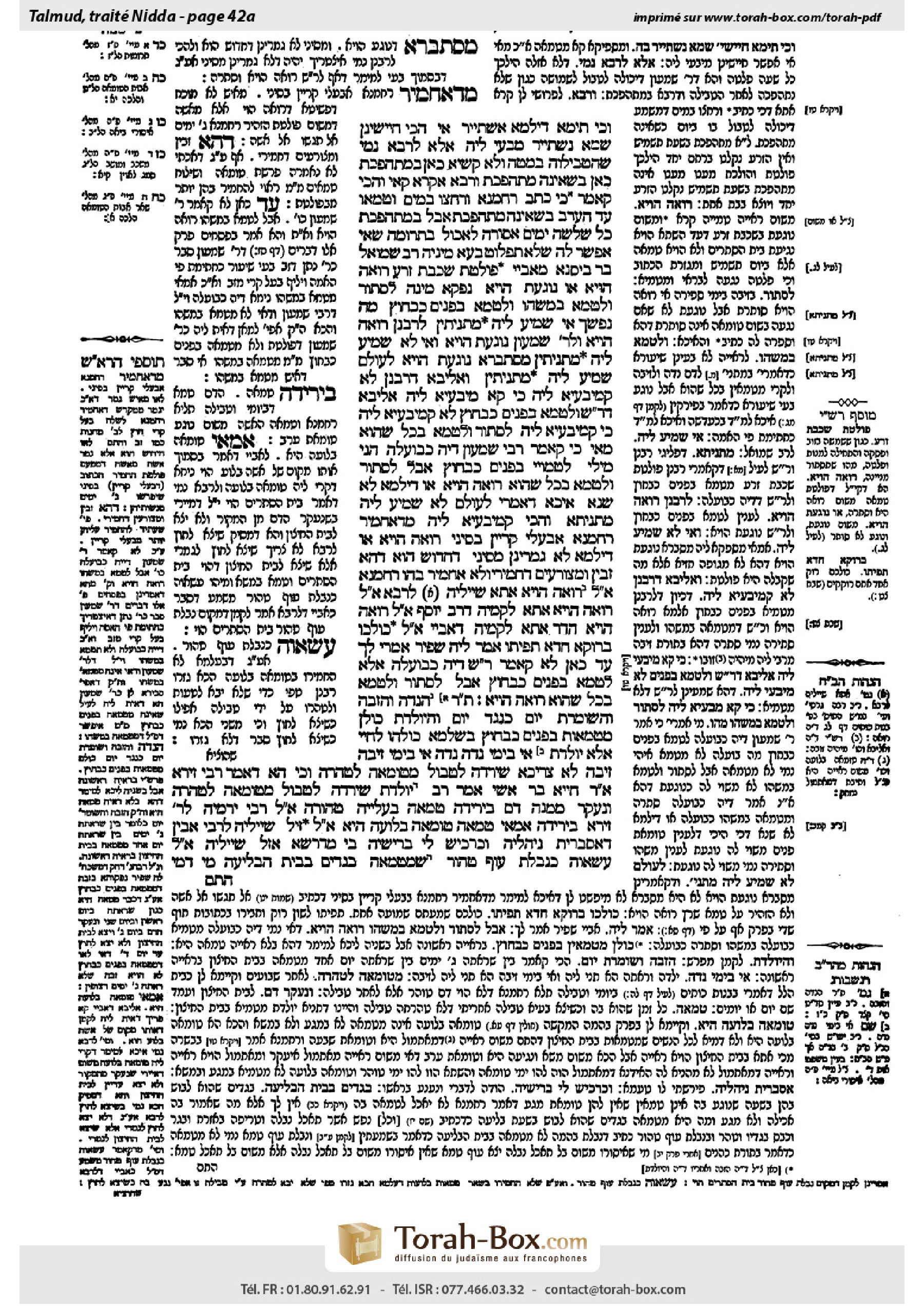
Niddah 42a: Talmud study for Daf Yomi
Daf Yomi is the daily study of one Talmud folio. Explore 37 tractates with scans, Hebrew text, Sefaria English and AI-generated French translations where annotated.
Passage selection and English or AI-generated French translation are available where the scan has annotations. Daf Study is independent of Torah-Box and Sefaria.
Browse Niddah · נידה · All tractatesNiddah 42a text and translations
This page of Niddah includes the Aramaic text, an English translation and an AI-generated French translation, alongside the scan above.
נידה מ״ב א · Aramaic and Hebrew text
וְכִי תֵּימָא דִּילְמָא אִשְׁתְּיַיר — אִי הָכִי, ״חָיְישִׁינַן שְׁמָא נִשְׁתַּיֵּיר״ מִבְּעֵי לֵיהּ!
אֶלָּא: לְרָבָא נָמֵי, שֶׁהִטְבִּילוּהָ בַּמִּטָּה, וְלָא קַשְׁיָא: כָּאן בְּמִתְהַפֶּכֶת, כָּאן בְּשֶׁאֵינָהּ מִתְהַפֶּכֶת.
וְרָבָא אַקְּרָא קָאֵי, וְהָכִי קָאָמַר: כִּי כְּתַב רַחֲמָנָא ״וְרָחֲצוּ בַמַּיִם וְטָמְאוּ עַד הָעָרֶב״ בְּשֶׁאֵינָהּ מִתְהַפֶּכֶת, אֲבָל בְּמִתְהַפֶּכֶת כׇּל שְׁלֹשָׁה יָמִים אֲסוּרָה לֶאֱכוֹל בִּתְרוּמָה, שֶׁאִי אֶפְשָׁר לָהּ שֶׁלֹּא תִּפְלוֹט.
בְּעָא מִינֵּיהּ רַב שְׁמוּאֵל בַּר בִּיסְנָא מֵאַבָּיֵי: פּוֹלֶטֶת שִׁכְבַת זֶרַע, רוֹאָה הָוְיָא אוֹ נוֹגַעַת הָוְיָא?
נָפְקָא מִינַּהּ לִסְתּוֹר, וּלְטַמֵּא בְּמַשֶּׁהוּ, וּלְטַמֵּא בִּפְנִים כְּבַחוּץ.
מָה נַפְשָׁךְ? אִי שְׁמִיעַ לֵיהּ מַתְנִיתִין — לְרַבָּנַן רוֹאָה הָוְיָא, וּלְרַבִּי שִׁמְעוֹן נוֹגַעַת הָוְיָא.
וְאִי לָא שְׁמִיעַ לֵיהּ מַתְנִיתִין, מִסְתַּבְּרָא נוֹגַעַת הָוְיָא!
לְעוֹלָם שְׁמִיעַ לֵיהּ מַתְנִיתִין, וְאַלִּיבָּא דְּרַבָּנַן — לָא קָמִיבַּעְיָא לֵיהּ, כִּי קָא מִיבַּעְיָא לֵיהּ — אַלִּיבָּא דְּרַבִּי שִׁמְעוֹן.
וּלְטַמֵּא בִּפְנִים כְּבַחוּץ — לָא קָמִיבַּעְיָא לֵיהּ, כִּי קָמִיבַּעְיָא לֵיהּ — לִסְתּוֹר וּלְטַמֵּא בְּכֹל שֶׁהוּא, מַאי?
כִּי קָאָמַר רַבִּי שִׁמְעוֹן דַּיָּהּ כְּבוֹעֲלָהּ — הָנֵי מִילֵּי לְטַמּוֹיֵי בִּפְנִים כְּבַחוּץ, אֲבָל לִסְתּוֹר וּלְטַמֵּא בְּכֹל שֶׁהוּא — רוֹאֶה הָוְיָא, אוֹ דִילְמָא לָא שְׁנָא?
אִיכָּא דְאָמְרִי, לְעוֹלָם לָא שְׁמִיעַ לֵיהּ מַתְנִיתָא, וְהָכִי קָמִיבַּעְיָא לֵיהּ: מִדְּאַחְמַיר רַחֲמָנָא אַבַּעֲלֵי קְרָיִין בְּסִינַי — רוֹאָה הָוְיָא.
אוֹ דִילְמָא: לָא גָּמְרִינַן מִסִּינַי, דְּחִדּוּשׁ הוּא, דְּהָא זָבִין וּמְצוֹרָעִים דַּחֲמִירִי, וְלָא אַחְמַיר בְּהוּ רַחֲמָנָא.
אֲמַר לֵיהּ: רוֹאָה הָוְיָא. אֲתָא שַׁיְילֵיהּ לְרָבָא, אֲמַר לֵיהּ: רוֹאָה הָוְיָא. אֲתָא לְקַמֵּיהּ דְּרַב יוֹסֵף, אֲמַר לֵיהּ: רוֹאָה הָוְיָא. הֲדַר אֲתָא לְקַמֵּיהּ דְּאַבָּיֵי, אֲמַר לֵיהּ: כּוּלְּכוּ בְּרוּקָּא חֲדָא תָּפִיתוּ.
אֲמַר לֵיהּ: שַׁפִּיר אָמְרִי לָךְ, עַד כָּאן לָא קָאָמַר רַבִּי שִׁמְעוֹן דַּיָּהּ כְּבוֹעֲלָהּ אֶלָּא לְטַמֵּא בִּפְנִים כְּבַחוּץ, אֲבָל לִסְתּוֹר וּלְטַמֵּא בְּכֹל שֶׁהוּא — רוֹאָה הָוְיָא.
תָּנוּ רַבָּנַן: הַנִּדָּה, וְהַזָּבָה, וְהַשּׁוֹמֶרֶת יוֹם כְּנֶגֶד יוֹם, וְהַיּוֹלֶדֶת — כּוּלָּן מְטַמְּאוֹת בִּפְנִים כְּבַחוּץ.
בִּשְׁלָמָא כּוּלְּהוּ — לְחַיֵּי, אֶלָּא יוֹלֶדֶת: אִי בִּימֵי נִדָּה — נִדָּה, אִי בִּימֵי זִיבָה — זִיבָה!
לָא צְרִיכָא — שֶׁיָּרְדָה לִטְבּוֹל מִטּוּמְאָה לְטׇהֳרָה.
וְכִי הָא דְּאָמַר רַבִּי זֵירָא, אָמַר רַבִּי חִיָּיא בַּר אָשֵׁי, אָמַר רַב: יוֹלֶדֶת שֶׁיָּרְדָה לִטְבּוֹל מִטּוּמְאָה לְטׇהֳרָה, וְנֶעֱקַר מִמֶּנָּה דָּם בַּיְּרִידָה — טְמֵאָה, בָּעֲלִיָּיה — טְהוֹרָה.
אֲמַר לֵיהּ רַבִּי יִרְמְיָה לְרַבִּי זֵירָא: בַּיְּרִידָה אַמַּאי טְמֵאָה? טוּמְאָה בְּלוּעָה הִיא! אֲמַר לֵיהּ: זִיל שַׁיְילֵיהּ לְרַבִּי אָבִין, דְּאַסְבַּרִית נִיהֲלֵיהּ, וְכַרְכֵּישׁ לִי בְּרֵישֵׁיהּ בֵּי מִדְרְשָׁא.
אֲזַל שַׁיְילֵיהּ, אֲמַר לֵיהּ: עֲשָׂאוּהָ כְּנִבְלַת עוֹף טָהוֹר שֶׁמְּטַמְּאָה בְּגָדִים בְּבֵית הַבְּלִיעָה. מִי דָּמֵי?
Niddah 42a · English translation
And if you would say that it is certainly possible that she released all the semen, but Rava’s concern was that perhaps some of it might have remained, if so, he should have said: We are concerned that perhaps some semen remained and will be discharged, rather than: It is impossible for her not to discharge semen throughout this period.
Rather, according to Rava too, this is referring even to a case where others immersed her while she was still in bed and she remained there for three days. And the contradiction is not difficult: Here, in the statement of Rava, he is referring to a woman who turns around in bed from side to side. It is therefore certain that she will discharge semen over the course of three days. There, in the statement of Rabbi Shimon, he is speaking of a woman lying in bed who does not turn around from side to side. Such a woman will not discharge semen at all.
And the statement of Rava is referring to a verse in the Torah, and this is what he is saying: When the Merciful One writes in the Torah, with regard to a man and woman who engaged in intercourse: “They shall both bathe themselves in water, and be impure until the evening” (Leviticus 15:18), which indicates that when evening comes the woman’s purification is complete, it is dealing with a case where she is in bed and does not turn around from side to side. But in a case where she does turn around, she is prohibited from partaking of teruma for the entire three days following the intercourse, as it is impossible for her not to discharge semen throughout this period.
Rav Shmuel bar Bisna asked Abaye: With regard to a woman who discharges semen, is her status that of one who experienced an emission of an impure substance, or is her status that of one who came into contact with an impure substance?
The practical difference between these two possibilities is threefold: Whether or not the discharge negates her counting of seven clean days at the end of the ziva period, whether or not it renders her impure by any amount, and whether or not it renders her impure while still inside her body as it would after emerging out of her body. If it is considered an emission of an impure substance, it negates her count of seven clean days, and it renders her impure even in the slightest amount, and it renders her impure even before it emerges from her body. If it renders her impure because she came into contact with it, it does not negate her count, it renders her impure only if a certain minimum amount emerges, and it renders her impure only after touching the outside of her body.
Before addressing the dilemma, the Gemara raises a difficulty with Rav Shmuel bar Bisna’s question itself: Whichever way you look at it, the question is problematic. If he had heard the baraita cited above, the answer is obvious: According to the Rabbis, her status is that of one who experienced an emission of an impure substance, as the baraita clearly states that in the Rabbis’ opinion the woman is rendered impure even before the semen emerges from her body. And according to Rabbi Shimon, her status is that of one who came into contact with the impure substance, as Rabbi Shimon states that the woman is impure only when the semen emerges from her body.
And if Rav Shmuel bar Bisna did not hear the baraita and was unaware of it, it is certainly more reasonable to assume that her status should be that of one who came into contact with the semen. Why would he think otherwise, as after all, the emitted substance did not originate in her body?
The Gemara answers: Actually, Rav Shmuel bar Bisna had heard the baraita, and he did not raise the dilemma according to the opinion of the Rabbis. According to their opinion it is clear that the woman has the status of one who experienced an emission of an impure bodily substance. Rather, when he raises the dilemma, it is according to the opinion of Rabbi Shimon.
And he does not raise the dilemma with regard to the question of whether or not the semen renders her impure when it is inside the body as it would after emerging outside the body, as Rabbi Shimon states explicitly that the woman is impure only when the semen leaves her body. Rather, when he raises the dilemma, it is only with regard to the other two issues mentioned above: Whether or not the discharge negates her counting of seven clean days at the end of the ziva period, and whether or not it renders her impure in any amount. He therefore asked: What is the status of her discharge of semen with respect to these two matters?
The Gemara explains the sides of the dilemma: It is possible that when Rabbi Shimon says: It is sufficient for her to be like the man who engaged in intercourse with her, this statement applies only with regard to the question of whether or not the semen renders her impure when it is inside the body as it would after emerging outside the body. It does not render her impure unless it touches her body on the outside. But with regard to the question of whether or not the discharge negates her counting of seven clean days at the end of the ziva period and whether or not it renders her impure in any amount, perhaps she is considered impure as one who experienced an emission of an impure substance. Or perhaps there is no difference. Rather, with regard to all three issues she has the status of one who came into contact with an impure substance.
There are those who say a different explanation of Rav Shmuel bar Bisna’s dilemma: Actually, he did not hear the baraita and was unaware of it. And as for the question of why he would think that the woman should have the status of one who experienced an emission of an impure bodily substance, this was his dilemma: Since the Merciful One was stringent before the giving of the Torah on Mount Sinai with regard to men who had experienced a seminal emission, in that they were prohibited from attending that event, as it is stated: “Be ready on the third day; do not come near a woman” (Exodus 19:15), whereas those who had come into contact with other impure items were not prohibited from attending, perhaps the stringency of this particular source of impurity should likewise be applied to a woman who discharges semen. If so, her status should be like one who experienced a seminal emission, rather than one who merely came into contact with semen.
The Gemara explains the other side of the dilemma: Or perhaps we should not derive any halakhot from the instructions given before the revelation at Sinai, as that was a novelty. The Gemara cites a proof for this claim: As that was the case with regard to zavin and lepers, whose impurity is even more stringent than that of one who experiences a seminal emission, but nevertheless the Merciful One was not stringent with regard to them, as He permitted them to attend the ceremony of the giving of the Torah.
After clarifying Rav Shmuel bar Bisna’s dilemma, the Gemara cites Abaye’s answer to him. Abaye said to him: The woman’s status is that of one who experienced an emission of semen. Rav Shmuel bar Bisna came and asked Rava the same question, and he too said to him: The woman’s status is that of one who experienced an emission. He came before Rav Yosef, and he too said to him: Her status is that of one who experienced an emission. Rav Shmuel bar Bisna came back to Abaye and said to him: You are all spewing the same saliva. None of you are teaching anything new, as you all repeat the same unsatisfactory answer.
Abaye said to him: I said well to you, i.e., my response was correct. Rabbi Shimon says that it is sufficient for the woman to be like the man who engaged in intercourse with her only with regard to the question of whether or not the semen renders her impure while still inside her body as it would after emerging out of her body. Rabbi Shimon rules that it does not render her impure until it touches her on the outside. But with regard to the other two issues, i.e., negating the woman’s count of seven clean days at the end of a ziva period and rendering her impure in any amount, Rabbi Shimon maintains that the woman’s status is that of one who experienced an emission. Therefore, the discharge negates her count and renders her impure by any amount.
§ The Gemara continues to discuss types of ritual impurity that apply whether the impure substance is still inside the body or has been discharged from it. The Sages taught in a baraita: With regard to a menstruating woman, a zava, a woman who observes a clean day for a day she experiences a discharge, and a woman after childbirth, they all become impure while the blood is still inside their bodies just as they would be when the blood emerges outside their bodies.
The Gemara asks: Granted, with regard to all those other cases, it is well, i.e., one can understand this ruling with regard to blood that has not left the body. But the halakha of a woman after childbirth is puzzling, since if this is referring to blood that she discharges in her days of menstruation, then she is a menstruating woman, and she is included in the earlier category. Likewise, if the baraita is referring to blood that she discharges in her days of ziva, she has the status of ziva, and once again is included in a previously mentioned category.
The Gemara answers: No, the mention of a woman after childbirth is necessary only in a case where the days of ritual impurity after childbirth, which are seven for a male and fourteen for a female, have passed, and the woman descended to immerse in a ritual bath in order to emerge from her status of impurity to purity.
And the halakha here is like that which Rabbi Zeira said that Rabbi Ḥiyya bar Ashi said that Rav said: In the case of a woman after childbirth who descended to immerse in a ritual bath in order to emerge from her status of impurity to purity, and blood was uprooted from her uterus but it did not leave her body, her status is as follows: If this occurred on her descent to the ritual bath, she remains impure, as the immersion is ineffective. If it happened on her ascent from the bath, she is pure, as her period of purity, which is thirty-three days for a male and sixty-six for a female, has commenced.
Rabbi Yirmeya said to Rabbi Zeira, with regard to this halakha: If the blood emerged on her descent to immerse, why is she impure? After all, the blood is a substance of impurity that is encapsulated inside a body, and there is a halakha that an encapsulated source of impurity does not impart impurity to other items (see Ḥullin 71a). Rabbi Zeira said to Rabbi Yirmeya: Go and ask Rabbi Avin, as I explained to him the reason for this halakha, and he nodded [vekharkish] his head to me in the study hall, in affirmation of my explanation.
The Gemara relates that Rabbi Yirmeya indeed went and asked Rabbi Avin the reason, and Rabbi Avin said to Rabbi Yirmeya: The Sages rendered this blood like the unslaughtered carcass of a kosher bird, which imparts impurity even to the garments of the one who eats it, when there is an olive-bulk of it in his throat, despite the fact that this source of impurity is encapsulated in his body. Rabbi Yirmeya asked Rabbi Avin: Are these cases comparable? How can one compare the impurity of a woman after childbirth to the impurity of one who eats the unslaughtered carcass of a kosher bird?
Niddah 42a · Traduction française (IA)
Et si tu dis qu’il est tout à fait possible qu’elle ait évacué toute la semence, mais que Rava craignait qu’il en soit peut-être resté une partie, alors il aurait dû dire : « Nous craignons qu’il reste peut-être de la semence qui sera ensuite expulsée », plutôt que : « Il est impossible qu’elle n’expulse pas de semence pendant toute cette période. »
Mais, selon Rava aussi, il s’agit d’un cas où d’autres l’ont immergée alors qu’elle était encore alitée et où elle est restée ainsi pendant trois jours. La contradiction n’est pas difficile à résoudre : ici, dans la déclaration de Rava, il s’agit d’une femme qui se retourne dans son lit d’un côté à l’autre. Il est donc certain qu’elle expulsera de la semence au cours des trois jours. Là, dans la déclaration de Rabbi Shimon, il s’agit d’une femme couchée dans son lit qui ne se retourne pas d’un côté à l’autre. Une telle femme n’expulsera pas du tout de semence.
La déclaration de Rava se rapporte à un verset de la Torah, et voici ce qu’il dit : lorsque le Miséricordieux écrit dans la Torah, au sujet d’un homme et d’une femme qui ont eu des rapports : « Ils se laveront tous deux dans l’eau et seront impurs jusqu’au soir » (Lévitique 15:18), ce qui indique qu’à la tombée du soir la purification de la femme est achevée, le verset traite d’un cas où elle est couchée dans son lit et ne se retourne pas d’un côté à l’autre. Mais si elle se retourne, il lui est interdit de consommer de la terouma pendant les trois jours entiers qui suivent les rapports, car il est impossible qu’elle n’expulse pas de semence pendant toute cette période.
Rav Shmuel bar Bisna demanda à Abaye : au sujet d’une femme qui expulse de la semence, son statut est-il celui d’une personne qui a eu une émission d’une substance impure ou celui d’une personne qui est entrée en contact avec une substance impure ?
La différence pratique entre ces deux possibilités porte sur trois points : l’expulsion annule-t-elle ou non son compte des sept jours purs à la fin de la période de ziva ; la rend-elle impure quelle que soit la quantité ou non ; et la rend-elle impure alors que la semence est encore dans son corps, comme après qu’elle en est sortie, ou non ? Si cela est considéré comme une émission d’une substance impure, cela annule son compte des sept jours purs, la rend impure même pour la quantité la plus infime et la rend impure avant même que la semence ne sorte de son corps. Si elle est rendue impure parce qu’elle est entrée en contact avec cette substance, cela n’annule pas son compte ; elle n’est rendue impure que si une quantité minimale en sort, et seulement après que la semence a touché l’extérieur de son corps.
Avant d’aborder la question, la Guemara soulève une difficulté concernant la question même de Rav Shmuel bar Bisna : quel que soit l’angle sous lequel on l’examine, sa question pose problème. S’il avait entendu la baraïta citée plus haut, la réponse serait évidente : selon les Rabbins, son statut est celui d’une personne qui a eu une émission d’une substance impure, puisque la baraïta affirme clairement que, selon eux, la femme est rendue impure avant même que la semence ne sorte de son corps. Et selon Rabbi Shimon, son statut est celui d’une personne qui est entrée en contact avec une substance impure, puisque Rabbi Shimon affirme que la femme n’est impure que lorsque la semence sort de son corps.
Et si Rav Shmuel bar Bisna n’avait pas entendu la baraïta et n’en avait pas connaissance, il serait certainement plus raisonnable de supposer que son statut est celui d’une personne entrée en contact avec la semence. Pourquoi penserait-il le contraire, puisque, après tout, la substance expulsée ne provient pas de son corps ?
La Guemara répond : en réalité, Rav Shmuel bar Bisna avait entendu la baraïta, et il ne soulevait pas la question selon l’opinion des Rabbins. Selon leur opinion, il est clair que la femme a le statut d’une personne qui a eu une émission d’une substance corporelle impure. Il soulevait plutôt la question selon l’opinion de Rabbi Shimon.
Il ne soulevait pas la question de savoir si la semence la rend impure lorsqu’elle est encore dans son corps, comme après qu’elle en est sortie, car Rabbi Shimon affirme explicitement que la femme n’est impure que lorsque la semence quitte son corps. Il soulevait seulement la question des deux autres points mentionnés plus haut : l’expulsion annule-t-elle ou non son compte des sept jours purs à la fin de la période de ziva, et la rend-elle impure quelle que soit la quantité ou non ? Il demanda donc : quel est le statut de l’expulsion de semence à l’égard de ces deux points ?
La Guemara expose les deux possibilités : il se peut que, lorsque Rabbi Shimon dit : « Il suffit qu’elle soit comme l’homme qui a eu des rapports avec elle », cette déclaration ne s’applique qu’à la question de savoir si la semence la rend impure alors qu’elle est encore dans son corps, comme après qu’elle en est sortie. Elle ne la rend impure que si elle touche l’extérieur de son corps. Mais quant à savoir si l’expulsion annule son compte des sept jours purs à la fin de la période de ziva et si elle la rend impure quelle que soit la quantité, peut-être est-elle considérée comme impure à la manière d’une personne qui a eu une émission d’une substance impure. Ou peut-être n’y a-t-il aucune différence : pour les trois points, elle a le statut d’une personne entrée en contact avec une substance impure.
Certains expliquent différemment la question de Rav Shmuel bar Bisna : en réalité, il n’avait pas entendu la baraïta et n’en avait pas connaissance. Quant à la question de savoir pourquoi il aurait pensé que la femme devait avoir le statut d’une personne qui a eu une émission d’une substance corporelle impure, voici ce qui le préoccupait : puisque le Miséricordieux avait imposé une rigueur, avant le don de la Torah au mont Sinaï, aux hommes qui avaient eu une émission séminale — en leur interdisant d’assister à cet événement, comme il est dit : « Tenez-vous prêts pour le troisième jour ; ne vous approchez pas d’une femme » (Exode 19:15) —, alors que ceux qui avaient été en contact avec d’autres objets impurs n’avaient pas l’interdiction d’y assister, peut-être cette rigueur particulière liée à cette source d’impureté devait-elle également s’appliquer à une femme qui expulse de la semence. Son statut serait alors celui d’une personne ayant eu une émission séminale, et non celui d’une personne simplement entrée en contact avec de la semence.
La Guemara expose l’autre possibilité : ou peut-être ne faut-il tirer aucune halakha des instructions données avant la révélation au Sinaï, car il s’agissait d’une disposition exceptionnelle. La Guemara apporte une preuve à cette idée : c’était également le cas des zavin et des lépreux, dont l’impureté est encore plus rigoureuse que celle d’une personne ayant eu une émission séminale ; pourtant, le Miséricordieux ne leur a pas imposé cette rigueur, puisqu’il leur a permis d’assister à la cérémonie du don de la Torah.
Après avoir clarifié la question de Rav Shmuel bar Bisna, la Guemara rapporte la réponse d’Abaye. Abaye lui dit : le statut de la femme est celui d’une personne qui a eu une émission de semence. Rav Shmuel bar Bisna vint ensuite poser la même question à Rava, qui lui répondit lui aussi : le statut de la femme est celui d’une personne qui a eu une émission. Il se présenta devant Rav Yosef, qui lui répondit également : son statut est celui d’une personne qui a eu une émission. Rav Shmuel bar Bisna revint auprès d’Abaye et lui dit : « Vous crachez tous la même salive. Aucun de vous n’enseigne rien de nouveau, puisque vous répétez tous la même réponse insatisfaisante. »
Abaye lui dit : « Je t’ai bien répondu », c’est-à-dire que ma réponse était correcte. Rabbi Shimon dit qu’il suffit que la femme soit comme l’homme qui a eu des rapports avec elle uniquement quant à savoir si la semence la rend impure alors qu’elle est encore dans son corps, comme après qu’elle en est sortie. Selon Rabbi Shimon, elle ne la rend impure que lorsqu’elle la touche à l’extérieur. Mais pour les deux autres points — annuler le compte des sept jours purs de la femme à la fin d’une période de ziva et la rendre impure quelle que soit la quantité —, Rabbi Shimon maintient que son statut est celui d’une personne qui a eu une émission. L’expulsion annule donc son compte et la rend impure quelle que soit la quantité.
§ La Guemara poursuit son examen des types d’impureté rituelle qui s’appliquent que la substance impure soit encore dans le corps ou qu’elle en ait été expulsée. Les Sages ont enseigné dans une baraïta : une femme nidda, une zava, une femme qui observe un jour de pureté pour chaque jour où elle subit un écoulement, et une femme après un accouchement deviennent toutes impures lorsque le sang est encore dans leur corps, tout comme lorsque le sang sort de leur corps.
La Guemara demande : pour tous les autres cas, cela se comprend, c’est-à-dire qu’on peut comprendre cette règle au sujet du sang qui n’a pas quitté le corps. Mais la halakha concernant une femme après un accouchement est énigmatique : si elle concerne le sang qu’elle expulse pendant ses jours de menstruation, alors elle est une femme nidda et relève déjà de la catégorie précédente. De même, si la baraïta concerne le sang qu’elle expulse pendant ses jours de ziva, elle a le statut d’une zava et relève, là encore, d’une catégorie déjà mentionnée.
La Guemara répond : non, la mention d’une femme après un accouchement est nécessaire uniquement dans le cas où les jours d’impureté rituelle après l’accouchement — sept pour un garçon et quatorze pour une fille — sont passés, et où la femme est descendue s’immerger dans un bain rituel afin de sortir de son statut d’impureté et d’accéder à la pureté.
Et la halakha, ici, est conforme à ce que Rabbi Zeira a dit au nom de Rabbi Ḥiyya bar Ashi, qui l’a dit au nom de Rav : dans le cas d’une femme après un accouchement qui est descendue s’immerger dans un bain rituel afin de sortir de son statut d’impureté et d’accéder à la pureté, et dont le sang s’est détaché de l’utérus sans quitter son corps, voici son statut : si cela s’est produit lorsqu’elle descendait dans le bain rituel, elle reste impure, car l’immersion est sans effet. Si cela s’est produit lorsqu’elle remontait du bain, elle est pure, car sa période de pureté a commencé : elle dure trente-trois jours pour un garçon et soixante-six jours pour une fille.
À propos de cette halakha, Rabbi Yirmeya dit à Rabbi Zeira : si le sang est sorti alors qu’elle descendait s’immerger, pourquoi est-elle impure ? Après tout, le sang est une substance impure enfermée dans un corps, et il existe une halakha selon laquelle une source d’impureté enfermée ne transmet pas l’impureté à d’autres objets (voir Ḥullin 71a). Rabbi Zeira dit à Rabbi Yirmeya : va interroger Rabbi Avin, car je lui ai expliqué la raison de cette halakha, et il a hoché [vekharkish] la tête dans la maison d’étude pour approuver mon explication.
La Guemara rapporte que Rabbi Yirmeya alla effectivement demander à Rabbi Avin la raison, et Rabbi Avin dit à Rabbi Yirmeya : les Sages ont assimilé ce sang à la carcasse d’un oiseau pur non abattu, qui transmet l’impureté même aux vêtements de celui qui le mange lorsqu’il en a un volume d’olive dans la gorge, bien que cette source d’impureté soit enfermée dans son corps. Rabbi Yirmeya demanda à Rabbi Avin : ces cas sont-ils comparables ? Comment peut-on comparer l’impureté d’une femme après un accouchement à celle d’une personne qui mange la carcasse d’un oiseau pur non abattu ?
Traduction française générée par IA à partir de l’édition anglaise de Sefaria. Vérifie toujours un passage avec le texte source.
Text from Sefaria: William Davidson Edition - Vocalized Aramaic (CC BY NC); William Davidson Edition - English (CC BY NC).