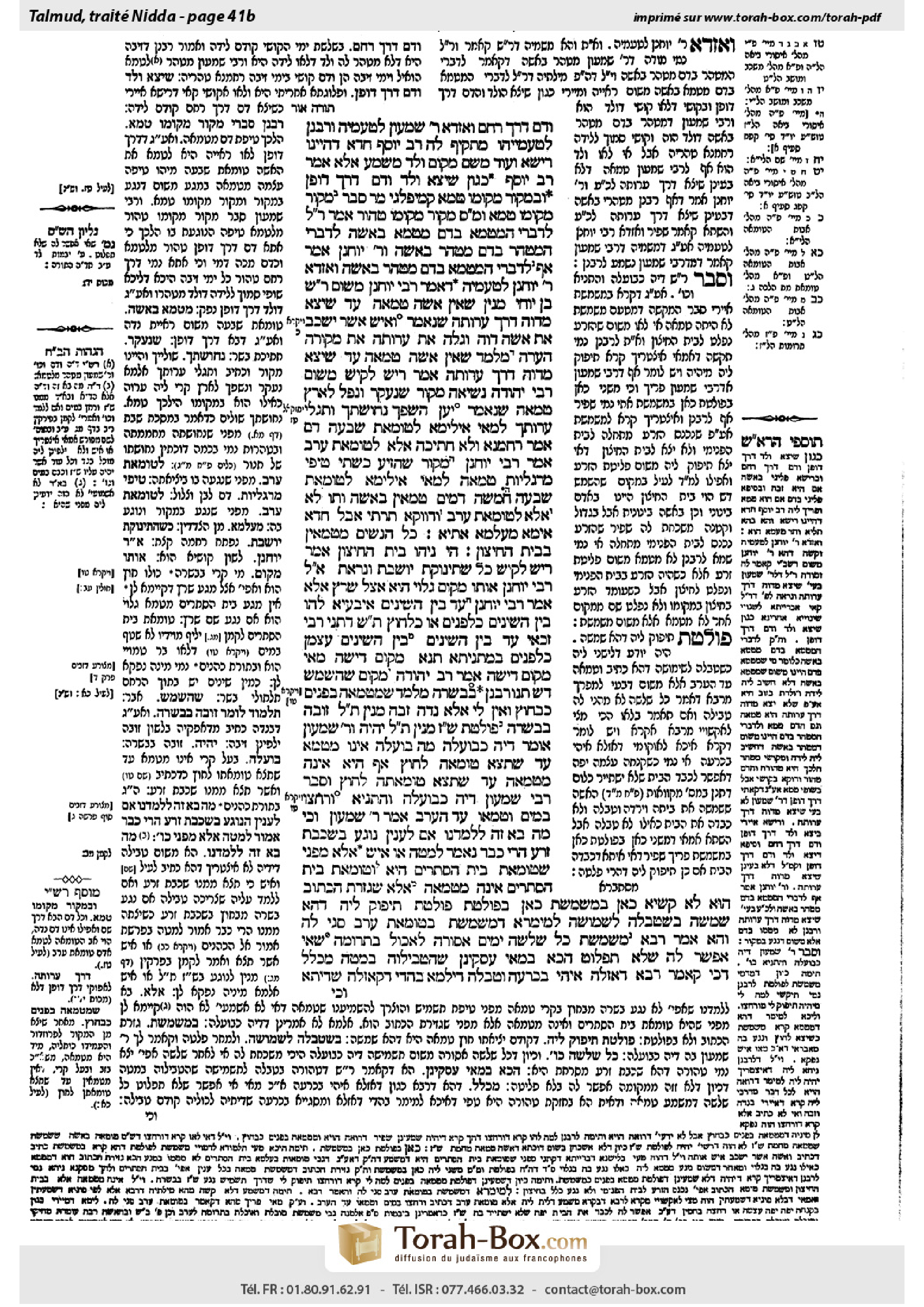
Niddah 41b: Talmud study for Daf Yomi
Daf Yomi is the daily study of one Talmud folio. Explore 37 tractates with scans, Hebrew text, Sefaria English and AI-generated French translations where annotated.
Passage selection and English or AI-generated French translation are available where the scan has annotations. Daf Study is independent of Torah-Box and Sefaria.
Browse Niddah · נידה · All tractatesNiddah 41b text and translations
This page of Niddah includes the Aramaic text, an English translation and an AI-generated French translation, alongside the scan above.
נידה מ״א ב · Aramaic and Hebrew text
וְדָם דֶּרֶךְ רֶחֶם, וְאַזְדָּא רַבִּי שִׁמְעוֹן לְטַעְמֵיהּ וְרַבָּנַן לְטַעְמַיְיהוּ.
מַתְקֵיף לַהּ רַב יוֹסֵף: חֲדָא — דְּהַיְינוּ רֵישָׁא, וְעוֹד — ״מִשָּׁם״ מְקוֹם וָלָד מַשְׁמַע!
אֶלָּא אָמַר רַב יוֹסֵף: כְּגוֹן שֶׁיָּצָא וָלָד וְדָם דֶּרֶךְ דּוֹפֶן,
וּבְמָקוֹר מְקוֹמוֹ טָמֵא קָמִיפַּלְגִי; מָר סָבַר: מָקוֹר מְקוֹמוֹ טָמֵא, וּמָר סָבַר: מָקוֹר מְקוֹמוֹ טָהוֹר.
אָמַר רֵישׁ לָקִישׁ: לְדִבְרֵי הַמְטַמֵּא בַּדָּם — מְטַמֵּא בָּאִשָּׁה, לְדִבְרֵי הַמְטַהֵר בַּדָּם — מְטַהֵר בָּאִשָּׁה. וְרַבִּי יוֹחָנָן אָמַר: אַף לְדִבְרֵי הַמְטַמֵּא בַּדָּם — מְטַהֵר בָּאִשָּׁה.
וְאַזְדָּא רַבִּי יוֹחָנָן לְטַעְמֵיהּ, דְּאָמַר רַבִּי יוֹחָנָן מִשּׁוּם רַבִּי שִׁמְעוֹן בֶּן יוֹחַי: מִנַּיִן שֶׁאֵין אִשָּׁה טְמֵאָה עַד שֶׁיֵּצֵא מַדְוֶהָ דֶּרֶךְ עֶרְוָתָהּ? שֶׁנֶּאֱמַר: ״וְאִישׁ אֲשֶׁר יִשְׁכַּב אֶת אִשָּׁה דָּוָה וְגִלָּה אֶת עֶרְוָתָהּ אֶת מְקוֹרָהּ הֶעֱרָה״, מְלַמֵּד שֶׁאֵין אִשָּׁה טְמֵאָה עַד שֶׁיֵּצֵא מַדְוֶהָ דֶּרֶךְ עֶרְוָתָהּ.
אָמַר רֵישׁ לָקִישׁ מִשּׁוּם רַבִּי יְהוּדָה נְשִׂיאָה: מָקוֹר שֶׁנֶּעֱקַר וְנָפַל לָאָרֶץ — טְמֵאָה, שֶׁנֶּאֱמַר: ״יַעַן הִשָּׁפֵךְ נְחֻשְׁתֵּךְ וַתִּגָּלֶה עֶרְוָתֵךְ״.
לְמַאי? אִילֵימָא לְטוּמְאַת שִׁבְעָה — דָּם אָמַר רַחֲמָנָא, וְלֹא חֲתִיכָה! אֶלָּא לְטוּמְאַת עֶרֶב.
אָמַר רַבִּי יוֹחָנָן: מָקוֹר שֶׁהִזִּיעַ כִּשְׁתֵּי טִיפֵּי מַרְגָּלִיּוֹת — טְמֵאָה. לְמַאי? אִילֵימָא לְטוּמְאַת שִׁבְעָה — חֲמִשָּׁה דָּמִים טְמֵאִין בָּאִשָּׁה וְתוּ לָא! אֶלָּא לְטוּמְאַת עֶרֶב. וְדַוְוקָא תַּרְתֵּי, אֲבָל חֲדָא — אֵימָא מֵעָלְמָא אָתְיָא.
כׇּל הַנָּשִׁים מְטַמְּאִין בַּבַּיִת הַחִיצוֹן. הֵי נִיהוּ בַּיִת הַחִיצוֹן? אָמַר רֵישׁ לָקִישׁ: כֹּל שֶׁתִּינוֹקֶת יוֹשֶׁבֶת וְנִרְאַת.
אֲמַר לֵיהּ רַבִּי יוֹחָנָן: אוֹתוֹ מָקוֹם גָּלוּי הוּא אֵצֶל שֶׁרֶץ! אֶלָּא אָמַר רַבִּי יוֹחָנָן: עַד בֵּין הַשִּׁינַּיִם.
אִיבַּעְיָא לְהוּ: בֵּין הַשִּׁינַּיִם כְּלִפְנִים אוֹ כְּלַחוּץ? תָּא שְׁמַע, דְּתָנֵי רַבִּי זַכַּאי: עַד בֵּין הַשִּׁינַּיִם, בֵּין הַשִּׁינַּיִם עַצְמָן כְּלִפְנִים.
בְּמַתְנִיתָא תָּנָא: מְקוֹם דִּישָׁה. מַאי ״מְקוֹם דִּישָׁה״? אָמַר רַב יְהוּדָה: מְקוֹם שֶׁהַשַּׁמָּשׁ דָּשׁ.
תָּנוּ רַבָּנַן: ״בִּבְשָׂרָהּ״ — מְלַמֵּד שֶׁמְּטַמְּאָה בִּפְנִים כְּבַחוּץ, וְאֵין לִי אֶלָּא נִדָּה, זָבָה מִנַּיִן? תַּלְמוּד לוֹמַר ״זָבָה בִּבְשָׂרָהּ״.
פּוֹלֶטֶת שִׁכְבַת זֶרַע, מִנַּיִן? תַּלְמוּד לוֹמַר ״יִהְיֶה״. וְרַבִּי שִׁמְעוֹן אוֹמֵר: דַּיָּהּ כְּבוֹעֲלָהּ — מָה בּוֹעֲלָהּ אֵינוֹ מְטַמֵּא עַד שֶׁתֵּצֵא טוּמְאָה לַחוּץ, אַף הִיא אֵינָהּ מְטַמְּאָה עַד שֶׁתֵּצֵא טוּמְאָתָהּ לַחוּץ.
וְסָבַר רַבִּי שִׁמְעוֹן דַּיָּהּ כְּבוֹעֲלָהּ? וְהָתַנְיָא: ״וְרָחֲצוּ בַמַּיִם וְטָמְאוּ עַד הָעָרֶב״, אָמַר רַבִּי שִׁמְעוֹן: וְכִי מָה בָּא זֶה לְלַמְּדֵנוּ? אִם לְעִנְיַן נוֹגֵעַ בְּשִׁכְבַת זֶרַע — הֲרֵי כְּבָר נֶאֱמַר לְמַטָּה: ״אוֹ אִישׁ״.
אֶלָּא, מִפְּנֵי שֶׁטּוּמְאַת בֵּית הַסְּתָרִים הִיא, וְטוּמְאַת בֵּית הַסְּתָרִים אֵינָהּ מְטַמְּאָה, אֶלָּא שֶׁגְּזֵרַת הַכָּתוּב הִיא!
לָא קַשְׁיָא — כָּאן בִּמְשַׁמֶּשֶׁת, כָּאן בְּפוֹלֶטֶת.
פּוֹלֶטֶת — תִּיפּוֹק לֵיהּ, דְּהָא שִׁמְּשָׁה! בְּשֶׁטָּבְלָה לְשִׁמּוּשָׁהּ.
לְמֵימְרָא דִּמְשַׁמֶּשֶׁת בְּטוּמְאַת עֶרֶב סַגִּי לַהּ? וְהָא אָמַר רָבָא: מְשַׁמֶּשֶׁת — כׇּל שְׁלֹשָׁה יָמִים אֲסוּרָה לֶאֱכוֹל בִּתְרוּמָה, שֶׁאִי אֶפְשָׁר לָהּ שֶׁלֹּא תִּפְלוֹט.
הָכָא בְמַאי עָסְקִינַן? שֶׁהִטְבִּילוּהָ בַּמִּטָּה, מִכְּלָל דְּכִי קָאָמַר רָבָא דְּאָזְלָה אִיהִי בְּכַרְעַהּ וְטָבְלָה, דִּילְמָא בַּהֲדֵי דְּקָאָזְלָה שְׁדֵיתֵאּ?
Niddah 41b · English translation
and blood emerged through the womb, i.e., vaginally, during the three days preceding the birth. And Rabbi Shimon conforms to his line of reasoning, that a caesarean birth is a full-fledged birth, and therefore the blood that emerged prior to the birth is ritually pure, and the Rabbis conform to their line of reasoning, that a caesarean birth is not halakhically considered a birth, which means that the blood which emerged beforehand is considered the blood of ziva, and is ritually impure.
Rav Yosef objects to this explanation: One difficulty is that according to this interpretation, the latter clause of the baraita is superfluous, as the dispute recorded there is identical to that of the first clause. And furthermore, the words: From there, in the phrase: The blood that emerges from there, indicate that this is referring to a place already mentioned in the baraita, i.e., the place from which the offspring emerged, which is the abdominal incision of the caesarean section, not the vagina.
Rather, Rav Yosef said that this is the explanation of the latter clause of the baraita: It is referring to a situation where both the offspring and blood emerged through the incision in the abdomen. It is in such a case that the first tanna deems the blood which emerged impure and Rabbi Shimon deems it pure.
And the matter with regard to which they disagree is whether or not the location of a woman’s source, i.e., her uterus, is ritually impure. One Sage, the first tanna, holds that the location of a woman’s source is ritually impure, and therefore any blood that emerges from it, regardless of how it came out of her body, is impure as well. And one Sage, Rabbi Shimon, holds that the location of a woman’s source is pure, and blood that emerges from there is also pure. Only uterine blood which emerges vaginally is impure.
§ Reish Lakish says: According to the statement of the one who deems the blood impure, the first tanna, he deems the woman impure as well, as though it were blood of menstruation. Likewise, according to the statement of the one who deems the blood pure, Rabbi Shimon, he deems the woman pure as well. But Rabbi Yoḥanan says: Even according to the statement of the one who deems the blood impure, the first tanna, he deems the woman pure.
And Rabbi Yoḥanan follows his standard line of reasoning here, as Rabbi Yoḥanan said in the name of Rabbi Shimon ben Yoḥai: From where is it derived that a woman does not become impure due to menstruation unless the flow of blood emerges from her nakedness, i.e., genitalia? As it is stated: “And a man who lies with a woman having her flow, and shall uncover her nakedness, he has made naked her source” (Leviticus 20:18) This teaches that a woman is not impure due to menstruation unless the flow emerges from her nakedness.
Reish Lakish says in the name of Rabbi Yehuda Nesia: If a woman’s source, i.e., her uterus, became dislodged and fell out of her body onto the ground, she is ritually impure, as it is stated: “Because your foundation was poured out, and your nakedness was uncovered” (Ezekiel 16:36). The word “foundation” alludes to the uterus, and the verse is referring to it after it has been “poured out,” i.e., detached, as an uncovering of nakedness, which indicates that it is still a source of impurity even after it has been detached from its place.
The Gemara asks: To what kind of impurity is this woman subject in this situation? If we say that she is subject to the impurity of seven days of menstruating women, that is impossible, as the Merciful One states in the Torah that such impurity is caused by “blood” (Leviticus 15:19), and not a piece of flesh. Rather, she is subject to impurity that lasts until the evening, as a result of the surface of her body having come into contact with the uterus, which is a source of impurity.
Rabbi Yoḥanan says: In the case of a woman’s source that discharged two whitish, clear, pearl-like [margaliyyot] drops, she is impure. The Gemara asks: To what kind of impurity is this woman subject in this situation? If we say that she is subject to the impurity of seven days of menstruating women, that is impossible, as the mishna (Nidda 19a) states that there are five distinct colors of ritually impure blood in a woman, but no more, and pearly white is not one of those colors. Rather, she is subject to impurity that lasts until the evening, as a result of her body having come into contact with a discharge from the uterus, which is a source of impurity. And this is the halakha specifically if there were two drops, but if there was only one such drop she is not impure, as I can say that the drop came from elsewhere, not from the uterus.
§ The mishna teaches: All women become ritually impure with the flow of blood from the uterus into the outer chamber, i.e., the vagina, as it is stated: “And her issue in her flesh shall be blood” (Leviticus 15:19). The Gemara asks: What exactly is the outer chamber? Reish Lakish says: Any place which can be seen when a little girl sits with her legs spread. When the blood reaches that area in the vagina, the woman becomes ritually impure.
Rabbi Yoḥanan said to Reish Lakish in objection: That place is considered exposed even with regard to contact with the carcass of a creeping animal. If one comes into contact with the carcass of a creeping animal he becomes impure. This is the halakha only if the animal touches a part of the body that is exposed, not an internal cavity such as the inside of the mouth. Since the area of the vagina described by Reish Lakish is considered an exposed part of the body for the purposes of the impurity imparted by the carcass of a creeping animal, it should not be necessary for the mishna to derive the halakha of her impurity from the expression “in her flesh.” Rather, Rabbi Yoḥanan says: The term outer chamber extends until the area between the teeth-like projections inside the vagina.
A dilemma was raised before the Sages: Is the area between the teeth-like projections itself considered as internal, which would mean that blood there would not render the woman impure, or as external? Come and hear a resolution, as Rabbi Zakkai teaches a baraita: The term outer chamber extends to the area between the teeth-like projections, but the area between the teeth-like projections themselves is considered as internal.
It was taught in a baraita that a woman becomes impure when the blood reaches the place of threshing, which is a euphemism. The Gemara asks: What is the meaning of this euphemism, the place of threshing? Rav Yehuda says: It is referring to the place in the vagina where the penis threshes, i.e., reaches, during intercourse.
§ The Sages taught in a baraita: It is written concerning a menstruating woman: “And if a woman has an issue, and her flow in her flesh shall be blood, she shall be in her menstruation seven days” (Leviticus 15:19). The term “in her flesh” teaches that she becomes impure while the blood is still inside her flesh just as when the blood emerges outside her body. I have derived only that this applies in the case of a menstruating woman. From where is it derived that it applies to a zava as well? The same verse states: “Her flow [zovah] in her flesh.”
From where is it derived that this also applies to a woman who discharges semen after intercourse? The same verse states the apparently superfluous term “shall be.” And Rabbi Shimon says: In the case of discharging semen, it is sufficient for her to be like the man who engaged in intercourse with her: Just as the man who engaged in intercourse with her does not become impure until the source of impurity, the semen, emerges outside his body, so too, she does not become impure until her source of impurity, the semen, emerges outside her body. It does not render her impure while it is still inside her body.
The Gemara asks: And does Rabbi Shimon in fact hold that it is sufficient for her to be like the man who engaged in intercourse with her? But isn’t it taught to the contrary in a baraita: The verse states: “The woman also with whom a man shall lie carnally, they shall both bathe themselves in water, and be impure until the evening” (Leviticus 15:18). Rabbi Shimon said: And what does this verse come to teach us? If it teaches with regard to one who comes into contact with semen that they are impure, it is already stated below (Leviticus 22:4): “Or a man from whom the flow of seed goes out,” from which it is derived that coming into contact with semen renders one impure.
Rather, this verse is necessary because in the case of intercourse the contact with the source of impurity occurs in a concealed part of the body, and contact with impurity by a concealed part of the body generally does not render one impure. But here it is a Torah edict that the woman does become impure in this manner. This baraita proves that according to Rabbi Shimon a woman is rendered impure by semen even when it is inside her body.
The Gemara answers that this is not difficult. Here, this second baraita is dealing with a woman who engages in intercourse, whereas there, the first baraita is dealing with a woman who discharges semen after intercourse. It is only during the act of intercourse that a woman becomes impure due to the semen. If she later discharges semen, she does not become impure, according to Rabbi Shimon, until the semen leaves her body and touches her on the outside.
The Gemara objects: But in the case of a woman who discharges semen, one can derive that she is impure due to the fact that she engaged in intercourse prior to the discharge. The Gemara answers: Rabbi Shimon is referring to a case where she immersed herself, thereby purifying herself from the impurity from her intercourse, and she subsequently discharged semen.
The Gemara asks: Is this to say that in the case of a woman who engages in intercourse it is sufficient for her to simply immerse herself, and then she is in a state of impurity only until evening? But didn’t Rava say: A woman who engages in intercourse is prohibited from partaking of teruma, even if she is married to a priest, for the entire three days following the intercourse, as it is impossible for her not to discharge semen throughout this period, and teruma may not be consumed by one who is impure?
The Gemara answers: Here we are dealing with a case where others immersed the woman while she was still in bed, and she remained there. If she remains lying down, it is possible for her not to discharge semen following intercourse, and the immersion after intercourse purifies her. The Gemara asks: By inference, one can conclude that when Rava said that a woman is in a constant state of impurity for three days after intercourse, he was referring to a case where she walked to the ritual bath by foot and immersed herself. But if so, perhaps while she was walking she released all the semen in her body even before the three days were over, and therefore will not subsequently become impure.
Niddah 41b · Traduction française (IA)
et que du sang est sorti par l’utérus, c’est-à-dire par voie vaginale, au cours des trois jours précédant la naissance. Rabbi Shimon suit son raisonnement habituel : une naissance par césarienne est une naissance à part entière ; par conséquent, le sang sorti avant la naissance est rituellement pur. Les Sages suivent leur raisonnement habituel : une naissance par césarienne n’est pas considérée halakhiquement comme une naissance, ce qui signifie que le sang sorti auparavant est considéré comme du sang de ziva et est rituellement impur.
Rav Yosef objecte à cette explication : selon cette interprétation, la dernière partie de la baraïta est superflue, puisque le désaccord qui y est rapporté est identique à celui de la première partie. De plus, les mots « de là », dans l’expression « le sang qui en sort », indiquent qu’il s’agit d’un endroit déjà mentionné dans la baraïta, à savoir l’endroit d’où le fœtus est sorti : l’incision abdominale de la césarienne, et non le vagin.
Rav Yosef dit plutôt que voici l’explication de la dernière partie de la baraïta : il s’agit d’un cas où le fœtus et le sang sont tous deux sortis par l’incision dans l’abdomen. C’est dans ce cas que le premier tanna considère impur le sang qui est sorti, tandis que Rabbi Shimon le considère pur.
Le désaccord porte sur la question de savoir si l’endroit où se trouve la source de la femme, c’est-à-dire son utérus, est rituellement impur ou non. Le premier tanna estime que cet endroit est rituellement impur ; par conséquent, tout sang qui en sort est impur, quelle que soit la façon dont il a quitté le corps de la femme. Rabbi Shimon, quant à lui, estime que la source de la femme est pure, et que le sang qui en sort est lui aussi pur. Seul le sang utérin qui sort par voie vaginale est impur.
§ Reish Lakish dit : Selon le premier tanna, qui considère le sang comme impur, la femme est elle aussi impure, comme s’il s’agissait de sang menstruel. De même, selon Rabbi Shimon, qui considère le sang comme pur, la femme est elle aussi pure. Mais Rabbi Yoḥanan dit : Même selon le premier tanna, qui considère le sang comme impur, la femme est pure.
Rabbi Yoḥanan suit ici son raisonnement habituel, car il a dit au nom de Rabbi Shimon ben Yoḥai : D’où apprend-on qu’une femme ne devient impure à cause de ses règles que si l’écoulement de sang sort de sa nudité, c’est-à-dire de ses organes génitaux ? Car il est dit : « Si un homme couche avec une femme qui a son écoulement et découvre sa nudité, il a mis à nu sa source » (Lévitique 20:18). Cela enseigne qu’une femme ne devient impure à cause de ses règles que si l’écoulement sort de sa nudité.
Reish Lakish dit au nom de Rabbi Yehuda Nesia : Si la source d’une femme, c’est-à-dire son utérus, se détache et tombe de son corps à terre, elle est rituellement impure, comme il est dit : « Parce que ta base a été répandue et que ta nudité a été découverte » (Ézéchiel 16:36). Le mot « base » fait allusion à l’utérus, et le verset parle de celui-ci après qu’il a été « répandu », c’est-à-dire détaché, comme d’une nudité découverte ; cela indique qu’il reste une source d’impureté même après avoir été détaché de son emplacement.
La Guemara demande : À quel type d’impureté cette femme est-elle soumise dans cette situation ? Si l’on dit qu’elle est soumise à l’impureté de sept jours des femmes menstruées, cela est impossible, car le Miséricordieux indique dans la Torah que cette impureté est causée par du « sang » (Lévitique 15:19), et non par un morceau de chair. Elle est donc soumise à une impureté qui dure jusqu’au soir, parce que la surface de son corps est entrée en contact avec l’utérus, qui est une source d’impureté.
Rabbi Yoḥanan dit : Si la source d’une femme a expulsé deux gouttes blanchâtres, limpides et semblables à des perles [margaliyyot], elle est impure. La Guemara demande : À quel type d’impureté cette femme est-elle soumise dans cette situation ? Si l’on dit qu’elle est soumise à l’impureté de sept jours des femmes menstruées, cela est impossible, car la Michna (Nidda 19a) enseigne qu’il existe cinq couleurs distinctes de sang rituellement impur chez une femme, et pas davantage ; le blanc nacré ne fait pas partie de ces couleurs. Elle est donc soumise à une impureté qui dure jusqu’au soir, parce que son corps est entré en contact avec un écoulement provenant de l’utérus, qui est une source d’impureté. Cette halakha ne s’applique que s’il y avait deux gouttes ; s’il n’y en avait qu’une, elle n’est pas impure, car on peut dire que la goutte venait d’ailleurs et non de l’utérus.
§ La Michna enseigne : Toutes les femmes deviennent rituellement impures lorsque le sang s’écoule de l’utérus vers la chambre extérieure, c’est-à-dire le vagin, comme il est dit : « Son écoulement dans sa chair sera du sang » (Lévitique 15:19). La Guemara demande : Qu’est-ce exactement que la chambre extérieure ? Reish Lakish dit : C’est toute zone que l’on peut voir lorsqu’une petite fille s’assied en écartant les jambes. Lorsque le sang atteint cette zone du vagin, la femme devient rituellement impure.
Rabbi Yoḥanan objecta à Reish Lakish : Cet endroit est considéré comme exposé même en ce qui concerne le contact avec la carcasse d’un animal rampant. Celui qui touche la carcasse d’un animal rampant devient impur. Cette halakha ne s’applique que si l’animal touche une partie exposée du corps, et non une cavité interne comme l’intérieur de la bouche. Puisque la zone du vagin décrite par Reish Lakish est considérée comme une partie exposée du corps aux fins de l’impureté transmise par la carcasse d’un animal rampant, la Michna n’aurait pas dû avoir besoin de déduire la halakha de l’impureté de la femme de l’expression « dans sa chair ». Rabbi Yoḥanan dit plutôt : Le terme « chambre extérieure » s’étend jusqu’à la zone située entre les saillies semblables à des dents à l’intérieur du vagin.
Une question fut soulevée devant les Sages : La zone située entre les saillies semblables à des dents est-elle elle-même considérée comme interne, auquel cas le sang qui s’y trouve ne rendrait pas la femme impure, ou comme externe ? Une réponse peut être déduite de l’enseignement de Rabbi Zakkai dans une baraïta : Le terme « chambre extérieure » s’étend jusqu’à la zone située entre les saillies semblables à des dents, mais la zone entre ces saillies elles-mêmes est considérée comme interne.
Il a été enseigné dans une baraïta qu’une femme devient impure lorsque le sang atteint l’endroit du battage, expression euphémistique. La Guemara demande : Que signifie cette expression, « l’endroit du battage » ? Rav Yehuda dit : Cela désigne l’endroit du vagin où le pénis bat, c’est-à-dire atteint, pendant le rapport sexuel.
§ Les Sages ont enseigné dans une baraïta : À propos d’une femme menstruée, il est écrit : « Si une femme a un écoulement et que son écoulement dans sa chair soit du sang, elle sera dans son impureté menstruelle pendant sept jours » (Lévitique 15:19). L’expression « dans sa chair » enseigne qu’elle devient impure lorsque le sang est encore dans sa chair, tout comme lorsque le sang sort de son corps. Je n’ai établi cette règle que pour une femme menstruée. D’où apprend-on qu’elle s’applique aussi à une zava ? Le même verset dit : « Son écoulement [zovah] dans sa chair ».
D’où apprend-on que cela s’applique aussi à une femme qui expulse du sperme après un rapport sexuel ? Le même verset contient le terme apparemment superflu « sera ». Rabbi Shimon dit : Dans le cas de l’expulsion de sperme, il suffit que la femme soit considérée comme l’homme qui a eu un rapport avec elle : de même que celui-ci ne devient impur que lorsque la source d’impureté, le sperme, sort de son corps, elle non plus ne devient impure que lorsque sa source d’impureté, le sperme, sort de son corps. Le sperme ne la rend pas impure tant qu’il se trouve encore dans son corps.
La Guemara demande : Rabbi Shimon considère-t-il vraiment qu’il suffit que la femme soit comme l’homme qui a eu un rapport avec elle ? Pourtant, n’est-il pas enseigné le contraire dans une baraïta : Le verset dit : « La femme aussi avec laquelle un homme aura une relation charnelle, ils se laveront tous deux dans l’eau et seront impurs jusqu’au soir » (Lévitique 15:18). Rabbi Shimon dit : Que vient nous enseigner ce verset ? S’il enseigne que celui qui entre en contact avec du sperme devient impur, cela est déjà dit plus loin (Lévitique 22:4) : « Ou un homme dont s’écoule le flux de semence », d’où l’on déduit que le contact avec du sperme rend impur.
Ce verset est plutôt nécessaire parce que, lors d’un rapport sexuel, le contact avec la source d’impureté a lieu dans une partie cachée du corps, et le contact avec une source d’impureté par une partie cachée du corps ne rend généralement pas impur. Mais ici, un décret de la Torah établit que la femme devient impure de cette manière. Cette baraïta prouve que, selon Rabbi Shimon, une femme est rendue impure par le sperme même lorsqu’il se trouve à l’intérieur de son corps.
La Guemara répond que ce n’est pas difficile. Ici, cette seconde baraïta traite d’une femme qui a un rapport sexuel, tandis que là, la première baraïta traite d’une femme qui expulse du sperme après le rapport. La femme ne devient impure à cause du sperme que pendant l’acte sexuel. Si elle expulse du sperme par la suite, selon Rabbi Shimon, elle ne devient impure que lorsque le sperme quitte son corps et la touche à l’extérieur.
La Guemara objecte : Mais dans le cas d’une femme qui expulse du sperme, on peut déduire qu’elle est impure du fait qu’elle a eu un rapport sexuel avant l’expulsion. La Guemara répond : Rabbi Shimon parle d’un cas où elle s’est immergée, se purifiant ainsi de l’impureté due à son rapport sexuel, puis a expulsé du sperme.
La Guemara demande : Faut-il donc en conclure que, dans le cas d’une femme qui a un rapport sexuel, il lui suffit de s’immerger pour n’être impure que jusqu’au soir ? Pourtant, Rava n’a-t-il pas dit qu’une femme qui a un rapport sexuel ne peut pas consommer de terouma, même si elle est mariée à un prêtre, pendant les trois jours qui suivent le rapport, car il est impossible qu’elle n’expulse pas de sperme pendant toute cette période, et qu’une personne impure ne peut pas consommer de terouma ?
La Guemara répond : Ici, il s’agit d’un cas où d’autres ont immergé la femme alors qu’elle était encore au lit, et où elle y est restée. Si elle reste allongée, il est possible qu’elle n’expulse pas de sperme après le rapport ; l’immersion après le rapport la purifie donc. La Guemara demande : On peut en déduire que lorsque Rava a dit qu’une femme reste constamment impure pendant les trois jours qui suivent un rapport sexuel, il parlait d’un cas où elle s’est rendue à pied au bain rituel et s’y est immergée. Mais dans ce cas, peut-être a-t-elle expulsé tout le sperme de son corps en marchant, avant même la fin des trois jours, et ne deviendra-t-elle donc pas impure par la suite ?
Traduction française générée par IA à partir de l’édition anglaise de Sefaria. Vérifie toujours un passage avec le texte source.
Text from Sefaria: William Davidson Edition - Vocalized Aramaic (CC BY NC); William Davidson Edition - English (CC BY NC).