Niddah 41a: Talmud study for Daf Yomi
Daf Yomi is the daily study of one Talmud folio. Explore 37 tractates with scans, Hebrew text, Sefaria English and AI-generated French translations where annotated.
Passage selection and English or AI-generated French translation are available where the scan has annotations. Daf Study is independent of Torah-Box and Sefaria.
Browse Niddah · נידה · All tractatesNiddah 41a text and translations
This page of Niddah includes the Aramaic text, an English translation and an AI-generated French translation, alongside the scan above.
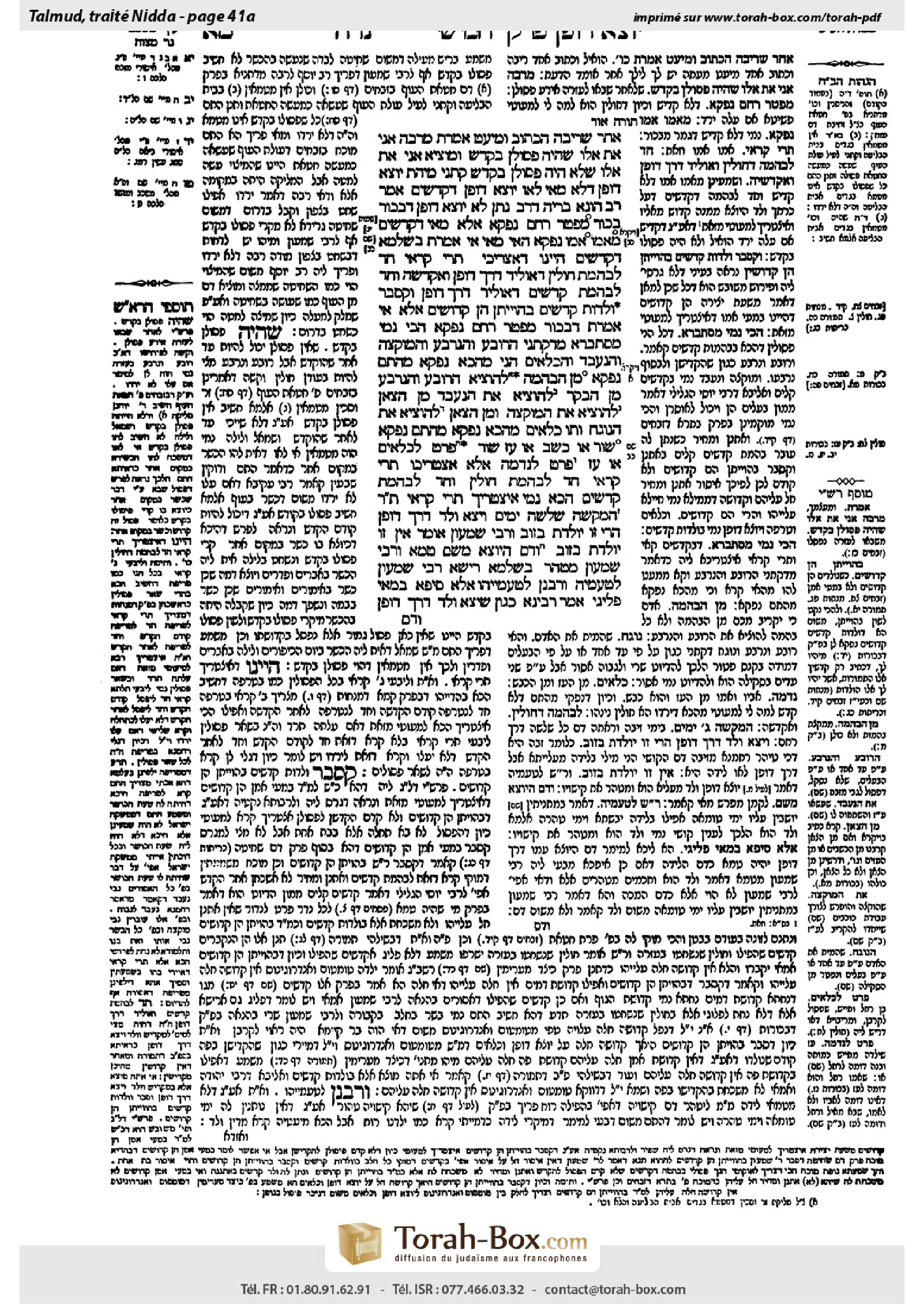
נידה מ״א א · Aramaic and Hebrew text
אַחַר שֶׁרִיבָּה הַכָּתוּב וּמִיעֵט, אָמַרְתָּ: מְרַבֶּה אֲנִי אֶת אֵלּוּ שֶׁהָיָה פְּסוּלָן בַּקֹּדֶשׁ, וּמוֹצִיא אֲנִי אֶת אֵלּוּ שֶׁלֹּא הָיָה פְּסוּלָן בַּקֹּדֶשׁ.
קָתָנֵי מִיהַת יוֹצֵא דּוֹפֶן דְּלָא, מַאי לַָאו יוֹצֵא דּוֹפֶן דְּקָדָשִׁים? אָמַר רַב הוּנָא בְּרֵיהּ דְּרַב נָתָן: לָא, יוֹצֵא דּוֹפֶן דִּבְכוֹר.
בְּכוֹר — מִ״פֶּטֶר רֶחֶם״ נָפְקָא!
אֶלָּא מַאי, דְּקָדָשִׁים? מֵ״אִמּוֹ״ ״אִמּוֹ״ נָפְקָא!
הַאי מַאי? אִי אָמְרַתְּ בִּשְׁלָמָא דְּקָדָשִׁים — הַיְינוּ דְּאִצְטְרִיכִי תְּרֵי קְרָאֵי; חַד לְבֶהֱמַת חוּלִּין דְּאוֹלִיד דֶּרֶךְ דּוֹפֶן וְאַקְדְּשַׁהּ,
וְחַד לְבֶהֱמַת קָדָשִׁים דְּאוֹלִיד דֶּרֶךְ דּוֹפֶן, וְקָסָבַר וַלְדוֹת קָדָשִׁים בַּהֲוָיָיתָן הֵן קְדוֹשִׁים. אֶלָּא אִי אָמְרַתְּ דִּבְכוֹר — מִ״פֶּטֶר רֶחֶם״ נָפְקָא!
הָכִי נָמֵי מִסְתַּבְּרָא, מִדְּקָתָנֵי: ״הָרוֹבֵעַ וְהַנִּרְבָּע וְהַמּוּקְצֶה וְהַנֶּעֱבָד וְהַכִּלְאַיִם״.
הָנֵי מֵהָכָא נָפְקָא? מֵהָתָם נָפְקָא! ״מִן הַבְּהֵמָה״ — לְהוֹצִיא הָרוֹבֵעַ וְהַנִּרְבָּע, ״מִן הַבָּקָר״ — לְהוֹצִיא אֶת הַנֶּעֱבָד, ״מִן הַצֹּאן״ — לְהוֹצִיא אֶת הַמּוּקְצֶה, ״וּמִן הַצֹּאן״ — לְהוֹצִיא אֶת הַנּוֹגֵחַ.
וְתוּ, כִּלְאַיִם מֵהָכָא נָפְקָא? מֵהָתָם נָפְקָא: ״שׁוֹר אוֹ כֶשֶׂב אוֹ עֵז״ — ״שׁוֹר״ פְּרָט לְכִלְאַיִם, ״אוֹ עֵז״ פְּרָט לְנִדְמֶה!
אֶלָּא, אִצְטְרִיכוּ תְּרֵי קְרָאֵי: חַד לְבֶהֱמַת חוּלִּין, וְחַד לְבֶהֱמַת קָדָשִׁים. הָכָא נָמֵי: אִיצְטְרִיךְ תְּרֵי קְרָאֵי.
תָּנוּ רַבָּנַן: הַמְקַשָּׁה שְׁלֹשָׁה יָמִים, וְיָצָא וָלָד דֶּרֶךְ דּוֹפֶן — הֲרֵי זוֹ יוֹלֶדֶת בְּזוֹב, וְרַבִּי שִׁמְעוֹן אוֹמֵר: אֵין זוֹ יוֹלֶדֶת בְּזוֹב, וְדָם הַיּוֹצֵא מִשָּׁם טָמֵא, וְרַבִּי שִׁמְעוֹן מְטַהֵר.
בִּשְׁלָמָא רֵישָׁא — רַבִּי שִׁמְעוֹן לְטַעְמֵיהּ וְרַבָּנַן לְטַעְמַיְיהוּ, אֶלָּא סֵיפָא בְּמַאי פְּלִיגִי? אָמַר רָבִינָא: כְּגוֹן שֶׁיָּצָא וָלָד דֶּרֶךְ דּוֹפֶן
Niddah 41a · English translation
Rabbi Shimon explains: After the verse both included some disqualified offerings in this principle and excluded others, you should say: I include in the items that should not be taken down if they had been placed on the altar those whose disqualification occurred in the sacred area, i.e., the Temple courtyard, in the course of the sacrificial service, e.g., an offering that was slaughtered at night, or whose blood spilled before sprinkling. And I exclude those whose disqualification was not in the sacred area, such as an animal that copulated with a person, as these animals were disqualified before their sacrificial process began. This concludes the baraita.
The Gemara explains how this baraita supports the opinion of Rabbi Yoḥanan. The baraita teaches, in any event, that an animal born by caesarean section is not fit for sacrifice. What, is it not referring to one who consecrates an animal born by caesarean section and renders it a sacrificial animal? Evidently, although Rabbi Shimon maintains that a human birth by caesarean section has the halakhic status of a regular birth, he concedes that animals born in this manner are unfit for sacrifice. Rav Huna, son of Rav Natan, said: No, the baraita is dealing with a firstborn animal born by caesarean section, and it is this animal that is disqualified as an offering. A firstborn animal is sacred only if it emerged from the womb.
The Gemara objects to this interpretation of the baraita: How can it be referring to a firstborn animal? The halakha that firstborn status does not apply to an animal born by caesarean section is derived from the phrase “opens the womb,” which teaches that only animals born in the natural manner are endowed with the sanctity of firstborn animals and may be sacrificed on the altar. Since an animal born by caesarean section is not sacred at all, and it is clear that a non-sacred animal cannot be sacrificed upon the altar, it is obvious that the animal must be taken down if it was placed there in error.
The Gemara responds to this objection: Rather, what would you say? Would you say that the baraita is referring to an ordinary animal, not a firstborn, that had been consecrated as a sacrificial animal? But this animal is not sacred either, as derived from the verbal analogy of the term “its mother” stated with regard to the firstborn and the term “its mother” stated in connection with consecrated animals, as Rabbi Yoḥanan taught earlier. If one seeks to consecrate as an offering an animal that was born by caesarean section, it is not rendered sacred at all. Accordingly, the same reasoning applies as before: It is evident that a non-sacred animal may not be placed on the altar, and it must be removed if placed there in error.
The Gemara rejects this response: What is this comparison between firstborn animals and consecrated animals? Granted, if you say that the baraita is referring to animals that are consecrated to be offerings, that is why two verses are necessary: One verse, the verbal analogy between consecrated animals and firstborn animals, teaches that a non-sacred animal whose mother gave birth to it by caesarean section and whose owner subsequently consecrated it as an offering is not sacred at all, and must therefore be removed from the altar if it was placed there in error.
And one verse: “This is the law of the burnt offering; that is the burnt offering that goes up on the pyre upon the altar” (Leviticus 6:2), teaches with regard to a sacrificial animal that gave birth by caesarean section, that although the offspring is sacred by virtue of its mother’s sanctity, it may not be sacrificed and must be removed from the altar if placed there in error. And the tanna of this baraita maintains that the offspring of sacrificial animals are automatically sacred upon their emergence from the womb. But if you say that the baraita is referring to a firstborn animal that was born by caesarean section, the halakha that this animal is not sacred is derived from the phrase “opens the womb.”
The Gemara adds: So too, it is reasonable to interpret the baraita in this manner, that it is referring to an offspring born to a sacrificial animal by caesarean section, from the fact that the baraita teaches that an animal that copulated with a person, and an animal that was the object of bestiality, and an animal that was set aside for idol worship, and an animal that was worshipped as a deity, and an animal that is an offspring of diverse kinds, must all be removed from the altar if placed there in error.
The Gemara explains: Now are these disqualifications derived from here, from the verse adduced by the baraita? No, they are derived from elsewhere, as taught in a baraita: The verse states: “You shall bring your offering from the cattle, even from the herd or from the flock” (Leviticus 1:2). The expression “from the cattle” serves to exclude from eligibility as an offering an animal that copulated with a person and an animal that was the object of bestiality. The expression “from the herd” serves to exclude an animal that was worshipped as a deity. “From the flock” serves to exclude an animal set aside for idol worship. The word “or” in the expression “or from the flock” serves to exclude an animal that gored a person, killing him. In all these cases the animal cannot be consecrated at all, and therefore it is not necessary for the Torah to teach that they must be removed from the altar if placed there in error.
And furthermore, is the disqualification of an animal born of a mixture of diverse kinds derived from here? No, it is derived from elsewhere, as taught in a baraita: The verse states: “When a bull or a sheep or a goat is born, it shall be seven days under its mother; but from the eighth day and onward it may be accepted for an offering” (Leviticus 22:27). The term “a bull” serves to exclude an offspring of diverse kinds from being used as an offering, The phrase “or a goat” serves to exclude an animal that resembles another, i.e., a sheep that is the offspring of sheep but that looks like a goat, or vice versa. Once again, as these animals cannot be consecrated at all, it is not necessary for the Torah to teach that they must be removed from the altar if placed there in error.
Rather, it must be that two verses are necessary for each of these cases: One to teach that a non-sacred animal that is subject to any of these disqualifications cannot be consecrated, and the other one to teach that with regard to a sacrificial animal that was born with this status by virtue of its mother’s sanctity, if it is subject to one of these disqualifications it may not be sacrificed and must be removed from the altar if placed there in error. Accordingly, it stands to reason that here too, in the case of an animal born by caesarean section, two verses are necessary for the same reason: One for a non-sacred animal, to teach that it cannot be consecrated, and another for the offspring of a sacrificial animal.
§ The Sages taught in a baraita: Although a woman who experiences a discharge of uterine blood after her menstrual period is rendered a zava and must count seven clean days before immersing and purifying herself, if a pregnant woman experiences birth pangs accompanied by bleeding for three days after her menstrual period, at the end of which she gives birth, she is not rendered a zava, as the bleeding is attributed to the childbirth. And if the offspring emerged by caesarean section, she is considered one who has given birth during a period of ziva. But Rabbi Shimon says: She is not considered one who has given birth during a period of ziva. And the blood that emerges from there is ritually impure, but Rabbi Shimon deems it pure.
The Gemara analyzes the baraita: Granted, the first clause of the baraita is clear: Rabbi Shimon conforms to his line of reasoning, cited in the mishna, that birth via caesarean section has the halakhic status of childbirth; and the Rabbis, i.e., the first tanna, conform to their line of reasoning, that birth via caesarean section does not have the halakhic status of childbirth. But in the latter clause, with regard to what matter do they disagree? Ravina said: The latter clause is referring to a case where the offspring emerged by caesarean section,
Niddah 41a · Traduction française (IA)
Rabbi Shimon explique : Puisque le verset a inclus certains sacrifices invalides dans ce principe et en a exclu d’autres, il faut dire que j’inclus parmi les sacrifices qui ne doivent pas être retirés s’ils ont été placés sur l’autel ceux dont l’invalidation est survenue dans le domaine sacré, c’est-à-dire dans la cour du Temple, au cours du service sacrificiel, par exemple un sacrifice abattu de nuit ou dont le sang s’est répandu avant l’aspersion. Et j’exclus ceux dont l’invalidation n’est pas survenue dans le domaine sacré, comme un animal qui a eu des rapports avec une personne, car ces animaux étaient invalides avant même le début de leur processus sacrificiel. C’est la fin de la baraïta.
La Guemara explique en quoi cette baraïta appuie l’opinion de Rabbi Yoḥanan. La baraïta enseigne, en tout état de cause, qu’un animal né par césarienne n’est pas apte au sacrifice. Ne parle-t-elle pas de quelqu’un qui consacre un animal né par césarienne et en fait un animal sacrificiel ? Il apparaît donc que, bien que Rabbi Shimon soutienne qu’une naissance humaine par césarienne a, du point de vue de la halakha, le statut d’une naissance ordinaire, il reconnaît que les animaux nés de cette manière ne sont pas aptes au sacrifice. Rav Huna, fils de Rav Natan, dit : Non, la baraïta traite d’un animal premier-né né par césarienne, et c’est cet animal qui est invalide comme sacrifice. Un animal premier-né n’est sacré que s’il est sorti de la matrice.
La Guemara objecte à cette interprétation de la baraïta : comment pourrait-elle traiter d’un animal premier-né ? La halakha selon laquelle le statut de premier-né ne s’applique pas à un animal né par césarienne est déduite de l’expression « ouvre la matrice », qui enseigne que seuls les animaux nés de manière naturelle reçoivent la sainteté des premiers-nés et peuvent être sacrifiés sur l’autel. Puisqu’un animal né par césarienne n’est pas du tout sacré et qu’il est évident qu’un animal profane ne peut pas être sacrifié sur l’autel, il va de soi que l’animal doit en être retiré s’il y a été placé par erreur.
La Guemara répond à cette objection : Alors, que dirais-tu ? Dirais-tu que la baraïta parle d’un animal ordinaire, qui n’est pas premier-né, et qui a été consacré comme animal sacrificiel ? Mais cet animal n’est pas sacré non plus, comme le montre la déduction par analogie verbale entre l’expression « sa mère », employée à propos du premier-né, et l’expression « sa mère », employée à propos des animaux consacrés, ainsi que Rabbi Yoḥanan l’a enseigné précédemment. Si l’on cherche à consacrer comme sacrifice un animal né par césarienne, celui-ci n’acquiert aucune sainteté. Le même raisonnement s’applique donc que précédemment : il est évident qu’un animal profane ne peut pas être placé sur l’autel et doit en être retiré s’il y a été placé par erreur.
La Guemara rejette cette réponse : quel est ce rapprochement entre les animaux premiers-nés et les animaux consacrés ? Certes, si tu dis que la baraïta parle d’animaux consacrés comme sacrifices, on comprend pourquoi deux versets sont nécessaires : un verset, l’analogie verbale entre les animaux consacrés et les animaux premiers-nés, enseigne qu’un animal profane né par césarienne, que son propriétaire a ensuite consacré comme sacrifice, n’est pas du tout sacré et doit donc être retiré de l’autel s’il y a été placé par erreur.
Et un verset — « Voici la loi de l’holocauste : c’est l’holocauste qui monte sur le brasier, sur l’autel » (Lévitique 6, 2) — enseigne au sujet d’un animal sacrificiel qui a mis bas par césarienne que, bien que le petit soit sacré du fait de la sainteté de sa mère, il ne peut pas être sacrifié et doit être retiré de l’autel s’il y a été placé par erreur. Et le tanna de cette baraïta soutient que les petits des animaux sacrificiels deviennent automatiquement sacrés dès leur sortie de la matrice. Mais si tu dis que la baraïta parle d’un animal premier-né né par césarienne, la halakha selon laquelle cet animal n’est pas sacré est déduite de l’expression « ouvre la matrice ».
La Guemara ajoute : Il est également raisonnable d’interpréter la baraïta de cette manière, comme parlant d’un petit né par césarienne d’un animal sacrificiel, car la baraïta enseigne qu’un animal qui a eu des rapports avec une personne, un animal qui a été l’objet de rapports avec un animal, un animal réservé au culte idolâtre, un animal adoré comme une divinité et un animal issu d’un croisement d’espèces doivent tous être retirés de l’autel s’ils y ont été placés par erreur.
La Guemara explique : Ces invalidations sont-elles donc déduites d’ici, du verset cité par la baraïta ? Non, elles sont déduites d’ailleurs, comme l’enseigne une baraïta : le verset dit : « Tu apporteras ton offrande parmi le bétail, parmi le gros ou le petit bétail » (Lévitique 1, 2). L’expression « parmi le bétail » sert à exclure de l’aptitude au sacrifice un animal qui a eu des rapports avec une personne et un animal qui a été l’objet de rapports avec un animal. L’expression « parmi le gros bétail » sert à exclure un animal adoré comme une divinité. « Parmi le petit bétail » sert à exclure un animal réservé au culte idolâtre. Le mot « ou », dans l’expression « ou parmi le petit bétail », sert à exclure un animal qui a encorné une personne et l’a tuée. Dans tous ces cas, l’animal ne peut pas du tout être consacré ; il n’est donc pas nécessaire que la Torah enseigne qu’il doit être retiré de l’autel s’il y a été placé par erreur.
Et en outre, l’invalidation d’un animal issu d’un croisement d’espèces est-elle déduite d’ici ? Non, elle est déduite d’ailleurs, comme l’enseigne une baraïta : le verset dit : « Lorsqu’un taureau, un mouton ou une chèvre naît, il restera sept jours sous sa mère ; mais à partir du huitième jour, il pourra être accepté comme offrande » (Lévitique 22, 27). Le terme « un taureau » sert à exclure un animal issu d’un croisement d’espèces des animaux pouvant être offerts en sacrifice. L’expression « ou une chèvre » sert à exclure un animal qui ressemble à un autre, c’est-à-dire un mouton issu de moutons mais qui ressemble à une chèvre, ou inversement. Là encore, puisque ces animaux ne peuvent pas du tout être consacrés, il n’est pas nécessaire que la Torah enseigne qu’ils doivent être retirés de l’autel s’ils y ont été placés par erreur.
Il faut plutôt dire que deux versets sont nécessaires dans chacun de ces cas : l’un pour enseigner qu’un animal profane frappé par l’une de ces invalidations ne peut pas être consacré, et l’autre pour enseigner qu’un animal sacrificiel né avec ce statut du fait de la sainteté de sa mère ne peut pas être sacrifié s’il est frappé par l’une de ces invalidations et doit être retiré de l’autel s’il y a été placé par erreur. Il est donc logique qu’ici aussi, dans le cas d’un animal né par césarienne, deux versets soient nécessaires pour la même raison : l’un à propos d’un animal profane, pour enseigner qu’il ne peut pas être consacré, et l’autre à propos du petit d’un animal sacrificiel.
§ Les Sages ont enseigné dans une baraïta : bien qu’une femme qui présente un écoulement de sang utérin après ses règles devienne zava et doive compter sept jours purs avant de s’immerger et de se purifier, si une femme enceinte éprouve des douleurs de l’enfantement accompagnées de saignements pendant trois jours après ses règles, au terme desquels elle accouche, elle ne devient pas zava, car le saignement est attribué à l’accouchement. Et si le petit est sorti par césarienne, elle est considérée comme ayant accouché pendant une période de ziva. Mais Rabbi Shimon dit : elle n’est pas considérée comme ayant accouché pendant une période de ziva. Et le sang qui en sort est rituellement impur, mais Rabbi Shimon le déclare pur.
La Guemara analyse la baraïta : certes, la première partie de la baraïta est claire : Rabbi Shimon suit la ligne de raisonnement qu’il a exposée dans la Michna, selon laquelle une naissance par césarienne a, du point de vue de la halakha, le statut d’un accouchement ; et les Rabbins, c’est-à-dire le premier tanna, suivent leur ligne de raisonnement, selon laquelle une naissance par césarienne n’a pas le statut d’un accouchement. Mais dans la dernière partie, sur quel point sont-ils en désaccord ? Ravina dit : la dernière partie traite d’un cas où le petit est sorti par césarienne,
Traduction française générée par IA à partir de l’édition anglaise de Sefaria. Vérifie toujours un passage avec le texte source.
Text from Sefaria: William Davidson Edition - Vocalized Aramaic (CC BY NC); William Davidson Edition - English (CC BY NC).