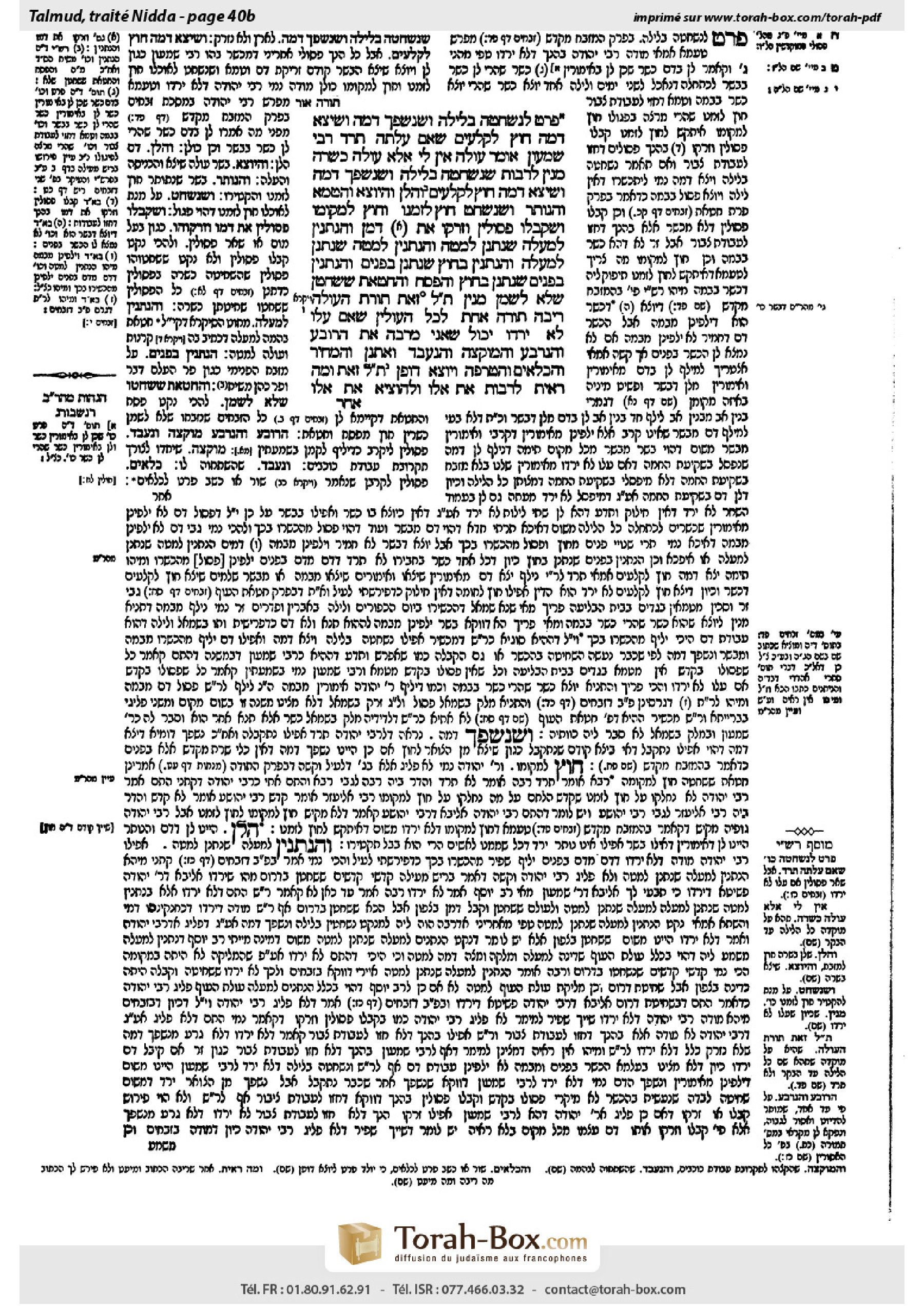
Niddah 40b: Talmud study for Daf Yomi
Daf Yomi is the daily study of one Talmud folio. Explore 37 tractates with scans, Hebrew text, Sefaria English and AI-generated French translations where annotated.
Passage selection and English or AI-generated French translation are available where the scan has annotations. Daf Study is independent of Torah-Box and Sefaria.
Browse Niddah · נידה · All tractatesNiddah 40b text and translations
This page of Niddah includes the Aramaic text, an English translation and an AI-generated French translation, alongside the scan above.
נידה מ׳ ב · Aramaic and Hebrew text
פָּרַט לְנִשְׁחֲטָה בַּלַּיְלָה, וְשֶׁנִּשְׁפַּךְ דָּמָהּ, וְשֶׁיָּצָא דָּמָהּ חוּץ לַקְּלָעִים שֶׁאִם עָלְתָה תֵּרֵד.
רַבִּי שִׁמְעוֹן אוֹמֵר: עוֹלָה — אֵין לִי אֶלָּא עוֹלָה כְּשֵׁרָה, מִנַּיִן לְרַבּוֹת שֶׁנִּשְׁחֲטָה בַּלַּיְלָה, וְשֶׁנִּשְׁפַּךְ דָּמָהּ, וְשֶׁיָּצָא דָּמָהּ חוּץ לַקְּלָעִים, וְהַלָּן, וְהַיּוֹצֵא, וְהַטָּמֵא, וְהַנּוֹתָר, וְשֶׁנִּשְׁחַט חוּץ לִזְמַנּוֹ וְחוּץ לִמְקוֹמוֹ,
וְשֶׁקִּבְּלוּ פְּסוּלִין וְזָרְקוּ אֶת דָּמָן, וְהַנִּתָּנִין לְמַעְלָה שֶׁנְּתָנָן לְמַטָּה, וְהַנִּתָּנִין לְמַטָּה שֶׁנְּתָנָן לְמַעְלָה, וְהַנִּתָּנִין בַּחוּץ שֶׁנְּתָנָן בִּפְנִים, וְהַנִּתָּנִין בִּפְנִים שֶׁנְּתָנָן בַּחוּץ, וְהַפֶּסַח וְהַחַטָּאת שֶׁשְּׁחָטָן שֶׁלֹּא לִשְׁמָן, מִנַּיִן?
תַּלְמוּד לוֹמַר: ״זֹאת תּוֹרַת הָעוֹלָה״ — רִיבָּה תּוֹרָה אַחַת לְכׇל הָעוֹלִין, שֶׁאִם עָלוּ לֹא יֵרְדוּ.
יָכוֹל שֶׁאֲנִי מְרַבֶּה אֶת הָרוֹבֵעַ, וְהַנִּרְבָּע, וְהַמּוּקְצֶה, וְהַנֶּעֱבָד, וְאֶתְנַן, וְהַמְחִיר, וְהַכִּלְאַיִם, וְהַטְּרֵפָה, וְיוֹצֵא דּוֹפֶן? תַּלְמוּד לוֹמַר ״זֹאת״.
וּמָה רָאִיתָ לְרַבּוֹת אֶת אֵלּוּ וּלְהוֹצִיא אֶת אֵלּוּ?
Niddah 40b · English translation
These three expressions allude to the exclusion of the following three cases from the above principle: An offering that was disqualified because it was slaughtered at night, and an offering whose blood spilled before it could be sprinkled on the altar, and an offering whose blood was disqualified because it was taken outside the curtains [lakela’im] surrounding the courtyard of the Tabernacle in the wilderness, i.e., it left the Temple courtyard. These three cases are excluded, as in these instances, if parts of the disqualified offering ascended, i.e., were brought upon the altar, they must descend, i.e., be taken down.
Rabbi Shimon says: From the verse’s reference to a burnt offering, I have derived only that a valid burnt offering should not be taken down from the altar. From where is it derived that the verse also serves to include the following disqualified offerings: An offering that is invalid because it was slaughtered at night; and one whose blood spilled before sprinkling; and one whose blood was taken outside the curtains, i.e., the Temple courtyard; and one whose blood was left overnight; and one that was itself taken out of the Temple courtyard; and one that became ritually impure; and one that was left overnight; and one that was slaughtered with the intent to eat its flesh beyond its designated time or outside its designated area.
And likewise, from where is it derived that the verse serves to include offerings that those who are unfit for performing the Temple service collected or sprinkled their blood; and offerings whose blood is supposed to be placed above the red line of the altar but which one placed below that line; and offerings whose blood is supposed to be placed below the red line of the altar but which one placed above it; and offerings whose blood should be placed on the altar situated outside the Sanctuary but which one instead placed on the altar inside the Sanctuary; and offerings whose blood should be placed on the altar inside the Sanctuary but which one placed on the altar outside; and a Paschal offering and a sin offering that one slaughtered not for their own sake, i.e., while slaughtering he actually intended to sacrifice a different offering? From where is it derived that although these offerings are disqualified, if they were brought up to the altar they are not taken down?
The verse states: “This is the law of the burnt offering.” The verse thereby included in one law all items that ascend upon the altar, even disqualified offerings, teaching that if they ascended the altar, they shall not descend.
Rabbi Shimon continues: One might have thought that I should also include an animal that copulated with a person; and an animal that was the object of bestiality; and an animal that was set aside for idol worship; and an animal that was worshipped as a deity; and an animal that was given as payment to a prostitute or as the price of a dog; and an animal that is an offspring of diverse kinds, i.e., crossbreeding; and an animal with a wound that will cause it to die within twelve months [tereifa]; and an animal born by caesarean section. Therefore, the verse states: “This,” to exclude these disqualifications.
Rabbi Shimon elaborates: And what did you see, i.e., what is the reason to include these particular cases and to exclude those particular cases?
Niddah 40b · Traduction française (IA)
Ces trois expressions font allusion à l’exclusion des trois cas suivants du principe énoncé plus haut : une offrande invalidée parce qu’elle a été égorgée de nuit ; une offrande dont le sang s’est répandu avant d’avoir pu être aspergé sur l’autel ; et une offrande dont le sang a été invalidé parce qu’il a été emporté au-delà des tentures [lakela’im] entourant la cour du Tabernacle dans le désert, c’est-à-dire qu’il a quitté la cour du Temple. Ces trois cas sont exclus, car dans ces situations, si des parties de l’offrande invalidée sont montées sur l’autel, elles doivent en redescendre, c’est-à-dire en être retirées.
Rabbi Shimon dit : De la mention d’un holocauste dans le verset, j’ai seulement déduit qu’un holocauste valide ne doit pas être retiré de l’autel. D’où déduit-on que le verset inclut également les offrandes invalidées suivantes : une offrande invalidée parce qu’elle a été égorgée de nuit ; une offrande dont le sang s’est répandu avant l’aspersion ; une offrande dont le sang a été emporté au-delà des tentures, c’est-à-dire hors de la cour du Temple ; une offrande dont le sang a passé la nuit ; une offrande qui a elle-même été emportée hors de la cour du Temple ; une offrande devenue rituellement impure ; une offrande qui a passé la nuit ; et une offrande égorgée avec l’intention d’en manger la chair après le délai fixé ou hors de l’endroit assigné ?
Et de même, d’où déduit-on que le verset inclut les offrandes dont le sang a été recueilli ou aspergé par des personnes inaptes au service du Temple ; les offrandes dont le sang doit être placé au-dessus de la ligne rouge de l’autel, mais qu’on a placé en dessous de cette ligne ; les offrandes dont le sang doit être placé en dessous de la ligne rouge de l’autel, mais qu’on a placé au-dessus ; les offrandes dont le sang doit être placé sur l’autel situé à l’extérieur du Sanctuaire, mais qu’on a placé à la place sur l’autel situé à l’intérieur du Sanctuaire ; les offrandes dont le sang doit être placé sur l’autel situé à l’intérieur du Sanctuaire, mais qu’on a placé sur l’autel situé à l’extérieur ; ainsi qu’un sacrifice pascal et un sacrifice expiatoire égorgés sans que leur intention propre soit visée, c’est-à-dire avec l’intention effective d’offrir un autre sacrifice au moment de l’égorgement ? D’où déduit-on que, bien que ces offrandes soient invalidées, si elles sont montées sur l’autel, elles n’en sont pas retirées ?
Le verset dit : « Telle est la loi de l’holocauste. » Le verset a ainsi inclus dans une seule loi tout ce qui monte sur l’autel, même les offrandes invalidées, enseignant que si elles sont montées sur l’autel, elles n’en redescendront pas.
Rabbi Shimon poursuit : On aurait pu penser que je devais également inclure un animal qui s’est accouplé avec une personne ; un animal ayant été l’objet d’un acte de bestialité ; un animal mis à part pour l’idolâtrie ; un animal auquel on a rendu un culte comme à une divinité ; un animal donné en paiement à une prostituée ou comme prix d’un chien ; un animal issu d’un croisement entre espèces ; un animal atteint d’une blessure qui entraînera sa mort dans les douze mois [tereifa] ; et un animal né par césarienne. Le verset dit donc : « Telle », afin d’exclure ces invalidités.
Rabbi Shimon précise : Et qu’as-tu vu, c’est-à-dire quelle est la raison d’inclure précisément ces cas et d’exclure précisément ceux-là ?
Traduction française générée par IA à partir de l’édition anglaise de Sefaria. Vérifie toujours un passage avec le texte source.
Text from Sefaria: William Davidson Edition - Vocalized Aramaic (CC BY NC); William Davidson Edition - English (CC BY NC).