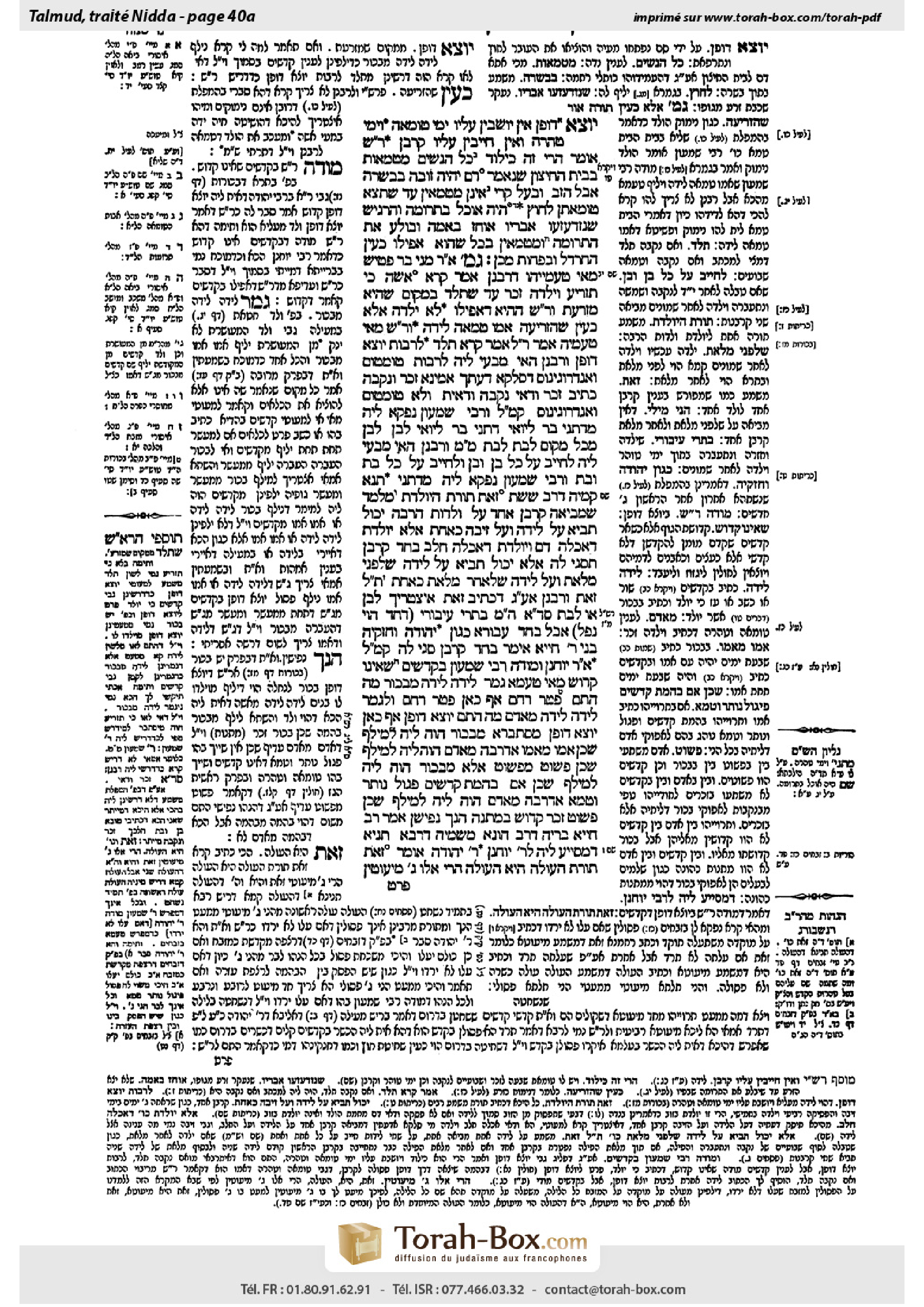
Niddah 40a: Talmud study for Daf Yomi
Daf Yomi is the daily study of one Talmud folio. Explore 37 tractates with scans, Hebrew text, Sefaria English and AI-generated French translations where annotated.
Passage selection and English or AI-generated French translation are available where the scan has annotations. Daf Study is independent of Torah-Box and Sefaria.
Browse Niddah · נידה · All tractatesNiddah 40a text and translations
This page of Niddah includes the Aramaic text, an English translation and an AI-generated French translation, alongside the scan above.
נידה מ׳ א · Aramaic and Hebrew text
מַתְנִי' יוֹצֵא דּוֹפֶן — אֵין יוֹשְׁבִין עָלָיו יְמֵי טוּמְאָה וִימֵי טׇהֳרָה, וְאֵין חַיָּיבִין עָלָיו קׇרְבָּן. רַבִּי שִׁמְעוֹן אוֹמֵר: הֲרֵי זֶה כְּיָלוּד.
כׇּל הַנָּשִׁים מְטַמְּאוֹת בַּבַּיִת הַחִיצוֹן, שֶׁנֶּאֱמַר: ״דָּם יִהְיֶה זוֹבָהּ בִּבְשָׂרָהּ״, אֲבָל הַזָּב וּבַעַל קֶרִי אֵינָן מְטַמְּאִין, עַד שֶׁתֵּצֵא טוּמְאָתָן לַחוּץ.
הָיָה אוֹכֵל בִּתְרוּמָה, וְהִרְגִּישׁ שֶׁנִּזְדַּעְזְעוּ אֵבָרָיו — אוֹחֵז בָּאַמָּה וּבוֹלֵעַ אֶת הַתְּרוּמָה, וּמְטַמְּאִין בְּכֹל שֶׁהוּא, אֲפִילּוּ כְּעֵין הַחַרְדָּל, וּבְפָחוֹת מִכֵּן.
גְּמָ' אָמַר רַבִּי מָנִי בַּר פַּטִּישׁ: מַאי טַעְמַיְיהוּ דְּרַבָּנַן? אָמַר קְרָא ״אִשָּׁה כִּי תַזְרִיעַ וְיָלְדָה זָכָר״ — עַד שֶׁתֵּלֵד בִּמְקוֹם שֶׁהִיא מַזְרַעַת.
וְרַבִּי שִׁמְעוֹן? הָהִיא — דַּאֲפִילּוּ לֹא יָלְדָה אֶלָּא כְּעֵין שֶׁהִזְרִיעָה, אִמּוֹ טְמֵאָה לֵידָה.
וְרַבִּי שִׁמְעוֹן, מַאי טַעְמֵיהּ? אָמַר רֵישׁ לָקִישׁ: אָמַר קְרָא ״תֵּלֵד״ — לְרַבּוֹת יוֹצֵא דּוֹפֶן.
וְרַבָּנַן? הַאי מִבְּעֵי לֵיהּ לְרַבּוֹת טוּמְטוּם וְאַנְדְּרוֹגִינוֹס, דְּסָלְקָא דַעְתָּךְ אָמֵינָא: ״זָכָר״ וּ״נְקֵבָה״ כְּתִיב — זָכָר וַדַּאי, נְקֵבָה וַדָּאִית, וְלֹא טוּמְטוּם וְאַנְדְּרוֹגִינוֹס, קָא מַשְׁמַע לַן.
וְרַבִּי שִׁמְעוֹן? נָפְקָא לֵיהּ מִדְּתָנֵי בַּר לֵיוַאי, דְּתָנֵי בַּר לֵיוַאי: ״לְבֵן״ — לְבֵן מִכׇּל מָקוֹם, ״לְבַת״ — לְבַת מִכׇּל מָקוֹם.
וְרַבָּנַן? הַאי מִבְּעֵי לֵיהּ לְחַיֵּיב עַל כׇּל בֵּן וּבֵן, וּלְחַיֵּיב עַל כׇּל בַּת וּבַת.
וְרַבִּי שִׁמְעוֹן? נָפְקָא לֵיהּ מִדְּתָנֵי תַּנָּא קַמֵּיהּ דְּרַב שֵׁשֶׁת: ״זֹאת תּוֹרַת הַיּוֹלֶדֶת״, מְלַמֵּד שֶׁמְּבִיאָה קׇרְבָּן אֶחָד עַל וְלָדוֹת הַרְבֵּה. יָכוֹל תָּבִיא עַל לֵידָה וְעַל זִיבָה כְּאֶחָת?
אֶלָּא, יוֹלֶדֶת דְּאָכְלָה דָּם וְיוֹלֶדֶת דְּאָכְלָה חֵלֶב, בְּחַד קׇרְבָּן תִּסְגֵּי לַהּ?
אֶלָּא, יָכוֹל תָּבִיא עַל לֵידָה שֶׁלִּפְנֵי מְלֹאת וְעַל לֵידָה שֶׁלְּאַחַר מְלֹאת כְּאַחַת? תַּלְמוּד לוֹמַר ״זֹאת״. וְרַבָּנַן, אַף עַל גַּב דִּכְתִיב ״זֹאת״, אִיצְטְרִיךְ ״לְבֵן אוֹ לְבַת״.
סָלְקָא דַעְתָּךְ אָמֵינָא: בִּתְרֵי עִיבּוּרֵי (דְּחַד הָוֵי נֵפֶל), אֲבָל בְּחַד עִבּוּרָא, כְּגוֹן יְהוּדָה וְחִזְקִיָּה בְּנֵי רַבִּי חִיָּיא, אֵימַר בְּחַד קׇרְבָּן סַגִּי לַהּ — קָא מַשְׁמַע לַן.
אָמַר רַבִּי יוֹחָנָן: וּמוֹדֶה רַבִּי שִׁמְעוֹן בְּקָדָשִׁים שֶׁאֵינוֹ קָדוֹשׁ. מַאי טַעְמָא? גָּמַר ״לֵידָה״ ״לֵידָה״ מִבְּכוֹר — מָה הָתָם ״פֶּטֶר רֶחֶם״, אַף כָּאן ״פֶּטֶר רֶחֶם״.
וְלִגְמַר ״לֵידָה״ ״לֵידָה״ מֵאָדָם — מָה הָתָם יוֹצֵא דּוֹפֶן, אַף כָּאן יוֹצֵא דּוֹפֶן!
מִסְתַּבְּרָא מִבְּכוֹר הֲוָה לֵיהּ לְמֵילַף, שֶׁכֵּן אִמּוֹ מֵ״אִמּוֹ״, אַדְּרַבָּה, מֵאָדָם הֲוָה לֵיהּ לְמֵילַף, שֶׁכֵּן פָּשׁוּט מִפָּשׁוּט!
אֶלָּא, מִבְּכוֹר הֲוָה לֵיהּ לְמֵילַף, שֶׁכֵּן אִם בֶּהֱמַת קָדָשִׁים, פִּגּוּל, נוֹתָר, וְטָמֵא.
אַדְּרַבָּה, מֵאָדָם הֲוָה לֵיהּ לְמֵילַף, שֶׁכֵּן פָּשׁוּט, זָכָר, קָדוֹשׁ, בְּמַתָּנָה! הָנָךְ נְפִישָׁן.
אָמַר רַב חִיָּיא בְּרֵיהּ דְּרַב הוּנָא מִשְּׁמֵיהּ דְּרָבָא: תַּנְיָא דִּמְסַיַּיע לֵיהּ לְרַבִּי יוֹחָנָן, רַבִּי יְהוּדָה אוֹמֵר: ״זֹאת תּוֹרַת הָעוֹלָה הִיא הָעוֹלָה״ — הֲרֵי אֵלּוּ שְׁלֹשָׁה מִיעוּטִין,
Niddah 40a · English translation
MISHNA: After the birth of an offspring by caesarean section, the mother does not observe seven or fourteen days of impurity and thirty-three or sixty-six days of purity for male and female offspring, respectively, and she is not obligated to bring for it the offering brought by a woman after childbirth. Rabbi Shimon says: The halakhic status of that offspring is like that of an offspring born in a standard birth.
All women become ritually impure with the flow of blood from the uterus into the outer chamber, i.e., the vagina, although it did not leave the woman’s body, as it is stated: “And her issue in her flesh shall be blood, she shall be in her menstruation seven days” (Leviticus 15:19), indicating that even if her menstrual blood remains in her flesh, she becomes impure. But one who experiences a gonorrhea-like discharge [zav] and one who experiences a seminal emission do not become ritually impure until their emission of impurity emerges outside the body.
If a priest was partaking of teruma, the portion of the produce designated for the priest, and sensed a quaking of his limbs indicating that a seminal emission was imminent, he should firmly hold his penis to prevent the emission from leaving his body, and swallow the teruma while ritually pure. And the emission of a zav and a seminal emission impart impurity in any amount, even like the size of a mustard seed or even smaller than that.
GEMARA: The mishna cites a dispute as to whether or not a birth by caesarean section is considered a birth with regard to the halakhot pertaining to childbirth. Rabbi Mani bar Patish said: What is the reason for the opinion of the Rabbis, who say that it is not considered a birth? It is because the verse states: “If a woman emitted seed and gave birth to a male, then she shall be impure seven days…And when the days of her purification are fulfilled, for a son, or for a daughter, she shall bring a lamb of the first year for a burnt offering, and a pigeon or a dove for a sin offering” (Leviticus 12:2–6). It is derived from here that the halakhot mentioned in that passage do not apply unless she gives birth through the place where she emits seed.
The Gemara asks: And how does Rabbi Shimon interpret the term “emitted seed”? The Gemara answers: That word serves to teach that even if she gave birth only to a fluid that resembles the seed that she emitted, i.e., the fetus died and entirely decomposed and dissolved before emerging, its mother is ritually impure due to childbirth.
The Gemara further asks: And Rabbi Shimon, what is the reason for his opinion that the halakhot of childbirth apply in the case of a caesarean section? Reish Lakish said that it is because the verse states: “But if she gives birth to a female” (Leviticus 12:5). The term “she gives birth” is superfluous in the context of the passage, as it was mentioned previously, and it therefore serves to include the birth of an offspring by caesarean section.
The Gemara asks: And what do the Rabbis derive from this superfluous expression? The Gemara answers: In their opinion, that expression is necessary to include the birth of a child whose sexual organs are indeterminate [tumtum] or a hermaphrodite. As it might enter your mind to say that as the words “male” (Leviticus 12:2) and “female” (Leviticus 12:5) are written in the passage, these halakhot apply only to a definite male and a definite female, but not to a tumtum or a hermaphrodite. Therefore, the term “she gives birth” teaches us that it is the birth itself, not the sex of the offspring, that matters.
The Gemara asks: And from where does Rabbi Shimon derive that these halakhot apply to a tumtum and a hermaphrodite? The Gemara answers: He derives it from that which bar Livai teaches, as bar Livai teaches a baraita that discusses the verse: “And when the days of her purity are fulfilled, for a son, or for a daughter” (Leviticus 12:6). Since the verse uses the terms “son” and “daughter,” rather than male and female, it is derived from the term “for a son” that these halakhot apply to a son in any case, even if his masculinity is not definite. Similarly, the term “for a daughter” teaches that these halakhot apply to a daughter in any case, even if her femininity is not definite.
The Gemara asks: And what do the Rabbis derive from the terms “for a son” and “for a daughter”? The Gemara answers: In their opinion, that term is necessary to obligate the mother to bring an offering for each and every son to whom she gives birth, rather than one offering after having given birth to several sons; and likewise to obligate her to bring an offering for each and every daughter to whom she gives birth.
The Gemara asks: And from where does Rabbi Shimon derive this halakha? The Gemara answers that he derives it from a baraita that a tanna taught before Rav Sheshet: The verse states: “This is the law for one who gives birth, whether to a male or a female” (Leviticus 12:7). This teaches that a woman brings a single offering for many offspring born within a short time, e.g., after a multiple birth. One might have thought that she may bring an offering for her childbirth and an offering for an irregular discharge of blood from the uterus [ziva], in a case where she is required to bring one, as one, i.e., that she may fulfill her two obligations with a single offering.
The Gemara interrupts the baraita to raise a difficulty: But how could it possibly enter your mind that a woman may bring one offering for two obligations? In the case of a woman after childbirth who consumed blood, or a woman after childbirth who ate forbidden fat, is one offering sufficient for her? One who eats blood or forbidden fat is obligated to bring a sin offering for atonement (see Leviticus 7:25–27). There is no reason to think that a woman after childbirth, who is required to bring a sin offering for a reason other than her childbirth, may bring one offering for both obligations. Similarly, there are no grounds for suggesting that a single offering might suffice for both childbirth and ziva.
Rather, the statement of the baraita should be revised, as follows: One might have thought that a woman may bring an offering for a childbirth that occurred before the completion of her term of postpartum purity, and for a second childbirth that happened after the completion of that period, as one, i.e., she may fulfill her two obligations with a single offering. Therefore, the verse states: “This is the law for one who gives birth” (Leviticus 12:7), indicating that each birth, unless it occurred within the period of purity following another birth, requires its own offering. The Gemara asks: And how do the Rabbis respond to this derivation? The Gemara answers that in their opinion, even though it is written: “This is the law,” it was still necessary for the verse to state: “For a son, or for a daughter.”
The Gemara explains: Had the Torah stated only the verse: “This is the law,” it might enter your mind to say that one offering does not suffice for two births that occurred as a result of two pregnancies, as the second one was a miscarriage whose conception occurred during the woman’s period of purity following the first birth. But if both births occurred as a result of one pregnancy, such as in the case of Yehuda and Ḥizkiyya, the twin sons of Rabbi Ḥiyya, who were born three months apart (see 27a), I would say that one offering for both births is sufficient for her. Therefore, the verse “for a son, or for a daughter” teaches us otherwise.
§ Rabbi Yoḥanan says: And Rabbi Shimon, who maintains that childbirth by caesarean section has the halakhic status of regular childbirth, concedes in the case of consecrated animals that if one attempts to consecrate an animal born by caesarean section, it is not consecrated. What is the reason for this opinion? He derives it by means of a verbal analogy from the word birth that is written with regard to consecrated animals (see Leviticus 22:27), and the word birth that is written in connection with a firstborn animal (see Deuteronomy 15:19). Just as there, in the case of the firstborn, the halakhot apply specifically to one who “opens the womb” (Exodus 13:15), so too here, in the case of consecrated animals, the halakhot apply only to one who opens the womb.
The Gemara objects: And let Rabbi Shimon derive a different conclusion by a similar verbal analogy, as the word birth is written with regard to consecrated animals, and the word birth is also written with regard to a person, i.e., a woman who gives birth (see Leviticus 12:2): Just as there, in the case of humans, childbirth by caesarean section has the status of childbirth according to Rabbi Shimon, so too here, in the case of consecrated animals, an animal born by caesarean section is considered the same as an animal born via a natural birth.
The Gemara answers: It is more reasonable for Rabbi Shimon to derive the halakha of a consecrated animal from a firstborn animal, rather than from the halakha of childbirth, as it is written with regard to a consecrated animal: “Its mother” (Leviticus 22:27), and it is likewise written with regard to a firstborn animal: “Its mother” (Exodus 22:29). The Gemara objects: On the contrary, he should derive it from human births, as that would be a derivation of the halakha concerning consecrated animals that are ordinary, i.e., not firstborns, from the halakha concerning human births of children that are ordinary, and not firstborns.
The Gemara adopts a different line of reasoning: Rather, Rabbi Shimon should derive it from a firstborn animal, as they both share the following five characteristics: In both cases it is written: “its mother”; both are cases of a sacrificial animal; both are subject to piggul, the disqualification of an offering through improper intent during its sacrificial rites; both are subject to notar, the disqualification of sacrificial meat after a prescribed time; and finally, both are subject to disqualification by becoming ritually impure. By contrast, humans do not share any of these characteristics.
The Gemara objects: On the contrary, he should derive it from human births, as both cases share the following four characteristics: They are both instances of ordinary, non-firstborn offspring; they both apply to the offspring of either sex, and are not exclusively males; they are both dealing with offspring that are not automatically sacred at birth; and they both apply to offspring that are not a gift to a priest, but belong to an individual non-priest. By contrast, firstborn animals do not share any of these characteristics. The Gemara answers that the comparison to firstborn animals is preferable to the comparison to human childbirth because these shared characteristics are more numerous. The comparison to consecrated animals includes five shared characteristics, whereas the comparison to human births involves only four.
Rav Ḥiyya, son of Rav Huna, said in the name of Rava: A baraita is taught which supports the statement of Rabbi Yoḥanan: Rabbi Yehuda says: “This is the law of the burnt offering; that is the burnt offering that goes up on the pyre upon the altar” (Leviticus 6:2). It is derived from this verse that the halakha is that if a part of a disqualified offering is taken up to the altar it should be burned there, rather than taken down, despite its unfit status. There are three expressions which indicate exclusion in this verse: The term “this is,” which indicates this one and not another one; the term “that is,” indicating that one and not another one; and the term “the burnt offering” instead of “a burnt offering.”
Niddah 40a · Traduction française (IA)
MICHNA : Après la naissance d’un enfant par césarienne, la mère n’observe pas les sept ou quatorze jours d’impureté, ni les trente-trois ou soixante-six jours de pureté prévus respectivement pour un enfant de sexe masculin et un enfant de sexe féminin, et elle n’est pas tenue d’apporter le sacrifice qu’une femme doit apporter après un accouchement. Rabbi Shimon dit : le statut halakhique de cet enfant est le même que celui d’un enfant né lors d’un accouchement normal.
Toutes les femmes deviennent rituellement impures lorsque le sang s’écoule de l’utérus vers la chambre extérieure, c’est-à-dire le vagin, même s’il n’a pas quitté le corps de la femme, comme il est dit : « Son écoulement dans sa chair est du sang ; elle sera en état de menstruation pendant sept jours » (Lévitique 15,19), ce qui indique que même si son sang menstruel demeure dans sa chair, elle devient impure. Mais celui qui a un écoulement semblable à celui d’un homme atteint de gonorrhée [zav] et celui qui a une émission séminale ne deviennent rituellement impurs que lorsque leur émission impure sort du corps.
Si un prêtre consommait de la terouma, la part des produits réservée au prêtre, et ressentait un frémissement de ses membres indiquant qu’une émission séminale était imminente, il devait saisir fermement son pénis pour empêcher l’émission de sortir de son corps, puis avaler la terouma alors qu’il était rituellement pur. L’écoulement d’un zav et une émission séminale transmettent l’impureté quelle qu’en soit la quantité, même si elle est de la taille d’un grain de moutarde ou plus petite encore.
GUEMARA : La Michna cite une controverse sur la question de savoir si une naissance par césarienne est considérée comme un accouchement au regard des halakhot relatives à l’accouchement. Rabbi Mani bar Patish dit : Quelle est la raison de l’opinion des Sages, qui disent qu’elle n’est pas considérée comme un accouchement ? C’est que le verset dit : « Si une femme a conçu et donne naissance à un mâle, elle sera impure pendant sept jours… Lorsque les jours de sa purification seront accomplis, pour un fils ou pour une fille, elle apportera un agneau d’un an en holocauste, et un pigeon ou une tourterelle en sacrifice expiatoire » (Lévitique 12,2-6). On en déduit que les halakhot mentionnées dans ce passage ne s’appliquent que si elle accouche par l’endroit où elle émet sa semence.
La Guemara demande : Et comment Rabbi Shimon interprète-t-il le terme « a conçu » ? La Guemara répond : Ce terme vient enseigner que même si elle a donné naissance uniquement à un liquide ressemblant à la semence qu’elle a émise, c’est-à-dire si le fœtus est mort et s’est entièrement décomposé et dissous avant de sortir, sa mère devient rituellement impure du fait de l’accouchement.
La Guemara demande encore : Et Rabbi Shimon, quelle est la raison de son opinion selon laquelle les halakhot de l’accouchement s’appliquent dans le cas d’une césarienne ? Reish Lakish dit que c’est parce que le verset dit : « Mais si elle donne naissance à une fille » (Lévitique 12,5). L’expression « elle donne naissance » est superflue dans le contexte du passage, puisqu’elle a déjà été mentionnée auparavant ; elle vient donc inclure la naissance d’un enfant par césarienne.
La Guemara demande : Et que déduisent les Sages de cette expression superflue ? La Guemara répond : Selon eux, cette expression est nécessaire pour inclure la naissance d’un enfant dont les organes sexuels sont indéterminés [tumtum] ou qui est hermaphrodite. On aurait pu penser que, puisque les mots « mâle » (Lévitique 12,2) et « femelle » (Lévitique 12,5) figurent dans le passage, ces halakhot ne s’appliquent qu’à un mâle dont le sexe est clairement établi et à une femelle dont le sexe est clairement établi, mais pas à un tumtum ni à un hermaphrodite. L’expression « elle donne naissance » enseigne donc que c’est la naissance elle-même qui compte, et non le sexe de l’enfant.
La Guemara demande : Et d’où Rabbi Shimon déduit-il que ces halakhot s’appliquent à un tumtum et à un hermaphrodite ? La Guemara répond : Il le déduit de ce qu’enseigne bar Livai, qui enseigne une baraïta au sujet du verset : « Lorsque les jours de sa purification seront accomplis, pour un fils ou pour une fille » (Lévitique 12,6). Puisque le verset emploie les termes « fils » et « fille », plutôt que « mâle » et « femelle », on déduit de l’expression « pour un fils » que ces halakhot s’appliquent à un fils dans tous les cas, même si son sexe masculin n’est pas certain. De même, l’expression « pour une fille » enseigne que ces halakhot s’appliquent à une fille dans tous les cas, même si son sexe féminin n’est pas certain.
La Guemara demande : Et que déduisent les Sages des expressions « pour un fils » et « pour une fille » ? La Guemara répond : Selon eux, ces expressions sont nécessaires pour obliger la mère à apporter un sacrifice pour chacun des fils auxquels elle donne naissance, plutôt qu’un seul sacrifice après avoir donné naissance à plusieurs fils ; et de même, pour l’obliger à apporter un sacrifice pour chacune des filles auxquelles elle donne naissance.
La Guemara demande : Et d’où Rabbi Shimon déduit-il cette halakha ? La Guemara répond qu’il la déduit d’une baraïta qu’un tanna enseigna devant Rav Sheshet : le verset dit : « Telle est la loi pour celle qui donne naissance, qu’il s’agisse d’un mâle ou d’une femelle » (Lévitique 12,7). Cela enseigne qu’une femme apporte un seul sacrifice pour plusieurs enfants nés dans un court intervalle, par exemple après une naissance multiple. On aurait pu penser qu’elle peut apporter un sacrifice pour son accouchement et un sacrifice pour un écoulement irrégulier de sang provenant de l’utérus [ziva], dans le cas où elle est tenue d’en apporter un, comme un seul, c’est-à-dire qu’elle peut s’acquitter de ses deux obligations au moyen d’un unique sacrifice.
La Guemara interrompt la baraïta pour soulever une difficulté : Mais comment pourrait-on seulement penser qu’une femme puisse apporter un seul sacrifice pour deux obligations ? Dans le cas d’une femme ayant accouché qui aurait consommé du sang, ou d’une femme ayant accouché qui aurait mangé de la graisse interdite, un seul sacrifice lui suffirait-il ? Celui qui mange du sang ou de la graisse interdite est tenu d’apporter un sacrifice expiatoire (voir Lévitique 7,25-27). Il n’y a aucune raison de penser qu’une femme ayant accouché, tenue d’apporter un sacrifice expiatoire pour une raison autre que son accouchement, puisse apporter un seul sacrifice pour les deux obligations. De même, rien ne permet de supposer qu’un unique sacrifice pourrait suffire à la fois pour l’accouchement et pour la ziva.
Il faut plutôt corriger ainsi la déclaration de la baraïta : On aurait pu penser qu’une femme peut apporter un sacrifice pour un accouchement survenu avant la fin de sa période de pureté post-partum et pour un second accouchement survenu après la fin de cette période, comme un seul, c’est-à-dire qu’elle peut s’acquitter de ses deux obligations au moyen d’un unique sacrifice. Le verset dit donc : « Telle est la loi pour celle qui donne naissance » (Lévitique 12,7), ce qui indique que chaque naissance, à moins qu’elle ne survienne pendant la période de pureté faisant suite à une autre naissance, exige son propre sacrifice. La Guemara demande : Et que répondent les Sages à cette déduction ? La Guemara répond que, selon eux, bien qu’il soit écrit : « Telle est la loi », il était néanmoins nécessaire que le verset précise : « pour un fils ou pour une fille ».
La Guemara explique : Si la Torah avait uniquement énoncé le verset « Telle est la loi », on aurait pu penser qu’un seul sacrifice ne suffit pas pour deux naissances résultant de deux grossesses, la seconde étant une fausse couche dont la conception s’était produite pendant la période de pureté faisant suite au premier accouchement. Mais si les deux naissances résultaient d’une seule grossesse, comme dans le cas de Yehuda et Ḥizkiyya, les fils jumeaux de Rabbi Ḥiyya, nés à trois mois d’intervalle (voir 27a), j’aurais dit qu’un seul sacrifice pour les deux naissances lui suffit. L’expression « pour un fils ou pour une fille » vient donc nous enseigner le contraire.
§ Rabbi Yoḥanan dit : Rabbi Shimon, qui soutient qu’une naissance par césarienne a le statut halakhique d’un accouchement normal, reconnaît que, dans le cas des animaux consacrés, si quelqu’un tente de consacrer un animal né par césarienne, celui-ci n’est pas consacré. Quelle est la raison de cette opinion ? Il la déduit par analogie verbale à partir du mot « naissance », écrit à propos des animaux consacrés (voir Lévitique 22,27), et du mot « naissance », écrit à propos d’un animal premier-né (voir Deutéronome 15,19). De même que, dans le cas du premier-né, les halakhot s’appliquent spécifiquement à celui qui « ouvre la matrice » (Exode 13,15), de même, ici, dans le cas des animaux consacrés, les halakhot ne s’appliquent qu’à celui qui ouvre la matrice.
La Guemara objecte : Rabbi Shimon ne devrait-il pas tirer une conclusion différente par une analogie verbale semblable, puisque le mot « naissance » est écrit à propos des animaux consacrés et qu’il est également écrit à propos d’un être humain, c’est-à-dire d’une femme qui accouche (voir Lévitique 12,2) ? De même que là, dans le cas des humains, une naissance par césarienne a le statut d’un accouchement selon Rabbi Shimon, de même ici, dans le cas des animaux consacrés, un animal né par césarienne est considéré comme équivalent à un animal né par voie naturelle.
La Guemara répond : Il est plus raisonnable que Rabbi Shimon déduise la halakha concernant un animal consacré à partir d’un animal premier-né plutôt qu’à partir des règles de l’accouchement, car à propos d’un animal consacré, il est écrit : « sa mère » (Lévitique 22,27), et il est également écrit à propos d’un animal premier-né : « sa mère » (Exode 22,29). La Guemara objecte : Au contraire, il devrait déduire la halakha des naissances humaines, car cela reviendrait à déduire la halakha concernant des animaux consacrés ordinaires, c’est-à-dire non premiers-nés, de celle concernant des naissances humaines ordinaires, et non des premiers-nés.
La Guemara adopte un autre raisonnement : Rabbi Shimon devrait plutôt déduire cette halakha à partir d’un animal premier-né, car les deux cas partagent les cinq caractéristiques suivantes : dans les deux cas, il est écrit « sa mère » ; il s’agit dans les deux cas d’un animal sacrificiel ; les deux sont sujets au piggul, c’est-à-dire à l’invalidation d’un sacrifice par une intention inappropriée pendant son rituel ; les deux sont sujets au notar, c’est-à-dire à l’invalidation de la viande sacrificielle après le délai prescrit ; enfin, les deux peuvent être invalidés par l’impureté rituelle. En revanche, les êtres humains ne partagent aucune de ces caractéristiques.
La Guemara objecte : Au contraire, il devrait déduire la halakha des naissances humaines, car les deux cas partagent les quatre caractéristiques suivantes : il s’agit dans les deux cas d’enfants ordinaires, non premiers-nés ; les règles s’appliquent aux enfants des deux sexes, et pas uniquement aux mâles ; dans les deux cas, les enfants ne sont pas automatiquement consacrés à la naissance ; enfin, les règles s’appliquent à des enfants qui ne sont pas un don destiné à un prêtre, mais appartiennent à un particulier qui n’est pas prêtre. En revanche, les animaux premiers-nés ne partagent aucune de ces caractéristiques. La Guemara répond que l’analogie avec les animaux premiers-nés est préférable à celle avec les naissances humaines, car les caractéristiques communes y sont plus nombreuses. L’analogie avec les animaux consacrés comporte cinq caractéristiques communes, tandis que celle avec les naissances humaines n’en comporte que quatre.
Rav Ḥiyya, fils de Rav Huna, dit au nom de Rava : Une baraïta vient appuyer la déclaration de Rabbi Yoḥanan : Rabbi Yehuda dit : « Telle est la loi de l’holocauste : c’est l’holocauste qui monte sur le bûcher, sur l’autel » (Lévitique 6,2). On déduit de ce verset que si une partie d’un sacrifice invalidé est portée sur l’autel, elle doit y être brûlée au lieu d’en être retirée, malgré son statut impropre. Trois expressions de ce verset indiquent une exclusion : les mots « telle est », qui signifient celle-ci et pas une autre ; les mots « c’est », qui signifient celui-là et pas un autre ; et l’expression « l’holocauste », au lieu de « un holocauste ».
Traduction française générée par IA à partir de l’édition anglaise de Sefaria. Vérifie toujours un passage avec le texte source.
Text from Sefaria: William Davidson Edition - Vocalized Aramaic (CC BY NC); William Davidson Edition - English (CC BY NC).