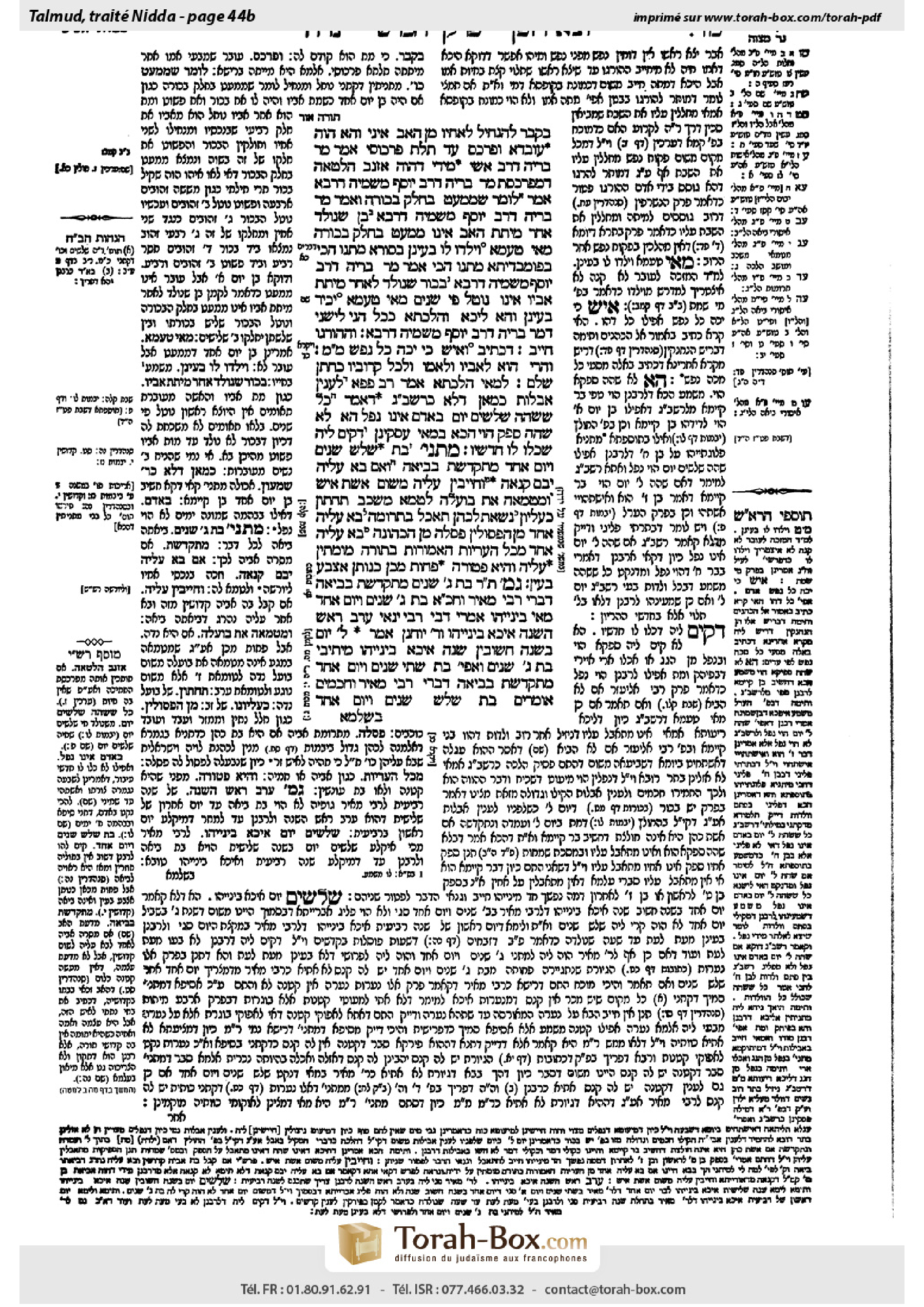
Niddah 44b: Talmud study for Daf Yomi
Daf Yomi is the daily study of one Talmud folio. Explore 37 tractates with scans, Hebrew text, Sefaria English and AI-generated French translations where annotated.
Passage selection and English or AI-generated French translation are available where the scan has annotations. Daf Study is independent of Torah-Box and Sefaria.
Browse Niddah · נידה · All tractatesNiddah 44b text and translations
This page of Niddah includes the Aramaic text, an English translation and an AI-generated French translation, alongside the scan above.
נידה מ״ד ב · Aramaic and Hebrew text
בַּקֶּבֶר לְהַנְחִיל לְאֶחָיו מִן הָאָב.
אִינִי? וְהָא הֲוָה עוֹבָדָא, וּפַרְכֵּס עַד תְּלָת פִּרְכּוּסֵי! אָמַר מָר בְּרֵיהּ דְּרַב אָשֵׁי: מִידֵּי דְּהָוֵה אַזְּנַב הַלְּטָאָה דִּמְפַרְכֶּסֶת.
מָר בְּרֵיהּ דְּרַב יוֹסֵף מִשְּׁמֵיהּ דְּרָבָא אָמַר: לוֹמַר שֶׁמְּמַעֵט בְּחֵלֶק בְּכוֹרָה, וְאָמַר מָר בְּרֵיהּ דְּרַב יוֹסֵף מִשְּׁמֵיהּ דְּרָבָא: בֵּן שֶׁנּוֹלַד אַחַר מִיתַת הָאָב אֵינוֹ מְמַעֵט בְּחֵלֶק בְּכוֹרָה, מַאי טַעְמָא? ״וְיָלְדוּ לוֹ״ בָּעֵינַן.
בְּסוּרָא מַתְנוּ הָכִי, בְּפוּמְבְּדִיתָא מַתְנוּ הָכִי: אָמַר מָר בְּרֵיהּ דְּרַב יוֹסֵף מִשְּׁמֵיהּ דְּרָבָא — בְּכוֹר שֶׁנּוֹלַד לְאַחַר מִיתַת אָבִיו אֵינוֹ נוֹטֵל פִּי שְׁנַיִם. מַאי טַעְמָא? ״יַכִּיר״ בָּעֵינַן, וְהָא לֵיכָּא.
וְהִלְכְתָא: כְּכֹל הָנֵי לִישָּׁנֵי דְּמָר בְּרֵיהּ דְּרַב יוֹסֵף מִשְּׁמֵיהּ דְּרָבָא.
וְהַהוֹרְגוֹ חַיָּיב. דִּכְתִיב ״וְאִישׁ כִּי יַכֶּה כׇּל נֶפֶשׁ״ — מִכׇּל מָקוֹם.
וַהֲרֵי הוּא לְאָבִיו וּלְאִמּוֹ וּלְכׇל קְרוֹבָיו כְּחָתָן שָׁלֵם. לְמַאי הִלְכְתָא? אָמַר רַב פָּפָּא: לְעִנְיַן אֲבֵלוּת.
כְּמַאן? דְּלָא כְּרַבָּן שִׁמְעוֹן בֶּן גַּמְלִיאֵל, דְּאָמַר: כֹּל שֶׁשָּׁהָה שְׁלֹשִׁים יוֹם בָּאָדָם אֵינוֹ נֵפֶל. הָא לֹא שָׁהָה — סָפֵק הָוֵי! הָכָא בְמַאי עָסְקִינַן? דְּקִים לֵיהּ שֶׁכָּלוּ לוֹ חֳדָשָׁיו.
מַתְנִי' בַּת שָׁלֹשׁ שָׁנִים וְיוֹם אֶחָד — מִתְקַדֶּשֶׁת בְּבִיאָה, וְאִם בָּא עָלֶיהָ יָבָם — קְנָאָהּ, וְחַיָּיבִין עָלֶיהָ מִשּׁוּם אֵשֶׁת אִישׁ,
וּמְטַמְּאָה אֶת בּוֹעֲלָהּ לְטַמֵּא מִשְׁכָּב תַּחְתּוֹן כָּעֶלְיוֹן.
נִשֵּׂאת לַכֹּהֵן — תֹּאכַל בִּתְרוּמָה; בָּא עָלֶיהָ אֶחָד מִן הַפְּסוּלִין — פְּסָלָהּ מִן הַכְּהוּנָּה; בָּא עָלֶיהָ אֶחָד מִכׇּל הָעֲרָיוֹת הָאֲמוּרוֹת בַּתּוֹרָה — מוּמָתִין עָלֶיהָ, וְהִיא פְּטוּרָה.
פָּחוֹת מִכֵּן — כְּנוֹתֵן אֶצְבַּע בָּעַיִן.
גְּמָ' תָּנוּ רַבָּנַן: בַּת שָׁלֹשׁ שָׁנִים מִתְקַדֶּשֶׁת בְּבִיאָה, דִּבְרֵי רַבִּי מֵאִיר. וַחֲכָמִים אוֹמְרִים: בַּת שָׁלֹשׁ שָׁנִים וְיוֹם אֶחָד. מַאי בֵּינַיְיהוּ? אָמְרִי דְּבֵי רַבִּי יַנַּאי: עֶרֶב רֹאשׁ הַשָּׁנָה אִיכָּא בֵּינַיְיהוּ.
וְרַבִּי יוֹחָנָן אָמַר: שְׁלֹשִׁים יוֹם בַּשָּׁנָה חֲשׁוּבִין שָׁנָה אִיכָּא בֵּינַיְיהוּ.
מֵיתִיבִי: בַּת שָׁלֹשׁ שָׁנִים, וַאֲפִילּוּ בַּת שְׁתֵּי שָׁנִים וְיוֹם אֶחָד — מִתְקַדֶּשֶׁת בְּבִיאָה, דִּבְרֵי רַבִּי מֵאִיר. וַחֲכָמִים אוֹמְרִים: בַּת שָׁלֹשׁ שָׁנִים וְיוֹם אֶחָד.
Niddah 44b · English translation
while in the grave, i.e., after death, in order to bequeath to his paternal half-brother.
The Gemara asks: Is that so, that it is presumed that the fetus died before its mother? But wasn’t there an incident in which the mother died and the fetus made up to three spasmodic motions afterward? Mar, son of Rav Ashi, said: That is just as it is with the tail of the lizard, which twitches after being severed from the lizard, but it is merely a spasmodic motion which does not indicate that it is still alive.
Mar, son of Rav Yosef, said a different explanation of the mishna’s ruling in the name of Rava: The mishna teaches that a one-day-old baby inherits in order to say that such a child reduces the portion of the firstborn. A firstborn is entitled to a double portion of the inheritance, which is calculated by taking into account the portion due to his dead brother. And Mar, son of Rav Yosef, further said in the name of Rava: A son who was born after his father’s death does not reduce the portion of the firstborn. Therefore, the halakha in the mishna does not apply to a fetus. What is the reason for this? We require fulfillment of the verse: “If a man has two wives, the one beloved, and the other hated, and they bore him children” (Deuteronomy 21:15), and this does not apply to a fetus not yet born at the time of the father’s death.
The Gemara notes: In Sura they taught Mar’s statement that way, whereas in Pumbedita they taught it this way: Mar, son of Rav Yosef, said in the name of Rava: A firstborn who was born after his father’s death does not receive a double portion. What is the reason for this? We require fulfillment of the verse: “But he shall acknowledge the firstborn…by giving him a double portion” (Deuteronomy 21:17), and in this case the father is not there to acknowledge him.
The Gemara concludes: And the halakha is in accordance with all these versions of the statement of Mar, son of Rav Yosef, in the name of Rava, i.e., a one-day-old baby reduces the portion of the firstborn, a son born after his father’s death does not reduce the portion of the firstborn, and a firstborn born after his father’s death does not receive a double portion.
§ The mishna teaches: And one who kills a one-day-old baby is liable for his murder. The Gemara explains that the reason for this is as it is written: “And he who smites any man mortally shall be put to death” (Leviticus 24:17), where the phrase “any man” indicates that this verse applies in any case, even in the case of a one-day-old baby.
The mishna further teaches: And if a one-day-old baby dies, his status in relation to his father and to his mother and to all his relatives is like that of a full-fledged groom. The Gemara asks: With regard to what halakha is this stated? Rav Pappa said: With regard to mourning.
The Gemara comments: In accordance with whose opinion is this stated? It is not in accordance with the opinion of Rabban Shimon ben Gamliel, who said: With regard to humans, any child that remained alive thirty days after birth is not considered a non-viable newborn. It can be inferred from this statement that if he did not remain alive for thirty days after birth, he is of uncertain status. The Gemara refutes this proof: Here we are dealing with a case where one is certain that its months of gestation were completed, and therefore it is certainly a viable newborn.
MISHNA: A girl who is three years and one day old, whose father arranged her betrothal, is betrothed through intercourse, as the halakhic status of intercourse with her is that of intercourse in all halakhic senses. And in a case where the childless husband of a girl three years and one day old dies, if his brother the yavam engages in intercourse with her, he acquires her as his wife; and if she is married, a man other than her husband is liable for engaging in intercourse with her due to violation of the prohibition against intercourse with a married woman.
And if she is impure due to menstruation, she imparts impurity to one who engages in intercourse with her who then renders impure all the layers of bedding beneath him, rendering them impure like the upper bedding covering a zav, in the sense that it assumes first-degree ritual impurity and does not become a primary source of ritual impurity, and it renders impure food and drink, but it does not render impure people and vessels.
If she marries a priest, she may partake of teruma, like any other wife of a priest; if she is unmarried and one of the men who are unfit for the priesthood, e.g., a mamzer or ḥalal, engaged in intercourse with her, he disqualifies her from marrying into the priesthood, and if she is the daughter of a priest, she is disqualified from partaking of teruma. Finally, if one of all those with whom relations are forbidden, as stated in the Torah, e.g., her father or her husband’s father, engaged in intercourse with her, they are executed by the court for engaging in intercourse with her, and she is exempt, because she is a minor.
If the girl is less than that age, younger than three years and one day, the status of intercourse with her is not that of intercourse in all halakhic senses; rather, it is like placing a finger into the eye. Just as in that case, the eye constricts, sheds tears, and then returns to its original state, so too, in a girl younger than three years and one day old, the hymen returns to its original state.
GEMARA: The Sages taught in a baraita: A girl who is three years old is betrothed through intercourse; this is the statement of Rabbi Meir. And the Rabbis say: She must be three years and one day old. The Gemara asks: What is the difference between their opinions, as both agree that she cannot be betrothed before the age of three? The Sages of the school of Rabbi Yannai said: There is a difference between their opinions in the case of a girl on the eve of the first day of the fourth year of her life. According to Rabbi Meir, she can be betrothed through intercourse, as on this day three years are complete, whereas the Rabbis maintain that she cannot be betrothed in this manner, as she has not yet entered the first day of her fourth year.
And Rabbi Yoḥanan said: There is a difference between their opinions with regard to the issue of whether thirty days in a year are considered equivalent to a year. Rabbi Meir maintains that thirty days in a year are considered equivalent to a year, and therefore a girl aged two years and thirty days is already considered like a three-year-old and may be betrothed through intercourse. By contrast, the Rabbis contend that thirty days in a year are not considered equivalent to a year, and she may be betrothed through intercourse only upon reaching the age of three years and one day.
The Gemara raises an objection against the explanation of Rabbi Yannai from a baraita: A girl who is three years old, and even one who is two years and one day old, is betrothed through intercourse; this is the statement of Rabbi Meir. And the Rabbis say: She must be three years and one day old.
Niddah 44b · Traduction française (IA)
alors qu’il est dans la tombe, c’est-à-dire après sa mort, afin de léguer à son demi-frère paternel.
La Guemara demande : Est-il donc vrai que l’on présume que le fœtus est mort avant sa mère ? Pourtant, il est arrivé qu’une mère meure et que le fœtus fasse encore jusqu’à trois mouvements spasmodiques après sa mort. Mar, fils de Rav Ashi, a dit : C’est comme la queue du lézard, qui frémit après avoir été séparée du lézard ; il ne s’agit toutefois que d’un mouvement spasmodique, qui n’indique pas qu’elle est encore vivante.
Mar, fils de Rav Yosef, donne au nom de Rava une autre explication de la décision de la Michna : la Michna enseigne qu’un bébé âgé d’un jour hérite afin d’établir qu’un tel enfant réduit la part du premier-né. Un premier-né a droit à une double part de l’héritage, calculée en tenant compte de la part qui serait revenue à son frère décédé. Mar, fils de Rav Yosef, a également dit au nom de Rava : un fils né après la mort de son père ne réduit pas la part du premier-né. Par conséquent, la halakha de la Michna ne s’applique pas à un fœtus. Pour quelle raison ? Il faut que s’accomplisse le verset : « Si un homme a deux femmes, l’une aimée et l’autre haïe, et qu’elles lui donnent des enfants » (Deutéronome 21,15) ; or, cela ne s’applique pas à un fœtus qui n’était pas encore né au moment de la mort de son père.
La Guemara relève : À Soura, on enseignait ainsi la déclaration de Mar, tandis qu’à Poumbedita on l’enseignait ainsi : Mar, fils de Rav Yosef, a dit au nom de Rava : un premier-né né après la mort de son père ne reçoit pas une double part. Pour quelle raison ? Il faut que s’accomplisse le verset : « Mais il reconnaîtra le premier-né… en lui donnant une double part » (Deutéronome 21,17) ; or, dans ce cas, le père n’est pas là pour le reconnaître.
La Guemara conclut : la halakha suit toutes ces versions de la déclaration de Mar, fils de Rav Yosef, au nom de Rava : un bébé âgé d’un jour réduit la part du premier-né ; un fils né après la mort de son père ne réduit pas la part du premier-né ; et un premier-né né après la mort de son père ne reçoit pas une double part.
§ La Michna enseigne : celui qui tue un bébé âgé d’un jour est passible pour son meurtre. La Guemara explique que cela tient au fait qu’il est écrit : « Celui qui frappe mortellement un homme sera mis à mort » (Lévitique 24,17) ; l’expression « un homme » indique que ce verset s’applique dans tous les cas, même à un bébé âgé d’un jour.
La Michna enseigne aussi : si un bébé âgé d’un jour meurt, son statut à l’égard de son père, de sa mère et de tous ses proches est celui d’un mari à part entière. La Guemara demande : À propos de quelle halakha cela est-il énoncé ? Rav Pappa a dit : à propos du deuil.
La Guemara fait remarquer : Selon l’opinion de qui cela est-il énoncé ? Ce n’est pas selon l’opinion de Rabban Shimon ben Gamliel, qui a dit : chez les êtres humains, tout enfant qui reste en vie trente jours après sa naissance n’est pas considéré comme un nouveau-né non viable. On peut déduire de cette déclaration que s’il ne reste pas en vie trente jours après sa naissance, son statut est incertain. La Guemara réfute cette preuve : ici, il s’agit d’un cas où l’on sait avec certitude que la gestation est arrivée à son terme ; il s’agit donc certainement d’un nouveau-né viable.
MICHNA : Une fille âgée de trois ans et un jour, que son père a fiancée, est fiancée par un rapport sexuel, car le rapport sexuel avec elle a le statut d’un rapport sexuel à tous égards halakhiques. Si le mari sans enfant d’une fille âgée de trois ans et un jour meurt, son frère, le yavam, peut l’acquérir comme épouse en ayant un rapport sexuel avec elle ; et si elle est mariée, un homme autre que son mari est passible pour avoir eu un rapport sexuel avec elle, en violation de l’interdiction d’avoir des rapports avec une femme mariée.
Et si elle est impure en raison de ses règles, elle transmet l’impureté à celui qui a un rapport sexuel avec elle ; celui-ci rend alors impures toutes les couches de literie placées sous lui, comme la literie supérieure qui couvre un zav. Celle-ci acquiert le statut d’impureté rituelle de premier degré, sans devenir une source primaire d’impureté rituelle ; elle rend impurs les aliments et les boissons, mais ne rend impurs ni les personnes ni les ustensiles.
Si elle épouse un prêtre, elle peut consommer la terouma, comme toute autre épouse de prêtre ; si elle n’est pas mariée et qu’un homme inapte à la prêtrise, par exemple un mamzer ou un ḥalal, a un rapport sexuel avec elle, il la rend inapte à épouser un prêtre et, si elle est la fille d’un prêtre, elle est disqualifiée de la consommation de terouma. Enfin, si l’un de ceux avec lesquels les rapports sont interdits par la Torah, par exemple son père ou le père de son mari, a un rapport sexuel avec elle, ils sont exécutés par le tribunal pour avoir eu un rapport sexuel avec elle, tandis qu’elle est exemptée, car elle est mineure.
Si la fille n’a pas encore atteint cet âge, c’est-à-dire si elle a moins de trois ans et un jour, le rapport sexuel avec elle n’a pas le statut d’un rapport sexuel à tous égards halakhiques ; il est plutôt comparable au fait de mettre un doigt dans l’œil. De même que, dans ce cas, l’œil se contracte, larmoie, puis retrouve son état initial, de même, chez une fille âgée de moins de trois ans et un jour, l’hymen retrouve son état initial.
GUEMARA : Les Sages ont enseigné dans une baraïta : une fille âgée de trois ans est fiancée par un rapport sexuel ; telle est la déclaration de Rabbi Meïr. Et les Rabbins disent : elle doit être âgée de trois ans et un jour. La Guemara demande : En quoi leurs opinions diffèrent-elles, puisque tous deux conviennent qu’elle ne peut pas être fiancée avant l’âge de trois ans ? Les Sages de l’école de Rabbi Yannai ont dit : leurs opinions diffèrent à propos d’une fille qui se trouve à la veille du premier jour de sa quatrième année. Selon Rabbi Meïr, elle peut être fiancée par un rapport sexuel, car ses trois ans sont accomplis ce jour-là ; les Rabbins soutiennent en revanche qu’elle ne peut pas être fiancée de cette manière, car elle n’est pas encore entrée dans le premier jour de sa quatrième année.
Et Rabbi Yoḥanan a dit : leurs opinions diffèrent sur la question de savoir si trente jours d’une année sont considérés comme équivalant à une année. Rabbi Meïr soutient que trente jours d’une année sont considérés comme équivalant à une année ; une fille âgée de deux ans et trente jours est donc déjà considérée comme âgée de trois ans et peut être fiancée par un rapport sexuel. Les Rabbins, en revanche, soutiennent que trente jours d’une année ne sont pas considérés comme équivalant à une année ; elle ne peut être fiancée par un rapport sexuel qu’une fois âgée de trois ans et un jour.
La Guemara soulève une objection à l’explication de Rabbi Yannai à partir d’une baraïta : une fille âgée de trois ans, et même une fille âgée de deux ans et un jour, est fiancée par un rapport sexuel ; telle est la déclaration de Rabbi Meïr. Et les Rabbins disent : elle doit être âgée de trois ans et un jour.
Traduction française générée par IA à partir de l’édition anglaise de Sefaria. Vérifie toujours un passage avec le texte source.
Text from Sefaria: William Davidson Edition - Vocalized Aramaic (CC BY NC); William Davidson Edition - English (CC BY NC).