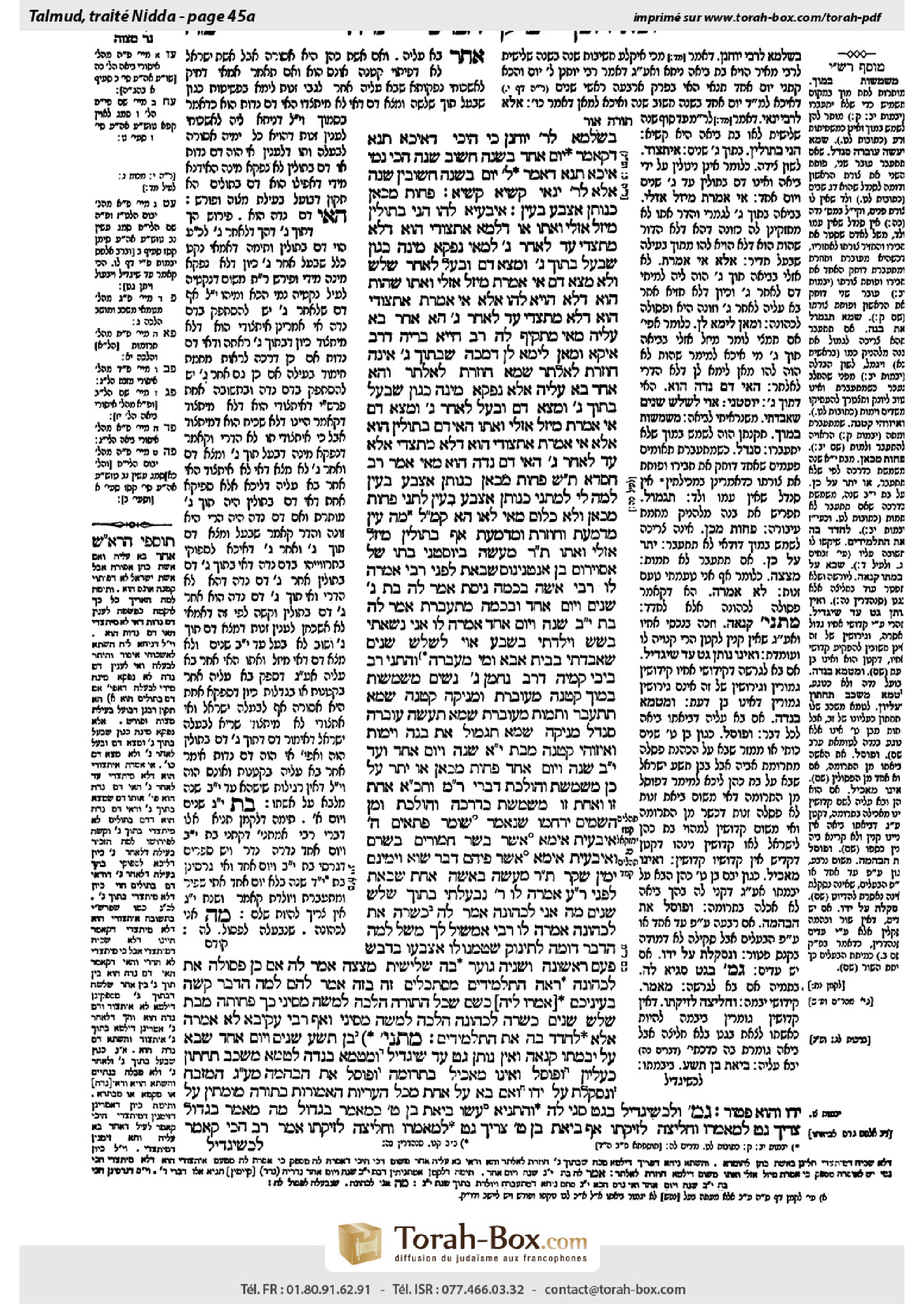
Niddah 45a: Talmud study for Daf Yomi
Daf Yomi is the daily study of one Talmud folio. Explore 37 tractates with scans, Hebrew text, Sefaria English and AI-generated French translations where annotated.
Passage selection and English or AI-generated French translation are available where the scan has annotations. Daf Study is independent of Torah-Box and Sefaria.
Browse Niddah · נידה · All tractatesNiddah 45a text and translations
This page of Niddah includes the Aramaic text, an English translation and an AI-generated French translation, alongside the scan above.
נידה מ״ה א · Aramaic and Hebrew text
בִּשְׁלָמָא לְרַבִּי יוֹחָנָן, כִּי הֵיכִי דְּאִיכָּא תַּנָּא דְּקָאָמַר יוֹם אֶחָד בַּשָּׁנָה חָשׁוּב שָׁנָה, הָכִי נָמֵי אִיכָּא תַּנָּא דְּאָמַר שְׁלֹשִׁים יוֹם בַּשָּׁנָה חֲשׁוּבִין שָׁנָה.
אֶלָּא לְרַבִּי יַנַּאי קַשְׁיָא! קַשְׁיָא.
פָּחוֹת מִכֵּן — כְּנוֹתֵן אֶצְבַּע בָּעַיִן. אִיבַּעְיָא לְהוּ: הָנֵי בְּתוּלִין — מֵיזָל אָזְלִי וְאָתוּ, אוֹ דִלְמָא אִתְּצוֹדֵי הוּא דְּלָא מִתַּצְדִּי עַד לְאַחַר שָׁלֹשׁ?
לְמַאי נָפְקָא מִינַּהּ? כְּגוֹן שֶׁבָּעַל בְּתוֹךְ שָׁלֹשׁ, וּמָצָא דָּם, וּבָעַל לְאַחַר שָׁלֹשׁ וְלֹא מָצָא דָּם. אִי אָמְרַתְּ מֵיזָל אָזְלִי וְאָתוּ — שְׁהוּת הוּא דְּלָא הָוְיָא לְהוּ.
אֶלָּא אִי אָמְרַתְּ: אִתְּצוֹדֵי הוּא דְּלָא מִתַּצְדִּי עַד לְאַחַר שָׁלֹשׁ, הָא אַחֵר בָּא עָלֶיהָ — מַאי?
מַתְקֵיף לַהּ רַב חִיָּיא בְּרֵיהּ דְּרַב אִיקָא: וּמַאן לֵימָא לַן דְּמַכָּה שֶׁבְּתוֹךְ שָׁלֹשׁ אֵינָהּ חוֹזֶרֶת לְאַלְתַּר? שֶׁמָּא חוֹזֶרֶת לְאַלְתַּר, וְהָא [וַדַּאי] אַחֵר בָּא עָלֶיהָ!
אֶלָּא נָפְקָא מִינַּהּ, כְּגוֹן שֶׁבָּעַל בְּתוֹךְ שָׁלֹשׁ וּמָצָא דָּם, וּבָעַל לְאַחַר שָׁלֹשׁ וּמָצָא דָּם. אִי אָמְרַתְּ מֵיזָל אָזְלִי וְאָתוּ — הַאי דַּם בְּתוּלִין הוּא, אֶלָּא אִי אָמְרַתְּ אִתְּצוֹדֵי הוּא דְּלָא מִתַּצְדִּי אֶלָּא עַד לְאַחַר שָׁלֹשׁ — הַאי דַּם נִדָּה הוּא. מַאי?
אָמַר רַב חִסְדָּא: תָּא שְׁמַע, פָּחוֹת מִכָּאן כְּנוֹתֵן אֶצְבַּע בָּעַיִן. לְמָה לִי לְמִתְנֵי ״כְּנוֹתֵן אֶצְבַּע בָּעַיִן״? לִתְנֵי: פָּחוֹת מִכָּאן וְלֹא כְלוּם! מַאי לַָאו הָא קָא מַשְׁמַע לַן: מָה עַיִן מַדְמַעַת, וְחוֹזֶרֶת וּמַדְמַעַת, אַף בְּתוּלִין מֵיזָל אָזְלִי וְאָתוּ.
תָּנוּ רַבָּנַן: מַעֲשֶׂה בְּיוֹסְטָנִי, בִּתּוֹ שֶׁל אַסְוִירוּס בֶּן אַנְטֹנִינוּס, שֶׁבָּאתָ לִפְנֵי רַבִּי. אָמְרָה לוֹ: רַבִּי, אִשָּׁה בְּכַמָּה נִיסֵּת? אָמַר לָהּ: בַּת שָׁלֹשׁ שָׁנִים וְיוֹם אֶחָד.
וּבְכַמָּה מִתְעַבֶּרֶת? אָמַר לָהּ: בַּת שְׁתֵּים עֶשְׂרֵה שָׁנָה וְיוֹם אֶחָד. אָמְרָה לוֹ: אֲנִי נִשֵּׂאתִי בְּשֵׁשׁ, וְיָלַדְתִּי בְּשֶׁבַע. אוֹי לְשָׁלֹשׁ שָׁנִים שֶׁאִבַּדְתִּי בְּבֵית אַבָּא!
וּמִי מִעַבְּרָה? וְהָתָנֵי רַב בִּיבִי קַמֵּיהּ דְּרַב נַחְמָן: שָׁלֹשׁ נָשִׁים מְשַׁמְּשׁוֹת בְּמוֹךְ — קְטַנָּה, מְעוּבֶּרֶת, וּמְנִיקָה.
קְטַנָּה — שֶׁמָּא תִּתְעַבֵּר וְתָמוּת; מְעוּבֶּרֶת — שֶׁמָּא תַּעֲשֶׂה עוּבָּרָהּ סַנְדָּל; מְנִיקָה — שֶׁמָּא תִּגְמוֹל אֶת בְּנָהּ וְיָמוּת.
וְאֵיזוֹהִי קְטַנָּה? מִבַּת אַחַת עֶשְׂרֵה שָׁנָה וְיוֹם אֶחָד וְעַד שְׁתֵּים עֶשְׂרֵה שָׁנָה וְיוֹם אֶחָד. פָּחוֹת מִכָּאן, אוֹ יָתֵר עַל כֵּן — מְשַׁמֶּשֶׁת [כְּדַרְכָּהּ] וְהוֹלֶכֶת, דִּבְרֵי רַבִּי מֵאִיר.
וַחֲכָמִים אוֹמְרִים: אַחַת זוֹ וְאַחַת זוֹ מְשַׁמֶּשֶׁת כְּדַרְכָּהּ וְהוֹלֶכֶת, וּמִן הַשָּׁמַיִם יְרַחֲמוּ, שֶׁנֶּאֱמַר ״שׁוֹמֵר פְּתָאיִם ה׳״!
אִיבָּעֵית אֵימָא: ״אֲשֶׁר בְּשַׂר חֲמוֹרִים בְּשָׂרָם״, וְאִיבָּעֵית אֵימָא: ״אֲשֶׁר פִּיהֶם דִּבֶּר שָׁוְא וִימִינָם יְמִין שָׁקֶר״.
תָּנוּ רַבָּנַן: מַעֲשֶׂה בְּאִשָּׁה אַחַת שֶׁבָּאת לִפְנֵי רַבִּי עֲקִיבָא, אָמְרָה לוֹ: רַבִּי, נִבְעַלְתִּי בְּתוֹךְ שָׁלֹשׁ שָׁנִים, מָה אֲנִי לִכְהוּנָּה? אָמַר לָהּ: כְּשֵׁרָה אַתְּ לַכְּהוּנָּה.
אָמְרָה לוֹ: רַבִּי, אֶמְשׁוֹל לְךָ מָשָׁל, לְמָה הַדָּבָר דּוֹמֶה? לְתִינוֹק שֶׁטָּמְנוּ לוֹ אֶצְבָּעוֹ בִּדְבַשׁ, פַּעַם רִאשׁוֹנָה וּשְׁנִיָּה גּוֹעֵר בָּהּ, שְׁלִישִׁית מֹצְצָהּ. אָמַר לָהּ: אִם כֵּן, פְּסוּלָה אַתְּ לַכְּהוּנָּה.
רָאָה הַתַּלְמִידִים מִסְתַּכְּלִים זֶה בָּזֶה, אָמַר לָהֶם: לָמָה הַדָּבָר קָשֶׁה בְּעֵינֵיכֶם? [אָמְרוּ לוֹ]: כְּשֵׁם שֶׁכׇּל הַתּוֹרָה הֲלָכָה לְמֹשֶׁה מִסִּינַי, כָּךְ פְּחוּתָה מִבַּת שָׁלֹשׁ שָׁנִים כְּשֵׁרָה לַכְּהוּנָּה הֲלָכָה לְמֹשֶׁה מִסִּינַי. וְאַף רַבִּי עֲקִיבָא לֹא אֲמָרָהּ אֶלָּא לְחַדֵּד בָּהּ אֶת הַתַּלְמִידִים.
מַתְנִי' בֶּן תֵּשַׁע שָׁנִים וְיוֹם אֶחָד, שֶׁבָּא עַל יְבִמְתּוֹ — קְנָאָהּ, וְאֵין נוֹתֵן גֵּט עַד שֶׁיַּגְדִּיל.
וּמְטַמֵּא בְּנִדָּה לְטַמֵּא מִשְׁכָּב תַּחְתּוֹן כָּעֶלְיוֹן.
וּפוֹסֵל, וְאֵינוֹ מַאֲכִיל בַּתְּרוּמָה, וּפוֹסֵל אֶת הַבְּהֵמָה מֵעַל גַּבֵּי הַמִּזְבֵּחַ, וְנִסְקֶלֶת עַל יָדוֹ, וְאִם בָּא עַל אַחַת מִכׇּל הָעֲרָיוֹת הָאֲמוּרוֹת בַּתּוֹרָה — מוּמָתִין עַל יָדוֹ, וְהוּא פָּטוּר.
גְּמָ' וְלִכְשֶׁיַּגְדִּיל. בְּגֵט סַגִּי לַהּ? וְהָתַנְיָא: עָשׂוּ בִּיאַת בֶּן תֵּשַׁע כְּמַאֲמָר בַּגָּדוֹל.
מָה מַאֲמָר בַּגָּדוֹל — צָרִיךְ גֵּט לְמַאֲמָרוֹ וַחֲלִיצָה לְזִיקָּתוֹ, אַף בִּיאַת בֶּן תֵּשַׁע — צָרִיךְ גֵּט לְמַאֲמָרוֹ וַחֲלִיצָה לְזִיקָּתוֹ!
אָמַר רַב: הָכִי קָאָמַר,
Niddah 45a · English translation
The Gemara asks: Granted, according to the opinion of Rabbi Yoḥanan, just as there is a tanna who says that one day in a year is considered equivalent to a year, so too, there is a tanna who says that thirty days in a year are considered equivalent to a year.The baraita states that according to Rabbi Meir, a girl two years and one day old is considered like a three-year-old, following the opinion that one day in a year is equivalent to a full year. Similarly, Rabbi Yoḥanan maintains that there is a second tanna who says that thirty days in a year are considered equivalent to a full year, and therefore a girl can be betrothed by intercourse from the age of two years and thirty days.
But according to the opinion of Rabbi Yannai, that Rabbi Meir requires a full three years, this baraita is difficult, as it explicitly states that in Rabbi Meir’s opinion even a girl aged two years and one day can be betrothed by intercourse. The Gemara concludes: Indeed, this baraita is difficult according to the opinion of Rabbi Yannai.
§ The last clause of the mishna teaches that if the girl is less than that age, i.e., younger than three years and one day, the status of intercourse with her is like placing a finger into the eye. A dilemma was raised before the Sages: What happens to this hymen, i.e., to the hymen of a girl under three with whom a man engaged in intercourse? Does it disappear and come back again later, or perhaps it is not removed at all until after she reaches the age of three?
The Gemara asks: What difference is there in halakha between these two suggestions? The Gemara answers that there is a practical ramification in a case where a priest engaged in intercourse with a girl to whom he is married within her first three years, and found blood on her due to that intercourse, and again engaged in intercourse with her many times, including after she turned three, but on that occasion he did not find blood. If you say that after engaging in intercourse when the girl is younger than three, the hymen disappears and comes back again, here one can maintain that it disappeared due to the first time they engaged in intercourse and did not grow back because there was not enough time without intercourse for it to grow back.
But if you say that the hymen is not removed at all until after she reaches the age of three, the fact that this girl did not emit blood after three years must be because another man engaged in intercourse with her after she turned three, in which case she is classified as a zona, a woman who has engaged in sexual intercourse with a man forbidden to her by the Torah, and is forbidden to her husband the priest. The Gemara reiterates: What, then, is the resolution of the dilemma?
Rav Ḥiyya, son of Rav Ika, objects to this explanation of the practical ramifications of the dilemma: But even if one maintains that the hymen of a girl younger than three disappears and grows back, one can still contend that this girl engaged in intercourse with another man, as who will say to us that a wound that was inflicted within three years of a girl’s birth is not restored and healed immediately? Perhaps it is restored immediately, and this girl did not emit blood because another man engaged in intercourse with her previously, and she is therefore a zona who is forbidden to a priest.
Rather, the practical difference between the two suggestions relates to a case where the husband engaged in intercourse with this girl within her first three years, and found blood, and engaged in intercourse with her again after she turned three, and again found blood. If you say that the hymen disappears and comes back again, this blood emitted when she is less than three years old is blood from the tearing of the hymen, which does not render her impure. But if you say that the hymen is not removed at all until after she reaches the age of three, then this blood she emitted when she was younger than three is menstrual blood, which renders her impure. What, then, is the resolution of the dilemma?
Rav Ḥisda said: Come and hear the mishna: If the girl is less than that age of three years and one day, intercourse with her is like placing a finger into the eye. Why do I need the mishna to teach: Like placing a finger into the eye? Let it teach simply: If she is less than that age, intercourse with her is nothing. What, is it not correct that this is what the mishna teaches us, by its comparison to an eye: Just as placing a finger in an eye causes it to tear and tear again, when another finger is placed in it, so too after the intercourse of a girl under three the hymen disappears and comes back again?
§ The Sages taught in a baraita: There was an incident involving a gentile woman called Yusteni, the daughter of Asveirus, son of Antoninus, a Roman emperor, who came before Rabbi Yehuda HaNasi. She said to him: My teacher, at what age is a woman fit to marry, i.e., at what age is it appropriate for a woman to engage in intercourse, which would therefore be the appropriate time to marry? Rabbi Yehuda HaNasi said to her: She must be at least three years and one day old.
Yusteni further inquired: And at what age is she fit to become pregnant? Rabbi Yehuda HaNasi said to her: When she is at least twelve years and one day old. She said to him: I married when I was six, and gave birth a year later, when I was seven. Woe for those three years, between the age of three, when I was fit for intercourse, and the age of six, when I married, as I wasted those years in my father’s house by not engaging in intercourse.
The Gemara asks: And can a minor of that age become pregnant? But didn’t Rav Beivai teach a baraita before Rav Naḥman: Three women may engage in intercourse while using a contraceptive absorbent cloth, a soft fabric placed at the entrance to the womb to prevent conception, despite the fact that this practice generally is prohibited. They are a minor; a pregnant woman; and a nursing woman.
The baraita specifies the reason for allowing these women to use contraceptive absorbent cloths: A minor, lest she become pregnant and perhaps die from this pregnancy; a pregnant woman, lest she be impregnated a second time and her older fetus become deformed into the shape of a sandal fish, by being squashed by the pressure of the second fetus; and a nursing woman, lest she become pregnant and her milk dry up, in which case she weans her son too early, thereby endangering him, and he dies.
The baraita continues: And who is considered a minor? It is a girl from the age of eleven years and one day until the age of twelve years and one day. If she was younger than that or older than that, she may go ahead and engage in intercourse in her usual manner, i.e., without contraception. This is the statement of Rabbi Meir. Since it is assumed that a minor who is less than eleven years old cannot become pregnant, she is considered to be in no danger.
And the Rabbis say: Both in this case of a minor girl who can become pregnant and in that case of a minor girl who cannot become pregnant, she may go ahead and engage in intercourse in her usual manner, and Heaven will have mercy upon her and prevent any mishap, as it is stated: “The Lord preserves the simple” (Psalms 116:6). In light of the statement of Rabbi Meir, how could Yusteni have become pregnant at age seven?
The Gemara answers: If you wish, say that Yusteni was able to become pregnant at such a young age because she was a gentile, and the verse states with regard to gentiles: “Their flesh is the flesh of donkeys” (Ezekiel 23:20). And if you wish, say instead that Yusteni was lying when she said she became pregnant at age seven, as it is stated with regard to gentiles: “Whose mouth speaks falsehood, and their right hand is a right hand of lying” (Psalms 144:8).
The Sages taught in a baraita: There was an incident involving a certain woman who came before Rabbi Akiva and said to him: My teacher, I engaged in intercourse within three years of my birth; what is my status with regard to marrying into the priesthood? Rabbi Akiva said to her: You are fit to marry into the priesthood.
She said to him: My teacher, I will tell you a parable; to what is this matter comparable? It is comparable to a baby whose finger one forcibly dipped in honey. On the first time and the second time, he moans at his mother for doing so, but on the third occasion, once he is used to the taste of honey, he willingly sucks the finger dipped in honey. She was insinuating to Rabbi Akiva that she engaged in intercourse several times, and although the first couple of times were against her will, the third incident was with her consent. Rabbi Akiva said to her: If so, you are disqualified from marrying into the priesthood.
Rabbi Akiva saw his students looking at each other, puzzling over this ruling. He said to them: Why is this matter difficult in your eyes? They said to him: Just as the entire Torah is a halakha transmitted to Moses from Sinai, so too this halakha of a girl who engaged in intercourse when she was less than three years old, i.e., that she is fit to marry into the priesthood, is a halakha transmitted to Moses from Sinai, and it applies whether she engaged intercourse against her will or with her consent. The Gemara notes: And even Rabbi Akiva did not say to the woman that she was unfit to marry into the priesthood because that is the halakha; rather, he did so only to sharpen the minds of his students with his statement, to see how they would respond.
MISHNA: In the case of a boy, nine years and one day old, whose brother had died childless, who engaged in intercourse with his yevama, his brother’s widow, the status of the intercourse is that of halakhic intercourse and he acquires her as his wife; but he cannot give her a bill of divorce, if he chooses to end the marriage, until he reaches majority.
And he becomes ritually impure after engaging in intercourse with a menstruating woman to the degree that he renders impure all the layers of bedding beneath him, such that they become impure like the upper bedding covering a zav. Accordingly, the bedding assumes first-degree ritual impurity status and does not become a primary source of ritual impurity, and it renders impure food and drink and does not render impure people and vessels.
And if he is disqualified from the priesthood and the woman with whom he engages in intercourse is the daughter of a priest, he disqualifies her from partaking of teruma; but if he is a priest who marries an Israelite woman, he does not enable her to partake of teruma. And if he engages in bestiality, he disqualifies the animal from being sacrificed upon the altar, and the animal is stoned due to his act. And if he engaged in intercourse with one of all those with whom relations are forbidden, as stated in the Torah, e.g., his aunt or his mother, they are executed by the court due to having engaged in intercourse with him, because they are adults; but he is exempt, as he is a minor.
GEMARA: The mishna teaches that a boy aged nine years and one day cannot give his yevama a bill of divorce until he reaches majority. The Gemara asks: And even when he reaches majority, is a bill of divorce enough to enable her to marry any man? But isn’t it taught in a baraita that the Sages rendered the halakhic status of the act of intercourse of a boy nine years and one day old like that of levirate betrothal by means of money or a document performed by an adult man, which is an acquisition by rabbinic law? Accordingly, she is not his full-fledged wife.
Therefore, one can assert as follows: Just as after a levirate betrothal performed by an adult man, the yavam must give the yevama a bill of divorce to release her from his levirate betrothal and perform ḥalitza to release her from his levirate bond, so too with regard to the intercourse of a boy nine years and one day old, the halakha should be that he must give her a bill of divorce for his levirate betrothal and perform ḥalitza to release her from his levirate bond.
Rav said in response that this is what the tanna of the mishna is saying:
Niddah 45a · Traduction française (IA)
La Guemara demande : Admettons, selon l'opinion de Rabbi Yoḥanan, qu'ainsi qu'il existe un tanna qui dit qu'un jour dans une année est considéré comme équivalent à une année, de même, il existe un tanna qui dit que trente jours dans une année sont considérés comme équivalents à une année. La baraïta énonce que, selon Rabbi Meir, une fille âgée de deux ans et un jour est considérée comme une fille de trois ans, conformément à l'opinion selon laquelle un jour dans une année est équivalent à une année complète. De même, Rabbi Yoḥanan soutient qu'il existe un second tanna qui dit que trente jours dans une année sont considérés comme équivalents à une année complète, et par conséquent, une fille peut être fiancée par le rapport sexuel à partir de l'âge de deux ans et trente jours.
Mais selon l'opinion de Rabbi Yannai, selon laquelle Rabbi Meir exige trois ans complets, cette baraïta est difficile, car elle énonce explicitement que, selon l'opinion de Rabbi Meir, même une fille âgée de deux ans et un jour peut être fiancée par le rapport sexuel. La Guemara conclut : En effet, cette baraïta est difficile selon l'opinion de Rabbi Yannai.
§ La dernière clause de la Michna enseigne que si la fille est plus jeune que cet âge, c'est-à-dire plus jeune que trois ans et un jour, le statut du rapport sexuel avec elle est comparable à l'introduction d'un doigt dans l'œil. Un dilemme a été posé devant les Sages : Que devient ce hymen, c'est-à-dire l'hymen d'une fille de moins de trois ans avec qui un homme a eu un rapport sexuel ? Disparaît-il pour revenir plus tard, ou peut-être n'est-il pas retiré du tout avant qu'elle n'atteigne l'âge de trois ans ?
La Guemara demande : Quelle différence y a-t-il en halakha entre ces deux propositions ? La Guemara répond qu'il y a une conséquence pratique dans le cas où un prêtre a eu des rapports sexuels avec une fille à laquelle il est marié au cours de ses trois premières années, et a trouvé du sang sur elle en raison de ces rapports, puis a de nouveau eu des rapports sexuels avec elle à de nombreuses reprises, y compris après qu'elle a atteint l'âge de trois ans, mais à cette occasion, il n'a pas trouvé de sang. Si vous dites qu'après avoir eu des rapports sexuels alors que la fille a moins de trois ans, l'hymen disparaît et reparaît, ici on peut maintenir qu'il a disparu lors de la première fois qu'ils ont eu des rapports sexuels et n'a pas repoussé parce qu'il n'y a pas eu assez de temps sans rapports sexuels pour qu'il repousse.
Mais si vous dites que l'hymen n'est pas retiré du tout avant qu'elle n'atteigne l'âge de trois ans, le fait que cette fille n'ait pas émis de sang après trois ans doit être dû au fait qu'un autre homme a eu des rapports sexuels avec elle après qu'elle a atteint l'âge de trois ans, auquel cas elle est classée comme une zona, une femme qui a eu des rapports sexuels avec un homme qui lui est interdit par la Torah, et elle est interdite à son mari, le prêtre. La Guemara réitère : Quelle est alors la résolution du dilemme ?
Rav Ḥiyya, fils de Rav Ika, objecte à cette explication des conséquences pratiques du dilemme : Mais même si l'on maintient que l'hymen d'une fille de moins de trois ans disparaît et repousse, on peut encore soutenir que cette fille a eu des rapports sexuels avec un autre homme, car qui nous dira qu'une plaie infligée dans les trois ans suivant la naissance d'une fille n'est pas restaurée et guérie immédiatement ? Peut-être est-elle restaurée immédiatement, et cette fille n'a pas émis de sang parce qu'un autre homme a eu des rapports sexuels avec elle auparavant, et elle est donc une zona qui est interdite à un prêtre.
En réalité, la différence pratique entre les deux propositions concerne un cas où le mari a eu des rapports avec cette fille au cours de ses trois premières années et a trouvé du sang, puis a eu de nouveau des rapports avec elle après qu'elle a atteint l'âge de trois ans et a encore trouvé du sang. Si vous dites que l'hymen disparaît et reparaît, ce sang émis alors qu'elle avait moins de trois ans est le sang de la déchirure de l'hymen, qui ne la rend pas impure. Mais si vous dites que l'hymen n'est pas retiré du tout avant qu'elle n'atteigne l'âge de trois ans, alors ce sang qu'elle a émis alors qu'elle avait moins de trois ans est du sang menstruel, qui la rend impure. Quelle est donc la résolution de ce dilemme ?
Rav Ḥisda a dit : Venez écouter la Michna : Si la fille est plus jeune que cet âge de trois ans et un jour, les rapports avec elle sont comme l'introduction d'un doigt dans l'œil. Pourquoi ai-je besoin que la Michna enseigne : Comme l'introduction d'un doigt dans l'œil ? Qu'elle enseigne simplement : Si elle est plus jeune que cet âge, les rapports avec elle ne comptent pour rien. N'est-il pas exact que c'est ce que la Michna nous enseigne par sa comparaison à un œil : Tout comme l'introduction d'un doigt dans un œil provoque sa déchirure, puis sa déchirure à nouveau lorsqu'un autre doigt y est introduit, de même, après les rapports avec une fille de moins de trois ans, l'hymen disparaît et reparaît ?
§ Les Sages ont enseigné dans une baraïta : Il y a eu un incident impliquant une femme non juive appelée Yusteni, fille d'Asveirus, fils d'Antoninus, un empereur romain, qui est venue devant Rabbi Yehuda HaNasi. Elle lui a dit : Mon maître, à quel âge une femme est-elle apte à se marier, c'est-à-dire à quel âge est-il approprié pour une femme d'avoir des rapports, ce qui serait donc le moment approprié pour se marier ? Rabbi Yehuda HaNasi lui a dit : Elle doit avoir au moins trois ans et un jour.
Yusteni a demandé en outre : À quel âge est-elle apte à concevoir ? Rabbi Yehuda HaNasi lui a dit : Lorsqu'elle a au moins douze ans et un jour. Elle lui a dit : Je me suis mariée à six ans et j'ai donné naissance un an plus tard, à sept ans. Malheur à ces trois années, entre l'âge de trois ans, où j'étais apte aux rapports sexuels, et l'âge de six ans, où je me suis mariée, car j'ai gaspillé ces années dans la maison de mon père en n'entretenant pas de rapports sexuels.
La Guemara demande : Et une mineure de cet âge peut-elle concevoir ? Mais n'est-ce pas Rav Beivai qui a enseigné une baraïta devant Rav Naḥman : Trois femmes peuvent entretenir des rapports sexuels en utilisant un tissu absorbant contraceptif, un tissu doux placé à l'entrée de l'utérus pour empêcher la conception, malgré le fait que cette pratique est généralement interdite. Il s'agit d'une mineure, d'une femme enceinte et d'une femme qui allaite.
La baraïta précise la raison pour laquelle ces femmes sont autorisées à utiliser des tissus absorbants contraceptifs : pour une mineure, de peur qu'elle ne tombe enceinte et qu'elle ne meure peut-être de cette grossesse ; pour une femme enceinte, de peur qu'elle ne soit fécondée une seconde fois et que son fœtus aîné ne se déforme en prenant la forme d'un poisson-sandale, écrasé par la pression du second fœtus ; et pour une femme qui allaite, de peur qu'elle ne tombe enceinte et que son lait ne s'épuise, auquel cas elle sevrerait son fils trop tôt, le mettant ainsi en danger, et il mourrait.
La baraïta continue : Et qui est considérée comme une mineure ? C'est une fille âgée de onze ans et un jour jusqu'à douze ans et un jour. Si elle est plus jeune ou plus âgée que cela, elle peut procéder aux rapports sexuels de manière habituelle, c'est-à-dire sans contraception. C'est l'avis de Rabbi Meïr. Étant donné qu'on suppose qu'une mineure de moins de onze ans ne peut pas tomber enceinte, elle est considérée comme ne courant aucun danger.
Et les Sages disent : Tant dans le cas d'une fille mineure qui peut tomber enceinte que dans celui d'une fille mineure qui ne peut pas tomber enceinte, elle peut procéder aux rapports sexuels de manière habituelle, et le Ciel aura pitié d'elle et empêchera tout accident, comme il est écrit : « L'Éternel préserve les simples » (Psaumes 116:6). À la lumière de l'avis de Rabbi Meïr, comment Yusteni a-t-elle pu tomber enceinte à l'âge de sept ans ?
La Guemara répond : Si vous le souhaitez, dites que Yusteni a pu tomber enceinte à un si jeune âge parce qu'elle était une non-Juive, et le verset dit à propos des non-Juifs : « Leur chair est la chair des ânes » (Ézéchiel 23:20). Et si vous le souhaitez, dites plutôt que Yusteni mentait lorsqu'elle a dit qu'elle était tombée enceinte à l'âge de sept ans, comme il est écrit à propos des non-Juifs : « Dont la bouche parle le mensonge, et dont la main droite est une main de mensonge » (Psaumes 144:8).
Les Sages ont enseigné dans une baraïta : Il est arrivé qu'une certaine femme se présente devant Rabbi Akiva et lui dise : Mon maître, j'ai eu des rapports sexuels dans les trois ans suivant ma naissance ; quelle est ma situation concernant le mariage avec un prêtre ? Rabbi Akiva lui dit : Vous êtes apte à épouser un prêtre.
Elle lui dit : Mon maître, je vais vous raconter une parabole ; à quoi cette affaire est-elle comparable ? C'est comparable à un bébé dont on a plongé le doigt dans le miel de force. La première fois et la deuxième fois, il gémit auprès de sa mère à cause de cela, mais la troisième fois, une fois qu'il est habitué au goût du miel, il aspire volontiers le doigt trempé de miel. Elle insinuait à Rabbi Akiva qu'elle avait eu des rapports sexuels plusieurs fois, et bien que les deux premières fois aient été contre sa volonté, le troisième incident s'était produit avec son consentement. Rabbi Akiva lui dit : Si c'est le cas, vous êtes inapte à épouser un prêtre.
Rabbi Akiva vit ses élèves se regarder, perplexes devant ce jugement. Il leur dit : Pourquoi cette affaire est-elle difficile à vos yeux ? Ils lui dirent : De même que toute la Torah est une halakha transmise à Moïse depuis le Sinaï, de même cette halakha concernant une fille qui a eu des rapports sexuels alors qu'elle avait moins de trois ans, c'est-à-dire qu'elle est apte à épouser un prêtre, est une halakha transmise à Moïse depuis le Sinaï, et elle s'applique qu'elle ait eu des rapports contre sa volonté ou avec son consentement. La Guemara note : Et même Rabbi Akiva n'a pas dit à la femme qu'elle était inapte à épouser un prêtre parce que c'est la halakha ; plutôt, il l'a fait uniquement pour aiguiser l'esprit de ses élèves par sa déclaration, pour voir comment ils réagiraient.
MICHNA : Dans le cas d'un garçon âgé de neuf ans et un jour, dont le frère est mort sans postérité, qui a eu des rapports avec sa yévama, la veuve de son frère, ces rapports ont le statut de rapports légaux et il l'acquiert comme épouse ; mais il ne peut pas lui donner un acte de divorce, s'il choisit de mettre fin au mariage, avant d'atteindre la majorité.
Et il contracte une impureté rituelle après avoir eu des rapports avec une femme en période menstruelle, au point de rendre impures toutes les couches de lit situées sous lui, de sorte qu'elles contractent l'impureté de la couche supérieure couvrant un zav. En conséquence, le lit acquiert un statut d'impureté rituelle de premier degré et ne devient pas une source primaire d'impureté rituelle ; il rend impurs les aliments et les boissons, mais ne rend pas impures les personnes et les récipients.
Et s'il est inapte au sacerdoce et que la femme avec laquelle il a des rapports est la fille d'un prêtre, il la rend inapte à consommer la terouma ; mais s'il est un prêtre qui épouse une femme israélite, il ne l'autorise pas à consommer la terouma. Et s'il commet un acte de bestialité, il rend l'animal inapte à être sacrifié sur l'autel, et l'animal est lapidé en raison de son acte. Et s'il a eu des rapports avec l'une de toutes celles avec qui les relations sont interdites, comme indiqué dans la Torah, par exemple sa tante ou sa mère, elles sont exécutées par le tribunal pour avoir eu des rapports avec lui, parce qu'elles sont adultes ; mais il est exempt, car il est mineur.
GUEMARA : La Michna enseigne qu'un garçon âgé de neuf ans et un jour ne peut pas donner à sa yévama un acte de divorce avant d'atteindre la majorité. La Guemara demande : Et même lorsqu'il atteint la majorité, un acte de divorce suffit-il pour lui permettre d'épouser n'importe quel homme ? Mais n'est-il pas enseigné dans une baraïta que les Sages ont assimilé le statut halakhique de l'acte de rapports sexuels d'un garçon âgé de neuf ans et un jour à celui de l'engagement lévirat effectué par un homme adulte au moyen de l'argent ou d'un document, qui constitue une acquisition par droit rabbinique ? En conséquence, elle n'est pas son épouse à part entière.
Par conséquent, on peut affirmer ce qui suit : De même qu'après un engagement lévirat effectué par un homme adulte, le yavam doit donner à la yévama un acte de divorce pour la libérer de son engagement lévirat et effectuer la ḥalitza pour la libérer de son lien lévirat, de même, en ce qui concerne les rapports sexuels d'un garçon âgé de neuf ans et un jour, la halakha devrait être qu'il doit lui donner un acte de divorce pour son engagement lévirat et effectuer la ḥalitza pour la libérer de son lien lévirat.
Rav a répondu que c'est ce que dit le tanna de la Michna :
Traduction française générée par IA à partir de l’édition anglaise de Sefaria. Vérifie toujours un passage avec le texte source.
Text from Sefaria: William Davidson Edition - Vocalized Aramaic (CC BY NC); William Davidson Edition - English (CC BY NC).