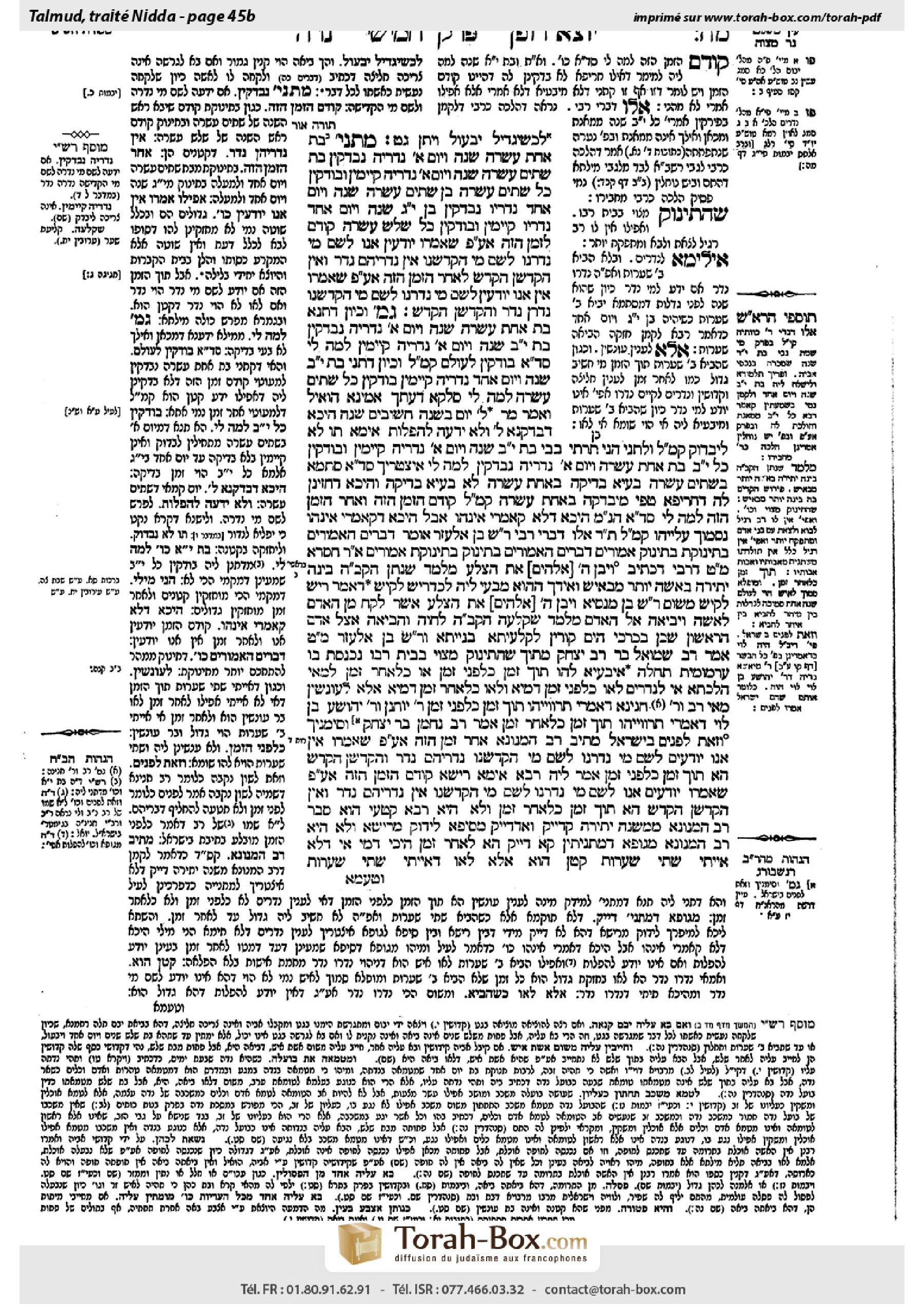
Niddah 45b: Talmud study for Daf Yomi
Daf Yomi is the daily study of one Talmud folio. Explore 37 tractates with scans, Hebrew text, Sefaria English and AI-generated French translations where annotated.
Passage selection and English or AI-generated French translation are available where the scan has annotations. Daf Study is independent of Torah-Box and Sefaria.
Browse Niddah · נידה · All tractatesNiddah 45b text and translations
This page of Niddah includes the Aramaic text, an English translation and an AI-generated French translation, alongside the scan above.
נידה מ״ה ב · Aramaic and Hebrew text
לִכְשֶׁיַּגְדִּיל יִבְעוֹל וְיִתֵּן גֵּט.
מַתְנִי' בַּת אַחַת עֶשְׂרֵה שָׁנָה וְיוֹם אֶחָד — נְדָרֶיהָ נִבְדָּקִין. בַּת שְׁתֵּים עֶשְׂרֵה שָׁנָה וְיוֹם אֶחָד — נְדָרֶיהָ קַיָּימִין, וּבוֹדְקִין כׇּל שְׁתֵּים עֶשְׂרֵה.
בֶּן שְׁתֵּים עֶשְׂרֵה שָׁנָה וְיוֹם אֶחָד — נְדָרָיו נִבְדָּקִין, בֶּן שְׁלֹשׁ עֶשְׂרֵה שָׁנָה וְיוֹם אֶחָד — נְדָרָיו קַיָּימִין, וּבוֹדְקִין כׇּל שְׁלֹשׁ עֶשְׂרֵה.
קוֹדֶם לַזְּמַן הַזֶּה, אַף עַל פִּי שֶׁאָמְרוּ: ״יוֹדְעִין אָנוּ לְשֵׁם מִי נָדַרְנוּ״, ״לְשֵׁם מִי הִקְדַּשְׁנוּ״ — אֵין נִדְרֵיהֶם נֶדֶר וְאֵין הֶקְדֵּשָׁן הֶקְדֵּשׁ. לְאַחַר הַזְּמַן הַזֶּה, אַף עַל פִּי שֶׁאָמְרוּ: ״אֵין אָנוּ יוֹדְעִין לְשֵׁם מִי נָדַרְנוּ״, ״לְשֵׁם מִי הִקְדַּשְׁנוּ״ — נִדְרָן נֶדֶר וְהֶקְדֵּשָׁן הֶקְדֵּשׁ.
גְּמָ' וְכֵיוָן דִּתְנָא ״בַּת אַחַת עֶשְׂרֵה שָׁנָה וְיוֹם אֶחָד נְדָרֶיהָ נִבְדָּקִין״, ״בַּת שְׁתֵּים עֶשְׂרֵה שָׁנָה וְיוֹם אֶחָד נְדָרֶיהָ קַיָּימִין״ לְמָה לִי? סָלְקָא דַעְתָּךְ אָמֵינָא: בּוֹדְקִין לְעוֹלָם, קָא מַשְׁמַע לַן.
וְכֵיוָן דְּתָנֵי בַּת ״שְׁתֵּים עֶשְׂרֵה שָׁנָה וְיוֹם אֶחָד נְדָרֶיהָ קַיָּימִין״, ״בּוֹדְקִין כׇּל שְׁתֵּים עֶשְׂרֵה״ לְמָה לִי? סָלְקָא דַעְתָּךְ אָמֵינָא: הוֹאִיל וְאָמַר מָר ״שְׁלֹשִׁים יוֹם בַּשָּׁנָה חֲשׁוּבִים שָׁנָה״, הֵיכָא דִּבְדַקְנָא שְׁלֹשִׁים וְלֹא יָדְעָה לְהַפְלוֹת, אֵימָא: תּוּ לָא לִיבְדּוֹק, קָא מַשְׁמַע לַן.
וְלִתְנֵי הָנֵי תַּרְתֵּי בָּבֵי: ״בַּת שְׁתֵּים עֶשְׂרֵה שָׁנָה וְיוֹם אֶחָד נְדָרֶיהָ קַיָּימִין, וּבוֹדְקִין כׇּל שְׁתֵּים עֶשְׂרֵה״. ״בַּת אַחַת עֶשְׂרֵה וְיוֹם אֶחָד נְדָרֶיהָ נִבְדָּקִין״ לְמָה לִי?
אִיצְטְרִיךְ, סָלְקָא דַעְתָּךְ אָמֵינָא: סְתָמָא — בִּשְׁתֵּים עֶשְׂרֵה בָּעֲיָא בְּדִיקָה, בְּאַחַת עֶשְׂרֵה לָא בָּעֲיָא בְּדִיקָה, וְהֵיכָא דְּחָזֵינַן לַהּ דַּחֲרִיפָא טְפֵי — (מִיבַּדְקָה) [לִיבְדְּקַהּ] בְּאַחַת עֶשְׂרֵה, קָא מַשְׁמַע לַן.
קוֹדֶם הַזְּמַן הַזֶּה וְאַחַר הַזְּמַן הַזֶּה, לְמָה לִי? סָלְקָא דַעְתָּךְ אָמֵינָא: הָנֵי מִילֵּי הֵיכָא דְּלָא קָאָמְרִי אִינְהוּ, אֲבָל הֵיכָא דְּקָאָמְרִי אִינְהוּ — נִסְמוֹךְ עֲלַיְיהוּ, קָא מַשְׁמַע לַן.
תָּנוּ רַבָּנַן: אֵלּוּ דִּבְרֵי רַבִּי. רַבִּי שִׁמְעוֹן בֶּן אֶלְעָזָר אוֹמֵר: דְּבָרִים הָאֲמוּרִים בְּתִינוֹקֶת — בְּתִינוֹק אֲמוּרִים, דְּבָרִים הָאֲמוּרִים בְּתִינוֹק — בְּתִינוֹקֶת אֲמוּרִים.
אָמַר רַב חִסְדָּא: מַאי טַעְמָא דְּרַבִּי? דִּכְתִיב ״וַיִּבֶן ה׳ [אֱלֹהִים] אֶת הַצֵּלָע״, מְלַמֵּד שֶׁנָּתַן הַקָּדוֹשׁ בָּרוּךְ הוּא בִּינָה יְתֵירָה בָּאִשָּׁה יוֹתֵר מִבָּאִישׁ.
וְאִידַּךְ, הַהוּא מִבָּעֵי לֵיהּ לְכִדְרֵישׁ לָקִישׁ, דְּאָמַר רֵישׁ לָקִישׁ מִשּׁוּם רַבִּי שִׁמְעוֹן בֶּן מְנַסְיָא: ״וַיִּבֶן ה׳ [אֱלֹהִים] אֶת הַצֵּלָע אֲשֶׁר לָקַח מִן הָאָדָם לְאִשָּׁה וַיְבִאֶהָ אֶל הָאָדָם״ — מְלַמֵּד שֶׁקִּלְּעָהּ הַקָּדוֹשׁ בָּרוּךְ הוּא לְחַוָּה וֶהֱבִיאָהּ אֵצֶל אָדָם הָרִאשׁוֹן, שֶׁכֵּן בִּכְרַכֵּי הַיָּם קוֹרִין לְקַלָּעִיתָא — בַּנָּיְיתָא.
וְרַבִּי שִׁמְעוֹן בֶּן אֶלְעָזָר מַאי טַעְמֵיהּ? אָמַר רַב שְׁמוּאֵל בַּר רַב יִצְחָק: מִתּוֹךְ שֶׁהַתִּינוֹק מָצוּי בְּבֵית רַבּוֹ, נִכְנֶסֶת בּוֹ עַרְמוּמִית תְּחִלָּה.
אִיבַּעְיָא לְהוּ: תּוֹךְ זְמַן — כְּלִפְנֵי זְמַן, אוֹ כִּלְאַחַר זְמַן?
לְמַאי הִלְכְתָא? אִי לִנְדָרִים — לָאו כְּלִפְנֵי זְמַן דָּמְיָא, וְלָאו כִּלְאַחַר זְמַן דָּמְיָא.
אֶלָּא, לָעֳונָשִׁין מַאי? רַב וְרַבִּי חֲנִינָא דְּאָמְרִי תַרְוַויְיהוּ: תּוֹךְ זְמַן כְּלִפְנֵי זְמַן, רַבִּי יוֹחָנָן וְרַבִּי יְהוֹשֻׁעַ בֶּן לֵוִי דְּאָמְרִי תַרְוַויְיהוּ: תּוֹךְ זְמַן כִּלְאַחַר זְמַן.
אָמַר רַב נַחְמָן בַּר יִצְחָק, וְסִימָנָיךְ ״וְזֹאת לְפָנִים בְּיִשְׂרָאֵל״.
מֵתִיב רַב הַמְנוּנָא: אַחַר זְמַן הַזֶּה, אַף עַל פִּי שֶׁאָמְרוּ ״אֵין אָנוּ יוֹדְעִים לְשֵׁם מִי נָדַרְנוּ״, ״לְשֵׁם מִי הִקְדַּשְׁנוּ״ — נִדְרֵיהֶם נֶדֶר וְהֶקְדֵּשָׁן הֶקְדֵּשׁ. הָא תּוֹךְ זְמַן — כְּלִפְנֵי זְמַן!
אֲמַר לֵיהּ רָבָא: אֵימָא רֵישָׁא — קוֹדֶם הַזְּמַן הַזֶּה, אַף עַל פִּי שֶׁאָמְרוּ ״יוֹדְעִים אָנוּ לְשֵׁם מִי נָדַרְנוּ״, ״לְשֵׁם מִי הִקְדַּשְׁנוּ״ — אֵין נִדְרֵיהֶם נֶדֶר וְאֵין הֶקְדֵּשָׁן הֶקְדֵּשׁ. הָא תּוֹךְ זְמַן — כִּלְאַחַר זְמַן!
וְלָא הִיא, רָבָא קָטָעֵי. הוּא סָבַר רַב הַמְנוּנָא מִמִּשְׁנָה יְתֵירָה קָדָיֵיק, וְאַדְּדָיֵיק מִסֵּיפָא — לֵידוּק מֵרֵישָׁא.
וְלָא הִיא, רַב הַמְנוּנָא מִגּוּפָא דְּמַתְנִיתִין קָא דָיֵיק: הָא ״לְאַחַר זְמַן״ הֵיכִי דָּמֵי? אִי דְּלָא אַיְיתִי שְׁתֵּי שְׂעָרוֹת — קָטָן הוּא, אֶלָּא לָאו דְּאַיְיתִי שְׁתֵּי שְׂעָרוֹת,
Niddah 45b · English translation
When he reaches majority he may engage in intercourse with her, and thereby acquire her as his full-fledged wife, and if he wished to divorce her he can then give her a bill of divorce without having to perform ḥalitza.
MISHNA: With regard to a girl who is eleven years and one day old, her vows are examined to ascertain whether she is aware of the meaning of her vow and in Whose name she vowed. Once she is twelve years and one day old and has grown two pubic hairs, which is a sign of adulthood, even without examination her vows are in effect. And one examines her vows throughout the entire twelfth year until her twelfth birthday.
With regard to a boy who is twelve years and one day old, his vows are examined to ascertain whether he is aware of the meaning of his vow and in Whose name he vowed. Once he is thirteen years and one day old and has grown two pubic hairs, even without examination his vows are in effect. And one examines his vows throughout the entire thirteenth year until his thirteenth birthday.
Prior to that time, eleven years and one day for a girl and twelve years and one day for a boy, even if they said: We know in Whose name we vowed and in Whose name we consecrated, their vow is not a valid vow and their consecration is not a valid consecration. After that time, twelve years and one day for a girl and thirteen years and one day for a boy, even if they said: We do not know in Whose name we vowed and in Whose name we consecrated, their vow is a valid vow and their consecration is a valid consecration.
GEMARA: The Gemara asks: But since the mishna teaches: With regard to a girl who is eleven years and one day old her vows are examined, why do I need the mishna to further state: Once she is twelve years and one day old her vows are in effect? After all, by this stage she is already an adult. The Gemara answers that this ruling is necessary, as it might enter your mind to say that one examines her vows forever, even when she is an adult. Therefore, the mishna teaches us that the vows of an adult are valid even without examination.
The Gemara further asks: And since the mishna teaches: Once she is twelve years and one day old her vows are in effect, why do I need it to further state: One examines her vows throughout the entire twelfth year? The Gemara answers that this ruling is necessary, as it might enter your mind to say: Since the Master says that thirty days in a year are considered equivalent to a year, in a case where we examine her for thirty days after she turned eleven and she did not know how to utter a vow properly, i.e., she did not have a clear understanding of the meaning of the vow, one might say that one should examine her no further until she reaches the age of twelve. Therefore, the mishna teaches us that she is examined throughout her twelfth year.
The Gemara asks: And let the mishna teach only these two clauses: Once she is twelve years and one day old her vows are in effect, and one examines her vows throughout the entire twelfth year. Once both of these have been taught, why do I need the ruling: With regard to a girl who is eleven years and one day old, her vows are examined?
The Gemara answers that this clause was necessary, as it might enter your mind to say: In an ordinary case, a girl requires examination in her twelfth year, whereas in her eleventh year she does not require examination. But in a case where we discern about her that she has a very sharp mind, perhaps she should be examined already in her eleventh year. Therefore, the tanna teaches us that she is not examined in her eleventh year irrespective of how intelligent she is, as she is too young.
The Gemara asks: Why do I need the mishna to teach that prior to that time their vows and consecration are always not valid and after that time they are always valid? These halakhot can be inferred from the previous statements of the mishna. The Gemara answers that these rulings are necessary, as it might enter your mind to say: These matters apply only in a case where they do not say: We know in Whose name we vowed, when they are younger than the periods mentioned in the mishna, or: We do not know in Whose name we vowed, when they are older. But in a case where they do say such statements, perhaps we rely on their claim. Therefore, the tanna teaches us that when they are younger than the periods stated in the mishna their vows are never valid, and when they are older, their vows are always valid.
§ The mishna indicates that the intellectual development of a girl is faster than that of a boy. In this regard, the Sages taught in a baraita: This opinion, with regard to the periods of vows for girls and boys, is in accordance with the statement of Rabbi Yehuda HaNasi. But Rabbi Shimon ben Elazar says the opposite, that the matter stated here with regard to a girl is actually stated with regard to a boy, whereas the matter stated with regard to a boy is in fact stated with regard to a girl, as the intellectual development of males is faster than that of females.
Rav Ḥisda said: What is the reason of Rabbi Yehuda HaNasi? As it is written, with regard to the creation of woman: “And the rib, which the Lord God had taken from the man, He made [vayyiven] a woman, and brought her to the man” (Genesis 2:22). This teaches that the Holy One, Blessed be He, granted a woman a greater understanding [bina] than that of a men.
The Gemara asks: And what does the other tanna, Rabbi Shimon ben Elazar, derive from this verse? The Gemara answers: He requires that verse for that which Reish Lakish taught, as Reish Lakish said in the name of Rabbi Shimon ben Menasya with regard to the verse: “And the rib, which the Lord God had taken from the man, He made a woman, and brought her to the man.” This teaches that the Holy One, Blessed be He, braided the hair of Eve, and then brought her to Adam the first man. As in the cities overseas [bikhrakei hayyam] they call braiding hair, building [benayita].
The Gemara asks: And Rabbi Shimon ben Elazar, what is the reason that he maintains that the intellectual development of males is faster than that of females? Rav Shmuel bar Rav Yitzḥak says: Since a boy frequents his teacher’s house, cleverness enters his mind first.
§ The mishna teaches that there are three periods in the development of girls and boys: When their vows are examined, i.e., the twelfth year for a girl and the thirteenth year for a boy, which will be termed below: During the time; the period beforehand, when their vows are entirely invalid, called: Before the time; and after that period, when their vows are always valid, known as: After the time. But the mishna does not address the issue of their physical development during these periods, with regard to the appearance of two pubic hairs. In this regard, a dilemma was raised before the Sages: If a boy or girl developed pubic hairs during the time, is this year considered like the development of signs indicating puberty before the time that the child reaches majority, and therefore they are not treated as signs indicating puberty, or is it considered as after the time?
The Gemara asks: With regard to what halakha is this dilemma raised? If it is with regard to vows, the development of pubic hairs is not considered as before the time, but it is not considered as after the time either. Instead, the status of the vow is determined in accordance with the examination of the child’s understanding, as stated in the mishna.
Rather, the dilemma is raised with regard to punishments, i.e., whether such a boy or girl is punished like an adult for violating the prohibitions of the Torah. What, then, is the halakha? The Sages disagree. Rav and Rabbi Ḥanina both say: The development of pubic hairs during that time is considered as before the time, and therefore the boy or girl is not liable to receive punishment for his or her actions. Rabbi Yoḥanan and Rabbi Yehoshua ben Levi both say: The development of pubic hairs during that time is considered as after the time, and they are punished.
Rav Naḥman bar Yitzḥak says: And your mnemonic, to remember which Sages said which ruling, is the verse: “Now this [vezot] was the custom in former times in Israel” (Ruth 4:7). The Sage whose name has a feminine form like the word vezot, namely, Rav Ḥanina, maintains that the development of pubic hairs during the time is considered as before the time, like the former times mentioned in the verse.
Rav Hamnuna raises an objection to the opinion of Rabbi Yoḥanan and Rabbi Yehoshua ben Levi from the mishna: After that time, twelve years and one day for a girl and thirteen years and one day for a boy, even if they say: We do not know in Whose name we vowed and in Whose name we consecrated, their vow is a valid vow and their consecration is a valid consecration. Rav Hamnuna infers from this ruling that if they issued this statement during the time, it is considered as before the time, even if they had developed two hairs.
Rava said to Rav Hamnuna, in rejection of this proof: Say the former clause in the mishna: Prior to that time, eleven years and one day for a girl and twelve years and one day for a boy, even if they said: We know in Whose name we vowed and in Whose name we consecrated, their vow is not a valid vow and their consecration is not a valid consecration. One can infer the opposite from here, that if they issued this statement during the time, it is considered as after the time.
The Gemara responds: And that is not so, as Rava erred. He thought that Rav Hamnuna inferred from the superfluous statement of the mishna, i.e., that the clause Rav Hamnuna cites is unnecessary for the halakha it states, which is why Rav Hamnuna inferred his conclusion from it. And therefore Rava responded that rather than inferring from the latter clause of the mishna that if the boy or girl claims not to know in Whose name he or she vowed during the time, it is considered as before the time, let him infer from the former clause that it is considered as after the time, as Rava demonstrated.
The Gemara continues: But it is not so; rather, Rav Hamnuna inferred that it is considered as before the time from the statement of the mishna itself, without assuming that it is superfluous, as follows: In that mention in the mishna of: After that time, what are the circumstances? If it is referring to a case where the boy has not yet developed two pubic hairs, he is a minor. Rather, is it not referring to a case where the boy has developed two pubic hairs,
Niddah 45b · Traduction française (IA)
Lorsqu’il atteint la majorité, il peut avoir des relations avec elle et l’acquérir ainsi comme épouse à part entière ; s’il souhaite la répudier, il peut alors lui remettre un acte de divorce sans avoir à procéder à la ḥalitsa.
MICHNA : Pour une fille âgée de onze ans et un jour, on examine ses vœux afin de déterminer si elle comprend le sens de son vœu et au nom de qui elle l’a formulé. Lorsqu’elle a douze ans et un jour et que deux poils pubiens lui sont apparus, signe de majorité, ses vœux sont valides même sans examen. On examine ses vœux pendant toute la douzième année, jusqu’à son douzième anniversaire.
Pour un garçon âgé de douze ans et un jour, on examine ses vœux afin de déterminer s’il comprend le sens de son vœu et au nom de qui il l’a formulé. Lorsqu’il a treize ans et un jour et que deux poils pubiens lui sont apparus, ses vœux sont valides même sans examen. On examine ses vœux pendant toute la treizième année, jusqu’à son treizième anniversaire.
Avant ces âges — onze ans et un jour pour une fille et douze ans et un jour pour un garçon —, même s’ils disent : « Nous savons au nom de qui nous avons formulé nos vœux et consacré [un bien] », leurs vœux ne sont pas valides et leur consécration n’est pas valide. Après ces âges — douze ans et un jour pour une fille et treize ans et un jour pour un garçon —, même s’ils disent : « Nous ne savons pas au nom de qui nous avons formulé nos vœux et consacré [un bien] », leurs vœux sont valides et leur consécration est valide.
GUEMARA : La Guemara demande : Puisque la Michna enseigne que, pour une fille âgée de onze ans et un jour, ses vœux sont examinés, pourquoi ajoute-t-elle que, lorsqu’elle a douze ans et un jour, ses vœux sont valides ? À ce stade, elle est déjà majeure. La Guemara répond que cette précision est nécessaire, car on aurait pu penser qu’on examine ses vœux indéfiniment, même lorsqu’elle est majeure. La Michna nous enseigne donc que les vœux d’une majeure sont valides sans examen.
La Guemara demande encore : Puisque la Michna enseigne que, lorsqu’elle a douze ans et un jour, ses vœux sont valides, pourquoi ajoute-t-elle qu’on examine ses vœux pendant toute la douzième année ? La Guemara répond que cette précision est nécessaire, car on aurait pu penser : puisque le Maître dit que trente jours dans une année sont considérés comme une année, si on l’examine pendant les trente jours qui suivent ses onze ans et qu’elle ne sait pas formuler correctement un vœu, c’est-à-dire qu’elle ne comprend pas clairement le sens du vœu, on pourrait dire qu’on ne doit plus l’examiner jusqu’à ce qu’elle ait douze ans. La Michna nous enseigne donc qu’on l’examine pendant toute sa douzième année.
La Guemara demande : Pourquoi la Michna ne se contente-t-elle pas d’enseigner ces deux règles : lorsqu’elle a douze ans et un jour, ses vœux sont valides, et on examine ses vœux pendant toute la douzième année ? Puisque ces deux règles ont été enseignées, pourquoi ajouter qu’on examine les vœux d’une fille âgée de onze ans et un jour ?
La Guemara répond que cette précision est nécessaire, car on aurait pu penser : en règle générale, une fille doit être examinée pendant sa douzième année, mais pas pendant sa onzième année. Cependant, si l’on constate qu’elle a un esprit particulièrement vif, peut-être faudrait-il déjà l’examiner pendant sa onzième année. Le tanna nous enseigne donc qu’on ne l’examine pas pendant sa onzième année, quelle que soit son intelligence, car elle est trop jeune.
La Guemara demande : Pourquoi la Michna doit-elle enseigner qu’avant ces âges, leurs vœux et leurs consécrations ne sont jamais valides, et qu’après ces âges, ils sont toujours valides ? Ces halakhot peuvent être déduites des enseignements précédents de la Michna. La Guemara répond que ces précisions sont nécessaires, car on aurait pu penser qu’elles ne s’appliquent que lorsqu’ils ne disent pas : « Nous savons au nom de qui nous avons formulé nos vœux », lorsqu’ils sont plus jeunes que les âges indiqués dans la Michna, ou : « Nous ne savons pas au nom de qui nous avons formulé nos vœux », lorsqu’ils sont plus âgés. Mais s’ils font effectivement de telles déclarations, peut-être faut-il se fier à ce qu’ils disent. Le tanna nous enseigne donc que, lorsqu’ils sont plus jeunes que les âges indiqués dans la Michna, leurs vœux ne sont jamais valides et que, lorsqu’ils sont plus âgés, leurs vœux sont toujours valides.
§ La Michna indique que le développement intellectuel d’une fille est plus rapide que celui d’un garçon. À ce sujet, les Sages ont enseigné dans une baraïta : cet avis, concernant les âges auxquels les vœux des filles et des garçons sont examinés, est celui de Rabbi Yehuda HaNasi. Mais Rabbi Shimon ben Elazar soutient le contraire : ce qui est dit ici à propos d’une fille concerne en réalité un garçon, tandis que ce qui est dit à propos d’un garçon concerne en réalité une fille, car le développement intellectuel des garçons est plus rapide que celui des filles.
Rav Ḥisda dit : Quelle est la raison de l’avis de Rabbi Yehuda HaNasi ? Il est écrit, au sujet de la création de la femme : « Et la côte que l’Éternel Dieu avait prise de l’homme, Il en fit [vayyiven] une femme et l’amena à l’homme » (Genèse 2,22). Cela enseigne que le Saint, béni soit-Il, a accordé à la femme une compréhension [bina] supérieure à celle de l’homme.
La Guemara demande : Et que déduit l’autre tanna, Rabbi Shimon ben Elazar, de ce verset ? La Guemara répond : Il a besoin de ce verset pour l’enseignement de Reish Lakish, car Reish Lakish a dit au nom de Rabbi Shimon ben Menasya, à propos du verset : « Et la côte que l’Éternel Dieu avait prise de l’homme, Il en fit une femme et l’amena à l’homme. » Cela enseigne que le Saint, béni soit-Il, a tressé les cheveux d’Ève, puis l’a amenée à Adam, le premier homme. En effet, dans les villes d’outre-mer [bikhrakei hayyam], on appelle le tressage des cheveux « construction » [benayita].
La Guemara demande : Pour quelle raison Rabbi Shimon ben Elazar soutient-il que le développement intellectuel des garçons est plus rapide que celui des filles ? Rav Shmuel bar Rav Yitzḥak dit : Comme un garçon fréquente la maison de son maître, l’intelligence pénètre d’abord dans son esprit.
§ La Michna enseigne qu’il existe trois périodes dans le développement des filles et des garçons : celle où leurs vœux sont examinés — la douzième année pour une fille et la treizième année pour un garçon —, appelée ci-dessous « pendant la période » ; la période précédente, où leurs vœux sont entièrement invalides, appelée « avant la période » ; et la période suivante, où leurs vœux sont toujours valides, appelée « après la période ». Mais la Michna ne traite pas de leur développement physique au cours de ces périodes, c’est-à-dire de l’apparition de deux poils pubiens. À ce sujet, les Sages ont soulevé une question : si un garçon ou une fille voit apparaître des poils pubiens pendant la période, cette année est-elle considérée comme une période où les signes de puberté apparus avant que l’enfant atteigne la majorité ne sont pas considérés comme des signes de puberté, ou est-elle considérée comme postérieure à cette période ?
La Guemara demande : Pour quelle halakha cette question est-elle soulevée ? S’il s’agit des vœux, l’apparition de poils pubiens n’est considérée ni comme antérieure à la période ni comme postérieure à celle-ci. Le statut du vœu dépend plutôt de l’examen de la compréhension de l’enfant, comme l’enseigne la Michna.
La question porte plutôt sur les sanctions : un garçon ou une fille de cet âge est-il puni comme un adulte pour avoir transgressé les interdictions de la Torah ? Quelle est donc la halakha ? Les Sages sont en désaccord. Rav et Rabbi Ḥanina disent tous deux que l’apparition de poils pubiens pendant cette période est considérée comme antérieure à celle-ci ; le garçon ou la fille n’est donc pas passible d’une peine pour ses actes. Rabbi Yoḥanan et Rabbi Yehoshua ben Levi disent tous deux que l’apparition de poils pubiens pendant cette période est considérée comme postérieure à celle-ci, et que le garçon ou la fille est punissable.
Rav Naḥman bar Yitzḥak dit : Le verset « Or voici [vezot] la coutume autrefois en Israël » (Ruth 4,7) sert de moyen mnémotechnique pour retenir quels Sages ont énoncé chacune des règles. Le Sage dont le nom a une forme féminine, comme le mot vezot, à savoir Rav Ḥanina, soutient que l’apparition de poils pubiens pendant la période est considérée comme antérieure à celle-ci, comme les temps anciens mentionnés dans le verset.
Rav Hamnuna soulève une objection à l’avis de Rabbi Yoḥanan et de Rabbi Yehoshua ben Levi à partir de la Michna : « Après ces âges — douze ans et un jour pour une fille et treize ans et un jour pour un garçon —, même s’ils disent : “Nous ne savons pas au nom de qui nous avons formulé nos vœux et consacré [un bien]”, leurs vœux sont valides et leur consécration est valide. » Rav Hamnuna déduit de cette règle que, si les enfants font cette déclaration pendant la période, cela est considéré comme antérieur à celle-ci, même si deux poils leur sont apparus.
Rava dit à Rav Hamnuna, pour réfuter cette preuve : Considère plutôt la clause précédente de la Michna : « Avant ces âges — onze ans et un jour pour une fille et douze ans et un jour pour un garçon —, même s’ils disent : “Nous savons au nom de qui nous avons formulé nos vœux et consacré [un bien]”, leurs vœux ne sont pas valides et leur consécration n’est pas valide. » On peut en déduire le contraire : si les enfants font cette déclaration pendant la période, cela est considéré comme postérieur à celle-ci.
La Guemara répond : Ce n’est pas ainsi, car Rava s’est trompé. Il a pensé que Rav Hamnuna déduisait sa conclusion d’un énoncé superflu de la Michna, c’est-à-dire que la clause citée par Rav Hamnuna n’était pas nécessaire pour établir la halakha qu’elle énonce, et que Rav Hamnuna en tirait donc sa conclusion. Rava a alors répondu qu’au lieu de déduire de la clause finale de la Michna que, si le garçon ou la fille affirme pendant la période ne pas savoir au nom de qui il ou elle a formulé son vœu, cela est considéré comme antérieur à la période, il fallait déduire de la clause précédente que cela est considéré comme postérieur à la période, comme Rava l’a montré.
La Guemara poursuit : Mais il n’en est pas ainsi ; Rav Hamnuna a plutôt déduit que cela est considéré comme antérieur à la période à partir de l’énoncé même de la Michna, sans supposer qu’il soit superflu, de la manière suivante : Dans la Michna, lorsqu’il est question d’« après cette période », de quel cas s’agit-il ? S’il s’agit d’un cas où le garçon n’a pas encore vu apparaître deux poils pubiens, il est mineur. N’est-ce donc pas plutôt un cas où deux poils pubiens sont apparus chez le garçon,
Traduction française générée par IA à partir de l’édition anglaise de Sefaria. Vérifie toujours un passage avec le texte source.
Text from Sefaria: William Davidson Edition - Vocalized Aramaic (CC BY NC); William Davidson Edition - English (CC BY NC).