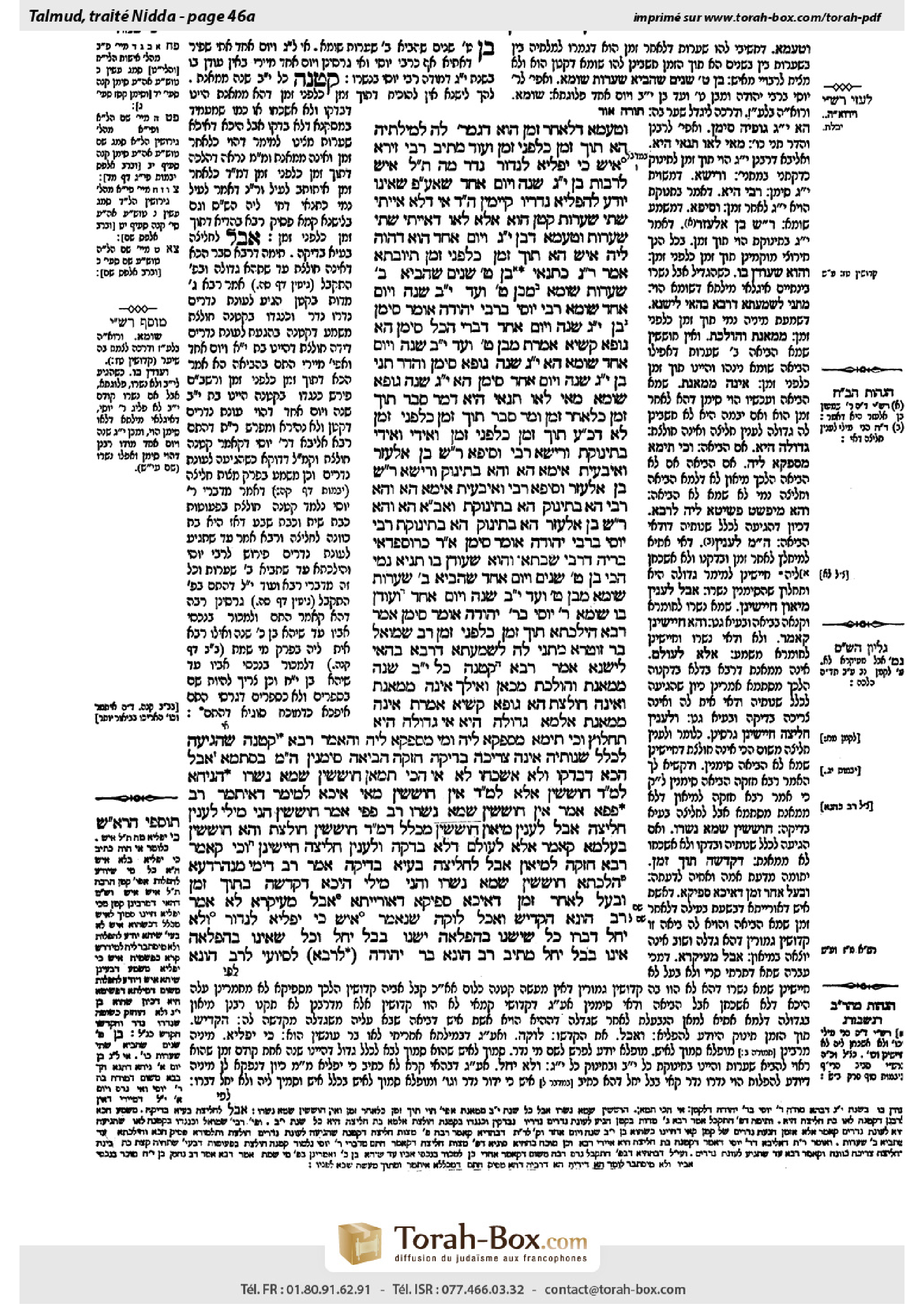
Niddah 46a: Talmud study for Daf Yomi
Daf Yomi is the daily study of one Talmud folio. Explore 37 tractates with scans, Hebrew text, Sefaria English and AI-generated French translations where annotated.
Passage selection and English or AI-generated French translation are available where the scan has annotations. Daf Study is independent of Torah-Box and Sefaria.
Browse Niddah · נידה · All tractatesNiddah 46a text and translations
This page of Niddah includes the Aramaic text, an English translation and an AI-generated French translation, alongside the scan above.
נידה מ״ו א · Aramaic and Hebrew text
וְטַעְמָא דִּלְאַחַר זְמַן הוּא דְּגָמְרָה לַהּ לְמִילְּתֵיהּ? הָא תּוֹךְ זְמַן — כְּלִפְנֵי זְמַן.
וְעוֹד מֵתִיב רַבִּי זֵירָא: ״אִישׁ כִּי יַפְלִא לִנְדּוֹר נֶדֶר״, מָה תַּלְמוּד לוֹמַר ״אִישׁ״? לְרַבּוֹת בֶּן שְׁלֹשׁ עֶשְׂרֵה שָׁנָה וְיוֹם אֶחָד, שֶׁאַף עַל פִּי שֶׁאֵינוֹ יוֹדֵעַ לְהַפְלִיא — נְדָרָיו קַיָּימִין.
הֵיכִי דָמֵי? אִי דְּלָא אַיְיתִי שְׁתֵּי שְׂעָרוֹת — קָטָן הוּא! אֶלָּא לָאו דְּאַיְיתִי שְׁתֵּי שְׂעָרוֹת, וְטַעְמָא דְּבֶן שְׁלֹשׁ עֶשְׂרֵה וְיוֹם אֶחָד הוּא דְּהָוֵה לֵיהּ ״אִישׁ״, הָא תּוֹךְ זְמַן כְּלִפְנֵי זְמַן! תְּיוּבְתָּא.
אָמַר רַב נַחְמָן: כְּתַנָּאֵי, בֶּן תֵּשַׁע שָׁנִים שֶׁהֵבִיא שְׁתֵּי שְׂעָרוֹת — שׁוּמָא, מִבֶּן תֵּשַׁע וְעַד שְׁתֵּים עֶשְׂרֵה שָׁנָה וְיוֹם אֶחָד — שׁוּמָא. רַבִּי יוֹסֵי בְּרַבִּי יְהוּדָה אוֹמֵר: סִימָן. בֶּן שְׁלֹשׁ עֶשְׂרֵה שָׁנָה וְיוֹם אֶחָד — דִּבְרֵי הַכֹּל סִימָן.
הָא גּוּפַאּ קַשְׁיָא, אָמְרַתְּ: ״מִבֶּן תֵּשַׁע וְעַד שְׁתֵּים עֶשְׂרֵה שָׁנָה וְיוֹם אֶחָד״ — שׁוּמָא, הָא שְׁלֹשׁ עֶשְׂרֵה שָׁנָה גּוּפָא — סִימָן, וַהֲדַר תָּנֵי: ״בֶּן שְׁלֹשׁ עֶשְׂרֵה שָׁנָה וְיוֹם אֶחָד״ — סִימָן, הָא שְׁלֹשׁ עֶשְׂרֵה שָׁנָה גּוּפָא — שׁוּמָא!
מַאי לַָאו תַּנָּאֵי הִיא: דְּמָר סָבַר תּוֹךְ זְמַן כִּלְאַחַר זְמַן, וּמָר סָבַר תּוֹךְ זְמַן כְּלִפְנֵי זְמַן?
לָא, דְּכוּלֵּי עָלְמָא תּוֹךְ זְמַן כְּלִפְנֵי זְמַן, וְאִידִי וְאִידִי בְּתִינוֹקֶת, וְרֵישָׁא רַבִּי וְסֵיפָא רַבִּי שִׁמְעוֹן בֶּן אֶלְעָזָר.
וְאִיבָּעֵית אֵימָא: הָא וְהָא בְּתִינוֹק, וְרֵישָׁא רַבִּי שִׁמְעוֹן בֶּן אֶלְעָזָר וְסֵיפָא רַבִּי.
וְאִיבָּעֵית אֵימָא: הָא וְהָא רַבִּי, הָא — בְּתִינוֹק, הָא — בְּתִינוֹקֶת. וְאִיבָּעֵית אֵימָא: הָא וְהָא רַבִּי שִׁמְעוֹן בֶּן אֶלְעָזָר, הָא — בְּתִינוֹק, הָא — בְּתִינוֹקֶת.
רַבִּי יוֹסֵי בְּרַבִּי יְהוּדָה אוֹמֵר: סִימָן. אָמַר רַבִּי כְּרוּסְפָּדַאי בְּרֵיהּ דְּרַבִּי שַׁבְּתַאי: וְהוּא שֶׁעוֹדָן בּוֹ.
תַּנְיָא נָמֵי הָכִי: בֶּן תֵּשַׁע שָׁנִים וְיוֹם אֶחָד שֶׁהֵבִיא שְׁתֵּי שְׂעָרוֹת — שׁוּמָא, מִבֶּן תֵּשַׁע וְעַד שְׁתֵּים עֶשְׂרֵה שָׁנָה וְיוֹם אֶחָד, וְעוֹדָן בּוֹ — שׁוּמָא. רַבִּי יוֹסֵי בְּרַבִּי יְהוּדָה אוֹמֵר: סִימָן.
אָמַר רָבָא, הִילְכְתָא: תּוֹךְ זְמַן — כְּלִפְנֵי זְמַן. רַב שְׁמוּאֵל בַּר זוּטְרָא מַתְנֵי לַהּ לִשְׁמַעְתָּא דְּרָבָא בְּהַאי לִישָּׁנָא, אָמַר רָבָא: קְטַנָּה כׇּל שְׁתֵּים עֶשְׂרֵה שָׁנָה מְמָאֶנֶת וְהוֹלֶכֶת, מִכָּאן וְאֵילָךְ אֵינָהּ מְמָאֶנֶת וְאֵינָהּ חוֹלֶצֶת.
הָא גוּפַאּ קַשְׁיָא: אָמְרַתְּ ״אֵינָהּ מְמָאֶנֶת״, אַלְמָא גְּדוֹלָה הִיא, אִי גְּדוֹלָה הִיא — תַּחְלוֹץ!
וְכִי תֵּימָא מְסַפְּקָא לֵיהּ, וּמִי מְסַפְּקָא לֵיהּ? וְהָאָמַר רָבָא: קְטַנָּה שֶׁהִגִּיעָה לִכְלַל שְׁנוֹתֶיהָ אֵינָהּ צְרִיכָה בְּדִיקָה, חֲזָקָה הֵבִיאָה סִימָנִין!
הָנֵי מִילֵּי בִּסְתָמָא, אֲבָל הָכָא דִּבְדַקוּ וְלָא אַשְׁכַּחוּ — לָא.
אִי הָכִי, תְּמָאֵן! חוֹשְׁשִׁין שֶׁמָּא נָשְׁרוּ.
הָנִיחָא לְמַאן דְּאָמַר חוֹשְׁשִׁין, אֶלָּא לְמַאן דְּאָמַר אֵין חוֹשְׁשִׁין, מַאי אִיכָּא לְמֵימַר? דְּאִיתְּמַר: רַב פָּפָּא אָמַר: אֵין חוֹשְׁשִׁין שֶׁמָּא נָשְׁרוּ, רַב פַּפֵּי אָמַר: חוֹשְׁשִׁין. הָנֵי מִילֵּי לְעִנְיַן חֲלִיצָה, אֲבָל לְעִנְיַן מֵיאוּן — חוֹשְׁשִׁין.
מִכְּלָל דְּמַאן דְּאָמַר ״חוֹשְׁשִׁין״ — חוֹלֶצֶת? וְהָא ״חוֹשְׁשִׁין״ בְּעָלְמָא קָאָמַר!
אֶלָּא, לְעוֹלָם דְּלָא (בַּדְקֻהָ) [בַּדְקַן], וּלְעִנְיַן חֲלִיצָה חָיְישִׁינַן, וְכִי קָאָמַר רָבָא חֲזָקָה לְמֵיאוּן, אֲבָל לַחֲלִיצָה בָּעֲיָא בְּדִיקָה.
אָמַר רַב דִּימִי מִנְּהַרְדְּעָא: הִלְכְתָא, חוֹשְׁשִׁין שֶׁמָּא נָשְׁרוּ.
וְהָנֵי מִילֵּי הֵיכָא דְּקִדְּשָׁהּ בְּתוֹךְ זְמַן, וּבָעַל לְאַחַר זְמַן, דְּאִיכָּא סְפֵיקָא דְּאוֹרָיְיתָא, אֲבָל מֵעִיקָּרָא — לָא.
אָמַר רַב הוּנָא: הִקְדִּישׁ וְאָכַל — לוֹקֶה.
שֶׁנֶּאֱמַר: ״אִישׁ כִּי יַפְלִא לִנְדּוֹר״, וְ״לֹא יַחֵל דְּבָרוֹ״ — כֹּל שֶׁיֶּשְׁנוֹ בְּהַפְלָאָה יֶשְׁנוֹ בְּבַל יַחֵל, וְכֹל שֶׁאֵינוֹ בְּהַפְלָאָה אֵינוֹ בְּבַל יַחֵל.
מֵתִיב רַב הוּנָא בַּר יְהוּדָה (לְרָבָא) לְסַיּוֹעֵי לְרַב הוּנָא:
Niddah 46a · English translation
and the reason that the development of two hairs renders him an adult is that the onset of his matter, i.e., his reaching puberty, was completed for him after the time? Rav Hamnuna infers from here that if the child developed two hairs during the time, it is considered as before the time, and he or she is not classified as an adult.
And furthermore, Rabbi Zeira raises an objection to the opinion that the development of signs indicating puberty during the time is equivalent to their development after the time. It is taught in a baraita which deals with the verse: “Speak to the children of Israel and say to them: When either man or a woman shall clearly utter a vow” (Numbers 6:2). What is the meaning when the verse states “man,” after it has already stated “the children of Israel”? This serves to include anyone who is thirteen years and one day old, that even if he does not know how to utter clearly and articulate the meaning of his statements, his vows are in effect.
Rabbi Zeira analyzes this baraita. What are the circumstances? If it is referring to a case where the boy has not yet developed two pubic hairs, then he is a minor, and the halakha with regard to him cannot be derived from the word “man.” Rather, is it not referring to a case where the boy has developed two pubic hairs? And by inference, the reason that he is considered a man due to his development of pubic hairs is that he is thirteen years and one day old, but if the boy developed two hairs during the time, it is considered as before the time. The Gemara concludes: This is indeed a conclusive refutation of the opinion of Rabbi Yoḥanan and Rabbi Yehoshua ben Levi that developing pubic hairs during the time is equivalent to developing hairs after the time.
Rav Naḥman said that the baraita is not a refutation of the opinion of Rabbi Yoḥanan and Rabbi Yehoshua ben Levi, as this matter is subject to a dispute between tanna’im, since there is another baraita which teaches the following: Everyone agrees with regard to a nine-year-old boy who developed two hairs that this is not considered a sign of puberty, as they are treated as hairs that grow on a mole. From nine years of age until the age of twelve years and one day, even if the hairs have not fallen out, this is still considered a mole. Rabbi Yosei, son of Rabbi Yehuda, says: At this stage it is a sign indicating puberty. If he is thirteen years and one day old and has grown two hairs, all agree that it is a sign indicating puberty.
Rav Naḥman analyzes the baraita. This baraita itself is difficult, as you initially said that from nine years of age until the age of twelve years and one day it is a mole, from which it can be inferred that if he developed two pubic hairs in the thirteenth year itself, it is a sign indicating puberty. And then the baraita teaches that if he is thirteen years and one day old and has grown two hairs, this is a sign indicating puberty, which indicates that if he developed the hairs in the thirteenth year itself, it is a mole.
Rav Naḥman concludes: What, is it not correct to say that there is a dispute between tanna’im, as one Sage, the tanna who states the first line of the baraita, holds that during that time is considered as after the time, and one Sage, the tanna of the last line of the baraita, holds that during that time is considered as before the time? If so, the opinion of Rabbi Yoḥanan and Rabbi Yehoshua ben Levi is one side of a dispute between tanna’im.
The Gemara rejects this suggestion: No, everyone, i.e., the tanna’im of both clauses of the baraita, agrees that during that time is considered as before the time, and this clause and that clause of the baraita are both referring to a young girl. And the difference between them is that the first clause of the baraita is in accordance with the opinion of Rabbi Yehuda HaNasi, who maintains that the thirteenth year for a female is considered after the time, and therefore the development of two pubic hairs at this stage is a sign of maturation; and the last clause is in accordance with the opinion of Rabbi Shimon ben Elazar, who holds that the thirteenth year for a female is considered before the time.
And if you wish, say that this clause and that clause are both dealing with a young boy, and the first clause is in accordance with Rabbi Shimon ben Elazar and the last clause is in accordance with the opinion of Rabbi Yehuda HaNasi, who maintains that the thirteenth year for a boy is considered before the time.
And if you wish, say that both this clause and that clause are in accordance with the opinion of Rabbi Yehuda HaNasi, and the difference between them is that this last clause of the baraita is referring to a young boy, whereas that first clause is referring to a young girl. And if you wish, say that both this clause and that clause are in accordance with the opinion of Rabbi Shimon ben Elazar, and that first clause of the baraita is referring to a young boy, whereas this last clause is referring to a young girl.
The baraita further teaches that Rabbi Yosei, son of Rabbi Yehuda, says with regard to hairs from nine years of age until the age of twelve years and one day, that it is a sign indicating puberty. In explanation of this opinion, Rabbi Keruspedai, son of Rabbi Shabbtai, says: And this is the halakha only when the hairs are still upon him, i.e., they had not fallen out when he reached the age of puberty, as otherwise they are considered a mole.
The Gemara notes that this opinion is also taught in a baraita: With regard to a boy nine years and one day old who developed two hairs, this is considered a mole. If the boy is from nine years of age until the age of twelve years and one day, and the hairs are still upon him, it is still considered a mole. Rabbi Yosei, son of Rabbi Yehuda, says: It is a sign indicating puberty.
§ In summary of the rulings cited above, Rava said: The halakha is that the development of two hairs during the time is considered as before the time, and it does not render one an adult. Rav Shmuel bar Zutra teaches this halakha of Rava in this formulation: Rava says: With regard to a minor girl whose father has passed away and whose mother or brothers accepted betrothal on her behalf, a form of betrothal instituted by the Sages, throughout her entire twelfth year she has the continuous right to perform refusal with regard to this marriage and thereby annul it. From that point forward, when she is already an adult, she may no longer perform refusal, and she may not perform ḥalitza with the brother of her husband, if he died without children.
The Gemara asks: This statement of Rava itself is difficult: You first said that once she is twelve she may not perform refusal. Evidently, she is an adult woman. But if she is an adult woman, let her perform ḥalitza, like any other adult woman.
And if you would say that Rava is uncertain whether a twelve-year-old girl is presumed to have developed two hairs and is therefore an adult, or whether it is presumed that she has not yet grown two hairs and remains a minor, and consequently he is stringent on both counts, that she may not perform refusal, like an adult, but she may also not perform ḥalitza, like a minor, this suggestion is problematic, as is Rava actually uncertain in this regard? But doesn’t Rava say: A minor girl who reached her full age of maturity, i.e., twelve years and one day, does not require examination to determine whether she has grown two hairs, as there is a presumption that she has developed signs indicating puberty.
The Gemara answers that this statement, that it is presumed that a twelve-year-old girl has developed two hairs, applies only in an ordinary situation. But here Rava is referring to a case where they examined her and did not find hairs. In such an instance, Rava did not say that the presumption is in effect.
The Gemara asks: If so, that she was actually examined, she should be considered a minor in all regards and she should be able to perform refusal. The Gemara answers: We are concerned that perhaps the girl had already developed pubic hairs but they fell out. Consequently, although the girl is not treated with the presumption that she is an adult, she does not have the certain status of a minor either, and cannot perform refusal.
The Gemara objects: This works out well according to the one who says that we are concerned that the pubic hairs fell out. But according to the one who says that we are not concerned that they have fallen out, what is there to say? As it was stated that amora’im disagreed with regard to this matter. Rav Pappa says: We are not concerned that perhaps the pubic hairs fell out; Rav Pappi says: We are concerned that they might have fallen out. The Gemara answers that this statement of Rav Pappa, that there is no concern that perhaps the pubic hairs fell out, applies only with regard to ḥalitza, but with regard to refusal everyone agrees that we are concerned that they might have fallen out.
The Gemara asks: By inference, does the one who says that we are concerned that perhaps the hairs fell out maintain that this twelve-year-old performs ḥalitza? But this cannot be correct, as he says that we are merely concerned that the hairs might have fallen out, not that this is certainly the case. How, then, can she perform ḥalitza like an adult?
Rather, Rava is actually referring to a case where one did not examine the girl, and with regard to ḥalitza we are concerned that she might not have developed hairs and is still a minor. And when Rava said that there is a presumption that a twelve-year-old has developed signs indicating puberty, he was referring to refusal, but with regard to ḥalitza she requires examination.
With regard to the issue of whether there is concern that hairs might have fallen out, Rav Dimi of Neharde’a said: The halakha is that if a girl reached the age of twelve and she was examined and the signs of puberty were not found, we are concerned that perhaps the pubic hairs fell out. Consequently, if her mother or brothers had accepted betrothal for her when she was a minor, she cannot perform refusal at that stage.
The Gemara adds: And this statement applies only in a case where her husband betrothed her during the time, before she reached the age of twelve years and one day, and engaged in intercourse with her after the time, when she was already twelve years and one day old. This is a situation where there is an uncertainty with regard to Torah law, since if she had developed two hairs and is an adult, the marriage applies by Torah law, due to the intercourse. But if he engaged in intercourse with her only at the outset, before she turned twelve, there is no concern that perhaps she developed pubic hairs and they fell out, as this marriage applies by rabbinic law.
§ With regard to a minor who vowed, Rav Huna says: If the minor is aware of the meaning of his vow and in Whose name he or she vowed, and the minor’s age is during the time, i.e., the twelfth year for a girl or the thirteenth year for a boy, and he consecrated an item of food and subsequently ate it, he is flogged, which is the punishment for one who eats consecrated food.
Rav Huna explains: As it is stated: “When either a man or a woman shall clearly utter a vow” (Numbers 6:2), from which it is derived that if one on the brink of adulthood is able to articulate that his vow is in the name of God, his vows are valid. And another verse states: “He shall not profane his word” (Numbers 30:3). This indicates that any person who is included in explicitness of intent is also included in the prohibition: “He shall not profane his word,” and anyone who is not included in explicitness of intent is not included in the prohibition: “He shall not profane his word.”
Rav Huna bar Yehuda raises an objection to Rava, in support of the opinion of Rav Huna:
Niddah 46a · Traduction française (IA)
et la raison pour laquelle le développement de deux poils le rend adulte est que l'apparition de son cas, c'est-à-dire son entrée dans la puberté, a été achevée pour lui après le temps ? Rav Hamnuna en déduit d'ici que si l'enfant a développé deux poils pendant le temps, cela est considéré comme avant le temps, et il ou elle n'est pas classé comme adulte.
De plus, Rabbi Zeira soulève une objection à l'opinion selon laquelle le développement de signes indiquant la puberté pendant le temps est équivalent à leur développement après le temps. Il est enseigné dans une baraïta qui traite du verset : « Parlez aux enfants d'Israël et dites-leur : Quand un homme ou une femme prononcera clairement un vœu » (Nombres 6:2). Quel est le sens du mot « homme » dans le verset, après qu'il a déjà mentionné « les enfants d'Israël » ? Cela sert à inclure quiconque a treize ans et un jour, de sorte que même s'il ne sait pas prononcer clairement et articuler le sens de ses déclarations, ses vœux sont en vigueur.
Rabbi Zeira analyse cette baraïta. Quelles sont les circonstances ? S'il s'agit d'un cas où le garçon n'a pas encore développé deux poils pubiens, alors il est mineur, et la halakha à son égard ne peut pas être déduite du mot « homme ». Plutôt, ne s'agit-il pas d'un cas où le garçon a développé deux poils pubiens ? Et par inférence, la raison pour laquelle il est considéré comme un homme en raison de son développement de poils pubiens est qu'il a treize ans et un jour, mais si le garçon a développé deux poils pendant le temps, cela est considéré comme avant le temps. La Guemara conclut : C'est bien une réfutation définitive de l'opinion de Rabbi Yoḥanan et de Rabbi Yehoshua ben Levi selon laquelle le développement de poils pubiens pendant le temps est équivalent au développement de poils après le temps.
Rav Naḥman a déclaré que la baraïta ne contredit pas l'opinion de Rabbi Yoḥanan et de Rabbi Yehoshua ben Levi, car cette question fait l'objet d'un désaccord entre les tannaïm, car il existe une autre baraïta qui enseigne ce qui suit : Tout le monde est d'accord à l'égard d'un garçon de neuf ans qui a développé deux poils, que cela n'est pas considéré comme un signe de puberté, car ils sont traités comme des poils qui poussent sur un grain de beauté. De neuf ans jusqu'à l'âge de douze ans et un jour, même si les poils ne sont pas tombés, cela est encore considéré comme un grain de beauté. Rabbi Yosei, fils de Rabbi Yehuda, dit : À ce stade, c'est un signe indiquant la puberté. S'il a treize ans et un jour et a développé deux poils, tout le monde est d'accord que c'est un signe indiquant la puberté.
Rav Naḥman analyse la baraïta. Cette baraïta elle-même est difficile, car vous avez d'abord dit que de neuf ans jusqu'à l'âge de douze ans et un jour, c'est un grain de beauté, d'où l'on peut inférer que s'il a développé deux poils pubiens dans la treizième année elle-même, c'est un signe indiquant la puberté. Et puis la baraïta enseigne que s'il a treize ans et un jour et a développé deux poils, c'est un signe indiquant la puberté, ce qui indique que s'il a développé les poils dans la treizième année elle-même, c'est un grain de beauté.
Rav Naḥman conclut : Quoi, n'est-il pas correct de dire qu'il y a un désaccord entre les tannaïm, car un Sage, le tanna qui énonce la première ligne de la baraïta, soutient que pendant ce temps est considéré comme après le temps, et un Sage, le tanna de la dernière ligne de la baraïta, soutient que pendant ce temps est considéré comme avant le temps ? Si c'est le cas, l'opinion de Rabbi Yoḥanan et de Rabbi Yehoshua ben Levi est un côté d'un désaccord entre les tannaïm.
La Guemara rejette cette suggestion : Non, tout le monde, c'est-à-dire les tannaïm des deux clauses de la baraïta, est d'accord pour dire que pendant cette période, on est considéré comme étant avant le temps, et que cette clause et celle-là de la baraïta se réfèrent toutes deux à une jeune fille. Et la différence entre elles est que la première clause de la baraïta est conforme à l'opinion de Rabbi Yehuda HaNasi, qui soutient que la treizième année pour une femme est considérée comme étant après le temps, et par conséquent le développement de deux poils pubiens à ce stade est un signe de maturation ; et la dernière clause est conforme à l'opinion de Rabbi Shimon ben Elazar, qui soutient que la treizième année pour une femme est considérée comme étant avant le temps.
Et si vous le souhaitez, dites que cette clause et celle-là traitent toutes deux d'un jeune garçon, et que la première clause est conforme à l'opinion de Rabbi Shimon ben Elazar et que la dernière clause est conforme à l'opinion de Rabbi Yehuda HaNasi, qui soutient que la treizième année pour un garçon est considérée comme étant avant le temps.
Et si vous le souhaitez, dites que cette clause et celle-là sont toutes deux conformes à l'opinion de Rabbi Yehuda HaNasi, et que la différence entre elles est que cette dernière clause de la baraïta se réfère à un jeune garçon, tandis que cette première clause se réfère à une jeune fille. Et si vous le souhaitez, dites que cette clause et celle-là sont toutes deux conformes à l'opinion de Rabbi Shimon ben Elazar, et que cette première clause de la baraïta se réfère à un jeune garçon, tandis que cette dernière clause se réfère à une jeune fille.
La baraïta enseigne par ailleurs que Rabbi Yosei, fils de Rabbi Yehuda, déclare à propos des poils apparus entre l'âge de neuf ans et celui de douze ans et un jour, qu'il s'agit d'un signe indiquant la puberté. Pour expliquer cette opinion, Rabbi Keruspedai, fils de Rabbi Shabbtai, dit : Et c'est la halakha seulement lorsque les poils sont encore sur lui, c'est-à-dire qu'ils n'avaient pas tombé lorsqu'il a atteint l'âge de la puberté, car sinon ils sont considérés comme un grain de beauté.
La Guemara note que cette opinion est également enseignée dans une baraïta : À l'égard d'un garçon de neuf ans et un jour qui a développé deux poils, cela est considéré comme un grain de beauté. Si le garçon est âgé de neuf ans jusqu'à douze ans et un jour, et que les poils sont encore sur lui, c'est encore considéré comme un grain de beauté. Rabbi Yosei, fils de Rabbi Yehuda, dit : C'est un signe indiquant la puberté.
§ En résumé des décisions citées ci-dessus, Rava a dit : La halakha est que le développement de deux poils pendant la période est considéré comme antérieur à la période, et cela ne fait pas d'elle une adulte. Rav Chmouël bar Zoutra enseigne cette halakha de Rava dans cette formulation : Rava dit : En ce qui concerne une jeune fille mineure dont le père est décédé et dont la mère ou les frères ont accepté les fiançailles en son nom, une forme de fiançailles instituée par les Sages, tout au long de sa douzième année, elle a le droit continu d'exercer le refus à l'égard de ce mariage et ainsi l'annuler. À partir de ce moment-là, lorsqu'elle est déjà adulte, elle ne peut plus exercer le refus, et elle ne peut pas effectuer la ḥalitza avec le frère de son mari, si celui-ci est décédé sans enfants.
La Guemara demande : Cette déclaration de Rava elle-même est difficile : vous avez d'abord dit que dès qu'elle a douze ans, elle ne peut pas effectuer le refus. Évidemment, elle est une femme adulte. Mais si elle est une femme adulte, qu'elle effectue la ḥalitza, comme toute autre femme adulte.
Et si vous diriez que Rava est incertain quant à savoir si une fille de douze ans est présumée avoir développé deux poils et est donc adulte, ou s'il est présumé qu'elle n'a pas encore fait pousser deux poils et reste mineure, et par conséquent qu'il est strict sur les deux points, qu'elle ne peut pas effectuer le refus, comme une adulte, mais qu'elle ne peut pas non plus effectuer la ḥalitza, comme une mineure, cette suggestion est problématique, car Rava est-il réellement incertain à ce sujet ? Mais Rava ne dit-il pas : Une jeune fille mineure qui a atteint son âge de maturité complet, c'est-à-dire douze ans et un jour, n'a pas besoin d'examen pour déterminer si elle a fait pousser deux poils, car il y a une présomption qu'elle a développé des signes indiquant la puberté.
La Guemara répond que cette déclaration, selon laquelle il est présumé qu'une fille de douze ans a développé deux poils, ne s'applique que dans une situation ordinaire. Mais ici, Rava fait référence à un cas où on l'a examinée et où l'on n'a pas trouvé de poils. Dans un tel cas, Rava n'a pas dit que la présomption est en vigueur.
La Guemara demande : Si c'est le cas, qu'elle a réellement été examinée, elle devrait être considérée comme mineure à tous les égards et devrait pouvoir exercer le refus. La Guemara répond : Nous craignons que la fille ait déjà développé des poils pubiens, mais qu'ils soient tombés. Par conséquent, bien que la fille ne bénéficie pas de la présomption d'adulte, elle n'a pas non plus le statut certain d'une mineure, et ne peut donc pas exercer le refus.
La Guemara objecte : Cela fonctionne bien selon celui qui dit que nous craignons que les poils pubiens soient tombés. Mais selon celui qui dit que nous ne craignons pas qu'ils soient tombés, que peut-on dire ? Car il a été rapporté que des amoraïm ont émis des avis divergents à ce sujet. Rav Pappa dit : Nous ne craignons pas que les poils pubiens soient peut-être tombés ; Rav Pappi dit : Nous craignons qu'ils aient pu tomber. La Guemara répond que cette déclaration de Rav Pappa, selon laquelle il n'y a pas de crainte que les poils pubiens soient peut-être tombés, ne s'applique qu'en ce qui concerne la ḥalitza, mais en ce qui concerne le refus, tout le monde est d'accord pour dire que nous craignons qu'ils aient pu tomber.
La Guemara demande : Par inférence, celui qui dit que nous craignons que les poils soient peut-être tombés soutient-il que cette fille de douze ans effectue la ḥalitza ? Mais cela ne peut pas être correct, car il dit que nous ne faisons que craindre que les poils aient pu tomber, et non que ce soit certainement le cas. Comment, alors, peut-elle effectuer la ḥalitza comme une adulte ?
En réalité, Rava fait référence à un cas où l'on n'a pas examiné la fille, et en ce qui concerne la ḥalitza, nous craignons qu'elle n'ait pas développé de poils et qu'elle soit encore mineure. Et lorsque Rava a dit qu'il y a une présomption qu'une fille de douze ans a développé des signes indiquant la puberté, il faisait référence au refus, mais en ce qui concerne la ḥalitza, elle nécessite un examen.
En ce qui concerne la question de savoir s'il y a lieu de craindre que les poils soient tombés, Rav Dimi de Neharde'a a dit : La halakha est que si une fille a atteint l'âge de douze ans et qu'elle a été examinée et que les signes de la puberté n'ont pas été trouvés, nous craignons que les poils pubiens soient peut-être tombés. Par conséquent, si sa mère ou ses frères avaient accepté les fiançailles pour elle lorsqu'elle était mineure, elle ne peut pas exercer le refus à ce stade.
La Guemara ajoute : Et cette déclaration ne s'applique que dans un cas où son mari l'a fiancée pendant la période, avant qu'elle n'atteigne l'âge de douze ans et un jour, et a eu des rapports sexuels avec elle après la période, lorsqu'elle était déjà âgée de douze ans et un jour. C'est une situation où il y a une incertitude en ce qui concerne la loi de la Torah, car si elle avait développé deux poils et est adulte, le mariage s'applique par la loi de la Torah, en raison des rapports sexuels. Mais s'il a eu des rapports sexuels avec elle seulement au début, avant qu'elle n'ait douze ans, il n'y a pas de crainte que peut-être elle a développé des poils pubiens et qu'ils sont tombés, car ce mariage s'applique par la loi rabbinique.
§ Concernant un mineur qui a fait un vœu, Rav Houna dit : Si le mineur est conscient de la signification de son vœu et au nom de Qui il a fait ce vœu, et que son âge correspond à la période requise, c'est-à-dire la douzième année pour une fille ou la treizième année pour un garçon, et qu'il a consacré un aliment puis l'a mangé, il est fouetté, ce qui est la punition pour celui qui mange un aliment consacré.
Rav Houna explique : Car il est écrit : « Quand un homme ou une femme aura clairement prononcé un vœu » (Nombres 6:2), d'où il est déduit que si une personne à la veille de l'âge adulte est capable d'articuler que son vœu est fait au nom de Dieu, ses vœux sont valides. Et un autre verset dit : « Il ne profanera pas sa parole » (Nombres 30:3). Cela indique que toute personne qui est incluse dans la clarté de l'intention est également incluse dans l'interdiction : « Il ne profanera pas sa parole », et quiconque n'est pas inclus dans la clarté de l'intention n'est pas inclus dans l'interdiction : « Il ne profanera pas sa parole ».
Rav Houna bar Yehuda soulève une objection à l'encontre de Rava, en appui de l'opinion de Rav Houna :
Traduction française générée par IA à partir de l’édition anglaise de Sefaria. Vérifie toujours un passage avec le texte source.
Text from Sefaria: William Davidson Edition - Vocalized Aramaic (CC BY NC); William Davidson Edition - English (CC BY NC).