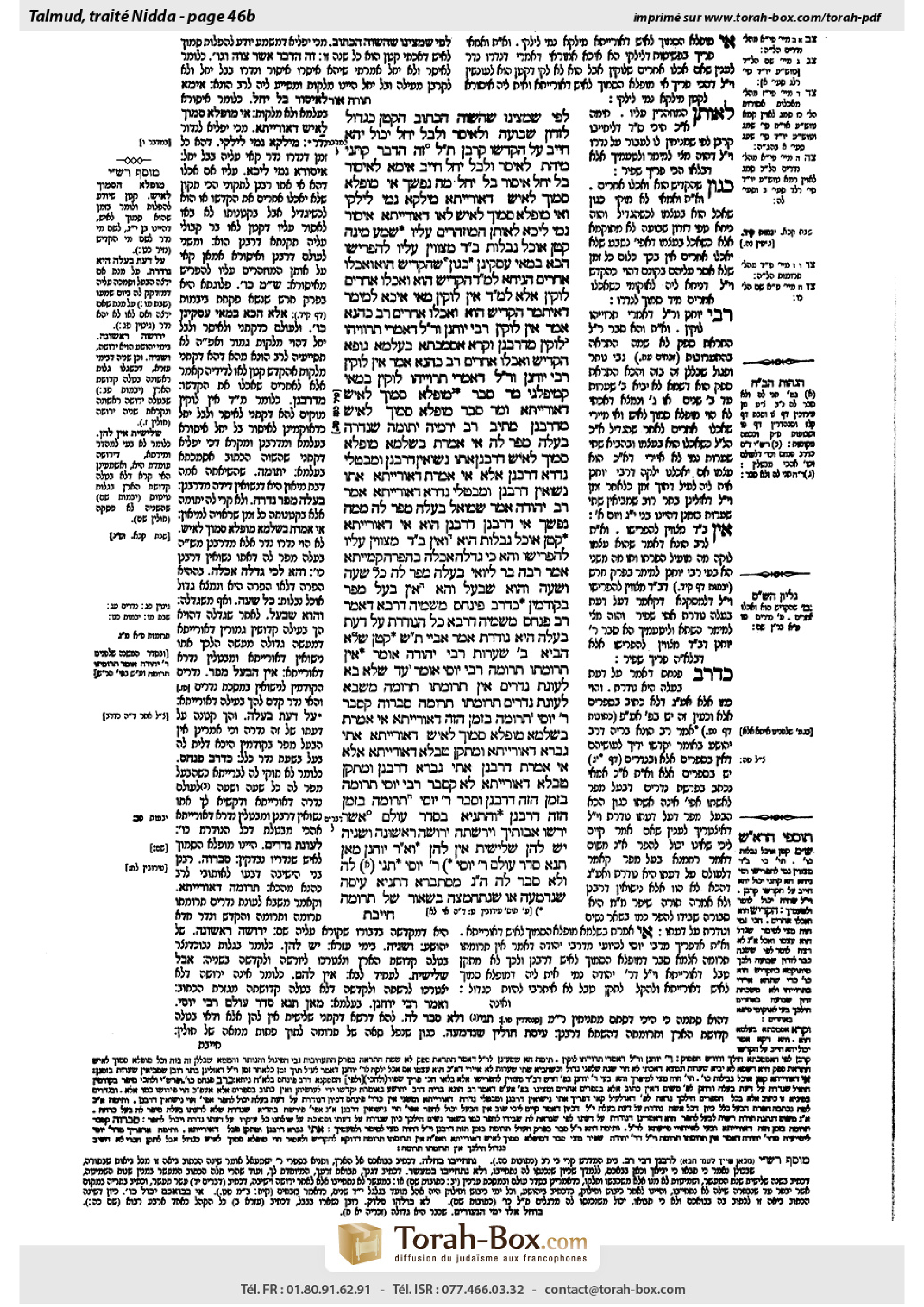
Niddah 46b: Talmud study for Daf Yomi
Daf Yomi is the daily study of one Talmud folio. Explore 37 tractates with scans, Hebrew text, Sefaria English and AI-generated French translations where annotated.
Passage selection and English or AI-generated French translation are available where the scan has annotations. Daf Study is independent of Torah-Box and Sefaria.
Browse Niddah · נידה · All tractatesNiddah 46b text and translations
This page of Niddah includes the Aramaic text, an English translation and an AI-generated French translation, alongside the scan above.
נידה מ״ו ב · Aramaic and Hebrew text
לְפִי שֶׁמָּצִינוּ שֶׁהִשְׁוָה הַכָּתוּב הַקָּטָן כַּגָּדוֹל לִזְדוֹן שְׁבוּעָה וּלְאִיסָּר וּלְבַל יַחֵל, יָכוֹל יְהֵא חַיָּיב עַל הֶקְדֵּשׁוֹ קׇרְבָּן?
תַּלְמוּד לוֹמַר: ״זֶה הַדָּבָר״.
קָתָנֵי מִיהַת לְאִיסָּר וּלְ״בַל יַחֵל״ חַיָּיב. אֵימָא: לְאִיסּוּר ״בַּל יַחֵל״.
אִיסּוּר ״בַּל יַחֵל״ — מָה נַפְשָׁךְ: אִי מוּפְלָא סָמוּךְ לְאִישׁ דְּאוֹרָיְיתָא — מִילְקָא נָמֵי לִילְקֵי, וְאִי מוּפְלָא סָמוּךְ לְאִישׁ לָאו דְּאוֹרָיְיתָא — אִיסּוּר נָמֵי לֵיכָּא, לְאוֹתָן הַמּוּזְהָרִים עָלָיו.
שְׁמַע מִינַּהּ: קָטָן אוֹכֵל נְבֵלוֹת — בֵּית דִּין מְצוִּּוין עָלָיו לְהַפְרִישׁוֹ. הָכָא בְמַאי עָסְקִינַן? כְּגוֹן שֶׁהִקְדִּישׁ הוּא, וְאָכְלוּ אֲחֵרִים.
הָנִיחָא לְמַאן דְּאָמַר: ״הִקְדִּישׁ הוּא וְאָכְלוּ אֲחֵרִים — לוֹקִין״, אֶלָּא לְמַאן דְּאָמַר: ״אֵין לוֹקִין״ — מַאי אִיכָּא לְמֵימַר? דְּאִיתְּמַר: הִקְדִּישׁ הוּא וְאָכְלוּ אֲחֵרִים, רַב כָּהֲנָא אָמַר: אֵין לוֹקִין, רַבִּי יוֹחָנָן וְרֵישׁ לָקִישׁ דְּאָמְרִי תַּרְוַויְהוּ: לוֹקִין!
מִדְּרַבָּנַן, וּקְרָא אַסְמַכְתָּא בְּעָלְמָא.
גּוּפָא: הִקְדִּישׁ וְאָכְלוּ אֲחֵרִים — רַב כָּהֲנָא אָמַר: אֵין לוֹקִין, רַבִּי יוֹחָנָן וְרֵישׁ לָקִישׁ דְּאָמְרִי תַּרְוַיְיהוּ: לוֹקִין. בְּמַאי קָמִיפַּלְגִי? מָר סָבַר: מוּפְלָא סָמוּךְ לְאִישׁ דְּאוֹרָיְיתָא, וּמָר סָבַר: מוּפְלָא סָמוּךְ לְאִישׁ מִדְּרַבָּנַן.
מֵתִיב רַב יִרְמְיָה: יְתוֹמָה שֶׁנָּדְרָה — בַּעְלָהּ מֵפֵר לָהּ. אִי אָמְרַתְּ בִּשְׁלָמָא מוּפְלָא סָמוּךְ לְאִישׁ דְּרַבָּנַן, אָתוּ נִשּׂוּאִין דְּרַבָּנַן וּמְבַטְּלִי נִדְרָא דְּרַבָּנַן; אֶלָּא אִי אָמְרַתְּ דְּאוֹרָיְיתָא, אָתוּ נִשּׂוּאִין דְּרַבָּנַן וּמְבַטְּלִי נִדְרָא דְּאוֹרָיְיתָא?
אָמַר רַב יְהוּדָה, אָמַר שְׁמוּאֵל: בַּעְלָהּ מֵפֵר לָהּ מִמָּה נַפְשָׁךְ, אִי דְּרַבָּנַן — דְּרַבָּנַן הוּא, אִי דְּאוֹרָיְיתָא — קָטָן אוֹכֵל נְבֵלוֹת הוּא, וְאֵין בֵּית דִּין מְצוִּּוין עָלָיו לְהַפְרִישׁוֹ.
וְהָא כִּי גָדְלָה אָכְלָה בַּהֲפָרָה קַמַּיְיתָא!
אָמַר רַבָּה בַּר לֵיוַאי: בַּעְלָהּ מֵפֵר לָהּ כׇּל שָׁעָה וְשָׁעָה, וְהוּא שֶׁבָּעַל.
וְהָא אֵין בַּעַל מֵפֵר בְּקוֹדְמִין, כִּדְרַב פִּינְחָס מִשְּׁמֵיהּ דְּרָבָא, דְּאָמַר רַב פִּנְחָס מִשְּׁמֵיהּ דְּרָבָא: כׇּל הַנּוֹדֶרֶת — עַל דַּעַת בַּעְלָהּ הִיא נוֹדֶרֶת.
אָמַר אַבָּיֵי: תָּא שְׁמַע, קָטָן שֶׁלֹּא הֵבִיא שְׁתֵּי שְׂעָרוֹת, רַבִּי יְהוּדָה אוֹמֵר: אֵין תְּרוּמָתוֹ תְּרוּמָה. רַבִּי יוֹסֵי אוֹמֵר: עַד שֶׁלֹּא בָּא לְעוֹנַת נְדָרִים — אֵין תְּרוּמָתוֹ תְּרוּמָה, מִשֶּׁבָּא לְעוֹנַת נְדָרִים — תְּרוּמָתוֹ תְּרוּמָה.
סַבְרוּהָ, קָסָבַר רַבִּי יוֹסֵי: תְּרוּמָה בַּזְּמַן הַזֶּה דְּאוֹרָיְיתָא. אִי אָמְרַתְּ בִּשְׁלָמָא מוּפְלָא סָמוּךְ לָאִישׁ דְּאוֹרָיְיתָא — אָתֵי גַּבְרָא דְּאוֹרָיְיתָא וּמְתַקֵּן טִבְלָא דְּאוֹרָיְיתָא, אֶלָּא אִי אָמְרַתְּ דְּרַבָּנַן — אָתֵי גַּבְרָא דְּרַבָּנַן וּמְתַקֵּן טִבְלָא דְּאוֹרָיְיתָא? לָא, קָסָבַר רַבִּי יוֹסֵי: תְּרוּמָה בַּזְּמַן הַזֶּה דְּרַבָּנַן.
וְסָבַר רַבִּי יוֹסֵי תְּרוּמָה בַּזְּמַן הַזֶּה דְּרַבָּנַן? וְהָתַנְיָא בְּסֵדֶר עוֹלָם: ״אֲשֶׁר יָרְשׁוּ אֲבוֹתֶיךָ וִירִשְׁתָּהּ״,
יְרוּשָּׁה רִאשׁוֹנָה וּשְׁנִיָּה — יֵשׁ לָהֶן, שְׁלִישִׁית — אֵין לָהֶן.
וְאָמַר רַבִּי יוֹחָנָן: מַאן תְּנָא סֵדֶר עוֹלָם? רַבִּי יוֹסֵי.
רַבִּי יוֹסֵי תָּנֵי לַהּ, וְלָא סָבַר לַהּ. הָכִי נָמֵי מִסְתַּבְּרָא, דְּתַנְיָא: עִיסָּה שֶׁנִּדְמְעָה, אוֹ שֶׁנִּתְחַמְּצָה בִּשְׂאוֹר שֶׁל תְּרוּמָה —
Niddah 46b · English translation
Since we find that the verse equates a minor, i.e., one on the brink of adulthood, to an adult with regard to an intentional violation of an oath and with regard to a vow of prohibition, where one renders an item prohibited to himself through a vow, and with regard to the prohibition of he shall not profane his word, one might have thought that this minor, like an adult, should also be liable to bring an offering for misuse of his consecrated property, e.g., if he ate an item that he consecrated.
Therefore, the verse states with regard to vows: “This is the matter which the Lord has commanded. When a man vows a vow to the Lord, or takes an oath” (Numbers 30:2–3). The emphasis of “this” indicates that it is only with regard to this matter, i.e., prohibitions resulting from vows, that a discriminating minor on the brink of adulthood is considered an adult, but he is not rendered liable to bring an offering for his misuse.
The Gemara analyzes the baraita. In any event, the baraita teaches that a discriminating minor on the brink of adulthood is considered an adult with regard to a vow of prohibition and with regard to the prohibition of he shall not profane his word, which indicates that he is liable for violating this prohibition. This supports the opinion of Rav Huna that a minor is flogged for eating food he consecrated. The Gemara refutes this proof: There is room to say that the word: And, in the phrase: With regard to a vow of prohibition and with regard to the prohibition of he shall not profane his word, should be omitted, and the baraita is comparing a minor to an adult with regard to the prohibition of he shall not profane his word, but it does not indicate that he is liable to receive lashes for violating this prohibition.
The Gemara asks: Can the baraita actually mean that a minor is compared to an adult with regard to the prohibition of he shall not profane his word, but he is not flogged? Whichever way you look at it, this is problematic: If a discriminating minor on the brink of adulthood is considered an adult by Torah law, he should be flogged too, for his violation. And if a discriminating minor on the brink of adulthood is not considered an adult by Torah law, there is no prohibition violated here either. The Gemara answers that according to the baraita the prohibition does not apply to the minor himself, but to those who are warned to keep him away from the prohibited item.
The Gemara raises a difficulty: If so, one can conclude from the baraita that if a minor eats meat from unslaughtered animal carcasses or violates other prohibitions, the court is commanded to prevent him from doing so. This is problematic, as elsewhere it is stated that this matter is subject to dispute (see Yevamot 114a). The Gemara explains: Here we are dealing with a case where the minor consecrated the food item and others ate it. They are liable to receive lashes for their consumption, but if he ate it he is not liable.
The Gemara raises another difficulty: This works out well according to the one who said that if a minor consecrated a food item and others ate it, they are flogged. But according to the one who said that in such a case they are not flogged, what can be said? As it was stated that amora’im disagreed with regard to this issue: If a minor consecrated a food item and others ate it, Rav Kahana says that they are not flogged; Rabbi Yoḥanan and Reish Lakish both say that they are flogged.
The Gemara therefore reverts to the interpretation that the baraita is referring to the prohibition of he shall not profane his word, not the punishment for violation of the vow. And the reason lashes are not administered is that the prohibition is by rabbinic law. And as for the verse mentioned in the baraita, when it states that the verse equates a minor to an adult, which indicates that it is dealing with Torah law, this verse is a mere support for a rabbinic law.
§ The Gemara discusses the matter itself, i.e., the dispute cited above. If a minor consecrated a food item and others ate it, Rav Kahana says that they are not flogged; Rabbi Yoḥanan and Reish Lakish both say that they are flogged. With regard to what principle do these Sages disagree? One Sage, i.e., Rabbi Yoḥanan and Reish Lakish, holds that a discriminating minor on the brink of adulthood is considered an adult by Torah law, which is why others are liable for eating an item he consecrated; and one Sage, Rav Kahana, holds that a discriminating minor on the brink of adulthood is considered an adult by rabbinic law.
Rav Yirmeya raises an objection from a baraita: In the case of a minor girl who is an orphan from her father and her mother or brothers accepted betrothal on her behalf, who vowed, her husband may nullify her vow, like any other husband, despite the fact that this marriage is valid merely by rabbinic law. Rav Yirmeya analyzes this baraita: Granted, if you say that a discriminating minor on the brink of adulthood is considered an adult by rabbinic law, one can explain that a husband whose marriage is by rabbinic law comes and negates a vow that also applies by rabbinic law. But if you say that a discriminating minor on the brink of adulthood is considered an adult by Torah law, can a husband whose marriage is by rabbinic law come and negate a vow that applies by Torah law?
Rav Yehuda says that Shmuel says: Her husband may nullify her vows, whichever way you look at it: If the validity of the vows of such a minor applies by rabbinic law, the husband may nullify her vows, as the validity of their marriage is likewise by rabbinic law. And if the validity of a vow by a discriminating minor on the brink of adulthood is by Torah law, which means she would be violating a Torah prohibition, this is the same as the case of a minor who may eat meat from unslaughtered animal carcasses or violate other prohibitions, and the court or any other adult, including her husband in this case, is not commanded to prevent him from doing so,and it does not matter if his nullification was not effective.
The Gemara raises a difficulty: But there is still concern for a violation, as when she grows and becomes an adult she will eat the food that she rendered forbidden to herself, relying on the initial nullification of her vow by her husband, which was not valid. At that stage she is an adult, whom the court is certainly commanded to prevent from violating prohibitions.
Rabba bar Livai said that this is not a concern, as her husband nullifies her vows each and every moment, and therefore when she reaches majority he will nullify her vow in a manner that is valid by Torah law. And this is the halakha, that the nullification takes effect by Torah law, only in a case where her husband engaged in intercourse with her after she became an adult, thereby rendering their marriage valid by Torah law.
The Gemara raises another difficulty: But there is a principle that a husband cannot nullify vows of his wife that preceded their marriage; and as she is considered his wife by Torah law only when she becomes an adult, her vow when she was a minor preceded their marriage. The Gemara answers that he can still nullify her vow, in accordance with the statement of Rav Pineḥas in the name of Rava, as Rav Pineḥas said in the name of Rava: Any woman who takes a vow, it is from the outset contingent on her husband’s consent that she takes the vow. Since the minor was married by rabbinic law, she vowed on the condition that her husband should agree to her vow, and therefore the nullification is valid by Torah law.
§ The Gemara continues to discuss the validity of the vows of a discriminating minor on the brink of adulthood. Abaye said: Come and hear a mishna (Terumot 1:3): With regard to a minor who has not grown two hairs, Rabbi Yehuda says: His teruma is not valid teruma. Rabbi Yosei says: Until he has reached the age of vows, i.e., when he does not yet have the status of a discriminating minor on the brink of adulthood, his teruma is not valid teruma, but once he has reached the age of vows, his teruma is teruma.
The Sages assumed that Rabbi Yosei holds that teruma in the present applies by Torah law. They therefore objected: Granted, if you say that a discriminating minor on the brink of adulthood is an adult by Torah law, one can understand that one who is a man by Torah law with regard to vows can come and prepare untithed produce [tivla] for consumption by tithing it, which also applies by Torah law. But if you say that a discriminating minor on the brink of adulthood is an adult by rabbinic law, can one who is a man by rabbinic law come and prepare untithed produce, which is prohibited by Torah law? The Gemara refutes this proof: No, perhaps Rabbi Yosei holds that teruma in the present applies by rabbinic law, and this is why he rules that a minor on the brink of adulthood can set aside teruma.
The Gemara asks: And does Rabbi Yosei hold that teruma in the present applies by rabbinic law? But isn’t it taught in a baraita in the anthology called Seder Olam: The verse that states with regard to the Jewish people’s return to Eretz Yisrael following their exile: “And the Lord your God will bring you into the land that your fathers possessed, and you shall possess it” (Deuteronomy 30:5).
These two expressions of possession indicate that the Jewish people had a first possession of Eretz Yisrael in the days of Joshua, when Eretz Yisrael was first sanctified with regard to the obligation of its mitzvot, and they had a second possession at the time of Ezra and the return of the Babylonian exile. In other words, the sanctity of the land lapsed when the First Temple was destroyed and the Jews were exiled to Babylonia, and therefore a second sanctification was necessary when they returned to their land. But they will not have a third possession. That is, it will never be necessary to sanctify the land a third time, as the second sanctification was permanent.
And Rabbi Yoḥanan said: Who is the tanna that taught Seder Olam? Rabbi Yosei. Since Rabbi Yosei maintains that the second sanctification of Eretz Yisrael did not lapse even after the destruction of the Second Temple, he must also maintain that teruma in the present applies by Torah law.
The Gemara answers that Rabbi Yosei taught Seder Olam but he does not maintain in accordance with its ruling here. The Gemara adds: So too, it is reasonable that this is so, as it is taught in a baraita: With regard to non-sacred dough that became mixed with teruma dough, or which was leavened with leaven of teruma,
Niddah 46b · Traduction française (IA)
Puisque nous trouvons que le verset assimile un mineur, c’est-à-dire un garçon sur le point d’atteindre la majorité, à un adulte en ce qui concerne la violation intentionnelle d’un serment, un vœu d’interdiction — par lequel on s’interdit un objet — et l’interdiction de « ne pas profaner sa parole », on aurait pu penser que ce mineur, comme un adulte, est également tenu d’apporter un sacrifice pour l’usage profane de biens consacrés, par exemple s’il a mangé un aliment qu’il avait consacré.
C’est pourquoi le verset dit, à propos des vœux : « Voici la parole que l’Éternel a ordonnée : Lorsqu’un homme fait un vœu à l’Éternel ou prête serment » (Nombres 30, 2-3). L’accent mis sur « voici » indique que c’est uniquement en cette matière, c’est-à-dire pour les interdictions résultant des vœux, qu’un mineur capable de discernement et sur le point d’atteindre la majorité est considéré comme un adulte ; il n’est toutefois pas tenu d’apporter un sacrifice pour l’usage profane de biens consacrés.
La Guemara analyse la baraïta. Quoi qu’il en soit, la baraïta enseigne qu’un mineur capable de discernement et sur le point d’atteindre la majorité est considéré comme un adulte en ce qui concerne un vœu d’interdiction et l’interdiction de « ne pas profaner sa parole », ce qui indique qu’il est passible de la flagellation pour avoir transgressé cette interdiction. Cela appuie l’opinion de Rav Huna selon laquelle un mineur reçoit la flagellation pour avoir mangé un aliment qu’il a consacré. La Guemara réfute cette preuve : on peut dire que le mot « et », dans l’expression « en ce qui concerne un vœu d’interdiction et l’interdiction de ne pas profaner sa parole », doit être omis. La baraïta assimile alors le mineur à un adulte en ce qui concerne l’interdiction de « ne pas profaner sa parole », mais n’indique pas qu’il est passible de la flagellation pour avoir transgressé cette interdiction.
La Guemara demande : La baraïta peut-elle réellement vouloir dire qu’un mineur est assimilé à un adulte en ce qui concerne l’interdiction de « ne pas profaner sa parole », sans pour autant recevoir la flagellation ? Quelle que soit la manière dont on considère la chose, cela pose problème : si un mineur capable de discernement et sur le point d’atteindre la majorité est considéré comme un adulte selon la Torah, il devrait aussi recevoir la flagellation pour sa transgression. Et si un mineur capable de discernement et sur le point d’atteindre la majorité n’est pas considéré comme un adulte selon la Torah, alors aucune interdiction n’a été transgressée non plus. La Guemara répond que, selon la baraïta, l’interdiction ne s’applique pas au mineur lui-même, mais à ceux qui doivent veiller à le tenir éloigné de l’aliment interdit.
La Guemara soulève une difficulté : dans ce cas, on peut déduire de la baraïta que si un mineur mange de la viande provenant de carcasses d’animaux non abattus selon le rite ou transgresse d’autres interdictions, le tribunal a l’obligation de l’en empêcher. Or, cela pose problème, car il est dit ailleurs que cette question fait l’objet d’une controverse (voir Yevamot 114a). La Guemara explique : il s’agit ici d’un cas où le mineur a consacré l’aliment et où d’autres l’ont mangé. Ils sont passibles de la flagellation pour l’avoir consommé, tandis que lui n’en est pas passible s’il l’a mangé.
La Guemara soulève une autre difficulté : cela fonctionne bien selon celui qui dit que, si un mineur a consacré un aliment et que d’autres l’ont mangé, ils reçoivent la flagellation. Mais que peut-on dire selon celui qui affirme que, dans un tel cas, ils ne reçoivent pas la flagellation ? Car il a été dit que les amoraïm sont en désaccord sur cette question : si un mineur a consacré un aliment et que d’autres l’ont mangé, Rav Kahana dit qu’ils ne reçoivent pas la flagellation ; Rabbi Yoḥanan et Reish Lakish disent tous deux qu’ils la reçoivent.
La Guemara revient donc à l’interprétation selon laquelle la baraïta parle de l’interdiction de « ne pas profaner sa parole », et non de la punition pour avoir transgressé le vœu. Si la flagellation n’est pas infligée, c’est parce que l’interdiction relève de la loi rabbinique. Quant au verset cité dans la baraïta, qui dit que le verset assimile le mineur à l’adulte et semble donc concerner la loi de la Torah, il ne constitue qu’un appui à une loi rabbinique.
§ La Guemara examine la question elle-même, c’est-à-dire la controverse citée plus haut. Si un mineur a consacré un aliment et que d’autres l’ont mangé, Rav Kahana dit qu’ils ne reçoivent pas la flagellation ; Rabbi Yoḥanan et Reish Lakish disent tous deux qu’ils la reçoivent. Sur quel principe ces Sages sont-ils en désaccord ? L’un des avis, celui de Rabbi Yoḥanan et de Reish Lakish, considère qu’un mineur capable de discernement et sur le point d’atteindre la majorité est considéré comme un adulte selon la Torah ; c’est pourquoi les autres sont passibles de la flagellation pour avoir mangé un aliment qu’il a consacré. L’autre avis, celui de Rav Kahana, considère qu’un mineur capable de discernement et sur le point d’atteindre la majorité est considéré comme un adulte selon la loi rabbinique.
Rav Yirmeya soulève une objection à partir d’une baraïta : dans le cas d’une jeune fille mineure, orpheline de père, dont la mère ou les frères ont accepté des fiançailles en son nom, et qui a fait un vœu, son mari peut annuler son vœu comme tout autre mari, bien que ce mariage ne soit valide qu’en vertu de la loi rabbinique. Rav Yirmeya analyse cette baraïta : il est compréhensible, si l’on dit qu’un mineur capable de discernement et sur le point d’atteindre la majorité est considéré comme un adulte selon la loi rabbinique, qu’un mari dont le mariage relève de la loi rabbinique puisse annuler un vœu qui relève également de la loi rabbinique. Mais si l’on dit qu’un mineur capable de discernement et sur le point d’atteindre la majorité est considéré comme un adulte selon la Torah, un mari dont le mariage relève de la loi rabbinique peut-il annuler un vœu qui relève de la Torah ?
Rav Yehuda dit au nom de Shmuel : Son mari peut annuler ses vœux, quelle que soit la manière dont on considère la chose. Si la validité des vœux d’une telle mineure relève de la loi rabbinique, son mari peut les annuler, puisque la validité de leur mariage relève elle aussi de la loi rabbinique. Et si la validité du vœu d’une mineure capable de discernement et sur le point d’atteindre la majorité relève de la Torah, ce qui signifie qu’elle transgresserait une interdiction de la Torah, son cas est semblable à celui d’un mineur qui peut manger de la viande provenant de carcasses d’animaux non abattus selon le rite ou transgresser d’autres interdictions : le tribunal ou tout autre adulte, y compris son mari dans ce cas, n’a pas l’obligation de l’en empêcher. Peu importe donc que l’annulation de son vœu par son mari n’ait pas été effective.
La Guemara soulève une difficulté : le risque d’une transgression subsiste néanmoins, car lorsqu’elle grandira et deviendra adulte, elle mangera l’aliment qu’elle s’est interdit, en se fiant à l’annulation initiale de son vœu par son mari, qui n’était pas valide. À ce stade, elle sera adulte et le tribunal aura certainement l’obligation de l’empêcher de transgresser les interdictions.
Rabba bar Livai dit que cela ne pose pas de problème, car son mari annule ses vœux à chaque instant ; ainsi, lorsqu’elle atteindra la majorité, il annulera son vœu d’une manière qui sera valide selon la Torah. Et telle est la halakha : l’annulation ne prend effet selon la Torah que dans un cas où son mari a eu des relations avec elle après qu’elle est devenue adulte, rendant ainsi leur mariage valide selon la Torah.
La Guemara soulève une autre difficulté : un principe veut qu’un mari ne puisse pas annuler les vœux de son épouse qui ont précédé leur mariage. Or, elle n’est considérée comme son épouse selon la Torah qu’à partir du moment où elle devient adulte ; son vœu, fait alors qu’elle était mineure, a donc précédé leur mariage. La Guemara répond qu’il peut néanmoins annuler son vœu, conformément à l’enseignement de Rav Pineḥas au nom de Rava. En effet, Rav Pineḥas a dit au nom de Rava : Toute femme qui fait un vœu le fait d’emblée sous réserve du consentement de son mari. Puisque la mineure était mariée en vertu de la loi rabbinique, elle a fait son vœu à condition que son mari y consente ; l’annulation est donc valide selon la Torah.
§ La Guemara poursuit l’examen de la validité des vœux d’un mineur capable de discernement et sur le point d’atteindre la majorité. Abaye dit : « Viens et entends » un enseignement d’une Michna (Teroumot 1:3) : au sujet d’un mineur qui n’a pas encore développé deux poils, Rabbi Yehuda dit : « Sa terouma n’est pas valide. » Rabbi Yosei dit : « Tant qu’il n’a pas atteint l’âge des vœux, c’est-à-dire tant qu’il n’a pas encore le statut de mineur capable de discernement et sur le point d’atteindre la majorité, sa terouma n’est pas valide ; mais dès qu’il a atteint l’âge des vœux, sa terouma est valide. »
Les Sages ont supposé que, selon Rabbi Yosei, la terouma à l’époque actuelle relève de la Torah. Ils objectent donc : il est compréhensible, si l’on dit qu’un mineur capable de discernement et sur le point d’atteindre la majorité est un adulte selon la Torah, qu’une personne considérée comme un homme selon la Torah en matière de vœux puisse rendre consommable une récolte non prélevée [tivla] en en prélevant la terouma, ce qui relève également de la Torah. Mais si l’on dit qu’un mineur capable de discernement et sur le point d’atteindre la majorité est un adulte selon la loi rabbinique, une personne considérée comme un homme selon la loi rabbinique peut-elle rendre consommable une récolte non prélevée, dont la consommation est interdite par la Torah ? La Guemara réfute cette preuve : non, peut-être Rabbi Yosei considère-t-il que la terouma à l’époque actuelle relève de la loi rabbinique, et c’est pourquoi il décide qu’un mineur sur le point d’atteindre la majorité peut prélever la terouma.
La Guemara demande : Rabbi Yosei considère-t-il que la terouma à l’époque actuelle relève de la loi rabbinique ? N’est-il pas enseigné dans une baraïta de l’anthologie appelée Seder Olam : le verset qui parle du retour du peuple juif en Eretz Yisrael après son exil dit : « L’Éternel, ton Dieu, te ramènera dans le pays que tes pères ont possédé, et tu le posséderas » (Deutéronome 30, 5).
Ces deux expressions de possession indiquent que le peuple juif a pris possession d’Eretz Yisrael une première fois à l’époque de Josué, lorsque la terre d’Eretz Yisrael a été sanctifiée pour la première fois en ce qui concerne l’obligation d’accomplir ses mitsvot, puis une seconde fois à l’époque d’Ezra et du retour de l’exil de Babylone. Autrement dit, la sainteté de la terre a cessé lorsque le Premier Temple a été détruit et que les Juifs ont été exilés à Babylone ; une seconde sanctification a donc été nécessaire à leur retour dans leur pays. Mais il n’y aura pas de troisième prise de possession. Autrement dit, il ne sera jamais nécessaire de sanctifier la terre une troisième fois, car la seconde sanctification a été permanente.
Et Rabbi Yoḥanan a dit : Quel est le tanna qui a enseigné Seder Olam ? Rabbi Yosei. Puisque Rabbi Yosei estime que la seconde sanctification d’Eretz Yisrael n’a pas cessé, même après la destruction du Second Temple, il doit également estimer que la terouma à l’époque actuelle relève de la Torah.
La Guemara répond que Rabbi Yosei a enseigné Seder Olam, mais qu’il n’en suit pas ici la décision. La Guemara ajoute : il est également raisonnable qu’il en soit ainsi, car une baraïta enseigne : au sujet d’une pâte profane qui s’est mélangée à une pâte de terouma, ou qui a levé sous l’action de levain de terouma,
Traduction française générée par IA à partir de l’édition anglaise de Sefaria. Vérifie toujours un passage avec le texte source.
Text from Sefaria: William Davidson Edition - Vocalized Aramaic (CC BY NC); William Davidson Edition - English (CC BY NC).