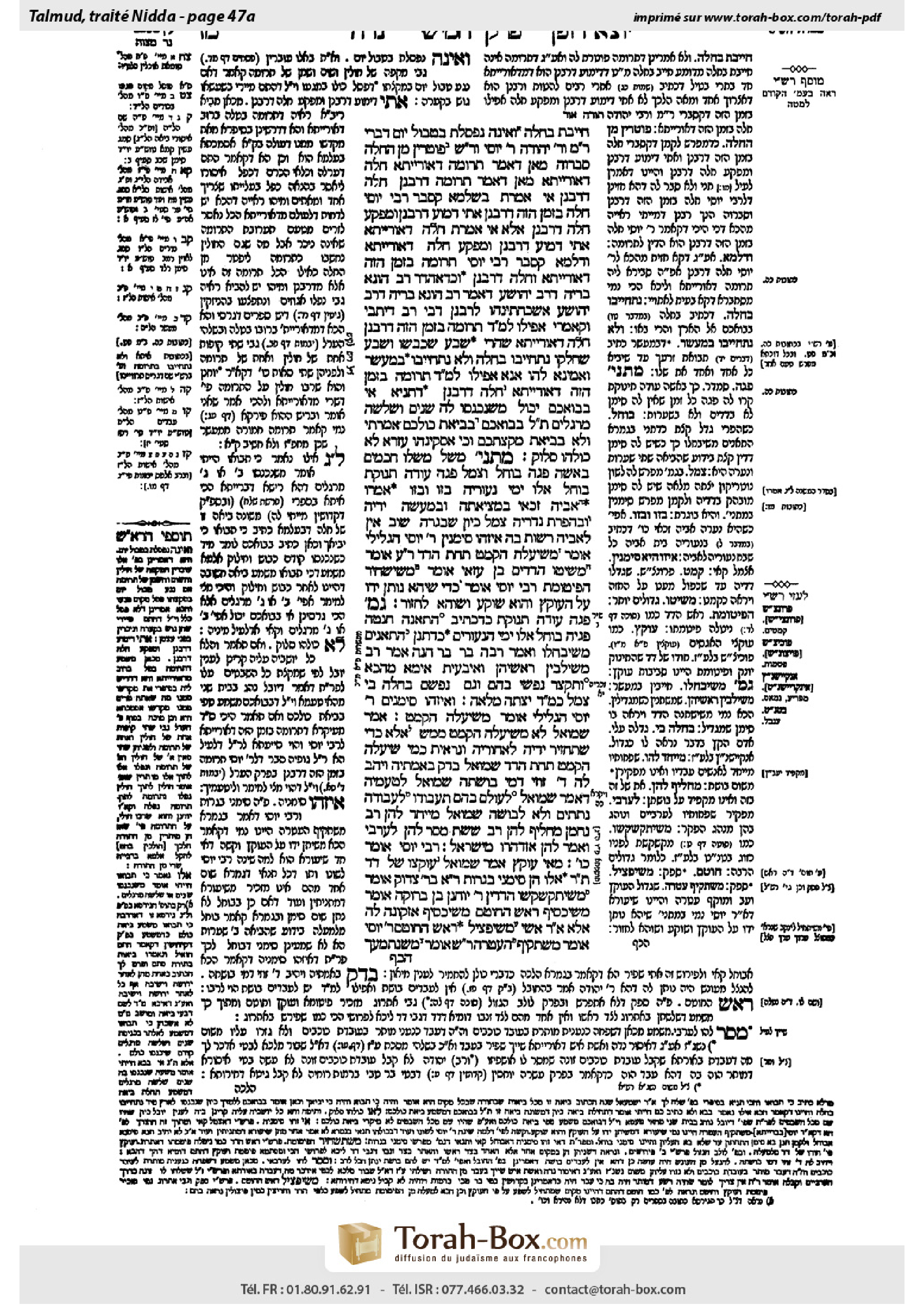
Niddah 47a: Talmud study for Daf Yomi
Daf Yomi is the daily study of one Talmud folio. Explore 37 tractates with scans, Hebrew text, Sefaria English and AI-generated French translations where annotated.
Passage selection and English or AI-generated French translation are available where the scan has annotations. Daf Study is independent of Torah-Box and Sefaria.
Browse Niddah · נידה · All tractatesNiddah 47a text and translations
This page of Niddah includes the Aramaic text, an English translation and an AI-generated French translation, alongside the scan above.
נידה מ״ז א · Aramaic and Hebrew text
חַיֶּיבֶת בְּחַלָּה וְאֵינָהּ נִפְסֶלֶת בִּטְבוּל יוֹם, דִּבְרֵי רַבִּי מֵאִיר וְרַבִּי יְהוּדָה; רַבִּי יוֹסֵי וְרַבִּי שִׁמְעוֹן פּוֹטְרִין מִן הַחַלָּה.
סַבְרוּהָ, מַאן דְּאָמַר תְּרוּמָה דְּאוֹרָיְיתָא — חַלָּה דְּאוֹרָיְיתָא, מַאן דְּאָמַר תְּרוּמָה דְּרַבָּנַן — חַלָּה דְּרַבָּנַן. אִי אָמְרַתְּ בִּשְׁלָמָא קָסָבַר רַבִּי יוֹסֵי חַלָּה בַּזְּמַן הַזֶּה דְּרַבָּנַן, אָתֵי דִּמּוּעַ דְּרַבָּנַן וּמַפְקַע חַלָּה דְּרַבָּנַן.
אֶלָּא אִי אָמְרַתְּ חַלָּה דְּאוֹרָיְיתָא, אָתֵי דִּמּוּעַ דְּרַבָּנַן וּמַפְקַע חַלָּה דְּאוֹרָיְיתָא?
וְדִלְמָא קָסָבַר רַבִּי יוֹסֵי: תְּרוּמָה בַּזְּמַן הַזֶּה דְּאוֹרָיְיתָא, וְחַלָּה דְּרַבָּנַן?
וְכִדְאַהְדַּר רַב הוּנָא בְּרֵיהּ דְּרַב יְהוֹשֻׁעַ, דְּאָמַר רַב הוּנָא בְּרֵיהּ דְּרַב יְהוֹשֻׁעַ: אַשְׁכַּחְתִּינְהוּ לְרַבָּנַן דְּבֵי רַב דְּיָתְבִי וְקָאָמְרִי: אֲפִילּוּ לְמַאן דְּאָמַר תְּרוּמָה בַּזְּמַן הַזֶּה דְּרַבָּנַן, חַלָּה דְּאוֹרָיְיתָא.
שֶׁהֲרֵי שֶׁבַע שֶׁכִּבְּשׁוּ, וְשֶׁבַע שֶׁחִלְּקוּ — נִתְחַיְּיבוּ בְּחַלָּה, וְלֹא נִתְחַיְּיבוּ בְּמַעֲשֵׂר.
וְאָמֵינָא לְהוּ אֲנָא: אֲפִילּוּ לְמַאן דְּאָמַר תְּרוּמָה בַּזְּמַן הַזֶּה דְּאוֹרָיְיתָא, חַלָּה דְּרַבָּנַן, דְּתַנְיָא: אִי ״בְּבוֹאֲכֶם״ יָכוֹל מִשֶּׁנִּכְנְסוּ לָהּ שְׁנַיִם וּשְׁלֹשָׁה מְרַגְּלִים? תַּלְמוּד לוֹמַר ״בְּבוֹאֲכֶם״ — בְּבִיאַת כּוּלְּכֶם אָמַרְתִּי, וְלֹא בְּבִיאַת מִקְצַתְכֶם.
וְכִי אַסְּקִינְהוּ עֶזְרָא — לָא כּוּלְּהוּ סְלוּק.
מַתְנִי' מָשָׁל מָשְׁלוּ חֲכָמִים בָּאִשָּׁה — ״פַּגָּה״, ״בּוֹחַל״, וָ״צֶמֶל״. ״פַּגָּה״ — עוֹדָהּ תִּינוֹקֶת, ״בּוֹחַל״ — אֵלּוּ יְמֵי נְעוּרֶיהָ.
בְּזוֹ וּבָזוֹ אָמְרוּ: אָבִיהָ זַכַּאי בִּמְצִיאָתָהּ, וּבְמַעֲשֵׂה יָדֶיהָ, וּבַהֲפָרַת נְדָרֶיהָ. צֶמֶל — כֵּיוָן שֶׁבָּגְרָה, שׁוּב אֵין לְאָבִיהָ רְשׁוּת בָּהּ.
אֵיזֶהוּ סִימָנִין? רַבִּי יוֹסֵי הַגְּלִילִי אוֹמֵר: מִשֶּׁיַּעֲלֶה הַקֶּמֶט תַּחַת הַדַּד. רַבִּי עֲקִיבָא אוֹמֵר: מִשֶּׁיַּטּוּ הַדַּדִּים. בֶּן עַזַּאי אוֹמֵר: מִשֶּׁתַּשְׁחִיר הַפִּיטּוֹמֶת. רַבִּי יוֹסֵי אוֹמֵר: כְּדֵי שֶׁיְּהֵא נוֹתֵן יָדוֹ עַל הָעוֹקֶץ, וְהוּא שׁוֹקֵעַ וְשׁוֹהֶא לַחֲזוֹר.
גְּמָ' פַּגָּה — עוֹדָהּ תִּינוֹקֶת, כְּדִכְתִיב: ״הַתְּאֵנָה חָנְטָה פַגֶּיהָ״, בּוֹחַל — אֵלּוּ יְמֵי הַנְּעוּרִים, כְּדִתְנַן: הַתְּאֵנִים מִשֶּׁיִּבְחֲלוּ, וְאָמַר רַבָּה בַּר בַּר חַנָּה אָמַר רַב: מִשֶּׁיַּלְבִּין רָאשֵׁיהֶן.
וְאִיבָּעֵית אֵימָא מֵהָכָא, ״וַתִּקְצַר נַפְשִׁי בָּהֶם וְגַם נַפְשָׁם בָּחֲלָה בִי״. צֶמֶל, כְּמַאן דְּאָמַר ״יָצְתָה מְלֵאָה״.
וְאֵיזֶהוּ סִימָנִים? רַבִּי יוֹסֵי הַגְּלִילִי אוֹמֵר: מִשֶּׁיַּעֲלֶה הַקֶּמֶט. אָמַר שְׁמוּאֵל: לֹא מִשֶּׁיַּעֲלֶה הַקֶּמֶט מַמָּשׁ, אֶלָּא כְּדֵי שֶׁתַּחְזִיר יָדֶיהָ לַאֲחוֹרֶיהָ, וְנִרְאֵית כְּמִי שֶׁיַּעֲלֶה הַקֶּמֶט תַּחַת הַדַּד.
שְׁמוּאֵל בְּדַק בְּאַמְתֵיהּ, וִיהַב לַהּ אַרְבְּעָה זוּזֵי דְּמֵי בוֹשְׁתָּהּ. שְׁמוּאֵל לְטַעְמֵיהּ, דְּאָמַר שְׁמוּאֵל: ״לְעוֹלָם בָּהֶם תַּעֲבוֹדוּ״ — לַעֲבוֹדָה נְתַתִּים, וְלֹא לְבוּשָׁה.
שְׁמוּאֵל מְיַיחֵד לְהוּ, רַב נַחְמָן מַחְלֵיף לְהוּ, רַב שֵׁשֶׁת מָסַר לְהוּ (לערבי) [לְעַרְבָיֵי] וְאָמַר לְהוּ: אִזְדְּהַרוּ מִיִּשְׂרָאֵל.
רַבִּי יוֹסֵי אוֹמֵר כּוּ׳. מַאי ״עוֹקֶץ״? אָמַר שְׁמוּאֵל: עוּקְצוֹ שֶׁל דַּד.
תָּנוּ רַבָּנַן: אֵלּוּ הֵן סִימָנֵי בַגְרוּת? רַבִּי אֶלְעָזָר בְּרַבִּי צָדוֹק אוֹמֵר: מִשֶּׁיִּתְקַשְׁקְשׁוּ הַדַּדִּין. רַבִּי יוֹחָנָן בֶּן בְּרוֹקָה אוֹמֵר: מִשֶּׁיַּכְסִיף רֹאשׁ הַחוֹטֶם. מִשֶּׁיַּכְסִיף? אַזְקִונַהּ לַהּ! אֶלָּא אָמַר רַב אָשֵׁי: מִשֶּׁיַּפְצִיל רֹאשׁ הַחוֹטֶם. רַבִּי יוֹסֵי אוֹמֵר: מִשֶּׁתַּקִּיף הָעֲטָרָה. רַבִּי שִׁמְעוֹן אוֹמֵר: מִשֶּׁנִּתְמַעֵךְ
Niddah 47a · English translation
it is subject to the obligation of separating ḥalla, the portion of the dough designated for the priest. And although teruma fell into it, that produce does not have the status of teruma, as the teruma was nullified by a majority of non-sacred produce. Consequently, it is not rendered unfit for consumption, i.e., rendered ritually impure, by one who was ritually impure who immersed that day and is waiting for nightfall for his purification process to be completed. This is the statement of Rabbi Meir and Rabbi Yehuda. Rabbi Yosei and Rabbi Shimon deem the dough exempt from the obligation of separating ḥalla, as this obligation does not apply to teruma, and the entire dough is exempt due to the mixture of teruma it contains.
The Sages assumed that the one who said that teruma in the present applies by Torah law maintains that ḥalla likewise applies in the present by Torah law, whereas the one who said that teruma in the present applies by rabbinic law holds that ḥalla also applies by rabbinic law. If so, granted, if you say that Rabbi Yosei holds that ḥalla in the present applies by rabbinic law, one can understand that a mixture which has the status of teruma by rabbinic law comes and abrogates the obligation of separating ḥalla, which also applies by rabbinic law.
But if you say that ḥalla in the present applies by Torah law, can a mixture that has the status of teruma by rabbinic law come and abrogate the mitzva of ḥalla which is by Torah law? Evidently, according to Rabbi Yosei the obligation of separating ḥalla in the present is by rabbinic law, and therefore teruma likewise applies by rabbinic law. If so, Rabbi Yosei does not agree with the opinion he cites in Seder Olam, according to which teruma applies in the present by Torah law.
The Gemara rejects this proof: But perhaps Rabbi Yosei maintains that teruma in the present applies by Torah law and yet ḥalla applies by rabbinic law, and therefore the mixture discussed in the above baraita, which has the status of teruma by Torah law, abrogates the obligation of ḥalla, which is by rabbinic law.
The Gemara adds: And this answer is as Rav Huna, son of Rav Yehoshua, responded to the statement of the other Sages. As Rav Huna, son of Rav Yehoshua, said: I once found the Sages of the study hall of Rav sitting and saying: Even according to the one who said that teruma in the present applies by rabbinic law, the obligation to separate ḥalla is by Torah law.
The reason is that during the seven years that the Jewish people conquered Eretz Yisrael led by Joshua and during the seven years that they divided the land, they were obligated to separate ḥalla but they were not obligated to separate teruma and tithe. In the present as well, although there is no obligation to set aside teruma in Eretz Yisrael by Torah law, the obligation to separate ḥalla applies by Torah law.
Rav Huna, son of Rav Yehoshua, continued: And I said to them: On the contrary, even according to the one who said that teruma in the present applies by Torah law, the obligation to separate ḥalla applies by rabbinic law, as it is taught in a baraita: The verse states with regard to ḥalla: “When you come into the land where I bring you…from the first of your dough you shall set apart a cake for a gift” (Numbers 15:18–20). If the obligation applies “when you come” into the land, one might have thought that it took effect from the moment that two or three spies entered the land. Therefore the verse states: “When you come,” from which it is derived that the Torah is saying: I said that the obligation applies when all of you come, and not when some of you come.
According to this baraita, the separation of ḥalla is an obligation by Torah law only when the entire Jewish people come to Eretz Yisrael. And when Ezra brought the Jewish people to Eretz Yisrael at the beginning of the Second Temple period, not all of them ascended. Since the majority of the Jewish people stayed behind, separating ḥalla was not restored to the status of an obligation by Torah law.
MISHNA: The Sages stated a parable based on the development of the fruit of a fig tree with regard to the three stages of development in a woman: Minority, young womanhood, and grown womanhood. An unripe fig, a ripening fig, and a ripe fig. An unripe fig represents the stage when she is still a child and has not yet developed the signs of puberty; a ripening fig represents the days of her young womanhood, when she reaches twelve years and one day and has developed two pubic hairs.
With regard to the periods both during this stage, minority, and during that stage, young womanhood, the Sages said that her father is entitled to any lost object that she finds that cannot be returned to its owner, and to her earnings, and to nullification of her vows. A ripe fig represents the stage of grown womanhood: Once she has reached her majority, her father no longer has authority over her. He can no longer nullify her vows, and he does not have a claim to lost objects found by her and her earnings belong to her.
What are the signs that indicate grown womanhood? Rabbi Yosei HaGelili says: Grown womanhood begins from when her breast grows sufficiently so that a fold appears below the breast. Rabbi Akiva says: It begins from when the breasts sag onto the chest. Ben Azzai says: It begins from when the areola at the tip of the breast darkens. Rabbi Yosei says: It begins when the breasts have developed to a size where a person places his hand on the nipple and it depresses and slows to return.
GEMARA: The mishna teaches that an unripe fig [paga] represents the stage when a woman is still a child. The Gemara explains that the meaning of the word paga is as it is written: “The fig tree puts forth her green fruits [fageha]” (Song of Songs 2:13). The mishna further teaches that a ripening fig [boḥal] represents the days of her young womanhood. The Gemara explains that the meaning of this word is as we learned in a mishna (Ma’asrot 1:2): The obligation of tithes applies to the figs from when they begin to ripen [misheyyibaḥalu]; and Rabba bar bar Ḥana says that Rav says that this means from when the heads of the figs whiten.
The Gemara adds: And if you wish, say instead that the source is from here: “For My soul became impatient of them, and their soul also grew in disgust [baḥala] toward Me” (Zechariah 11:8). The verse indicates that this word denotes growth. As for the third term in the mishna, a ripe fig [tzemel], it is as one would say: A fruit has come forth complete [yatzeta mele’a].
§ The mishna teaches: And what are the signs that indicate grown womanhood? Rabbi Yosei HaGelili says: Grown womanhood begins from when her breast grows sufficiently so that a fold appears below the breast. Shmuel says: This does not literally mean from when her breast grows sufficiently so that a permanent fold appears below the breast. Rather, it means that the breast has grown enough so that if she were to stretch her hand behind her back, it would appear as though her breast has grown sufficiently that there is a fold below the breast.
The Gemara relates that Shmuel examined these stages in his Canaanite maidservant, and subsequently gave her four dinars as payment for her humiliation. The Gemara notes that in this regard Shmuel conforms to his line of reasoning, as Shmuel said that the verse: “You may enslave them forever” (Leviticus 25:46) teaches: I gave them to you for the service of slaves, but not for humiliation. Consequently, if a master humiliated his Canaanite slave, he must pay him damages.
The Gemara further relates, with regard to the attitude toward maidservants, that Shmuel would designate a particular slave for each of his maidservants for intercourse, and he would not allow his slaves to engage in intercourse with whichever maidservant they chose. By contrast, Rav Naḥman would exchange his maidservants between his slaves, while Rav Sheshet handed his maidservants to an Arab, and said to them: You may engage in intercourse with whomever you choose, but take care not to engage in intercourse with a Jew.
§ The mishna teaches that Rabbi Yosei says: Grown womanhood begins when the breasts have developed to a size where if a person places his hand on the nipple [oketz] it depresses and slows to return. The Gemara asks: What is the meaning of oketz? Shmuel said: It means the protrusion [oketz] of the breast, i.e., the nipple.
The Sages taught in a baraita: What are the signs of maturity? Rabbi Elazar, son of Rabbi Tzadok, says: From when the breasts knock against each other, due to their size. Rabbi Yoḥanan ben Beroka says: From when the head of the protrusion in the center of the nipple darkens. The Gemara asks with regard to this suggestion: From when it darkens? One thereby renders her old, i.e., if one accepts this sign, the beginning of maturity is delayed significantly. Rather, Rav Ashi said: From when the head of the protrusion splits. Rabbi Yosei says: From when the nipple grows to such an extent that it is surrounded by a circle. Rabbi Shimon says: From when there is a softening
Niddah 47a · Traduction française (IA)
La pâte est soumise à l’obligation de prélever la ḥalla, la portion de pâte destinée au prêtre. Bien que de la terouma y soit tombée, ce produit n’a pas le statut de terouma, car celle-ci a été annulée par la majorité de produits profanes. Par conséquent, la pâte n’est pas rendue impropre à la consommation — c’est-à-dire rituellement impure — par une personne rituellement impure qui s’est immergée ce jour-là et attend la nuit pour que son processus de purification soit achevé. Telle est l’opinion de Rabbi Meïr et de Rabbi Yehouda. Rabbi Yosei et Rabbi Shimon exemptent la pâte de l’obligation de prélever la ḥalla, car cette obligation ne s’applique pas à la terouma ; toute la pâte est donc exemptée en raison du mélange de terouma qu’elle contient.
Les Sages ont supposé que celui qui affirme que la terouma s’applique de nos jours en vertu de la Torah considère que la ḥalla s’applique également de nos jours en vertu de la Torah, tandis que celui qui affirme que la terouma s’applique de nos jours en vertu d’une loi rabbinique estime que la ḥalla s’applique elle aussi en vertu d’une loi rabbinique. Dans ce cas, si l’on admet que, selon Rabbi Yosei, la ḥalla s’applique de nos jours en vertu d’une loi rabbinique, on peut comprendre qu’un mélange ayant le statut de terouma en vertu d’une loi rabbinique annule l’obligation de prélever la ḥalla, qui s’applique elle aussi en vertu d’une loi rabbinique.
Mais si l’on affirme que la ḥalla s’applique de nos jours en vertu de la Torah, un mélange ayant le statut de terouma en vertu d’une loi rabbinique peut-il annuler la mitsva de ḥalla, qui relève de la Torah ? Il apparaît donc que, selon Rabbi Yosei, l’obligation de prélever la ḥalla de nos jours relève d’une loi rabbinique et que, par conséquent, la terouma s’applique elle aussi en vertu d’une loi rabbinique. Dans ce cas, Rabbi Yosei n’est pas d’accord avec l’opinion qu’il cite dans le Seder Olam, selon laquelle la terouma s’applique de nos jours en vertu de la Torah.
La Guemara rejette cette preuve : Mais peut-être Rabbi Yosei considère-t-il que la terouma s’applique de nos jours en vertu de la Torah, tandis que la ḥalla s’applique en vertu d’une loi rabbinique. Le mélange évoqué dans la baraïta ci-dessus, qui a le statut de terouma en vertu de la Torah, annule donc l’obligation de ḥalla, qui relève d’une loi rabbinique.
La Guemara ajoute : Cette réponse correspond à celle que Rav Houna, fils de Rav Yehoshoua, donna aux autres Sages. En effet, Rav Houna, fils de Rav Yehoshoua, dit : « Un jour, j’ai trouvé les Sages de la maison d’étude de Rav assis et affirmant : Même selon celui qui dit que la terouma s’applique de nos jours en vertu d’une loi rabbinique, l’obligation de prélever la ḥalla relève de la Torah. »
La raison en est que, pendant les sept années où le peuple juif, conduit par Josué, conquit Eretz Israël, ainsi que pendant les sept années où il partagea le pays, il était tenu de prélever la ḥalla, mais pas la terouma ni la dîme. De nos jours également, bien qu’il n’y ait pas en Eretz Israël d’obligation de prélever la terouma en vertu de la Torah, l’obligation de prélever la ḥalla relève de la Torah.
Rav Houna, fils de Rav Yehoshoua, poursuivit : « Je leur ai dit : Au contraire, même selon celui qui dit que la terouma s’applique de nos jours en vertu de la Torah, l’obligation de prélever la ḥalla relève d’une loi rabbinique, comme l’enseigne une baraïta : Au sujet de la ḥalla, le verset dit : “Lorsque vous entrerez dans le pays où je vous conduis… vous prélèverez une offrande de la première partie de votre pâte” (Nombres 15:18–20). Si l’obligation s’applique “lorsque vous entrerez” dans le pays, on aurait pu penser qu’elle prend effet dès que deux ou trois espions y sont entrés. Le verset dit donc : “Lorsque vous entrerez”, ce dont on déduit que la Torah dit : J’ai dit que l’obligation s’applique lorsque vous entrez tous, et non lorsque certains d’entre vous entrent. »
Selon cette baraïta, le prélèvement de la ḥalla n’est une obligation relevant de la Torah que lorsque tout le peuple juif arrive en Eretz Israël. Or, lorsque Ezra ramena le peuple juif en Eretz Israël au début de la période du Second Temple, tous ne montèrent pas. Puisque la majorité du peuple juif resta sur place, le prélèvement de la ḥalla ne retrouva pas le statut d’obligation relevant de la Torah.
MICHNA : Les Sages ont formulé une parabole fondée sur le développement du fruit du figuier pour évoquer les trois stades de développement d’une femme : l’enfance, la jeune fille et la femme adulte. Une figue non mûre, une figue qui mûrit et une figue mûre. La figue non mûre représente le stade où elle est encore enfant et n’a pas développé les signes de la puberté ; la figue qui mûrit représente les jours de sa jeune fille, lorsqu’elle atteint douze ans et un jour et que deux poils pubiens ont poussé.
Au sujet de ces deux stades — l’enfance et la jeune fille —, les Sages ont dit que son père a droit à tout objet perdu qu’elle trouve et qui ne peut être rendu à son propriétaire, à ses revenus, et au pouvoir d’annuler ses vœux. La figue mûre représente le stade de la femme adulte : une fois qu’elle a atteint sa majorité, son père n’a plus d’autorité sur elle. Il ne peut plus annuler ses vœux, il n’a aucun droit sur les objets perdus qu’elle trouve, et ses revenus lui appartiennent.
Quels sont les signes qui indiquent qu’elle est devenue adulte ? Rabbi Yosei HaGelili dit : La majorité commence lorsque son sein a suffisamment grandi pour qu’un pli apparaisse dessous. Rabbi Akiva dit : Elle commence lorsque ses seins retombent sur sa poitrine. Ben Azaï dit : Elle commence lorsque l’aréole au bout du sein s’assombrit. Rabbi Yosei dit : Elle commence lorsque ses seins ont atteint une taille telle que, si quelqu’un pose la main sur le mamelon, celui-ci s’enfonce et tarde à reprendre sa forme.
GUEMARA : La Michna enseigne qu’une figue non mûre [paga] représente le stade où une femme est encore enfant. La Guemara explique que le mot paga a le sens qu’on trouve dans le verset : « Le figuier donne ses figues vertes [fageha] » (Cantique des Cantiques 2:13). La Michna enseigne en outre qu’une figue qui mûrit [boḥal] représente les jours de sa jeune fille. La Guemara explique que ce mot a le sens de celui que nous avons appris dans une Michna (Ma’asserot 1:2) : l’obligation des dîmes s’applique aux figues à partir du moment où elles commencent à mûrir [misheyyibaḥalu] ; et Rabba bar bar Ḥana dit au nom de Rav que cela signifie à partir du moment où les sommets des figues blanchissent.
La Guemara ajoute : Et si tu le souhaites, dis plutôt que la source se trouve ici : « Mon âme s’est lassée d’eux, et leur âme aussi s’est dégoûtée [baḥala] de moi » (Zacharie 11:8). Le verset indique que ce mot désigne la croissance. Quant au troisième terme de la Michna, une figue mûre [tzemel], il s’explique par l’expression : un fruit est apparu, achevé [yatzeta mele’a].
§ La Michna enseigne : Quels sont les signes qui indiquent qu’elle est devenue adulte ? Rabbi Yosei HaGelili dit : La majorité commence lorsque son sein a suffisamment grandi pour qu’un pli apparaisse dessous. Shmouel dit : Cela ne signifie pas littéralement que son sein a suffisamment grandi pour qu’un pli permanent apparaisse dessous. Cela signifie plutôt que son sein a assez grandi pour que, si elle tendait la main derrière son dos, il semblerait qu’il ait suffisamment grandi pour qu’un pli apparaisse dessous.
La Guemara rapporte que Shmouel examina ces stades chez sa servante cananéenne, puis lui donna quatre dinars en dédommagement de l’humiliation qu’elle avait subie. La Guemara note qu’à cet égard, Shmouel agit conformément à son propre raisonnement, car il dit que le verset « Vous pourrez les asservir pour toujours » (Lévitique 25:46) enseigne : « Je vous les ai donnés pour qu’ils vous servent comme esclaves, mais pas pour les humilier. » Par conséquent, si un maître humilie son esclave cananéen, il doit lui verser des dommages-intérêts.
La Guemara rapporte encore, au sujet de l’attitude envers les servantes, que Shmouel désignait un esclave particulier pour chacune d’elles afin qu’il ait des relations avec elle, et qu’il ne permettait pas à ses esclaves d’avoir des relations avec la servante de leur choix. Rav Naḥman, en revanche, échangeait ses servantes entre ses esclaves, tandis que Rav Sheshet confiait ses servantes à un Arabe et leur disait : « Vous pouvez avoir des relations avec qui vous voulez, mais veillez à ne pas en avoir avec un Juif. »
§ La Michna enseigne que Rabbi Yosei dit : La majorité commence lorsque les seins ont atteint une taille telle que, si quelqu’un pose la main sur le mamelon [oketz], celui-ci s’enfonce et tarde à reprendre sa forme. La Guemara demande : Que signifie oketz ? Shmouel dit : Cela signifie la protubérance [oketz] du sein, c’est-à-dire le mamelon.
Les Sages ont enseigné dans une baraïta : Quels sont les signes de maturité ? Rabbi Elazar, fils de Rabbi Tsadok, dit : À partir du moment où les seins se heurtent l’un à l’autre en raison de leur taille. Rabbi Yoḥanan ben Beroka dit : À partir du moment où l’extrémité de la protubérance au centre du mamelon s’assombrit. La Guemara interroge cette proposition : À partir du moment où elle s’assombrit ? On la ferait ainsi paraître vieille, c’est-à-dire que, si l’on acceptait ce signe, le début de la maturité serait considérablement retardé. Rav Ashi dit plutôt : À partir du moment où l’extrémité de la protubérance se fend. Rabbi Yosei dit : À partir du moment où le mamelon grandit au point d’être entouré d’un cercle. Rabbi Shimon dit : À partir du moment où il y a un ramollissement
Traduction française générée par IA à partir de l’édition anglaise de Sefaria. Vérifie toujours un passage avec le texte source.
Text from Sefaria: William Davidson Edition - Vocalized Aramaic (CC BY NC); William Davidson Edition - English (CC BY NC).