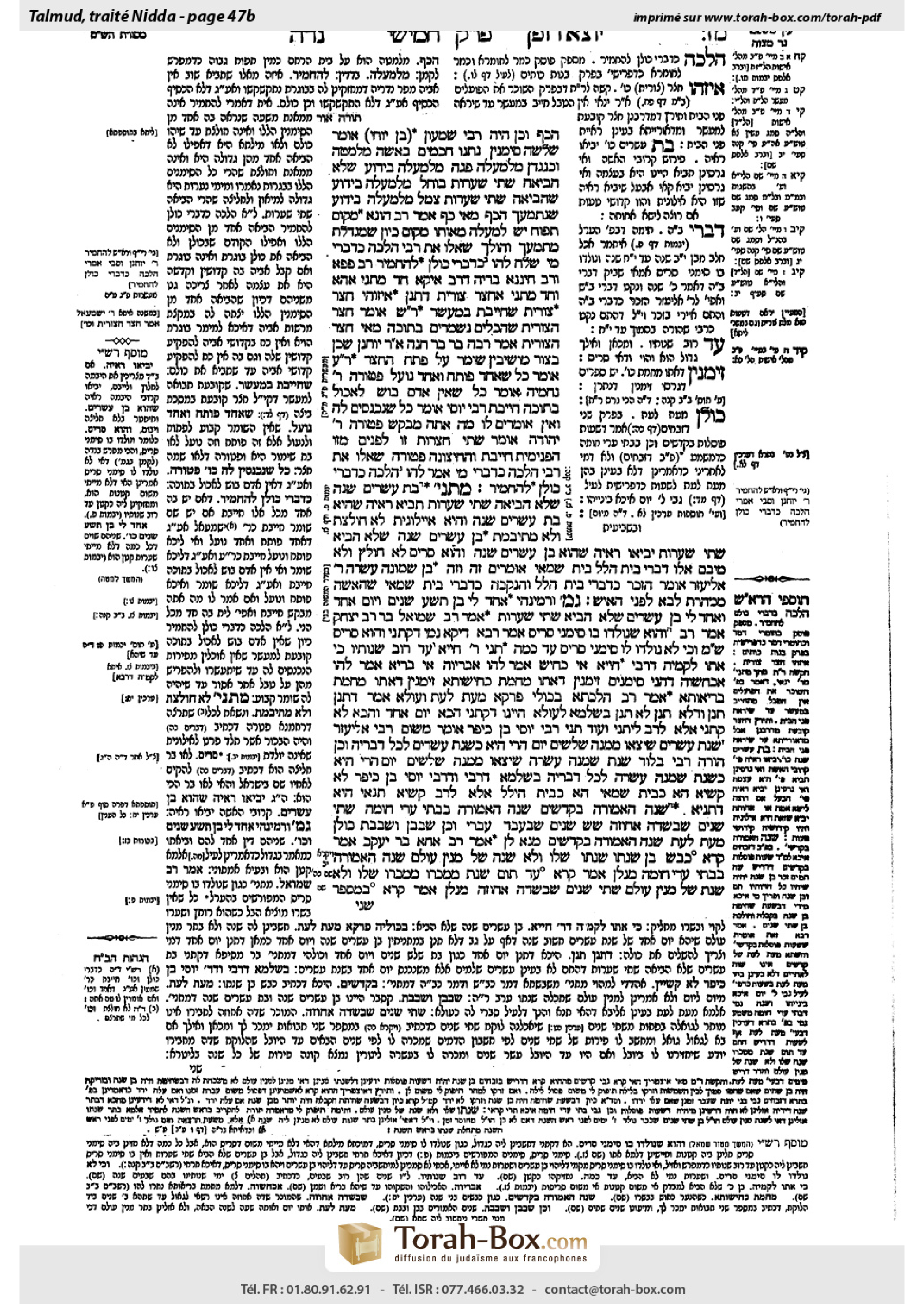
Niddah 47b: Talmud study for Daf Yomi
Daf Yomi is the daily study of one Talmud folio. Explore 37 tractates with scans, Hebrew text, Sefaria English and AI-generated French translations where annotated.
Passage selection and English or AI-generated French translation are available where the scan has annotations. Daf Study is independent of Torah-Box and Sefaria.
Browse Niddah · נידה · All tractatesNiddah 47b text and translations
This page of Niddah includes the Aramaic text, an English translation and an AI-generated French translation, alongside the scan above.
נידה מ״ז ב · Aramaic and Hebrew text
הַכַּף.
וְכֵן הָיָה רַבִּי שִׁמְעוֹן (בֶּן יוֹחַי) אוֹמֵר: שְׁלֹשָׁה סִימָנִין נָתְנוּ חֲכָמִים בָּאִשָּׁה מִלְּמַטָּה, וּכְנֶגְדָּן מִלְּמַעְלָה. פַּגָּה מִלְּמַעְלָה — בְּיָדוּעַ שֶׁלֹּא הֵבִיאָה שְׁתֵּי שְׂעָרוֹת, בּוֹחַל מִלְּמַעְלָה — בְּיָדוּעַ שֶׁהֵבִיאָה שְׁתֵּי שְׂעָרוֹת, צֶמֶל מִלְּמַעְלָה — בְּיָדוּעַ שֶׁנִּתְמַעֵךְ הַכַּף.
מַאי כַּף? אָמַר רַב הוּנָא: מָקוֹם תָּפוּחַ יֵשׁ לְמַעְלָה מֵאוֹתוֹ מָקוֹם, כֵּיוָן שֶׁמְּגַדֶּלֶת מִתְמַעֵךְ וְהוֹלֵךְ. שָׁאֲלוּ אֶת רַבִּי: הֲלָכָה כְּדִבְרֵי מִי? (שְׁלַח לְהוּ) [אָמַר לָהֶן]: כְּדִבְרֵי כּוּלָּן לְהַחְמִיר.
רַב פָּפָּא וְרַב חִינָּנָא בְּרֵיהּ דְּרַב אִיקָא, חַד מַתְנֵי אַהָא, וְחַד מַתְנֵי אַחָצֵר צוֹרִית, דִּתְנַן: אֵיזוֹהִי חָצֵר צוֹרִית שֶׁחַיֶּיבֶת בְּמַעֲשֵׂר? רַבִּי שִׁמְעוֹן אוֹמֵר: חָצֵר הַצּוֹרִית שֶׁהַכֵּלִים נִשְׁמָרִים בְּתוֹכָהּ.
מַאי ״חָצֵר הַצּוֹרִית״? אָמַר רַבָּה בַּר בַּר חַנָּה אָמַר רַבִּי יוֹחָנָן: שֶׁכֵּן בְּצוֹר מוֹשִׁיבִין שׁוֹמֵר עַל פֶּתַח הֶחָצֵר. רַבִּי עֲקִיבָא אוֹמֵר: כֹּל שֶׁאֶחָד פּוֹתֵחַ וְאֶחָד נוֹעֵל — פְּטוּרָה.
רַבִּי נְחֶמְיָה אוֹמֵר: כֹּל שֶׁאֵין אָדָם בּוֹשׁ לֶאֱכוֹל בְּתוֹכָהּ — חַיֶּיבֶת. רַבִּי יוֹסֵי אוֹמֵר: כֹּל שֶׁנִּכְנָסִים לָהּ וְאֵין אוֹמְרִים לוֹ ״מָה אַתָּה מְבַקֵּשׁ״ — פְּטוּרָה.
רַבִּי יְהוּדָה אוֹמֵר: שְׁתֵּי חֲצֵרוֹת זוֹ לִפְנִים מִזּוֹ — הַפְּנִימִית חַיֶּיבֶת, וְהַחִיצוֹנָה פְּטוּרָה.
שָׁאֲלוּ אֶת רַבִּי: הֲלָכָה כְּדִבְרֵי מִי? אֲמַר (לְהוּ) [לָהֶן]: הֲלָכָה כְּדִבְרֵי כּוּלָּן לְהַחְמִיר.
מַתְנִי' בַּת עֶשְׂרִים שָׁנָה שֶׁלֹּא הֵבִיאָה שְׁתֵּי שְׂעָרוֹת — תָּבִיא רְאָיָה שֶׁהִיא בַּת עֶשְׂרִים שָׁנָה, וְהִיא אַיְילוֹנִית — לֹא חוֹלֶצֶת וְלֹא מִתְיַבֶּמֶת.
בֶּן עֶשְׂרִים שָׁנָה שֶׁלֹּא הֵבִיא שְׁתֵּי שְׂעָרוֹת — יָבִיאוּ רְאָיָה שֶׁהוּא בֶּן עֶשְׂרִים שָׁנָה, וְהוּא סָרִיס, לֹא חוֹלֵץ וְלֹא מְיַבֵּם. אֵלּוּ דִּבְרֵי בֵּית הִלֵּל. בֵּית שַׁמַּאי אוֹמְרִים: זֶה וָזֶה בֶּן שְׁמוֹנֶה עֶשְׂרֵה.
רַבִּי אֱלִיעֶזֶר אוֹמֵר: הַזָּכָר — כְּדִבְרֵי בֵּית הִלֵּל, וְהַנְּקֵבָה — כְּדִבְרֵי בֵּית שַׁמַּאי, שֶׁהָאִשָּׁה מְמַהֶרֶת לָבֹא לִפְנֵי הָאִישׁ.
גְּמָ' וּרְמִינְהִי: אֶחָד לִי בֶּן תֵּשַׁע שָׁנִים וְיוֹם אֶחָד, וְאֶחָד לִי בֶּן עֶשְׂרִים שֶׁלֹּא הֵבִיא שְׁתֵּי שְׂעָרוֹת!
אָמַר רַב שְׁמוּאֵל בַּר רַב יִצְחָק, אָמַר רַב: וְהוּא שֶׁנּוֹלְדוּ בּוֹ סִימָנֵי סָרִיס. אָמַר רָבָא: דַּיְקָא נָמֵי, דְּקָתָנֵי ״וְהוּא סָרִיס״, שְׁמַע מִינַּהּ.
וְכִי לֹא נוֹלְדוּ לוֹ סִימָנֵי סָרִיס, עַד כַּמָּה? תָּנֵי רַבִּי חִיָּיא: עַד רוֹב שְׁנוֹתָיו.
כִּי אָתוּ לְקַמֵּיהּ דְּרַבִּי חִיָּיא, אִי כְּחִישׁ — אֲמַר לְהוּ: ״אַבְרְיוּהּ״. אִי בָּרִיא — אֲמַר לְהוּ: ״אַכְחֲשׁוּהּ״, דְּהָנֵי סִימָנִים זִימְנִין דְּאָתוּ מֵחֲמַת כְּחִישׁוּתָא, זִימְנִין דְּאָתוּ מֵחֲמַת בְּרִיאוּתָא.
אָמַר רַב: הִלְכְתָא בְּכוּלֵּי פִּרְקָא — מֵעֵת לְעֵת. וְעוּלָּא אָמַר: דִּתְנַן תְּנַן, וּדְלָא תְּנַן לָא תְּנַן.
בִּשְׁלָמָא לְעוּלָּא, הַיְינוּ דְקָתָנֵי הָכָא ״יוֹם אֶחָד״, וְהָכָא לָא קָתָנֵי. אֶלָּא לְרַב לִיתְנֵי!
וְעוֹד תָּנֵי: רַבִּי יוֹסֵי בֶּן כִּיפָּר אוֹמֵר מִשּׁוּם רַבִּי אֱלִיעֶזֶר, שְׁנַת עֶשְׂרִים שֶׁיָּצְאוּ מִמֶּנָּה שְׁלֹשִׁים יוֹם — הֲרֵי הִיא כִּשְׁנַת עֶשְׂרִים לְכׇל דְּבָרֶיהָ, וְכֵן הוֹרָה רַבִּי בְּלוֹד: שְׁנַת שְׁמֹנֶה עֶשְׂרֵה שֶׁיָּצְאוּ מִמֶּנָּה שְׁלֹשִׁים יוֹם — הֲרֵי הִיא כִּשְׁנַת שְׁמֹנֶה עֶשְׂרֵה לְכׇל דְּבָרֶיהָ.
בִּשְׁלָמָא דְּרַבִּי וּדְרַבִּי יוֹסֵי בֶּן כִּיפָּר לָא קַשְׁיָא, הָא כְּבֵית שַׁמַּאי, הָא כְּבֵית הִילֵּל, אֶלָּא לְרַב קַשְׁיָא!
תַּנָּאֵי הִיא, דְּתַנְיָא: שָׁנָה הָאֲמוּרָה בַּקֳּדָשִׁים, שָׁנָה הָאֲמוּרָה בְּבָתֵּי עָרֵי חוֹמָה, שְׁתֵּי שָׁנִים שֶׁבִּשְׂדֵה אֲחוּזָּה.
שֵׁשׁ שָׁנִים שֶׁבְּעֶבֶד עִבְרִי, וְכֵן שֶׁבַּבֵּן וְשֶׁבַּבַּת — כּוּלָּן מֵעֵת לְעֵת.
שָׁנָה הָאֲמוּרָה בַּקֳּדָשִׁים מְנָא לַן? אָמַר רַב אַחָא בַּר יַעֲקֹב, אָמַר קְרָא: ״כֶּבֶשׂ בֶּן שְׁנָתוֹ״, שְׁנָתוֹ שֶׁלּוֹ, וְלֹא שָׁנָה שֶׁל מִנְיַן עוֹלָם.
שָׁנָה הָאֲמוּרָה בְּבָתֵּי עָרֵי חוֹמָה מְנָלַן? אָמַר קְרָא: ״עַד תֹּם שְׁנַת מִמְכָּרוֹ״ — מִמְכָּרוֹ שֶׁלּוֹ, וְלֹא שָׁנָה שֶׁל מִנְיַן עוֹלָם. שְׁתֵּי שָׁנִים שֶׁבִּשְׂדֵה אֲחוּזָּה מְנָלַן? אָמַר קְרָא: ״בְּמִסְפַּר
Niddah 47b · English translation
of the protuberance above the womb, the mons pubis.
And Rabbi Shimon ben Yoḥai would likewise say: The Sages provided three signs indicating puberty in a woman below, i.e., near her vagina, and they stated three corresponding signs above. If a woman has the signs of an unripe fig above, it is known that she has not grown two pubic hairs; if she has the signs of a ripening fig above, it is known that she has grown two hairs; and if she has the signs of a ripe fig above, it is known that the protuberance has softened.
The Gemara asks: What is this protuberance? Rav Huna says: There is a swollen place in a woman’s body, above that place, a euphemism for the vagina. It is initially hard, but when a girl grows it increasingly softens. The Sages asked Rabbi Yehuda HaNasi: With regard to the signs of maturity in woman, in accordance with whose statement is the halakha? He sent them in response: The halakha is stringent in accordance with all of their statements, i.e., if any one of these signs mentioned by the Sages cited above appears in a girl, she must be treated as an adult with regard to all stringent aspects of this classification.
Rav Pappa and Rav Ḥinnana, son of Rav Ika, disagree about the context of this statement of Rabbi Yehuda HaNasi that the halakha is stringent in accordance with all of the Sages’ statements. One of them teaches it with regard to this matter, of a woman’s signs of puberty, and the other one teaches it with regard to the case of a Tyrian courtyard, as we learned in a mishna (Ma’asrot 3:5): What is a Tyrian courtyard, which renders food brought inside it to be required to be tithed? Rabbi Shimon says: A Tyrian courtyard is one inside of which vessels are safe.
The Sages discuss this mishna: What is the meaning of a Tyrian courtyard? Rabba bar bar Ḥana says that Rabbi Yoḥanan says: The courtyard is called by this name as the custom in the city of Tyre is to place a watchman at the entrance of the courtyard to guard the articles inside. Consequently, any courtyard in which vessels are safe is called a Tyrian courtyard. Rabbi Akiva says: In any courtyard where there is no permanent watchman who locks and unlocks it, but rather one of its residents opens the courtyard and another one locks it, e.g., a courtyard shared by several partners, each of whom can do as he chooses without asking the other, the produce inside it is exempt from the obligation of separating tithe, as such a courtyard is not considered one in which vessels are safe.
Rabbi Neḥemya says: Any courtyard which is hidden from the gaze of outsiders, and therefore a person is not ashamed to eat inside it, that courtyard renders produce inside it obligated to have tithe separated from it. Rabbi Yosei says: Any courtyard that one who does not live there can enter it, and the residents do not say to him: What do you want here, produce inside such a courtyard is exempt from tithe.
Rabbi Yehuda says: If there are two courtyards, one within the other, positioned in such a manner that the residents of the inner courtyard cannot enter their houses without passing through the outer courtyard, whereas the residents of the outer courtyard do not traverse the inner one, the inner courtyard renders any produce located inside it obligated to have tithe separated from it, but produce located in the outer courtyard is exempt from tithe. It is not safe, as residents of a different courtyard pass freely through it.
According to the opinion of one of the amora’im mentioned above, i.e., either Rav Pappa or Rav Ḥinnana, son of Rav Ika, it was with regard to this issue that the Sages asked Rabbi Yehuda HaNasi: In accordance with whose statement is the halakha? He said to them: The halakha is stringent in accordance with all of the Sages’ statements. In other words, with regard to any courtyard in which produce must be tithed according to any of these opinions, the halakha is that tithe must be separated from this produce.
MISHNA: A girl twelve years and one day old who grew two pubic hairs is classified as a young woman. Six months later, she becomes a grown woman. But a woman who is twenty years old who did not grow two pubic hairs and was never classified as a young woman shall bring proof that she is twenty years old, and from that point forward she assumes the status of a sexually underdeveloped woman [ailonit], who is incapable of bearing children. If she married and her husband died childless, she neither performs ḥalitza nor does she enter into levirate marriage, as the mitzva of levirate marriage applies only to a woman capable of conceiving a child. An ailonit is excluded from that mitzva.
In the case of a man who is twenty years old who did not grow two pubic hairs, they shall bring proof that he is twenty years old and he assumes the status of a sexually underdeveloped man [saris], who is excluded from the mitzva of levirate marriage. Therefore, if his married brother dies childless, he neither performs ḥalitza nor enters into levirate marriage with his yevama. This is the statement of Beit Hillel. Beit Shammai say: For both this case of a woman and that case of a man, they shall bring proof that they are eighteen years old, and they assume the status of a sexually underdeveloped woman and man respectively.
Rabbi Eliezer says: The status of the male is determined in accordance with the statement of Beit Hillel, i.e., he assumes the status of a sexually underdeveloped man at the age of twenty; and the status of the female is determined in accordance with the statement of Beit Shammai, i.e., she assumes the status of a sexually underdeveloped woman at the age of eighteen. The reason is that the woman is quick to reach physical maturity, and reaches that stage before the man reaches physical maturity.
GEMARA: The mishna teaches that a sexually underdeveloped man does not enter into levirate marriage with the widow of his childless brother. And the Gemara raises a contradiction from another mishna (Yevamot 96b): A boy who is nine years and one day old, who has not developed two hairs, and a man who is twenty years old who has not grown two hairs, are one and the same to me with regard to levirate marriage, in that if they engaged in intercourse with the widow of their childless brother, this levirate marriage is partially effective, to the extent that this woman requires both a bill of divorce and ḥalitza.
Rav Shmuel bar Yitzḥak says that Rav says in explanation of the ruling of the mishna here: And this halakha applies only in a case where he developed physical signs of a sexually underdeveloped man (see Yevamot 80b) by the age of twenty. By contrast, the mishna in Yevamot is referring to one who did not develop signs of a sexually underdeveloped man. Rava said: The language of the mishna is also precise, as it teaches: And he is a sexually underdeveloped man, which indicates that he had already developed physical signs of such a condition. The Gemara concludes: Conclude from it that this is the correct interpretation of the mishna.
The Gemara asks a question with regard to the halakha itself: And in a case where he does not develop the signs of a sexually underdeveloped man, until what age is he considered a minor? Rabbi Ḥiyya teaches: Until most of his years have passed, i.e., until he reaches the age of thirty-five, halfway to seventy, which is the standard length of a person’s life.
The Gemara relates: When people would come before Rabbi Ḥiyya to inquire about someone who had reached the age of puberty but had not yet developed the physical signs of maturity, if the person in question was thin, he would say to them: Go and fatten him up before we decide on his status. If he was fat, Rabbi Ḥiyya would say to them: Go and make him thin. As these signs indicating puberty sometimes come due to thinness and sometimes they come due to fatness. It is therefore possible that after his bodily shape is properly adjusted this individual will develop the signs indicating puberty and will not have the status of a sexually underdeveloped man.
§ Rav said: The halakha in this entire chapter with regard to all of the places where an age is mentioned in years is that even when the phrase: And one day, is not explicitly noted, they are all calculated from the time of year of birth until that same time of year in the age specified. And Ulla said: With regard to cases where we learned in the mishna a quantity of years including the phrase: And one day, we learned that the reference is to full years; and with regard to cases where we did not learn this phrase, i.e., where a quantity of years is mentioned in the mishna without the phrase: And one day, we did not learn it, and part of the final year is equivalent to a whole year.
The Gemara discusses these two opinions. Granted, according to Ulla, this is the reason that the tanna teaches there, in previous mishnayot (44b, 45a, 45b): And one day; and here, in this mishna, the tanna does not teach this phrase. But according to Rav, let the tanna be consistent and teach this phrase in all cases, including the mishna here.
And furthermore, it is taught in a baraita that Rabbi Yosei ben Keifar says in the name of Rabbi Eliezer with regard to the halakhot of a sexually underdeveloped man and a sexually underdeveloped woman: The twentieth year, of which thirty days have passed, i.e., from the age of nineteen and thirty days, is considered like the twentieth year in all regards; and Rabbi Yehuda HaNasi similarly issued a practical ruling of halakha in the city of Lod, that the eighteenth year of which thirty days have passed is considered like the eighteenth year in all regards.
Granted, according to the opinion of Ulla, it is not difficult that Rabbi Yehuda HaNasi is referring to the eighteenth year whereas Rabbi Yosei ben Keifar discusses the twentieth year, as this statement of Rabbi Yehuda HaNasi is in accordance with the opinion of Beit Shammai with regard to the age of a sexually underdeveloped woman, and that statement of Rabbi Yosei ben Keifar is in accordance with the opinion of Beit Hillel. But according to the opinion of Rav, who maintains that full years are required for a sexually underdeveloped man or woman, this baraita poses a difficulty.
The Gemara answers that this matter is a dispute between tanna’im, and Rav maintains in accordance with the opinion that full years are required. As it is taught in a baraita: Full years are required with regard to the period of one year stated with regard to sacrificial animals, e.g., “a lamb in its first year” (Leviticus 12:6); the one year stated with regard to houses of walled cities, during which one can redeem a house he has sold in a walled city (see Leviticus 25:29); and the two years stated with regard to an ancestral field, during which one cannot yet redeem an ancestral field he has sold (see Leviticus 25:15).
The six years stated with regard to a Hebrew slave (see Exodus 21:2) and similarly the years of a son and of a daughter, as will be explained, all of these are years from the time of the first year until that same time of year in the year specified, i.e., these periods are units of whole years instead of expiring on predetermined dates, as at the end of the calendar year. This supports the opinion of Rav that the years mentioned with regard to a sexually underdeveloped man or woman are full years.
The Gemara asks: From where do we derive that the one year stated with regard to sacrificial animals is calculated by whole years and not by calendar years? Rav Aḥa bar Ya’akov said that the verse states: “A lamb in its first year” (Leviticus 12:6). Since the verse does not state: A one-year-old lamb, it means a year based on calculation of its life, and not a year of the universal count, i.e., the calendar year.
The Gemara further asks: From where do we derive the halakha that the one year stated with regard to houses of walled cities is calculated by a whole year and not by calendar year? The verse states: “Then he may redeem it within a whole year after it is sold, for a full year he shall have the right of redemption” (Leviticus 25:29). The verse is referring to a year counted from the day of its own sale, and not the year of the universal count. From where do we derive that the two years stated with regard to an ancestral field are whole years? The verse states: “According the number of years after the Jubilee you shall buy from your neighbor, and according to the number
Niddah 47b · Traduction française (IA)
de la protubérance située au-dessus de l'utérus, le mont de Vénus.
Et Rabbi Shimon ben Yoḥai dirait de même : Les Sages ont établi trois signes indiquant la puberté chez la femme en bas, c'est-à-dire près de son vagin, et ils ont énoncé trois signes correspondants en haut. Si une femme présente les signes d'une figue non mûre en haut, il est connu qu'elle n'a pas fait pousser deux poils pubiens ; si elle présente les signes d'une figue en train de mûrir en haut, il est connu qu'elle a fait pousser deux poils ; et si elle présente les signes d'une figue mûre en haut, il est connu que la protubérance s'est adoucie.
La Guemara demande : Quelle est cette protubérance ? Rav Huna dit : Il y a un endroit enflé dans le corps de la femme, au-dessus de cet endroit, un euphémisme pour le vagin. Il est initialement dur, mais lorsqu'une fille grandit, il s'adoucit de plus en plus. Les Sages ont demandé à Rabbi Yehuda HaNasi : En ce qui concerne les signes de maturité chez la femme, selon la déclaration de qui la halakha est-elle ? Il leur a répondu : La halakha est stricte conformément à toutes leurs déclarations, c'est-à-dire que si l'un de ces signes mentionnés par les Sages cités ci-dessus apparaît chez une fille, elle doit être traitée comme une adulte en ce qui concerne tous les aspects stricts de cette classification.
Rav Pappa et Rav Ḥinnana, fils de Rav Ika, sont en désaccord quant au contexte de cette déclaration de Rabbi Yehuda HaNasi, selon laquelle la halakha est stricte conformément à toutes les déclarations des Sages. L'un d'eux l'enseigne en ce qui concerne cette affaire, à savoir les signes de puberté d'une femme, et l'autre l'enseigne en ce qui concerne le cas de la cour tyrienne, comme nous l'avons appris dans une Michna (Ma'asrot 3:5) : Qu'est-ce qu'une cour tyrienne, qui rend les aliments apportés à l'intérieur tenus d'être dîmés ? Rabbi Shimon dit : Une cour tyrienne est celle à l'intérieur de laquelle les récipients sont en sécurité.
Les Sages discutent de cette Michna : Quelle est la signification d'une cour tyrienne ? Rabba bar bar Ḥana dit que Rabbi Yoḥanan dit : La cour est appelée de ce nom car la coutume dans la ville de Tyr est de placer un gardien à l'entrée de la cour pour garder les objets à l'intérieur. Par conséquent, toute cour dans laquelle les récipients sont en sécurité est appelée cour tyrienne. Rabbi Akiva dit : Dans toute cour où il n'y a pas de gardien permanent qui la verrouille et la déverrouille, mais plutôt où l'un de ses résidents ouvre la cour et un autre la verrouille, par exemple une cour partagée par plusieurs associés, chacun pouvant faire ce qu'il veut sans demander à l'autre, les produits à l'intérieur sont exempts de l'obligation de séparer la dîme, car une telle cour n'est pas considérée comme une cour dans laquelle les récipients sont en sécurité.
Rabbi Neḥemya dit : Toute cour qui est cachée au regard des étrangers, et par conséquent où une personne n'éprouve pas de honte à manger à l'intérieur, cette cour rend les produits à l'intérieur tenus d'avoir la dîme séparée. Rabbi Yosei dit : Toute cour que celui qui n'y vit pas peut entrer, et où les résidents ne lui disent pas : Que veux-tu ici, les produits à l'intérieur d'une telle cour sont exempts de dîme.
Rabbi Yehuda dit : S'il y a deux cours, l'une à l'intérieur de l'autre, disposées de telle manière que les résidents de la cour intérieure ne peuvent pas entrer dans leurs maisons sans passer par la cour extérieure, tandis que les résidents de la cour extérieure ne traversent pas la cour intérieure, la cour intérieure rend les produits situés à l'intérieur obligés d'avoir la dîme séparée, mais les produits situés dans la cour extérieure sont exempts de dîme. Ce n'est pas sûr, car les résidents d'une autre cour y passent librement.
Selon l'opinion de l'un des amoraïm mentionnés ci-dessus, c'est-à-dire soit Rav Pappa, soit Rav Ḥinnana, fils de Rav Ika, c'est en ce qui concerne cette question que les Sages ont demandé à Rabbi Yehuda HaNasi : Selon l'avis de qui la halakha est-elle ? Il leur a dit : La halakha est stricte conformément à tous les avis des Sages. En d'autres termes, en ce qui concerne toute cour dans laquelle les produits doivent être soumis à la dîme selon l'une de ces opinions, la halakha est que la dîme doit être séparée de ces produits.
MICHNA : Une fille de douze ans et un jour qui a fait pousser deux poils pubiens est classée comme jeune femme. Six mois plus tard, elle devient une femme adulte. Mais une femme qui a vingt ans et qui n'a pas fait pousser deux poils pubiens et qui n'a jamais été classée comme jeune femme doit apporter la preuve qu'elle a vingt ans, et à partir de ce moment, elle assume le statut de femme sexuellement sous-développée [ailonit], qui est incapable de porter des enfants. Si elle s'est mariée et que son mari est mort sans enfants, elle ne pratique ni la ḥalitza ni le mariage lévirat, car la mitsva du mariage lévirat ne s'applique qu'à une femme capable de concevoir un enfant. Une ailonit est exclue de cette mitsva.
Dans le cas d'un homme âgé de vingt ans qui n'a pas fait pousser deux poils pubiens, on doit apporter la preuve qu'il a vingt ans, et il assume le statut d'homme sexuellement sous-développé [saris], qui est exclu de la mitsva du mariage lévirat. Par conséquent, si son frère marié meurt sans enfants, il ne pratique ni la ḥalitza ni le mariage lévirat avec sa yevama. C'est l'avis de Beit Hillel. Beit Shammai disent : Dans le cas de cette femme comme dans celui de cet homme, on doit apporter la preuve qu'ils ont dix-huit ans, et ils assument respectivement le statut de femme et d'homme sexuellement sous-développés.
Rabbi Eliezer dit : Le statut de l'homme est déterminé conformément à l'avis de Beit Hillel, c'est-à-dire qu'il assume le statut d'homme sexuellement sous-développé à l'âge de vingt ans ; et le statut de la femme est déterminé conformément à l'avis de Beit Shammai, c'est-à-dire qu'elle assume le statut de femme sexuellement sous-développée à l'âge de dix-huit ans. La raison en est que la femme atteint rapidement la maturité physique, et atteint ce stade avant que l'homme n'atteigne la maturité physique.
GUEMARA : La Michna enseigne qu'un homme sexuellement sous-développé ne contracte pas de mariage lévirat avec la veuve de son frère sans enfant. Et la Guemara soulève une contradiction à partir d'une autre Michna (Yevamot 96b) : Un garçon âgé de neuf ans et un jour, qui n'a pas développé deux poils, et un homme âgé de vingt ans qui n'a pas fait pousser deux poils, sont pour moi identiques en ce qui concerne le mariage lévirat, en ce sens que s'ils ont eu des rapports sexuels avec la veuve de leur frère sans enfant, ce mariage lévirat est partiellement effectif, au point que cette femme a besoin à la fois d'un acte de divorce et d'une ḥalitza.
Rav Chmouël bar Yitsḥak rapporte que Rav explique ainsi la décision de la Michna ici : Et cette halakha ne s'applique que dans le cas où il a développé les signes physiques d'un homme sexuellement sous-développé (voir Yevamot 80b) à l'âge de vingt ans. En revanche, la Michna dans Yevamot fait référence à celui qui n'a pas développé de signes d'un homme sexuellement sous-développé. Rava a dit : Le langage de la Michna est également précis, car elle enseigne : Et il est un homme sexuellement sous-développé, ce qui indique qu'il avait déjà développé les signes physiques d'un tel état. La Guemara conclut : On en déduit que c'est l'interprétation correcte de la Michna.
La Guemara pose une question concernant la halakha elle-même : Et dans le cas où il ne développe pas les signes d'un homme sexuellement sous-développé, jusqu'à quel âge est-il considéré comme mineur ? Rabbi Ḥiyya enseigne : Jusqu'à ce que la majorité de ses années soit passée, c'est-à-dire jusqu'à ce qu'il atteigne l'âge de trente-cinq ans, la moitié de soixante-dix, qui est la durée standard de la vie d'une personne.
La Guemara rapporte : Lorsque des gens venaient devant Rabbi Ḥiyya pour s'enquérir de quelqu'un qui avait atteint l'âge de la puberté mais n'avait pas encore développé les signes physiques de la maturité, si la personne en question était maigre, il leur disait : Allez et engraissez-le avant que nous ne décidions de son statut. S'il était gras, Rabbi Ḥiyya leur disait : Allez et faites-le maigrir. Car ces signes indiquant la puberté apparaissent parfois en raison de la maigreur et parfois en raison de la graisse. Il est donc possible qu'après que sa forme corporelle ait été correctement ajustée, cet individu développe les signes indiquant la puberté et n'ait pas le statut d'un homme sexuellement sous-développé.
§ Rav a dit : La halakha dans ce chapitre entier, concernant tous les endroits où un âge est mentionné en années, est que même lorsque la phrase « Et un jour » n'est pas explicitement notée, elles sont toutes calculées à partir du moment de l'année de naissance jusqu'à ce même moment de l'année à l'âge spécifié. Et Oula a dit : En ce qui concerne les cas où nous avons appris dans la Michna une quantité d'années incluant la phrase « Et un jour », nous avons appris que la référence est à des années complètes ; et en ce qui concerne les cas où nous n'avons pas appris cette phrase, c'est-à-dire où une quantité d'années est mentionnée dans la Michna sans la phrase « Et un jour », nous ne l'avons pas appris, et une partie de l'année finale est équivalente à une année entière.
La Guemara discute de ces deux opinions. Certes, selon Oula, c'est la raison pour laquelle le tanna enseigne là, dans les Michnot précédentes (44b, 45a, 45b) : « Et un jour » ; et ici, dans cette Michna, le tanna n'enseigne pas cette phrase. Mais selon Rav, que le tanna soit cohérent et enseigne cette phrase dans tous les cas, y compris dans la Michna ici.
Et de plus, il est enseigné dans une baraïta que Rabbi Yosse ben Keïfar dit au nom de Rabbi Eliezer concernant les halakhot d'un homme sexuellement sous-développé et d'une femme sexuellement sous-développée : La vingtième année, dont trente jours sont passés, c'est-à-dire à partir de l'âge de dix-neuf ans et trente jours, est considérée comme la vingtième année en tous points ; et Rabbi Yehouda HaNassi a également émis un jugement pratique de halakha dans la ville de Lod, que la dix-huitième année dont trente jours sont passés est considérée comme la dix-huitième année en tous points.
Certes, selon l'opinion d'Oula, il n'est pas difficile que Rabbi Yehouda HaNassi fasse référence à la dix-huitième année tandis que Rabbi Yosse ben Keïfar discute de la vingtième année, car cette déclaration de Rabbi Yehouda HaNassi est conforme à l'opinion de la Maison de Chammaï concernant l'âge d'une femme sexuellement sous-développée, et cette déclaration de Rabbi Yosse ben Keïfar est conforme à l'opinion de la Maison de Hillel. Mais selon l'opinion de Rav, qui soutient que des années complètes sont requises pour un homme ou une femme sexuellement sous-développé, cette baraïta pose une difficulté.
La Guemara répond que cette question est une dispute entre les tannaïm, et Rav maintient conformément à l'opinion que des années complètes sont requises. Car il est enseigné dans une baraïta : Des années complètes sont requises concernant la période d'un an énoncée concernant les animaux sacrificiels, par exemple, « un agneau de sa première année » (Lévitique 12:6) ; l'année énoncée concernant les maisons des villes murées, durant laquelle on peut racheter une maison qu'on a vendue dans une ville murée (voir Lévitique 25:29) ; et les deux ans énoncés concernant un champ ancestral, durant lesquels on ne peut pas encore racheter un champ ancestral qu'on a vendu (voir Lévitique 25:15).
Les six ans énoncés concernant un esclave hébreu (voir Exode 21:2) et de même les années d'un fils et d'une fille, comme cela sera expliqué, toutes ces années sont comptées à partir du moment de la première année jusqu'à ce même moment de l'année à l'année spécifiée, c'est-à-dire que ces périodes sont des unités d'années entières au lieu d'expirer à des dates prédéterminées, comme à la fin de l'année civile. Cela soutient l'opinion de Rav que les années mentionnées concernant un homme ou une femme sexuellement sous-développé sont des années complètes.
La Guemara demande : D'où déduisons-nous que l'année mentionnée au sujet des animaux destinés au sacrifice est calculée par années entières et non par années civiles ? Rav Aḥa bar Ya'akov a dit que le verset énonce : « Un agneau de sa première année » (Lévitique 12:6). Puisque le verset n'énonce pas : Un agneau d'un an, cela signifie une année basée sur le calcul de sa vie, et non une année du décompte universel, c'est-à-dire l'année civile.
La Guemara demande ensuite : D'où déduisons-nous la halakha selon laquelle l'année mentionnée au sujet des maisons des villes murées est calculée par année complète et non par année civile ? Le verset énonce : « Il pourra la racheter dans l'année entière après sa vente, car il aura le droit de rachat pendant une année complète » (Lévitique 25:29). Le verset fait référence à une année comptée à partir du jour de sa propre vente, et non à l'année du décompte universel. D'où déduisons-nous que les deux années mentionnées au sujet d'un champ ancestral sont des années complètes ? Le verset énonce : « Selon le nombre d'années après la Yovel, tu achèteras de ton prochain, et selon le nombre »
Traduction française générée par IA à partir de l’édition anglaise de Sefaria. Vérifie toujours un passage avec le texte source.
Text from Sefaria: William Davidson Edition - Vocalized Aramaic (CC BY NC); William Davidson Edition - English (CC BY NC).