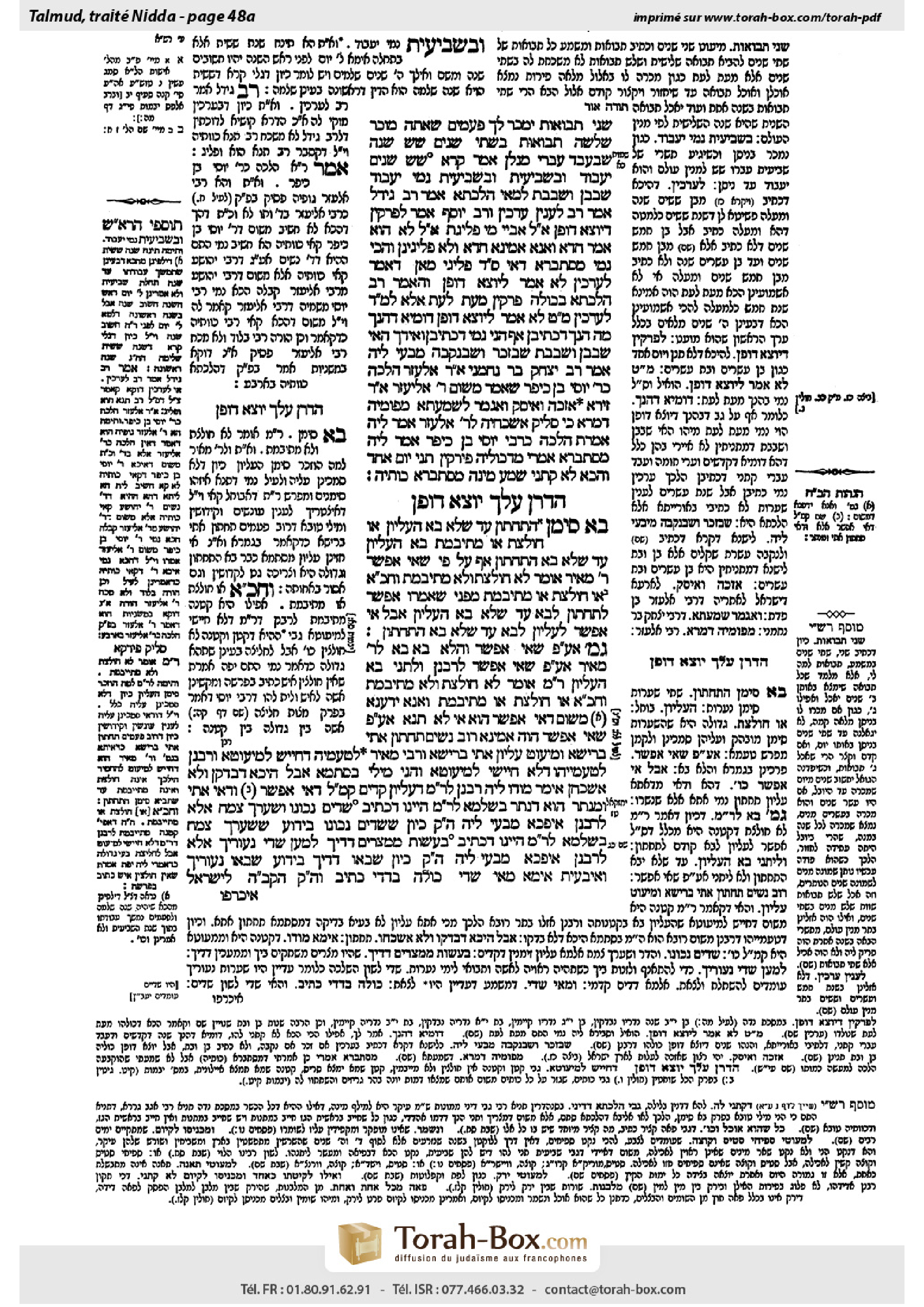
Niddah 48a: Talmud study for Daf Yomi
Daf Yomi is the daily study of one Talmud folio. Explore 37 tractates with scans, Hebrew text, Sefaria English and AI-generated French translations where annotated.
Passage selection and English or AI-generated French translation are available where the scan has annotations. Daf Study is independent of Torah-Box and Sefaria.
Browse Niddah · נידה · All tractatesNiddah 48a text and translations
This page of Niddah includes the Aramaic text, an English translation and an AI-generated French translation, alongside the scan above.
נידה מ״ח א · Aramaic and Hebrew text
שְׁנֵי תְבוּאוֹת יִמְכׇּר לָךְ״ — פְּעָמִים שֶׁאַתָּה מוֹכֵר שָׁלֹשׁה תְּבוּאוֹת בִּשְׁתֵּי שָׁנִים.
שֵׁשׁ שָׁנִים שֶׁבְּעֶבֶד עִבְרִי מְנָלַן? אָמַר קְרָא: ״שֵׁשׁ שָׁנִים יַעֲבוֹד וּבַשְּׁבִיעִת״, וּבִשְׁבִיעִית נָמֵי יַעֲבוֹד.
שֶׁבַּבֵּן וְשֶׁבַּבַּת, לְמַאי הִלְכְתָא? אָמַר רַב גִּידֵּל אָמַר רַב: לְעִנְיַן עֲרָכִין, וְרַב יוֹסֵף אָמַר: לְפִרְקִין דְּ״יוֹצֵא דּוֹפֶן״.
אֲמַר לֵיהּ אַבָּיֵי: מִי פְּלִיגַתְּ? אֲמַר לֵיהּ: לָא, הוּא אָמַר חֲדָא, וַאֲנָא אָמֵינָא חֲדָא, וְלָא פְּלִיגִינַן.
וְהָכִי נָמֵי מִסְתַּבְּרָא, דְּאִי סָלְקָא דַעְתָּךְ פְּלִיגִי, מַאן דְּאָמַר לַעֲרָכִין לָא אָמַר לְיוֹצֵא דּוֹפֶן, וְהָאָמַר רַב: הִלְכְתָא בְּכוּלֵּה פִּרְקִין מֵעֵת לְעֵת!
אֶלָּא, לְמַאן דְּאָמַר לַעֲרָכִין, מַאי טַעְמָא לָא אָמַר לְיוֹצֵא דּוֹפֶן? דּוּמְיָא דְּהָנָךְ: מָה הָנָךְ דִּכְתִיבָן, אַף הָנֵי נָמֵי דִּכְתִיבָן.
וְאִידָּךְ, הַאי ״שֶׁבַּבֵּן וְשֶׁבַּבַּת״ — ״שֶׁבַּזָּכָר וְשֶׁבַּנְּקֵבָה״ מִבְּעֵי לֵיהּ!
אָמַר רַב יִצְחָק בַּר נַחְמָנִי, אָמַר רַבִּי אֶלְעָזָר: הֲלָכָה כְּרַבִּי יוֹסֵי בֶּן כִּיפָּר, שֶׁאָמַר מִשּׁוּם רַבִּי אֱלִיעֶזֶר. אָמַר רַבִּי זֵירָא: אֶזְכֶּה וְאֶיסַּק וְאַגְמַר לִשְׁמַעְתָּא מִפּוּמֵּיהּ דְּמָרַהּ.
כִּי סְלֵיק, אַשְׁכְּחֵיהּ לְרַבִּי אֶלְעָזָר, אֲמַר לֵיהּ: אָמְרַתְּ הֲלָכָה כְּרַבִּי יוֹסֵי בֶּן כִּיפָּר? אֲמַר לֵיהּ: מִסְתַּבְּרָא אֲמַרִי, מִדְּכוּלֵּיהּ פִּירְקִין תָּנֵי ״יוֹם אֶחָד״, וְהָכָא לָא קָתָנֵי — שְׁמַע מִינַּהּ מִסְתַּבְּרָא כְּוָתֵיהּ.
הֲדַרַן עֲלָךְ יוֹצֵא דּוֹפֶן.
מַתְנִי' בָּא סִימָן הַתַּחְתּוֹן עַד שֶׁלֹּא בָּא הָעֶלְיוֹן — אוֹ חוֹלֶצֶת אוֹ מִתְיַבֶּמֶת.
בָּא הָעֶלְיוֹן עַד שֶׁלֹּא בָּא הַתַּחְתּוֹן, אַף עַל פִּי שֶׁאִי אֶפְשָׁר, רַבִּי מֵאִיר אוֹמֵר: לֹא חוֹלֶצֶת וְלֹא מִתְיַבֶּמֶת.
וַחֲכָמִים אוֹמְרִים: אוֹ חוֹלֶצֶת אוֹ מִתְיַבֶּמֶת, מִפְּנֵי שֶׁאָמְרוּ: אֶפְשָׁר לַתַּחְתּוֹן לָבֹא עַד שֶׁלֹּא בָּא הָעֶלְיוֹן, אֲבָל אִי אֶפְשָׁר לָעֶלְיוֹן לָבֹא עַד שֶׁלֹּא בָּא הַתַּחְתּוֹן.
גְּמָ' אַף עַל פִּי שֶׁאִי אֶפְשָׁר. וַהֲלֹא בָּא! ״בָּא״ לְרַבִּי מֵאִיר, ״אַף עַל פִּי שֶׁאִי אֶפְשָׁר״ לְרַבָּנַן.
וְלִתְנֵי: ״בָּא הָעֶלְיוֹן — רַבִּי מֵאִיר אוֹמֵר: לֹא חוֹלֶצֶת וְלֹא מִתְיַבֶּמֶת, וַחֲכָמִים אוֹמְרִים: אוֹ חוֹלֶצֶת אוֹ מִתְיַבֶּמֶת״, וַאֲנָא יָדַעְנָא מִשּׁוּם דְּאִי אֶפְשָׁר הוּא!
אִי לָא תְּנָא ״אַף עַל פִּי שֶׁאִי אֶפְשָׁר״, הֲוָה אָמֵינָא: רוֹב נָשִׁים תַּחְתּוֹן אָתֵי בְּרֵישָׁא, וּמִיעוּט עֶלְיוֹן אָתֵי בְּרֵישָׁא; וְרַבִּי מֵאִיר לְטַעְמֵיהּ דְּחָיֵישׁ לְמִיעוּטָא, וְרַבָּנַן לְטַעְמַיְיהוּ דְּלָא חָיְישִׁי לְמִיעוּטָא.
וְהָנֵי מִילֵּי בִּסְתָמָא, אֲבָל הֵיכָא דְּבַדְקַן וְלָא אַשְׁכְּחַן — אֵימַר מוֹדוּ לֵיהּ רַבָּנַן לְרַבִּי מֵאִיר דְּעֶלְיוֹן קָדֵים.
קָא מַשְׁמַע לַן, דְּאִי אֶפְשָׁר. וַדַּאי אָתֵי, וּמִנְתָּר הוּא דִּנְתַר.
בִּשְׁלָמָא לְרַבִּי מֵאִיר, הַיְינוּ דִּכְתִיב ״שָׁדַיִם נָכוֹנוּ וּשְׂעָרֵךְ צִמֵּחַ״, אֶלָּא לְרַבָּנַן, אִיפְּכָא מִבָּעֵי לֵיהּ! הָכִי קָאָמַר: כֵּיוָן שֶׁ״שָּׁדַיִם נָכוֹנוּ״ — בְּיָדוּעַ שֶׁ״שְּׂעָרֵךְ צִמֵּחַ״.
בִּשְׁלָמָא לְרַבִּי מֵאִיר, הַיְינוּ דִּכְתִיב ״בַּעְשׂוֹת מִמִּצְרַיִם דַּדַּיִךְ לְמַעַן שְׁדֵי נְעוּרָיִךְ״, אֶלָּא לְרַבָּנַן, אִיפְּכָא מִבָּעֵי לֵיהּ!
הָכִי קָאָמַר: כֵּיוָן שֶׁבָּאוּ דַּדַּיִךְ — בְּיָדוּעַ שֶׁבָּאוּ נְעוּרַיִךְ, וְאִיבָּעֵית אֵימָא: מַאי ״שְׁדֵי״? כּוּלֵּהּ בְּדַדֵּי כְּתִיב, וְהָכִי קָאָמַר הַקָּדוֹשׁ בָּרוּךְ הוּא לְיִשְׂרָאֵל:
Niddah 48a · English translation
of years of the crops he shall sell to you” (Leviticus 25:15). The plural form of both “years” and “crops” indicates that the number of years does not necessarily correspond to the quantity of crops. Consequently, sometimes you might sell three yields of crops in two years. If one purchases a field in the summer, when the produce has not yet been harvested, and he harvests that yield and subsequently grows and harvests two more crops before the completion of the whole two years, he will have gained three yields in less than two years.
The Gemara asks: From where do we derive the halakha that the six years stated with regard to a Hebrew slave is calculated by whole years? The Gemara answers that the verse states: “Six years he shall work, and in the seventh he shall go out free for nothing” (Exodus 21:2). The word “and” in the phrase “and in the seventh” indicates that he shall also work in the seventh calendar year, if six full years have not passed since he was sold. For example, if he was sold in the month of Nisan, it means that five years and six months have passed when Tishrei, the first month of the seventh year, arrives; he has not yet completed six years of service, and he must work in this seventh calendar year as well, until the date on which he was sold.
The baraita mentions the years of a son and of a daughter among those calculated as full years. The Gemara asks: With regard to what halakha is this stated? Rav Giddel says that Rav says: With regard to valuations, i.e., the age of a valuated male or female is calculated in whole years from the date of his birth, not by calendar years. And Rav Yosef says: The halakha is stated with regard to the matters taught in our fifth chapter in tractate Nidda, which is named after its opening words: Yotze Dofen, meaning an offspring born by caesarean section. In other words, when a mishna in this chapter mentions years, it means full years, even when it does not state this explicitly.
Abaye said to Rav Yosef: Do you and Rav disagree with regard to this matter? In other words, as you interpreted the mention of a son and a daughter differently, does each of you reject the halakhic application of the other? Rav Yosef said to Abaye: No, he said one matter, and I said one different matter, but we do not disagree.
The Gemara notes: And this, too, stands to reason, as if it enters your mind that they disagree with regard to this matter, then the one who said full years are required for determining valuations does not say that full years are necessary for the halakhot of this chapter, Yotze Dofen. But doesn’t Rav say, like Rav Yosef, that the halakha in this entire chapter with regard to all of the places where an age is mentioned in years is that even when the phrase: And one day, is not explicitly noted, they are all calculated from the time of year of birth until that same time of year in the age specified, not by calendar years?
The Gemara asks: But if that is correct, then according to Rav, who is the one who said that full years are required for determining valuations, what is the reason that he does not say in his interpretation of the baraita that full years are required for the halakhot of Yotze Dofen? The Gemara answers: Rav maintains that the years of a son and of a daughter mentioned in the baraita are similar to those other cases mentioned in the baraita: Just as those numbers of years are written in the Torah, so too these years of a son and of a daughter are referring to matters where the years are written in the Torah, i.e., the years of valuations, unlike the topics discussed in Yotze Dofen, where the years are not mentioned explicitly in the Torah.
The Gemara asks: And how would the other amora, Rav Yosef, respond to this contention? The Gemara answers: He would maintain that if the baraita were referring to the years of valuations, which are written in the Torah, then this expression in the baraita: Of a son and of a daughter, is unsuitable. Rather, the baraita should have stated: Of the male and of the female, which are the terms the Torah uses with regard to valuations, whereas the terms: Son and daughter, are used in Yotze Dofen.
§ Rav Yitzḥak bar Naḥmani says that Rabbi Elazar says: The halakha is in accordance with the opinion of Rabbi Yosei ben Keifar, who said his ruling in the name of Rabbi Eliezer, that a man nineteen years and thirty days of age who has not developed signs of puberty is deemed a sexually underdeveloped man. In this regard, the Gemara relates that Rabbi Zeira said: May it be God’s will that I merit to ascend to Eretz Yisrael, and that I learn this halakha from the mouth of its Master, Rabbi Elazar.
The Gemara recounts that when Rabbi Zeira eventually ascended to Eretz Yisrael he indeed found Rabbi Elazar and said to him: Did you say that the halakha is in accordance with the opinion of Rabbi Yosei ben Keifar? Rabbi Elazar said to him: I said that it stands to reason that the halakha is in accordance with his opinion. He elaborated: From the fact that throughout the entire chapter the Mishna teaches: And one day, but here, in the last mishna, it does not teach this phrase, one can conclude from it that it stands to reason that there is a reason for this discrepancy, in accordance with the opinion of Rabbi Yosei ben Keifar.
MISHNA: If the lower sign of puberty, two pubic hairs, appeared in a young woman before the upper sign, development of the breasts, appeared, then she is an adult, as the pubic hairs are an unequivocal sign. Therefore, if her childless husband died and she came before her husband’s brother [yavam] for levirate marriage, she either performs the ritual through which a yavam frees a yevama of her levirate bonds [ḥalitza] or enters into levirate marriage with her husband’s brother.
If the upper sign indicating puberty appeared before the lower sign appeared, i.e., the two pubic hairs are not visible, although that order of development is apparently impossible, Rabbi Meir says: In fact, it is possible for the breasts to develop before the growth of two pubic hairs, and the concern is that the two hairs did not grow and fall out but rather they never grew in the first place, which would mean that she remains a minor. Therefore, if her childless husband dies, she neither performs ḥalitza nor does she enter into levirate marriage with her husband’s brother.
And the Rabbis say: She has reached majority, and therefore if her childless husband dies she either performs ḥalitza or enters into levirate marriage with her husband’s brother. That is due to the fact that the Sages said: It is possible for the lower sign of puberty to appear before the upper sign appears; but it is impossible for the upper sign to appear before the lower sign appears.
GEMARA: The mishna teaches that Rabbi Meir and the Rabbis disagree with regard to the halakha when the upper sign of puberty appears before the lower sign. The mishna stated about that case: Although that order of development is impossible. The Gemara raises a difficulty: But the mishna explicitly states that it is referring to a situation where the upper sign did appear before the lower one. The Gemara explains: When the mishna states that it did appear, that is according to the opinion of Rabbi Meir, who maintains that such an occurrence is possible, whereas when the mishna teaches: Although that order of development is impossible, it is referring to the opinion of the Rabbis, who contend that it is not possible.
The Gemara objects: But why is it necessary at all to mention the phrase: Although that order of development is impossible. Instead, let the mishna simply teach: If the upper sign of puberty appeared, Rabbi Meir says: She neither performs ḥalitza nor does she enter into levirate marriage with her husband’s brother; and the Rabbis say: She either performs ḥalitza or enters into levirate marriage with her husband’s brother. And I would know that the ruling of the Rabbis is due to the fact that it is impossible for the upper sign of puberty to appear before the lower sign.
The Gemara explains: If the mishna had not taught: Although that order of development is impossible, I would say that with regard to most women the lower sign appears first, before the upper sign; but in a minority of women, the upper sign appears first. And Rabbi Meir, who rules that she is a minor who may not perform either ḥalitza or enter into levirate marriage, conforms to his standard line of reasoning, that one must be concerned for the minority. In other words, Rabbi Meir takes into account the minority of women in whom the upper sign appears first, and therefore he considers her to be a minor. And the Rabbis likewise conform to their standard line of reasoning that one need not be concerned for the minority, and therefore they consider the young woman to have reached majority.
And this statement, that one can rely on the assumption that if a woman has the upper sign then she certainly has the lower sign, while the minority of cases are not taken into account, applies only in an ordinary case, where the woman was not examined to determine if she had the lower sign. But in a case where we examined her and did not find the lower sign, one might say that the Rabbis concede to Rabbi Meir that the upper sign appeared before the lower sign, and therefore she neither performs ḥalitza nor enters into levirate marriage with her husband’s brother.
Therefore, the mishna teaches us that according to the Rabbis it is impossible for the upper sign to precede the lower sign, which means that even if she was examined and no lower sign was found, the assumption is that the two hairs of the lower sign had certainly appeared, but later they fell out.
The Gemara raises a difficulty: Granted, according to the opinion of Rabbi Meir, who holds that it is possible for the upper sign to precede the lower, that accounts for that verse which is written with regard to a maturing young woman: “And you increased and grew up, and you came to excellent beauty; your breasts were fashioned, and your hair was grown” (Ezekiel 16:7). This verse mentions the upper sign before the lower sign. But according to the opinion of the Rabbis, the verse should have said the reverse, first stating “your hair has grown,” and then stating “your breasts were fashioned.” The Gemara answers that this is what the verse is saying: Since your breasts were fashioned, it is known that your hair was already grown.
The Gemara raises a further difficulty: Granted, according to the opinion of Rabbi Meir, this accounts for that which is written: “When they from Egypt bruised your breasts for the sprouting forth of your young womanhood” (Ezekiel 23:21). This verse, which compares the Jewish people to a promiscuous girl, describes how, in her childhood, Egyptian men would play with her by pressing her breasts in order to engage in licentious sexual intercourse with her when she became a young woman, i.e., once the pubic hairs that indicate puberty developed. This indicates that it is possible for the upper sign to appear before the lower sign. But according to the opinion of the Rabbis, the verse should have said the reverse.
The Gemara similarly answers that this is what the verse is saying: Since your breasts appeared, it is known that the pubic hairs, which are the sign of your young womanhood, have already appeared. Or if you wish, say instead: What is the meaning of the phrase: The sprouting forth of [shedei] your young womanhood? It is not speaking of the lower sign, but rather of the upper sign, i.e., the entire verse is written in reference to the breasts, shadayim in Hebrew. And this is what the Holy One, Blessed be He, is saying to the Jewish people:
Niddah 48a · Traduction française (IA)
« des années des récoltes, il te le vendra » (Lévitique 25:15). Le pluriel des termes « années » et « récoltes » indique que le nombre d’années ne correspond pas nécessairement à la quantité de récoltes. Il peut donc arriver que l’on récolte trois fois en deux ans. Si quelqu’un achète un champ en été, alors que la récolte n’a pas encore été moissonnée, qu’il la moissonne, puis cultive et moissonne deux autres récoltes avant que deux années entières ne se soient écoulées, il aura récolté trois fois en moins de deux ans.
La Guemara demande : D’où déduisons-nous la halakha selon laquelle les six années mentionnées à propos d’un esclave hébreu se comptent en années complètes ? La Guemara répond que le verset dit : « Il servira six ans, et la septième année, il sortira libre, sans rien payer » (Exode 21:2). Le « et » dans l’expression « et la septième année » indique qu’il servira également pendant la septième année civile si six années complètes ne se sont pas écoulées depuis sa vente. Par exemple, s’il a été vendu au mois de Nissan, cinq ans et six mois se seront écoulés à l’arrivée de Tichri, le premier mois de la septième année ; il n’aura pas encore achevé six années de service et devra donc travailler pendant cette septième année civile jusqu’à la date anniversaire de sa vente.
La baraïta mentionne les années d’un fils et d’une fille parmi celles qui se comptent en années complètes. La Guemara demande : À propos de quelle halakha cela est-il énoncé ? Rav Giddel dit au nom de Rav : à propos des évaluations, c’est-à-dire que l’âge d’un homme ou d’une femme faisant l’objet d’une évaluation se compte en années complètes à partir de sa naissance, et non selon les années civiles. Rav Yossef dit que cette halakha concerne les sujets enseignés dans notre cinquième chapitre du traité Niddah, intitulé d’après ses premiers mots : Yotze Dofen, c’est-à-dire un enfant né par césarienne. Autrement dit, lorsqu’une Michna de ce chapitre mentionne des années, elle désigne des années complètes, même si cela n’est pas précisé explicitement.
Abayé dit à Rav Yossef : Toi et Rav êtes-vous en désaccord sur cette question ? Autrement dit, puisque vous interprétez différemment la mention d’un fils et d’une fille, chacun de vous rejette-t-il l’application halakhique proposée par l’autre ? Rav Yossef lui répond : Non, il a dit une chose et moi, une autre, mais nous ne sommes pas en désaccord.
La Guemara fait remarquer : Cela aussi est logique, car si tu penses qu’ils sont en désaccord sur cette question, alors celui qui dit que les années complètes sont requises pour les évaluations ne dit pas que des années complètes sont nécessaires pour les halakhot de ce chapitre, Yotze Dofen. Pourtant, Rav ne dit-il pas, comme Rav Yossef, que dans tout ce chapitre, pour tous les cas où un âge est exprimé en années, même si l’expression « et un jour » n’est pas mentionnée explicitement, le calcul se fait depuis la période de l’année où l’enfant est né jusqu’à cette même période de l’année correspondant à l’âge indiqué, et non selon les années civiles ?
La Guemara demande : Mais si c’est exact, selon Rav, qui est celui qui a dit que des années complètes sont requises pour les évaluations, pourquoi ne dit-il pas, dans son interprétation de la baraïta, que des années complètes sont requises pour les halakhot de Yotze Dofen ? La Guemara répond : Rav estime que les années d’un fils et d’une fille mentionnées dans la baraïta sont semblables aux autres cas qui y sont mentionnés : de même que, dans ces autres cas, le nombre d’années est écrit dans la Torah, de même, les années d’un fils et d’une fille renvoient ici à des situations où les années sont écrites dans la Torah, c’est-à-dire aux années des évaluations, contrairement aux sujets abordés dans Yotze Dofen, où les années ne sont pas mentionnées explicitement dans la Torah.
La Guemara demande : Et comment l’autre amora, Rav Yossef, répondrait-il à cette objection ? La Guemara répond : Il soutiendrait que si la baraïta faisait référence aux années des évaluations, qui sont mentionnées dans la Torah, l’expression « d’un fils et d’une fille » qu’elle emploie serait inappropriée. Elle aurait plutôt dû dire « du mâle et de la femelle », termes que la Torah utilise à propos des évaluations, tandis que les termes « fils et fille » sont employés dans Yotze Dofen.
§ Rav Yitzḥak bar Naḥmani dit au nom de Rabbi Elazar : La halakha est conforme à l’opinion de Rabbi Yosei ben Keifar, qui a énoncé sa décision au nom de Rabbi Eliezer : un homme âgé de dix-neuf ans et trente jours qui n’a pas développé de signes de puberté est considéré comme un homme sexuellement sous-développé. À ce propos, Rabbi Zeira dit : Puisse-t-il être dans la volonté de Dieu que je mérite de monter en Eretz Yisrael et d’apprendre cette halakha de la bouche de son maître, Rabbi Elazar.
La Guemara rapporte que, lorsque Rabbi Zeira monta finalement en Eretz Yisrael, il trouva effectivement Rabbi Elazar et lui demanda : As-tu dit que la halakha est conforme à l’opinion de Rabbi Yosei ben Keifar ? Rabbi Elazar lui répondit : J’ai dit qu’il semble logique que la halakha soit conforme à son opinion. Il précisa : Puisque, tout au long du chapitre, la Michna enseigne « et un jour », mais que, dans la dernière Michna, elle ne reprend pas cette expression, on peut en conclure qu’il semble logique que cette différence ait une raison, conformément à l’opinion de Rabbi Yosei ben Keifar.
MICHNA : Si le signe inférieur de puberté, les deux poils pubiens, est apparu chez une jeune femme avant le signe supérieur, le développement des seins, elle est alors adulte, car les poils pubiens constituent un signe sans équivoque. Par conséquent, si son mari meurt sans enfant et qu’elle se présente devant le frère de son mari [yavam] en vue du mariage léviratique, elle accomplit soit le rituel par lequel un yavam libère une yevama de son lien léviratique [ḥalitza], soit elle contracte un mariage léviratique avec le frère de son mari.
Si le signe supérieur de puberté est apparu avant le signe inférieur, c’est-à-dire que les deux poils pubiens ne sont pas visibles, bien que cet ordre de développement soit apparemment impossible, Rabbi Meir dit : Il est en réalité possible que les seins se développent avant la pousse des deux poils pubiens. On craint que les deux poils n’aient pas poussé puis ne soient tombés, mais qu’ils n’aient jamais poussé, ce qui signifierait qu’elle reste mineure. Par conséquent, si son mari meurt sans enfant, elle ne pratique pas la ḥalitza et ne contracte pas de mariage léviratique avec le frère de son mari.
Et les Sages disent : Elle a atteint la majorité ; par conséquent, si son mari meurt sans enfant, elle pratique soit la ḥalitza, soit contracte un mariage léviratique avec le frère de son mari. En effet, les Sages enseignent qu’il est possible que le signe inférieur de puberté apparaisse avant le signe supérieur, mais qu’il est impossible que le signe supérieur apparaisse avant le signe inférieur.
GUEMARA : La Michna enseigne que Rabbi Meir et les Sages sont en désaccord sur la halakha lorsque le signe supérieur de puberté apparaît avant le signe inférieur. À propos de ce cas, la Michna a déclaré : « bien que cet ordre de développement soit impossible ». La Guemara soulève une difficulté : mais la Michna dit explicitement qu’elle se réfère à une situation où le signe supérieur est apparu avant le signe inférieur. La Guemara explique : lorsqu’elle dit qu’il est apparu, cela correspond à l’opinion de Rabbi Meir, qui estime qu’un tel événement est possible ; tandis que lorsqu’elle enseigne « bien que cet ordre de développement soit impossible », elle se réfère à l’opinion des Sages, qui soutiennent que cela est impossible.
La Guemara objecte : Mais pourquoi est-il nécessaire de mentionner l’expression « bien que cet ordre de développement soit impossible » ? La Michna pourrait simplement enseigner : Si le signe supérieur de puberté est apparu, Rabbi Meir dit qu’elle ne pratique pas la ḥalitza et ne contracte pas de mariage léviratique avec le frère de son mari ; et les Sages disent qu’elle pratique soit la ḥalitza, soit contracte un mariage léviratique avec le frère de son mari. On comprendrait alors que la décision des Sages repose sur le fait qu’il est impossible que le signe supérieur de puberté apparaisse avant le signe inférieur.
La Guemara explique : Si la Michna n’avait pas enseigné « bien que cet ordre de développement soit impossible », j’aurais dit que, chez la plupart des femmes, le signe inférieur apparaît en premier, avant le signe supérieur, mais que, chez une minorité d’entre elles, le signe supérieur apparaît en premier. Rabbi Meir, qui statue qu’elle est mineure et ne peut ni pratiquer la ḥalitza ni contracter de mariage léviratique, suit sa position habituelle, selon laquelle il faut tenir compte de la minorité. Autrement dit, Rabbi Meir prend en considération la minorité de femmes chez lesquelles le signe supérieur apparaît en premier et la considère donc comme mineure. Les Sages suivent eux aussi leur position habituelle, selon laquelle il n’est pas nécessaire de tenir compte de la minorité ; ils considèrent donc que la jeune femme a atteint la majorité.
Cette déclaration, selon laquelle on peut se fier à l’hypothèse que si une femme présente le signe supérieur, elle présente certainement le signe inférieur, sans tenir compte des cas minoritaires, ne s’applique qu’à un cas ordinaire, où la femme n’a pas été examinée afin de déterminer si elle présentait le signe inférieur. Mais si elle a été examinée et que le signe inférieur n’a pas été trouvé, on pourrait dire que les Sages concèdent à Rabbi Meir que le signe supérieur est apparu avant le signe inférieur ; elle ne pratique donc pas la ḥalitza et ne contracte pas de mariage léviratique avec le frère de son mari.
La Michna nous enseigne donc que, selon les Sages, il est impossible que le signe supérieur précède le signe inférieur. Cela signifie que même si elle a été examinée et qu’aucun signe inférieur n’a été trouvé, on présume que les deux poils constituant le signe inférieur sont bien apparus, puis sont tombés.
La Guemara soulève une difficulté : certes, selon l’opinion de Rabbi Meir, qui considère qu’il est possible que le signe supérieur précède le signe inférieur, cela explique le verset écrit à propos d’une jeune fille qui grandit : « Tu as grandi et tu es devenue grande, tu es parvenue à une beauté remarquable ; tes seins se sont formés et tes poils ont poussé » (Ézéchiel 16:7). Ce verset mentionne le signe supérieur avant le signe inférieur. Mais selon l’opinion des Sages, le verset aurait dû dire l’inverse, mentionner d’abord « tes poils ont poussé », puis « tes seins se sont formés ». La Guemara répond que voici ce que dit le verset : puisque tes seins se sont formés, on sait que tes poils avaient déjà poussé.
La Guemara soulève une autre difficulté : certes, selon l’opinion de Rabbi Meir, cela explique ce qui est écrit : « lorsque ceux d’Égypte ont meurtri tes seins, au début de ta jeune féminité » (Ézéchiel 23:21). Ce verset, qui compare le peuple juif à une fille débauchée, décrit comment, pendant son enfance, les hommes d’Égypte jouaient avec elle en lui pressant les seins afin d’avoir avec elle des rapports sexuels licencieux lorsqu’elle deviendrait une jeune femme, c’est-à-dire une fois que les poils pubiens indiquant la puberté auraient poussé. Cela indique qu’il est possible que le signe supérieur apparaisse avant le signe inférieur. Mais selon l’opinion des Sages, le verset aurait dû dire l’inverse.
La Guemara répond de même que voici ce que dit le verset : puisque tes seins sont apparus, on sait que les poils pubiens, qui sont le signe de ta jeune féminité, sont déjà apparus. Ou bien, si tu préfères, on peut dire : quel est le sens de l’expression « l’épanouissement de [shedei] ta jeune féminité » ? Elle ne parle pas du signe inférieur, mais plutôt du signe supérieur, c’est-à-dire que tout le verset se réfère aux seins, shadayim en hébreu. Et voici ce que le Saint, béni soit-Il, dit au peuple juif :
Traduction française générée par IA à partir de l’édition anglaise de Sefaria. Vérifie toujours un passage avec le texte source.
Text from Sefaria: William Davidson Edition - Vocalized Aramaic (CC BY NC); William Davidson Edition - English (CC BY NC).