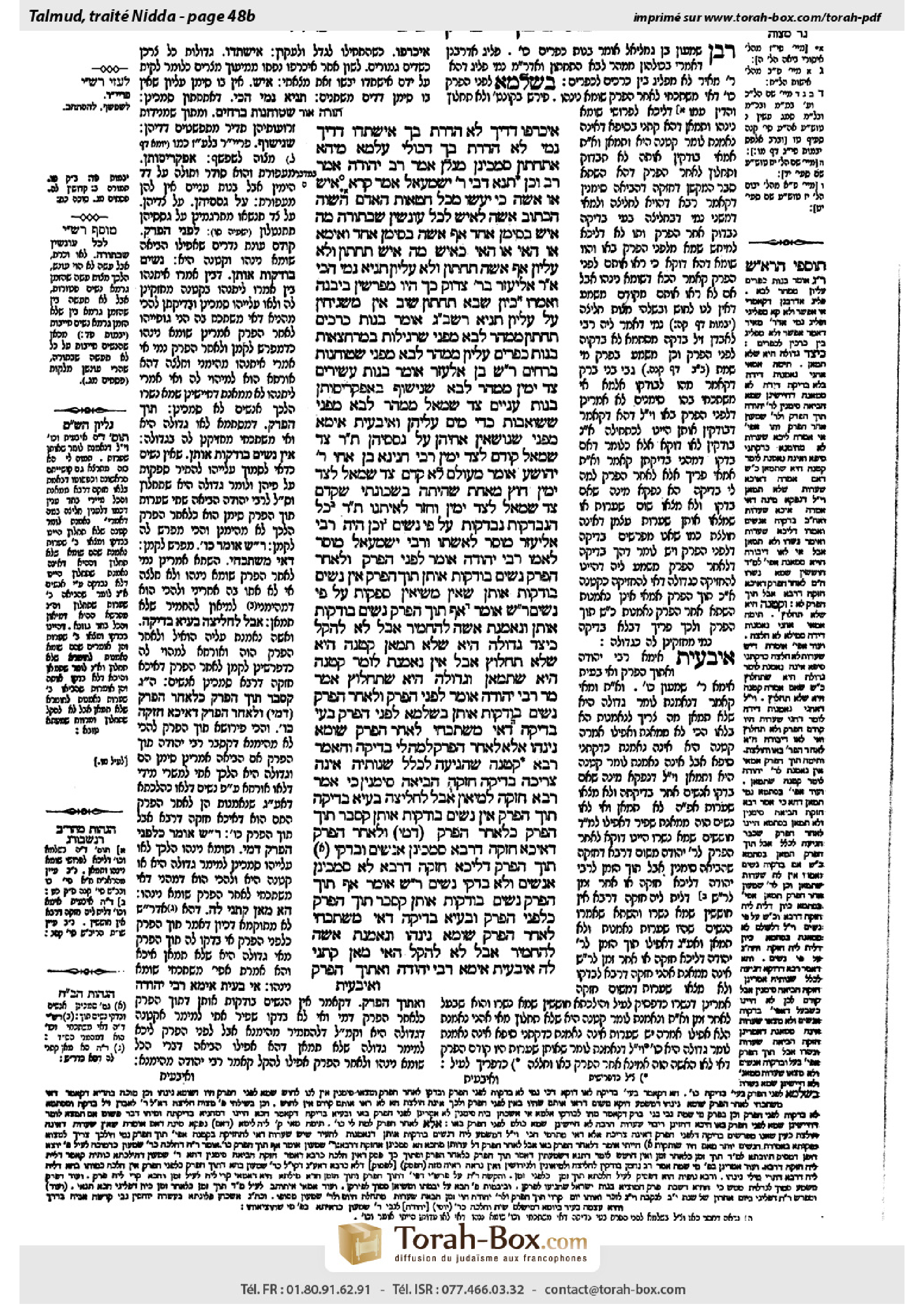
Niddah 48b: Talmud study for Daf Yomi
Daf Yomi is the daily study of one Talmud folio. Explore 37 tractates with scans, Hebrew text, Sefaria English and AI-generated French translations where annotated.
Passage selection and English or AI-generated French translation are available where the scan has annotations. Daf Study is independent of Torah-Box and Sefaria.
Browse Niddah · נידה · All tractatesNiddah 48b text and translations
This page of Niddah includes the Aramaic text, an English translation and an AI-generated French translation, alongside the scan above.
נידה מ״ח ב · Aramaic and Hebrew text
אִיכְּרַפוּ דַּדַּיִךְ — לָא הֲדַרְתְּ בָּךְ, אִישְׁתְּדוֹ דַּדַּיִךְ — נָמֵי לָא הֲדַרְתְּ בָּךְ.
דְּכוּלֵּי עָלְמָא מִיהָא אַתַּחְתּוֹן סָמְכִינַן, מְנָלַן? אָמַר רַב יְהוּדָה אָמַר רַב, וְכֵן תָּנָא דְּבֵי רַבִּי יִשְׁמָעֵאל: אָמַר קְרָא ״אִישׁ אוֹ אִשָּׁה כִּי יַעֲשׂוּ מִכׇּל חַטֹּאת הָאָדָם״, הִשְׁוָה הַכָּתוּב אִשָּׁה לְאִישׁ לְכׇל עֳונָשִׁין שֶׁבַּתּוֹרָה. מָה אִישׁ בְּסִימָן אֶחָד, אַף אִשָּׁה בְּסִימָן אֶחָד.
וְאֵימָא: אוֹ הַאי אוֹ הַאי! כְּאִישׁ — מָה אִישׁ תַּחְתּוֹן וְלֹא עֶלְיוֹן, אַף אִשָּׁה תַּחְתּוֹן וְלֹא עֶלְיוֹן.
תַּנְיָא נָמֵי הָכִי: אָמַר רַבִּי אֱלִיעֶזֶר בְּרַבִּי צָדוֹק, כָּךְ הָיוּ מְפָרְשִׁין בְּיַבְנֶה, וְאָמְרוּ: כֵּיוָן שֶׁבָּא תַּחְתּוֹן — שׁוּב אֵין מַשְׁגִּיחִין עַל עֶלְיוֹן.
תַּנְיָא, רַבָּן שִׁמְעוֹן בֶּן גַּמְלִיאֵל אוֹמֵר: בְּנוֹת כְּרַכִּים — תַּחְתּוֹן מְמַהֵר לָבֹא, מִפְּנֵי שֶׁרְגִילוֹת בְּמֶרְחֲצָאוֹת; בְּנוֹת כְּפָרִים — עֶלְיוֹן מְמַהֵר לָבֹא, מִפְּנֵי שֶׁטּוֹחֲנוֹת בְּרֵחַיִם.
רַבִּי שִׁמְעוֹן בֶּן אֶלְעָזָר אוֹמֵר: בְּנוֹת עֲשִׁירִים — צַד יָמִין מְמַהֵר לָבֹא, שֶׁנִּישּׁוֹף בְּאֶפִּקְרִיסוּתָן. בָּנוֹת עֲנִיִּים — צַד שְׂמֹאל מְמַהֵר לָבֹא, מִפְּנֵי שֶׁשּׁוֹאֲבוֹת כַּדֵּי מַיִם עֲלֵיהֶן. וְאִיבָּעֵית אֵימָא: מִפְּנֵי שֶׁנּוֹשְׂאִין אֲחֵיהֶן עַל גִּסְסֵיהֶן.
תָּנוּ רַבָּנַן: צַד שְׂמֹאל קוֹדֵם לְצַד יָמִין. רַבִּי חֲנִינָא בֶּן אֲחִי רַבִּי יְהוֹשֻׁעַ אוֹמֵר: מֵעוֹלָם לֹא קָדַם צַד שְׂמֹאל לְצַד יָמִין, חוּץ מֵאַחַת שֶׁהָיְתָה בִּשְׁכוּנָתִי, שֶׁקָּדַם צַד שְׂמֹאל לְצַד יָמִין, וְחָזַר לְאֵיתָנוֹ.
תָּנוּ רַבָּנַן: כׇּל הַנִּבְדָּקוֹת נִבְדָּקוֹת עַל פִּי נָשִׁים, וְכֵן הָיָה רַבִּי אֱלִיעֶזֶר מוֹסֵר לְאִשְׁתּוֹ, וְרַבִּי יִשְׁמָעֵאל מוֹסֵר לְאִמּוֹ.
רַבִּי יְהוּדָה אוֹמֵר: לִפְנֵי הַפֶּרֶק וּלְאַחַר הַפֶּרֶק — נָשִׁים בּוֹדְקוֹת אוֹתָן, תּוֹךְ הַפֶּרֶק — אֵין נָשִׁים בּוֹדְקוֹת אוֹתָן, שֶׁאֵין מַשִּׂיאִין סְפֵקוֹת עַל פִּי נָשִׁים. רַבִּי שִׁמְעוֹן אוֹמֵר: אַף תּוֹךְ הַפֶּרֶק נָשִׁים בּוֹדְקוֹת אוֹתָן, וְנֶאֱמֶנֶת אִשָּׁה לְהַחְמִיר אֲבָל לֹא לְהָקֵל.
כֵּיצַד? ״גְּדוֹלָה הִיא״ — שֶׁלֹּא תְּמָאֵן, ״קְטַנָּה הִיא״ — שֶׁלֹּא תַּחְלוֹץ.
אֲבָל אֵין נֶאֱמֶנֶת לוֹמַר ״קְטַנָּה הִיא״ שֶׁתְּמָאֵן, וּ״גְדוֹלָה הִיא״ שֶׁתַּחְלוֹץ.
אָמַר מָר: רַבִּי יְהוּדָה אוֹמֵר: לִפְנֵי הַפֶּרֶק וּלְאַחַר הַפֶּרֶק נָשִׁים בּוֹדְקוֹת אוֹתָן. בִּשְׁלָמָא לִפְנֵי הַפֶּרֶק בָּעֵי בְּדִיקָה, דְּאִי מִשְׁתַּכְחִי לְאַחַר הַפֶּרֶק — שׁוּמָא נִינְהוּ.
אֶלָּא לְאַחַר הַפֶּרֶק, לְמָה לִי בְּדִיקָה? וְהָאָמַר רָבָא: קְטַנָּה שֶׁהִגִּיעָה לִכְלַל שְׁנוֹתֶיהָ אֵינָהּ צְרִיכָה בְּדִיקָה, חֲזָקָה הֵבִיאָה סִימָנִין! כִּי אָמַר רָבָא חֲזָקָה לְמֵיאוּן, אֲבָל לַחֲלִיצָה בָּעֲיָא בְּדִיקָה.
תּוֹךְ הַפֶּרֶק — אֵין נָשִׁים בּוֹדְקוֹת אוֹתָן, קָסָבַר: תּוֹךְ הַפֶּרֶק כִּלְאַחַר הַפֶּרֶק (דָּמֵי).
וּלְאַחַר הַפֶּרֶק, דְּאִיכָּא חֲזָקָה דְּרָבָא — סָמְכִינַן אַנָּשִׁים וּבָדְקִי. תּוֹךְ הַפֶּרֶק, דְּלֵיכָּא חֲזָקָה דְּרָבָא — לָא סָמְכִינַן אַנָּשִׁים וְלָא בָּדְקִי נָשִׁים.
רַבִּי שִׁמְעוֹן אוֹמֵר: אַף תּוֹךְ הַפֶּרֶק, נָשִׁים בּוֹדְקוֹת אוֹתָן. קָסָבַר: תּוֹךְ הַפֶּרֶק כְּלִפְנֵי הַפֶּרֶק, וּבָעֲיָא בְּדִיקָה, דְּאִי מִשְׁתַּכְחִי לְאַחַר הַפֶּרֶק — שׁוּמָא נִינְהוּ.
וְנֶאֱמֶנֶת אִשָּׁה לְהַחְמִיר, אֲבָל לֹא לְהָקֵל. הַאי מַאן קָתָנֵי לַהּ? אִיבָּעֵית אֵימָא: רַבִּי יְהוּדָה, וְאַתּוֹךְ הַפֶּרֶק.
Niddah 48b · English translation
Although your breasts began to develop, you still did not reform your ways, and you continued to act licentiously. And furthermore, even when your breasts grew fully, you also did not reform your ways.
§ The Gemara asks: In any event, everyone, both Rabbi Meir and the Rabbis, agrees that we rely on the lower sign. From where do we derive that we rely exclusively on the lower sign and do not require the appearance of the upper sign as well? Rav Yehuda said that Rav said, and likewise a Sage of the school of Rabbi Yishmael taught: The verse states: “A man or woman, when they commit any of the sins of men” (Numbers 5:6). The Torah thereby rendered a woman equal to a man with regard to all punishments of the Torah. Just as a man is considered to have reached majority based on one sign, i.e., the lower sign of two pubic hairs, so too, a woman reaches majority based on one sign, the lower sign.
The Gemara raises a difficulty: But one can say that although a woman’s status, like that of a man, depends on one sign, in the case of a woman she reaches majority either through this, the lower sign, or that, the upper sign. From where is it derived that it must be specifically the lower sign? The Gemara answers: This is based on the same comparison of men and women. Her halakha is like that of a man: Just as a man reaches majority based on the lower sign and not the upper sign, as this is not applicable to him, so too, a woman reaches majority based on the lower sign and not the upper sign.
The Gemara notes that this halakha, that the lower sign is sufficient by itself for a woman, is also taught in a baraita. Rabbi Eliezer, son of Rabbi Tzadok, said: This is how the Sages would explain it in the study hall of Yavne. They said: Once the lower sign has appeared, we no longer concern ourselves with the appearance of the upper sign in order to establish a woman’s status, as she is considered to have reached her majority by virtue of the lower sign.
§ It is taught in a baraita, with regard to the appearance of signs indicating puberty in young women, that Rabban Shimon ben Gamliel says: In the case of young women who reside in cities, the lower sign appears more quickly than the upper sign, because they frequent the bathhouses, which stimulates the growth of the hair. By contrast, in the case of young women who reside in villages, the upper sign appears more quickly than the lower sign, because they grind with mills, which develops their breasts.
Rabbi Shimon ben Elazar says: There are differences in the rate of development of the breasts. In the case of the daughters of the wealthy, the growth of the breast on the right side arrives more quickly than that of the left side, as it rubs against their upper body cloaks, which are worn by the wealthy. By contrast, in the case of the daughters of the poor, the growth of the breast on the left side arrives more quickly than that of the right side, because they draw jugs of water on that side. And if you wish, say instead that the left breast develops more quickly because they carry their younger brothers on their left sides.
The Sages taught in a baraita: The growth of the breast on the left side arrives before that of the right side. Rabbi Ḥanina, son of the brother of Rabbi Yehoshua, says: It never occurred that the growth of the breast on the left side arrived before that of the right side, except for the case of one young woman who was in my neighborhood, as the growth of the breast on her left side arrived before that of the right side, and later the right breast returned to its normal condition and developed normally.
§ The Sages taught in a baraita: All girls who are examined to determine whether or not their signs indicating puberty have appeared are examined based on the testimony of women. And likewise, Rabbi Eliezer would follow this halakha in practice and give the girls to his wife to examine, and Rabbi Yishmael would similarly give the girls to his mother to examine.
The baraita continues: Rabbi Yehuda says: Before the minimum age at which pubic hair is considered a sign, i.e., eleven years and one day, when any hair that is found is considered to be merely a mole and not a sign, and similarly after the age of majority, twelve years and one day, when a female is presumed to have grown pubic hair like most girls her age, women may examine them and their testimony is accepted. But during the time between eleven years and one day and twelve years and one day, women may not examine them. The reason is that one does not resolve cases of uncertainty based on the testimony of women. Rabbi Shimon says: Even during the time between eleven years and one day and twelve years and one day, women may examine them. And a woman is deemed credible, and her testimony is accepted, to be stringent but not to be lenient.
The baraita continues: How so, i.e., how is a woman’s testimony accepted with regard to the girl she has examined as a stringency but not a leniency? If the woman said that the girl is a female who reached majority, her claim is accepted to the extent that she does not perform refusal. The refusal of a husband, which applies in the case of a girl whose father had died and who was married off by her mother or brother, can be performed by the girl only until she reaches majority. If the woman said that this girl is a minor, her testimony is accepted to the extent that she does not perform ḥalitza.
The baraita concludes: But the woman who examined the girl is not deemed credible to say that she is a minor girl to the extent that she performs refusal. And likewise, the woman is not deemed credible to say that she is a female who reached majority to the extent that she performs ḥalitza.
The Gemara analyzes the baraita. The Master said that Rabbi Yehuda says: Before the minimum age at which pubic hair is considered a sign, and similarly after the age of majority, women may examine them. The Gemara raises a difficulty: Granted, one can understand that before the minimum age there is a requirement for examination, so that if they find hair after the minimum age which they already saw before the minimum age, these hairs are evidently a mere mole, not a sign of maturity.
But why do I need a girl to undergo an examination after the age of majority? Didn’t Rava say: A minor girl who reached her full years, i.e., her age of majority, twelve years and one day, does not require an examination, as there is a presumption that she has developed signs indicating puberty? The Gemara explains: When Rava said that one relies on this presumption, he was referring specifically to her inability from now on to perform refusal. But with regard to ḥalitza, she requires an examination to determine that she has reached maturity.
The baraita stated that according to Rabbi Yehuda, women are deemed credible to examine girls who are either younger than eleven years and one day or older than twelve years and one day. But during the time between eleven years and one day and twelve years and one day, women may not examine them. The Gemara explains that Rabbi Yehuda holds that the period during this time is considered like after the age of majority. In other words, the signs indicating puberty that a girl develops during this time are considered to be full-fledged signs, which means that she has reached majority even before the age of twelve and one day. Accordingly, the testimony of women is not accepted for this period, as her change of status enables her to perform ḥalitza with her husband’s brother.
But after the minimum age of twelve years and one day, when there is the presumption of Rava that a girl has already developed signs indicating puberty, one may rely on women and have them examine the girl. During this age, between eleven and twelve, when there is no presumption of Rava that she has already developed signs indicating puberty, one may not rely on women, and therefore women may not examine the girl.
By contrast, Rabbi Shimon says that even during this age, between eleven years and one day and twelve years and one day, women may examine girls to determine if they have grown pubic hair. This is because Rabbi Shimon holds that the period during this age is considered like before the minimum age, which means that the girl is a minor based on her age, regardless of the results of the examination. And the only reason she requires an examination is that if they find hair after the minimum age, which they had already seen before the minimum age, these hairs are deemed a mere mole, not a sign of maturity.
The baraita further teaches: And a woman is deemed credible to testify to be stringent with regard to the girl who she examined but not to be lenient. The Gemara asks: Who taught this halakha? The Gemara answers: If you wish, say that it is in accordance with the opinion of Rabbi Yehuda, and it is referring to during the age between eleven years and one day and twelve and one day.
Niddah 48b · Traduction française (IA)
Bien que tes seins aient commencé à se développer, tu n’as toujours pas amendé ta conduite et tu as continué à agir de manière licencieuse. De plus, même lorsque tes seins se sont pleinement développés, tu n’as pas davantage amendé ta conduite.
§ La Guemara demande : Quoi qu’il en soit, tous, Rabbi Meïr comme les Rabbins, conviennent que l’on se fonde sur le signe inférieur. D’où apprend-on que l’on se fonde exclusivement sur le signe inférieur et qu’on n’exige pas aussi l’apparition du signe supérieur ? Rav Yehouda a dit au nom de Rav, et un tanna de l’école de Rabbi Yishmaël a également enseigné : Le verset dit : « Un homme ou une femme, lorsqu’ils commettent l’un des péchés des hommes » (Nombres 5,6). La Torah a ainsi rendu la femme égale à l’homme en ce qui concerne toutes les sanctions de la Torah. De même qu’un homme est considéré comme ayant atteint la majorité sur la base d’un seul signe, à savoir le signe inférieur, la présence de deux poils pubiens, de même une femme atteint la majorité sur la base d’un seul signe, le signe inférieur.
La Guemara soulève une difficulté : Mais on pourrait dire que, bien que le statut d’une femme, comme celui d’un homme, dépende d’un seul signe, une femme atteint la majorité soit grâce à celui-ci, le signe inférieur, soit grâce à celui-là, le signe supérieur. D’où apprend-on qu’il doit s’agir précisément du signe inférieur ? La Guemara répond : Cela découle de la même comparaison entre hommes et femmes. Sa halakha est semblable à celle d’un homme : de même qu’un homme atteint la majorité sur la base du signe inférieur et non du signe supérieur, puisque ce dernier ne le concerne pas, de même une femme atteint la majorité sur la base du signe inférieur et non du signe supérieur.
La Guemara relève que cette halakha, selon laquelle le signe inférieur suffit à lui seul dans le cas d’une femme, est également enseignée dans une baraïta. Rabbi Eliezer, fils de Rabbi Tzadok, a dit : C’est ainsi que les Sages l’expliquaient dans la maison d’étude de Yavné. Ils disaient : Dès que le signe inférieur est apparu, nous ne nous préoccupons plus de l’apparition du signe supérieur pour établir le statut de la femme, puisqu’elle est considérée comme ayant atteint la majorité en vertu du signe inférieur.
§ Une baraïta enseigne, au sujet de l’apparition des signes de puberté chez les jeunes filles, que Rabban Shimon ben Gamliel dit : Chez les jeunes filles qui vivent en ville, le signe inférieur apparaît plus rapidement que le signe supérieur, car elles fréquentent les bains publics, ce qui stimule la pousse des poils. En revanche, chez les jeunes filles qui vivent dans les villages, le signe supérieur apparaît plus rapidement que le signe inférieur, car elles moulent le grain, ce qui développe leurs seins.
Rabbi Shimon ben Elazar dit : Le rythme de développement des seins varie. Chez les filles de riches, le sein droit se développe plus rapidement que le gauche, car il frotte contre leurs manteaux couvrant le haut du corps, comme en portent les riches. En revanche, chez les filles de pauvres, le sein gauche se développe plus rapidement que le droit, parce qu’elles portent de ce côté des cruches d’eau. Et si tu veux, dis plutôt que le sein gauche se développe plus rapidement parce qu’elles portent leurs jeunes frères sur leur côté gauche.
Les Sages ont enseigné dans une baraïta : Le sein gauche se développe avant le sein droit. Rabbi Ḥanina, fils du frère de Rabbi Yehoshua, dit : Il n’est jamais arrivé que le sein gauche se développe avant le droit, sauf dans le cas d’une jeune fille de mon voisinage : son sein gauche s’est développé avant le droit, puis, plus tard, son sein droit a retrouvé son état normal et s’est développé normalement.
§ Les Sages ont enseigné dans une baraïta : Toutes les jeunes filles examinées afin de déterminer si leurs signes de puberté sont apparus ou non le sont par des femmes. De même, Rabbi Eliezer appliquait cette halakha en pratique et confiait les jeunes filles à son épouse pour qu’elle les examine ; Rabbi Yishmaël les confiait pareillement à sa mère pour qu’elle les examine.
La baraïta poursuit : Rabbi Yehuda dit : Avant l’âge minimum auquel les poils pubiens sont considérés comme un signe, c’est-à-dire onze ans et un jour, tout poil trouvé étant considéré comme une simple tache de naissance et non comme un signe, et de même après l’âge de la majorité, douze ans et un jour, lorsqu’on présume qu’une fille a poussé des poils pubiens comme la plupart des filles de son âge, les femmes peuvent l’examiner et leur témoignage est accepté. Mais entre onze ans et un jour et douze ans et un jour, les femmes ne peuvent pas l’examiner. En effet, on ne tranche pas les cas d’incertitude sur la foi du témoignage de femmes. Rabbi Shimon dit : Même entre onze ans et un jour et douze ans et un jour, les femmes peuvent l’examiner. Une femme est considérée comme digne de foi et son témoignage est accepté pour appliquer une rigueur, mais non une indulgence.
La baraïta poursuit : Comment cela, c’est-à-dire comment le témoignage d’une femme est-il accepté au sujet de la jeune fille qu’elle a examinée pour appliquer une rigueur, mais non une indulgence ? Si la femme dit que la jeune fille a atteint la majorité, sa déclaration est acceptée dans la mesure où celle-ci ne peut pas exercer le mioune. Le mioune, le refus que peut exprimer une jeune fille dont le père est mort et qui a été mariée par sa mère ou son frère, ne peut être exercé que jusqu’à ce qu’elle atteigne la majorité. Si la femme dit que cette jeune fille est mineure, son témoignage est accepté dans la mesure où celle-ci ne peut pas accomplir la ḥalitza.
La baraïta conclut : Mais la femme qui a examiné la jeune fille n’est pas considérée comme digne de foi pour affirmer qu’elle est mineure de manière à lui permettre d’exercer le mioune. De même, la femme n’est pas considérée comme digne de foi pour affirmer qu’elle a atteint la majorité de manière à lui permettre d’accomplir la ḥalitza.
La Guemara analyse la baraïta. Le Maître a dit que Rabbi Yehuda dit : Avant l’âge minimum auquel les poils pubiens sont considérés comme un signe, et de même après l’âge de la majorité, les femmes peuvent les examiner. La Guemara soulève une difficulté : On comprend qu’un examen soit nécessaire avant l’âge minimum, afin que, si l’on trouve après cet âge des poils que l’on avait déjà observés avant, il soit évident qu’il s’agit de simples taches de naissance et non de signes de maturité.
Mais pourquoi une jeune fille doit-elle être examinée après l’âge de la majorité ? Rava n’a-t-il pas dit : Une jeune fille mineure qui a atteint le nombre d’années requis, c’est-à-dire l’âge de la majorité, douze ans et un jour, n’a pas besoin d’être examinée, car on présume qu’elle a développé les signes de puberté ? La Guemara explique : Lorsque Rava a dit qu’on se fonde sur cette présomption, il faisait précisément référence au fait qu’à partir de ce moment, elle ne peut plus exercer le mioune. Mais, pour la ḥalitza, elle doit être examinée afin de déterminer si elle a atteint la maturité.
La baraïta a déclaré que, selon Rabbi Yehuda, les femmes sont considérées comme dignes de foi pour examiner les jeunes filles qui ont moins de onze ans et un jour ou plus de douze ans et un jour. Mais entre onze ans et un jour et douze ans et un jour, les femmes ne peuvent pas les examiner. La Guemara explique que Rabbi Yehuda considère que cette période équivaut à celle qui suit l’âge de la majorité. Autrement dit, les signes de puberté qu’une jeune fille développe pendant cette période sont considérés comme des signes pleinement valables, ce qui signifie qu’elle a atteint la majorité avant même l’âge de douze ans et un jour. Par conséquent, le témoignage des femmes n’est pas accepté pour cette période, car ce changement de statut lui permet d’accomplir la ḥalitza avec le frère de son mari.
Mais après l’âge minimum de douze ans et un jour, lorsqu’il existe la présomption de Rava selon laquelle une jeune fille a déjà développé les signes de puberté, on peut se fier aux femmes et les laisser examiner la jeune fille. Durant la période entre onze et douze ans, lorsqu’il n’existe pas de présomption de Rava selon laquelle elle a déjà développé les signes de puberté, on ne peut pas se fier aux femmes ; elles ne peuvent donc pas examiner la jeune fille.
En revanche, Rabbi Shimon dit que même à cet âge, entre onze ans et un jour et douze ans et un jour, les femmes peuvent examiner les jeunes filles afin de déterminer si des poils pubiens ont poussé. En effet, Rabbi Shimon considère que cette période équivaut à celle qui précède l’âge minimum, ce qui signifie que la jeune fille est mineure en raison de son âge, quels que soient les résultats de l’examen. La seule raison pour laquelle elle doit être examinée est que, si l’on trouve après l’âge minimum des poils que l’on avait déjà observés avant cet âge, ces poils sont considérés comme de simples taches de naissance et non comme des signes de maturité.
La baraïta enseigne encore : Une femme est considérée comme digne de foi pour témoigner afin d’appliquer une rigueur au sujet de la jeune fille qu’elle a examinée, mais non pour appliquer une indulgence. La Guemara demande : Qui a enseigné cette halakha ? La Guemara répond : Si tu veux, dis que cela correspond à l’opinion de Rabbi Yehuda et qu’il s’agit de la période comprise entre onze ans et un jour et douze ans et un jour.
Traduction française générée par IA à partir de l’édition anglaise de Sefaria. Vérifie toujours un passage avec le texte source.
Text from Sefaria: William Davidson Edition - Vocalized Aramaic (CC BY NC); William Davidson Edition - English (CC BY NC).