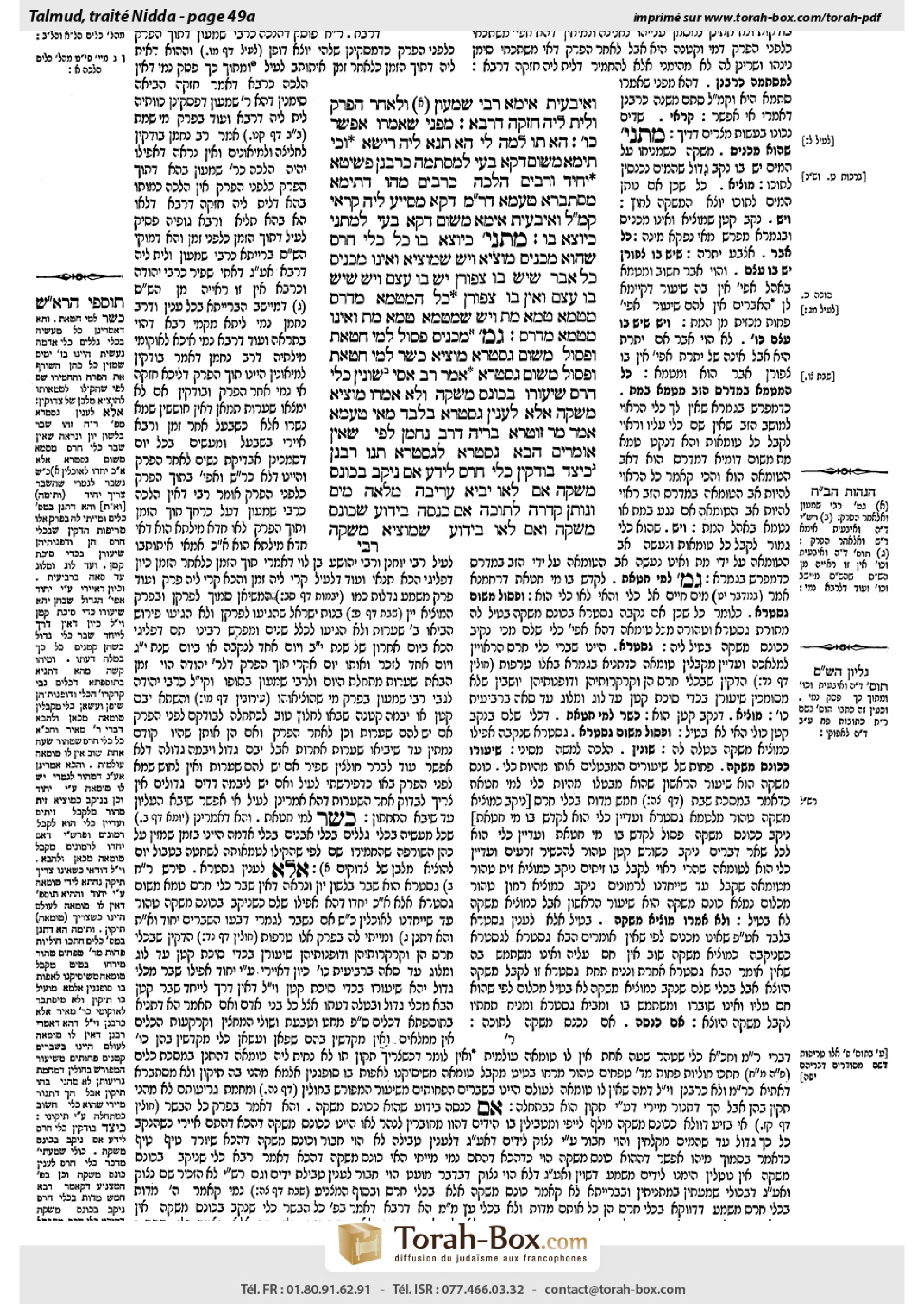
Niddah 49a: Talmud study for Daf Yomi
Daf Yomi is the daily study of one Talmud folio. Explore 37 tractates with scans, Hebrew text, Sefaria English and AI-generated French translations where annotated.
Passage selection and English or AI-generated French translation are available where the scan has annotations. Daf Study is independent of Torah-Box and Sefaria.
Browse Niddah · נידה · All tractatesNiddah 49a text and translations
This page of Niddah includes the Aramaic text, an English translation and an AI-generated French translation, alongside the scan above.
נידה מ״ט א · Aramaic and Hebrew text
וְאִיבָּעֵית אֵימָא: רַבִּי שִׁמְעוֹן, וּלְאַחַר הַפֶּרֶק, וְלֵית לֵיהּ חֲזָקָה דְּרָבָא.
מִפְּנֵי שֶׁאָמְרוּ אֶפְשָׁר כּוּ׳. הָא תּוּ לְמָה לִי? הָא תָּנָא לֵיהּ רֵישָׁא!
וְכִי תֵּימָא, מִשּׁוּם דְּקָא בָעֵי לְמִסְתְּמַהּ כְּרַבָּנַן — פְּשִׁיטָא! יָחִיד וְרַבִּים — הֲלָכָה כְּרַבִּים.
מַהוּ דְּתֵימָא: מִסְתַּבְּרָא טַעְמָא דְּרַבִּי מֵאִיר, דְּקָא מְסַיַּיע לֵיהּ קְרָאֵי, קָא מַשְׁמַע לַן. וְאִיבָּעֵית אֵימָא: מִשּׁוּם דְּקָא בָּעֵי לְמִתְנֵי ״כַּיּוֹצֵא בוֹ״.
מַתְנִי' כַּיּוֹצֵא בוֹ, כׇּל כְּלִי חֶרֶס שֶׁהוּא מַכְנִיס — מוֹצִיא, וְיֵשׁ שֶׁמּוֹצִיא וְאֵינוֹ מַכְנִיס.
כׇּל אֵבֶר שֶׁיֵּשׁ בּוֹ צִפּוֹרֶן — יֵשׁ בּוֹ עֶצֶם, וְיֵשׁ שֶׁיֵּשׁ בּוֹ עֶצֶם וְאֵין בּוֹ צִפּוֹרֶן.
כׇּל הַמִּטַּמֵּא מִדְרָס — מִטַּמֵּא טְמֵא מֵת, וְיֵשׁ שֶׁמִּטַּמֵּא טְמֵא מֵת — וְאֵינוֹ מִטַּמֵּא מִדְרָס.
גְּמָ' מַכְנִיס — פָּסוּל לְמֵי חַטָּאת, וּפָסוּל מִשּׁוּם גִּסְטְרָא. מוֹצִיא — כָּשֵׁר לְמֵי חַטָּאת, וּפָסוּל מִשּׁוּם גִּסְטְרָא.
אָמַר רַב אַסִּי, שׁוֹנִין: כְּלֵי חֶרֶס שִׁיעוּרוֹ בְּכוֹנֵס מַשְׁקֶה, וְלֹא אָמְרוּ מוֹצִיא מַשְׁקֶה אֶלָּא לְעִנְיַן גִּסְטְרָא בִּלְבַד. מַאי טַעְמָא? אָמַר מָר זוּטְרָא בְּרֵיהּ דְּרַב נַחְמָן: לְפִי שֶׁאֵין אוֹמְרִים ״הָבֵא גִּסְטְרָא לְגִסְטְרָא״.
תָּנוּ רַבָּנַן: כֵּיצַד בּוֹדְקִין כְּלִי חֶרֶס לֵידַע אִם נִיקַּב בְּכוֹנֵס מַשְׁקֶה אִם לָאו? יָבִיא עֲרֵיבָה מְלֵאָה מַיִם, וְנוֹתֵן קְדֵרָה לְתוֹכָהּ. אִם כְּנָסָהּ — בְּיָדוּעַ שֶׁכּוֹנֵס מַשְׁקֶה, וְאִם לָאו — בְּיָדוּעַ שֶׁמּוֹצִיא מַשְׁקֶה.
Niddah 49a · English translation
And if you wish, say instead that the tanna who taught this ruling was Rabbi Shimon, and the baraita is referring to an examination conducted after the age of majority. And Rabbi Shimon does not accept the presumption of Rava that a girl of this age has already developed signs indicating puberty.
§ The mishna teaches that according to the Rabbis a young woman who apparently developed the upper sign before the lower sign has reached majority, and therefore if her childless husband died she either performs ḥalitza or enters into levirate marriage with her husband’s brother. This ruling is due to the fact that the Sages said: It is possible for the lower sign of puberty to appear before the upper sign, but it is impossible for the upper sign to appear before the lower sign. The Gemara asks: Why do I need this additional repetition of this point? It was already taught in the first clause that it is impossible for the upper sign to appear without the lower sign having already appeared.
And if you would say that it is repeated because the tanna wants to teach an unattributed mishna in accordance with the opinion of the Rabbis, in order to establish that the halakha follows their opinion in their dispute with Rabbi Meir, that cannot be the case. The Gemara explains why this suggestion is incorrect: This is obvious, as there is a principle that in a dispute between an individual Sage and a majority of other Sages, the halakha is always decided in accordance with the opinion of the majority.
The Gemara answers: It is necessary for the tanna to state that the halakha is in accordance with the opinion of the Rabbis despite the fact that they are the majority, lest you say that the rationale for the opinion of Rabbi Meir is more reasonable. One might have thought this, as the verses cited above support it: “Your breasts were fashioned, and your hair was grown,” and: “When they from Egypt bruised your breasts for the sprouting forth of your young womanhood.” Therefore, the mishna teaches us that the halakha is in accordance with the opinion of the Rabbis. And if you wish, say instead that the tanna repeated the claim that the upper sign cannot precede the lower one because he wants to teach a case in the next mishna which is similar to this one, i.e., this summary provides a transition to the halakha brought in the following mishna.
MISHNA: Similar to the order of the appearance of the signs of puberty in a girl, where it is impossible for the upper sign to appear before the lower sign, there is an analogous principle with regard to the mutual dependency of two items: Any earthenware vessel with a hole that enables entry of liquid into the vessel certainly enables exit of liquid through that hole, and it thereby ceases to be a vessel fit for sanctification of the waters mixed with the ashes of the red heifer. And there are holes that enable exit of liquids from the earthenware vessels but do not enable entry of liquids from outside the vessel, and therefore it remains a vessel.
Likewise, in any limb of the body where there is a nail, there is certainly a bone in it as well. If it is the limb of a corpse, it transmits ritual impurity through contact, movement, and in a tent, even if its size is less than that of an olive-bulk. And there are limbs in which there is a bone but yet there is not a nail in it. That limb does not transmit impurity in a tent if its size is less than that of an olive-bulk.
Similarly, any item that becomes ritually impure with impurity of a zav imparted by treading, e.g., a vessel designated for sitting, becomes ritually impure with impurity imparted by a corpse. And there are vessels that become ritually impure with impurity imparted by a corpse but do not become ritually impure with impurity of a zav imparted by treading.
GEMARA: The mishna teaches that any earthenware vessel with a hole that enables entry of liquid into the vessel certainly enables exit of liquid through that hole, whereas there are holes that enable exit of liquids but do not enable entry. The Gemara explains the halakhic significance of this distinction. A vessel that contains a hole that is large enough to enable liquid to enter is no longer considered a vessel and is therefore unfit to contain the water of purification. And it is also disqualified as a shard [gastera] of a vessel. A shard still has some utility and is therefore susceptible to ritual impurity. By contrast, an earthenware vessel that contains a small hole that enables only the exit of liquids is fit for the water of purification, but is disqualified as a shard of a vessel.
Rav Asi says that they teach the following halakha: In the case of an earthenware vessel, its measure of a hole that renders it no longer ritually impure is one that is large enough to enable liquid to enter it. And they said that the measure of a small hole is that which enables the exit of liquids only with regard to a shard. The Gemara inquires: What is the reason for this? Mar Zutra, son of Rav Naḥman, said: It is because people do not say: Bring another shard to seal the leak of a shard; rather, they throw it out immediately. A shard is used as a plate beneath a perforated earthenware vessel. If the shard itself is also perforated and leaks, it is no longer of any use.
§ On the topic of holes in earthenware vessels, the Sages taught in a baraita: How does one test a broken earthenware vessel to know if it was pierced with a hole that enables liquid to enter it or not? One brings a tub filled with water and places the broken pot into it. If the water from the tub enters the pot, it is known that the pot contains a hole that enables liquid to enter. And if the water does not enter the pot, it is known that the vessel contains only a small hole that merely enables the exit of liquids.
Niddah 49a · Traduction française (IA)
Et si tu veux, dis plutôt que le tanna qui a enseigné cette halakha est Rabbi Shimon, et que la baraïta parle d’un examen effectué après l’âge de la majorité. Rabbi Shimon n’admet pas la présomption de Rava selon laquelle une fille de cet âge a déjà développé les signes de la puberté.
§ La Michna enseigne que, selon les Rabbins, une jeune femme qui semble avoir développé le signe supérieur avant le signe inférieur a atteint la majorité ; par conséquent, si son mari meurt sans enfant, elle accomplit la ḥalitsa ou contracte un mariage léviratique avec le frère de son mari. Cette décision repose sur ce que les Sages ont dit : il est possible que le signe inférieur de la puberté apparaisse avant le signe supérieur, mais il est impossible que le signe supérieur apparaisse avant le signe inférieur. La Guemara demande : Pourquoi faut-il répéter ce point ? Il a déjà été enseigné dans la première partie qu’il est impossible que le signe supérieur apparaisse sans que le signe inférieur soit apparu auparavant.
Et si tu dis que ce point est répété parce que le tanna veut enseigner une Michna anonyme conformément à l’opinion des Rabbins, afin d’établir que la halakha suit leur opinion dans leur controverse avec Rabbi Meir, cela ne peut pas être le cas. La Guemara explique pourquoi cette proposition est erronée : cela va de soi, car un principe veut que, dans une controverse entre un Sage isolé et la majorité des autres Sages, la halakha soit toujours tranchée conformément à l’opinion de la majorité.
La Guemara répond : Il faut que le tanna précise que la halakha suit l’opinion des Rabbins, bien qu’ils soient majoritaires, de peur que tu ne dises que le raisonnement de Rabbi Meir est plus convaincant. On aurait pu le penser, puisque les versets cités plus haut l’appuient : « Tes seins ont pris forme, et tes cheveux ont poussé », et : « Lorsque ceux d’Égypte meurtrirent tes seins, au moment où ta jeunesse s’épanouissait ». La Michna nous enseigne donc que la halakha suit l’opinion des Rabbins. Et si tu veux, dis plutôt que le tanna répète que le signe supérieur ne peut pas précéder le signe inférieur parce qu’il veut enseigner un cas dans la Michna suivante qui est analogue à celui-ci ; autrement dit, ce résumé sert de transition vers la halakha présentée dans la Michna suivante.
MICHNA : De même que, dans l’ordre d’apparition des signes de la puberté chez une fille, il est impossible que le signe supérieur apparaisse avant le signe inférieur, il existe un principe analogue concernant la dépendance réciproque de deux éléments : tout récipient en terre cuite dont le trou permet à un liquide d’entrer dans le récipient permet certainement aussi à un liquide de s’en écouler par ce trou ; il cesse alors d’être un récipient apte à la sanctification des eaux mêlées aux cendres de la vache rousse. Il existe des trous qui permettent aux liquides de s’écouler des récipients en terre cuite sans permettre aux liquides extérieurs d’y entrer ; le récipient reste donc un récipient.
De même, tout membre du corps où se trouve un ongle contient certainement aussi un os. S’il s’agit du membre d’un cadavre, il transmet l’impureté rituelle par contact, par mouvement et sous une tente, même si sa taille est inférieure à celle d’un volume d’olive. Il existe des membres qui contiennent un os mais pas d’ongle. Ce membre ne transmet pas l’impureté sous une tente si sa taille est inférieure à celle d’un volume d’olive.
De même, tout objet qui devient rituellement impur par l’impureté d’un zav transmise par piétinement, par exemple un récipient destiné à servir de siège, devient rituellement impur par l’impureté transmise par un cadavre. Et il existe des récipients qui deviennent rituellement impurs par l’impureté transmise par un cadavre, mais ne deviennent pas rituellement impurs par l’impureté d’un zav transmise par piétinement.
GUEMARA : La Michna enseigne que tout récipient en terre cuite dont le trou permet à un liquide d’entrer dans le récipient permet certainement aussi à un liquide de s’en écouler, tandis qu’il existe des trous qui permettent aux liquides de s’écouler sans permettre aux liquides d’entrer. La Guemara explique la portée halakhique de cette distinction. Un récipient dont le trou est assez grand pour permettre à un liquide d’y entrer n’est plus considéré comme un récipient et ne peut donc pas contenir l’eau de purification. Il est également invalidé en tant que tesson [gastera] de récipient. Un tesson conserve une certaine utilité et peut donc devenir rituellement impur. En revanche, un récipient en terre cuite doté d’un petit trou qui permet seulement aux liquides de s’écouler est apte à contenir l’eau de purification, mais est invalidé en tant que tesson de récipient.
Rav Asi dit qu’ils enseignent la halakha suivante : dans le cas d’un récipient en terre cuite, la taille du trou qui fait qu’il ne peut plus devenir rituellement impur est celle d’un trou assez grand pour permettre à un liquide d’y entrer. La mesure du petit trou, qui permet seulement aux liquides de s’écouler, a été énoncée uniquement à propos d’un tesson. La Guemara demande : Quelle en est la raison ? Mar Zutra, fils de Rav Naḥman, dit : c’est parce que les gens ne disent pas : « Apporte un autre tesson pour boucher la fuite d’un tesson » ; ils le jettent immédiatement. Un tesson sert d’assiette sous un récipient en terre cuite percé. Si le tesson lui-même est également percé et fuit, il ne sert plus à rien.
§ Au sujet des trous dans les récipients en terre cuite, les Sages ont enseigné dans une baraïta : Comment vérifier si un récipient en terre cuite brisé est percé d’un trou qui permet à un liquide d’y entrer ou non ? On prend une cuve remplie d’eau et on y place le pot brisé. Si l’eau de la cuve entre dans le pot, on sait que celui-ci est percé d’un trou qui permet à un liquide d’y entrer. Si l’eau n’entre pas dans le pot, on sait que le récipient n’a qu’un petit trou qui permet seulement aux liquides de s’écouler.
Traduction française générée par IA à partir de l’édition anglaise de Sefaria. Vérifie toujours un passage avec le texte source.
Text from Sefaria: William Davidson Edition - Vocalized Aramaic (CC BY NC); William Davidson Edition - English (CC BY NC).