Niddah 49b: Talmud study for Daf Yomi
Daf Yomi is the daily study of one Talmud folio. Explore 37 tractates with scans, Hebrew text, Sefaria English and AI-generated French translations where annotated.
Passage selection and English or AI-generated French translation are available where the scan has annotations. Daf Study is independent of Torah-Box and Sefaria.
Browse Niddah · נידה · All tractatesNiddah 49b text and translations
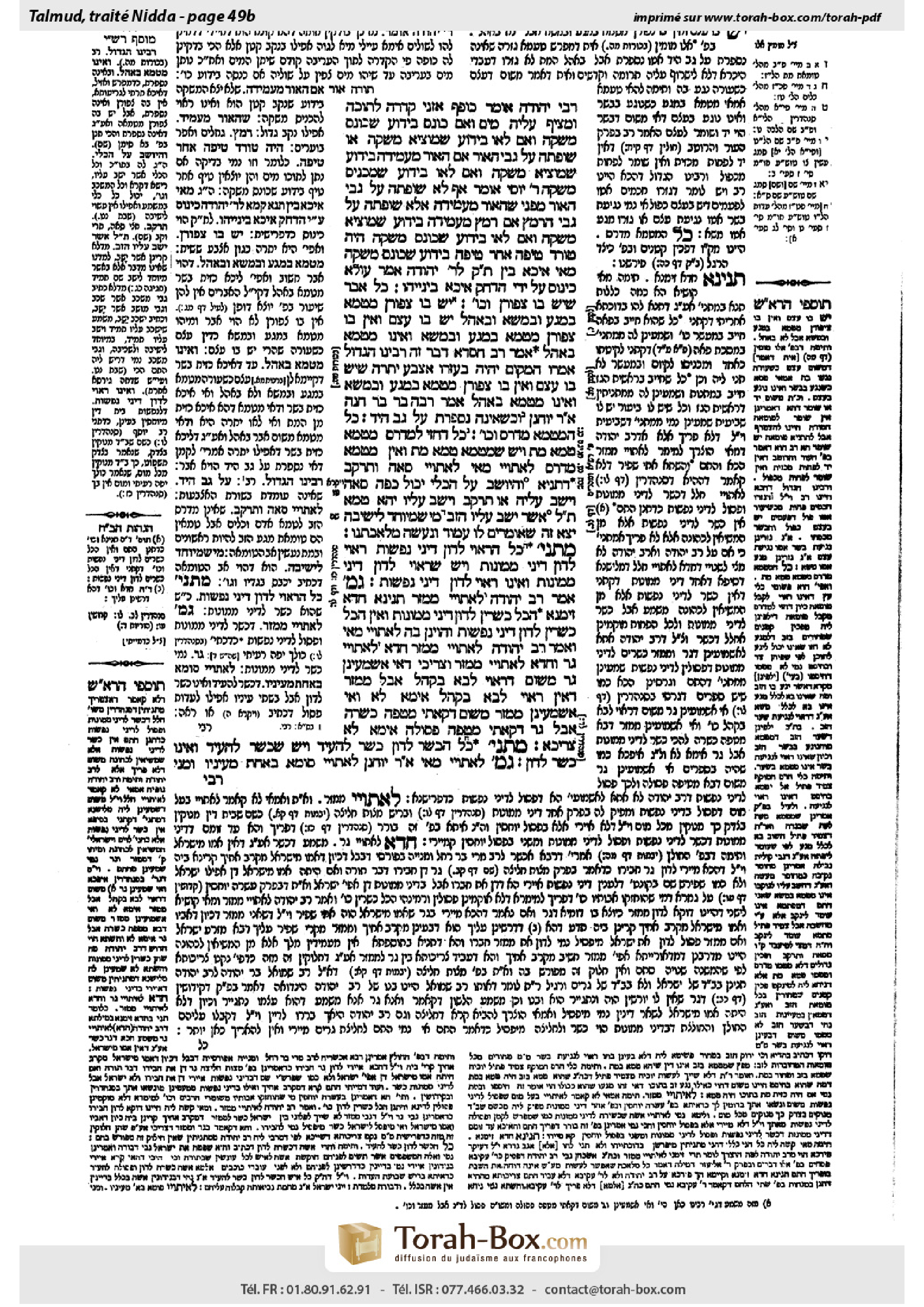
This page of Niddah includes the Aramaic text, an English translation and an AI-generated French translation, alongside the scan above.
נידה מ״ט ב · Aramaic and Hebrew text
רַבִּי יְהוּדָה אוֹמֵר: כּוֹפֵף אׇזְנֵי קְדֵרָה לְתוֹכָהּ וּמֵצִיף עָלֶיהָ מַיִם, וְאִם כּוֹנֵס — בְּיָדוּעַ שֶׁכּוֹנֵס מַשְׁקֶה, וְאִם לָאו — בְּיָדוּעַ שֶׁמּוֹצִיא מַשְׁקֶה.
אוֹ שׁוֹפְתָהּ עַל גַּבֵּי הָאוּר, אִם הָאוּר מַעֲמִידָהּ — בְּיָדוּעַ שֶׁמּוֹצִיא מַשְׁקֶה, וְאִם לָאו — בְּיָדוּעַ שֶׁמַּכְנִיס מַשְׁקֶה.
רַבִּי יוֹסֵי אוֹמֵר: אַף לֹא שׁוֹפְתָהּ עַל גַּבֵּי הָאוּר, מִפְּנֵי שֶׁהָאוּר מַעֲמִידָהּ, אֶלָּא שׁוֹפְתָהּ עַל גַּבֵּי הָרֶמֶץ. אִם רֶמֶץ מַעֲמִידָהּ — בְּיָדוּעַ שֶׁמּוֹצִיא מַשְׁקֶה, וְאִם לָאו — בְּיָדוּעַ שֶׁכּוֹנֵס מַשְׁקֶה. הָיָה טוֹרֵד טִיפָּה אַחַר טִיפָּה — בְּיָדוּעַ שֶׁכּוֹנֵס מַשְׁקֶה.
מַאי אִיכָּא בֵּין תַּנָּא קַמָּא לְרַבִּי יְהוּדָה? אָמַר עוּלָּא: כִּינּוּס עַל יְדֵי הַדְּחָק אִיכָּא בֵינַיְיהוּ.
כׇּל אֵבֶר שֶׁיֵּשׁ בּוֹ צִפּוֹרֶן וְכוּ׳. יֵשׁ בּוֹ צִפּוֹרֶן — מְטַמֵּא בְּמַגָּע וּבְמַשָּׂא וּבְאֹהֶל; יֵשׁ בּוֹ עֶצֶם וְאֵין בּוֹ צִפּוֹרֶן — מְטַמֵּא בְּמַגָּע וּבְמַשָּׂא וְאֵינוֹ מְטַמֵּא בְּאֹהֶל.
אָמַר רַב חִסְדָּא: דָּבָר זֶה רַבֵּינוּ הַגָּדוֹל אֲמָרוֹ, הַמָּקוֹם יִהְיֶה בְּעֶזְרוֹ. אֶצְבַּע יְתֵרָה שֶׁיֵּשׁ בּוֹ עֶצֶם וְאֵין בּוֹ צִפּוֹרֶן — מְטַמֵּא בְּמַגָּע וּבְמַשָּׂא, וְאֵינוֹ מְטַמֵּא בְּאֹהֶל.
אָמַר רַבָּה בַּר בַּר חַנָּה אָמַר רַבִּי יוֹחָנָן: וּכְשֶׁאֵינָהּ נִסְפֶּרֶת עַל גַּב הַיָּד.
כׇּל הַמְטַמֵּא מִדְרָס וְכוּ׳. כֹּל דַּחֲזֵי לְמִדְרָס — מִטַּמֵּא טְמֵא מֵת.
וְיֵשׁ שֶׁמִּטַּמֵּא טְמֵא מֵת וְאֵין מִטַּמֵּא מִדְרָס. לְאֵתוֹיֵי מַאי? לְאֵתוֹיֵי סְאָה וְתַרְקַב.
דְּתַנְיָא: ״וְהַיּוֹשֵׁב עַל הַכְּלִי״, יָכוֹל כָּפָה סְאָה וְיָשַׁב עָלֶיהָ, אוֹ תַּרְקַב וְיָשַׁב עָלָיו, יְהֵא טָמֵא?
תַּלְמוּד לוֹמַר ״אֲשֶׁר יֵשֵׁב עָלָיו הַזָּב״ — מִי שֶׁמְיוּחָד לִישִׁיבָה, יָצָא זֶה שֶׁאוֹמְרִים לוֹ: עֲמוֹד וְנַעֲשֶׂה מְלַאכְתֵּנוּ.
מַתְנִי' כׇּל הָרָאוּי לָדוּן דִּינֵי נְפָשׁוֹת — רָאוּי לָדוּן דִּינֵי מָמוֹנוֹת, וְיֵשׁ שֶׁרָאוּי לָדוּן דִּינֵי מָמוֹנוֹת וְאֵינוֹ רָאוּי לָדוּן דִּינֵי נְפָשׁוֹת.
גְּמָ' אָמַר רַב יְהוּדָה: לְאֵתוֹיֵי מַמְזֵר.
תְּנֵינָא חֲדָא זִימְנָא: הַכֹּל כְּשֵׁרִין לָדוּן דִּינֵי מָמוֹנוֹת, וְאֵין הַכֹּל כְּשֵׁרִין לָדוּן דִּינֵי נְפָשׁוֹת. וְהָוֵינַן בַּהּ, לְאֵתוֹיֵי מַאי? וְאָמַר רַב יְהוּדָה: לְאֵתוֹיֵי מַמְזֵר. חֲדָא לְאֵתוֹיֵי גֵּר, וַחֲדָא לְאֵתוֹיֵי מַמְזֵר.
וּצְרִיכִי, דְּאִי אַשְׁמְעִינַן גֵּר — מִשּׁוּם דְּרָאוּי לָבֹא בַּקָּהָל, אֲבָל מַמְזֵר דְּאֵין רָאוּי לָבֹא בַּקָּהָל, אֵימָא לָא.
וְאִי אַשְׁמְעִינַן מַמְזֵר — מִשּׁוּם דְּקָאָתֵי מִטִּפָּה כְּשֵׁרָה, אֲבָל גֵּר דְּקָאָתֵי מִטִּפָּה פְּסוּלָה — אֵימָא לָא, צְרִיכָא.
מַתְנִי' כׇּל הַכָּשֵׁר לָדוּן — כָּשֵׁר לְהָעִיד, וְיֵשׁ שֶׁכָּשֵׁר לְהָעִיד וְאֵינוֹ כָּשֵׁר לָדוּן.
גְּמָ' לְאֵתוֹיֵי מַאי? אָמַר רַבִּי יוֹחָנָן: לְאֵתוֹיֵי סוֹמֵא בְּאַחַת מֵעֵינָיו. וּמַנִּי?
Niddah 49b · English translation
Rabbi Yehuda says that the method for determining whether an earthenware vessel contains a hole that allows liquid to enter is as follows: One takes the handles of the pot and turns it over,placing it upside down in an empty tub, and he then covers the pot with water. If water enters the pot, it is known that it contains a hole that enables liquid to enter, and if the water does not enter the pot, it is known that the vessel contains a small hole that enables only the exit of liquids.
Or one can determine the size of the hole by the following method: One places the pot, with liquid in it, on the fire. If the fire holds the liquid back and does not allow it to exit the vessel, then it is known that the vessel contains a small hole that enables only the exit of liquids. And if the fire does not hold the liquid back and does not prevent it from exiting the vessel, then it is known that it contains a hole that enables liquid to enter.
Rabbi Yosei says: One should not place the pot with liquid in it on the fire. This is not a reliable test for determining the size of the hole, as it is possible that the hole is actually large enough to enable liquid to enter, but nevertheless the fire prevents the liquid from exiting. Rather, one places the pot with liquid in it on hot ash. If the hot ash holds the liquid back and does not allow it to exit the vessel, then it is known that the vessel contains a small hole that enables only the exit of liquids. But if the hot ash does not hold the liquid back and does not prevent it from exiting the vessel, it is known that it contains a hole that enables liquid to enter. Another manner of testing is to fill the vessel with liquid. If it drips one drop after another drop, it is known that it contains a hole that enables liquid to enter.
The Gemara asks: What difference is there between the method of testing stated by the first tanna, placing the vessel in a tub of water, and that of Rabbi Yehuda, placing the vessel upside down into the tub and then covering it with water? Ulla said: The difference between their opinions is whether liquid that enters through a hole with difficulty, i.e., as the result of force, is considered entering. According to Rabbi Yehuda, placing the vessel directly into a tub of water constitutes the use of force to a certain degree, and he maintains that if water enters the vessel in such a case, this does not count as liquid entering the vessel. Therefore, he rejects the testing method of the first tanna.
§ The mishna teaches: In any limb of the body where there is a nail, there is certainly a bone in it as well. But it is possible for there to be limbs that contain a bone without a nail. The Gemara explains the halakhic significance of this distinction. A limb in which there is a nail and which therefore certainly contains a bone has the status of a full-fledged limb. Therefore, it transmits impurity through contact, movement, and in a tent, even if its size is less than that of an olive-bulk. By contrast, if there is a bone in the limb but there is no nail, it transmits impurity through contact and movement even if its size is less than that of an olive-bulk, but it does not transmit impurity in a tent unless its size is that of an olive-bulk.
Rav Ḥisda says: The following matter was stated by our great rabbi, Rav, may the Omnipresent come to his assistance. An extra finger on one’s hand in which there is a bone but there is no nail transmits impurity through contact and movement even if its size is less than that of an olive-bulk, but it does not transmit impurity in a tent.
Rabba bar bar Ḥana says that Rabbi Yoḥanan said: And this is the halakha, that it must contain both bone and a nail for it to be considered a limb, only in a case where this finger cannot be counted along the back of the hand, i.e., the extra finger is not aligned with the others. But if it is aligned with the other fingers then it is considered like any other limb and imparts impurity in a tent, whether or not it contains a nail.
§ The mishna further teaches: Similarly, any item that becomes ritually impure with impurity of a zav imparted by treading becomes ritually impure with impurity imparted by a corpse. The Gemara explains that this means that any item that is fit to become impure with the impurity of a zav imparted by treading is fit to become ritually impure with impurity imparted by a corpse.
The mishna continues: And there are vessels that become ritually impure with impurity imparted by a corpse but do not become ritually impure with impurity of a zav imparted by treading. The Gemara asks: What is added by this statement? The Gemara answers: This serves to add a measuring vessel, e.g., the measure of a se’a or a half-se’a [vetarkav].
As it is taught in a baraita: The verse states with regard to the impurity of the treading of a zav: “And he who sits on any object whereon the zav sits shall wash his clothes and bathe himself in water, and is impure until the evening” (Leviticus 15:6). One might have thought that if a zav turned over a vessel used to measure a se’a and sat on it, or if he turned over a vessel used to measure a half-se’a and sat on it, that vessel should be rendered impure as a seat upon which a zav sat.
Therefore, the verse states: “And he who sits on any object whereon the zav sits” (Leviticus 15:6). The wording of the verse indicates that it is speaking of an object that is designated for sitting, i.e., upon which people generally sit, excluding such a vessel, with regard to which we say to someone sitting on it: Stand up and allow us to use it to do our work, i.e., to measure. This is not defined as a vessel used for sitting, as it serves another function.
MISHNA: Any person who is fit to adjudicate cases of capital law is fit to adjudicate cases of monetary law, and there are those who are fit to adjudicate cases of monetary law but are unfit to adjudicate cases of capital law.
GEMARA: Rav Yehuda said: The statement of the mishna that some are fit to adjudicate cases of monetary law but are unfit to adjudicate cases of capital law serves to add the case of a mamzer. Although he may not adjudicate cases of capital law, nevertheless he may adjudicate cases of monetary law.
The Gemara asks: Why is it necessary to teach this here? We already learned this on another occasion, in a mishna (Sanhedrin 32a): All are fit to judge cases of monetary law, but not all are fit to judge cases of capital law. And we discussed it, and asked what is added by the phrase: All are fit to judge. And Rav Yehuda said in response that this serves to add the case of a mamzer. The Gemara answers: One mishna serves to add the case of a convert, and one other mishna serves to add the case of a mamzer.
The Gemara explains: And both additions are necessary. As, if the mishnayot had taught us only that a convert is fit to judge cases of monetary law, one might have said that the halakha is lenient in the case of a convert because he is fit to enter into the congregation, i.e., marry a Jewish woman. But with regard to a mamzer, who is unfit to enter into the congregation, one might say that he is not fit to judge cases of monetary law.
And if the mishnayot had taught us only that a mamzer is fit to judge cases of monetary law, one might have said that the halakha is lenient in the case of a mamzer because he comes from a fit drop of semen, i.e., his father is Jewish. But with regard to a convert, who comes from an unfit drop, as he was born a gentile, one might say that he is not fit to judge cases of monetary law. Therefore, it is necessary to teach the halakhot of both a convert and a mamzer.
MISHNA: Any person who is fit to adjudicate a case and serve as a judge is fit to testify as a witness, and there are those who are fit to testify but are not fit to adjudicate.
GEMARA: The Gemara asks: What is added by this statement, that some people are fit to testify but not to adjudicate? Rabbi Yoḥanan said: This serves to add one who is blind in one of his eyes. And in accordance with whose opinion is this ruling?
Niddah 49b · Traduction française (IA)
Rabbi Yehuda dit que, pour déterminer si un récipient en terre cuite présente un trou qui laisse entrer un liquide, on procède ainsi : on saisit les anses du pot et on le retourne, en le plaçant à l’envers dans un baquet vide, puis on recouvre le pot d’eau. Si l’eau pénètre dans le pot, on sait qu’il présente un trou qui laisse entrer un liquide ; si l’eau n’y pénètre pas, on sait que le récipient présente un petit trou qui ne laisse sortir que les liquides.
On peut aussi déterminer la taille du trou par la méthode suivante : on place sur le feu le pot qui contient un liquide. Si le feu retient le liquide et l’empêche de sortir du récipient, on sait que celui-ci présente un petit trou qui ne laisse sortir que les liquides. Si le feu ne retient pas le liquide et ne l’empêche pas de sortir du récipient, on sait qu’il présente un trou qui laisse entrer un liquide.
Rabbi Yosei dit : On ne doit pas placer sur le feu le pot qui contient un liquide. Ce test ne permet pas de déterminer avec certitude la taille du trou, car il est possible que celui-ci soit en réalité assez grand pour laisser entrer un liquide, mais que le feu empêche néanmoins le liquide de sortir. On place plutôt le pot contenant un liquide sur des cendres chaudes. Si celles-ci retiennent le liquide et l’empêchent de sortir du récipient, on sait que celui-ci présente un petit trou qui ne laisse sortir que les liquides. Mais si les cendres chaudes ne retiennent pas le liquide et ne l’empêchent pas de sortir du récipient, on sait qu’il présente un trou qui laisse entrer un liquide. Une autre méthode de vérification consiste à remplir le récipient de liquide. S’il goutte, goutte après goutte, on sait qu’il présente un trou qui laisse entrer un liquide.
La Guemara demande : Quelle différence y a-t-il entre la méthode de vérification énoncée par le premier tanna, qui consiste à placer le récipient dans un baquet d’eau, et celle de Rabbi Yehuda, qui consiste à placer le récipient à l’envers dans le baquet, puis à le recouvrir d’eau ? Oulla dit : Leurs opinions diffèrent quant à savoir si un liquide qui pénètre difficilement par un trou, c’est-à-dire sous l’effet d’une pression, est considéré comme étant entré. Selon Rabbi Yehuda, placer directement le récipient dans un baquet d’eau exerce une certaine pression, et il considère que si de l’eau pénètre dans le récipient dans ces conditions, cela ne compte pas comme une entrée de liquide dans le récipient. Il rejette donc la méthode de vérification du premier tanna.
§ La Michna enseigne : Tout membre du corps qui comporte un ongle contient nécessairement aussi un os. Mais il est possible que des membres contiennent un os sans comporter d’ongle. La Guemara explique la portée halakhique de cette distinction. Un membre qui comporte un ongle et contient donc nécessairement un os est considéré comme un membre à part entière. Il transmet donc l’impureté par contact, par déplacement et sous une tente, même si sa taille est inférieure à celle d’une olive. En revanche, si le membre contient un os mais ne comporte pas d’ongle, il transmet l’impureté par contact et par déplacement même si sa taille est inférieure à celle d’une olive, mais il ne transmet pas l’impureté sous une tente à moins d’avoir la taille d’une olive.
Rav Ḥisda dit : La déclaration suivante a été faite par notre grand maître, Rav — que le Lieu lui vienne en aide. Un doigt supplémentaire à la main, qui contient un os mais ne comporte pas d’ongle, transmet l’impureté par contact et par déplacement même si sa taille est inférieure à celle d’une olive, mais ne transmet pas l’impureté sous une tente.
Rabba bar bar Ḥana dit au nom de Rabbi Yoḥanan : Cette halakha, selon laquelle le doigt doit contenir à la fois un os et un ongle pour être considéré comme un membre, ne s’applique que lorsque ce doigt ne peut pas être compté dans l’alignement du dos de la main, c’est-à-dire lorsque le doigt supplémentaire n’est pas aligné avec les autres. Mais s’il est aligné avec les autres doigts, il est considéré comme tout autre membre et transmet l’impureté sous une tente, qu’il comporte ou non un ongle.
§ La Michna enseigne également : De même, tout objet qui devient rituellement impur par l’impureté d’un zav transmise par foulage devient rituellement impur par l’impureté transmise par un cadavre. La Guemara explique que cela signifie que tout objet susceptible de devenir impur par l’impureté d’un zav transmise par foulage est aussi susceptible de devenir rituellement impur par l’impureté transmise par un cadavre.
La Michna poursuit : Certains récipients deviennent rituellement impurs par l’impureté transmise par un cadavre, mais ne deviennent pas rituellement impurs par l’impureté d’un zav transmise par foulage. La Guemara demande : Qu’ajoute cette déclaration ? La Guemara répond : Elle inclut un récipient de mesure, par exemple la mesure d’une séa ou d’une demi-séa [vetarkav].
Comme il est enseigné dans une baraïta : Au sujet de l’impureté transmise par le foulage d’un zav, le verset dit : « Et celui qui s’assied sur un objet quelconque sur lequel le zav s’est assis lavera ses vêtements et se baignera dans l’eau, et il sera impur jusqu’au soir » (Lévitique 15,6). On aurait pu penser que si un zav retournait un récipient servant à mesurer une séa et s’asseyait dessus, ou s’il retournait un récipient servant à mesurer une demi-séa et s’asseyait dessus, ce récipient serait rendu impur en tant que siège sur lequel un zav s’est assis.
Le verset dit donc : « Et celui qui s’assied sur un objet quelconque sur lequel le zav s’est assis » (Lévitique 15,6). La formulation du verset indique qu’il s’agit d’un objet destiné à servir de siège, c’est-à-dire sur lequel les gens s’assoient habituellement. Cela exclut un tel récipient, à propos duquel on dit à quelqu’un qui s’y assied : « Lève-toi et laisse-nous l’utiliser pour notre travail », c’est-à-dire pour mesurer. Il n’est pas défini comme un récipient servant de siège, puisqu’il a une autre fonction.
MICHNA : Toute personne apte à juger des affaires criminelles est apte à juger des affaires pécuniaires ; mais certains sont aptes à juger des affaires pécuniaires sans être aptes à juger des affaires criminelles.
GUEMARA : Rav Yehuda dit : La déclaration de la Michna selon laquelle certains sont aptes à juger des affaires pécuniaires sans être aptes à juger des affaires criminelles inclut le cas d’un mamzer. Bien qu’il ne puisse pas juger des affaires criminelles, il peut néanmoins juger des affaires pécuniaires.
La Guemara demande : Pourquoi est-il nécessaire de l’enseigner ici ? Nous l’avons déjà appris ailleurs, dans une Michna (Sanhédrin 32a) : Tous sont aptes à juger des affaires pécuniaires, mais tous ne sont pas aptes à juger des affaires criminelles. Nous avons étudié ce passage et demandé ce que la formule « Tous sont aptes à juger » ajoute. Rav Yehuda a répondu qu’elle inclut le cas d’un mamzer. La Guemara répond : Une Michna inclut le cas d’un converti et une autre Michna inclut celui d’un mamzer.
La Guemara explique : Les deux ajouts sont nécessaires. En effet, si les Michnayot nous avaient seulement enseigné qu’un converti est apte à juger des affaires pécuniaires, on aurait pu dire que la halakha est indulgente envers le converti parce qu’il peut entrer dans l’assemblée, c’est-à-dire épouser une femme juive. Mais pour un mamzer, qui ne peut pas entrer dans l’assemblée, on aurait pu dire qu’il n’est pas apte à juger des affaires pécuniaires.
Et si les Michnayot nous avaient seulement enseigné qu’un mamzer est apte à juger des affaires pécuniaires, on aurait pu dire que la halakha est indulgente envers lui parce qu’il est issu d’une semence apte, c’est-à-dire que son père est juif. Mais pour un converti, issu d’une semence inapte puisqu’il est né non-juif, on aurait pu dire qu’il n’est pas apte à juger des affaires pécuniaires. Il est donc nécessaire d’enseigner les halakhot concernant à la fois un converti et un mamzer.
MICHNA : Toute personne apte à juger une affaire et à exercer la fonction de juge est apte à témoigner ; mais certains sont aptes à témoigner sans être aptes à juger.
GUEMARA : La Guemara demande : Qu’ajoute cette déclaration, selon laquelle certaines personnes sont aptes à témoigner sans être aptes à juger ? Rabbi Yoḥanan dit : Elle inclut celui qui est aveugle d’un œil. Et selon l’opinion de qui cette décision est-elle rendue ?
Traduction française générée par IA à partir de l’édition anglaise de Sefaria. Vérifie toujours un passage avec le texte source.
Text from Sefaria: William Davidson Edition - Vocalized Aramaic (CC BY NC); William Davidson Edition - English (CC BY NC).