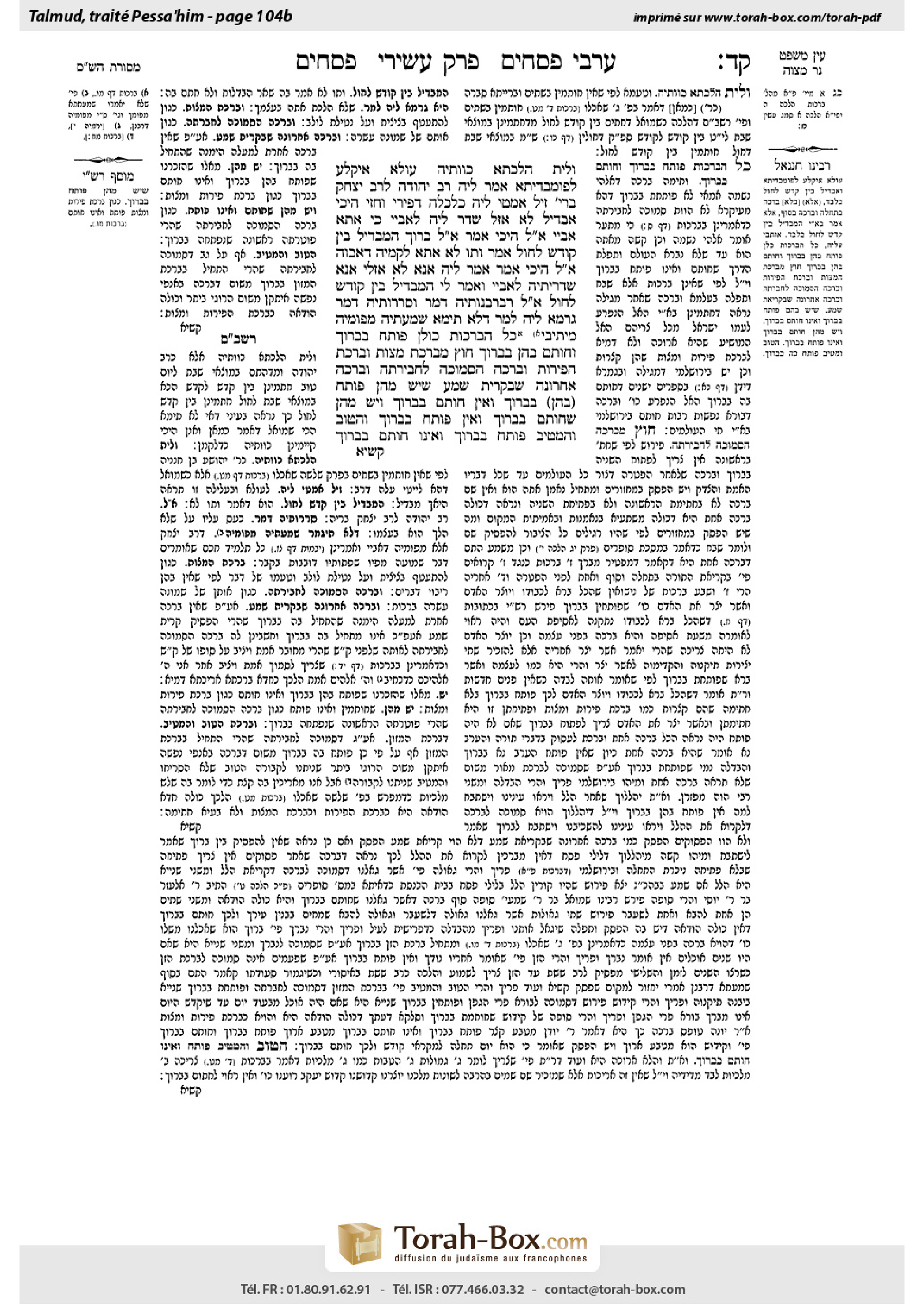
Pesachim 104b: Talmud study for Daf Yomi
Daf Yomi is the daily study of one Talmud folio. Explore 37 tractates with scans, Hebrew text, Sefaria English and AI-generated French translations where annotated.
Passage selection and English or AI-generated French translation are available where the scan has annotations. Daf Study is independent of Torah-Box and Sefaria.
Browse Pesachim · פסחים · All tractatesPesachim 104b text and translations
This page of Pesachim includes the Aramaic text, an English translation and an AI-generated French translation, alongside the scan above.
פסחים ק״ד ב · Aramaic and Hebrew text
וְלֵית הִלְכְתָא כְּווֹתֵיהּ.
עוּלָּא אִיקְּלַע לְפוּמְבְּדִיתָא, אֲמַר לֵיהּ רַב יְהוּדָה לְרַב יִצְחָק בְּרֵיהּ: זִיל אַמְטִי לֵיהּ כַּלְכַּלָּה דְפֵירֵי, וַחֲזִי הֵיכִי אַבְדֵּיל. לָא אֲזַל, שַׁדַּר לֵיהּ לְאַבָּיֵי. כִּי אֲתָא אַבָּיֵי, אֲמַר לֵיהּ: הֵיכִי אָמַר? אֲמַר לֵיהּ: ״בָּרוּךְ הַמַּבְדִּיל בֵּין קוֹדֶשׁ לְחוֹל״ אָמַר, וְתוּ לָא.
אֲתָא לְקַמֵּיהּ דַּאֲבוּהּ, אֲמַר לֵיהּ: הֵיכִי אָמַר? אֲמַר לֵיהּ: אֲנָא לָא אֲזַלִי, אֲנָא שַׁדְּרִיתֵיהּ לְאַבָּיֵי, וַאֲמַר לִי ״הַמַּבְדִּיל בֵּין קוֹדֶשׁ לְחוֹל״. אֲמַר לֵיהּ: רַבְרְבָנוּתֵיהּ דְּמָר, וּסְרָרוּתֵיהּ דְּמָר, גְּרַמָא לֵיהּ לְמָר דְּלָא תֵּימָא שְׁמַעְתֵּיהּ מִפּוּמֵּיהּ.
מֵיתִיבִי: כׇּל הַבְּרָכוֹת כּוּלָּן פּוֹתֵחַ בְּבָרוּךְ וְחוֹתֵם בָּהֶן בְּבָרוּךְ, חוּץ מִבִּרְכַּת מִצְוֹת וּבִרְכַּת הַפֵּירוֹת וּבְרָכָה הַסְּמוּכָה לַחֲבֶירְתָּהּ וּבְרָכָה אַחֲרוֹנָה שֶׁבִּקְרִיַּת שְׁמַע,
שֶׁיֵּשׁ מֵהֶן פּוֹתֵחַ (בָּהֶן) בְּבָרוּךְ וְאֵין חוֹתֵם בְּבָרוּךְ, וְיֵשׁ מֵהֶן שֶׁחוֹתֵם בְּבָרוּךְ וְאֵין פּוֹתֵחַ בְּבָרוּךְ. וְ״הַטּוֹב וְהַמֵּטִיב״ פּוֹתֵחַ בְּבָרוּךְ וְאֵינוֹ חוֹתֵם בְּבָרוּךְ.
Pesachim 104b · English translation
However, the Gemara states: And the halakha is not in accordance with that opinion. Instead, the halakha is in accordance with the opinion of Shmuel.
The Gemara relates: Ulla happened to come to Pumbedita. Rav Yehuda said to his son, Rav Yitzḥak: Go and bring him a basket of fruit as a gift, and while you are there, observe how he recites havdala. Rav Yitzḥak himself did not go. In his place, he sent to him Abaye, who was a young student at the time. When Abaye came back, Rav Yitzḥak said to him: How did Ulla recite the blessing of havdala? Abaye said to him that Ulla said: Blessed is He Who distinguishes between sacred and profane, but he did not say anything further.
Rav Yitzḥak came before his father, Rav Yehuda, who said to him: How did Ulla recite havdala? He said to him: I myself did not go. Instead, I sent Abaye, who said to me that Ulla recited: Who distinguishes between sacred and profane. Rav Yehuda grew angry and said to him: The Master’s haughtiness and the Master’s pride caused the Master to act in a way that ensured that the halakha will not be said in his name. In other words, had you gone yourself, this halakha would have been attributed to you, but due to your haughtiness and pride, it will be transmitted in the name of Abaye.
The Gemara raises an objection to Ulla’s practice from a baraita: With regard to all blessings, one begins their recitation with: Blessed, and concludes reciting them with: Blessed, except for blessings over mitzvot, blessings over fruit, a blessing that is juxtaposed to another blessing in the order of prayer, e.g., during the Amida prayer, and the final blessing after Shema.
The baraita elaborates: These blessings are different, as some of them begin with: Blessed, and do not conclude with: Blessed, e.g., blessings over mitzvot and before eating, and some of them conclude with: Blessed, and do not begin with: Blessed, such as a blessing that is juxtaposed to another blessing. And the blessing: He Who is good and does good, is exceptional, as it is a blessing that is juxtaposed to another blessing, and yet it begins with: Blessed, and does not conclude with: Blessed.
Pesachim 104b · Traduction française (IA)
Toutefois, la Guemara affirme que la halakha n’est pas conforme à cet avis, mais à celui de Chmouel.
La Guemara rapporte : Oulla arriva par hasard à Poumbedita. Rav Yehouda dit à son fils, Rav Yitsḥak : « Va lui apporter un panier de fruits en cadeau et, pendant que tu y seras, observe comment il récite la havdala. » Rav Yitsḥak n’y alla pas lui-même. À sa place, il envoya Abayé, qui était alors un jeune étudiant. À son retour, Rav Yitsḥak lui demanda : « Comment Oulla a-t-il récité la bénédiction de la havdala ? » Abayé lui répondit qu’Oulla avait dit : « Béni soit Celui qui distingue le sacré du profane », sans rien ajouter.
Rav Yitsḥak se présenta devant son père, Rav Yehouda, qui lui demanda : « Comment Oulla a-t-il récité la havdala ? » Il lui répondit : « Je n’y suis pas allé moi-même. J’ai envoyé Abayé, qui m’a dit qu’Oulla avait récité : “Celui qui distingue le sacré du profane.” » Rav Yehouda se mit en colère et lui dit : « L’arrogance et l’orgueil du maître l’ont amené à agir de telle sorte que la halakha ne sera pas rapportée en son nom. » Autrement dit, si tu y étais allé toi-même, cette halakha t’aurait été attribuée ; mais à cause de ton arrogance et de ton orgueil, elle sera transmise au nom d’Abayé.
La Guemara soulève une objection à la pratique d’Oulla à partir d’une baraïta : Pour toutes les bénédictions, on commence par « Béni soit… » et on conclut par « Béni soit… », à l’exception des bénédictions sur les mitsvot, des bénédictions sur les fruits, d’une bénédiction accolée à une autre dans l’ordre de la prière, par exemple dans la Amida, et de la bénédiction finale après le Chéma.
La baraïta précise : Ces bénédictions diffèrent, car certaines commencent par « Béni soit… » sans se conclure par « Béni soit… », par exemple les bénédictions sur les mitsvot et celles récitées avant de manger ; d’autres se concluent par « Béni soit… » sans commencer par « Béni soit… », comme une bénédiction accolée à une autre. La bénédiction « Celui qui est bon et qui fait le bien » fait exception : elle est accolée à une autre bénédiction et pourtant commence par « Béni soit… » sans se conclure par « Béni soit… ».
Traduction française générée par IA à partir de l’édition anglaise de Sefaria. Vérifie toujours un passage avec le texte source.
Text from Sefaria: William Davidson Edition - Vocalized Aramaic (CC BY NC); William Davidson Edition - English (CC BY NC).