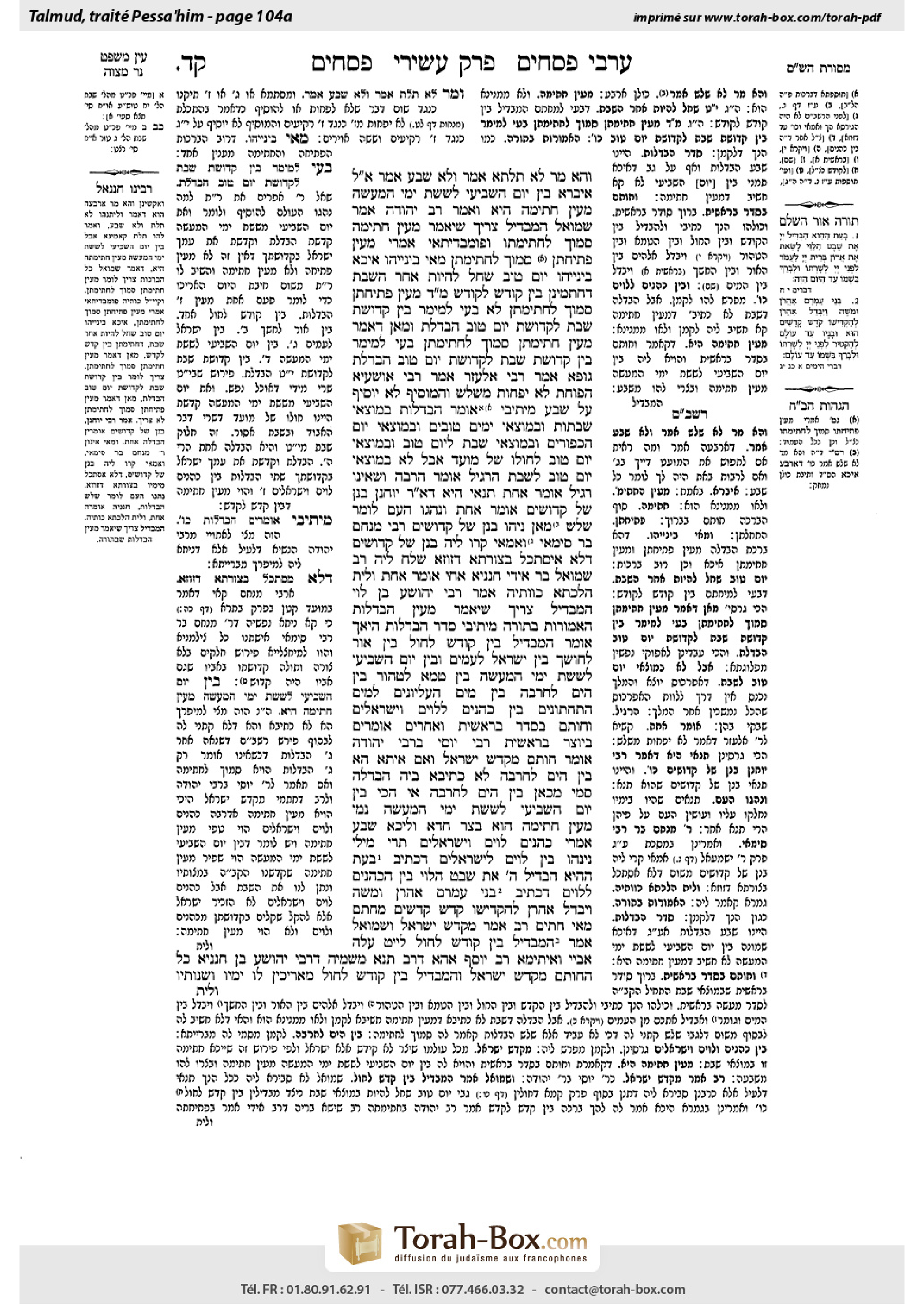
Pesachim 104a: Talmud study for Daf Yomi
Daf Yomi is the daily study of one Talmud folio. Explore 37 tractates with scans, Hebrew text, Sefaria English and AI-generated French translations where annotated.
Passage selection and English or AI-generated French translation are available where the scan has annotations. Daf Study is independent of Torah-Box and Sefaria.
Browse Pesachim · פסחים · All tractatesPesachim 104a text and translations
This page of Pesachim includes the Aramaic text, an English translation and an AI-generated French translation, alongside the scan above.
פסחים ק״ד א · Aramaic and Hebrew text
וְהָא מָר לָא תְּלָתָא אָמַר וְלָא שְׁבַע אָמַר! אֲמַר לֵיהּ: אִיבְרָא ״בֵּין יוֹם הַשְּׁבִיעִי לְשֵׁשֶׁת יְמֵי הַמַּעֲשֶׂה״, מֵעֵין חֲתִימָה הִיא, וְאָמַר רַב יְהוּדָה אָמַר שְׁמוּאֵל: הַמַּבְדִּיל צָרִיךְ שֶׁיֹּאמַר מֵעֵין חֲתִימָה סָמוּךְ לַחֲתִימָתוֹ. וּפוּמְבְּדִיתָאֵי אָמְרִי מֵעֵין פְּתִיחָתָן סָמוּךְ לַחֲתִימָתָן.
מַאי בֵּינַיְיהוּ? אִיכָּא בֵּינַיְיהוּ יוֹם טוֹב שֶׁחָל לִהְיוֹת אַחַר הַשַּׁבָּת, דְּחָתְמִינַן ״בֵּין קוֹדֶשׁ לְקוֹדֶשׁ״,
מַאן דְּאָמַר מֵעֵין פְּתִיחָתָן סָמוּךְ לַחֲתִימָתָן, לָא בָּעֵי לְמֵימַר ״בֵּין קְדוּשַּׁת שַׁבָּת לִקְדוּשַּׁת יוֹם טוֹב הִבְדַּלְתָּ״. וּמַאן דְּאָמַר מֵעֵין חֲתִימָתָן סָמוּךְ לַחֲתִימָתָן, בָּעֵי לְמֵימַר ״בֵּין קְדוּשַּׁת שַׁבָּת לִקְדוּשַּׁת יוֹם טוֹב הִבְדַּלְתָּ״.
גּוּפָא. אָמַר רַבִּי אֶלְעָזָר אָמַר רַבִּי אוֹשַׁעְיָא: הַפּוֹחֵת — לֹא יִפְחוֹת מִשָּׁלֹשׁ, וְהַמּוֹסִיף — לֹא יוֹסִיף עַל שֶׁבַע.
מֵיתִיבִי: אוֹמֵר הַבְדָּלוֹת בְּמוֹצָאֵי שַׁבָּתוֹת וּבְמוֹצָאֵי יָמִים טוֹבִים וּבְמוֹצָאֵי יוֹם הַכִּפּוּרִים, וּבְמוֹצָאֵי שַׁבָּת לְיוֹם טוֹב וּבְמוֹצָאֵי יוֹם טוֹב לְחוּלּוֹ שֶׁל מוֹעֵד, אֲבָל לֹא בְּמוֹצָאֵי יוֹם טוֹב לְשַׁבָּת. הָרָגִיל — אוֹמֵר הַרְבֵּה, וְשֶׁאֵינוֹ רָגִיל — אוֹמֵר אַחַת.
תַּנָּאֵי הִיא, דְּאָמַר רַבִּי יוֹחָנָן: בְּנָן שֶׁל קְדוֹשִׁים אוֹמֵר אַחַת, וְנָהֲגוּ הָעָם לוֹמַר שָׁלֹשׁ. מַאן נִיהוּ ״בְּנָן שֶׁל קְדוֹשִׁים״? רַבִּי מְנַחֵם בַּר סִימַאי. וְאַמַּאי קָרוּ לֵיהּ ״בְּנָן שֶׁל קְדוֹשִׁים״? דְּלָא אִיסְתַּכַּל בְּצוּרְתָּא דְזוּזָא. שְׁלַח לֵיהּ רַב שְׁמוּאֵל בַּר אִידִי: חֲנַנְיָא אָחִי אוֹמֵר אַחַת. וְלֵית הִלְכְתָא כְּווֹתֵיהּ.
אָמַר רַבִּי יְהוֹשֻׁעַ בֶּן לֵוִי: הַמַּבְדִּיל צָרִיךְ שֶׁיֹּאמַר מֵעֵין הַבְדָּלוֹת הָאֲמוּרוֹת בַּתּוֹרָה. מֵיתִיבִי: סֵדֶר הַבְדָּלוֹת הֵיאַךְ? אוֹמֵר: ״הַמַּבְדִּיל בֵּין קוֹדֶשׁ לְחוֹל, בֵּין אוֹר לְחוֹשֶׁךְ, בֵּין יִשְׂרָאֵל לָעַמִּים, וּבֵין יוֹם הַשְּׁבִיעִי לְשֵׁשֶׁת יְמֵי הַמַּעֲשֶׂה, בֵּין טָמֵא לְטָהוֹר, בֵּין הַיָּם לֶחָרָבָה, בֵּין מַיִם הָעֶלְיוֹנִים לְמַיִם הַתַּחְתּוֹנִים, בֵּין כֹּהֲנִים לִלְוִיִּם וְיִשְׂרְאֵלִים״.
וְחוֹתֵם בְּ״סֵדֶר בְּרֵאשִׁית״. וַאֲחֵרִים אוֹמְרִים: בְּ״יוֹצֵר בְּרֵאשִׁית״. רַבִּי יוֹסֵי בְּרַבִּי יְהוּדָה אוֹמֵר: חוֹתֵם ״מְקַדֵּשׁ יִשְׂרָאֵל״. וְאִם אִיתָא, הָא ״בֵּין הַיָּם לֶחָרָבָה״ לָא כְּתִיבָא בֵּיהּ ״הַבְדָּלָה״! סְמִי מִכָּאן ״בֵּין הַיָּם לֶחָרָבָה״.
אִי הָכִי ״בֵּין יוֹם הַשְּׁבִיעִי לְשֵׁשֶׁת יְמֵי הַמַּעֲשֶׂה״ נָמֵי? מֵעֵין חֲתִימָה הוּא, בְּצַר חֲדָא וְלֵיכָּא שֶׁבַע!
אָמְרִי, כֹּהֲנִים לְוִיִּם וְיִשְׂרְאֵלִים תְּרֵי מִילֵּי נִינְהוּ. בֵּין לְוִיִּם לְיִשְׂרְאֵלִים, דִּכְתִיב: ״בָּעֵת הַהִיא הִבְדִּיל ה׳ אֶת שֵׁבֶט הַלֵּוִי״. בֵּין הַכֹּהֲנִים לַלְוִיִּם, דִּכְתִיב: ״בְּנֵי עַמְרָם אַהֲרֹן וּמֹשֶׁה וַיִּבָּדֵל אַהֲרֹן לְהַקְדִּישׁוֹ קֹדֶשׁ קָדָשִׁים״.
מִחְתָּם מַאי חָתֵים? רַב אָמַר: ״מְקַדֵּשׁ יִשְׂרָאֵל״, וּשְׁמוּאֵל אָמַר: ״הַמַּבְדִּיל בֵּין קוֹדֶשׁ לְחוֹל״. לָיֵיט עֲלַהּ אַבָּיֵי וְאִיתֵּימָא רַב יוֹסֵף אַהָא דְּרַב.
תָּנָא מִשְּׁמֵיהּ דְּרַבִּי יְהוֹשֻׁעַ בֶּן חֲנַנְיָא: כׇּל הַחוֹתֵם ״מְקַדֵּשׁ יִשְׂרָאֵל וְהַמַּבְדִּיל בֵּין קוֹדֶשׁ לְחוֹל״ מַאֲרִיכִין לוֹ יָמָיו וּשְׁנוֹתָיו.
Pesachim 104a · English translation
But the Master did not say three distinctions, nor did he say seven, as he actually mentioned four distinctions. He said to him: In truth, that is inaccurate, as the distinction between the seventh day and the six days of work is not considered a separate statement of distinction. Rather, this distinction is mentioned because it is similar to the conclusion of the blessing, and Rav Yehuda said that Shmuel said: One who recites havdala must say an expression that is similar to the conclusion near the conclusion of the blessing, to emphasize the connection between the blessing and its conclusion. And the scholars of Pumbedita say that one must say a phrase similar to the beginnings of blessings near their conclusions.
With regard to the previously cited dispute, the Gemara asks: What is the practical difference between them? Since the beginning and end of a blessing generally address the same topic, what is the difference between these two opinions? The Gemara responds: The practical difference between them is in the case of a Festival that occurs after Shabbat, as one concludes this havdala with the phrase: Who separates between sacred and sacred.
The one who said that one must mention an expression similar to the beginnings of blessings near their conclusions would say that one is not required to say: Between the sanctity of Shabbat and the sanctity of the Festival You have distinguished, before concluding the blessing, as the beginning of the blessing refers simply to the sacred and the profane. And according to the one who said that one must say a phrase similar to the conclusions of blessings near their conclusions, one is required to say: Between the sanctity of Shabbat and the sanctity of the Festival You have distinguished.
The Gemara returns to the aforementioned matter itself. Rabbi Elazar said that Rabbi Oshaya said: One who decreases the number of distinctions mentioned in havdala should not decrease their number to less than three, and one who increases their number should not increase them to more than seven.
The Gemara raises an objection from the Tosefta: One says statements of distinctions at the conclusion of Shabbat, and at the conclusion of Festivals, and at the conclusion of Yom Kippur, and at the conclusion of Shabbat that leads into a Festival, and at the conclusion of a Festival that leads into the intermediate days of a Festival. However, one does not mention distinctions at the conclusion of a Festival that leads into Shabbat, as the sanctity of Shabbat is greater than that of a Festival. One who is accustomed to reciting distinctions may recite many distinctions, and one who is not accustomed to doing so recites only one distinction. This ruling implies that there is no absolute requirement to mention more than one distinction.
The Gemara answers: It is a dispute between tanna’im, as Rabbi Yoḥanan said: The son of sacred ones recites only one distinction, but the people were accustomed to recite three distinctions. The Gemara asks: Who is this person called the son of sacred ones? The Gemara answers: Rabbi Menaḥem bar Simai. And why did they call him the son of sacred ones? Because he would not look at the forms on coins, which were occasionally idolatrous symbols or some other prohibited image. The Gemara relates that Rav Shmuel bar Idi sent Rabbi Menaḥem bar Simai the following message: My brother Ḥananya says that one should mention only one distinction. However, the Gemara concludes: And the halakha is not in accordance with that opinion.
Rabbi Yehoshua ben Levi said: One who recites havdala must say distinctions similar to the distinctions stated explicitly in the Torah. One should not add other distinctions. The Gemara raises an objection from a baraita: How should one say the order of the distinctions in havdala? One recites: Who distinguishes between sacred and profane: Between light and darkness; between Israel and the nations; and between the seventh day and the six days of work; between the ritually impure and the ritually pure; between the sea and the dry land; between the upper waters above the firmament and the lower waters below the firmament; and between priests, Levites, and Israelites. This is an extended version of havdala, which includes references to seven distinctions.
The baraita continues: And one concludes the blessing with the order of Creation: Blessed is He Who arranges the order of Creation, or: Who orders Creation. And others say that one concludes with: Who fashions Creation. Rabbi Yosei, son of Rabbi Yehuda, says that one concludes with the phrase: Who sanctifies Israel. The Gemara explains its objection: And if what Rabbi Yehoshua ben Levi said is so, the distinction between the sea and the dry land should not be mentioned, as the term distinction is not written with regard to this issue. The Gemara answers: Remove from here the distinction between the sea and the dry land.
The Gemara asks: If so, the distinction between the seventh day and the six days of work should also not be counted in the tally of the distinctions, as it is mentioned only to repeat something similar to the conclusion. Consequently, this text of havdala lacks one more distinction, and this means that there are not seven distinctions in total.
They say in answer to this question: The distinction between priests, Levites, and Israelites is two matters, i.e., it counts as two separate distinctions. One distinction is between Levites and Israelites, as it is written: “At that time the Lord separated the tribe of Levi to bear the Ark of the covenant of the Lord” (Deuteronomy 10:8). A further distinction is that between the priests and the Levites, as it is written: “The sons of Amram: Aaron and Moses; and Aaron was separated, that he should be sanctified as most holy, he and his sons forever” (I Chronicles 23:13).
The Gemara asks: What formula should be used to conclude the blessing of havdala? Rav said the blessing should conclude with the phrase: Who sanctifies Israel. And Shmuel said the concluding phrase is: Who distinguishes between sacred and profane. The Gemara adds that Abaye, and some say it was Rav Yosef, cursed it, i.e., he would become angry at one who concluded the blessing in accordance with that opinion of Rav.
It was taught in the name of Rabbi Yehoshua ben Ḥananya: Anyone who concludes the havdala blessing with the combined formula: Who sanctifies Israel and distinguishes between sacred and profane, God will lengthen his days and years.
Pesachim 104a · Traduction française (IA)
Mais le Maître n’a dit ni trois distinctions ni sept, puisqu’il en a effectivement mentionné quatre. Il lui répondit : À vrai dire, cela n’est pas exact, car la distinction entre le septième jour et les six jours de travail n’est pas considérée comme une expression distincte de distinction. Elle est plutôt mentionnée parce qu’elle ressemble à la conclusion de la bénédiction. Or Rav Yehouda a dit au nom de Chmouel : Celui qui récite la havdala doit prononcer, près de la conclusion de la bénédiction, une expression qui ressemble à cette conclusion, afin de souligner le lien entre la bénédiction et sa conclusion. Les sages de Poumbedita disent qu’il faut prononcer, près de la conclusion, une formule qui ressemble au début des bénédictions.
À propos du désaccord cité précédemment, la Guemara demande : Quelle est la différence pratique entre eux ? Puisque le début et la fin d’une bénédiction portent généralement sur le même sujet, quelle différence y a-t-il entre ces deux avis ? La Guemara répond : La différence pratique concerne un jour de fête qui tombe après Chabbat, car on conclut alors cette havdala par la formule : « Qui distingue entre le sacré et le sacré. »
Celui qui dit qu’il faut prononcer, près de leur conclusion, une expression qui ressemble au début des bénédictions, dirait qu’il n’est pas nécessaire de dire, avant de conclure la bénédiction : « Tu as distingué entre la sainteté de Chabbat et la sainteté du jour de fête », puisque le début de celle-ci évoque simplement le sacré et le profane. Selon celui qui dit qu’il faut prononcer, près de leur conclusion, une formule qui ressemble à la conclusion des bénédictions, il faut dire : « Tu as distingué entre la sainteté de Chabbat et la sainteté du jour de fête. »
La Guemara revient à la question elle-même : Rabbi Elazar a dit au nom de Rabbi Ochaya : Celui qui réduit le nombre de distinctions mentionnées dans la havdala ne doit pas en mentionner moins de trois ; et celui qui en augmente le nombre ne doit pas en mentionner plus de sept.
La Guemara soulève une objection tirée de la Tossefta : On prononce des formules de distinction à la fin de Chabbat, à la fin des jours de fête, à la fin de Yom Kippour, à la fin de Chabbat qui précède un jour de fête, ainsi qu’à la fin d’un jour de fête qui précède les jours intermédiaires de la fête. En revanche, on ne mentionne pas de distinctions à la fin d’un jour de fête qui précède Chabbat, car la sainteté de Chabbat est supérieure à celle d’un jour de fête. Celui qui a l’habitude de réciter des distinctions peut en réciter beaucoup, tandis que celui qui n’en a pas l’habitude n’en récite qu’une seule. Cette décision implique qu’il n’est pas absolument obligatoire de mentionner plus d’une distinction.
La Guemara répond : Il s’agit d’un désaccord entre des tannaïm, car Rabbi Yo’hanan a dit : Le fils des saints ne récite qu’une seule distinction, mais les gens avaient l’habitude d’en réciter trois. La Guemara demande : Qui est cet homme appelé le fils des saints ? La Guemara répond : Rabbi Mena’hem bar Simai. Et pourquoi l’appelait-on le fils des saints ? Parce qu’il ne regardait pas les effigies figurant sur les pièces, qui étaient parfois des symboles idolâtres ou d’autres images interdites. La Guemara rapporte que Rav Chmouel bar Idi fit parvenir à Rabbi Mena’hem bar Simai le message suivant : « Mon frère ‘Hananya dit qu’il ne faut mentionner qu’une seule distinction. » Toutefois, la Guemara conclut : La halakha n’est pas conforme à cet avis.
Rabbi Yehochoua ben Lévi a dit : Celui qui récite la havdala doit mentionner des distinctions semblables à celles qui sont explicitement énoncées dans la Torah. Il ne faut pas en ajouter d’autres. La Guemara soulève une objection tirée d’une baraïta : Comment doit-on réciter l’ordre des distinctions dans la havdala ? On récite : « Qui distingue entre le sacré et le profane ; entre la lumière et l’obscurité ; entre Israël et les nations ; entre le septième jour et les six jours de travail ; entre l’impur rituellement et le pur rituellement ; entre la mer et la terre ferme ; entre les eaux supérieures au-dessus du firmament et les eaux inférieures au-dessous du firmament ; et entre les prêtres, les Lévites et les Israélites. » Il s’agit d’une version développée de la havdala, qui mentionne sept distinctions.
La baraïta poursuit : On conclut la bénédiction par une formule relative à l’ordre de la Création : « Béni soit Celui qui ordonne la Création », ou : « Qui ordonne la Création ». D’autres disent que l’on conclut par : « Qui façonne la Création. » Rabbi Yossi, fils de Rabbi Yehouda, dit que l’on conclut par la formule : « Qui sanctifie Israël. » La Guemara explique l’objection : Si ce que dit Rabbi Yehochoua ben Lévi est exact, il ne faudrait pas mentionner la distinction entre la mer et la terre ferme, car le terme « distinction » n’est pas employé à propos de cette question. La Guemara répond : Retire d’ici la distinction entre la mer et la terre ferme.
La Guemara demande : Dans ce cas, il ne faudrait pas non plus compter parmi les distinctions celle entre le septième jour et les six jours de travail, puisqu’elle n’est mentionnée que pour répéter une formule semblable à la conclusion. Par conséquent, ce texte de havdala comporte une distinction de moins encore, ce qui signifie qu’il n’y a pas sept distinctions en tout.
On répond à cette question : La distinction entre les prêtres, les Lévites et les Israélites comprend deux éléments, c’est-à-dire qu’elle compte comme deux distinctions distinctes. L’une est la distinction entre les Lévites et les Israélites, comme il est écrit : « À cette époque, le Seigneur sépara la tribu de Lévi pour porter l’Arche de l’alliance du Seigneur » (Deutéronome 10:8). Une autre distinction est celle entre les prêtres et les Lévites, comme il est écrit : « Fils d’Amram : Aaron et Moïse ; Aaron fut mis à part afin d’être sanctifié comme très saint, lui et ses fils pour toujours » (I Chroniques 23:13).
La Guemara demande : Quelle formule faut-il employer pour conclure la bénédiction de la havdala ? Rav dit que la bénédiction doit se conclure par la formule : « Qui sanctifie Israël. » Et Chmouel dit que la formule de conclusion est : « Qui distingue entre le sacré et le profane. » La Guemara ajoute qu’Abayé — et certains disent que c’était Rav Yossef — le maudissait, c’est-à-dire qu’il se mettait en colère contre celui qui concluait la bénédiction conformément à l’avis de Rav.
Il a été enseigné au nom de Rabbi Yehochoua ben ‘Hananya : Quiconque conclut la bénédiction de la havdala par la formule combinée : « Qui sanctifie Israël et distingue entre le sacré et le profane », Dieu prolongera ses jours et ses années.
Traduction française générée par IA à partir de l’édition anglaise de Sefaria. Vérifie toujours un passage avec le texte source.
Text from Sefaria: William Davidson Edition - Vocalized Aramaic (CC BY NC); William Davidson Edition - English (CC BY NC).