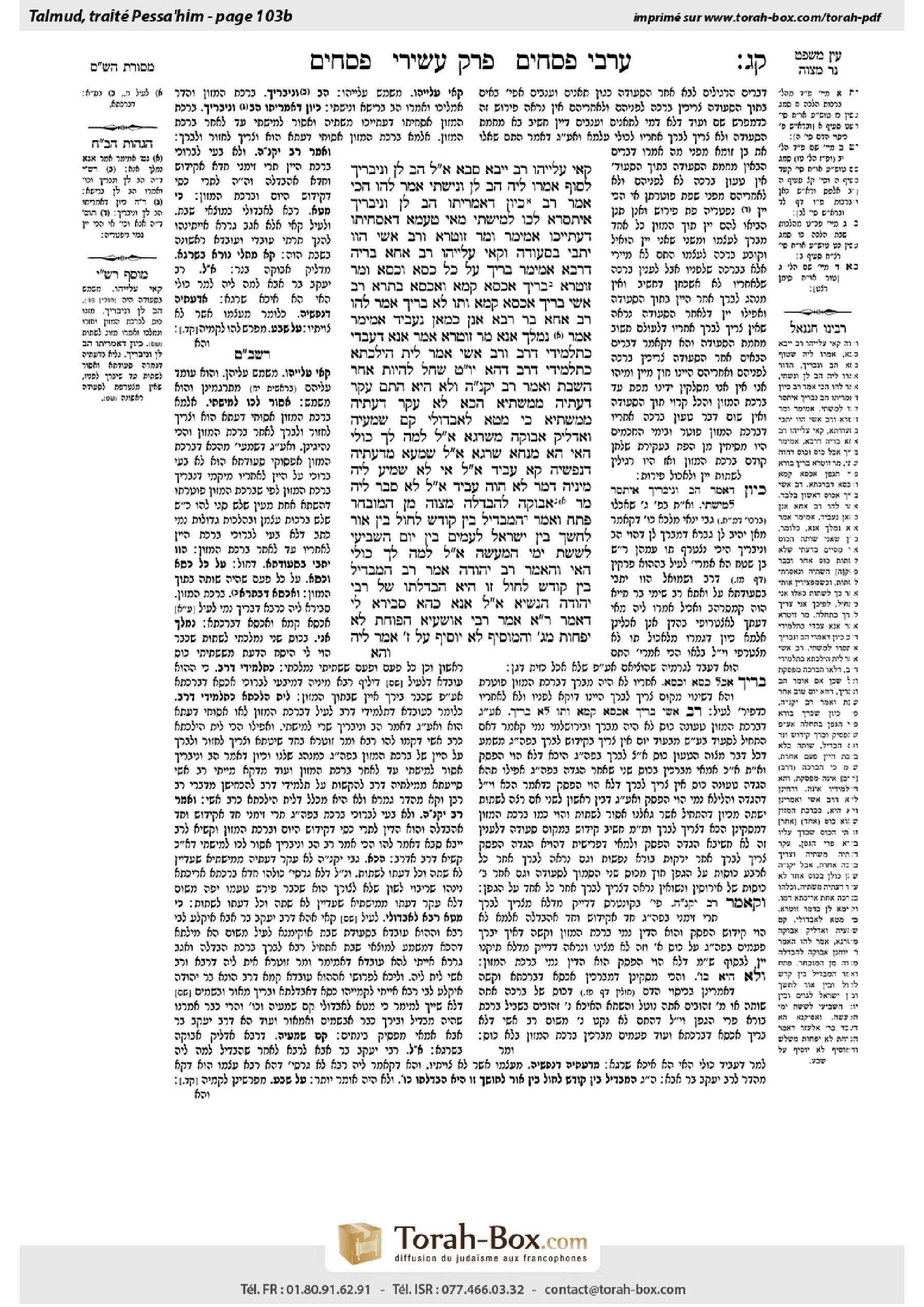
Pesachim 103b: Talmud study for Daf Yomi
Daf Yomi is the daily study of one Talmud folio. Explore 37 tractates with scans, Hebrew text, Sefaria English and AI-generated French translations where annotated.
Passage selection and English or AI-generated French translation are available where the scan has annotations. Daf Study is independent of Torah-Box and Sefaria.
Browse Pesachim · פסחים · All tractatesPesachim 103b text and translations
This page of Pesachim includes the Aramaic text, an English translation and an AI-generated French translation, alongside the scan above.
פסחים ק״ג ב · Aramaic and Hebrew text
קָאֵי עֲלַיְיהוּ רַב יֵיבָא סָבָא. אֲמַרוּ לֵיהּ: הַב לַן וְנִיבָרֵיךְ. לְסוֹף אֲמַרוּ לֵיהּ: הַב לַן וְנִישְׁתֵּי, אֲמַר לְהוּ: הָכִי אָמַר רַב, כֵּיוָן דְּאָמְרִיתוּ הַב לַן וְנִיבָרֵיךְ, אִיתַּסְרָא לְכוּ לְמִישְׁתֵּי. מַאי טַעְמָא, דְּאַסְחִיתוּ דַּעְתַּיְיכוּ.
אַמֵּימָר וּמָר זוּטְרָא וְרַב אָשֵׁי הֲווֹ יָתְבִי בִּסְעוּדָה, וְקָאֵי עֲלַיְיהוּ רַב אַחָא בְּרֵיהּ דְּרָבָא. אַמֵּימָר בָּרֵיךְ עַל כׇּל כָּסָא וְכָסָא, וּמָר זוּטְרָא בָּרֵיךְ אַכָּסָא קַמָּא וְאַכָּסָא בָּתְרָא, רַב אָשֵׁי בָּרֵיךְ אַכָּסָא קַמָּא, וְתוּ לָא בָּרֵיךְ.
אֲמַר לְהוּ רַב אַחָא בַּר רָבָא: אֲנַן כְּמַאן נַעֲבֵיד? אַמֵּימָר אָמַר: נִמְלָךְ אֲנָא. מָר זוּטְרָא אָמַר: אֲנָא דַּעֲבַדִי כְּתַלְמִידֵי דְרַב.
וְרַב אָשֵׁי אָמַר: לֵית הִילְכְתָא כְּתַלְמִידֵי דְרַב, דְּהָא יוֹם טוֹב שֶׁחָל לִהְיוֹת אַחַר הַשַּׁבָּת, וְאָמַר רַב: יַקְנֶ״ה.
וְלָא הִיא, הָתָם — עָקַר דַּעְתֵּיהּ מִמִּשְׁתְּיָא, הָכָא — לָא עָקַר דַּעְתֵּיהּ מִמִּשְׁתְּיָא.
כִּי מְטָא לְאַבְדּוֹלֵי, קָם שַׁמָּעֵיהּ וְאַדְלֵיק אֲבוּקָה מִשְּׁרָגָא. אֲמַר לֵיהּ: לְמָה לָךְ כּוּלֵּי הַאי, הָא מַנְחָא שְׁרָגָא! אֲמַר לֵיהּ: שַׁמָּעָא מִדַּעְתֵּיהּ דְּנַפְשֵׁיהּ קָא עָבֵיד. אֲמַר לֵיהּ: אִי לָא שְׁמִיעַ לֵיהּ מִינֵּיהּ דְּמָר, לָא הֲוָה עָבֵיד! אֲמַר לֵיהּ: לָא סָבַר לֵיהּ מָר אֲבוּקָה לְהַבְדָּלָה מִצְוָה מִן הַמּוּבְחָר.
פָּתַח וְאָמַר: ״הַמַּבְדִּיל בֵּין קוֹדֶשׁ לְחוֹל בֵּין אוֹר לְחֹשֶׁךְ בֵּין יִשְׂרָאֵל לָעַמִּים בֵּין יוֹם הַשְּׁבִיעִי לְשֵׁשֶׁת יְמֵי הַמַּעֲשֶׂה״ אֲמַר לֵיהּ: לְמָה לָךְ כּוּלֵּי הַאי? וְהָאָמַר רַב יְהוּדָה אָמַר רַב: ״הַמַּבְדִּיל בֵּין קוֹדֶשׁ לְחוֹל״ זוֹ הִיא הַבְדָּלָתוֹ שֶׁל רַבִּי יְהוּדָה הַנָּשִׂיא?
אֲמַר לֵיהּ: אֲנָא כְּהָא סְבִירָא לִי, דְּאָמַר רַבִּי אֶלְעָזָר אָמַר רַבִּי אוֹשַׁעְיָא: הַפּוֹחֵת לֹא יִפְחוֹת מִשָּׁלֹשׁ, וְהַמּוֹסִיף לֹא יוֹסִיף עַל שֶׁבַע. אֲמַר לֵיהּ:
Pesachim 103b · English translation
and Rav Yeiva the Elder stood over them to serve them. They said to him: Give us a cup of wine and we will recite the blessings of Grace after Meals. Ultimately, they changed their mind and said to him: Give us a cup of wine and we will drink it. He said to them that Rav said as follows: Since you have said: Give us a cup and we will recite the blessings of Grace after Meals, it is prohibited for you to drink any more. What is the reason for this? The reason is that you have diverted your attention from drinking. Therefore, if you want to drink any more, you must recite the blessing over wine again.
The Gemara relates that Ameimar, Mar Zutra, and Rav Ashi were sitting at a meal, and Rav Aḥa, son of Rava, stood over them to serve them. Ameimar recited a blessing over each and every cup of wine he drank. And Mar Zutra recited a blessing over the first cup he drank during the meal and over the last cup he drank, upon concluding Grace after Meals. Rav Ashi recited a blessing over the first cup and did not recite any further blessings over the subsequent cups he drank.
Rav Aḥa bar Rava said to them: In accordance with whose opinion should we act in this matter? We have witnessed three different courses of action. Ameimar said: I repeatedly changed my mind. In other words, the reason Ameimar recited a blessing over each cup was not because he maintains that it is always necessary to do so. Rather, he drank each cup with the intention that it should be his last. Consequently, he diverted his attention from drinking each time, and therefore he was required to recite a new blessing before he could drink again. Mar Zutra said: I acted in accordance with the opinion of the students of Rav. They maintain that one who prepares to recite Grace after Meals has completely diverted his attention from drinking, and therefore the blessing on wine that one recites during the meal does not include the wine he drinks after Grace after Meals.
And Rav Ashi said: The halakha is not in accordance with the opinion of the students of Rav. This can be proven from a ruling of Rav himself, as with regard to a Festival that occurs after Shabbat, Rav said that the order of blessings is yod, kuf, nun, heh: Wine [yayin], kiddush, candle [ner], and havdala. This shows that although one recites kiddush between the blessing over wine and havdala, it is unnecessary to recite the blessing over wine again before havdala. The same should hold true in our case: Just as kiddush is not considered an interruption between the blessing over wine and its consumption, Grace after Meals should not be considered an interruption either.
The Gemara rejects this reasoning: And that is not so. There, when one is preparing himself to recite Grace after Meals, he has already uprooted his mind from drinking. Here, with regard to kiddush and havdala, he has not uprooted his mind from drinking.
After discussing the opinion of the students of Rav, the Gemara returns to the story of Rav Ya’akov bar Abba’s visit to Rava. When the time came to recite havdala, Rava’s attendant got up and lit a torch from a candle. Rav Ya’akov bar Abba said to him: Why do you need all this? The candle was present, and you could have recited the blessing over the light of the candle itself. Rava said to him: The attendant did this on his own accord, without consulting me. Rav Ya’akov bar Abba said to him: If he had not heard it from the Master he would not have done it on his own; he must have been following your opinion on this matter. Rava said to him: Does the Master not maintain that using a torch for havdala is the optimal manner in which to fulfill the mitzva? It is for this reason that the attendant lit a torch for havdala.
Rava began his recitation of havdala and said: Who distinguishes between sacred and profane, between light and darkness, between Israel and the nations, between the seventh day and the six days of work. Rav Ya’akov bar Abba said to him: Why do you need all this? Didn’t Rav Yehuda say that Rav said with regard to the statement: Who distinguishes between sacred and profane, that this alone is the havdala of Rabbi Yehuda HaNasi? Why is this plain statement not enough for you?
He said to him: I maintain in accordance with this statement that Rabbi Elazar said that Rabbi Oshaya said: One who decreases the number of distinctions in the text of the havdala should not decrease them to less than three, and one who increases the number of distinctions should not increase them to more than seven. Rav Ya’akov bar Abba said to him:
Pesachim 103b · Traduction française (IA)
Et Rav Yeiva l’Ancien se tenait auprès d’eux pour les servir. Ils lui dirent : « Donne-nous une coupe de vin et nous réciterons le Birkat Hamazon. » Finalement, ils changèrent d’avis et lui dirent : « Donne-nous une coupe de vin et nous la boirons. » Il leur répondit que Rav avait enseigné ceci : « Puisque vous avez dit : “Donne-nous une coupe et nous réciterons le Birkat Hamazon”, il vous est interdit de boire davantage. » Pourquoi ? Parce que vous avez détourné votre attention de la boisson. Par conséquent, si vous voulez encore boire, vous devez réciter de nouveau la bénédiction sur le vin.
La Guemara rapporte qu’Ameimar, Mar Zutra et Rav Ashi étaient attablés, et que Rav Aḥa, fils de Rava, se tenait auprès d’eux pour les servir. Ameimar récitait une bénédiction sur chaque coupe de vin qu’il buvait. Mar Zutra récitait une bénédiction sur la première coupe qu’il buvait pendant le repas, puis sur la dernière, après avoir achevé le Birkat Hamazon. Rav Ashi récitait une bénédiction sur la première coupe et n’en récitait aucune autre sur les coupes suivantes qu’il buvait.
Rav Aḥa bar Rava leur dit : « Selon l’opinion de qui devons-nous agir en la matière ? Nous avons vu trois conduites différentes. » Ameimar répondit : « Je changeais sans cesse d’avis. » Autrement dit, s’il récitait une bénédiction sur chaque coupe, ce n’était pas parce qu’il estimait qu’il fallait toujours le faire. Il buvait chaque coupe avec l’intention que ce soit la dernière. Ainsi, chaque fois, il détournait son attention de la boisson et devait donc réciter une nouvelle bénédiction avant de pouvoir boire à nouveau. Mar Zutra dit : « J’ai agi conformément à l’opinion des élèves de Rav. » Selon eux, celui qui se prépare à réciter le Birkat Hamazon a complètement détourné son attention de la boisson ; la bénédiction sur le vin récitée pendant le repas ne couvre donc pas le vin qu’il boit après le Birkat Hamazon.
Rav Ashi dit : « La halakha n’est pas conforme à l’opinion des élèves de Rav. » On peut le démontrer par une décision de Rav lui-même : au sujet d’une fête qui tombe après Chabbat, Rav a dit que l’ordre des bénédictions est יַקְנֶה״ז : le vin [yayin], le kiddouch, la flamme [ner] et la havdala. Cela montre que, bien que l’on récite le kiddouch entre la bénédiction sur le vin et la havdala, il n’est pas nécessaire de réciter de nouveau la bénédiction sur le vin avant la havdala. Il devrait en être de même dans notre cas : de même que le kiddouch n’est pas considéré comme une interruption entre la bénédiction sur le vin et sa consommation, le Birkat Hamazon ne devrait pas non plus être considéré comme une interruption.
La Guemara rejette ce raisonnement : « Il n’en est pas ainsi. Dans ce cas, lorsqu’on se prépare à réciter le Birkat Hamazon, on a déjà détourné son attention de la boisson. Ici, pour le kiddouch et la havdala, on n’a pas détourné son attention de la boisson. »
Après avoir discuté de l’opinion des élèves de Rav, la Guemara revient au récit de la visite de Rav Ya’akov bar Abba chez Rava. Lorsque vint le moment de réciter la havdala, le serviteur de Rava se leva et alluma une torche à l’aide d’une bougie. Rav Ya’akov bar Abba lui dit : « Pourquoi tout cela ? La bougie était là, et tu aurais pu réciter la bénédiction sur sa lumière. » Rava lui répondit : « Le serviteur a agi de son propre chef, sans me consulter. » Rav Ya’akov bar Abba lui dit : « S’il ne l’avait pas entendu du Maître, il ne l’aurait pas fait de lui-même ; il a dû suivre ton opinion en la matière. » Rava lui répondit : « Le Maître ne considère-t-il pas que l’usage d’une torche pour la havdala est la manière optimale d’accomplir la mitsva ? C’est pour cette raison que le serviteur a allumé une torche pour la havdala. »
Rava commença à réciter la havdala et dit : « Celui qui distingue entre le sacré et le profane, entre la lumière et l’obscurité, entre Israël et les nations, entre le septième jour et les six jours de travail. » Rav Ya’akov bar Abba lui dit : « Pourquoi tout cela ? Rav Yehouda n’a-t-il pas dit au nom de Rav, au sujet de la formule “Celui qui distingue entre le sacré et le profane”, que cette seule formule constitue la havdala de Rabbi Yehouda HaNassi ? Pourquoi cette simple formule ne te suffit-elle pas ? »
Il lui répondit : « Je suis cette opinion, selon laquelle Rabbi Elazar a dit au nom de Rabbi Oshaya : Celui qui réduit le nombre de distinctions dans le texte de la havdala ne doit pas les réduire à moins de trois, et celui qui augmente le nombre de distinctions ne doit pas les porter à plus de sept. » Rav Ya’akov bar Abba lui dit :
Traduction française générée par IA à partir de l’édition anglaise de Sefaria. Vérifie toujours un passage avec le texte source.
Text from Sefaria: William Davidson Edition - Vocalized Aramaic (CC BY NC); William Davidson Edition - English (CC BY NC).