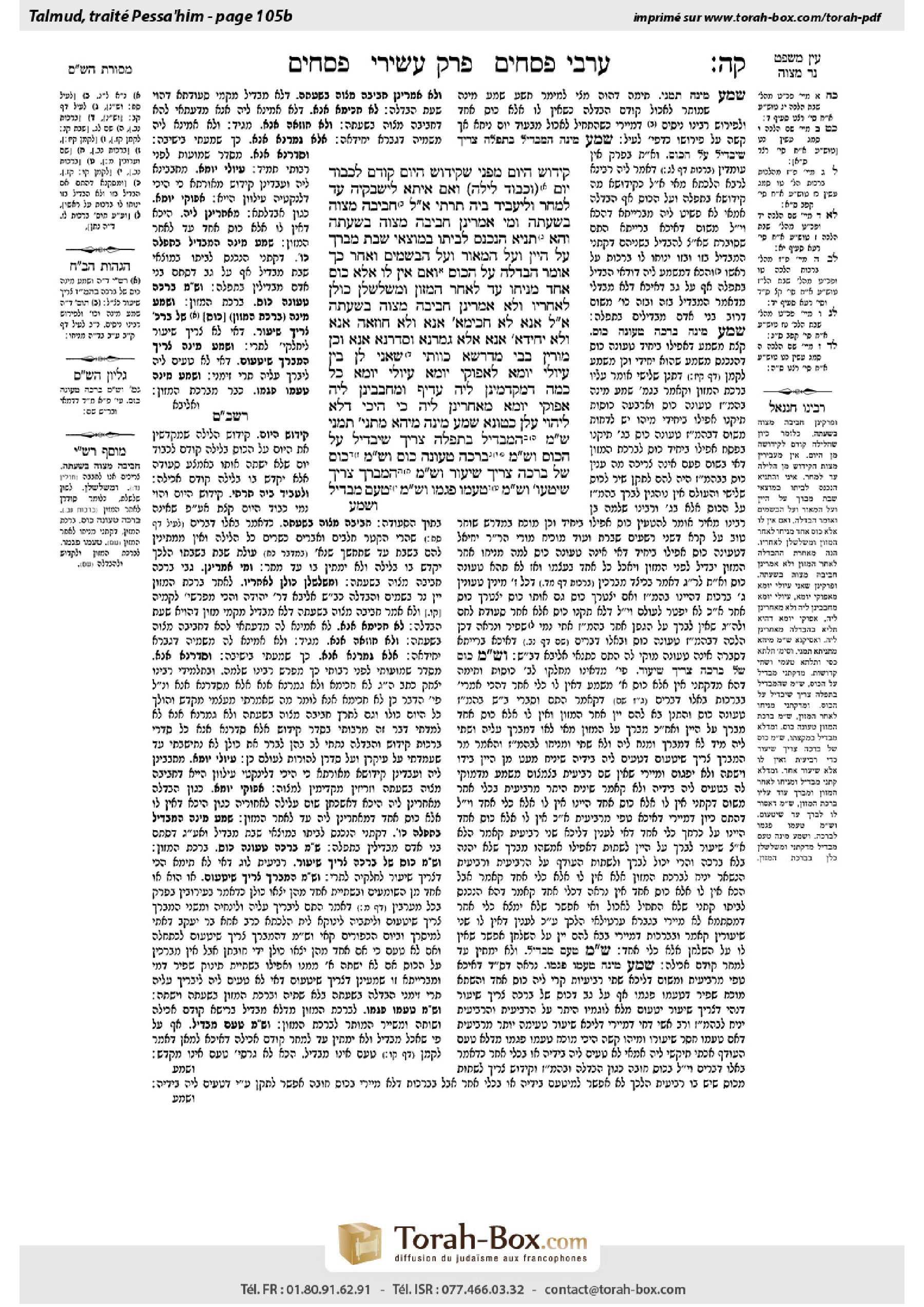
Pesachim 105b: Talmud study for Daf Yomi
Daf Yomi is the daily study of one Talmud folio. Explore 37 tractates with scans, Hebrew text, Sefaria English and AI-generated French translations where annotated.
Passage selection and English or AI-generated French translation are available where the scan has annotations. Daf Study is independent of Torah-Box and Sefaria.
Browse Pesachim · פסחים · All tractatesPesachim 105b text and translations
This page of Pesachim includes the Aramaic text, an English translation and an AI-generated French translation, alongside the scan above.
פסחים ק״ה ב · Aramaic and Hebrew text
קִידּוּשׁ הַיּוֹם, מִפְּנֵי שֶׁקִּידּוּשׁ הַיּוֹם קוֹדֵם לִכְבוֹד יוֹם (וּכְבוֹד לַיְלָה). וְאִם אִיתָא — לִישְׁבְּקֵיהּ עַד לִמְחַר, וְלֶיעְבֵּיד בֵּיהּ תַּרְתֵּי! אֲמַר לֵיהּ: חֲבִיבָה מִצְוָה בִּשְׁעָתָהּ.
וּמִי אָמְרִינַן חֲבִיבָה מִצְוָה בִּשְׁעָתָהּ? וְהָא תַּנְיָא: הַנִּכְנָס לְבֵיתוֹ בְּמוֹצָאֵי שַׁבָּת מְבָרֵךְ עַל הַיַּיִן וְעַל הַמָּאוֹר וְעַל הַבְּשָׂמִים, וְאַחַר כָּךְ אוֹמֵר הַבְדָּלָה עַל הַכּוֹס. וְאִם אֵין לוֹ אֶלָּא כּוֹס אֶחָד — מַנִּיחוֹ עַד לְאַחַר הַמָּזוֹן וּמְשַׁלְשְׁלָן כּוּלָּן לְאַחֲרָיו, וְלָא אָמְרִינַן חֲבִיבָה מִצְוָה בִּשְׁעָתָהּ!
אֲמַר לֵיהּ: אֲנָא לָא חַכִּימָאָה אֲנָא, וְלָא חוֹזָאָה אֲנָא, וְלָא יְחִידָאָה אֲנָא, אֶלָּא גַּמְרָנָא וְסַדְרָנָא אֲנָא, וְכֵן מוֹרִין בְּבֵי מִדְרְשָׁא כְּווֹתִי. שָׁאנֵי לַן בֵּין עַיּוֹלֵי יוֹמָא לְאַפּוֹקֵי יוֹמָא: עַיּוֹלֵי יוֹמָא — כׇּל כַּמָּה דְּמַקְדְּמִינַן לֵיהּ עֲדִיף, וּמְחַבְּבִינַן לֵיהּ. אַפּוֹקֵי יוֹמָא — מְאַחֲרִינַן לֵיהּ, כִּי הֵיכִי דְּלָא לֶיהֱוֵי עֲלַן כְּטוּנָא.
שְׁמַע מִינַּהּ מִיהָא מַתְנִיתָא תַּמְנֵי. שְׁמַע מִינַּהּ: הַמַּבְדִּיל בִּתְפִלָּה — צָרִיךְ שֶׁיַּבְדִּיל עַל הַכּוֹס.
וּשְׁמַע מִינַּהּ: בְּרָכָה טְעוּנָה כּוֹס. וּשְׁמַע מִינַּהּ: כּוֹס שֶׁל בְּרָכָה צָרִיךְ שִׁיעוּר.
וּשְׁמַע מִינַּהּ: הַמְבָרֵךְ צָרִיךְ שֶׁיִּטְעוֹם. וּשְׁמַע מִינַּהּ: טְעָמוֹ — פְּגָמוֹ. וּשְׁמַע מִינַּהּ: טָעַם מַבְדִּיל.
Pesachim 105b · English translation
the sanctification of the day, i.e., kiddush at night, at the beginning of Shabbat, because the sanctification of the day takes precedence over the honor of the day and the honor of the night. And if it is so, that one who fails to recite kiddush at night may do so at any time during the day, let him leave over the cup of wine until the following day and use it for two mitzvot, as he can recite kiddush during the day and simultaneously honor the Shabbat day by drinking wine. Rav Naḥman bar Yitzḥak said to him: A mitzva is beloved in its proper time.
Ravina objected to this answer: And do we say that a mitzva is beloved in its proper time? But wasn’t it taught in a baraita: One who enters his home at the conclusion of Shabbat recites the blessing over the wine, and then over the light, and then over the spices, and recites havdala thereafter over the cup of wine. And if he has only one cup of wine, he leaves it for after he eats his food, and uses it for Grace after Meals, and arranges all of the other blessings together thereafter. This baraita indicates that we do not say that a mitzva is beloved in its proper time, as one does not have to recite havdala immediately, i.e., before partaking of his meal.
He said to him: I am neither a scholar, nor a speculator, nor an important individual; rather, I teach and systematically arrange halakhic rulings, and the scholars instruct the students in the study hall in accordance with my opinion. I maintain that there is a difference for us between the arrival of the day of Shabbat and the departure of the day. With regard to the arrival of the day, the sooner we welcome the day by reciting kiddush the better, and we thereby express how beloved it is to us. With regard to the conclusion of the day, we delay it so that Shabbat will not appear to be like a burden to us.
The Gemara points out that one may learn from this baraita eight halakhot. The Gemara elaborates: Learn from it that one who recites havdala in the evening prayer must also recite havdala over a cup. The baraita states that one who comes home must recite the blessing over wine and havdala, despite the fact that he has presumably already recited havdala in the evening prayer service.
And learn from it that one who recites the blessing of Grace after Meals requires a cup of wine. And learn from it that a cup of blessing requires a minimum measure, for otherwise it would have been possible for one who has only one cup of wine to simply divide it into two, recite havdala immediately, and still have a cup of wine left over for Grace after Meals.
And learn from it that one who recites a blessing must taste the food over which he recites the blessing. Otherwise, one who has only one cup of wine would be able to use it for both havdala and Grace after Meals. And learn from it that once he has tasted the wine in the cup he has disqualified it from further use as a cup of blessing. And learn from it that even if one has tasted food after Shabbat, he nevertheless recites havdala.
Pesachim 105b · Traduction française (IA)
La sanctification du jour, c’est-à-dire le kiddouch le soir, au début de Chabbat, car la sanctification du jour prime sur l’honneur dû au jour et à la nuit. Et s’il en est ainsi, si celui qui n’a pas récité le kiddouch le soir peut le faire à n’importe quel moment de la journée, qu’il garde la coupe de vin jusqu’au lendemain et l’utilise pour deux mitsvot, puisqu’il pourra réciter le kiddouch pendant la journée tout en honorant le jour de Chabbat en buvant du vin. Rav Naḥman bar Yitzḥak lui dit : Une mitsva est chère lorsqu’elle est accomplie en son temps.
Ravina objecta à cette réponse : Dit-on donc qu’une mitsva est chère lorsqu’elle est accomplie en son temps ? Pourtant, n’a-t-on pas enseigné dans une baraïta : Celui qui rentre chez lui à la fin de Chabbat récite la bénédiction sur le vin, puis sur la lumière, puis sur les aromates, et récite ensuite la havdala sur la coupe de vin. Et s’il ne dispose que d’une seule coupe de vin, il la garde pour après son repas, l’utilise pour le Birkat Hamazon, puis récite alors toutes les autres bénédictions. Cette baraïta indique que nous ne disons pas qu’une mitsva est chère lorsqu’elle est accomplie en son temps, car il n’est pas nécessaire de réciter la havdala immédiatement, c’est-à-dire avant de prendre son repas.
Il lui dit : Je ne suis ni un érudit, ni un homme de réflexion, ni un personnage important ; j’enseigne et ordonne systématiquement les décisions de halakha, et les érudits enseignent aux élèves à la maison d’étude conformément à mon avis. À mon sens, il y a pour nous une différence entre l’arrivée du jour de Chabbat et son départ. À l’arrivée du jour, plus tôt nous l’accueillons en récitant le kiddouch, mieux c’est, et nous montrons ainsi combien il nous est cher. À la fin du jour, nous tardons à le faire afin que Chabbat ne nous apparaisse pas comme un fardeau.
La Guemara relève que l’on peut tirer de cette baraïta huit halakhot. Elle précise : Apprends-en que celui qui récite la havdala dans la prière du soir doit également réciter la havdala sur une coupe. La baraïta indique que celui qui rentre chez lui doit réciter la bénédiction sur le vin et la havdala, bien qu’il ait vraisemblablement déjà récité la havdala pendant la prière du soir.
Et apprends-en que celui qui récite le Birkat Hamazon a besoin d’une coupe de vin. Et apprends-en qu’une coupe de bénédiction doit contenir une quantité minimale ; sinon, celui qui ne dispose que d’une seule coupe de vin pourrait simplement la partager en deux, réciter immédiatement la havdala et garder suffisamment de vin pour une coupe destinée au Birkat Hamazon.
Et apprends-en que celui qui récite une bénédiction doit goûter l’aliment sur lequel porte cette bénédiction. Sinon, celui qui ne dispose que d’une seule coupe de vin pourrait l’utiliser à la fois pour la havdala et pour le Birkat Hamazon. Et apprends-en qu’une fois qu’il a goûté le vin de la coupe, il l’a rendue impropre à servir de nouveau de coupe de bénédiction. Et apprends-en que même si l’on a goûté de la nourriture après Chabbat, on récite néanmoins la havdala.
Traduction française générée par IA à partir de l’édition anglaise de Sefaria. Vérifie toujours un passage avec le texte source.
Text from Sefaria: William Davidson Edition - Vocalized Aramaic (CC BY NC); William Davidson Edition - English (CC BY NC).