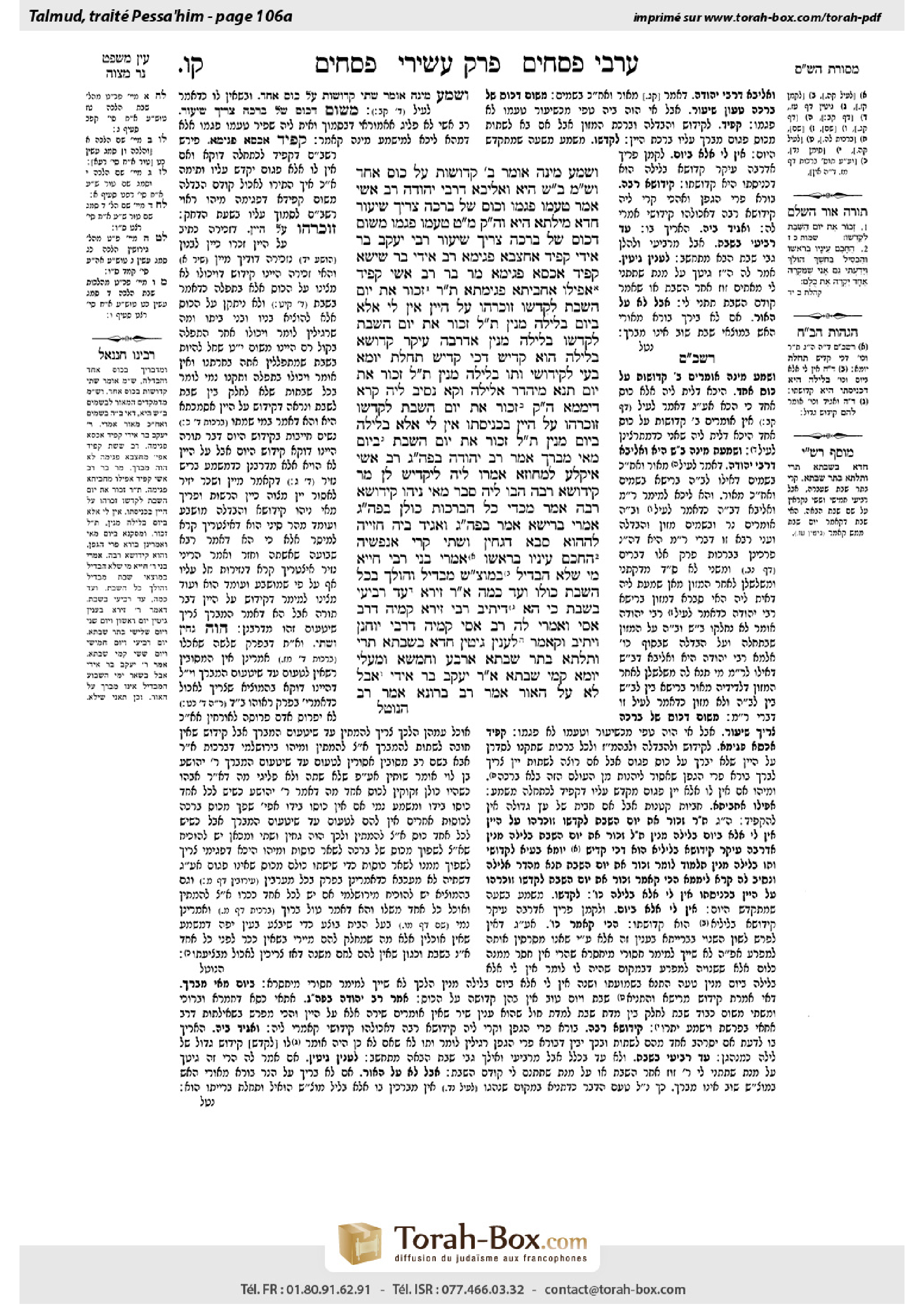
Pesachim 106a: Talmud study for Daf Yomi
Daf Yomi is the daily study of one Talmud folio. Explore 37 tractates with scans, Hebrew text, Sefaria English and AI-generated French translations where annotated.
Passage selection and English or AI-generated French translation are available where the scan has annotations. Daf Study is independent of Torah-Box and Sefaria.
Browse Pesachim · פסחים · All tractatesPesachim 106a text and translations
This page of Pesachim includes the Aramaic text, an English translation and an AI-generated French translation, alongside the scan above.
פסחים ק״ו א · Aramaic and Hebrew text
וּשְׁמַע מִינַּהּ: אוֹמֵר שְׁתֵּי קְדוּשּׁוֹת עַל כּוֹס אֶחָד. וּשְׁמַע מִינַּהּ: בֵּית שַׁמַּאי הִיא, וְאַלִּיבָּא דְּרַבִּי יְהוּדָה.
רַב אָשֵׁי אָמַר: טְעָמוֹ פְּגָמוֹ וְכוֹס שֶׁל בְּרָכָה צָרִיךְ שִׁיעוּר — חֲדָא מִילְּתָא הִיא.
וְהָכִי קָאָמַר: מַאי טַעְמָא טְעָמוֹ פְּגָמוֹ? מִשּׁוּם דְּכוֹס שֶׁל בְּרָכָה צָרִיךְ שִׁיעוּר.
רַבִּי יַעֲקֹב בַּר אִידִי קָפֵיד אַחַצְבָּא פְּגִימָא. רַב אִידִי בַּר שִׁישָׁא קָפֵיד אַכָּסָא פְּגִימָא. מָר בַּר רַב אָשֵׁי קָפֵיד אֲפִילּוּ אַחָבִיתָא פְּגִימְתָּא.
תָּנוּ רַבָּנַן: ״זָכוֹר אֶת יוֹם הַשַּׁבָּת לְקַדְּשׁוֹ״ — זוֹכְרֵהוּ עַל הַיַּיִן. אֵין לִי אֶלָּא בְּיוֹם, בַּלַּיְלָה מִנַּיִן? תַּלְמוּד לוֹמַר: ״זָכוֹר אֶת יוֹם הַשַּׁבָּת לְקַדְּשׁוֹ״.
״בַּלַּיְלָה מִנַּיִן״?! אַדְּרַבָּה, עִיקַּר קִדּוּשָׁא בַּלַּיְלָה הוּא קָדֵישׁ, דְּכִי קָדֵישׁ — תְּחִלַּת יוֹמָא בָּעֵי לְקַידּוֹשֵׁי! וְתוּ: ״בַּלַּיְלָה מִנַּיִן תַּלְמוּד לוֹמַר: זָכוֹר אֶת יוֹם״, תַּנָּא מְיהַדַּר אַלַּיְלָה וְקָא נָסֵיב לֵיהּ קְרָא דִּימָמָא?!
הָכִי קָאָמַר: ״זָכוֹר אֶת יוֹם הַשַּׁבָּת לְקַדְּשׁוֹ״ — זוֹכְרֵהוּ עַל הַיַּיִן בִּכְנִיסָתוֹ, אֵין לִי אֶלָּא בַּלַּיְלָה, בַּיּוֹם מִנַּיִן? תַּלְמוּד לוֹמַר: ״זָכוֹר אֶת יוֹם הַשַּׁבָּת״.
בְּיוֹם מַאי מְבָרֵךְ? אָמַר רַב יְהוּדָה: ״בּוֹרֵא פְּרִי הַגֶּפֶן״. רַב אָשֵׁי אִיקְּלַע לְמָחוֹזָא, אֲמַרוּ לֵיהּ: לִיקַדֵּישׁ לַן מָר קִידּוּשָׁא רַבָּה (הַבוּ לֵיהּ).
סְבַר: מַאי נִיהוּ ״קִידּוּשָׁא רַבָּה״? אָמַר, מִכְּדֵי כׇּל הַבְּרָכוֹת כּוּלָּן ״בּוֹרֵא פְּרִי הַגֶּפֶן״ אָמְרִי בְּרֵישָׁא, אֲמַר ״בּוֹרֵא פְּרִי הַגֶּפֶן״ וְאַגֵּיד בֵּיהּ. חַזְיֵיהּ לְהָהוּא סָבָא דְּגָחֵין וְשָׁתֵי, קָרֵי אַנַּפְשֵׁיהּ ״הֶחָכָם עֵינָיו בְּרֹאשׁוֹ״.
אָמְרִי בְּנֵי רַבִּי חִיָּיא: מִי שֶׁלֹּא הִבְדִּיל בְּמוֹצָאֵי שַׁבָּת — מַבְדִּיל וְהוֹלֵךְ בְּכׇל הַשַּׁבָּת כּוּלּוֹ. וְעַד כַּמָּה? אָמַר רַבִּי זֵירָא: עַד רְבִיעִי בְּשַׁבָּת.
כִּי הָא דְּיָתֵיב רַבִּי זֵירָא קַמֵּיהּ דְּרַב אַסִּי, וְאָמְרִי לַהּ רַב אַסִּי קַמֵּיהּ דְּרַבִּי יוֹחָנָן, וְיָתֵיב וְקָאָמַר: לְעִנְיַן גִּיטִּין, חֲדָא בְּשַׁבְּתָא תְּרֵי וּתְלָתָא — בָּתַר שַׁבְּתָא. אַרְבַּע וְחַמְשָׁא וּמַעֲלֵי יוֹמָא — קַמֵּי שַׁבְּתָא.
אָמַר רַבִּי יַעֲקֹב בַּר אִידִי: אֲבָל לֹא עַל הָאוּר.
אָמַר רַב בְּרוֹנָא אָמַר רַב:
Pesachim 106a · English translation
And learn from it that if one has only one cup of wine, he may recite two sanctifications over one cup, as the baraita states that one may recite two entirely unrelated blessings over a single cup. And learn from it that this baraita is according to the ruling of Beit Shammai, in accordance with the explanation of Rabbi Yehuda, who says that Beit Shammai maintain that one should recite the blessing over fire before the blessing over spices.
Rav Ashi said: On close examination, two of the inferences from the baraita, the ruling that once one who has tasted the cup has disqualified it and the ruling that a cup of blessing requires a specific minimum measure, are actually one matter and should not be counted separately.
Rav Ashi elaborates: And this is what the baraita is saying: What is the reason that once one has tasted the cup he has disqualified it from further usage as a cup of blessing? It is because a cup of blessing requires a specific minimum measure. Once one has tasted, there is not enough wine left in the cup. The disqualification is not because of the act of tasting itself. If enough wine remains in the cup after one has taken a sip, it may be used again as a cup of blessing. This ruling is not in accordance with the opinion of certain Sages, who maintain that sipping from the cup itself constitutes an inherent disqualification.
The Gemara relates that Rabbi Ya’akov bar Idi was particular with regard to a blemished pitcher, i.e., he would not recite kiddush or havdala with a pitcher from which someone had already taken a sip. Rav Idi bar Sheisha was particular with regard to a blemished cup. Mar bar Rav Ashi was particular even with regard to a blemished barrel and would take wine for kiddush only from a previously unopened barrel.
The Sages taught in a baraita with regard to the verse: “Remember the day of Shabbat to sanctify it” (Exodus 20:7): Remember it over wine, through the recitation of kiddush. I have only derived that there is a mitzva to recite kiddush during the day, as the verse is referring to the day of Shabbat. From where do I derive that one must also recite kiddush at night? The verse states: “Remember the day of Shabbat to sanctify it,” which indicates that one should also remember Shabbat as soon as it is sanctified.
The Gemara expresses surprise at this last question: From where is it derived that one must recite kiddush at night? Is this the appropriate question? On the contrary, the essential mitzva of kiddush is to sanctify the day at night, as one must sanctify the beginning of the day, i.e., Friday night; there is no reason to sanctify Shabbat in the middle of the day, i.e., in the morning. And furthermore, the continuation of the baraita states: From where do we derive the obligation of kiddush at night? The verse states: “Remember the day of Shabbat.” The tanna is seeking a source for kiddush at night, and yet he cites a verse that is referring to the day.
The Gemara answers that this is what the tanna is saying: “Remember the day of Shabbat to sanctify it” is a mitzva to remember it over wine when it begins. I have only derived the obligation to recite kiddush at night; from where do I derive that one must also recite kiddush during the day? The verse states: “Remember the day of Shabbat.” The emphasis of the word day indicates that one must recite kiddush again during the day.
The Gemara asks: During the day, when one does not recite the same kiddush as at night, what blessing does one recite? Rav Yehuda said: Before the meal, one brings a cup of wine and simply recites the usual blessing over wine: Who creates the fruit of the vine. The Gemara relates that Rav Ashi happened to come to the city of Meḥoza. The Sages of Meḥoza said to him on Shabbat day: Will the Master recite for us the great kiddush? And they immediately brought him a cup of wine.
Rav Ashi was unsure what they meant by the term great kiddush and wondered if the residents of Meḥoza included other matters in their kiddush. He thought: What is this great kiddush to which they refer? He said to himself: Since with regard to all the blessings that require a cup of wine, one first recites the blessing: Who creates the fruit of the vine, I will start with that blessing. He recited: Who creates the fruit of the vine, and lengthened it to see if they were expecting an additional blessing. He saw a particular elder bending over his cup and drinking, and he realized that this was the end of the great kiddush. He read the following verse about himself: “The wise man, his eyes are in his head” (Ecclesiastes 2:14), as he was alert enough to discern the expectations of the local residents.
As stated above, the sons of Rabbi Ḥiyya say: One who did not recite havdala at the conclusion of Shabbat may recite havdala anytime over the course of the entire week. The Gemara asks: And until how many days of that week have passed may one still recite havdala? Rabbi Zeira said: Until the fourth day of the week, Wednesday, after which it is no longer considered the same week as the previous Shabbat.
This is like that ruling of halakha stated when Rabbi Zeira sat before Rav Asi, and some say it was Rav Asi who sat before Rabbi Yoḥanan. And he sat and said: With regard to the wording of bills of divorce, the first day of the week and the second and third days of the week are all called: After Shabbat. If a bill of divorce or a condition upon which the document depends includes the phrase: After Shabbat, it refers to one of the first three days of the week. However, the fourth and fifth days of the week and the eve of the day of Shabbat are called: Before Shabbat. Likewise, with regard to havdala, the first three days of the week are considered the time period after Shabbat, and therefore one may still recite havdala on these days.
Rabbi Ya’akov bar Idi said: However, one who recites havdala during this time period may not recite the blessing over fire. This blessing may be recited only at the conclusion of Shabbat, at the time when fire was originally created.
Rav Beruna said that Rav said:
Pesachim 106a · Traduction française (IA)
Apprends-en que celui qui n’a qu’une seule coupe de vin peut réciter deux bénédictions de sanctification sur la même coupe, puisque la baraïta enseigne que l’on peut réciter deux bénédictions sans rapport entre elles sur une seule coupe. Apprends-en également que cette baraïta suit l’avis de Beit Shammaï, selon l’explication de Rabbi Yehouda, qui dit que Beit Shammaï soutiennent qu’il faut réciter la bénédiction sur le feu avant celle sur les épices.
Rav Ashi dit : À y regarder de près, deux des déductions tirées de la baraïta — à savoir que celui qui a goûté à la coupe l’a rendue impropre, et qu’une coupe de bénédiction doit contenir une quantité minimale déterminée — ne constituent en réalité qu’un seul point et ne doivent pas être comptées séparément.
Rav Ashi précise : Voici ce que dit la baraïta : pourquoi celui qui a goûté à la coupe l’a-t-il rendue impropre à un nouvel usage comme coupe de bénédiction ? Parce qu’une coupe de bénédiction doit contenir une quantité minimale déterminée. Après qu’on y a goûté, il ne reste pas assez de vin dans la coupe. Ce n’est pas l’acte de goûter lui-même qui la rend impropre. S’il reste assez de vin dans la coupe après qu’on en a pris une gorgée, elle peut être réutilisée comme coupe de bénédiction. Cette décision ne suit pas l’avis de certains Sages, qui soutiennent que le fait de boire une gorgée à même la coupe la rend intrinsèquement impropre.
La Guemara rapporte que Rabbi Yaakov bar Idi était exigeant concernant une cruche entamée : il ne récitait ni le kiddouch ni la havdala avec une cruche dont quelqu’un avait déjà bu une gorgée. Rav Idi bar Sheisha était exigeant concernant une coupe entamée. Mar bar Rav Ashi était exigeant même concernant un tonneau entamé et ne prenait du vin pour le kiddouch que dans un tonneau qui n’avait pas encore été ouvert.
Les Sages enseignèrent dans une baraïta au sujet du verset : « Souviens-toi du jour du Chabbat pour le sanctifier » (Exode 20, 7) : Souviens-t’en sur du vin, en récitant le kiddouch. Je n’ai appris de là que l’obligation de réciter le kiddouch pendant la journée, puisque le verset parle du jour du Chabbat. D’où apprend-on qu’il faut également réciter le kiddouch le soir ? Le verset dit : « Souviens-toi du jour du Chabbat pour le sanctifier », ce qui indique qu’il faut également se souvenir du Chabbat dès qu’il est sanctifié.
La Guemara s’étonne de cette dernière question : D’où apprend-on qu’il faut réciter le kiddouch le soir ? Est-ce là la question qui convient ? Au contraire, la mitsva essentielle du kiddouch consiste à sanctifier le jour le soir, car il faut sanctifier le début du jour, c’est-à-dire le vendredi soir ; il n’y a aucune raison de sanctifier le Chabbat au milieu de la journée, c’est-à-dire le matin. En outre, la suite de la baraïta dit : D’où déduisons-nous l’obligation du kiddouch le soir ? Le verset dit : « Souviens-toi du jour du Chabbat. » Le tanna cherche une source pour le kiddouch du soir, et pourtant il cite un verset qui parle du jour.
La Guemara répond que voici ce que dit le tanna : « Souviens-toi du jour du Chabbat pour le sanctifier » signifie qu’il y a une mitsva de s’en souvenir sur du vin dès qu’il commence. Je n’ai appris de là que l’obligation de réciter le kiddouch le soir ; d’où apprend-on qu’il faut également réciter le kiddouch pendant la journée ? Le verset dit : « Souviens-toi du jour du Chabbat. » L’accent mis sur le mot « jour » indique qu’il faut réciter de nouveau le kiddouch pendant la journée.
La Guemara demande : Pendant la journée, quand on ne récite pas le même kiddouch que le soir, quelle bénédiction récite-t-on ? Rav Yehouda dit : Avant le repas, on apporte une coupe de vin et l’on récite simplement la bénédiction habituelle sur le vin : « Qui crée le fruit de la vigne. » La Guemara rapporte que Rav Ashi arriva par hasard dans la ville de Meḥoza. Le Chabbat, pendant la journée, les Sages de Meḥoza lui dirent : « Le Maître va-t-il réciter pour nous le grand kiddouch ? » Et aussitôt, ils lui apportèrent une coupe de vin.
Rav Ashi ne savait pas ce qu’ils entendaient par « grand kiddouch » et se demanda si les habitants de Meḥoza incluaient d’autres éléments dans leur kiddouch. Il pensa : « Quel est donc ce grand kiddouch dont ils parlent ? » Il se dit : « Puisque, pour toutes les bénédictions qui requièrent une coupe de vin, on récite d’abord la bénédiction : “Qui crée le fruit de la vigne”, je vais commencer par cette bénédiction. » Il récita : « Qui crée le fruit de la vigne », et prolongea sa récitation afin de voir s’ils attendaient une bénédiction supplémentaire. Il vit un certain ancien se pencher sur sa coupe et boire, et comprit que c’était la fin du grand kiddouch. Il appliqua à son propre cas le verset suivant : « Le sage a les yeux dans la tête » (Ecclésiaste 2, 14), car il avait été assez attentif pour discerner ce qu’attendaient les habitants du lieu.
Comme cela a été indiqué plus haut, les fils de Rabbi Ḥiyya disent : Celui qui n’a pas récité la havdala à la fin du Chabbat peut la réciter à tout moment au cours de la semaine entière. La Guemara demande : Jusqu’à quel jour de cette semaine peut-on encore réciter la havdala ? Rabbi Zeira dit : Jusqu’au quatrième jour de la semaine, le mercredi ; après cela, on ne considère plus qu’il s’agit de la même semaine que celle du Chabbat précédent.
Cela correspond à cette règle de halakha énoncée alors que Rabbi Zeira siégeait devant Rav Asi — certains disent que c’est Rav Asi qui siégeait devant Rabbi Yoḥanan. Il siégeait et disait : Dans la formulation des actes de divorce, le premier, le deuxième et le troisième jour de la semaine sont tous désignés par l’expression « après Chabbat ». Si un acte de divorce, ou une condition dont dépend le document, contient la formule « après Chabbat », celle-ci désigne l’un des trois premiers jours de la semaine. En revanche, le quatrième et le cinquième jour de la semaine, ainsi que la veille du jour de Chabbat, sont désignés par l’expression « avant Chabbat ». De même, pour la havdala, les trois premiers jours de la semaine sont considérés comme la période qui suit le Chabbat ; on peut donc encore réciter la havdala ces jours-là.
Rabbi Yaakov bar Idi dit : Toutefois, celui qui récite la havdala pendant cette période ne peut pas réciter la bénédiction sur le feu. Cette bénédiction ne peut être récitée qu’à la fin du Chabbat, au moment où le feu fut créé à l’origine.
Rav Berouna dit au nom de Rav :
Traduction française générée par IA à partir de l’édition anglaise de Sefaria. Vérifie toujours un passage avec le texte source.
Text from Sefaria: William Davidson Edition - Vocalized Aramaic (CC BY NC); William Davidson Edition - English (CC BY NC).