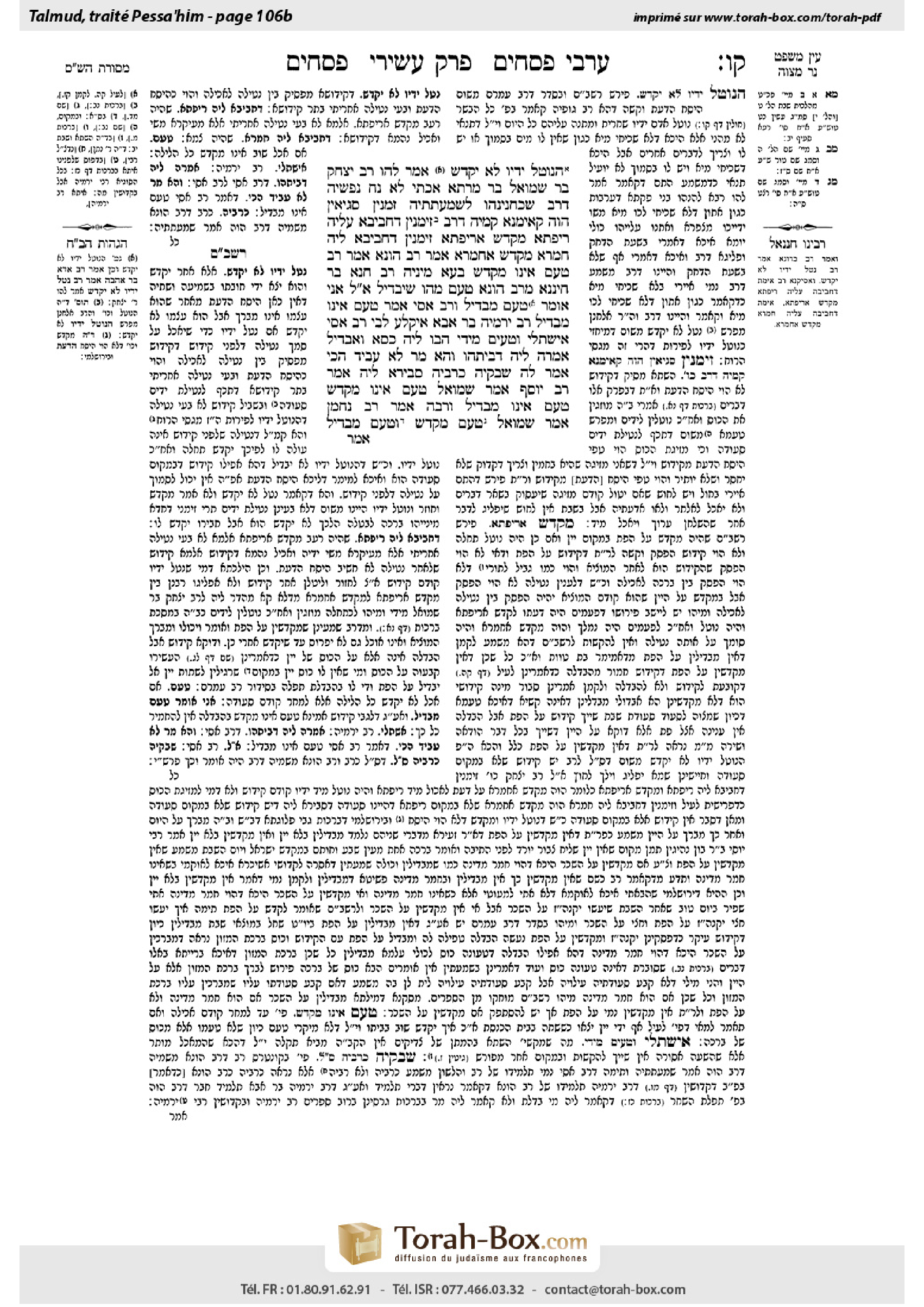
Pesachim 106b: Talmud study for Daf Yomi
Daf Yomi is the daily study of one Talmud folio. Explore 37 tractates with scans, Hebrew text, Sefaria English and AI-generated French translations where annotated.
Passage selection and English or AI-generated French translation are available where the scan has annotations. Daf Study is independent of Torah-Box and Sefaria.
Browse Pesachim · פסחים · All tractatesPesachim 106b text and translations
This page of Pesachim includes the Aramaic text, an English translation and an AI-generated French translation, alongside the scan above.
פסחים ק״ו ב · Aramaic and Hebrew text
הַנּוֹטֵל יָדָיו לֹא יְקַדֵּשׁ. אֲמַר לְהוּ רַב יִצְחָק בַּר שְׁמוּאֵל בַּר מָרְתָא: אַכַּתִּי לָא נָח נַפְשֵׁיהּ דְּרַב שְׁכַחְנִינְהוּ לִשְׁמַעְתְּתֵיהּ. זִמְנִין סַגִּיאִין הֲוָה קָאֵימְנָא קַמֵּיהּ דְּרַב, זִימְנִין דַּחֲבִיבָא עֲלֵיהּ רִיפְתָּא — מְקַדֵּשׁ אַרִיפְתָּא. זִימְנִין דַּחֲבִיבָא לֵיהּ חַמְרָא — מְקַדֵּשׁ אַחַמְרָא.
אָמַר רַב הוּנָא אָמַר רַב: טָעַם אֵינוֹ מְקַדֵּשׁ. בְּעָא מִינֵּיהּ רַב חָנָא בַּר חִינָּנָא מֵרַב הוּנָא: טָעַם מַהוּ שֶׁיַּבְדִּיל? אֲמַר לֵיהּ, אֲנִי אוֹמֵר: טָעַם — מַבְדִּיל, וְרַב אַסִּי אָמַר: טָעַם — אֵינוֹ מַבְדִּיל.
רַב יִרְמְיָה בַּר אַבָּא אִיקְּלַע לְבֵי רַב אַסִּי, אִישְׁתְּלִי וְטָעִים מִידֵּי, הַבוּ לֵיהּ כָּסָא וְאַבְדֵּיל. אֲמַרָה לֵיהּ דְּבֵיתְהוּ: וְהָא מָר לָא עָבֵיד הָכִי! אֲמַר לַהּ: שִׁבְקֵיהּ, כְּרַבֵּיהּ סְבִירָא לֵיהּ.
אָמַר רַב יוֹסֵף אָמַר שְׁמוּאֵל: טָעַם — אֵינוֹ מְקַדֵּשׁ, טָעַם — אֵינוֹ מַבְדִּיל. וְרַבָּה אָמַר רַב נַחְמָן אָמַר שְׁמוּאֵל: טָעַם — מְקַדֵּשׁ, וְטָעַם — מַבְדִּיל.
Pesachim 106b · English translation
One who washes his hands should not recite kiddush after washing, as this would constitute an interruption between washing and eating, and he will have to wash again. Instead, he should hear kiddush from someone else. Rav Yitzḥak bar Shmuel bar Marta said to them: Not a lot of time has yet passed since Rav died, and we have already forgotten his halakhic rulings. Many times I stood before Rav and saw that sometimes he preferred bread, and he would recite kiddush over bread. On those occasions Rav would wash his hands, recite kiddush over the bread, and eat it. At other times he preferred wine and would recite kiddush over wine. This shows that kiddush is not considered an interruption between washing one’s hands and eating bread.
Rav Huna said that Rav said: One who has tasted any food on Shabbat night may not recite kiddush anymore that night, as one must recite kiddush before he eats. Instead, he recites kiddush during the day before the meal. Rav Ḥana bar Ḥinnana raised a dilemma before Rav Huna: If one tasted food at the conclusion of Shabbat before reciting havdala, what is the halakha with regard to whether he may recite havdala? He said to him: I say that one who has tasted food may still recite havdala. And Rav Asi said: One who has tasted food may not recite havdala.
The Gemara relates that Rav Yirmeya bar Abba happened to come to the house of Rav Asi. He forgot and tasted some food after Shabbat before havdala. They gave him a cup and he recited havdala. Later, Rav Asi’s wife said to her husband: But my Master does not act this way. In your opinion, one who eats before havdala does not recite havdala. He said to her: Leave Rav Yirmeya bar Abba. He maintains in accordance with the opinion of his rabbi. Rav Yirmeya bar Abba was a student of Rav, who ruled that even one who has eaten may recite havdala.
Rav Yosef said that Shmuel said: One who has tasted food before kiddush may not recite kiddush, and one who has tasted food before havdala may not recite havdala. And Rabba said that Rav Naḥman said that Shmuel said: One who has tasted may nevertheless recite kiddush, and one who has tasted may likewise recite havdala.
Pesachim 106b · Traduction française (IA)
Celui qui s’est lavé les mains ne doit pas réciter le kiddouch ensuite, car cela constituerait une interruption entre le lavage des mains et le repas, et il devrait se laver de nouveau. Il doit plutôt écouter quelqu’un d’autre réciter le kiddouch. Rav Yitzḥak bar Shmuel bar Marta leur dit : « Cela ne fait pas encore longtemps que Rav est mort, et nous avons déjà oublié ses décisions halakhiques. Bien souvent, je me tenais devant Rav et je voyais que, parfois, il préférait le pain et récitait le kiddouch sur le pain. Dans ces occasions, Rav se lavait les mains, récitait le kiddouch sur le pain, puis le mangeait. D’autres fois, il préférait le vin et récitait le kiddouch sur le vin. Cela montre que le kiddouch n’est pas considéré comme une interruption entre le lavage des mains et le fait de manger du pain. »
Rav Huna dit au nom de Rav : Celui qui a goûté à un aliment le soir de Chabbat ne peut plus réciter le kiddouch cette nuit-là, car il faut réciter le kiddouch avant de manger. Il récite plutôt le kiddouch pendant la journée, avant le repas. Rav Ḥana bar Ḥinnana posa une question à Rav Huna : Si quelqu’un a goûté à un aliment à la fin de Chabbat, avant de réciter la havdala, quelle est la halakha ? Peut-il réciter la havdala ? Rav Huna lui répondit : « Je pense que celui qui a goûté à un aliment peut encore réciter la havdala. » Rav Asi dit : Celui qui a goûté à un aliment ne peut pas réciter la havdala.
La Guemara rapporte que Rav Yirmeya bar Abba se rendit par hasard chez Rav Asi. Il oublia qu’il devait réciter la havdala et goûta à un aliment après Chabbat. On lui tendit une coupe et il récita la havdala. Plus tard, la femme de Rav Asi dit à son mari : « Mais mon maître n’agit pas ainsi. Selon vous, celui qui mange avant la havdala ne récite pas la havdala. » Il lui répondit : « Laisse Rav Yirmeya bar Abba. Il suit l’opinion de son maître. » Rav Yirmeya bar Abba était un élève de Rav, qui statuait que même celui qui a mangé peut réciter la havdala.
Rav Yosef dit au nom de Shmuel : Celui qui a goûté à un aliment avant le kiddouch ne peut pas réciter le kiddouch, et celui qui a goûté à un aliment avant la havdala ne peut pas réciter la havdala. Rabba dit au nom de Rav Naḥman, qui le dit au nom de Shmuel : Celui qui a goûté à un aliment peut néanmoins réciter le kiddouch, et celui qui a goûté à un aliment peut également réciter la havdala.
Traduction française générée par IA à partir de l’édition anglaise de Sefaria. Vérifie toujours un passage avec le texte source.
Text from Sefaria: William Davidson Edition - Vocalized Aramaic (CC BY NC); William Davidson Edition - English (CC BY NC).