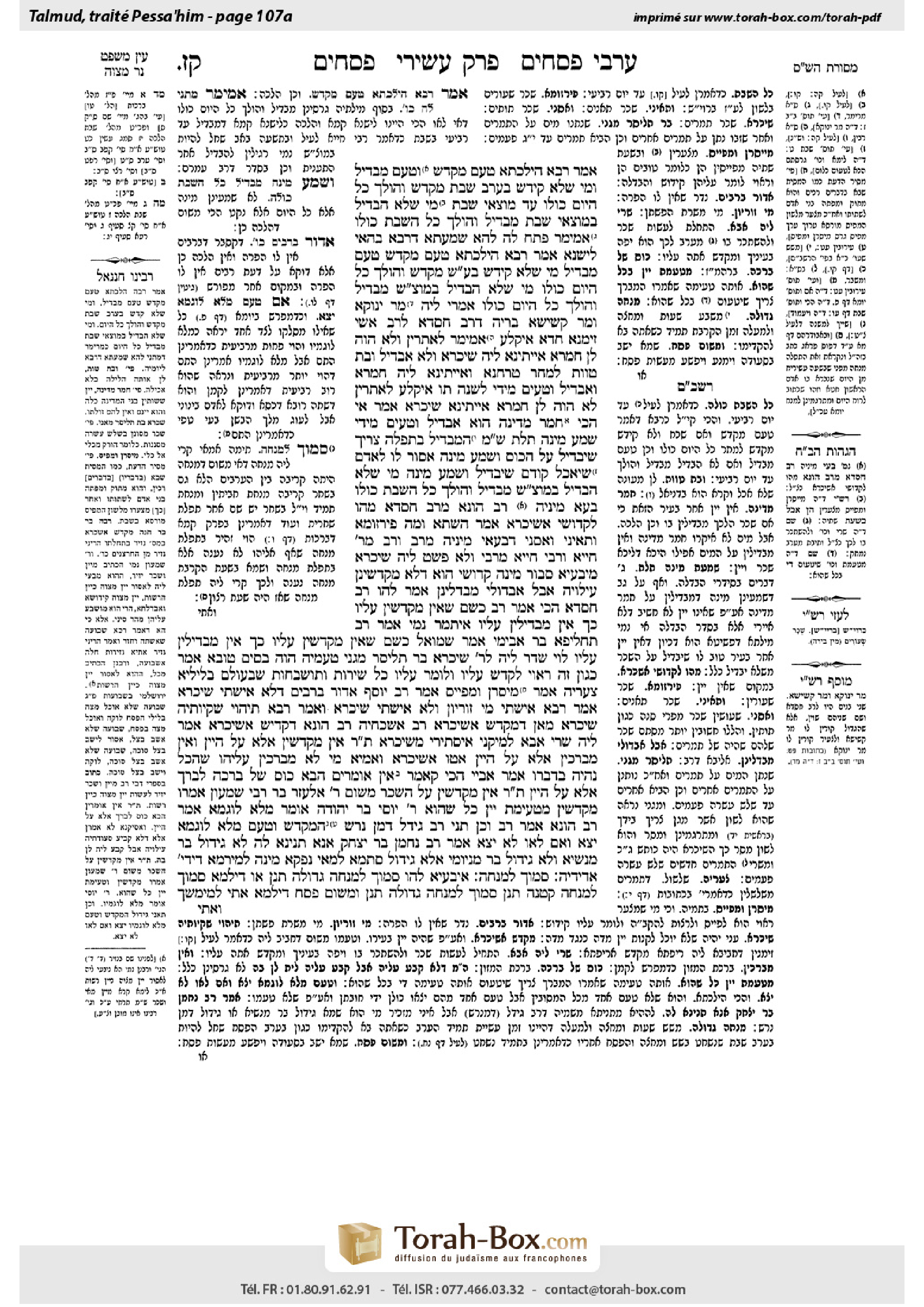
Pesachim 107a: Talmud study for Daf Yomi
Daf Yomi is the daily study of one Talmud folio. Explore 37 tractates with scans, Hebrew text, Sefaria English and AI-generated French translations where annotated.
Passage selection and English or AI-generated French translation are available where the scan has annotations. Daf Study is independent of Torah-Box and Sefaria.
Browse Pesachim · פסחים · All tractatesPesachim 107a text and translations
This page of Pesachim includes the Aramaic text, an English translation and an AI-generated French translation, alongside the scan above.
פסחים ק״ז א · Aramaic and Hebrew text
אָמַר רָבָא: הִילְכְתָא, טָעַם — מְקַדֵּשׁ, וְטָעַם — מַבְדִּיל, וּמִי שֶׁלֹּא קִידֵּשׁ בְּעֶרֶב שַׁבָּת — מְקַדֵּשׁ וְהוֹלֵךְ כׇּל הַיּוֹם כּוּלּוֹ עַד מוֹצָאֵי שַׁבָּת. מִי שֶׁלֹּא הִבְדִּיל בְּמוֹצָאֵי שַׁבָּת — מַבְדִּיל וְהוֹלֵךְ כׇּל הַשַּׁבָּת כּוּלּוֹ.
אַמֵּימָר פָּתַח לַהּ לְהָא שְׁמַעְתָּא דְּרָבָא בְּהַאי לִישָּׁנָא, אָמַר רָבָא: הִילְכְתָא, טָעַם — מְקַדֵּשׁ, טָעַם — מַבְדִּיל, מִי שֶׁלֹּא קִידֵּשׁ בָּעֶרֶב שַׁבָּת — מְקַדֵּשׁ וְהוֹלֵךְ כׇּל הַיּוֹם כּוּלּוֹ, מִי שֶׁלֹּא הִבְדִּיל בְּמוֹצָאֵי שַׁבָּת — מַבְדִּיל וְהוֹלֵךְ כׇּל הַיּוֹם כּוּלּוֹ.
אָמְרִי לֵיהּ מָר יָנוֹקָא וּמָר קַשִּׁישָׁא בְּרֵיהּ דְּרַב חִסְדָּא לְרַב אָשֵׁי: זִימְנָא חֲדָא אִיקְּלַע אַמֵּימָר לְאַתְרִין, וְלָא הֲוָה לַן חַמְרָא. אַיְיתִינָא לֵיהּ שִׁיכְרָא, וְלָא אַבְדֵּיל וּבָת טְווֹת. לִמְחַר, טְרַחְנָא וְאַיְיתִינָא לֵיהּ חַמְרָא, וְאַבְדֵּיל וּטְעֵים מִידֵּי. לְשָׁנָה תּוּ אִיקְּלַע לְאַתְרִין, לָא הֲוָה לַן חַמְרָא, אַיְיתִינָא שִׁיכְרָא, אָמַר: אִי הָכִי, חֲמַר מְדִינָה הוּא, אַבְדֵּיל וּטְעֵים מִידֵּי.
שְׁמַע מִינַּהּ תְּלָת. שְׁמַע מִינַּהּ: הַמַּבְדִּיל בִּתְפִלָּה, צָרִיךְ שֶׁיַּבְדִּיל עַל הַכּוֹס. וּשְׁמַע מִינַּהּ: אָסוּר לוֹ לָאָדָם שֶׁיֹּאכַל קוֹדֶם שֶׁיַּבְדִּיל. וּשְׁמַע מִינַּהּ: מִי שֶׁלֹּא הִבְדִּיל בְּמוֹצָאֵי שַׁבָּת, מַבְדִּיל וְהוֹלֵךְ כׇּל הַשַּׁבָּת כּוּלּוֹ.
בְּעָא מִינֵּיהּ רַב הוּנָא מֵרַב חִסְדָּא: מַהוּ לְקַדּוֹשֵׁי אַשִּׁיכְרָא? אָמַר: הַשְׁתָּא וּמָה פִּירְזוּמָא וּתְאֵינֵי וְאַסְנֵי דִּבְעַאי מִינֵּיהּ מֵרַב, וְרַב מֵרַבִּי חִיָּיא, וְרַבִּי חִיָּיא מֵרַבִּי, וְלָא פְּשַׁט לֵיהּ — שִׁיכְרָא מִיבַּעְיָא?!
סְבוּר מִינָּה קַדּוֹשֵׁי הוּא דְּלָא מְקַדְּשִׁינַן עִילָּוֵיהּ, אֲבָל אַבְדּוֹלֵי מַבְדְּלִינַן. אֲמַר לְהוּ רַב חִסְדָּא: הָכִי אָמַר רַב: כְּשֵׁם שֶׁאֵין מְקַדְּשִׁין עָלָיו, כָּךְ אֵין מַבְדִּילִין עָלָיו. אִיתְּמַר נָמֵי, אָמַר רַב תַּחְלִיפָא בַּר אֲבִימִי אָמַר שְׁמוּאֵל: כְּשֵׁם שֶׁאֵין מְקַדְּשִׁין עָלָיו, כָּךְ אֵין מַבְדִּילִין עָלָיו.
לֵוִי שַׁדַּר לֵיהּ לְרַבִּי שִׁיכְרָא בַּר תְּלֵיסַר מְגָנֵי, טַעְמֵיהּ — הֲוָה בְּסִים טוּבָא, אֲמַר: כְּגוֹן זֶה רָאוּי לְקַדֵּשׁ עָלָיו וְלוֹמַר עָלָיו כׇּל שִׁירוֹת וְתוּשְׁבָּחוֹת שֶׁבָּעוֹלָם. בְּלֵילְיָא צַעֲרֵיהּ. אָמַר: מְיַסְּרָן וּמְפַיֵּיס.
אָמַר רַב יוֹסֵף: אֶדּוֹר בָּרַבִּים דְּלָא אִישְׁתֵּי שִׁיכְרָא. אָמַר רָבָא: אִישְׁתֵּי מֵי זוּרְיוֹן וְלָא אִישְׁתֵּי שִׁיכְרָא.
וְאָמַר רָבָא: תֶּיהְוֵי שַׁקְיוּתֵיהּ שִׁיכְרָא מַאן דִּמְקַדֵּשׁ אַשִּׁיכְרָא. רַב, אַשְׁכְּחֵיהּ רַב הוּנָא דְּקַדֵּישׁ אַשִּׁיכְרָא, אֲמַר לֵיהּ: שָׁרֵי אַבָּא לְמִיקְנֵי אִיסְתֵּירֵי מִשִּׁיכְרָא.
תָּנוּ רַבָּנַן: אֵין מְקַדְּשִׁין אֶלָּא עַל הַיַּיִן, וְאֵין מְבָרְכִין אֶלָּא עַל הַיַּיִן. אַטּוּ אַשִּׁיכְרָא וְאַמַּיָּא מִי לָא מְבָרְכִין עֲלַיְהוּ שֶׁהַכֹּל נִהְיֶה בִּדְבָרוֹ? אָמַר אַבָּיֵי, הָכִי קָאָמַר: אֵין אוֹמְרִים ״הָבֵא כּוֹס שֶׁל בְּרָכָה לְבָרֵךְ״ אֶלָּא עַל הַיַּיִן. תָּנוּ רַבָּנַן: אֵין מְקַדְּשִׁין עַל הַשֵּׁכָר. מִשּׁוּם רַבִּי אֶלְעָזָר בַּר רַבִּי שִׁמְעוֹן אָמְרוּ: מְקַדְּשִׁין.
מַטְעֶימֶת יַיִן כׇּל שֶׁהוּא. רַבִּי יוֹסֵי בַּר יְהוּדָה אוֹמֵר: מְלֹא לוּגְמָא. אָמַר רַב הוּנָא אָמַר רַב, וְכֵן תָּנֵי רַב גִּידֵּל דְּמִן נָרֶשׁ: הַמְקַדֵּשׁ וְטָעַם מְלֹא לוּגְמָא — יָצָא, וְאִם לָאו — לֹא יָצָא.
אָמַר רַב נַחְמָן בַּר יִצְחָק: אֲנָא תְּנֵינָא לַהּ לָא גִּידּוֹל בַּר מְנַשְּׁיָא וְלָא גִּידּוֹל בַּר מִנְיוֹמֵי אֶלָּא גִּידּוֹל סְתָמָא. לְמַאי נָפְקָא מִינַּהּ? לְמִירְמָא דִּידֵיהּ אַדִּידֵיהּ.
סָמוּךְ לַמִּנְחָה. אִיבַּעְיָא לְהוּ: סָמוּךְ לְמִנְחָה גְּדוֹלָה תְּנַן, אוֹ דִילְמָא סָמוּךְ לְמִנְחָה קְטַנָּה תְּנַן?
סָמוּךְ לְמִנְחָה גְּדוֹלָה תְּנַן — וּמִשּׁוּם פֶּסַח, דִּילְמָא אָתֵי לְמִימְּשַׁךְ,
Pesachim 107a · English translation
Rava said: The halakha is that one who tasted food before kiddush may recite kiddush; and one who tasted food before havdala may recite havdala; and one who did not recite kiddush on Shabbat eve, at night, may recite kiddush any time during the entire day until the conclusion of Shabbat. Likewise, one who did not recite havdala at the conclusion of Shabbat may recite havdala any time during the entire week, i.e., during the first three days of the week, the time period called: After Shabbat.
Ameimar began this teaching of Rava in this emended formulation: Rava said: The halakha is that one who tasted food before kiddush may recite kiddush; and one who tasted food before havdala may recite havdala; and one who did not recite kiddush on Shabbat eve, at night, may recite kiddush any time during the entire day. One who did not recite havdala at the conclusion of Shabbat may recite havdala any time during the entire day of Sunday, but no later.
The Gemara relates that the Mar Yanuka, the younger Mar, and Mar Kashisha, the elder Mar, both sons of Rav Ḥisda, said to Rav Ashi: Once Ameimar happened to come to our place and we did not have wine for havdala. We brought him beer and he did not recite havdala, and he passed the night fasting, as it is prohibited to eat before havdala. The next day we exerted ourselves and brought him wine, and he recited havdala and tasted some food. The next year he again happened to come to our place. Once again we did not have wine and we brought him beer. He said: If so, if it is so difficult to obtain wine in your place, beer is the wine of the province. He recited havdala over the beer and tasted some food.
The Gemara notes that one may learn from Ameimar’s conduct three halakhot: Learn from it that one who recites havdala in the prayer service must recite havdala again over a cup, as Ameimar had presumably recited the paragraph of havdala in his Amida prayer. And learn from it that it is prohibited for a person to eat before he recites havdala. And learn from it that one who did not recite havdala at the conclusion of Shabbat may recite havdala anytime during the entire week, i.e., during the first three days of the week.
In the above story, Ameimar refused to recite havdala over beer. The Gemara addresses this issue at greater length. Rav Huna raised a dilemma before Rav Ḥisda: What is the halakha with regard to whether it is permitted to recite kiddush over date beer? He said: Now, if with regard to barley beer, fig beer, and beer produced from berries, I raised a dilemma before Rav as to whether or not they may be used for kiddush, and Rav had previously raised this dilemma before Rabbi Ḥiyya, and Rabbi Ḥiyya had inquired of Rabbi Yehuda HaNasi, and he did not resolve it for him, as he could not find a source that clearly permits it, is it necessary to say that date beer, which is inferior to those other types of beer, may not be used for kiddush?
Those who heard this response understood from it that it is kiddush that one may not recite over it, but one may recite havdala over date beer. Rav Ḥisda said to them that Rav said as follows: Just as one may not recite kiddush over date beer, so one may not recite havdala over it. It was also stated that Rav Taḥalifa bar Avimi said that Shmuel said: Just as one may not recite kiddush over date beer, so one may not recite havdala over it.
The Gemara relates that Levi sent Rabbi Yehuda HaNasi a beer of thirteen soakings, i.e., thirteen batches of dates had been soaked in water until it had thoroughly absorbed the taste of the dates. This was considered a high-quality beer. Rabbi Yehuda HaNasi tasted it and it was especially pleasant. He said: A beer like this is fit to recite kiddush over and to say upon it all the songs and praises in the world, as it is as good as wine. At night, it disrupted his digestion and caused him pain. He said: It pains on the one hand and soothes on the other.
With regard to the discomfort caused by beer, the Gemara cites related statements of amora’im. Rav Yosef said: I will take a vow in public, which cannot be nullified, that I will not drink beer due to its negative effects, despite the fact that beer was a popular beverage in Babylonia. Rava said: I would rather drink water used for soaking flax, and I will not drink beer.
And Rava said: One who recites kiddush over beer, his regular drink should be beer. In other words, the fitting punishment for one who recites kiddush over beer, the poor man’s drink in Babylonia, is for him to become poor himself and have to drink beer on a regular basis. The Gemara relates that Rav was found by Rav Huna reciting kiddush over beer. He said to him: Abba, Rav’s first name, has started to acquire coins with beer. As Rav recently began selling beer, it has become his favorite beverage, to the extent that he uses it for kiddush.
The Sages taught: One may recite kiddush only over wine, and one may recite blessings only over wine. The Gemara expresses surprise: Is that to say that one does not say the blessing: By Whose word all things [shehakol] came to be, over beer and water? Abaye said: This is what the baraita is saying: One only says: Bring a cup of blessing to recite the blessing of Grace after Meals, over wine. The Rabbis taught in a baraita: One may not recite kiddush over beer. In the name of Rabbi Elazar, son of Rabbi Shimon, they said that one may recite kiddush over beer.
With regard to the halakha that one who recites kiddush must drink from the cup, the Gemara states that one fulfills the mitzva of kiddush by tasting any amount of wine. Rabbi Yosei, son of Yehuda, says that one must drink at least a cheekful. Rav Huna said that Rav said, and Rav Giddel from the city of Neresh likewise teaches: One who recites kiddush and tastes a cheekful has fulfilled his obligation, and if not, he has not fulfilled his obligation.
Rav Naḥman bar Yitzḥak said: I teach this baraita in a precise manner, and I do not mention Giddul bar Menashya, nor Giddul bar Minyumei, but rather the plain name Giddul, without any identifying moniker. The Gemara asks: What is the practical difference in Rav Giddel’s name? The Gemara answers: To raise a contradiction between one of his rulings and another one of his rulings. Since it is not clear exactly which Sage issued this ruling, it is impossible to prove that he reversed or contradicted his opinion in a later statement.
The Gemara returns to the mishna, which stated that it is prohibited to eat adjacent to minḥa time on Passover eve. A dilemma was raised before the Sages in the study hall: Did we learn in the mishna that it is prohibited to eat adjacent to the time of the greater minḥa [minḥa gedola], which is half an hour after midday, or perhaps we learned in the mishna that it is prohibited to eat adjacent to the time of the lesser minḥa [minḥa ketana], two and a half hours before sunset?
The Gemara elaborates: Did we learn in the mishna that it is prohibited to eat adjacent to the time of the greater minḥa, and this is because of the Paschal lamb, lest one come to be drawn after the meal and spend a long time eating, as was typical for large meals,
Pesachim 107a · Traduction française (IA)
Rava a dit : La halakha est que celui qui a goûté de la nourriture avant le kiddouch peut réciter le kiddouch ; celui qui a goûté de la nourriture avant la havdala peut réciter la havdala ; et celui qui n’a pas récité le kiddouch le vendredi soir peut le réciter à tout moment de la journée, jusqu’à la fin de Chabbat. De même, celui qui n’a pas récité la havdala à la fin de Chabbat peut la réciter à tout moment de la semaine, c’est-à-dire pendant les trois premiers jours de la semaine, période appelée « après Chabbat ».
Ameimar commença à transmettre cet enseignement de Rava sous cette formulation corrigée : Rava a dit : La halakha est que celui qui a goûté de la nourriture avant le kiddouch peut réciter le kiddouch ; celui qui a goûté de la nourriture avant la havdala peut réciter la havdala ; et celui qui n’a pas récité le kiddouch le vendredi soir peut le réciter à tout moment de la journée. Celui qui n’a pas récité la havdala à la fin de Chabbat peut la réciter à tout moment de la journée du dimanche, mais pas au-delà.
La Guemara rapporte que Mar Yanuka, le jeune Mar, et Mar Kashisha, le vieux Mar, tous deux fils de Rav Ḥisda, dirent à Rav Ashi : Un jour, Ameimar arriva chez nous et nous n’avions pas de vin pour la havdala. Nous lui apportâmes de la bière, mais il ne récita pas la havdala et passa la nuit à jeun, car il est interdit de manger avant la havdala. Le lendemain, nous fîmes de grands efforts pour lui procurer du vin ; il récita la havdala et goûta de la nourriture. L’année suivante, il arriva de nouveau chez nous. Une fois encore, nous n’avions pas de vin et nous lui apportâmes de la bière. Il dit : Si le vin est si difficile à trouver chez vous, alors la bière est le vin de la région. Il récita la havdala sur la bière et goûta de la nourriture.
La Guemara relève que l’on peut déduire de la conduite d’Ameimar trois halakhot : premièrement, celui qui récite la havdala dans la prière doit la réciter de nouveau sur une coupe, car Ameimar avait vraisemblablement récité le passage de la havdala dans sa prière de la Amida. Deuxièmement, il est interdit de manger avant d’avoir récité la havdala. Enfin, celui qui n’a pas récité la havdala à la fin de Chabbat peut la réciter à tout moment de la semaine, c’est-à-dire pendant les trois premiers jours de la semaine.
Dans le récit précédent, Ameimar refusa de réciter la havdala sur de la bière. La Guemara examine cette question plus en détail. Rav Huna posa à Rav Ḥisda la question suivante : Quelle est la halakha concernant la permission de réciter le kiddouch sur de la bière de dattes ? Il lui répondit : Si, au sujet de la bière d’orge, de la bière de figues et de la bière produite à partir de baies, j’ai demandé à Rav si elles pouvaient servir au kiddouch, et que Rav avait auparavant posé cette question à Rabbi Ḥiyya, lequel s’était renseigné auprès de Rabbi Yehuda HaNasi sans parvenir à résoudre la question, faute d’avoir trouvé une source qui l’autorise clairement, faut-il même demander si la bière de dattes, inférieure à ces autres sortes de bière, peut servir au kiddouch ?
Ceux qui entendirent cette réponse comprirent qu’on ne peut réciter le kiddouch sur cette bière, mais qu’on peut réciter la havdala sur de la bière de dattes. Rav Ḥisda leur dit que Rav avait enseigné ceci : de même qu’on ne peut réciter le kiddouch sur de la bière de dattes, on ne peut pas non plus y réciter la havdala. Il fut également enseigné que Rav Taḥalifa bar Avimi dit au nom de Shmuel : de même qu’on ne peut réciter le kiddouch sur de la bière de dattes, on ne peut pas non plus y réciter la havdala.
La Guemara rapporte que Levi envoya à Rabbi Yehuda HaNasi une bière obtenue après treize macérations, c’est-à-dire que treize lots de dattes avaient été trempés dans l’eau jusqu’à ce que celle-ci en absorbe complètement le goût. Cette bière était considérée comme étant de grande qualité. Rabbi Yehuda HaNasi la goûta et la trouva particulièrement agréable. Il dit : Une bière comme celle-ci convient pour réciter le kiddouch et pour prononcer sur elle tous les chants et toutes les louanges du monde, car elle est aussi bonne que le vin. Pendant la nuit, elle perturba sa digestion et lui causa des douleurs. Il dit : D’un côté, elle fait mal et, de l’autre, elle apaise.
Au sujet du malaise causé par la bière, la Guemara cite des déclarations apparentées d’amoraïm. Rav Yosef dit : Je prononcerai publiquement un vœu, qui ne peut être annulé, de ne pas boire de bière, en raison de ses effets néfastes, bien que la bière fût une boisson très répandue en Babylonie. Rava dit : Je préférerais boire l’eau qui a servi à faire tremper du lin plutôt que de boire de la bière.
Et Rava dit : Celui qui récite le kiddouch sur de la bière devrait avoir la bière pour boisson habituelle. Autrement dit, le châtiment approprié pour celui qui récite le kiddouch sur de la bière, boisson des pauvres en Babylonie, est de devenir lui-même pauvre et de devoir boire régulièrement de la bière. La Guemara rapporte que Rav fut surpris par Rav Huna en train de réciter le kiddouch sur de la bière. Il lui dit : Abba, le prénom de Rav, s’est mis à gagner des pièces grâce à la bière. Comme Rav avait récemment commencé à vendre de la bière, celle-ci était devenue sa boisson favorite, au point qu’il l’utilisait pour le kiddouch.
Les Sages enseignèrent : On ne peut réciter le kiddouch que sur du vin, et on ne peut réciter les bénédictions que sur du vin. La Guemara s’étonne : Cela signifie-t-il qu’on ne prononce pas sur la bière et l’eau la bénédiction « par la parole de qui tout est advenu » [shehakol] ? Abaye dit : Voici ce que dit la baraïta : On ne demande d’apporter une coupe de vin pour la bénédiction que pour réciter la bénédiction de grâce après le repas. Les Rabbins enseignèrent dans une baraïta : On ne peut pas réciter le kiddouch sur de la bière. Au nom de Rabbi Elazar, fils de Rabbi Shimon, ils dirent qu’on peut réciter le kiddouch sur de la bière.
Au sujet de la halakha selon laquelle celui qui récite le kiddouch doit boire à la coupe, la Guemara affirme que l’on accomplit la mitsva du kiddouch en goûtant n’importe quelle quantité de vin. Rabbi Yosei, fils de Yehuda, dit qu’il faut boire au moins une pleine joue. Rav Huna dit au nom de Rav, et Rav Giddel, de la ville de Neresh, enseigne de même : Celui qui récite le kiddouch et boit une pleine joue s’est acquitté de son obligation ; sinon, il ne s’en est pas acquitté.
Rav Naḥman bar Yitzḥak dit : J’enseigne cette baraïta avec précision et ne mentionne ni Giddul bar Menashya ni Giddul bar Minyumei, mais seulement le nom Giddul, sans aucun surnom distinctif. La Guemara demande : Quelle différence pratique y a-t-il quant au nom de Rav Giddel ? La Guemara répond : Cela permet de mettre en contradiction l’une de ses décisions avec une autre. Puisqu’on ne sait pas exactement quel Sage a émis cette décision, il est impossible de prouver qu’il a révisé ou contredit son opinion dans une déclaration ultérieure.
La Guemara revient à la Michna, qui déclarait qu’il est interdit de manger à l’approche de l’heure de minha la veille de Pessa’h. Les Sages, dans la salle d’étude, soulevèrent une question : Avons-nous appris dans la Michna qu’il est interdit de manger à l’approche de l’heure de la grande minha [minḥa gedola], soit une demi-heure après midi, ou bien y avons-nous appris qu’il est interdit de manger à l’approche de l’heure de la petite minha [minḥa ketana], soit deux heures et demie avant le coucher du soleil ?
La Guemara développe : Avons-nous appris dans la Michna qu’il est interdit de manger à l’approche de l’heure de la grande minha, à cause de l’agneau pascal, de peur que l’on ne se laisse entraîner par le repas et que l’on ne passe longtemps à manger, comme c’était l’usage lors des grands repas,
Traduction française générée par IA à partir de l’édition anglaise de Sefaria. Vérifie toujours un passage avec le texte source.
Text from Sefaria: William Davidson Edition - Vocalized Aramaic (CC BY NC); William Davidson Edition - English (CC BY NC).